R E S E A R C H
Open Access
Validating a set of tools designed to assess the
perceived quality of training of pediatric
residency programs
Liviana Da Dalt
1*, Pasquale Anselmi
2, Sara Furlan
2, Silvia Carraro
1, Eugenio Baraldi
1, Egidio Robusto
2and Giorgio Perilongo
1Abstract
Background:The Paediatric Residency Program (PRP) of Padua, Italy, developed a set of questionnaires to assess the quality of the training provided by each faculty member, the quality of the professional experience the residents experienced during the various rotations and the functioning of the Resident Affair Committee (RAC), named respectively:“Tutor Assessment Questionnaire”(TAQ),“Rotation Assessment Questionnaire”(RAQ), and RAC Assessment Questionnaire”. The process that brought to their validation are herein presented.
Method:Between July 2012 and July 2013, 51 residents evaluated 26 tutors through the TAQ, and 25 rotations through the RAQ. Forty-eight residents filled the RAC Assessment Questionnaire. The three questionnaires were validated through a many-facet Rasch measurement analysis.
Results:In their final form, the questionnaires produced measures that were valid, reliable, unidimensional, and free from gender biases. TAQ and RAQ distinguished tutors and rotations into 5–6 levels of different quality and effectiveness. The three questionnaires allowed the identification of strengths and weaknesses of tutors,
rotations, and RAC. The agreement observed among judges was coherent to the predicted values, suggesting that no particular training is required for developing a shared interpretation of the items.
Conclusions:The work herein presented serves to enrich the armamentarium of tools that resident medical
programs can use to monitor their functioning. A larger application of these tools will serve to consolidate and refine further the results presented.
Keywords:Evaluation tools, Validation study, Many-facet Rasch model, Pediatric residency program, Teaching
faculty
Introduction
The fundamental issue of monitoring and evaluating the quality of training provided by accredited post-graduate medical training programs remains widely unsolved, at least in Europe. A variety of components contribute to the quality of the training; thus, a comprehensive articu-lated multi-dimensional system should be conceived to assess it. Periodic, “proxy-evaluations” by an independ-ent third party is the inspiring model adopted by those countries in which the issue has been or is going to be
addressed [1]. Concurrently, tools to evaluate at least some of the components determining the quality of the training, notably, the teaching performance of the fac-ulty, have been validated and largely developed [2-9].
The Paediatric Residency Program (PRP) of the University of Padua, in Italy, while waiting for having the proxy-evaluation system implemented, addressed the issue of mon-itoring and evaluating the quality of the training by having the program going through a periodic, systematic ISO:9001 certification process [10]. Furthermore, it implemented a comprehensive evaluation system [11]. This system targets the following components: i) the residents’knowledge and performance; ii) the quality of the teaching provided by the Faculty, iii) the quality of professional experience maturated * Correspondence:[email protected]
1
Paediatric Residency Program, Department of Woman’s and Child’s Health, University of Padua, Via Giustiniani 3–35128, Padua, Italy
Full list of author information is available at the end of the article
during each rotation they go though and iv) of the function-ing of the Resident Affair Committee (RAC), the body in charge of running the program. The “In-training examin-ation”, provided by the American Board of Paediatrics, is the tool adopted to evaluate the residents’ knowledge [12], while, for evaluating all the other components of the pro-gram, a series of web-based ad hoc questionnaires has been developed.
Herein, we describe the results of the validation process of the questionnaires, which were elaborated to evaluate the quality of teaching provided by the Faculty, the ro-tations and the functioning of the RAC: named re-spectively the“Tutor Assessment Questionnaire” (TAQ), the“Rotation Assessment Questionnaire”(RAQ), and the
“RAC Assessment Questionnaire”. The validation of these tools is a fundamental pre-requisite to imple-ment their use. The validation of the questionnaire elaborated to evaluate residents’performance has been already published [11].
Methods
The PRP of the University of Padua is a 5-year national accredited program for post-graduate training in Pediatrics. Approximately 80% of learning activities takes place in the clinical setting, practicing medicine under faculty’s supervi-sion with the ultimate goal of increasing the levels of re-sponsibilities throughout training. The remaining learning activities include formal lectures (e.g. ground rounds and ward lectures), seminars, workshops and personal studies. Residents rotate through 15 of the 25 Divisions/Services of the Department of Woman’s and Child’s Health of Padua and of the affiliated Hospitals during their first three years; rotations range in time from three to six months. During the last two years of training, residents select elective rota-tions involving at most three divisions, each lasting from six to twelve months. The“tutors”under evaluation by the residents were the senior members of the Faculty in charge of running the service and of organizing and supervising the activity of the residents. Tutors have also the responsi-bility of providing the residents initiating the rotation with clear information regarding the learning objectives and the way the service is organised and the rotation planned. The RAC is composed by the Program Director, three faculties and the chief resident. It has the ultimate responsibility of running the PRP.
The three questionnaires, TAQ, RAQ and the RAC Assessment Questionnaire, consist of 9, 12, and 15 items respectively. They were constructed in order to be easy to complete and minimally time consuming. Participants rated each items on a five-point scale from 1 (“poor”) to 5 (“excellent”; see Additional file 1); the last item of each questionnaire asked for an overall comprehensive judg-ment. The residents were given brief instructions about completing the questionnaires.
In Italy, the academic year for residents goes from July to June. The data used for validating the three question-naires were collected between July 2012 and July 2013. Residents completed the TAQ and the RAQ within two weeks by the end of each rotation and, the RAC Assess-ment Questionnaire, yearly, within two weeks by the end of the academic year. Albeit the questionnaires were not anonymous, it was up to the RAC to ensure that the in-dividual resident was unrecognizable when providing feed-backs to the Faculty.
A many-facet Rasch measurement (MFRM, [13]) analysis was used for the validation of the questionnaires. Peculiar features of Rasch models (e.g., transformation of ordinal raw scores into interval measures, identification of poorly func-tioning items, reproducibility of results across samples and items, investigation of response behavior) make them valu-able tools in both the analysis of clinical data [14-17], and the development and evaluation of instruments [18-21].
Many-Facet Rasch Measurement (MFRM)
The MFRM [13] is a formal model for transforming nonlinear, scale-dependent ordinal raw scores into linear, scale-free interval measures. In its basic form, the model represents the probability Pnijk of an examined n being given by judgeja scorekon an itemias an effect of the ability of examinedn(βn), the difficulty of itemi(δi), the severity of judge j (γj), and the impediment in giving a scorekrather thank-1 (τk):
Examined, judges, and items are facets. In the analyses that follow, the residents are the judges and, according to the questionnaire under consideration, the tutors, the rotations or the RAC are the examined. Facets concern-ing the gender of residents (ε), and the year in the pro-gram (ζ) are considered as well.
The MFRM analyses are performed using the puter program Facets 3.71.3 [22]. A measure is com-puted for each element of each facet. Greater measures mean more positive evaluations for examined, greater difficulty (i.e., fewer positive evaluations) for items, and greater severity for judges (residents).
The validation of each of the three questionnaires has been conducted by taking into account aspects concern-ing the functionconcern-ing of the items and that of the response scale, the dimensionality, reliability and construct valid-ity of the questionnaire [11].
The functioning of the response scale is assessed by determining whether the step calibrationsτkare ordered or not. If they are not ordered, the response scale is not adequate for the measurement purpose [25]: for instance, the highest rating scale categories are not the most prob-able ones for the examined with the highest levels of performance.
Reliability of each questionnaire is assessed by examin-ing the spread of examined measures on the latent vari-able. Internal consistency is assessed by means of the indexes separation reliability (R) and strata of examined. When there are not missing data,Ris the Rasch equiva-lent of Cronbach’sα[26]. Strata evaluates the number of statistically distinct groups of examined that the ques-tionnaire is able to discern [27]. For instance, Strata = 2 means that the questionnaire is able to discern the best examined from the worst. Inter-rater reliability is assessed by comparing the observed percentage of agreement among judges with that expected when their different degrees of severity are taken into account.
Construct validity of each questionnaire is assessed by examining the spread of the item difficulties along the latent variable. In particular, the item strata identify the number of statistically distinct groups of item difficulties that the judges can discern. In addition, bias interaction analyses are performed in order to investigate whether the functioning of the items differs with the gender of judges. The first test provides information about content representativeness, whereas the second test provides in-formation about construct reproducibility [26-28].
It is a requirement of the Italian Law on Post-graduate Medical Residency Programs to set evaluation system. As a such, the study presented was not considered a re-search proposal to be approved by Ethical Committee. However, we submitted our Comprehensive evaluation program to the Institutional Review Board of our Uni-versity and we received an informal approval.
Results
Validation of the Tutor Assessment Questionnaire (TAQ) Fifty-one residents (47 females, No. 14, 14, 10, 9, 4 for 1st to 5th year residents, respectively) evaluated 26 tutors. Each resident evaluated from 1 to 6 tutors, and each tutor received from 1 to 16 evaluations. Given the longer dur-ation of rotdur-ations, a smaller number of evaludur-ations was provided by the residents of the last two years. The data matrix had dimensions 159 (overall number of evaluations) × 9 (items).
The functioning of Item 1 (“[The tutor] respects time tables of the collective activities) changed with the gender of residents. In particular, male residents provided more severe evaluations than female resi-dents (t(19) = 2.17, p< .05). A new analysis was run without item 1. The remaining 8 items defined a
substantively unidimensional scale (the first contrast in the residuals had a value of 2), and none of them exhibited misfit.
The step calibrations were ordered (τpoor-mediocre=−
1.04; τmediocre-respectable=− .84; τrespectable-good=− .19;
τgood-excellent= 2.07). Therefore, residents used adequately
the response scale.
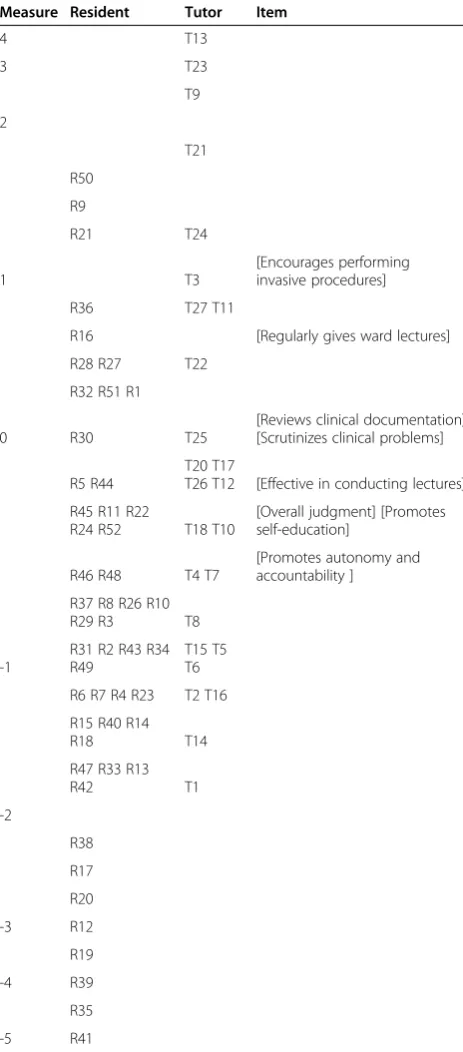
Locations of residents, tutors and items on the latent variable are depicted as below (see Table 1).
Greater measures for residents indicate that they were more severe; greater measures for tutors indicate that they received more positive evaluations, and greater measures for items indicate that they were more difficult. Table 2 re-ports the summary statistics for the eight items. Overall, tutors received more positive evaluations on Item 7 (“[The tutor] promotes autonomy and accountability”) and less positive evaluations on Item 8 (“[The tutor] encourages performing invasive procedures”). These eight items allowed the residents to identify almost seven levels of different quality (strata = 6.93). Moreover, they provided a reliable evaluation of tutors (R= .92), and allowed the dis-tinction of tutors in almost five levels.
Although residents differed in severity (χ2(50) = 645.4, p< .001), the observed agreement among them is in line with that expected (Exp = 28.4%; Obs = 29%). The se-verity of residents did not change with their gender (χ2(1) = .6, p= .45), but with the year of program that they were attending (χ2(4) = 26.6,p< .001).
Validation of the Rotation Assessment Questionnaire (RAQ) Fifty-one residents (46 females; No. 14, 14, 10, 9, 4 for 1st to 5st year residents, respectively) evaluated 25 rota-tions. Each resident evaluated from 1 to 7 rotations, and each rotation received from 1 to 16 evaluations. The data matrix had dimensions 164 (overall number of evaluations) × 12 (items).
The value of the first contrast in the residuals was 2.9, very close to the criterion indicative of multidimensionality. In addition, Item 3 (“rotation was organized as declared”), Item 4 (“Teaching activities were regularly delivered”), and Item 11 (“[The rotation] allowed participation in other cultural activities of the program”) exhibited misfit (infit = 1.43, outfit = 1.52 for Item 3; infit = 1.46, outfit = 1.51 for Item 4; infit = 1.85, outfit = 2.09 for Item 11). These items were excluded and a new analysis was run. The infit of Item 7 (“[The rota-tion] contributed to improve my clinical skills”) exceeded the criterion of 1.4. However, its value (1.47) is not so large to require the removal of the item from the pool. The 9 items defined a substantively unidimensional scale (the value of the first contrast decreased from 2.9 to 2.1), and none of them exhibited differential gender functioning.
The step calibrations were ordered (τpoor-mediocre=−
τgood-excellent= 2.61). Therefore, the response scale had
been adequately used by residents.
Locations of residents, rotations and items on the la-tent variable are depicted as below (see Table 3).
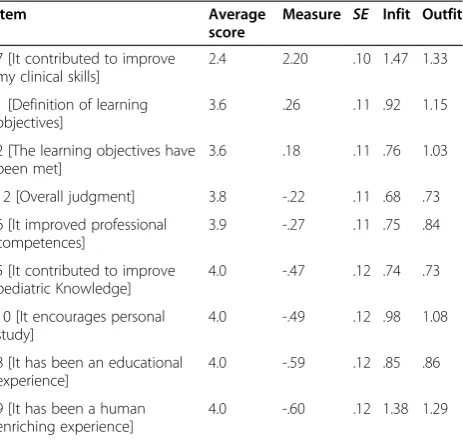
Greater measures for rotations indicate that they received more positive evaluations. The measures of residents and
items read as in Table 1. Table 4 contains summary statis-tics for the 9 items. On the whole, the rotations received more positive evaluations on Item 9 (“[The rotation] has been a enriching experience from a human point of view”) and less positive evaluations on Item 7 (“[The rotation] contributed to improve my clinical skills”). These 9 items allowed the residents to distinguish ten qualitatively differ-ent levels in the rotation quality (strata = 10.02). In addition, they provided a reliable evaluation of rotations (R= .95), and allowed to distinguish them in almost six groups of dif-ferent quality (strata = 5.88).
The residents differed in severity (χ2(50) = 749.8,p< .001), but the observed agreement among them is in line with that expected (Exp = 34.6%; Obs = 34.9%). Male and female resi-dents did not differ in severity (χ2(1) = 1.0, p= .31). There were some differences among residents attending different years of program, but they were not reliable (χ2(4) = 16.6, p< .01;R= .35).
Validation of the RAC Assessment Questionnaire (RACAQ) Forty-eight residents (42 females; N = 14, 13, 8, 11, 2 for 1st to 5th year residents, respectively) evaluated the RAC. The data matrix had dimensions 48 (evaluations) × 15 (items).
The functioning of Item 14 (Scoring “the teaching attitude of the faculty”) changed with the gender of residents (i.e., males provided more severe evalua-tions than females; t(7) = 2.38, p< .05), whereas Item 5 (“[The RAC] It provides residents with individual-ized feedbacks regarding the evaluation they received”) exhibited misfit (infit = 1.64, outfit = 1.66). These two items were excluded and a new analysis was run. The remaining 13 items defined a substantively Table 2 Average scores, item measures, standard errors and fit statistics of the Tutor Assessment Questionnaire (measure order)
Item Average
score
Measure SE Infit Outfit
8 [Encouragesinvasive procedures]
2.8 .98 .09 1.30 1.21
2 [Regularly gives ward lectures]
3.1 .58 .09 1.19 1.29
6 [Reviews clinical documentation]
3.5 .05 .10 1.05 1.09
4 [Scrutinizes clinical problems] 3.5 -.05 .10 .87 .86
3 [Is effective in conducting lectures]
3.7 -.23 .10 1.16 1.16
9 [Overall judgment] 3.7 -.36 .10 .51 .52
5 [Promotes self-education] 3.7 -.37 .10 .70 .74
7 [Promotesautonomy and accountability]
3.9 -.60 .11 1.02 1.15
Note. Greater measures indicate more difficult items (i.e., that received fewer positive evaluations).
Table 1 Validation of the Tutor Assessment Questionnaire (TAQ) - Locations of residents, tutors and items on the latent variable
Measure Resident Tutor Item
4 T13
3 T23
T9
2
T21
R50
R9
R21 T24
1 T3
[Encourages performing invasive procedures]
R36 T27 T11
R16 [Regularly gives ward lectures]
R28 R27 T22
R32 R51 R1
0 R30 T25
[Reviews clinical documentation] [Scrutinizes clinical problems]
R5 R44
T20 T17
T26 T12 [Effective in conducting lectures]
R45 R11 R22
R24 R52 T18 T10
[Overall judgment] [Promotes self-education]
R46 R48 T4 T7
[Promotes autonomy and accountability ]
R37 R8 R26 R10
R29 R3 T8
-1
R31 R2 R43 R34 R49
T15 T5 T6
R6 R7 R4 R23 T2 T16
R15 R40 R14
R18 T14
R47 R33 R13
R42 T1
-2
R38
R17
R20
-3 R12
R19
-4 R39
R35
unidimensional scale (the value of the first contrast in the residuals was equal to 2.1) and none of them ex-hibited misfit (the largest Infit was 1.41).
The step calibrations were ordered (τpoor-mediocre=−
3.08; τmediocre-respectable=− 1.81; τrespectable-good= .48;
τgood-excellent= 4.40). Therefore, residents used the
re-sponse scale appropriately.
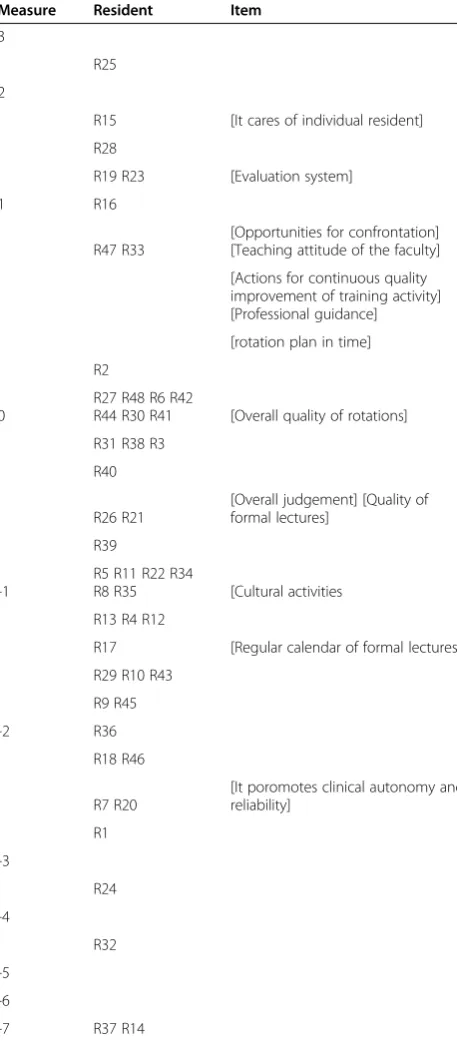
Locations of residents and items on the latent variable are depicted as below (see Table 5), whereas Table 6 con-tains summary statistics for the items. On the whole, the RAC received more positive evaluations on Item 10 (“Scoring the capacity of the program to promote clin-ical autonomy and reliability”) and less positive evalua-tions on Item 4 (“[The RAC] cares of individual residents”). These measures provided a reliable depiction of strengths and weaknesses of the RAC (R= .95; Strata = 6.14).
The residents differed in severity (χ2(47) = 428.4,p< .001), but the observed agreement among them is in line with that expected (Exp = 35.8%; Obs = 36.4%). The severity of resi-dents did not change with their gender (χ2(1) = 1.4,p= .23), whereas the differences observed among residents attending different years of program are barely sufficient (χ2(4) = 24.6, p< .001;R= .58).
Discussion
This report presents the validation process of three questionnaires designed for the residents to assess,the quality of the training provided by each faculty member, the quality of the professional experience they maturated during the various rotations they have to go through and Table 3 Validation of the Rotation Assessment
Questionnaire (RAQ) - locations of residents, rotations and items on the latent variable
Measure Resident Rotation Item
5
RO23
4
3
[It contributed to improve clinical skills]
2 RO21 RO22
R50
RO3
1 R9 RO24
RO9
R5 RO6
R28
RO26 RO20 RO7 RO25
[A clear definition of learning objectives provided] [Learning objectives met]
0 R45 RO4 RO27
R16 R27 RO10
[Overall judgment] [It served to improve professional competences]
R32 R52 RO8
[It contributed to improves pediatric knowledge] [It encouraged personal studies]
R14 RO19 RO17
[It has been an educational experience] [It has been an enriching experience from a human point of view]
R21 R11 R10
-1 R30 R24 R26 RO18 RO12
R29 R36 RO5 RO16
R3 R43 R44 R51 R1 R18 R6
R48 R49 RO15 RO1
R8 RO2
-2
R47 R46 R22
R33 RO14
R23 R7 R2 R37 R4
R34 R20 R13
R40
R15
-3 R12 R31
R42
R25
R38 R17
R35
-4
-5 R39 R19
Table 4 Average scores, item measures, standard errors and fit statistics of the Rotation Assessment
Questionnaire (measure order)
Item Average
score
Measure SE Infit Outfit
7 [It contributed to improve my clinical skills]
2.4 2.20 .10 1.47 1.33
1 [Definition of learning objectives]
3.6 .26 .11 .92 1.15
2 [The learning objectives have been met]
3.6 .18 .11 .76 1.03
12 [Overall judgment] 3.8 -.22 .11 .68 .73
6 [It improved professional competences]
3.9 -.27 .11 .75 .84
5 [It contributed to improve pediatric Knowledge]
4.0 -.47 .12 .74 .73
10 [It encourages personal study]
4.0 -.49 .12 .98 1.08
8 [It has been an educational experience]
4.0 -.59 .12 .85 .86
9 [It has been a human enriching experience]
4.0 -.60 .12 1.38 1.29
the functioning of the RAC within the context of the Paediatric Residency Program of the University of Padua. In their final form, the questionnaires produced unidi-mensional measures and our results suggest that they are valid and reliable evaluation tools. TAQ and RAQ allowed reliable assessments of tutors and rotations, and distinguished them into 5–6 levels of different quality.
In brief, the three questionnaires provided a reliable as-sessment of the strengths and of the weaknesses of the tutors, the rotations, and the RAC. The agreement ob-served among judges was coherent to the predicted values. The usage of the questionnaires is immediate and does not require to train judges to have a shared in-terpretation of the items.
The MFRM represents a valuable tool for the valid-ation of these questionnaires. Being a Rasch model, the MFRM allows transforming ordinal raw scores into interval measures. This is a relevant feature of the model since researchers showed serious concerns toward meas-uring ordinal raw scores as they were interval measures [29,30]. Erroneous conclusions may derive from applying parametric analyses to ordinal data [31]. In addition, the MFRM estimates judge severity and removes it from the measurement [13]. This allows the elimination of the de-pendence of the evaluations on the severity of judges, which is a serious concern when the different judges evaluate different persons. It is worth noting that Rasch models are especially demanding of data that satisfy the requirements for constructing measures [32]. The items removed during the validation process are an example of data that do not adequately conform to the model.
In conclusion, the data herein presented allows us to be confident, upon further internal refining, of the validity of Table 5 Validation of the RAC Assessment Questionnaire
-Locations of residents and items on the latent variable
Measure Resident Item
3
R25
2
R15 [It cares of individual resident]
R28
R19 R23 [Evaluation system]
1 R16
R47 R33
[Opportunities for confrontation] [Teaching attitude of the faculty]
[Actions for continuous quality improvement of training activity] [Professional guidance]
[rotation plan in time]
R2
0
R27 R48 R6 R42
R44 R30 R41 [Overall quality of rotations]
R31 R38 R3
R40
R26 R21
[Overall judgement] [Quality of formal lectures]
R39
-1
R5 R11 R22 R34
R8 R35 [Cultural activities
R13 R4 R12
R17 [Regular calendar of formal lectures]
R29 R10 R43
R9 R45
-2 R36
R18 R46
R7 R20
[It poromotes clinical autonomy and reliability]
R1
-3
R24
-4
R32
-5
-6
-7 R37 R14
Table 6 Average scores, item measures, standard errors and fit statistics of the RAC Assessment Questionnaire (measure order)
Item Average
score
Measure SE Infit Outfit
4 [It cares of individual residents]
2.8 1.54 .22 .98 .98
13 [Systems of evaluation] 2.9 1.29 .23 .95 1.01
3 [It provides opportunities of confrontation…]
3.1 .84 .23 .82 .82
12 [Quality score of the formal lessons]
3.1 .84 .23 1.41 1.35
7 [Actions to improve the quality of training]
3.2 .61 .23 .92 1.02
6[Professional guidance] 3.3 .52 .24 1.02 1.04
2[Rotation plan] 3.3 .41 .24 1.13 1.20
9 [Quality score of the rotations]
3.4 .07 .24 1.13 1.18
15 [Overall judgment] 3.6 -.50 .26 .55 .54
8 [Overall quality of the training]
3.7 -.68 .26 .72 .65
11 [Quality score of the cultural environment]
3.8 −1.10 .27 1.04 .92
1 [Formal lectures plan] 3.9 −1.48 .28 1.04 .97
10 [Autonomy and reliability] 4.1 −2.37 .29 1.16 1.13
these questionnaires for other Italian pediatric residency pro-grams. Thus, the work presented served to enrich the arma-mentarium of tools the resident medical programs can use to monitor their functioning. Their larger application is now needed in order to consolidate and further refine the data herein presented. The development and validation of these tools is indeed a sort of continuous exercise. The challenge of documenting how faculty and the RAC respond to the feed-backs generated by these tools and ultimately, their im-pact on the quality of the training, and above all, on the qual-ity of the pediatricians licensed by the program, remains an open issue to face with [33,34].
Additional file
Additional file 1:Tutor Assessment Questionnaire; Rotation Assessment Questionnaire; Resident Affaire Committee Assessment Questionnaire.
Competing interests
The authors declare that they have no competing interest.
Authors’contributions
LDD & GP–Vice-chairmen of the Resident Affair Committee of the Pediatric Residency Program of the Department of Woman’s and Child’s Health of the University of Padua–Personal involvement in designing the entire evaluation process of the program, in setting the contents of each questionnaire, in interpreting the data and in writing the manuscript. EB & SC–Chairman of the Resident Affair Committee and member of the resident Affair Committee, respectively, of the Pediatric Residency Program of the Department of Woman’s and Child’s Health of the University of Padua; personal involvement in running the program and in the evaluation process. PA, SF, ER–Research Assistants and Full Professor, respectively; personal involvement in the validation process of the questionnaire and in writing this report. All authors read and approved the final manuscript.
Author details
1Paediatric Residency Program, Department of Woman’s and Child’s Health, University of Padua, Via Giustiniani 3–35128, Padua, Italy.2Department FISPPA, University of Padua, Padua, Italy.
Received: 26 July 2014 Accepted: 18 December 2014
References
1. Weiss KB, Wagner R, Nasca TJ. Development, testing, and implementation of the ACGME Clinical Learning Environment Review (CLER) program. J Grad Med Educ. 2012;4:396–8.
2. Snell L, Tallett S, Haist S, Hays R, Norcini J, Prince K, et al. A review of the evaluation of clinical teaching: new perspectives and challenges. Med Educ. 2000;34:862–70.
3. Ghosh AK, Beckman TJ, Cook DA, Erwin PJ, Mandrekar JN. How reliable are assessments of clinical teaching? A review of the published instruments. J Gen Intern Med. 2004;19:971–7.
4. Lombarts KM, Bucx MJ, Arah OA. Development of a system for the evaluation of the teaching qualities of anesthesiology faculty. Anesthesiology. 2009;111:709–16.
5. Fluit CR, Bolhuis S, Grol R, Laan R, Wensing. Assessing the quality of clinical teachers: a systematic review of content and quality of questionnaires for assessing clinical teachers. J Gen Intern Med. 2010;25:1337–45. 6. Arah OA, Hoekstra JBL, Bos AP, Lombarts KM. New tools for systematic
evaluation of teaching qualities of medical faculty: results of an ongoing multi-center survey. PLoS ONE. 2011;6:e25983.
7. Nation JG, Carmichael E, Fidler H, Violato C. The development of an instrument to assess clinical teaching with linkage to CanMEDS roles: a psychometric analysis. Medical Teacher. 2011;33:e290–6.
8. van der Leeuw R, Lombarts K, Heineman MJ, Arah O. Systematic evaluation of the teaching qualities of obstet- rics and gynecology faculty: Reliability and validity of the SETQ tools. PLoS ONE. 2011;6:e19142.
9. Boerebach BC, Arah OA, Busch OR, Lombarts KM. Reliable and valid tools for measuring surgeons’teaching performance: residents’vs. self Evaluation. J Surgical Education. 2012;69:511–20.
10. Da Dalt L, Callegaro S, Mazzi A, Scipioni A, Lago P, Chiozza ML, et al. A model of quality assurance and quality improvement for post-graduate medical education in Europe. Med Teach. 2010;32:e57–64.
11. Da Dalt L, Anselmi P, Bressan S, Carraro S, Baraldi E, Robusto E, et al. A short questionnaire to assess pediatric resident’s competencies: the validation process. Ital J Pediatr. 2013;5:39–41.
12. American Board of Pediatrics.The General Pediatrics International In-training Examination (I-ITE). [http://abp-intl.org/intrainingexamination.html], (last access June 4, 2014).
13. Linacre JM. Many-facet Rasch measurement. Chicago, IL: MESA Press; 1989. 14. Anselmi P, Vianello M, Voci A, Robusto E. Implicit sexual attitude of
heterosexual, gay and bisexual individuals: disentangling the contribution of specific associations to the overall measure. Plos One. 2013;8:e78990. 15. Anselmi P, Vianello M, Robusto E. Preferring thin people does not imply
derogating fat people. A Rasch analysis of the implicit weight attitude. Obesity. 2013;21:261–5.
16. Fisher AG. The assessment of IADL motor skills: an application of many-facet Rasch analysis. Am J Occup Ther. 1993;47:319–29.
17. Heinemann AW, Linacre JM, Wright BD, Hamilton BB, Granger C. Prediction of rehabilitation outcomes with disability measures. Arch Phys Med Rehab. 1994;75:133–43.
18. Clauser BE, Ross LP, Nungester RJ, Clyman SG. An evaluation of the Rasch model for equating multiple forms of a performance assessment of physicians’patient-management skills. Acad Med. 1997;39 Suppl 1:76–8. 19. Conrad KJ, Wright BD, McKnight P, McFall M, Fontana A, Rosenheck R.
Comparing traditional and Rasch analyses of the Mississippi PTSD Scale: revealing limitations of reverse-scored items. J Appl Meas. 2004;39:15–30. 20. de Morton NA, Nolan JS. Unidimensionality of the Elderly Mobility Scale in
older acute medical patients: different methods, different answers. J Clin Epidemiol. 2011;39:667–74. doi:10.1016/j.jclinepi.2010.09.004.
21. Haley SM, McHorney CA, Ware Jr JE. Evaluation of the MOS SF-36 physical functioning scale (PF-10): I. unidimensionality and reproducibility of the Rasch item scale. J Clin Epidemiol. 1994;47:671–84.
22. Linacre JM. Facets Rasch measurement computer program (Version 3.71.3) [Computer software]. Chicago, IL: Winsteps.com; 2013.
23. Wright BD, Linacre JM. Reasonable mean-square fit values. Rasch Meas Trans. 1994;8:370.
24. Linacre JM. Winsteps (Version 3.68.0) [Computer software]. Chicago, IL: Winsteps.com; 2009.
25. Linacre JM. Optimizing rating scale category effectiveness. J Appl Meas. 2002;39:85–106.
26. Smith EV. Evidence for the reliability of measures and validity of measure interpretation: a Rasch measurement perspective. J Appl Meas. 2001;39:281–311.
27. Fisher WP. Reliability statistics. Rasch Meas Trans. 1992;39:238. 28. Messick S. Validity. In: Linn RL, editor. Educational measurement. 3rd ed.
New York: Macmillan; 1989. p. 13–103.
29. Forrest M, Andersen B. Ordinal scale and statistics in medical research. BMJ. 1986;39:537–8. doi:10.1136/bmj.292.6519.537.
30. Merbitz C, Morris J, Grip JC. Ordinal scales and foundations of mis-inference. Arch Phys Med Rehabil. 1989;39:308–12.
31. Kahler E, Rogausch A, Brunner E, Himmel W. A parametric analysis of ordinal quality-of-life data can lead to erroneous results. J Clin Epidemiol. 2008;39:475–80. 32. Fluit C, Bolhuis S, Grol R, Ham M, Feskens R, Laan R, et al. Evaluation and
feedback for effective clinical teaching in postgraduate medical education: validation of an assessment instrument incorporating the CanMEDS roles. Med Teach. 2012;34:893–901.
33. Fluit CV, Bolhuis S, Klaassen T, DE Visser M, Grol R, Laan R, et al. Residents provide feedback to their clinical teachers: reflection through dialogue. Med Teach. 2013;35:e1485–92.