S T U D Y P R O T O C O L
Open Access
Protocol for a randomized comparison of
integrated versus consecutive dual task practice
in Parkinson
’
s disease: the DUALITY trial
Carolien Strouwen
1†, Esther ALM Molenaar
2†, Samyra HJ Keus
2, Liesbeth Münks
1, Marten Munneke
2,
Wim Vandenberghe
3,4, Bastiaan R Bloem
5and Alice Nieuwboer
1*Abstract
Background:Multiple tasking is an integral part of daily mobility. Patients with Parkinson’s disease have dual tasking difficulties due to their combined motor and cognitive deficits. Two contrasting physiotherapy interventions have been proposed to alleviate dual tasking difficulties: either to discourage simultaneous execution of dual tasks (consecutive training); or to practice their concurrent use (integrated training). It is currently unclear which of these training methods should be adopted to achieve safe and consolidated dual task performance in daily life. Therefore, the proposed randomized controlled trial will compare the effects of integrated versus consecutive training of dual tasking (tested by combining walking with cognitive exercises).
Methods and design:Hundred and twenty patients with Parkinson’s disease will be recruited to participate in this multi-centered, single blind, randomized controlled trial. Patients in Hoehn & Yahr stage II-III, with or without freezing of gait, and who report dual task difficulties will be included. All patients will undergo a six-week control period without intervention after which they will be randomized to integrated or consecutive task practice. Training will consist of standardized walking and cognitive exercises delivered at home four times a week during six weeks. Treatment is guided by a physiotherapist twice a week and consists of two sessions of self-practice using an MP3 player. Blinded testers will assess patients before and after the control period, after the intervention period and after a 12-week follow-up period. The primary outcome measure is dual task gait velocity, i.e. walking combined with a novel untrained cognitive task to evaluate the consolidation of learning. Secondary outcomes include several single and dual task gait and cognitive measures, functional outcomes and a quality of life scale. Falling will be recorded as a possible adverse event using a weekly phone call for the entire study period.
Discussion:This randomized study will evaluate the effectiveness and safety of integrated versus consecutive task training in patients with Parkinson’s disease. The study will also highlight whether dual task gait training leads to robust motor learning effects, and whether these can be retained and carried-over to untrained dual tasks and functional mobility.
Trial registration:Clinicaltrials.gov NCT01375413.
Keywords:Parkinson disease, Rehabilitation, Physical therapy, Neurologic gait disorder, Cognition, Dual task
* Correspondence:[email protected] †Equal contributors
1
Department of Rehabilitation Sciences, KU Leuven, Faculty of Kinesiology and Rehabilitation, Tervuursevest 101 bus 1501, Leuven 3001, Belgium Full list of author information is available at the end of the article
Background
Parkinson’s disease (PD) is a common, multisystem
neuro-degenerative disease which is characterized by motor and non-motor symptoms [1]. The motor symptoms of PD are manifold but include gait and balance disorders, which have a significant impact on functional mobility and qual-ity of life [2]. Depending on the disease stage, up to 79.2 percent of patients (advanced stage) may report to have freezing of gait (FOG) [3], which is a disabling gait disorder characterized by episodes of lack of forward progression despite the intention to walk [4]. Approxi-mately 60% of patients fall each year and about two thirds fall recurrently [5-7].
Dual tasking is the simultaneous performance of two attention-demanding tasks with different goals, whereby one task can be denoted as the primary and the other as the secondary task [8]. Factors that affect dual task performance are the environment in which the task takes place, the nature of the secondary task, the age and disease-specific factors of each individual [9]. Gait has been found to deteriorate during dual task (DT) performance in PD [10-14], resulting in a decrease of gait velocity, cadence and step length [9,13-18], an increase in gait variability [9,13,17,19] and an increase in double support time [14,20]. Also, falling and FOG are more commonly provoked in DT conditions [11,21,22].
Mild cognitive impairment is thought to occur in
20-57% of PD patients, even as early as 3–5 years after the
diagnosis [23,24]. Several studies have indicated that executive dysfunction is a robust determinant of DT interference at least in mid but not in early stage PD [13,17,25,26]. Executive function refers to a set of abil-ities which flexibly guide behavior towards goals and includes switching between cognitive sets or tasks, ap-propriately inhibiting and generating responses and updating working memory contents [27,28]. Wild et al. [13] showed that cognitive performance in PD worsened during DT walking and that this was correlated to global cognitive condition.
Motor learning is highly dependent on cognitive status in PD [29,30]. Patients with freezing of gait (FOG) showed greater executive deficits than their non-freezing counter-parts [31-33] and were also found to learn a serial reaction time task less well [34]. This raises the question as to the extent of the cognitive challenge which is appropriate for achieving robust learning in PD.
Evidence for the efficacy of physiotherapy is growing in PD [35,36]. Various modes of gait training were found effective in improving gait velocity [37,38]. Although more controlled studies remain needed, cognitive training shows promising benefits in several cognitive domains including executive function in PD [39]. Despite the fact that evidence-based physiotherapy guidelines discourage the use of dual task exercise [40], a number of open label
studies [38,41-46] support the feasibility and efficacy of DT training in PD [45,46]. Hence, a phase III randomized study is currently being undertaken in which the effect of single and dual task gait training is compared in a wide variety of PD patients [47].
The current trial proposes to test the efficacy of two strategies for DT training. The first strategy entails consecutive task training (CTT), whereby each task will be trained separately. We expect that as a result of this type of training, performance of each task may become more automatic and thus free residual brain capacity for subsequent simultaneous task performance. The second strategy proposes integrated dual task practice (IDT). We expect that this training mode may increase the efficiency of shared neural resources [48] and as such improve DT performance. IDT may have additional benefits over CTT as this training mode may also improve the efficiency of specific brain areas involved in task integration [49,50], enhance executive function and ease the transfer of learn-ing to daily DT situations. Moreover, an advantage of IDT is that dual tasking can realistically never be avoided entirely, so it might be wise to prepare patients for such inevitable dual task events that commonly occur in daily life. Interestingly, in balance-impaired older adults, IDT and CTT led to largely similar performance increases with the exception of better retention in IDT [51,52]. These findings call for replication, and importantly, it is currently unknown to what extent these results apply to PD patients.
Therefore, the primary aim of this study is to compare the effectiveness of consecutive versus integrated training (tested by combining walking with cognitive exercises) on DT gait performance in PD. We hypothesize that IDT practice will resort in better dual task outcomes and better consolidated learning results, particularly in patients with-out cognitive impairment. As secondary questions we will examine which dual task training mode is most beneficial in terms of fall risk reduction and leads to the best dual task gains in freezers versus non-freezers. Here, we de-scribe the design of this training study, also referred to as the DUALITY trial.
Methods/design
Study design and setting
The study has a parallel group design and involves a dual-centered, single blind, randomized controlled trial with a 12 week follow-up period. The study will include 120 patients with PD of Hoehn & Yahr stage II to III [53]. Individuals with PD will be randomly allocated to two arms: (a) six weeks of integrated dual task training (IDT); or (b) six weeks of consecutive task training (CTT).
Both interventions will be delivered at the patient’s home
sessions. Preceding the intervention, participants will undergo a six week control period without training to ascertain the effect of repeated measures (Figure 1). All other interventions (medication, allied health care) will be kept as stable as possible. Any changes in treatment or medication will be monitored. The trial will be con-ducted in two countries. Sixty patients will be recruited at the Radboud University Medical Center (RUMC) in the Netherlands and sixty patients will be recruited at the University Hospitals in Belgium.
Participants
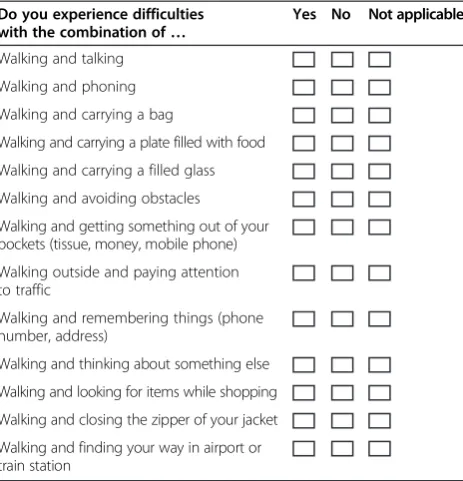
Inclusion criteria for recruitment are: (a) diagnosis of PD according to the UK Brain Bank criteria [54]; (b) Hoehn and Yahr stage II-III in the subjective best ON-phase of the medication cycle [53]; (c) able to walk 10 minutes continuously; (d) presence of dual task interference as established by a structured checklist (see Table 1); (e) a
score≥24 on the Mini Mental State Examination (MMSE)
[55]; (f) stable medication over the past 3 months; (g) no hearing and visual problems that interfere with testing or training; and (h) stable Deep Brain Stimulator (DBS) set-tings over the past year. Exclusion criteria are: (a) unstable medical conditions including acute orthopedic conditions affecting gait; and (b) ongoing dual task training or other interfering physical therapy. Patients who received dual task training in the past are allowed to participate if at the moment of inclusion they report to have dual task problems based on a structured checklist (Table 1). Re-cruitment of patients will be conducted via the databases of the Movement Disorder clinic at University Hospitals Leuven and RUMC and affiliated medical centers. All in-terested participants will be screened by a physiotherapist during a first home visit in which informed consent will be obtained and inclusion criteria applied. Full ethical approval has been granted for the study in the
Recruitment of 120 PD patients 60 patients at RUMC – 60 patients at KUL
Home screening
Baseline evaluation 1
Gait, DT assessment, cognitive function, quality of life
Control period – no intervention (6 weeks)
Baseline evaluation 2
Randomization
Consecutive task training
4 sessions per week (2 with/2without PT)
6 weeks
Integrated task training
4 sessions per week (2 with/2without PT)
6 weeks
Post-intervention test
12-week follow-up period
Follow-up test
DUALITY
Fall monitoring
Week 0
Week 6
Week 12
Week 24
Netherlands (CMO Regio Arnhem-Nijmegen) protocol ID/number NL39530.091.12 and in Belgium (CME KU Leuven) B322201213165/S53419.
Sample size
Primary outcome is DT gait velocity. Single task gait velocity changes of around 0.05 m/s have been found clinically meaningful [38] but no such data presently exist for dual task gait velocity. Sample size power calcula-tion [56] was based on data from the RESCUE trial in which in a similar study population had a mean dual task gait speed of 0.77 m/s (SD = 0.21) [38,57]. Power was set at 80% and based on two-sided 95% confidence intervals. We assumed that there would be a difference of 15% be-tween both arms in favor of IDT based on previous study [51]. In analogy to the RESCUE study, in which a home-based intervention was delivered, a drop-out rate of 5% was envisaged. Assuming a stable control period, we cal-culated our sample size to include a total of 108 subjects (54 per center). Incorporating a loss to follow-up, we will aim to recruit 60 patients (total of 120 subjects) per group over a period of two years.
Randomization and blinding
Subjects will be randomly assigned per center to the earlier described integrated dual task (IDT) or consecutive task training (CTT). A computerized block randomization procedure will be implemented by an independent statisti-cian using a block size of four subjects. Group allocation will be performed by an independent person, who will notify the treating physiotherapist by email to ensure
concealed allocation. Randomization will be stratified by subgroup with or without FOG and by stage of the disease (Hoehn & Yahr stage II and III). To avoid bias, patients are assessed by blinded testers. In addition, participants will be explicitly instructed not to reveal any details about their training regime during testing to prevent unblinding. Both therapists and patients will be explained that both arms of the study are likely to be effective in improving dual task performance to control for expectancy effects, in line with the above outlined ra-tionale for each training approach.
Intervention
Both interventions are delivered by trained
physiothera-pists, twice a week at the patient’s home. These sessions
entail 30 minutes of supervised gait and cognitive exer-cises and 10 minutes of functional practice. Unsupervised exercises will be conducted twice a week for 30 minutes and include gait and mental practice using an MP3 player. MP3-player delivery of cognitive training was found feas-ible in an earlier pilot DT study [45]. User-friendly devices with a large display and buttons (DIFRNCE MP1850) will be used (Figure 2a). Therapists will assess whether the home exercise is perceived as safe and without risk of fall-ing or needs to be performed together with a carer.
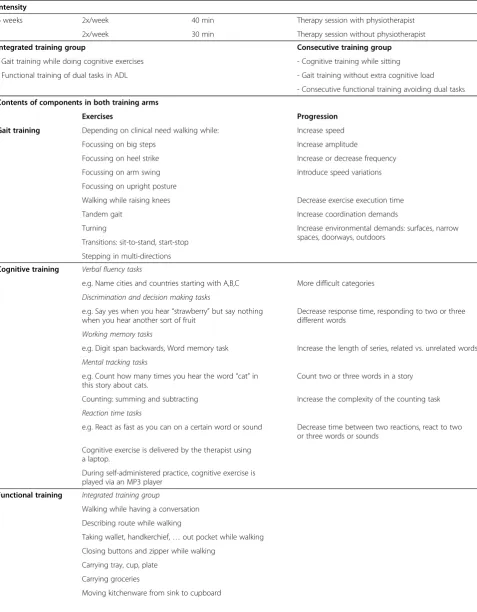
In order to contrast CTT and IDT training precisely and ensure that both training arms offered sufficient challenge for a variety of patients, a standardized program of cogni-tive training based on structured progression levels was developed by an expert team of four physiotherapists with the input of 1 psychologist. Hence, the programs for CTT and IDT consist of three identical components: (1) gait practice; (2) auditory cognitive exercise; and (3) functional training suitable to be delivered at home (Table 2). The program was piloted on several patients at home in the first six months of trial preparation.
Table 2 illustrates the components of training in both study arms. Gait practice involves specific gait exercises aimed to improve gait quality at home. Progression is introduced once patients can perform the exercise fluently (CTT) or without noticeable DT interference (IDT). Cog-nitive exercises (Table 2) are offered in five categories demonstrated to cause gait interference in older people [58]: (1) verbal fluency; (2) discrimination and decision making tasks; (3) working memory tasks; (4) mental track-ing tasks; and (5) reaction time tasks. The cognitive exer-cises and levels of progression are audiotaped, allowing
segments to be played on the therapists’laptops or on the
MP3 players for self-practice. Subjects will be instructed to respond to the tasks with spoken word sequences. Ver-bal responses are monitored and scored by the therapist, who provides feedback on performance after each bout of practice. Flawless performance at the starting level (CTT) or no noticeable interference during DT (IDT)
Table 1 Dual task screening list to determine dual task problems
Do you experience difficulties with the combination of…
Yes No Not applicable
Walking and talking
Walking and phoning
Walking and carrying a bag
Walking and carrying a plate filled with food
Walking and carrying a filled glass
Walking and avoiding obstacles
Walking and getting something out of your pockets (tissue, money, mobile phone)
Walking outside and paying attention to traffic
Walking and remembering things (phone number, address)
Walking and thinking about something else
Walking and looking for items while shopping
Walking and closing the zipper of your jacket
will be adopted as guidelines to progress to the next level. Functional tasks, relevant for each patient, are chosen for the functional part of the training program to ensure generalization of practice (Table 2).
Table 2 also shows that in the CTT arm of the study, each session will consist of 15 minutes of gait practice, 15 mi-nutes of cognitive practice and 10 mimi-nutes of functional task training. Gait practice is focused on improving gait quality. Cognitive training is performed while the patient is sitting on a chair. CTT functional training will emphasize safety, avoiding dual tasking and carrying out task compo-nents separately as much as possible. Table 2 also shows that in contrast IDT is based on performing motor-cognitive tasks concurrently for 30 minutes right from the first session. Gait practice is performed while at the same time verbally responding to the cognitive exercises. Given
the likely cognitive deterioration in PD [29,30], a fixed pri-ority of dividing attention on both tasks will be imple-mented in the beginning of the training, aimed to improve better and safe walking. If possible a variable locus of at-tention [51,52] is adopted as the patient progresses. Dur-ing functional task practice, dual taskDur-ing will be positively encouraged to ensure transfer of learning to daily life.
Rigorous measures of standardization of the interven-tions are implemented between the two centers by having a cross-center training week of therapists at the onset of the trial and by regular follow-up meetings.
Testing and outcome measures
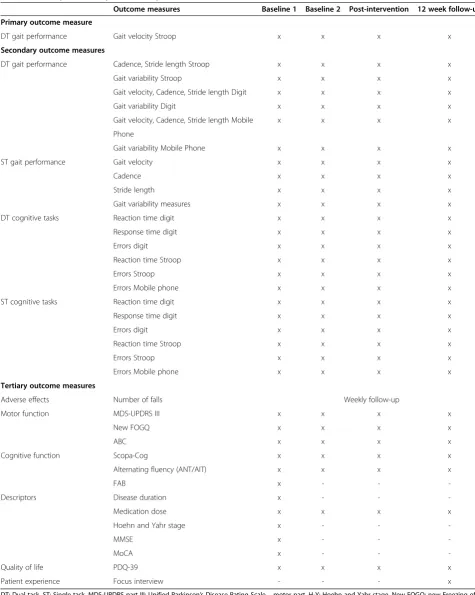
Table 3 gives an overview of the outcome measures which will be tested at various time points. The primary outcome measure is DT gait velocity while performing an untrained
(d)
(c)
(a)
(b)
Table 2 The duality training program
Intensity
6 weeks 2x/week 40 min Therapy session with physiotherapist
2x/week 30 min Therapy session without physiotherapist
Integrated training group Consecutive training group
- Gait training while doing cognitive exercises - Cognitive training while sitting
- Functional training of dual tasks in ADL - Gait training without extra cognitive load
- Consecutive functional training avoiding dual tasks
Contents of components in both training arms
Exercises Progression
Gait training Depending on clinical need walking while: Increase speed
Focussing on big steps Increase amplitude
Focussing on heel strike Increase or decrease frequency
Focussing on arm swing Introduce speed variations
Focussing on upright posture
Walking while raising knees Decrease exercise execution time
Tandem gait Increase coordination demands
Turning Increase environmental demands: surfaces, narrow
spaces, doorways, outdoors Transitions: sit-to-stand, start-stop
Stepping in multi-directions
Cognitive training Verbal fluency tasks
e.g. Name cities and countries starting with A,B,C More difficult categories
Discrimination and decision making tasks
e.g. Say yes when you hear“strawberry”but say nothing when you hear another sort of fruit
Decrease response time, responding to two or three different words
Working memory tasks
e.g. Digit span backwards, Word memory task Increase the length of series, related vs. unrelated words
Mental tracking tasks
e.g. Count how many times you hear the word“cat”in this story about cats.
Count two or three words in a story
Counting: summing and subtracting Increase the complexity of the counting task
Reaction time tasks
e.g. React as fast as you can on a certain word or sound Decrease time between two reactions, react to two or three words or sounds
Cognitive exercise is delivered by the therapist using a laptop.
During self-administered practice, cognitive exercise is played via an MP3 player
Functional training Integrated training group
Walking while having a conversation
Describing route while walking
Taking wallet, handkerchief,…out pocket while walking Closing buttons and zipper while walking
Carrying tray, cup, plate
Carrying groceries
auditory Stroop task. The clinical test battery includes the following descriptive, disease and cognitive characteristics assessed at baseline: Dual Task screening questionnaire (Table 1); MMSE [55]; Montreal Cognitive Assessment (MoCA) [59,60]; Frontal Assessment Battery (FAB) [61]; Unified Parkinson’s Disease Rating Scale part I, II and IV; and retrospective fall frequency (past year). Following ques-tionnaires are assessed at all four time points: the Unified
Parkinson’s Disease Rating Scale part III (MDS UPDRS-III)
[62]; the new Freezing of Gait Questionnaire (new FOGQ) [63]; the Activities specific Balance Confidence Scale(ABC-scale) [64]; the Scales for Outcomes of Parkinson’s disease-Cognition (ScopaCog) [65]; the Alternating Names Test (ANT)/Alternating Intake Test (AIT) [66] and the Parkin-son’s disease Questionnaire for quality of life (PDQ-39) [67]. After the 12 weeks follow-up, a qualitative interview
will be conducted probing patients’ perceptions about
the intervention and how it affected their ADL-performance. All assessments will be performed in the ON-phase at a standardized moment after medication intake. Standardization of testing procedures between the two centers is applied by regular meetings and shared testing sessions. Any adverse effects will be re-corded and the weekly number of falls will be determined.
The primary and secondary gait outcomes will be mea-sured with the same GAITRite Walkway System embedded in the gait laboratories of both centers [68]. The order of the GAITRite testing procedures and the clinical test battery will be conducted randomly but will be kept constant in each patient. The GAITRite mat, placed in a quiet laboratory space, uses pressure sensors to detect footfalls during walking (see Figure 2b). The GAITRite has been found a reliable system for measuring spatiotemporal gait parameters over time [68]. Gait outcomes will be measured with and without secondary tasks at comfort-able walking speed. An average of two trials per condition will be used for statistical analysis.
Performance on the secondary tasks will be assessed during walking as well as in sitting position. The order of single and dual task assessments is determined randomly and will remain the same in each test session for an individ-ual patient. In the DT conditions, a verbal signal is given to the patient to start walking and at the same time the sec-ondary task is started to synchronize the measurements.
Three secondary tasks are used to assess dual task performance: (a) an auditory Stroop task [69,70]; (b) a Backwards Digit Span task [71,72]; and (c) an especially designed functional mobile phone task (MPT). The audi-tory Stroop task is an untrained dual task and represents the primary outcome. During this task, the patient will verbally respond to congruent and incongruent high and low tones. The patient hears three different trials consist-ing of four stimuli. Stimuli are presented with a variable
interval (1.5–2 seconds) to control for cueing effects.
The difficulty level is the same for all participants. The Stroop task assesses set shifting ability and inhibition of incongruent responses. During the Backwards Digit Span task, the patient will have to repeat an array of numbers in reverse, the length of which will be adapted to the level of the patient and is determined at baseline. The Backwards Digit Span is a trained task and loads working memory, as part of executive function.
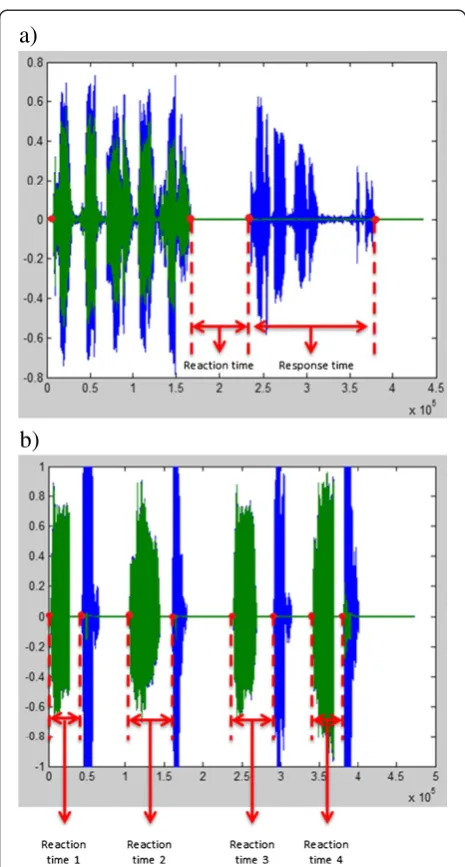
Verbal responses to both the Backwards Digit Span task and the Stroop task will be recorded via a wireless headset system (Beyerdynamic; transmitter: t-bone DS16T and receiver: t-bone IEM100R) (Figure 2c). Ver-bal responses are recorded and saved in the same chan-nel as the sound fragments, which guarantees optimal synchronization, and measurement of the number of correct responses, reaction (Digit Span task and Stroop task) and response times (Digit Span task). Figure 3 indicates how reaction time is defined for the Stroop and Digit Span task. Response time is the total duration of verbalizing a backward sequence of the Digit Span task. Analysis of reaction and response times will be performed using Audacity 1.3 Beta program and Matlab (R2011b).
The custom-made mobile phone task is a combined motor and cognitive task, in which the patients will have to type the test date (8 numbers) into a large-buttoned mobile phone (Emporia Talk Premium; Austria) (see Figure 2d). The number of errors and the time it takes to complete this task will be measured. The task is an untrained DT and tests recall and working memory as well as fine motor skills.
Falls monitoring
For the entire study period of 24 weeks, the patient will receive a weekly phone call to ask about any fall events in
Table 2 The duality training program(Continued)
Integrated AND consecutive training group
Laying the table
Picking object from the ground
Maneuvering in bathroom
Getting mail out the mailbox
Table 3 Primary, secondary and tertiary outcome measures
Outcome measures Baseline 1 Baseline 2 Post-intervention 12 week follow-up Primary outcome measure
DT gait performance Gait velocity Stroop x x x x
Secondary outcome measures
DT gait performance Cadence, Stride length Stroop x x x x
Gait variability Stroop x x x x
Gait velocity, Cadence, Stride length Digit x x x x
Gait variability Digit x x x x
Gait velocity, Cadence, Stride length Mobile x x x x
Phone
Gait variability Mobile Phone x x x x
ST gait performance Gait velocity x x x x
Cadence x x x x
Stride length x x x x
Gait variability measures x x x x
DT cognitive tasks Reaction time digit x x x x
Response time digit x x x x
Errors digit x x x x
Reaction time Stroop x x x x
Errors Stroop x x x x
Errors Mobile phone x x x x
ST cognitive tasks Reaction time digit x x x x
Response time digit x x x x
Errors digit x x x x
Reaction time Stroop x x x x
Errors Stroop x x x x
Errors Mobile phone x x x x
Tertiary outcome measures
Adverse effects Number of falls Weekly follow-up
Motor function MDS-UPDRS III x x x x
New FOGQ x x x x
ABC x x x x
Cognitive function Scopa-Cog x x x x
Alternating fluency (ANT/AIT) x x x x
FAB x - -
-Descriptors Disease duration x - -
-Medication dose x x x x
Hoehn and Yahr stage x - -
-MMSE x - -
-MoCA x - -
-Quality of life PDQ-39 x x x x
Patient experience Focus interview - - - x
the previous week. In case of a fall, questions are asked about the consequences and specific circumstances in which the fall took place (Table 4). Individual fall records will be communicated to the therapist, to enable adapta-tion of treatment. If a worrying trend of an increased fall risk would occur as a result of the treatment, therapists are expected to adapt their treatment accordingly and re-port this to the safety board of the trial. In addition, thera-pists will record any falls that may occur during the intervention. If safety adaptations imply a reduction of the
intensity of treatment or in essence will require a change from an integrated to a consecutive training, patients will be considered to become a dropout and are included for the intention to treat analysis. The review board of the trial will have a six-monthly meeting in which the global fall rates will be monitored and discussed. A-priori fall rate in-creases as cutoffs for trial cessation will not be determined as falling can be very variable in PD and fluctuate according to medication status.
Data analysis/statistics
A statistical analysis plan will be developed prior to unblinding and analysis. The primary data analysis will be performed according to an intention to treat principle. The primary endpoint, the DT walking performance at test session 1, 2, 3 and 4 will be evaluated using a linear
mixed model. Tests will be two-sided with α 0.05. The
fixed factors will be treatment (IDT vs. CTT), test session (1, 2, 3 and 4) and the interaction between test session and treatment group. Subject will be a random factor. The treatment difference will then be estimated by the appro-priate contrast for the difference between the mean scores at test session 1, 2, 3 and 4. Secondary endpoints will be analyzed in a similar way. As a secondary question we will also model the three-way interaction between subgroup, i.e. those with and without freezing of gait (defined as a score of 1 on the New FOGQ), treatment group and time. Fall frequency data will be analyzed using a negative binomial model depending on the distribution of the data.
The influence of center, disease severity (Hoehn and Yahr scores) and cognition will be explored by including the interaction terms between treatment and each of these
a)
b)
Figure 3Visual presentation of reaction and response times in Matlab R2011b. (a)Visual presentation of Backwards Digit Span task–green = stimulus that is heard by the patient, blue = answer of the patient;(b)Visual presentation of Stroop task. Since four stimuli per fragment are given, four reaction times per fragment can be calculated–green = stimulus that is heard by the patient, blue = answer of the patient.
Table 4 Weekly follow-up of falling
In case of a fall:
Description of fall When did you fall? At what time of the day?
Can you describe what happened at the moment you fell?
What were you doing?
What was the cause of the fall?
Where did you fall (inside or outside)?
Medication When was the last time before the fall that you took medication?
Was this medication still working (on or off)?
Freezing Did freezing occur at the time of the fall?
Dual tasking Were your hands free at the time of the fall? Were you talking to someone at the time of the fall?
Adverse aspects related to fall
Did you have any injury related to the fall?
variables in the model. Throughout, 95% confidence intervals will be determined. Sensitivity analyses will be carried out to evaluate the impact of missing values on the outcome.
In addition descriptive statistics will be presented by means and standard deviations, as appropriate. When data are skewed, medians and quartiles will be calculated and for categorical data, frequencies and percentages will be presented.
Data will be analyzed using the data analysis software package IBM SPSS Statistics (version 19).
Discussion
Acknowledging that dual tasking forms an integral part of daily functioning, the DUALITY study proposed here aims to investigate the efficacy and safety of a rehabili-tation intervention to improve dual tasking in PD pa-tients. We will establish robust evidence on which training modality, i.e. integrated or consecutive training, leads to the best training results and how this compares with a control period without intervention. Given the reduced capacity for consolidation of motor learning in PD [49,73] and the presence of executive deficits [28], it will be established whether dual task learning effects transfer to improvements in daily life and are sustained for 12 weeks without training.
A paucity of dual task studies have been performed in PD patients, most of which with poor methodological designs. This pilot work has shown short-term positive effects on gait performance [42-45], although there was considerable variation in the population, training period and tasks (motor, cognitive) that were studied. This is the first power-based and randomized trial that compares two interventions in an early to mid-stage PD population that are both aimed at improving dual task performance but with contrasting treatment strategies. In analogy with a DT training study in balance-impaired older people [51,52], we expect that both groups will show some im-provement on DT outcomes However, as integrated DT training is more cognitively challenging we hypothesize that this will result in a better consolidation and reten-tion of the training effects in line with motor learning theory [74]. In addition, we expect that integrated train-ing will resort in better DT outcomes as the exact prac-tice conditions mimics real life tasks more closely and this is important for transfer of learning [74]. In this study, the evaluation of motor performance will be supple-mented by assessment of cognitive performance which allows monitoring of learning effects in both motor and cognitive domains. We focus on assessing various components of executive functions, an area that is spe-cifically shown to be affected in PD patients [28]. This implies that this trial will also provide novel evidence on the impact of cognitive training on executive function
in PD which may inform future power-based studies in this area.
This will be the first dual task training study that will look at differences in dual task gains between freezers versus non-freezers after stratification for these subgroups. The results of this study will establish which training strategy is optimal in each subgroup, taking their dif-ferent cognitive profiles into account. Since freezers show greater executive deficits than their non-freezing counter-parts [31-33,75] and learn less well in dual task conditions [34], we anticipate that freezers may benefit more from consecutive training in order to achieve dual task learning. In conclusion, in this DUALITY trial we will study two different strategies aimed at improving dual tasking in PD patients. We expect that the trial will provide novel and clinically important information on the most effective and safe training strategy in different patient subgroups and in this way will contribute to developing future direc-tions for rehabilitation targets in PD.
Consent
Written informed consent will be obtained from every patient included in the study. A copy of the written consent will be available for review by the Editor of this journal.
Abbreviations
PD:Parkinson’s disease; FOG: Freezing of gait; DT: Dual task; CTT: Consecutive task training; IDT: Integrated dual task training; RUMC: Radboud University Medical Centre; MMSE: Mini mental status examination; DBS: Deep brain stimulation; SD: Standard deviation; MoCA: Montreal cognitive assessment; FAB: Frontal assessment battery; UPDRS: Unified Parkinson’s disease rating scale; New FOGQ: New freezing of gait questionnaire; ABC: Activities specific balance confidence scale; ScopaCog: Scales for outcomes of Parkinson’s disease - cognition; ANT: Alternating names test; AIT: Alternating intake test; PDQ-39: Parkinson’s disease questionnaire for quality of life; ADL: Activities of daily living; MPT: Mobile phone task.
Competing interests
The authors declare that they have no competing interests.
Authors’contributions
AN and MM conceived the idea for the study and obtained funding for the study. AN, SK and MM contributed to the research design. EM, CS, LM, WV and BB were involved in patient recruitment. AN, EM and CS were principally responsible for the drafting of the manuscript. All authors contributed to the design of the study, intervention and outcome measures. All authors assisted in editing the final submitted manuscript. All authors have read and approved the manuscript.
Acknowledgements
This research is funded by the Gossweiler Foundation. The authors thank George F Borm for the statistical input.
Author details 1
Department of Rehabilitation Sciences, KU Leuven, Faculty of Kinesiology and Rehabilitation, Tervuursevest 101 bus 1501, Leuven 3001, Belgium. 2
Received: 3 March 2014 Accepted: 24 March 2014 Published: 27 March 2014
References
1. Jankovic J:Parkinson’s disease: clinical features and diagnosis.J Neurol
Neurosurg Psychiatry2008,79(4):368–376.
2. Soh SE, McGinley JL, Watts JJ, Iansek R, Murphy AT, Menz HB, Huxham F, Morris ME:Determinants of health-related quality of life in people with Parkinson’s disease: a path analysis.Qual Life Res2013,22(7):1543–1553. 3. Tan DM, McGinley JL, Danoudis ME, Iansek R, Morris ME:Freezing of gait and activity limitations in people with Parkinson’s disease.Arch Phys Med
Rehabil2011,92(7):1159–1165.
4. Nutt JG, Bloem BR, Giladi N, Hallett M, Horak FB, Nieuwboer A:Freezing of gait: moving forward on a mysterious clinical phenomenon.Lancet
Neurol2011,10(8):734–744.
5. Pickering RM, Grimbergen YA, Rigney U, Ashburn A, Mazibrada G, Wood B, Gray P, Kerr G, Bloem BR:A meta-analysis of six prospective studies of falling in Parkinson’s disease.Mov Disord2007,22(13):1892–1900. 6. Allen NE, Schwarzel AK, Canning CG:Recurrent falls in Parkinson’s disease:
a systematic review.Parkinsons Dis2013,2013:906274.
7. Paul SS, Sherrington C, Canning CG, Fung VS, Close JC, Lord SR:The relative contribution of physical and cognitive fall risk factors in people with Parkinson’s disease: a large prospective cohort study.Neurorehabil Neural
Repair2014,28(3):282–290.
8. Beauchet O, Berrut G:Gait and dual task: definition, interest and perspectives in the elderly.Psychologie et neuropsychiatrie du vieillissement
2006,4(3):10.
9. Kelly VE, Eusterbrock AJ, Shumway-Cook A:A review of dual-task walking deficits in people with Parkinson’s disease: motor and cognitive contributions, mechanisms, and clinical implications.Parkinsons Dis2012, 2012:918719.
10. Ashburn A, Stack E, Pickering RM, Ward CD:A community-dwelling sample of people with Parkinson’s disease: characteristics of fallers and non-fallers.
Age Ageing2001,30(1):6.
11. Spildooren J, Vercruysse S, Desloovere K, Vandenberghe W, Kerckhofs E, Nieuwboer A:Freezing of gait in Parkinson’s disease: the impact of dual-tasking and turning.Mov Disord2010,25(15):2563–2570. 12. Snijders AH, Haaxma CA, Hagen YJ, Munneke M, Bloem BR:Freezer or
non-freezer: clinical assessment of freezing of gait.Parkinsonism Relat
Disord2012,18(2):149–154.
13. Wild LB, de Lima DB, Balardin JB, Rizzi L, Giacobbo BL, Oliveira HB, De Lima A II, Peyre-Tartaruga LA, Rieder CR, Bromberg E:Characterization of cognitive and motor performance during dual-tasking in healthy older adults and patients with Parkinson’s disease.J Neurol2013,260(2):580–589.
14. O’Shea S, Morris ME, Iansek R:Dual task interference during gait in people with Parkinson’s disease: effects of motor versus cognitive secondary tasks.Phys Ther2002,82(9):10.
15. Bond JM, Morris M:Goal-directed secondary motor tasks: their effects on gait in subjects with Parkinson’s Disease.Arch Phys Med Rehabil2000,81(1):7. 16. Plotnik M, Giladi N, Dagan Y, Hausdorff JM:Postural instability and fall risk in
Parkinson’s disease: impaired dual tasking, pacing, and bilateral coordination of gait during the“ON”medication state.Exp Brain Res2011,210(3–4):529–538. 17. Plotnik M, Dagan Y, Gurevich T, Giladi N, Hausdorff JM:Effects of cognitive function on gait and dual tasking abilities in patients with Parkinson’s disease suffering from motor response fluctuations.Exp Brain Res2011, 208(2):169–179.
18. Smulders K, Esselink RA, Weiss A, Kessels RP, Geurts AC, Bloem BR: Assessment of dual tasking has no clinical value for fall prediction in Parkinson’s disease.J Neurol2012,259(9):1840–1847.
19. Yogev G, Giladi N, Peretz C, Springer S, Simon ES, Hausdorff JM:Dual tasking, gait rhythmicity, and Parkinson’s disease: which aspects of gait are attention demanding?Eur J Neurosci2005,22(5):1248–1256. 20. Brown LA, de Bruin N, Doan JB, Suchowersky O, Hu B:Novel challenges to
gait in Parkinson’s disease: the effect of concurrent music in single- and dual-task contexts.Arch Phys Med Rehabil2009,90(9):1578–1583. 21. Ashburn A, Stack E, Ballinger C, Fazakarley L, Fitton C:The circumstances of
falls among people with Parkinson’s disease and the use of falls diaries to facilitate reporting.Disabil Rehabil2008,30(16):1205–1212.
22. Bloem BR, Grimbergen YA, Cramer M, Willemsen M, Zwinderman AH: Prospective assessment of falls in Parkinson’s disease.J Neurol2001, 248(11):950–958.
23. Kehagia AA, Barker RA, Robbins TW:Neuropsychological and clinical heterogeneity of cognitive impairment and dementia in patients with Parkinson’s disease.Lancet Neurol2010,9(12):14.
24. Aarsland D, Bronnick K, Williams-Gray C, Weintraub D, Marder K, Kulisevsky J, Burn D, Barone P, Pagonabarraga J, Allcock L, Santangelo G, Foltynie T, Janvin C, Larsen JP, Barker RA, Emre M:Mild cognitive impairment in Parkinson disease: a multicenter pooled analysis.Neurology2010, 75(12):1062–1069.
25. Lord S, Rochester L, Hetherington V, Allcock LM, Burn D:Executive dysfunction and attention contribute to gait interference in‘off’state Parkinson’s Disease.Gait Posture2010,31(2):169–174.
26. Rochester L, Galna B, Lord S, Burn D:The nature of dual-task interference during gait in incident Parkinson’s disease.Neuroscience2014,265:83–94. 27. Miyake A, Friedman NP, Emerson MJ, Witzki AH, Howerter A, Wager TD:The
unity and diversity of executive functions and their contributions to complex“Frontal Lobe”tasks: a latent variable analysis.Cogn Psychol
2000,41(1):49–100.
28. Kudlicka A, Clare L, Hindle JV:Executive functions in Parkinson’s disease: systematic review and meta-analysis.Mov Disord2011, 26(13):2305–2315.
29. Vandenbossche J, Deroost N, Soetens E, Kerckhofs E:Does implicit learning in non-demented Parkinson’s disease depend on the level of cognitive functioning?Brain Cogn2009,69(1):194–199.
30. Price A, Shin JC:The impact of Parkinson’s disease on sequence learning: perceptual pattern learning and executive function.Brain Cogn2009, 69(2):252–261.
31. Vandenbossche J, Deroost N, Soetens E, Coomans D, Spildooren J, Vercruysse S, Nieuwboer A, Kerckhofs E:Freezing of gait in Parkinson’s disease: disturbances in automaticity and control.Front Hum Neurosci
2012,6:356.
32. Shine JM, Naismith SL, Palavra NC, Lewis SJ, Moore ST, Dilda V, Morris TR: Attentional set-shifting deficits correlate with the severity of freezing of gait in Parkinson’s disease.Parkinsonism Relat Disord2013,19(3):388–390. 33. Amboni M, Cozzolino A, Longo K, Picillo M, Barone P:Freezing of gait and
executive functions in patients with Parkinson’s disease.Mov Disord2008, 23(3):395–400.
34. Vandenbossche J, Deroost N, Soetens E, Coomans D, Spildooren J, Vercruysse S, Nieuwboer A, Kerckhofs E:Impaired implicit sequence learning in Parkinson’s disease patients with freezing of gait.
Neuropsychology2013,27(1):28–36.
35. Tomlinson CL, Patel S, Meek C, Herd CP, Clarke CE, Stowe R, Shah L, Sackley C, Deane KHO, Wheatley K, Ives N:Physiotherapy intervention in Parkinson’s disease: systematic review and meta-analysis.BMJ2012, 345(1):e5004.
36. Allen NE, Sherrington C, Paul SS, Canning CG:Balance and falls in Parkinson’s disease: a meta-analysis of the effect of exercise and motor training.Mov Disord2011,26(9):1605–1615.
37. Mehrholz J, Friis R, Kugler J, Twork S, Storch A, Pohl M:Treadmill training for patients with Parkinson’s disease (review).Cochrane Database Syst Rev
2010,20(1):CD007830.
38. Nieuwboer A, Kwakkel G, Rochester L, Jones D, van Wegen E, Willems AM, Chavret F, Hetherington V, Baker K, Lim I:Cueing training in the home improves gait-related mobility in Parkinson’s disease: the RESCUE trial.
J Neurol Neurosurg Psychiatry2007,78(2):134–140.
39. Hindle JV, Petrelli A, Clare L, Kalbe E:Nonpharmacological enhancement of cognitive function in Parkinson’s disease: A systematic review.Mov
Disord2013.
40. Keus SH, Bloem BR, Hendriks EJ, Bredero-Cohen AB, Munneke M:Evidence-based analysis of physical therapy in Parkinson’s disease with recommendations for practice and research.Mov Disord2007,22(4):451–460. quiz 600. 41. Brauer SG, Morris ME:Can people with Parkinson’s disease improve dual
tasking when walking?Gait Posture2010,31(2):229–233.
42. Canning CG, Ada L, Woodhouse E:Multiple-task walking training in people with mild to moderate Parkinson’s disease: a pilot study.Clin
Rehabil2008,22(3):8.
43. de Bruin N, Doan JB, Turnbull G, Suchowersky O, Bonfield S, Hu B, Brown LA:Walking with music is a safe and viable tool for gait training in Parkinson’s disease: the effect of a 13-week feasibility study on single and dual task walking.Parkinsons Dis2010,2010:483530.
45. Yogev-Seligmann G, Giladi N, Brozgol M, Hausdorff JM:A training program to improve gait while dual tasking in patients with Parkinson’s disease: a pilot study.Arch Phys Med Rehabil2012,93(1):176–181.
46. Mirelman A, Maidan I, Herman T, Deutsch JE, Giladi N, Hausdorff JM:Virtual reality for gait training: can it induce motor learning to enhance complex walking and reduce fall risk in patients with Parkinson’s disease?J Gerontol A Biol Sci Med Sci2011,66(2):234–240.
47. Brauer SG, Woollacott MH, Lamont R, Clewett S, O’Sullivan J, Silburn P, Mellick GD, Morris ME:Single and dual task gait training in people with Parkinson’s disease: a protocol for a randomised controlled trial.BMC
Neurol2011,11:90.
48. Wu T, Chan P, Hallett M:Effective connectivity of neural networks in automatic movements in Parkinson’s disease.Neuroimage2010, 49(3):2581–2587.
49. Wu T, Hallett M:Neural correlates of dual task performance in patients with Parkinson’s disease.J Neurol Neurosurg Psychiatry2008,79(7):760–766. 50. Wu T, Liu J, Hallett M, Zheng Z, Chan P:Cerebellum and integration of
neural networks in dual-task processing.Neuroimage2013,65:466–475. 51. Silsupadol P, Lugade V, Shumway-Cook A, van Donkelaar P, Chou LS, Mayr U,
Woollacott MH:Training-related changes in dual-task walking performance of elderly persons with balance impairment: a double-blind, randomized controlled trial.Gait Posture2009,29(4):634–639.
52. Silsupadol P, Shumway-Cook A, Lugade V, van Donkelaar P, Chou LS, Mayr U, Woollacott MH:Effects of single-task versus dual-task training on balance performance in older adults: a double-blind, randomized controlled trial.Arch Phys Med Rehabil2009,90(3):381–387.
53. Hoehn MM, Yahr MD:Parkinsonism: onset, progression and mortality.
Neurology1967,17(5):16.
54. Hughes AJ, Daniel SE, Kilford L, Lees AJ:Accuracy of clinical diagnosis of idiopathic Parkinson’s disease: a clinico-pathological study of 100 cases.
J Neurol Neurosurg Psychiatry1992,55(3):4.
55. Tombaugh TN, McIntyre NJ:The mini-mental state examination: a comprehensive review.J Am Geriatr Soc1992,40(9):14.
56. Perera S, Mody SH, Woodman RC, Studenski SA:Meaningful change and responsiveness in common physical performance measures in older adults.J Am Geriatr Soc2006,54(5):743–749.
57. Rochester L, Baker K, Hetherington V, Jones D, Willems AM, Kwakkel G, Van Wegen E, Lim I, Nieuwboer A:Evidence for motor learning in Parkinson’s disease: acquisition, automaticity and retention of cued gait
performance after training with external rhythmical cues.Brain Res2010, 1319:103–111.
58. Al-Yahya E, Dawes H, Smith L, Dennis A, Howells K, Cockburn J:Cognitive motor interference while walking: a systematic review and meta-analysis.
Neurosci Biobehav Rev2011,35(3):715–728.
59. Chou KL, Amick MM, Brandt J, Camicioli R, Frei K, Gitelman D, Goldman J, Growdon J, Hurtig HI, Levin B, Litvan I, Marsh L, Simuni T, Troster AI, Uc EY: A recommended scale for cognitive screening in clinical trials of Parkinson’s disease.Mov Disord2010,25(15):2501–2507.
60. Dalrymple-Alford JC, MacAskill MR, Nakas CT, Livingston L, Graham C, Crucian GP, Melzer TR, Kirwan J, Keenan R, Wells S, Porter RJ, Watts R, Anderson TJ:The MoCA: well-suited screen for cognitive impairment in Parkinson disease.Neurology2010,75(19):1717–1725.
61. Cohen OS, Vakil E, Tanne D, Molshatzki N, Nitsan Z, Hassin-Baer S:The frontal assessment battery as a tool for evaluation of frontal lobe dysfunction in patients with Parkinson disease.J Geriatr Psychiatry Neurol2012,25(2):71–77. 62. Siderowf A, McDermott M, Kieburtz K, Blindauer K, Plumb S, Shoulson I:
Test-retest reliability of the unified Parkinson’s disease rating scale in patients with early Parkinson’s disease: results from a multicenter clinical trial.Mov Disord2002,17(4):758–763.
63. Nieuwboer A, Rochester L, Herman T, Vandenberghe W, Emil GE, Thomaes T, Giladi N:Reliability of the new freezing of gait questionnaire: agreement between patients with Parkinson’s disease and their carers.
Gait Posture2009,30(4):459–463.
64. Dal Bello-Haas V, Klassen L, Sheppard MS, Metcalfe A:Psychometric properties of activity, self-efficacy, and quality-of-life measures in individuals with Parkinson disease.Physiother Can2011,63(1):47–57.
65. Kulisevsky J, Pagonabarraga J:Cognitive impairment in Parkinson’s disease: tools for diagnosis and assessment.Mov Disord2009,24(8):1103–1110. 66. Hyde T, Fritsch T:Assessing executive function in Parkinson disease: the
alternating names test. Part I. Reliability, validity, and normative data.
Parkinsonism Relat Disord2011,17(2):100–105.
67. Damiano AM, Snyder C, Strausser B, Willian MK:A review of health-related quality-of-life concepts and measures for Parkinson’s disease.Qual Life Res1999,8(3):9.
68. Menz HB, Latt MD, Tiedemann A, Mun San Kwan M, Lord SR:Reliability of the GAITRite® walkway system for the quantification of temporo-spatial parameters of gait in young and older people.Gait Posture2004, 20(1):20–25.
69. Morgan AL, Brandt JF:An auditory Stroop effect for pitch, loudness, and time.Brain Lang1989,36(4):592–603.
70. Hegeman J, Weerdesteyn V, van den Bemt B, Nienhuis B, van Limbeek J, Duysens J:Dual-tasking interferes with obstacle avoidance reactions in healthy seniors.Gait Posture2012,36(2):236–240.
71. Iverson GL, Tulsky DS:Detecting malingering on the WAIS-III. Unusual digit span performance patterns in the normal population and in clinical groups.Arch Clin Neuropsychol2003,18(1):1–9.
72. Tamura I, Kikuchi S, Otsuki M, Kitagawa M, Tashiro K:Deficits of working memory during mental calculation in patients with Parkinson’s disease.
J Neurol Sci2003,209(1–2):19–23.
73. Nieuwboer A, Rochester L, Müncks L, Swinnen SP:Motor learning in Parkinson’s disease: limitations and potential for rehabilitation.
Parkinsonism Relat Disord2009,15(Suppl 3):5.
74. Kantak SS, Winstein CJ:Learning-performance distinction and memory processes for motor skills: a focused review and perspective.Behav Brain Res2012,228(1):219–231.
75. Heremans E, Nieuwboer A, Spildooren J, Vandenbossche J, Deroost N, Soetens E, Kerckhofs E, Vercruysse S:Cognitive aspects of freezing of gait in Parkinson’s disease: a challenge for rehabilitation.J Neural Transm
2013,120(4):543–557.
doi:10.1186/1471-2377-14-61
Cite this article as:Strouwenet al.:Protocol for a randomized comparison of integrated versus consecutive dual task practice in Parkinson’s disease: the DUALITY trial.BMC Neurology201414:61.
Submit your next manuscript to BioMed Central and take full advantage of:
• Convenient online submission
• Thorough peer review
• No space constraints or color figure charges
• Immediate publication on acceptance
• Inclusion in PubMed, CAS, Scopus and Google Scholar
• Research which is freely available for redistribution