ORIGINAL RESEARCH
Effects of age and physical activity on response speed in knee
flexor and extensor muscles
D. Rodríguez-Ruiz
&J. M. García-Manso
&D. Rodríguez-Matoso
&S. Sarmiento
&M. Da Silva-Grigoletto
&R. Pisot
Received: 12 September 2011 / Accepted: 9 March 2013 / Published online: 3 April 2013 #European Group for Research into Elderly and Physical Activity (EGREPA) 2013
Abstract
This study aims to determine the normalized
re-sponse speed (
V
rn) in vastus lateralis (VL) and biceps femoris
(BF) muscles in different age groups using tensiomyography.
Eighty-four male subjects were divided into four age
groups: teenage subjects (T); undergraduate students (U),
adult subjects (A), and the elderly group (E). Differences
in
V
rnwere observed between E and T (
p
= 0.000), E and
U (
p
= 0.000), and E and A (
p
= 0.018) for right VL and
between E and T (
p
< 0.000) and U (
p
= 0.003) for left VL;
between T and U (
p
= 0.010) and A (
p
= 0.000) for right
VL, and A (
p
= 0.004) for left VL.
V
rnin the BF displayed
different behavior from that of the VL, increasing
moder-ately or stabilizing and declining slightly in E, in right leg
(
p
= 0.020). The data obtained highlighted a decline in
V
rnfor the VL in both legs with increasing age and, declines
in BF response speed were observed only in E.
Keywords
Tensiomyography (TMG) . Muscular response
speed . Physical activity . Elderly
Introduction
Loss of muscle mass is one of the leading causes of the
functional limitations and disabilities associated with aging
[
37
,
52
] and the main cause of reduced strength in adults
between 25 and 80 years of age [
43
]. It is particularly
marked in highly sedentary (hypokinetic) subjects.
Among the various muscles most affected by disuse and
inactivity, the extensors and non-postural muscles are those
showing the greatest atrophy [
14
,
15
,
46
]. Atrophy involves
changes in the contractile elements of muscle [
35
,
64
,
70
], a
reduction in the total number of muscle fibers [
29
], and a
loss of motor units [
4
,
62
]. Research has shown that type II,
or fast twitch, muscle fibers are more susceptible to atrophy
than type I fibers [
2
,
19
,
23
,
36
,
38
,
53
].
Of all the body systems, the neuromuscular system
dis-plays the most significant differences between sedentary,
inactive, and trained or active individuals: muscles that are
never used deteriorate more rapidly over time, and at an
advanced age, muscle status is poorer, in sedentary subjects
than in those who have maintained an adequate training
regime [
8
,
21
,
69
].
Muscle strength declines more rapidly in the lower
extrem-ities than in the upper body [
28
,
40
,
48
,
68
], in both sexes [
9
,
28
]; this poses a serious problem in elderly people with
“
fragility syndrome,
”
due to the greater risk of falls [
54
].
Loss of muscle mass involves morphological and functional
changes which impair the subjects
’
quality of life and give rise
to problems directly affecting their ability to perform the
activities of daily life [
25
].
The aim of this study was to analyze biomechanical
characteristics of selected skeletal muscles and to determine
the normalized response speed (
V
rn) in knee flexor and
extensor muscles in different age groups engaged in
moder-ate physical activity using tensiomyography (TMG).
D. Rodríguez-Ruiz and J. M. García-Manso: Collecting data andprepare statistical data. Perform the manuscript. D. Rodríguez-Matoso and S. Sarmiento: Collecting data and prepare statistical data. M. Da Silva-Grigoletto and R. Pisot: Perform the manuscript.
D. Rodríguez-Ruiz (*)
:
J. M. García-Manso:
D. Rodríguez-Matoso:
S. SarmientoDepartment of Physical Education, University of Las Palmas de Gran Canaria, Campus Universitario de Tafira, s/n, Edificio de Ciencias de la Actividad Física y el Deporte, 35017 Las Palmas de Gran Canaria, Spain
e-mail: [email protected]
M. Da Silva-Grigoletto
Andalusian Sports Medicine Centre, Seville, Spain
R. Pisot
Methods
Sample
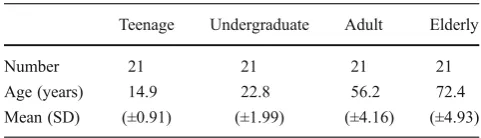
A total of 84 male subjects were divided into four age
groups (Table
1
). Subject selection was based on the
fol-lowing criteria: teenage subjects (T) that regularly trained,
three times a week; undergraduate students (U) that were
enrolled at the Faculty of Physical Education and Sport
Sciences, University of Las Palmas de Gran Canaria, where
they are obliged by the curriculum to engage in constant but
moderate physical activity; adult subjects (A) that were
active at work and engage in recreational physical activity
during the week; the elderly group (
E
) that comprised
sub-jects aged 65 or over, whose physical activity was limited to
the requirements of daily living.
The vastus lateralis (VL) and biceps femoris (BF) muscles
were selected for study, as being the most involved in knee
flexion and extension; this choice also enabled comparison
between a postural (BF) and a non-postural muscle (VL).
All subjects, and the parents or guardians of subjects
under the age of 18, were fully informed of the procedures
involved and provided written consent. The study was
performed in accordance with the ethical standards laid
down in the World Medical Association
’
s
Declaration of
Helsinki
on medical research involving human subjects.
Measuring procedure
TMG measures muscle tone [
66
] and contractile properties
[
11
–
13
,
47
] by means of a displacement sensor positioned
directly on the skin over the muscle belly and perpendicular
to it [
66
]; the muscle segment was selected following
man-ufacturer
’
s instructions [
16
,
22
,
58
]. Single maximal 1 ms
twitch stimulation was applied in bipolar mode (100 mA),
through electrodes placed at the proximal and distal ends of
the muscle, avoiding the insertion tendons [
31
,
55
,
65
]; a
pause was included between stimulations in order to rule out
post-tetanic activation [
6
,
49
,
55
]. The reproducibility of the
method and the validity of the experimental procedure used
in TMG have been examined in a number of studies, which
confirm its value as a high-precision technique [
6
,
13
,
33
,
50
,
55
,
57
,
58
,
63
].
This measurement provides numerical information on the
magnitude and timing of radial displacements of transverse
muscle fibers [
55
,
66
]. The present study focused on the
normalized response speed
(
V
rn) [
51
,
66
].
This parameter relates the difference in radial displacement
of a muscle belly between 10 and 90 % of the maximal
amplitude of the muscle response (
Δ
d
r) and the rise time, i.e.,
the increase in muscle contraction time (
Δ
t
c) between 10 and
90 % of the muscle response (Eq.
1
). Valencic and Knez [
66
]
note that in order to compare the rise time of different muscles,
the rise time has to be normalized to the maximum value of a
certain response. This is done by dividing the previous
equa-tion by the maximum relative displacement (Dm) of each
muscle (Eq.
2
). Since
Δ
d
requals 0.8×Dm, the normalized
response speed equals 0.8 divided by the rise time (Eq.
3
):
V
r¼
Δ
Δ
d
rt
cmm s
=
½
ð
1
Þ
V
rn¼
V
rDm
¼
Δ
d
r=
Δ
t
cDm
mm s
=
mm
ð
2
Þ
V
rn¼
0;
8
t
cmm s
=
½
ð
3
Þ
Statistical analysis
Data were tested for normal distribution using the Shapiro
–
Wilk test, and independent sample means for VL and BF
(both legs) were compared using the Student
’
s
t
test for
parametric data and the Mann
–
Whitney adjustment for
non-parametric data (significance level
p
≤
0.05). Statistical analysis
was performed using the SPSS-v17 software package (SPSS
Inc., Chicago, IL, USA).
Results
The data obtained highlighted a decline in the response
speed (
V
rn) for the vastus lateralis muscle in both legs with
increasing age (Figs.
1
and
2
). The decline was particularly
marked in elderly subjects and in the right VL (right (32.5 %)
vs. left (27.1 %)).
Statistically significant differences in
V
rnwere observed
(Figs.
1
and
2
) between the elderly group (E) and the other
groups for the right VL (E vs. T,
p
=0.000; E vs. U,
p
=0.000;
and E vs. A,
p
=0.018) and between the elderly group and the
teenage and undergraduate groups for the left VL (E vs. T,
p
<0.000; E vs. U,
p
=0.003). Significant differences were also
found between the teenage group and the undergraduate and
adult groups for the right VL (T vs. U,
p
=0.010; T vs. A,
p
=0.000), and with respect to the adult group for the left VL
(T vs. A,
p
=0.004).
Table 1 Study age group
Teenage Undergraduate Adult Elderly
Number 21 21 21 21
Age (years) 14.9 22.8 56.2 72.4 Mean (SD) (±0.91) (±1.99) (±4.16) (±4.93)
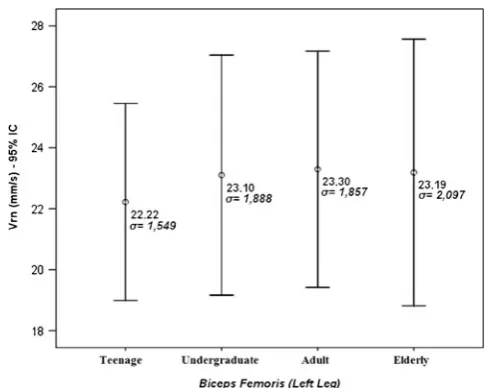
Muscle contraction speed in the BF (Fig.
3
) displayed
different behavior from that of the VL (Fig.
4
), increasing
moderately or stabilizing until the fifth or sixth decade of life,
and thereafter declining slightly in the elderly group. The
decline in speed was more marked in the right leg (
p
=0.020).
Discussion
The results indicated a decline in
V
rnin the VL (both legs)
with increasing age. By contrast, values in the BF tended to
remain stable throughout life, with only a slight decline in
the elderly group (E). These functional changes in muscle
response in elderly subjects reduce their functional capacity
and their ability to perform the tasks of daily life, impairing
postural balance control [
20
,
27
] and thus increasing the risk
of falls [
7
,
42
,
54
,
61
]. Additionally, the main muscles used
in walking (knee extensors and plantar flexors) lose their
functional capacity more rapidly than the muscles used in
maintaining postural balance [
5
,
39
,
40
,
45
,
48
,
68
].
The decline in response speed (
V
rn) observed here may be
considered indicative of the changes in muscle response
taking place due to aging. The magnitude of the decline
reflects the loss of muscle mass, a decrease in contractile
Fig. 1 Mean values for normalized response speed (Vrn) expressed inmillimeter per second, at a 95 % confidence interval (95 % CI) andσ (standard error of mean), for the right vastus lateralis muscle (VL) for each of the study groups (p≤0.05)
Fig. 2 Mean values for normalized response speed (Vrn) expressed in
millimeter per second, at a 95 % confidence interval (95 % CI) andσ (standard error of mean), for the left vastus lateralis muscle (VL) for each of the study groups (p≤0.05)
Fig. 4 Mean values for normalized response speed (Vrn) expressed in
millimeter per second, at a 95 % confidence interval (95 % CI) andσ (standard error of mean), for the left biceps femoris muscle (BF) for each of the study groups (p≤0.05)
Fig. 3 Mean values for normalized response speed (Vrn) expressed in
elements [
1
,
35
,
64
,
70
], neuromuscular alterations [
4
,
43
,
62
], and changes in functional balance [
17
].
Pisot et al. [
46
] note some dissociation between the
contractile changes after long term of complete inactivity
occurring at whole-muscle level and those observed at
single-fiber level, and their associated changes in myosin
heavy chain (MHC) composition. It has been clearly shown
that type II muscle fibers are more susceptible to atrophy
than type I fibers [
2
,
3
,
30
,
32
,
59
], although a number of
studies report similar changes in the two types of fiber [
56
].
Furthermore, other authors found correlation between high
values in the muscle contraction time (Tc) with the highest
percentage of type I fibers [
30
,
31
] or with the increased
presence of myosin heavy chain (MHC-I) [
18
].
The extent of changes in muscle composition and
re-sponse potential is directly linked to the subject
’
s level of
physical activity, as long as functional capacity is not
governed by some other pathology. Aagard et al. [
1
] note
that strength training induces adaptation of skeletal muscle
plasticity as well as improved muscle response in elderly
subjects even at a very old age. In the present study, the level
of physical activity declined with age, being greatest in the
teenage group and lowest in the elderly group. Response
speed in the vastus lateralis muscle diminished at a similar
rate to physical activity; similar findings have been reported
by other authors [
8
,
21
,
69
].
The results indicated that the biceps femoris (Fig.
2
) had
a lower response speed and behaved differently to the VL
with increasing age: over the first five or six decades of life,
muscle response speed appeared to undergo no significant
changes. However, a moderate but statistically significant
decline was noted between the adult and elderly groups
(
p
=0.020) for the right BF, indicating a serious impairment
of physical activity in the oldest subjects.
Analysis of the results obtained here should take into
account that changes in muscle response may be due not
only to age but also to the amount and type of physical
activity in each group.
The findings of the present study with regard to age-related
changes in muscle response speed match those reported by
Clark et al. [
10
] in a study of elderly subjects with limited
mobility, elderly subjects with no limitations and middle-aged
subjects. These authors found the greatest decline in response
speed in elderly subjects with limited mobility and the
smallest decline in middle-aged subjects. The decline was
more marked in knee extensor muscles (VL, VM, and RF)
than in knee flexor muscles (BF and ST). Asaka and Wang [
5
]
report that, with advancing age, the center of pressure moves
forward, prompting a constant need for posture rebalancing
using the knee flexor muscles, which thus compensate for the
progressive loss of knee extensor strength.
It is generally recognized that the ability to make fast
movements (dynamic strength) declines more rapidly with
age than the ability to maintain static balance (static strength)
[
26
,
27
,
34
,
60
,
67
]. It also seems clear that diminished
displacement speed increases the risk of falls in elderly
subjects [
24
,
41
,
44
].
Conclusions
The results obtained indicated a decline in the normalized
response speed (
V
rn) of the vastus lateralis muscle in both
legs as subjects grow older and engage in less physical
activity. The decline was especially apparent in the elderly
group compared to the teenage and undergraduate groups,
and between the adult and teenage groups.
In the teenage, undergraduate, and adult groups, flexor
muscles behaved differently from extensors. While VL
re-sponse speed decreased with age, BF increased slightly or
remained stable over the first five decades of life; declines in
BF response speed were observed only in the elderly group.
The results confirmed that TMG monitoring of muscle
response speed using the VL provides an efficient indicator
of loss of quality in dynamic movements involving lower
limb muscles (ankle and knee joints).
Acknowledgments The authors are grateful to all the subjects who took part in the study and to the families of the young and elderly participants.
Disclosures
Conflict of interest D. Rodríguez-Ruiz, J. M. García-Manso, D. Rodríguez-Matoso, S. Sarmiento, M. Da Silva-Grigoletto, R. Pisot declare that they have no conflict of interest.
Informed consent All subjects, and the parents or guardians of sub-jects under the age of 18, were fully informed of the procedures involved and provided written consent.
Human & animal studies This article does not contain any studies with human or animal subjects performed by the any of the authors.
Ethical statement The study was performed in accordance with the ethical standards laid down in the World Medical Association’s Dec-laration of Helsinki on medical research involving human subjects.
References
1. Aagard P, Suetta C, Caserotti P, Magnusso SP, Kjaer M (2010) Role of the nervous system in sarcopenia and muscle atrophy with aging: strength training as a countermeasure. Scand J Med Sci Sports 20(1):46–64
2. Akima H, Kawakami Y, Kubo K, Sekiguchi C, Ohshima H, Miyamoto A, Fukunaga T (2000) Effect of short-duration space-flight on thigh and leg muscle volume. Med Sci Sports Exerc 32:1743–1747
3. Andersen L, Andersen J, Magnuson P, Suetta C, Madsen J, Christensen L, Aagaard P (2005) Changes in the human muscle force–velocity relationship in response to resistance training and subsequent detraining. J Appl Physiol 99:87–94
4. Antonutto G, Capelli C, Girardis M, Zamparo P, di Prampero PE (1999) Effects of microgravity on maximal power of lower limbs during very short efforts in humans. J Appl Physiol 86:85–92 5. Asaka T, Wang Y (2008) Effects of aging on feedforward postural
synergies. J Hum Kinet 20:63–70
6. Belic A, Knez N, Karba R, Valencic V (2000) Validation of the human muscle model. Proceedings of the 2000 Summer Computer Simulation Conference, 16–20. July 2000, Vancouver, British Columbia. Session 1: Issues on Whole Body Modeling
7. Brouwer BK, Musselman BK, Culham E (2004) Physical function and health status among seniors with and without a fear of falling. Gerontology 50(3):135–141
8. Buckwalter JA (1997) Decrease mobility in elderly: the exer-cise antidote. Phys Sports Med 25(9):126–133. doi:10.3810/ psm.1997.09.1516
9. Camiña Fernández F, Cancela Carral JM, Romo Pérez V (2001) La prescripción del ejercicio físico para personas mayores. Valores normativos de la condición física. Revista Internacional de Medicina y Ciencias de la Actividad Física y el Deporte 1(2):136– 154
10. Clark DJ, Patten C, Reid KF, Carabello RJ, Phillips EM, Fielding RA (2010) Impaired voluntary neuromuscular activation limits muscle power in mobility-limited older adults. J Gerontol A Biol Sci Med Sci 65A(5):495–502
11. Dahmane RG, Djordjevic S,Šimunic B, Valencic V (2005) Spa-tial fiber type distribution in normal human muscle histochemical and tensiomyographical evaluation. J Biomech 38(12):2451– 2459
12. Dahmane R, Djordjevic S, Smerdu V (2006) Adaptive potential of human biceps femoris muscle demonstrated by histochemical, immunohistochemical and mechanomyographical methods. Med Bio Eng Comput 44(11):999–1006
13. Dahmane R, Knez N, Valencic V, Erzen I (2000) Tensiomyography, a non-invasive method reflecting the percentage of slow muscle fiber in human skeletal muscles. Book of Abstract: Life Sciences 2000, Gozd Martuljek, Slovenia, September 28 to October 1, 2000, pp./str. 29
14. De Boer MD, Seynnes OR, Di Prampero PE, Pisot R, Mekjavic IB, Biolo G, Narici MV (2008) Effect of 5 weeks horizontal bed rest on human muscle thickness and architecture of weight bearing and non-weight bearing muscle. Eur J Appl Physiol 104(2):401–407 15. Di Prampero PE, Narici MV (2003) Muscles in microgravity: from
fibres to human motion. J Biomech 36:403–412
16. Djordjevic S, Valencic V, Knez N, Dahmane R, Jurcic-Zlobec B, Bednarik J, Simunic B, Kersevan K, Godina N (2000) Contractile properties of skeletal muscles of two groups of sportsmen-sprinters and cyclist measured by Tensiomyography. 2000 Pre-Olympic Congress, Brisbane, Australia, Abstract 220
17. Enoka RM, Christou EA, Hunter S, Kornatz K, Semmler J, Taylor A, Tracy B (2003) Mechanisms that contribute to differences in motor performance between young and old adults. J Electromyogr Kinesiol 13(1):1–12
18. Essen-Gustavsson B, Borges O (1986) Histochemical and meta-bolic characteristics of human skeletal muscle in relation to age. Acta Physiol Scand 126:107–114
19. Fitts RH, Riley DR, Widrick JJ (2000) Microgravity and skeletal muscle. J Appl Physiol 89:823–839
20. Foldvari M, Clark M, Laviolette L, Bernstein MJA, Castanda C, Pu CT, Hausdorff JM, Fielding RA, Fiatarone-Singh MA (2000) Association of muscle power with functional status in community-dwelling elderly women. J Gerontol: Biol Med Sci 55A: M192–M199
21. González JM, Valero M (2000) Indicaciones y sugerencias sobre el entrenamiento de fuerza y resistencia en ancianos. Int J Med Sci Physic Act Sport 1:41–48
22. Gorelick ML, Brown JM (2007) Mechanomyographic assessment of contractile properties within seven segments of the human deltoid muscle. Eur J Appl Physiol 100(1):35–44
23. Grimby G, Danneskiold-Samsoe B, Hvid K, Saltin B (1982) Mor-phology and enzyme capacity in arm and leg muscles in 78–81 year old men and women. Acta Physiol Scand 115:125–134
24. Holbein J, Mary JA, McDermott K, Shaw C, Demchak J (2007) Validity of functional stability limits as a measure of balance in adults aged 23–73 years. Ergonomics 50(5):631–646
25. Hunter GR, McCarthy JP, Bamman MM (2004) Effects of resis-tance training on older adults. Sports Med 34(5):329–348 26. Hwang IS, Huang CT, Cherng CC (2006) Postural fluctuations
during pointing from a unilateral or bilateral stance. Hum Mov Sci 25:275–291
27. Izquierdo M, Ibanez J, Gorostiaga E, Garrues M, Zuñiga A, Antón A, Larrión JL, Hakkinen K (1999) Maximal strength and power characteristics in isometric and dynamic actions of the upper and lower extremities in middle-aged and older men. Acta Physiol Scand 167:57–68
28. Janssen I, Heymfield SB, Wang Z, Ross R (2000) Skeletal muscle mass and distribution in 468 men and women aged 18–88 yr. J Appl Physiol 89:81–88
29. Kamel H (2003) Sarcopenia and aging. Nutr Rev 61(5):157–167 30. Klitgaard H, Mantoni M, Schiaffino S, Ausoni S, Gorza L,
Laurent-Winter C, Schnohr P, Saltin B (1990) Function, morphol-ogy and protein expression of ageing skeletal muscle: a cross-sectional study of elderly men with different training backgrounds. Acta Physiologica Scandinavica 140:41–54
31. Knez N, Valencic V (2000) Proceedings of the ninth Electrochem-ical and Computer Science Conference ERK 2000, 21–23, Sep-tember 2000, Portoroz, Slovenia. Ljubljana: IEEE Region 8, Slovenian section IEEE, Vol. B, pp 301–304
32. Kosek D, Kim J, Petrella J, Cross J, Bamman M (2006) Efficacy of 3 days/wk resistance training on myofiber hypertrophy and myo-genic mechanisms in young vs. older adults. J Appl Physiol 101:531–544
33. Krizaj D, Simunic B, Zagar T (2008) Short-term repeatability of parameters extracted from radial displacement of muscle belly. J Electromyogr Kinesiol 18:645–651
34. Lanza IR, Towse TF, Caldwell GE, Wigmore DM, Kent-Braun JA (2003) Effects of age on human muscle torque, velocity, and power in two muscle groups. J Appl Physiol 95:2361–2369
35. Larsson L, Li X, Berg HE, Frontera WR (1996) Effects of removal of weight-bearing function on contractility and myosin isoform composition in single human skeletal muscle cells. Pflügers Archiv Eur J Physiol 432:320–328
36. LeBlanc A, Rowe R, Schneider V, Evans H, Hedrick T (1995) Regional muscle loss after short duration spaceflight. Aviat Space Environ Med 66:1151–1154
37. Leenders N (2003) The elderly. In: Ehrman JK, Gordon PM, Visich PS, Keteyian SJ (eds) Clinical exercise physiology. Human Kinetics, Champaing
38. Lidboe CF, Torvik A (1982) The effects of ageing, cachexia and neoplasms on striated muscle. Quantitative histological and histochem-ical observations on an autopsy material. Acta Neuropathol 57:85–92 39. Loram ID, Maganaris CN, Lakie M (2004) Paradoxical muscle
movement in human standing. J Physiol 556:683–689
40. Macaluso A, de Vito G (2004) Muscle strength, power and adap-tations to resistance training in older people. Eur J Appl Physiol 91:450–472
42. Maki BE, Holliday PJ, Topper AK (1994) A prospective study of postural balance and risk of falling in an ambulatory and indepen-dent elderly population. J Gerontol 49:M72–M84
43. McArdle WD, Katch FI, Katch FL (2001) Exercise physiology: energy, nutrition, and human performance, 5th edn. Lippincott Williams & Wilkins, Hagerstown
44. Melzer I, Benjuya N, Kaplanski J (2004) Postural stability in the elderly: a comparison between fallers and non-fallers. Age Ageing 33(6):602–607
45. Onambele GL, Narici MV, Maganaris CN (2006) Calf muscle– tendon properties and postural balance in old age. J Appl Physiol 100:2048–2056
46. Pisot R, Narici MV, Simunic B, De Boer M, Seynnes O, Jurdana M, Biolo G, Mekjavic IB (2008) Whole muscle contractile param-eters and thickness loss during 35-day bed rest. Eur J Appl Physiol 104(2):409–414
47. Pisot R, Valencic V, Simunic B (2002) Influence of biomechanical properties of particular skeletal muscles on child motor develop-ment. Ann Ser Hist Nat 12:99–106
48. Reeves ND, Narici MV, Maganaris CN (2006) Musculoskeletal adaptations to resistance training in old age. Man Ther 11:192–196 49. Rodríguez-Matoso D, Rodríguez-Ruiz D, Quiroga ME, Sarmiento S, De Saa Y, García-Manso JM (2010) Tensiomiografía, utilidad y metodología en la evaluación muscular. Revista Internacional de Medicina y Ciencias de la Actividad Física y el Deporte 10(40): 620–629
50. Rodríguez-Matoso D, Rodríguez-Ruiz D, Sarmiento S, Vaamonde D, Da Silva-Grigoletto ME, García-Manso JM (2010) Reproduc-ibility of muscle response measurements using tensiomyography in a range of positions. Rev Andal Med Deporte 3(3):81–86 51. Rodríguez-Ruiz D, Rodríguez-Matoso D, Quiroga ME, Sarmiento
S, Da Silva-Grigoletto ME, García-Manso JM (2012) Study of extensor and flexor musculature in the knees of male and female volleyball players. Eur J Sport Sci 112(5):399–407
52. Rouvenoff R (2001) Origins and clinical relevance of sarcopenia. Can J Appl Physiol 26(1):78–89
53. Scelsi R, Marchetti C, Poggi P (1980) Histochemical and ultra-structural aspects of m. vastus lateralis in sedentary old people (65–89 years). Acta Neuropathol 51:99–105
54. Schrager M, Bandinelli S, Maggi S, Ferrucci L (2003) Sarcopenia: twenty open questions for research agenda. Basic Appl Myol 13(4):203–208
55. Simunic B (2003) Model of longitudinal contractions and trans-verse deformations in skeletal muscles. Doctoral Thesis. Ljubljana 56. Simunic B, Degens H, Rittweger J, Narici M, Mekjavi IB, Pisot R (2011) Noninvasive Estimation of Myosin Heavy Chain Composi-tion in Human Skeletal Muscle. Med Sci Sports Exerc 43(9):1619– 1625
57. Simunic B, Krizaj D, Narici M, Pisot R (2010) Twitch parameters in transversal and longitudinal biceps brachii response. Annales Kinesiologiae 1:61–80
58. Simunic B, Valencic V (2001) Proceedings of X Electrochemical and Computer Science Conference. IEEE Region 8, Slovenian Section IEEE, Vol. B, pp 363–366. September 24–26, 2001. Portoroz (Eslovenia)
59. Singh MAF, Ding W, Manfredi T, Solares G, O’Neill E, Clements K, Ryan N, Kehayias J, Fielding R, Evans W (1999) Insulin-like growth factor I in skeletal muscle after weight-lifting exercise in frail elders. Am J Physiol Endocrinol Metab 277:E137–E143 60. Skelton DA, Greig CA, Davies JM, Young A (1994) Strength,
power and related functional ability of healthy people aged 65– 89 years. Age Ageing 23:371–377
61. Stalenhoef PA, Diederiks JP, Knottnerus JA, Kester AD, Crebolder HF (2002) A risk model for the prediction of recurrent falls in community-dwelling elderly: a prospective cohort study. J Clin Epidemiol 55(11):1088–1094
62. Stolberg E, Fawcett P (1982) Macro EMG in healthy subjects of different ages. J Neurol Neurosurg Psychiatry 5:870–878 63. Tous-Fajardo J, Moras G, Rodríguez-Jiménez S, Usach R, Doutres
DM, Maffiuletti NA (2010) Inter-rater reliability of muscle contrac-tile property measurements using non-invasive tensiomyography. J Electromyogr Kinesiol 20(4):761–766
64. Trappe S, Trappe T, Gallagher P, Harber M, Alkner B, Tesch P (2004) Human single muscle fibre function with 84 day bed-rest and resistance exercise. J Physiol 557:501–513
65. Valencic V (2002) Method for selective and non-invasive detection of skeletal muscles contraction process. International Application Published under the Patent Cooperation Treaty (PCT). No. WO 02/ 074167 A1
66. Valencic V, Knez N (1997) Measuring of the skeletal muscles’ dynamic properties. Artific Org 21:240–242
67. Valour D, Ochala J, Ballay Y, Pousson M (2003) The influence of ageing on the force–velocity–power characteristics of human elbow flexor muscles. Exp Gerontol 38:387–395
68. Vandervoort AA (2002) Aging of the human neuromuscular system. Muscle Nerve 25:17–25
69. Wilmore JH, Costill DL (2004) Physiology of sport and exercise, 3rd edn. Human Kinetics, Champaign
70. Young A, Stokes M, Crowe M (1984) Size and strength of the quadriceps muscle of old and young women. Eur J Clin Invest 14:282–287
We can declare that is original research.