1
Benchmarking and Assessment Working Group 2015 Progress Report
October 2015
Membership
Current Members:
Kate Willett (Chair) Met Office Hadley Centre, UK
Claude Williams National Centers for Environmental Information, USA Ian Jolliffe Exeter Climate Systems, University of Exeter, UK Robert Lund Department of Mathematical Sciences, Clemson
University, USA
Lisa Alexander Climate Change Research Centre, University of New South Wales, Australia
Stefan Brönnimann University of Bern, Switzerland
Lucie A. Vincent Climate Research Division, Environment Canada, Canada
Steve Easterbrook Department of Computer Science, University of Toronto, Canada
Victor Venema Meteorologisches Institut, University of Bonn, Germany David Berry National Oceanography Centre, Southampton, UK Rachel Warren Met Office Hadley Centre, UK
Giuseppina Lopardo, Istituto Nazionale di Ricerca Metrologica (INRiM), Italy Renate Auchmann Oeschger Center for Climate Change Research &
Institute of Geography, University of Bern, Switzerland Enric Aguilar Centre for Climate Change, Universitat Rovira i Virgili,
Spain
Matt Menne National Centers for Environmental Information, USA Colin Gallagher Department of Mathematical Sciences, Clemson
University, USA Zeke Hausfather Berkeley Earth, USA
Thordis Thorarinsdottir Statistical Analysis, Pattern Recognition, and Image Analysis (SAMBA), Norwegian Computing Centre, Norway
Peter Thorne (ex-officio) – Maynooth University, Ireland
New Members:
Robert Dunn Met Office Hadley Centre, UK
Ex-Members: NA
October 2014 to October 2015 Objectives:
1) Advocacy of ISTI and the benchmarks and support for users
2) Up to date reference list of work on homogenisation/benchmarking:
https://sites.google.com/a/surfacetemperatures.org/home/benchmarking-and-assessment-working-group?pli=1#Reference%20Literature
2 5) Submit clean-world methods paper
6) Finalise distribution and probability framework for analog-error-worlds 7) Create software to produce analog-error-worlds on the global scale 8) Submit error-worlds methods paper
9) Produce the official first version of analog-error-worlds 10) Finalise validation concepts
11) Create software and score system/intercomparison tables to run the validation on a proof of concepts scale
12) Produce a validation methods paper
13) Produce first version validation software ready to perform on real returned benchmarks
14) Release first version benchmarks (blind and open worlds)
15) Create a benchmarking support webpage to host the benchmarks, validation results, feedback
Objectives (Partially) Fullfilled:
1) Advocacy of ISTI and the benchmarks and support for users
July 2015 – Kate Willett presented a poster at the Copernicus Climate Change Service workshop on Climate Data, ECMWF, Reading, UK: The International Surface Temperature Initiative.
April 2015 – Victor Venema presented a poster at EGU, Vienna, Austria: Benchmarking and Assessment of Homogenisation Algorithms for the International Surface Temperature Initiative (ISTI).
February 2015 - Kate Willett presented at the WCRP Grand Challenge on Data for Extremes workshop, University of New South Wales, Sydney, Australia (and also CSIRO, BOM):
The ISTI: Land surface air temperature datasets for the 21st Century.
December 2014 - Kate Willett presentation at the University of Bern, Switzerland:
The International Surface Temperature Initiative and Benchmarking for Homogenisation Algorithms.
2) Up to date reference list of work on homogenisation/benchmarking:
https://sites.google.com/a/surfacetemperatures.org/home/benchmarking-and-assessment-working-group?pli=1#Reference%20Literature
This has been updated with all articles published this year.
3) Create software to produce analog-clean-worlds on the global scale Software has been written in Python and R to run the analog-clean-worlds from ISTIv1.0.1 (July download) and should now be able to be run on any future versions in the same format. All code is stored in the GitHub
SurfaceTemp organisation in the ISTI_Clean_Worlds repository:
https://github.com/SurfaceTemp/ISTI_Clean_Worlds. A wiki has been created (https://github.com/SurfaceTemp/ISTI_Clean_Worlds/wiki) and a clear
3
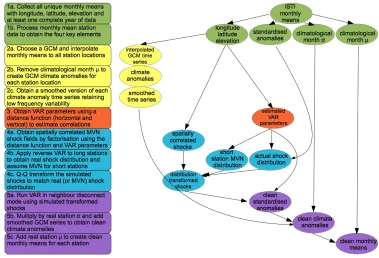
deviation, autocorrelation, cross-correlations at lag 0 and lag 1 and difference series autocorrelation and standard deviation.
Figure 1. Flow chart of analog-clean-world creation.
5) Submit clean-world methods paper PARTIALLY MET
A first draft of this paper has been written and circulated around co-authors. Response from co-authors is still awaited and revisions (possibly
methodological) are likely prior to submission.
6) Finalise distribution and probability framework for analog-error-worlds The selection of open and blind worlds, which ones will be mandatory (versus optional), and the distribution and probability framework for the analog-error-worlds have now been finalised. One point of note is the agreement on each inhomogeneity having a random and biased component. This is described in Figure 2.
7) Create software to produce analog-error-worlds on the global scale PARTIALLY MET
All code is stored in the GitHub SurfaceTemp organisation in the ISTI_Error_Worlds repository:
https://github.com/SurfaceTemp/ISTI_Error_Worlds. A wiki has been created to describe the work and code/code structure is well under way.
8) Submit error-worlds methods paper PARTIALLY MET
4
the error world code. This will likely include an assessment of inhomogeneities found in real world data such as GHCNv4.
Figure 2 Diagrammatical example of how inhomogeneities will be implemented in a station time series. The vertical red lines show the changepoint locations. The horizontal grey line shows the mean of the
reference period – the most recent ‘homogeneous’ period. The dashed black lines indicate the bias (permanent) component of each inhomogeneity and the dashed orange lines indicate the random (temporary) component of each homogeneity. The bias component sizes are selected from the distributions shown in blue and are always centred around the mean of the previous bias component (working backwards from present day). The random component sizes are added to the current bias component and selected from the
distributions shown in orange which are always centred around the mean of the current bias component.
10) Finalise validation concepts PARTIALLY MET
There has been quite a bit of discussion on this in teleconferences but the validation measures have not yet been finalised. Rachel Warren’s PhD on daily benchmarks is nearing completion and includes a well developed
validation framework. We envisage building on this to a large extent. One key issue for the global benchmarks is allowing for regional submissions and refusal to homogenise some stations that are too short, contain too much missing data or are of too poor quality initially.
Objectives Not Fullfilled:
5
The clean world code has yet to pass through methodological sign off. The official open and blind worlds cannot be created until the methods have been finalised.
5) Submit clean-world methods paper Partially met – see above
7) Create software to produce analog-error-worlds on the global scale Partially met – see above
8) Submit error-worlds methods paper Partially met – see above
9) Produce the official first version of analog-error-worlds
This requires both finalisation of the clean world methodology following review from three statisticians and completion of the error world code.
10) Finalise validation concepts Partially met – see above
11) Create software and score system/intercomparison tables to run the validation on a proof of concepts scale
There has been no progress but Rachel Warren’s PhD on daily benchmarks is near completion with a well developed validation framework and code which we can use as a basis for our own.
12) Produce a validation methods paper No progress has been made.
13) Produce first version validation software ready to perform on real returned benchmarks
No progress has been made.
14) Release first version benchmarks (blind and open worlds)
This has not been done. This can be done after sign off of the clean world methodology and completion of the error world code.
15) Create a benchmarking support webpage to host the benchmarks, validation results, feedback
No progress has been made.
Other Efforts and Achievements:
• Rachel Warren’s PhD to develop a benchmarking process for daily data and work in collaboration with ISTI is nearing completion. Daily benchmarks for four regions of the USA and 3 worlds have now been released as blind worlds. Eight methods have been run on the
6
• Victor Venema visited the Met Office which was very helpful to progress work on the error worlds.
2015 Annual Overview:
Progress during 2015, as in previous years, has been slower than hoped and the benchmarks are still not completed. This is mostly due to the complexity of getting the clean world methods up and running on the global scale and
7
Objectives for October 2015 and Beyond:
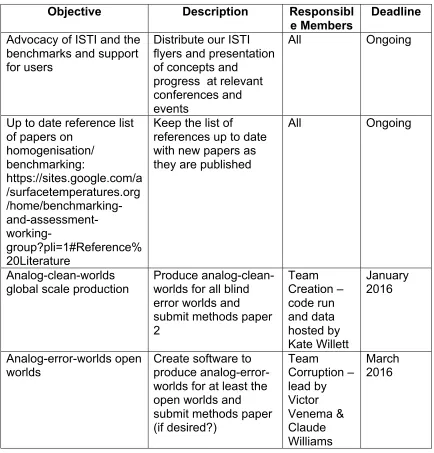
Table 1. Suggested timeline and plan for achieving objectives.
Objective Description Responsibl
e Members
Deadline
Advocacy of ISTI and the benchmarks and support for users
Distribute our ISTI flyers and presentation of concepts and
progress at relevant conferences and events
All Ongoing
Up to date reference list of papers on
homogenisation/ benchmarking:
https://sites.google.com/a /surfacetemperatures.org /home/benchmarking- and-assessment-
working-group?pli=1#Reference% 20Literature
Keep the list of
references up to date with new papers as they are published
All Ongoing
Analog-clean-worlds
global scale production Produce analog-clean-worlds for all blind error worlds and submit methods paper 2
Team Creation – code run and data hosted by Kate Willett
January 2016
Analog-error-worlds open
worlds Create software to produce analog-error-worlds for at least the open worlds and submit methods paper (if desired?)
Team
Corruption – lead by Victor Venema & Claude Williams
8 Analog-error-worlds blind
worlds (official benchmarks)
Produce analog-error-worlds from the analog-clean-worlds ready for distribution as official benchmark data Team Corruption – lead by Claude Williams &Victor Venema. (parametric choices made by Kate Willett and kept blind from all potential users) June 2016 Validation concepts finalised (including regional and incomplete submissions)
Decide upon number and type of tests with which to perform validation
Team Validation – lead by Ian Jolliffe
December 2015
Validation proof-of-concept
Create software and score
system/intercompariso n tables to run the validation on a proof-of-concept scale and submit methods paper (if desired?)
Team Validation – lead by Ian Jolliffe
July 2016
Validation global scale
production Produce software and framework ready for running on the global scale – automated or manual
Team Validation – lead by Ian Jolliffe
December 2016
Benchmark Cycle Release of analog-error-worlds
Release first official benchmarks – publicise widely
All – lead by Kate Willett
July 2016
Benchmarking Platform
Design Update the benchmarking webpage to include step-by-step ‘How to benchmark’ with appropriate links to data, validation and intercomparison tables, feedback to be invited through the benchmarking blog, a private list of
participants contact details will be maintained offline.
All – lead by
9 Deadline for submission
of benchmark results
Homogenisers to submit their homogenised
benchmark data and a set of specified
statistics
Dataset creators
July 2018
Benchmark Cycle – release of the ‘answers’
Release the ‘answers’ (analog-clean-worlds) for the blind worlds
All – lead by Kate Willett
July 2018
Return of assessment of benchmark
homogenisation
Supply all appropriate statistics to the dataset creators
Team Validation led by Ian Jolliffe and working group
January 2019
Organise benchmark cycle 1 wrap-up workshop
Plan and run a
workshop, perhaps in conjunction with full ISTI meeting or other conference? Resource dependent.
All – lead by Kate Willett
Summer 2019
Publication of benchmark results and assessment of the cycle
Benchmarking working group
December 2019
Release of second benchmark cycle
Some improvements made from previous cycle and different issues explored with the error worlds.
Potential extensions to other variables, daily data, and other dataset creation issues.
Benchmarking working group