
Optimizing Bloom Filter: Challenges, Solutions,
and Comparisons
Lailong Luo, Deke Guo, Richard T.B. Ma, Ori Rottenstreich, and Xueshan Luo
Abstract—Bloom filter (BF) has been widely used to support membership query, i.e., to judge whether a given element xis a member of a given setSor not. Recent years have seen a flourish design explosion of BF due to its characteristic of space-efficiency and the functionality of constant-time membership query. The existing reviews or surveys mainly focus on the applications of BF, but fall short in covering the current trends, thereby lacking intrinsic understanding of their design philosophy. To this end, this survey provides an overview of BF and its variants, with an emphasis on the optimization techniques. Basically, we survey the existing variants from two dimensions, i.e., performance and generalization. To improve the performance, dozens of variants devote themselves to reducing the false positives and implementation costs. Besides, tens of variants generalize the BF framework in more scenarios by diversifying the input sets and enriching the output functionalities. To summarize the existing efforts, we conduct an in-depth study of the existing literature on BF optimization, covering more than 60 variants. We unearth the design philosophy of these variants and elaborate how the employed optimization techniques improve BF. Further-more, comprehensive analysis and qualitative comparison are conducted from the perspectives of BF components. Lastly, we highlight the future trends of designing BFs. This is, to the best of our knowledge, the first survey that accomplishes such goals.
Index Terms—Bloom filter, Performance, Generalization, False positive, False negative.
I. INTRODUCTION
B
LOOM filter [1] is a space-efficient probabilistic data structure for representing a set of elements with support-ing membership queries with an acceptable false positive rate. Hitherto, the applications of BF and its variants are manyfold. In the field of networking, BF has been employed to enable routing and forwarding [2] [3] [4] [5] [6] [7] [8], web caching [9] [10], network monitoring [11], security enhancement [12] [13], content delivering [14], etc. In the area of databases, BF is a proper option to support query and search [15] [16], privacy preservation [17], key-value store [18] [19], content synchronization [20] [21] [22] [23] [24], duplicate detection [25] and so on. Beyond the general fields of networking andThis work is partially supported by National Natural Science Foundation of China under Grant No.61772544, and the Hunan Provincial Natural Science Fund for Distinguished Young Scholars under Grant No.2016JJ1002.
Corresponding author: Deke Guo.
Lailong Luo, Deke Guo, and Xueshan Luo are with the Science and Technology Laboratory on Information Systems Engineering, National Uni-versity of Defense Technology, Changsha, Hunan, 410073, China. E-mail: {luolailong09, dekeguo, xsluo}@nudt.edu.cn.
Deke Guo is also with the College of Intelligence and Computing, Tianjin University, Tianjin, 300350, P. R. China.
Richard T. B. Ma is with the School of Computing, National University of Singapore, Singapore. E-mail: [email protected].
Ori Rottenstreich is with the Technion and ORBS Research, Israel. E-mail: [email protected].
TABLE I
COMPARISON WITH EXISTING SURVEYS.
First author # variants Scenarios Optimizations Broder [30] ≤5 Networks Not mentioned Geravand [31] ≤15 Network security Not mentioned Tarkoma [29] ≤25 Distributed system Not mentioned
This survey ≥60 General Detailed
databases, BFs have been recently used to resolve biometric issues [26] [27], and even navigation tasks in the mobile computing scenarios [28]. Other detailed applications can be found in several surveys [29] [30] [31].
The major motivation for conducting this survey is two-fold. First of all, tens of BF variants have been proposed in recent years. Existing surveys, however, are somehow out-of-date and do not cover these new proposals. The latest survey [29], which covers about 25 variants, was published five years ago. Secondly, the existing surveys [29] [30] [31] mainly focus on the applications of BF, but lack essential understandings of the optimization techniques of the proposed variants. Therefore, they do not provide operational advice to the users in reality. As shown in Table I, compared with the existing surveys, our survey covers more BF variants (more than 60) and introduces general applications rather than focus on a single scenario. In particular, our survey concentrates on the optimization techniques employed in these variants.
IEEE COMMUNICATIONS SURVEYS AND TUTORIALS, VOL. X, NO. X, 201X 2
Bloom Filters
Reduction of FPs
Implementation optimization
Functionality enrichment
Set diversity Input Output
[image:2.612.326.547.57.227.2]Cost Result
Fig. 1. The top view of the optimization angles for Bloom filter.
functionalities. The intrinsic logic of the four angles is shown in Fig. 1. Basically, from the perspective of performance, the BF can be improved by reducing the false positives and optimizing the implementation. Besides, the BF framework can also be generalized from both the input and output aspects by representing more types of sets and enabling more functionalities beyond set membership queries.
Following the above directions, we organize the rest of this survey as follows. Section II details the design philosophy of BF and analyzes the challenging issues while Section III briefly introduces the applications of BFs. Thereafter, we detail the variants designed for reducing false positives (FPs) in Section IV, implementation optimizations in Section V, generalizing the set diversity in Section VI, and functional-ity enrichment in Section VII. Following that, Section VIII analyzes and compares all mentioned variants from a quality perspective. We summarize this survey and enumerate several open issues about the BF framework in Section IX and then conclude this survey in Section X.
II. BLOOMFILTERS
In this section, we detail the basic theory of Bloom filter in terms of its framework, characteristics, and challenges.
A. Framework of Bloom filter
Bloom filter (BF) is a space-efficient probabilistic data structure that enables constant-time membership queries [1].
Let S={x1,x2, ...,xn} be a set of n elements such that S⊆U,
whereUis a universal set. BF represents suchnelements using a bit vector of length m. All of the m bits in the vector are initialized to 0. Specifically, to insert an element x, a group of k independent hash functions, {h1,h2, ...,hk}, are employed to randomly map x into k positions {h1(x),h2(x), ...,hk(x)} (where hi(x)∈[0,m−1]) in the bit vector. Then the bits in these
kvector positions are all set to 1. To query whether an arbitrary element is a member of setS, BF maps the element into its bit vector with thekhash functions and thereafter checks whether all the k bits are 1s. If any bit at the k hashed positions of the element is 0, the BF concludes that this element does not belong to the set; otherwise, the BF indicates that the queried element belongs to the set S.
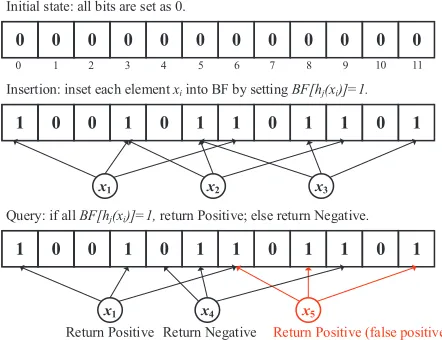
Fig. 2 presents an example of BF with m=12bits and k=3
hash functions to represent the set S={x1,x2,x3}. To insert
these elements, the 3 corresponding bits for each element are set to 1. When querying, the BF checks the 3 corresponding bits for the queried element. For x1, the bits at position 0, 3
ĂĂĂ
ĂĂĂ ĂĂĂ
ĂĂ ĂĂ
ĂĂ ĂĂ
0 0 0 0 0 0 0 0 0 0 0 0
Initial state: all bits are set as 0.
1 0 0 1 0 1 1 0 1 1 0 1
Insertion: inset each element xi into BF by setting BF[hj(xi)]=1.
1 0 0 1 0 1 1 0 1 1 0 1
Query: if all BF[hj(xi)]=1, return Positive; else return Negative.
0 1 2 3 4 5 6 7 8 9 10 11
x1 x2 x3
x1 x4 x5
Return Positive Return Negative Return Positive (false positive) Fig. 2. An illustrative example of BF withm=12andk=3to represent set
S={x1,x2,x3}. Note that the query ofx5results in a false positive error.
and 6 are all 1, thus BF returns “Positive” for the query. The membership query of x4 returns “Negative” since the bit at
position 4 is 0. Note that, due to the unavoidable hash conflicts (generating same hash value for diverse input elements), the membership query based on BF may incur false positive errors, i.e., wrongly indicating that a non-member element is a member ofS. In Fig. 2, the query ofx5returns positive because
the bits at position 6, 8, and 11 are all 1, though x5 < S.
Although BF incurs false positives, for many applications the space savings and constant locating time outweigh this drawback when the probability of false positive is small.
To realize acceptable false positive rate fr, the parameters of BF, i.e., the BF length m, the number of employed hash functionsk, and the number of elements in the setn, call for careful design. Theoretically, the value of false positive rate can be calculated as:
fr =
"
1−
1− 1 m
nk#k
≈1−e−k nm k
, (1)
where(1−1/m)nkis approximated bye−kn/m. Consequently, to realize the minimum value of fr,e−kn/mshould be minimized. With this insight, the optimal value of k is derived as:
kopt =
m n ln 2≈
9m
13n. (2)
Followed bykopt, the resulted false positive rate equals0.5k ≈
0.6185m/n. That is, with the given k, to maintain a fixed false positive rate, the value ofmshould be increased linearly with the value ofn.
However, as reported in [32] and [33], the false positive rate in real deployments is higher than the value given by Equ. 1. Theoretically, it has been proven in [34] that Equ. 1 offered a lower bound of the false positive rate. After formulating the BF framework as a typical problem of balls and urns, the authors in [34] present a more accurate false positive rate of BF as:
fr =
1 mk(n+1)
m
Õ
i=1
iki!
m i
kn i
[image:2.612.60.287.58.159.2]
where
kn i
= 1
i!
Íi
j=0(−1)j ij
jkn is called a Stirling
num-ber of the second kind [35].
Naturally, in the framework of BF, deleting an element is not permitted. The reason is that resetting the corresponding 1s to 0s directly may lead to false negative results for other elements. Therefore, Counting BF (CBF) [36] extends the BF by replacing each bit as a counter with multiple bits. When inserting an element, the correspondingkbits will be increased by 1. In contrast, the deletion of an element will be supported via decreasing the corresponding counters by 1. In this way, the deletion of an element will not affect the existence of other elements. It has been proved that 4 bits for a counter are enough to achieve eligible overflow probability (less than
1.37×10⁻¹⁵×m, wherem is the number of counters in CBF). CBF also supports constant-time membership query. To an-swer a membership query, the CBF checks thekcorresponding counters. If all of them are non-zero, CBF judges that the queried element is a member; otherwise, negative.
B. Intrinsic characteristics of Bloom filter
As a probabilistic data structure, BF supports fast mem-bership query with potential false positive errors. For better understanding, we highlight the intrinsic characteristics of BF as follows.
Space-efficient. BF programmes each element in a given set with am-bit vector, irrespective of the number of bits in a bit representation of an element. With each element as input, the kindependent hash functions will selectkbits in the bit vector and set the chosen bits as 1s. The caused space overhead, i.e., the value ofm, is only proportional to the number of elements n, and will not be affected by the length of the elements. For example, given the bpe (bits per element) as 5, i.e., m/n=5, the optimized k can be derived out as 3 or 4 according to Equ. 2. Then the bit vector represents the nelements, without concerning the size of each element.
Constant-time query. By employing BF, querying the membership of elements in U can be simplified as binary checking of the corresponding k bits. If all thek bits are 1s, BF believes the queried element belongs to the setS, otherwise not. Thus the time-complexity of querying an element is O(k), which is much faster than trees (O(logn)) and table or list (O(n)). Note that, when the Bloom filter is implemented and k will be a constant. Then both the insertion and query complexity will beO(1).
One-sided error. Intrinsically, BF suffers from unavoidable false positive errors during a query, but no false negative errors. Specifically, if BF infers that an element x is not in the setS, users can exactly trust the judgment. By contrast, if BF concludes that x belongs to S, users cannot rule out the probability that x<S.
C. Challenging issues of Bloom filter
BF is proven to be easy-deployable and practical for situa-tions where space is limited and membership query is required with allowable errors. However, BF incurs intrinsic challenges. We uncover the challenges as follows.
False positives. Although the false positive rate can be controlled by careful setting of the parameters, the misjudged elements may lead to serious impact on the upper-level ap-plications. For instance, when routing with BF, the leaked flows caused by misjudgements may burden or even block bandwidth-scarce networks (e.g., Wireless Sensor Network, Internet of Vehicles). To reduce the false positive rate, more space or more complicated operations are needed. Note that decreasing the false positive rate by extending the length of BF incurs marginal effect. That is, with the same increment of m, the decrement of false positive rate will be more and more indistinctive. Another strategy is to remedy the misreported elements (e.g., using whitelist). However, picking up the false positives from the query results can be challenging for a large-scale dataset.
Implementation. Despite the feature of easy-deployable, when BF or its variants are employed, some implementation ingredients (e.g., memory access, space utilization, computa-tion overhead) may be the bottleneck of the applicacomputa-tions. To query an element, the accessed bits can be arbitrarily located in the bit vector, which results inO(k)memory access. For a standard BF design, roughly only half of the bits are set to 1. Besides, high-performance hash functions (e.g., RSA, SHA-1, MD-5) calls for complex computation process which may be not possible for low-end or light-weight hardware. The above measurements get even worse when the dataset contains a large number of elements.
Elasticity. Note that, the parameters (including m, n and k) are predefined, and the employed hash functions cannot be changed once selected. The bits are not permitted to be changed once they have been set as 1s. Consequently, the BF can only successfully represent a static set. Once been implemented, the number of bits can be neither extended nor shrunk adaptively. Besides, the internal logical relationship (e.g., distance, similarity, precedence, etc) between elements will be annihilated. For example, when representing a mul-ticast tree, the BF only programmes the nodes into the bit vector. Therefore, the generated BF cannot tell the children or father of any node in the multicast tree directly.
Functionality. The original BF was designed to support fast membership query and only offer two operations to the users, i.e., insertion and query. More complicated operations (e.g., deletion and decoding) or other types of queries (e.g., multi-plicity) are not enabled. When an elementx is removed from S, the bitsBF[h1(x)],· · ·,BF[hk(x)]cannot be reversed as 0s. Thek1s may also represent the membership of other elements, thus changing them from 1s to 0s may lead to false negatives of other elements. Moreover, BF fails to tell the multiplicity of an element in a multiset (a set in which elements are permitted to have multiple replicas), and cannot report which set or sets an element belongs to, when representing multiple sets with a shared bit vector simultaneously. To realize more operations and enable more types of queries, the BF framework calls for additional design.
III. APPLICATIONS OFBLOOM FILTERS
com-munication and networking. Usually, BFs are employed to represent a given set of elements and support membership queries. We focus on the extensive applications of BFs in recent years since previous applications have been covered by existing surveys.
A. Content caching
BFs are naturally helpful for caches and storages via rep-resenting the contents to cache and supporting constant-time membership queries.
Consider a generic system composed of a user, a main memory containing all the data, and a cache with a subset of the data. Usually, BFs are employed to represent the content stored in the cache. The access of a specific element xis first directed to the BFs. If the BFs indicate that xis an element in the cache, the access tries to read the element from the cache. Due to the potential false positive errors,xmay be not found in the cache, then the access will be routed to the main memory. If BFs judges that x is not stored by the cache, the request will fetchxfrom the main memory directly without accessing the cache. In this manner, BFs eliminate unnecessary cache reads [9].
In reality, Akamai establishes BFs in its servers for efficient cache accesses [14]. Extensively, Akamai records the accessed elements with BFs to select the elements which should be pushed into the cache. As a consequence, the cache hit-rate is guaranteed [14]. Moreover, in a computing system with multiple cores, BFs are utilized to reduce the cache coherence cost [37]. Both local caches and the shared bus system have their BFs. With the BFs in the cache and the system interconnections, the filter mechanism screens out the unnecessary snooping messages that would be otherwise handled by each core. The BF for the bus system further reduces system-wide data broadcasts. As for web caching, BF is redesigned to represent cache content of each Internet proxy in a compact form [10]. Thereafter, the BFs are shared with other proxies in the web caching system. To further decrease the inter-proxy overhead, a BF only records the portion of a proxy’s cache content that will be of interest to other proxies. In the field of wireless communications, BFs are employed to speed up the cache lookups [38] and update the cache mechanism [39]. On-demand routing protocols for wireless ad hoc networks cache the discovered paths locally for subsequent routing operations. In this case, BF provides summaries of the cache content for testing cache membership and thereby averting negative lookups and easing the computational burden [38]. In large wireless networks, each node caches the public key of some nodes in the network. The cache space in each node is limited and is capable of storing a few public keys only. By representing these public keys as BF vectors, more keys can be stored and queried within constant time [39].
B. Packet routing and forwarding
BFs are space-efficient so that they can be embedded in the header of a packet or implemented on chip to improve both wired and wireless networks.
1) BFs in wired networking: In traditional wired networks, BFs are widely used to speed-up IP lookups, enable multicast, support named data forwarding, etc.
High-speed IP address lookup is essential to achieve wire-speed packet forwarding in Internet routers [40]. High-performance hardware such as ternary content addressable memory (TCAM) has been adopted to solve the IP lookups. However, this hardware requires vast investment and incurs non-trivial power consumption. Alternatively, on-chip BFs are utilized to record the IP lengths thereby enabling fast longest IP prefix matching with ordinary memories [40]. Recently, the on-chip BF is further improved. The primary idea is to explore the discrepancy in length distribution between the set of patterns and the set of prefixes of input text that are examined against the patterns [41]. Specifically, the stored prefixes are grouped according to their lengths and mapped into the BF vectors with variable numbers of hash functions. The in-packet BF naturally enables multicast routing by recording the nodes in the pre-calculated multicast tree [42]. For any node in the multicast tree, it checks the membership of its neighbours against the BF in the incoming packet. Then the node forwards the packet to the neighbours which pass the membership test. Most-recently, endeavours have been made to improve the BF-enabled multicast routing in terms of scalability [5] [3] [43], loop mitigation [4], and flow leakage [3] [43]. Due to the limited bits in the header and the large number of nodes in the multicast tree, the in-packet BF incurs scalability to some extent. A possible solution is to split the multicast tree into multiple parts and represent them separately. Nikolavskiy et al. propose to represent the multicast tree as multiple trees with their splitting algorithms [5]. By contrast, as stated in [43], the multicast tree can also be divided hierarchically so that nodes in each stage are represented by a BF. In the destination-oriented multicast, the in-packet BFs records the destination IP addresses instead of the multicast tree. The multicast routing is accomplished with the collaboration of the in-packet BFs and the local routers. In this framework, the forwarding loop can be hopefully eliminated if specific conditions are satisfied. More details can be found in [4].
In the above multicast routing strategies, the false positive errors of BFs lead to flow leakage in the network. Tapolcai et al. reduce the false positive errors by dividing the multicast tree as multiple layers and adjusting the BF length according to the number of nodes in each layer [43]. For in-switch BF based multicast routing, Li et al. alter the number of hash functions for each multicast group according to the probability that the switch is a node in that multicast tree [3]. These techniques are detailed in Section IV.
into B-prefix followed by T-suffix [45]. B-prefix is matched by BFs whereas T-suffix is processed by the small-scale trie. The length of B-prefixes (and T-suffixes) is dynamically throttled based on their popularity in order to accelerate the lookup. Thus, they achieve a lower false positive rate than NameFilter. 2) BFs in wireless networking: In wireless networking, BFs are mainly utilized to represent the routing table and support fast lookups in each node.
In mobile ad hoc networks (MANETs), the nodes are free to move independently in any direction, and will therefore change their links to other devices. The self-organizing and infrastructure-less features disable the traditional protocols in MANETs. HRAN protocol [46] [47] proposes to store and spread topology information with BFs among the nodes to downsize the routing messages in the network. HRAN merges BFs to discover and maintain routes, rather than broadcast topology information when the network state changes. In the scenario of vehicular ad hoc networks (VANETs), BFs are applied to maintain and disseminate 2-hop neighborship information among the nodes. The using of BFs reduces the length of the beacon messages, thereby keeping channel load and packet collision probability considerably low [48]. Such a design enables various applications on top of neighborship information, including broadcast, routing, clustering, etc.
In wireless sensor networks (WSNs), each node keeps a precise list of events that may be found through each neighbor [49]. Event flooding-based routing protocols are enabled by querying these events. Here, BFs are used to represent these events and support fast queries [49]. Hebden and Pearce propose to partition the sensors into a set of clusters where each node in a cluster can only exchange data with its cluster head [50]. Cluster heads process member data and/or reports from other cluster heads, make routing decisions and forward the result to another cluster head or the sink node. A hierarchy of BFs were used by the sink, cluster head ports, and each cluster head itself to filter out unpromising transmissions [50]. Particularly, in tree-structured data collection WSNs, packets are routed towards a sink node [51]. Each node in the collection tree stores the addresses of its direct and indirect child nodes in its local BF. With such setting, the node’s local BF identifies routes from the sink node to any other nodes.
Especially, in wireless NDN, BFs are applied to improve the gossip algorithm [52]. Gossip protocols guarantee robust data dissemination at the cost of a more aggressive bandwidth usage. To reduce the communication overhead, Angius et al. propose to record the pre-calculated path with an in-packet BF [52]. As a result, unnecessary transmissions are avoided. We note that BFs are extensively utilized to navigate vehicles and mobile robots in the environment of wireless sensors [53]. The wireless sensors provide necessary information for the navigation. Thereafter, the derived global routing table is represented with a BF in each sensor. By querying the routing table, a vehicle can be navigated to any destination.
C. Privacy preservation
BFs naturally anonymize the elements with the support of membership queries. Therefore, they are employed to preserve data privacy in various scenarios.
Nowadays, location-based services (LBSs) bring us un-precedented convenience, as well as potential challenge to location privacy. Calderoni et al. divide the geographical areas into different classes and represent them with BFs [17]. In this way, they hide the actual locations of users with the support of a fast location query. In cognitive radio networks, geo-location database-driven methods are proposed to identify vacant frequency bands for the secondary users without harm the primary users [54] [55]. In these methods, the secondary users are equipped with GPS devices to query the geo-location database. Then the database returns the available channels to the secondary users. To preserve the location privacy of secondary users, Grissa et al. propose to represent the locations with probabilistic data structures [54] [55].
Additionally, biometric data (iris, face, handshape, finger-print, etc) is widely adopted in authentication mechanisms. However, any privacy leakage of these data may lead to severe security crises. Consequently, researchers suggest representing these biometric data with BFs and enable the authentica-tion mechanisms based on membership queries. Specifically, Barrero et al. code the facial biometric templates with BFs [27]. Rathgeb et al. represent iris biometric template with BFs [56]. Hermans et al. further employ linear and non-invertible hash functions to map the biometric data to ensure the unlinkability of BF based representations [26].
In the context of record linkage analysis, items are searched and matched to identify records that refer to the same entity across different data sources. When data to be matched is deemed to be sensitive or private, the privacy preservation problem arises [57]. Karapiperis and Verykio anonymize the records in the database by programming them as BFs and thereby enabling approximate matching [57].
Mobile social networks (MSNs) allow users to discover and interact with existing and potential friends to exchange information on a subject of common interest [58]. The MSNs are helpful for chatting, file-sharing, and web page pre-fetching applications. However, security and privacy issues in these applications remain severe. Oriero et al. employ BFs to represent users’ interested topics and thereafter share these BFs among trusted friends [58]. The using of BFs leads to less communication and storage overhead. Most importantly, the actual interested topics are anonymized for privacy.
In particular, call detail records (CDRs) that are generated by users of mobile devices and collected by telecom operators could potentially be used for the socio-economic development and well-being of populations [59]. Therefore, it is necessary to mine CDRs while preserving the privacy of the individuals contained in this data. To this end, Alaggan et al. sanitize CDRs data with BFs and thus preserve users’ privacy [59]. The idea is to anonymize the users detected by cellular antennas with BFs. These BFs will be exchanged for further analysis.
TABLE II
THE PURPOSES AND GAINS OF USINGBFS IN DIVERSE SCENARIOS.
Scenarios Purposes Gains Scenarios Purposes Gains
Caching [9] Content summarization CQ, AR Akamai [14] Content summarization CQ, AR Wireless ad hoc [38] Content summarization CQ, AR Wireless net. [39] Content summarization CQ, AR IP lookup [40][41] Representing routing table CQ, SS Multicast [42] Representing multicast tree CQ, SS MANETs [46] [47] Representing topology info. CQ, SS NDN [44] [45] Representing content names CQ, SS Wireless NDN [52] Data dissemination CQ, SS WSNs [49] Routing packets CQ, SS Cog. rad. net. [54] [55] Location anonymization CQ, CA LBSs [17] Location anonymization CQ, CA Biometrics [27] [26] Biometrics info. anonymization CQ, CA MSNs [58] Interested topics anonymization CQ, CA Record linkage [57] Entry anonymization CQ, CA CDRs [59] Record anonymization CQ, CA
Smart grid [65] Representing CRL list CQ, SS
BF is a popular choice in designing privacy-friendly solutions. In the survey which aims at the security and privacy of U.S. National Science Foundation’s future internet architectures, M. Ambrosin et. al emphasize the BF-based method to defeat DoS attacks [62]. Especially, in cryptocurrency such as Bitcoin, BFs are used to secure the wallet by letting the simplified payment verification clients only request matching transactions and merkle blocks from full nodes [63] [64].
D. Network security
The survey [31] published in 2013 has systematically sum-marised the application of BFs and their variants to address security problems in different types of networks. Specifically, in wireless networks, BFs are employed for authentication, anonymity, firewalling, tracebacking, misbehavior detection, replay attack detection, and node replication detection. In wired networks, various uses of BFs are found in the design of different security mechanisms, including string matching, IP tracebacking, spam filtering and e-mail protection, DoS and DDoS attacks detection, and anomaly detection. Herein, we briefly introduce a recent BF usage in the smart grid.
In smart grid advanced metering infrastructure (AMI) net-works, to revoke a certificate, the certificate revocation lists (CRLs) are maintained for each smart meters [65]. However, both maintenance and access of these CRLs are challenging due to the large geographic deployment and scalability of the AMI networks. Therefore, Rabieh et al. propose BF based revocation schemes for AMI networks that can enable the meters to identify and nullify the false positives [65]. Basically, one BF records the serial numbers of the revoked certificates in the AMI network and an additional BF represents the valid certificates. To fix the potential false positives of BFs, Merkle tree is established to verify the query results from BFs.
We find more extensive and novel applications in data dissemination in WSN [66], application discovery in classifi-cation [67], device-to-device communiclassifi-cations [68], etc. From the length concern, we omit the details here. As Mitzenmacher explains that: whenever you have a set or list, and space is an issue, a BF may be a useful alternative [30]. Next, we detail the existing optimization techniques of BFs with the following four sections by analyzing each related variant. The readers can also continue to Section VIII directly for comprehensive analysis and comparison for all the covered BF variants.
E. Gains of using BFs
From a general perspective, we highlight the potential gains of using BFs in these applications as follows.
Constant-time query (CQ). As stated in Section II-B, the time-complexity of membership query of BF is constant, which is much faster than trees (O(logn)) and table or list (O(n)). This feature leads to higher query throughput.
Space saving (SS). BF represents the information of each element with the bits in its vector, instead of storing the content of the element like other data structures. The required space cost is determined by the target false positive rate and the number of elements to represent while being independent to the size of each element. BFs introduce space efficiency and space constant features into their applications. Therefore, BFs are both storage-friendly and communication-friendly, so that on-chip and in-packet implementations are often possible.
Access refinement (AR).BFs summarize elements as a bit (or cell) vector and filter unnecessary accesses of the elements. Intuitively, the access requests are directed to the BFs first. If BFs indicate the requested elements are stored by the memory, the requests will further check the memory and fetch the requested elements. Otherwise, the requested elements are beyond this set and the access will be denied accordingly. This refinement is extremely helpful in the scenarios of caching and storage systems.
Content anonymization (CA).The actual content of each element is programmed as 1s in the vectors by BFs. Therefore, BFs naturally anonymize the elements with the support of membership queries. The applications are able to hide the real content while releasing the BFs for membership queries. This ability is meaningful to privacy preservation and data security. Especially, Table. II summarizes the major purposes and gains of using BFs in the aforementioned scenarios. All these systems represent elements with BF and benefit from constant-time membership query for sure. Additionally, for diverse design purpose, the gains of using BFs may be different. For content caching, BF works as content summarization and refines unnecessary access of the cache memory. For packet routing and forwarding, BFs enable the routing strategies and provide space efficiency so that they can be embedded into packet headers. For privacy preservation, BFs anonymize data and support fast queries simultaneously. Lastly, in our example of using BFs for network security, BFs save space for the representation of CRLs.
IV. REDUCTION OF FALSE POSITIVES
U
T S
(a) False positive rate.
U
T S Q
[image:7.612.52.299.61.158.2](b) False positive proportion.
Fig. 3. The false positive rate and false positive proportion in Bloom filters, shown by the filled areas.
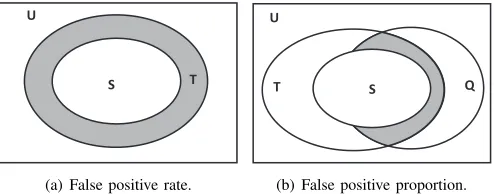
query times. In contrast, FPR is a theoretical term used to quantify the probability of any query result incurs a false positive error. Usually, FPP can be employed as the point estimation of FPR. FPR is a fixed value and determined by the BF framework itself, while FPP is variable and fluctuates around the value of FPR. As shown in Fig. 3, let U be the universal set, S denote the set represented by a BF, Q denote the elements to be queried andT record the elements which return positive for the membership query, respectively. Then the elements which lead to false positive errors can be derived asF=T−S. With the above notations, the false positive rate for all the query of elements in U can be calculated as fr=|F|/|U|=|T−S|/|U|. Pair-wisely, the false positive propor-tion for the query of elements inQis fp=|(T∩Q)−(S∩Q)|/|Q|.
Therefore, to reduce the number of false positives in an instance of BF, we have methods to lower FPR and techniques to control FPP. Reducing FPR means to decreaseT and thusF directly. A brute-force solution to reduce FPR is to increase the number of bits or cells in the vector, with the penalty of more space overhead. But this method doesn’t work in space-scarce situations. Reducing FPR is more general to be extended to diverse scenarios, while decreasing FPP is more specific and case-dependent. For example, for specific instance of BF with givenQ, it is possible to select hash functions which lead to lower FPP. Both the two design philosophies are reasonable.
The intrinsic reason of false positive is that BF arbitrates the membership of an element based on the presence or non-presence of the corresponding 1s, without concerning which element (or elements) fills these hash bits. The bits in the vector, however, may suffer from hash collisions, which may finally cause false positive query results. One may reduce false positives from the following aspects. First, prior knowledge can be helpful when setting the parameters of BF to reduce FPs. Second, the one-sided error property can also identify FPs. Given a main BF and multiple attached BFs, the negative query results in the attached BFs can prone some false positive results of the main BF. Third, if the non-zero bits are reset as 0s, the potential false positive errors will not happen. But this will introduce the possibility of false negative errors instead. Fourth, the hash functions are optional and one may select the hash functions which lead to the least false positives. At last, if the elements are inserted differentially, the hash collisions will not impose false positives to the query result. The details are shown in the following five subsections, respectively.
A. Reducing FP with prior knowledge
Note that, some prior knowledge is helpful to identify some false positives of BF queries and accordingly decrease the resulted FPs. For example, if the elements to be queried (Q) are known as prior knowledge, it is possible for the BF users to select the hash functions which yield the least FPs. A typical scenario whereQ is known is multicast routing based on BF. Actually, BF enables both switch routing and in-packet routing schemes for multicast. For in-switch routing, each interface in the switch uses a BF to maintain the multicast groups it joins. By contrast, in-packet routing embeds a BF in the header of each packet to encode the multicast tree information. The false positives will result in traffic leakage via leading flows to additional nodes which are not in the multicast tree. Multi-class BF [3] and False-positive-free multistage BF [43] are proposed to reduce the FPs of in-switch and in-packet BFs, respectively. Additionally, in the case of web caching, Rottenstreich et al. uncover the Bloom paradox and suggest to insert and query elements selectively based on their priori membership probability. Moreover, the Optihash [69] scheme selects the hash functions which generate the lowest FPP in the context of PSIRP (Publish/Subscribe Internet Routing Parading) systems.
Multi-class BF. For in-switch multicast routing, Li et al. point out that, the presence probability of a multicast group on a certain switch interface can be evaluated via joint consideration of the multicast group size and the data center topology [3]. With this insight, they propose Multi-class BF, a variant of BF to minimize the traffic leakage [3]. They observe that an element with a higher presence probability indicates a lower impact of its false probability on the expected number of falsely matched elements. Therefore, Multi-class BF proposes to employ different number of hash functions for each element to minimize the expected number of falsely matched elements. Specifically, in a switch interface, the groups with higher presence probability are encoded with fewer hash functions, while the groups with lower presence probability should be programmed with more hash functions. In this way, the multicast groups with lower presence probability must check more bits when querying their memberships. In other words, Multi-class BF removes some elements which may lead to false positives with high probability from set T, by setting stricter conditions to pass the queries.
False-positive-free multistage BF (FPF-MBF).As for in-packet multicast routing, Tapolcai et al. devote to solving the scalable forwarding problem, especially the scalability of the multicast trees [43]. To this end, the multistage BFs [70] [71] are employed to record the links in each stage of the multicast tree. A multicast tree ofv hops is represented byv BFs, and the vth BF contains only the links residing atv hop-distance from the source node. When leaving the source, the multicast in-packet BF header consists of v stage filters, which then shrinks as the packet travels along the tree. To this end, each stage BF consists of two parts, i.e., the first γbits to indicate its stage, and the later b bits to record the memberships of links in this stage.
prior knowledge of the number of elements to be included (ρ) and the number of elements to be excluded from the filter (ζ). In effect, FPF-MBF reduces the generated false positive proportion from two aspects. On one hand, unlike the tradi-tional in-packet BFs which record all links in a multicast tree, each stage filter only encodes the links in the corresponding stage. On the other hand, given the value of ρ and ζ, the length of each stage filter is adjusted to further decrease the false positive proportion. Essentially, the design philosophy of FPF-MBF is to reach the goal that (T−S)∩(Q−S)=∅, where Q is the known set of elements to be queried. As a result, all queried elements will not be matched false-positively, and it performs like with a false positive proportion of 0.
Bloom paradox. We consider a generic system composed of a user, a main memory containing all the data, and a cache with a subset of the data. A BF is employed to record the data in the cache. When the user reads a piece of data, he checks the BF first. If the query result is negative, the user will access the main memory directly; otherwise, it goes to the cache instead. However, the positive results can be true or false. For the false positives, the user still needs to access the main memory. Let M, C and T be the elements in the main memory, the elements in the cache, and the elements in main memory that lead to positive result when querying the BF, respectively. We have |T|=|C|+fp∗(|M|−|C|), where fp is the false positive proportion of the BF. The probability that a positive query result is false positive can be evaluated as:
|T|−|C| |T| =
fp∗(|M|−|C|)
|C|+fp∗(|M|−|C|)
. (4)
Given |M|=1010,|C|=104 and fp=10−3, the probability that a positive query result is false positive is almost1−10−3. That is,
among the positive results of the BF for the various elements, most of them are false positives. This phenomena is called Bloom paradox [9].
With the prior knowledge, i.e., the value of |M|, |C| and the parameter setting of BF, one may calculate the condition of Bloom paradox. Rottenstreich et al. suggest selective BF insertion, as well as selective BF query [9]. When inserting (querying) an element, if the element satisfies the Bloom paradox condition, it will not be inserted (queried). Namely, in the scenario of Bloom paradox, the users should not trust the BF such that they will survive the impact of false positives.
Optihash. Optihash [69] is designed to extend the BF in the context of PSIRP (Publish/Subscribe Internet Routing Parading) which is a new redesign of the whole Internet architecture as far as the physical layer [72]. The in-packet BFs are employed as encoding to identify routes and links between nodes. The optihash is a bit array w which consists of three parts: a bit array v and two integer parameters α and β. Only one hash function h is initialized to map each element into the bit arrayv. As depicted in Fig. 4, S is a set of elements (S may be a multiset) encoded in the optihash, the hash function h maps the elements in S to a generally smaller set R. The inverse h−1 maps the set of hashes R to a set of elements which is bigger thanS. LetQdenote the set of elements to be queried, then the set of false-positive elements F can be derived as F=(h−1(R) ∩Q)−S.
Q
h-1(R)
S
R F
[image:8.612.325.555.58.198.2]F
Fig. 4. The theory of Optihash [69]. Its basic insight is to choose a set of transformed hash values which leads to the smallest volume ofF.
Optihash proposes to generate a family of hash values according to the value ofα,βand the employed hash function h. Generally, there will be 2mα2mβ new sets of hash values,
where mα and mβ are the number of bits to store α and β, respectively. Consider that all elements in the setQare known, the user can employ the set of hash values which lead to the smallest volume of F. In this particular manner, optihash decreases the number of elements which cause false positives, at the cost of complicated computation.
B. Reducing FP with the one-sided error
As stated in the subsection II-B, BF suffers from unavoid-able false positive errors during query, but no false negative errors. Namely, the conclusion drawn by BF that an element x is not a member of S is 100% correct. This one-sided error characteristic, indeed, is helpful to identify some false positives from the query results [40] [73] [74] [75].
For example, it has been recently studied that the search performance of trie-based algorithms can be significantly improved by adding a BF [40] to record the nodes in the trie. In such algorithms, the number of trie accesses can be greatly reduced because BF can determine whether a node exists in a trie without actually accessing the trie. However, the false positives of BF bring unnecessary trie accesses. Fortunately, Mun et al. notice that arbitrary node (except the source node) in a trie can only exist if its ancestors are also in the trie [73]. Therefore, they propose to use more BF queries to reduce the false positive proportion of a BF in trie-based algorithms.
When the BF returns positive upon querying an element y, to check it is a false positive or not, the ancestor node of
y, i.e., node z will also be queried. If the BF indicates that
A B
T(S)-(T(A) T(B))
T(A)-T(S) T(B)-T(S)
T(A) T(B)
T(S)
U
(T(A)-A) ꓵT(S) (T(B)-B) ꓵT(S)
S
[image:9.612.321.547.78.111.2]∩
Fig. 5. Set diagram withT(A),T(B)andT(S)for cross-checking BFs and the main BF, with the assumption thatT(A) ∩T(B)=∅[74].
all the elements in the set S, and multiple cross-checking BFs which are responsible to record the elements in several disjoint subsets of S. As depicted in Fig. 5, consider the set S as the union of two disjoint subsets A and B, i.e., S=A∪B and A∩B=∅. In this case, the BF for the entire set S is the main BF, while the BFs for the set AandBare cross-checking BFs to check the false positives of the main BF. A positive result of the main BF for elementxwill be recognized as false positive, if both of the cross-checking BFs return negative query results for x. The underlying basis is that the negative query results of BF are 100% correct, due to the one-sided error characteristic. Theoretically, as shown in Fig. 5, the main BF and the two cross-checking BFs all suffer from false positives. Let T(S),T(A), andT(B)denote the set of elements which return a positive result when querying upon the main BF and the two checking BFs, respectively. By querying the cross-checking BFs, the elements in T(S)−(T(A)∪T(B)) will be identified as false positives. Therefore, with the help of cross-checking BFs, the global false positive rate will be decreased from |T(|SU)−|S| to:
|((T(A)−A) ∩T(S)) ∪ ((T(B)−B) ∩T(S))|
|U| . (5)
The specific value of the false positive rate is further given in [74]. Undoubtedly, the cross-checking BFs requires more queries and more space overhead.
Complement BF. When BF is associated with an off-chip hash table, the hash table can verify the positive results of the BF for S. To reduce the access frequency of the hash table, complement BF [75] is introduced. Unlike the cross-checking BFs which split the setSas multiple disjoint subsets, Lim et al. propose to divide the union setU as two independent subsets, i.e., S and its complement setSC [75]. Typically, a main BF is programmed according to the elements in S, and another BF (complement BF) is initialized to record the elements in the set SC. The complement BF helps to identify some false positive errors since the elements not in SC must belong toS. With this insight, Table III presents the truth table of a query with joint consideration of the main BF and complement BF. Note that, the two BFs will never return negative query result simultaneously, since U=S∪SC and any element not in S must belong to SC. Only if both the main BF and the complement BF return positive when querying an element x, the membership of x will be further checked by the off-chip
TABLE III
TRUTH TABLE OF QUERY WITH BOTH MAINBFAND COMPLEMENTBF.
Main BF forS 1 0 1 0
Complement BF 0 1 1 0
Conclusion x∈S x<S Hash table Not exist
hash table. Consequently, the frequency of hash table access can be significantly decreased from T(S) to T(S)∩T(SC). It has been proven that the probability of both BFs producing positives converges the summation of the false positive rate of each BF [75]. However, in the case of large-scale complement setSC, the complement BF may cost vast on-chip memory.
Yes-no BF. Unlike the previous proposals which remove the elements from the set T directly, yes-no BF keeps track not only the elements belonging to the set S, but also the elements which generate false positives [76]. The yes-no BF is composed of two parts, i.e., the yes-filter which encodes the set elements, and the no-filter which stores the elements which generate false-positives. The m bits in yes-no BF are consequently split into two parts, pbits for the yes-filter, and r×q bits for the r no-filters each of q bits. The yes-filter performs just like a normal BF and record the membership of elements in S. In contrast, the no-filter for the setS tracks the elements which cause false-positives in the yes-filter. Note that, an element can only be stored in one of ther no-filters. When querying, the yes-no BF will conclude that an element x belongs to S, if and only if the corresponding bits in the yes-filter are all 1s and none of ther no-filters indicates x is a false positive. In Yes-no BF, the positive results given by the yes-filter are further tested by the no-filters. Consequently, the number of elements in T can be decreased, but at the risk of false negatives. To reduce the potential false negatives, additional queries must be conducted.
C. Reducing FP via bit resetting
Intrinsically, the false positives appear because BF checks thek1s without distinguishing the elements which are hashed into these positions. As a result, an element can be false-positively matched because its corresponding bits are set to 1s by other elements. Thus, several proposals try to reduce the false positive errors by modulating the bit vector directly. Note that the retouched BF [77] and generalized BF [78] are designed for standard BF, while multi-partitioned counting BF [79] are proposed to reduce the false positive rate of CBF [36]. Retouched BF.Retouched BF is proposed as an extension to make the BF more flexible by permitting the removal of selected false positives at the expense of generating random false negatives [77]. To do so, the selected bits are cleared by resetting from 1 to 0. The authors present two strategies for the clearing. The randomized bit clearing resets a certain number of bits from the bit vector randomly. Theoretical analysis demonstrates that, after executing the randomised bit clearing process, the increment of false negatives and the decrement of false positives are very close [77].
x
1 0 1 0 1 0 0 0
0 1 2 3 4 5 6 7
Level 1
Level 2 0 0 0 8 9 10
Remainder
x
1 0 1 0 1 0 0 1
0 1 2 3 4 5 6 7
Level 1
Level 2 0 1 1 8 9 10
Remainder
y
0
11
0 0
12 13
[image:10.612.60.288.54.143.2]Level 3
Fig. 6. Hierarchical structure in a 16-bit word of MPCBF [79]. Initially, the number of hash functionsk=3, and level 1 has 8 bits which have been initialized as 0.
proposed to trade-off the false positives and false negatives. When removing an element, there are k candidate bits to reset. Thereafter, Retouched BF have: 1) the random selection algorithm randomly selects a bit amongst the k candidates; 2) the minimum FN selection resets the bit which generates the least increment of false negatives; 3) the maximum FP selection chooses the bit which enables the maximum false positive decrement; and 4) the ratio selection prefers resetting the bit which minimizes the generated false negatives while maximizing the false positives removed. With the above strate-gies, Retouched BF reduces FPR at the cost of false negatives. Generalized BF.Generalized BF [78] employs two groups of hash functions, i.e., {g1,· · ·gk0} and {h1,· · ·hk1}. When inserting an element into the bit vector, the k0 bits mapped
by the hash functions {g1,· · ·gk0} are reset as 0, while the k1 bits derived by the hash functions{h1,· · ·hk1}are set to 1 (break the tie by keeping reset). When querying an element x, generalized BF checks whether the bits corresponding to the positions {g1(x),· · ·gk0(x)} are all 0 and the bits
{h1(x),· · ·hk1(x)} are all 1. If at least one bit is inverted, generalized BF returns a negative query result; otherwise, it returns a positive result.
False positive will happen if the {g1(x),· · ·gk0(x)} are all 0, and if the bits {h1(x),· · ·hk1(x)} are all 1, due to the insertion of other elements in the setS. Moreover, it is possible that an element x∈S may not be reported as a member of S, resulting in a false negative. False negative will occur if at least one of the {g1(x),· · ·gk0(x)} bits is set as 1 by the k1 hash functions for another element y, or one of the
{h1(x),· · ·hk1(x)} bits are reset as 0 by thek0 hash functions. Certainly, generalized BF offers rigid constraints to pass the membership query, thus reducing the false positive rate. But it calls for reconsideration when put generalized BF into real use, due to the non-negligible false negatives.
Multi-partitioned Counting BF (MPCBF). CBF [36] extends BF by allowing insertions and deletions to support dynamic datasets. To reduce the number of memory accesses, MPCBF divides the m cells into l words so that each word can be fetched in a single memory access [79]. To insert an element x, an extra hash function he is employed to map
x into one of the l words. Thereafter, the k hash functions
{h1(x),· · ·,hk(x)} map x into k cells in the selected word. This strategy, however, leads to more false positive errors. To reduce the false positives, MPCBF suggests to reconstruct each word as a hierarchical structure.
As depicted in Fig. 6, MPCBF allocates the bits in each word as multiple levels. The basic principle for constructing
the hierarchical structure is as follows. Whenever an element is inserted into the word,k bits must be set from 0 to 1. And whenever a bit is set from 0 to 1, an empty bit should be added into the next level and initialized as 0. This is realized by using a function popcount(i)which computes the number of ones before positioniat the hierarchy level that bitibelongs to. Note that, only level 1 is utilized for membership query. Therefore, the membership in this word can be recorded with 8 bits, instead of 4 cells (suppose that each cell in CBF has 4 bits). As a result, the false positive rate can be significantly decreased at the cost of a little more computation overhead.
D. Reducing FP with selected hash functions
False positive errors are not avoidable for BF and its variants, due to the potential hash collisions. Typically, the false positive rate of BF is proportional to the number of 1s in the bit vector. Based on this observation, endeavours have been made to select proper hash functions for the elements. A typical work is to introduce “the power of two choices” into the design of BF [80]. The basic idea is to employ two (or more) groups of hash functions, and the insertion will utilize the group of hash functions which increase the least 1s in the bit vector. During membership query, if the element passes the checking of any group of hash functions, the query result will be positive; otherwise, negative. The cost is more hash computation and lookups.
Moreover, a partitioned hashing scheme [81] is then pro-posed to further optimize the hash function selection, based on the balls and bins theory. Before insertion, the elements in set S is divided into g independent groups by hashing their keys. Given H hash functions, each group of the elements will be mapped into the bit vector t times for test, where k≤t≤ Hk
. In each test, every element will be hashed ktimes. Thereafter, the set of hash functions which increase the least 1s in the bit vector will be selected. Then, the group of elements will be mapped into the vector with the selected k hash functions. Note that, the hash functions intra a group are independent, but can be dependent inter groups. That is, a hash function is allowed to be shared among multiple groups of hash functions. A greedy algorithm is designed to speed up the selection process. The conducted experiments indicate that the partitioned hashing scheme results in as much as a ten-fold increase in accuracy over standard BF.
Selecting the hash functions is a computation-intensive task, especially when the number of candidate hash functions is large, there are in total Hk
possible combinations. Besides, for dynamic datasets, this kind of methods call for re-selection of the hash functions when the dataset changes. Therefore, selecting khash functions from many candidates suits for the situations where the query accuracy must be guaranteed, while the computation is not an issue and the dataset is static.
Most recently, Kiss et al. propose EGH filter to replace the khash functions{h1,· · ·,hk}with theksimple functions
filter [82]. In other words, given a finite universe set U with
|U|elements, an EGH filter vector withmbits will not suffer from any false positive errors if at mostntelements are stored. The essence of the solution is to use the Chinese Remainder Theorem [83] and solve a combination group testing (CGT) problem [84] by finding a solution to a system of linear congruences. Note that there are strong constraints between the parametersm,|U|,ntandk. Basically,nt|U| should be less than the product result of the first k prime numbers. Then the value of m will be set as the summation result of the first kprime numbers. With the above parameter setting, EGH filter performs the insertion and query just like the standard BF. Furthermore, the EGH filter can be extended to support deletion and listing of the recorded elements.
Definitely, the used functions in EGH filter are determin-istic, fast and simple to calculate, enabling a superior lookup performance compared to BFs. However, the generated false positive free zone is relatively small. For example, an EGH filter withm=2,127andk=34only guarantees a false positive free zone which covers 20 elements from a set with 562 elements. Still, when the number of record elements is larger than the threshold nt, EGH filter may incurs false positive errors. Besides, to maintain the false positive free zone, the bpe in EGH filter is higher than Bloom filter. In the above example, the bpe of EGH filter is nm
t=
2,127
20 =106.35 which
is much higher than standard BF. Therefore, EGH filter is advisable when false positives should be completely avoided, the universe set is finite and the set is small while the available space is relatively large.
E. Reducing FP by differentiated representation
CBF [36] also suffers from false positives, since the counters fail to differentiate the elements mapped into it effectively. Unlike the MPCBF which optimizes the utilization of bits in the counter, variable-increment counting BF [85] and finger-print counting BF [86] seek the ways to reduce FPR with differentiated representations of elements.
Variable-increment counting BF (VI-CBF).Unlike CBFs, when inserting an element, the counters of VI-CBF are in-cremented by a hashed variable increment instead of a unit increment [85]. Then, to query an element, the exact value of a counter is considered, not just its positiveness. The specific insertion operation is shown in Fig. 7. VI-CBF consists of two counter vectors: the first counter vectors to record the number of elements hashed into this position (C1), and the second
counter vectors to provide a weight sum of these elements with diverse increments (C2). A family of hash functions
G={g1,· · ·,gk} are employed to select thek increments from the set D. Note that D={v1,v2,· · ·,vu} is a set of integers such that all the sums vi1+vi2+· · ·+vil with 1≤i1≤ · · · ≤il≤u are distinct. Thereafter, k hash functions {h1,· · ·,hk} map the element into k cells of VI-CBF. Thek counters inC1 are
increased by 1, while the counters inC2 are updated with the
k selected increments, respectively.
To query an element x, VI-CBF first checks the kcounters C1[h1(x)],· · ·,C1[hk(x)]. If any counter is 0, obviously x<S.
If C1(i) is small, VI-CBF considers the exact values in both
5 2 3 3
C1 4
34 26 21 6 26
C2
x y
1 2 3 4 5 6 7 8 9
0
1
3
4
2
3
3
4
0
8
25
29
17
30
9
13
[image:11.612.323.553.54.150.2]8 4 13 4
Fig. 7. An illustrative example of VICBF insertion withk=2and the base setD={1,4,8,13}[85].
counter vectors. In this case, no more than u elements were hashed into these cells. Thereafter, VI-CBF can deduce the employed increments in the value of C2(i). If vgi(x) is con-tained inC2[gi(x)](i∈[1,k]), thenx∈S with high probability; otherwise, x<S. Lastly, if C1(i) is large, VI-CBF holds that
this cell is not useful and examines other cells for possibly eliminating the membership of x. By updating the counters with diverse increments, VI-CBF effectively distinguishes the elements mapped into a cell. It was shown that the VI-CBF has an improved false positive rate than the CBF for fixed number of bits per element (bpe) although it requires more bits per counter allowing having a smaller number of counters.
Fingerprint counting BF (FP-CBF). Different from the VI-CBF, FP-CBF labels the elements with unique fingerprints [86]. To be specific, each cell in FP-CBF consists of two fields, i.e., the fingerprint field and the counter field. The fingerprint hasabits to store the fingerprints mapped into this cell. Note that the fingerprint of an element is generated by employing a hash functionhf p(x)to map elementxinto the range [0,2a]. The counter field counts the number of elements withcbits. To insert an element x, thek hash functions map xinto the cells in positions h1(x),· · ·,hk(x). Thereafter, in these cells, the fingerprint field is updated by executing the XOR operations between the existing fingerprint and hf p(x). By contrast, the counters are increased by 1. To delete an element yfrom the FP-CBF, the corresponding k counters are decreased by 1, while the fingerprint fields are updated by XORing the existing fingerprints in each counter with hf p(y).
To query an element x, if any counter in the corresponding k cells is 0, x<S. For all counters that have a value of
1, FP-CBF checks whether the fingerprint field is different from hf p(x). If so, x<S. Otherwise, if the above two checks
are passed, FP-CBF believes x∈S with high probability. That is, FP-CBF recognizes the false-positively matched elements which have at least one counter value of 1. This is realized by checking the fingerprint in the cell with the fingerprint of the queried element. In effect, the similar design philosophy is also achieved in the literature [20] by Luo et al in order to synchronize two given multisets. The dedicated encoding, subtracting and decoding operations are designed to identify the different elements between the multisets. So that only the different elements are transmitted to save bandwidth. However, imposing fingerprint field to the cells requires more memory.
F. Summary and lessons learned
novel intuitions. They remove or recognize the potential false positives by using prior knowledge [3] [43] [69] [9], selecting optimal hash functions [80] [81], generating multiple BFs [76] [74] [75] and queries [73], resetting the bits [77] [78] [79], or differentially representing the elements [85] [86]. Among these variants, FPF-MBF [43], Optihash [69], strategies to lessen Bloom paradox [9], and Selected hash [80] [81] control the FPP by carefully choosing the hash functions. Other variants, on the contrary, try to decrease the FPR directly. Both of these two design philosophies are reasonable and functional. However, all the above strategies impose either additional memory cost or complicated computation process. In reality, the users may trade-off the impact of false positives and the introduced cost of reducing FPs.
V. OPTIMIZATIONS OF IMPLEMENTATION MEASUREMENTS
BF is a lightweight and easy-deployable data structure. But its performance can be further improved. To this end, the ex-isting desgins consider four practical measurements, including computation complexity, memory access, space efficiency, and energy consumption.
A. Computation optimization
The major computation overhead of BF stems from two folds, i.e., the computation of hash functions and the judg-ment process for a query. BF requires multiple indepen-dent hash functions, while well-designed hash functions are computation-intensive, e.g., MD5, SHA-1. Other hash func-tions, e.g., perfect hash, locality-sensitive hash, are even more complicated to calculate. To lessen the computation overhead due to hash functions, state-of-the-art techniques try to gen-erate multiple independent hash values with only one or two hash functions [87] [88].
Less hashing, same performance. Kirsch and Mitzen-macher [87] use two pseudorandom hash functions h1(x)
and h2(x) to generate additional hash functions.
Specif-ically, the k hash functions will be calculated as: gi(x)=h1(x)+i×h2(x) mod m, where 0≤i≤k−1 and m is the
number of bits in BF. It has been soundly proved that using the generated hash functions imposes no any increase in the asymptotic false positive rate, based on the balls-and-bins analysis [87] [89]. Since then, this kind of method has been widely utilized in practice to accelerate BF and its variants.
One Hash BF (OHBF). Unlike the above strategy which needs two hash functions as seeds, OHBF [88] is more ambitious and generates k hash values with only one hash function. OHBF points out that the hash mapping consists of two stages, i.e., the hash stage which maps the input element into a machine word (e.g., 32 bits, 64 bits), and the modulo stage which maps the generated word into a given range via modulo. Consequently, OHBF divides the m-bit vector as k parts unevenly, such that m=m1+· · ·+mk, where mi is the length of the ith part. Thereafter, the generated word will modulo withm1,· · ·,mk respectively to derive the location of the element x in each part. Similar with the variants which partition the bit vector into multiple segments, OHBF also slightly damages the randomness of the hash function. The
reason is that the result of a hash function is limited in a dedicated range, rather than the overall bit vector. As a consequence, more hash collisions will be triggered thereby leading to a higher false positive rate. Fortunately, when m increases, the gap of false positive rate between the standard BF and the partitioned variants will degrade gradually.
On the other hand, another thinking is to speed up the hash computation, sequent programmes and check operations. A general strategy is to parallelize the computations. In scenarios where the bit (or cell) vector is divided into multiple segments, these segments can be accessed simultaneously thereby the thereafter computations can be parallelized. This kind of variants include Space-code BF [90], Dynamic BF [91], Dynamic BF array [92], Par-BF [93], BloomStore [18], Cross-checking BF [74], One hash BF [88], Bloom-1 [94], OMASS [95], Parallel BF [96], etc. The parallelism strategy can efficiently reduce the response time to 1/ξ, where ξ is the number of parallelized instances. Note that, some variants with multiple segments, on the contrary, cannot be parallelized, since they are designed for sequent checking, e.g., Yes-no BF [76], Bloomier filter [97], Complement BF [75], and Multi-partitioned counting BF [79]. Specifically, the Yes-no BF [76] consists of both yes-filter and no-filter. Only the elements which pass the check of yes-filter will be further checked by the no-filter. Similarly, the Complement BF for the complement setSC only need to be checked if the elementx has passed the check of the main BF for set S. By contrast, the Bloomier filter [97] and Multi-partitioned counting BF [79] cannot be parallelized because the bit vectors in them are constructed recursively.
In the following, we present two other variants which also enable the parallelism methodology with multiple divisions [98] [99], as well as one recent proposal which tries to parallelize the hash computation by employing acceleration technique named Single Instruction Multiple Data (SIMD) instructions [100].
Distributed Load Balanced BF (DLB-BF).DLB-BF [98] is designed for IP lookup (longest prefix matching). Usually, the IP prefixes have different lengths. Based on their lengths, the prefixes are categorized as diverse prefix groups, w.l.o.g., g groups. DLB-BF employs k equal-length BFs, as well as k groups of hash functions, to represent these prefix groups. Note that, each group of hash function hasgindependent hash functions in it. Each hash function in a group is responsible to a specific group of IP prefixes. Specifically, the hash function Hi,j (1≤i≤g, 1≤j≤k) is responsible to map the ith group of IP prefixes into the jth BF. Under this framework, to encode a prefix with lengthi, the k corresponding functions, i.e., Hi,1,Hi,2,· · ·,Hi,k, map the prefix into the k BFs and programme the bits to 1s. Thus the membership information of the inserted IP prefix is dispersedly recorded in thek BFs. To query an IP prefixxwith lengthi, DLB-BF checks the bits generated by the k hash functions (Hi,1,Hi,2,· · ·,Hi,k) in the
k BFs. If all these bits are non-zero, the queried IP prefix is in the routing table and the associated forwarding port can be identified reasonably.
![Fig. 4. The theory of Optihash [69]. Its basic insight is to choose a set oftransformed hash values which leads to the smallest volume of F.](https://thumb-us.123doks.com/thumbv2/123dok_us/8350431.309458/8.612.325.555.58.198/theory-optihash-insight-choose-oftransformed-values-smallest-volume.webp)
![Fig. 5. Set diagram with Tthe main BF, with the assumption that(A), T(B) and T(S) for cross-checking BFs and T(A) ∩ T(B) = ∅ [74].](https://thumb-us.123doks.com/thumbv2/123dok_us/8350431.309458/9.612.321.547.78.111/fig-diagram-tthe-main-assumption-cross-checking-bfs.webp)
![Fig. 6.Hierarchical structure in a 16-bit word of MPCBF [79]. Initially,the number of hash functions k=3, and level 1 has 8 bits which have beeninitialized as 0.](https://thumb-us.123doks.com/thumbv2/123dok_us/8350431.309458/10.612.60.288.54.143/hierarchical-structure-mpcbf-initially-number-functions-level-beeninitialized.webp)
![Fig. 7. An illustrative example of VICBF insertion with kset=2 and the base D={1, 4, 8, 13} [85].](https://thumb-us.123doks.com/thumbv2/123dok_us/8350431.309458/11.612.323.553.54.150/fig-illustrative-example-vicbf-insertion-kset-base-d.webp)
![Fig. 8. The framework of Ultra-Fast BF [100].](https://thumb-us.123doks.com/thumbv2/123dok_us/8350431.309458/13.612.60.289.56.127/fig-the-framework-of-ultra-fast-bf.webp)
![Fig. 9. An example of Forest-structured BF [108] with λ=b=4.](https://thumb-us.123doks.com/thumbv2/123dok_us/8350431.309458/15.612.61.289.57.190/fig-example-forest-structured-bf-l-b.webp)
![Fig. 10. Hash function states in EABF [112].](https://thumb-us.123doks.com/thumbv2/123dok_us/8350431.309458/16.612.57.293.58.164/fig-hash-function-states-in-eabf.webp)
![Fig. 11. The construction of Shifting BF [117].](https://thumb-us.123doks.com/thumbv2/123dok_us/8350431.309458/18.612.57.290.57.130/fig-the-construction-of-shifting-bf.webp)
