AP Chem Lab Techniques and
Analysis Tools Review
2 FRQs based on lab data and experimental
design!
Preparing Solutions
•
Molarities by diluting
•
(you should be able to explain how to make a
new solution and chose the correct tools to
use to make these solutions)
–
Aqueous to aqueous
–
Solid to aqueous
•
ALWAYS measure volumes in pipets, burets or
Example:
Data Analysis
•
If given data from a lab experiment, you should be
able to figure out what experiment was performed
and why. This will help you figure out what types
of calculations you must perform to analyze the
data and answer the questions in the FRQs.
–
Pressure, volume data = gas laws (PV=nRT)
What to do if
Use the last heating mass and figure out what to subtract
from it to determine a mass
(a) Calculate the mass of the blue crystals at the start of the
investigation.
What to do if
What to do if
What to do if
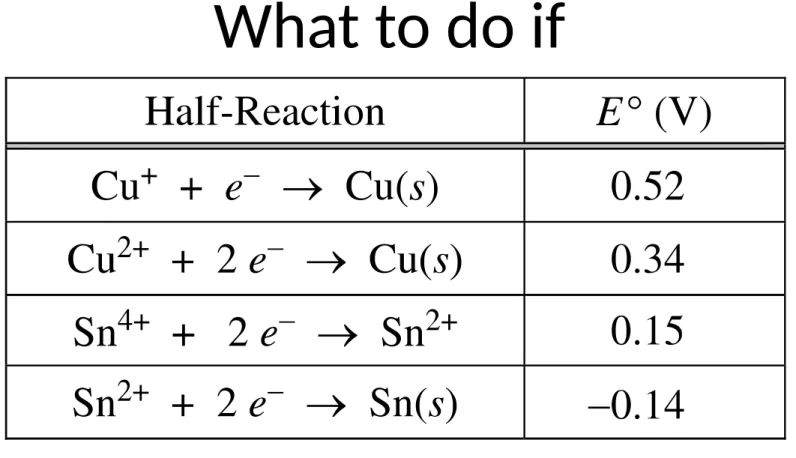
Figure out which will go thru oxidation and which thru reduction.
Remember that the greatest (most positive cell potential) is
reduced at the cathode (red cat) and the lowest (most negative cell
potential) is oxidized at the anode (an ox).
What to do if
What to do if
What to do if
Spectroscopy
•
Many different types, each will be outlined
with an example of data.
•
In a “nutshell” spectroscopy works by utilizing
electrons (sometimes ions) and their ability to
absorb and release energy, this energy can
then be analyzed.
•
Main types
: mass spectrometry, emission
Mass Spectrometry
• Intensity of the peaks
gives us relative %
abundance.
• Which Cl isotope is
more abundant?
Emission Spectroscopy
•
Used to determine energy emitted by
electrons within atoms. Can also be used to
probe electronic structure; also can be used as
a means to identify unknowns since each
Infrared Spectroscopy (IR)
•
IR is associated with transitions in molecular
vibrations and can also be used to detect the
presence of different types of bonds. It is
Photoelectron Spectroscopy (PES)
•
Used to prove existence of the “shell model”
of the atom and electrons residing in regions
of different energy (eg. 1s, 2s, 2p all have
different energies associated with them at
different distances from the nucleus)
•
(You have a PES packet that would be good to
review!)
•
Coulomb’s Law and nuclear charge
are used
Data from PES
•
Peaks with more “Binding Energy” are held
tighter to nucleus than valance electrons.
Intensity of the peaks relates to how many e-
are found in each sublevel.
•
E- tightly bound have more nuclear charge
!! _ !
© 2013 Greenbowe, Pearson.
_ Q!!A%,' * !+1!&$' !51(+48 %&5+1!<4+65* ' * !51!M+* ' 7!" B!)%7)=7%&' !&$' !@51* 51>!' 1' 4>0!%,, +)5%&' * ! ; 5&$!' %)$!' ]' )&' * !' 7' )&4+1!(4+8 !@' 40775=8 Q!!# $5)$!4' N=54' , !8 +4' !' 1' 4>0!&+!' ]' )&!(4+8 !&$' ! %&+8 B!&$' !" , !' 7' )&4+1!+4!&$' !Y, !' 7' )&4+19!!FR<7%51!; $0Q!
!
[ Q!!?(!%!, %8 <7' !+(!@' 40775=8 !)+1&%51' * !+1' !8 +7' !+(!@' 40775=8 B!$+; !8 %10!M' >%^+=7' , !%4' ! 4' N=54' * !&+!4' 8 +6' !+1' !8 +7' !+(!' 7' )&4+1, !(4+8 !&$' !" , !' 1' 4>0!7' 6' 79!!H4+8 !&$' !Y, !' 1' 4>0! 7' 6' 79!
!
J FI !4' 8 +6' , !+170!+1' !' 7' )&4+1!(4+8 !' %)$!%&+8 Q!!!M' %151>B!+1)' !%1!%&+8 !$%,!+1' !' 7' )&4+1! 4' 8 +6' * !5&!5, !T58 8 =1' U!(4+8 !(=4&$' 4!%&&%)O!(4+8 !51)+8 51>!4%* 5%&5+1Q!!: +; ' 6' 4B!, 51)' !&$' 4' ! %4' !@5775+1, !+(!%&+8 , !+1!&$' !, =4(%)' !+(!%1!' 7' 8 ' 1&!+4!)+8 <+=1* !+4!51!%!>%,!<$%,' !, %8 <7' B! &$' 4' !%4' !8 %10!%&+8 , !%6%57%@7' !&+!4%* 5%&' Q!!: ' 1)' B!&$' 4' !%4' !8 %10!' 7' )&4+1, !' ]' )&' * Q!!S$' ! O51' &5)!' 1' 4>0!+(!&$' !' 7' )&4+1, !%4' !8 ' %,=4' * !%1* !&$' !1=8 @' 4!+(!' 7' )&4+1, !' ]' )&' * !; 5&$! , <' )5(5)!O51' &5)!' 1' 4>0!%4' !T)+=1&' * UQ!!!
!
?1!%!J FI !' R<' 458 ' 1&B!&$' !=7&4%.65+7' &!(4' N=' 1)0!+4!&$' !- . 4%0!(4' N=' 1)0!(+4!%!<%4&5)=7%4!4=1! 5, !(5R' * Q!!S$' 4' (+4' B!&$' !' 1' 4>0!+(!&$' !51)+8 51>!4%* 5%&5+1!5, !O1+; 1Q!!!I 51)' !5&!4' N=54' , !8 +4' ! ' 1' 4>0!&+!4' 8 +6' !511' 4!' 7' )&4+1!)+8 <%4' * !&+!6%7' 1)' !' 7' )&4+1, B!&$' 4' !5, !%!* 5((' 4' 1)' !51!&$' ! O51' &5)!' 1' 4>0!+(!%1!' ]' )&' * !' 7' )&4+1!(4+8 !%1!511' 4!' 7' )&4+1!6' 4, =, !%1!+=&' 4!' 7' )&4+1Q!S$' ! @51* 51>!' 1' 4>0!+(!&$' !' ]' )&' * !' 7' )&4+1!5, !)%7)=7%&' * !@0!, =@&4%)&51>!&$' !O51' &5)!' 1' 4>0!+(!&$' ! ' 7' )&4+1!(4+8 !&$' !' 1' 4>0!+(!&$' !4%* 5%&5+1Q!!!!
!
² "9"0! "?@$A5"+$"BC"<"67"&8&.*&, "&1&.*$+)"""; $' 4' !² !5, !&$' !/ %( 0%( . '!( !,. 1!+(!%1!' 7' )&4+1!
!
` !)+8 <=&' 4!<4+>4%8 !<7+&,!&$' !4' 7%&56' !1=8 @' 4!+(!' 7' )&4+1, !6' 4, =, !&$' !A51* 51>!F1' 4>0Q!!A0! )+16' 1&5+1B!&$' !A51* 51>!' 1' 4>0!5, !<7+&&' * !, =)$!&$%&!&$' !7%4>' , &!AF!51)4' %,' , !&+; %4* !&$' !7' (&! 5(!AF!5, !&$' !TRU!%R5, !+4!&$' !$+45K+1&%7!%R5, !%,!, $+; 1!51!H5>=4' !_ Q" Q!!I +8 ' &58 ' , B!&$' !AF!5, !
<7+&&' * !%,!&$' !T0!%R5, U!+4!&$' !6' 4&5)%7!%R5, !%1* !4' 7%&56' !1=8 @' 4!+(!' 7' )&4+1, !<7+&&' * !+1!&$' ! TRU!%R5, !+4!6' 4&5)%7!%R5, Q!!?1!&$5, !)%,' B!AF!51)4' %,' , !(4+8 !&+<!&+!&$' !@+&&+8 Q!
!
H5>=4' !_ Q"!, $+; , !%!J FI !(+4!@' 40775=8 !WV!P