Publication Date: May. 25, 2017 DOI: 10.14738/abr.55.3140.
Semenov, A. S., & Kuznetsov, V. S. (2017). Identification Of Core Indicators Of The Dynamic Efficiency Evaluation Method Of Design Solutions. Archives of Business Research, 5(5), 94-105.
Copyright © Society for Science and Education, United Kingdom
Identification Of Core Indicators Of The Dynamic Efficiency
Evaluation Method Of Design Solutions
Aleksandr Sergeevich Semenov Saint-Petersburg mining university,
Russian Federation;
Vladimir Sergeevich Kuznetsov Saint-Petersburg mining university,
Russian Federation;
ABSTRACT
Optimization methods in mining industry, taking into account the time factor develop abroad from the end of 19 century. However, in the context of policy centrally planned economy development of dynamic methods substantially restrained. In the last decade have developed research in the field of dynamic methods for solving design problems of the domestic mining industry, including a number of official recommendations [1, 2]. However, the formation of a national market economy, especially the contemporary stage of the open mining (particularly complex), the development of mineral resources markets require constant adjustment and improvement of dynamic design techniques of quarries. In the mining industry specific investments, establishing the capital investment is several times bigger than the in manufacturing industries. Dynamic evaluation methods taking into account the time factor can help you determine the value of the investment in time unlike the way economic evaluation methods. Mineral markets there is a tendency for problems with the deterioration of the of economic indicators of development. This is due to the oxygen dissipated rich deposits, increasing depth development, involvement in the development of minerals with lower quality involved and content of useful components, to be found in the more difficult geological and location conditions. Investment opportunities of the development mineral-raw materials base have significant limitations, the result of which is a disproportion between the mining, metallurgical or processing capacity.
Keywords: Risk, management, design, solution, quarry, decision-making project, risk analysis, dynamic evaluation methods, economic indicators
INTRODUCTION
More comprehensive development and utilization of mineral resources located in the sphere of influence of planned and produced by mining, is achieved with a comprehensive design and development of complex fields [5, 6]. To expand the area of deposits, which are economically feasible, open cast mine, you must shoot seek to increase the proportion of the total mineral rock quarries; inclusion of new sources of mineral resources, such as off-balance sheet reserves, overburden-passing fossil, mineral processing waste; not previously retrieved accompanying climbed components.
With the continued performance career on minerals appears to reduce the sinking rate, increase exploitation term deposits if necessary and reduce the operational stripping ratio.
Involvement in the development of associated minerals, with unchanged performance career on a mountain mass, lets you increase the performance of the quarry for commodity products and mineral resources, increase the possible depth career, mineral reserves.
The basis of the dynamic method is to identify the following key indicators [2, 9, 10]:
1. Net present value (NPV), sold at the market of mineral raw materials for the whole period of refining the extracted minerals deposits or learned useful components;
2. Rate of return or internal rate of return (IRR) for the implementation of the project of open-cast.
3. The payback period of investment (PBP).
METHODOLOGY
Accounting for changes in the value of investments in time sponsored by using the discounting factor serving to bring economic indicators, dating to the same time
(
)
nn i
q− −
+
=1 , (1)
q-n - discounting factor (discount);
i - interest rate (interest);
n - sequence number of the year evaluation.
To determine the net present value (NPV), realizing the mineral market, for the entire period of refining and of extracted minerals or minerals extracted, net current profit-net cash flow(NC - net cash flow) to discount taking into account that the interest rates (interest rate (i)), and the total investment (I) shall be deducted from the amount of discounted net current profit.
Thus, in a general form for career where one kind of mineral is extracted (uniform deposit) ) ( ) ( 1 1 n N n j N j j
c NC q I q
NPV С − = − = ⋅ − ⋅ =
∑
∑
ω ωω , (2)
j ∈ k1 , ω∈ k2,
k1 = {1,2,3,…, N} - the duration of the practicing quarry, years;
k2 = {1,2,3,..., Nc} - investment duration, years;
qj-n - discounting factor of net current profit in j-th year;
q-n
ω - discounting factor of investment in ω-th year;
NCj - net current profit from development of career in the j-th year, after accounting for
interest rate payments and taxes; Iω - the value of investments in ω-th year.
Investment can take place prior to the commencement of the maintenance period and in this case equation (2) will take the following form
(
)
∑
∑
= ʹ − ʹ = ʹ ʹ − ⋅ − ⋅ = ʹ N j n j t j j n jj q I q
NC V
NP
1 0
URL: http://dx.doi.org/10.14738/abr.55.3140. 96 j/ = (1,2,...,n/ ) - sequence number year of investing before the start of the maintenance period in his career;
t - investment duration, years.
When developing complex deposits net present value of the project realization career
∑∑
∑
∑∑∑
= = = = =
− −
=
⋅
−
⋅
=
r
f d
z
r
f d
z N
n zf zf n
jzf N
j
jzf c
С
q
I
q
NC
NPV
1 1 1 1 1 1
)
(
)
(
ω
ω
ω (4)
f ∈ k1 , z ∈ k2 , j ∈ k3 , ω∈ k4
k1 = {1,2,3,...,r}, k2 = {1,2,3,...,d}, k3 = {1,2,3,...,N}, k4 = {1,2,3,...,Nc},
k1 = {1,2,3,...,r } - the number of minerals mined in the quarry;
k2 = {1,2,3,...,d} - number of useful components, derived from one type of mineral being mined in the quarry;
k3 = {1,2,3,...,N} - the duration of the career, years; k4 = {1,2,3,..., Nc } - duration of investment, years;
NCjzf - net current profit from realization of z-th useful component extracted from f-th kinds of ore extracted in a career in the j-th period;
q-njzf = (1+i)-n - discounting factor of net current profit z-th useful component extracted from f-th kinds of ore extracted in career in f-the j-f-th period;
q-n
ωzf = (1+i)-n - discounting factor in investment ω-th year in obtaining z-th useful component
extracted from f-th kinds of ore extracted in the quarry; i - interest rate (interest);
Iωzf - the value of investment in design, construction and operation of a career in the ω-th year
to obtain z-th useful component extracted from f- th kind of ore.
Net present value (NPV) shows potential investors the value of investments in the development of the field, to which have not yet been developed, taking into account the following factors:
• the amount of total investment in design, construction and operation quarry, developing the deposit;
• individual annual net current profit, defined as channeled by current profit after taxes and a possible discount rate (interest rate);
• year (nj) determine the present net current profit;
• the risk inherent in choosing investment interest rate (interest rate).
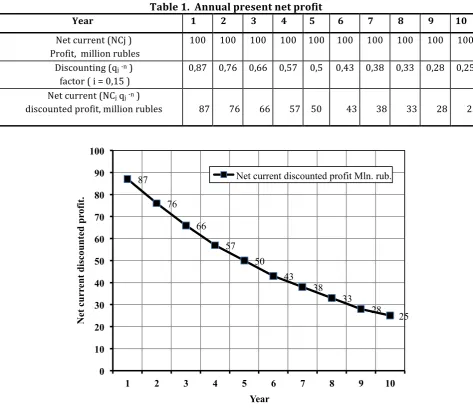
In table 1 and figure 1 is an example of the calculation of the net present value for the project, with the largest one-time career summary of investments in mining, held immediately before the commencement of construction career Ic = 430 million rubles and equal values of annual net current profit.
Under the net present value career development project refers to the economic cost of the project, calculated by summing the costs and revenues that its implementation would bring during the time of its functioning, and subtracting that amount from the last first.
take into account simultaneously the internal rates of return of the project. For the considered example the net present value of project
(
)
=(503 -430)106=73million rubles10 1 ∑
= −
− ⋅
=
j Ic
n j q j NC NPV
Therefore, if the investor expects to make money on interest rate 15% of your capital, it should evaluate the project in 73 million. rub. before you make an investment. The net present value of the implementation of the project depends mainly on the size of the interest rate which developed mining countries usually does not exceed 15% for open mining.
Table 1. Annual present net profit
Year 1 2 3 4 5 6 7 8 9 10
Net current (NCj ) Profit, million rubles
100 100 100 100 100 100 100 100 100 100
Discounting (qj -n ) factor ( i = 0,15 )
0,87 0,76 0,66 0,57 0,5 0,43 0,38 0,33 0,28 0,25
Net current (NCj qj -n )
discounted profit, million rubles 87 76 66 57 50 43 38 33 28 25
Figure 1. Change in the time schedule of net current profit
As a rule, the Government's level of commitment is chosen as a long-term investment with minimal risk. If the obligations represented 10% interest rate, the discount factor for this project must be at least 15% to compensate for the risk of involving career in operation [5].
Results you are presented in the table 1, show that the discounted net current profit through the 10 years will be evaluated only in 29% of the first year. While developing a career in 25 years, with a fixed interest rate of 15%, the last 5 years (20% of the total duration of the construction) will make up only 3% of the total net current profit.
87
76
66
57 50
43 38
33 28
25
0 10 20 30 40 50 60 70 80 90 100
1 2 3 4 5 6 7 8 9 10
N
et c
u
rr
en
t d
is
cou
n
te
d
p
rofi
t.
Year
URL: http://dx.doi.org/10.14738/abr.55.3140. 98
For mining projects in our country, in the case of foreign financing, interest rates can exceed 30%. Norm for discounting and interest rate on investments do not always coincide. In the midst of the crisis phenomena in the economy and high inflation in determining the discount rules, you can navigate to the deposit rate in the most stable foreign currency (Euro or United States dollar).
Receipt of annual current profit equal during the assessment allows simplify calculations using annual factor present value - annuity factor (bn) [6, 7, 8]
(
1)
(5)1
− −
=
q n q
n q n b
q = 1 + i .
Thus, the formula 2 can be represented
NPV=CF ⋅bn -I , (6)
CF - annual current profit (cash flow) from deposit, rubles
Consider the method for determining the rate of return of the project careers in justifying investments in building career. Let's say, for open-cast mining of ore deposits needed to attract investments in the amount of I = 500 million rub. Deposits of ore reserves and demand on the market for this type of mineral raw material allows to estimate the time in 12 years. Define the net present value of the project realization with knowledge of exclusions career interest rate 10%, 20%, 30% and the net current profit per annum equal NC = 120 million rub. Investments are held just before the start of lump sum construction career.
1. Determine the amount of the annuity factor, when n = 12 years, according to the formula 6
for i = 0,1
(
1,1 1)
12 1 , 1
1 12 1 , 1 1
− −
=
n
b = 6,81 ;
for i = 0,2 bn2 = 4,44 ;
for i = 0,3 bn3 = 3,19 .
2. Determine the value of the net present value of the project realization careers for different values of the interest rate
for i = 0,1 NPV1 = 120 ⋅ 6,81 - 500 = 317,2 million rubles
for i = 0,2 NPV2 = 120 ⋅ 4,44 - 500 = 28 million rubles
for i = 0,3 NPV3 = 120 ⋅ 3,19 - 500 = - 117,2 million rubles .
3. Building plot of the net present value of the project realization of career interest rates figure 2.
The magnitude of the project rate of return is determined by the total equity net present current profit (in some cases present gross current profit) largest summary of investment: (at unequal annual CF)
(
)
(7)1 1 ∑ = − ⋅ ∑ = = − ⋅ N j n q С N I n j q j NC ω ω ω
(at equal annual CF)
CF ⋅ bn = I , (8)
bn - annuity factor.
When the project has uneven annual current profit value, rate of return cannot be calculated directly, but must be determined through an iterative process.
Figure 2. Diagram of dependence of net present value of the project realization of career interest rate
In the table 2 provides an example of the calculation of discounted net current profit for the project career, for i = 0.2. Investments in the amount of I = 280 million rub. held just before the start of lump sum construction career.
The data presented in table 2 permit to determine the rate of return of the project career
(
)
∑
= − ⋅ 8 1 j n j j qNC = 305,0 million rubles
(
)
∑
= − ⋅ − 8 1 j n j j q NCI = 280 - 305 = - 25 million rubles
317.2 41 -117.2 -150 -100 -50 0 50 100 150 200 250 300 350
10 15 20 25 30
URL: http://dx.doi.org/10.14738/abr.55.3140. 100
Table 2.Annual net profit project present career when i = 0.2.
Year 0 1 2 3 4 5 6 7 8
Investment (I), million rubles 280
Net current (NCj) profit, million rubles 65 95 90 85 80 75 70 65
Discounting (qj-n) factor (i = 0.2) 0,83 0,69 0,58 0,48 0,4 0,34 0,28 0,23
Net current (NCj qj-n) discounted
profit, million rubles 53,9 65,6 52,2 40,8 32 25,5 19,6 15,3
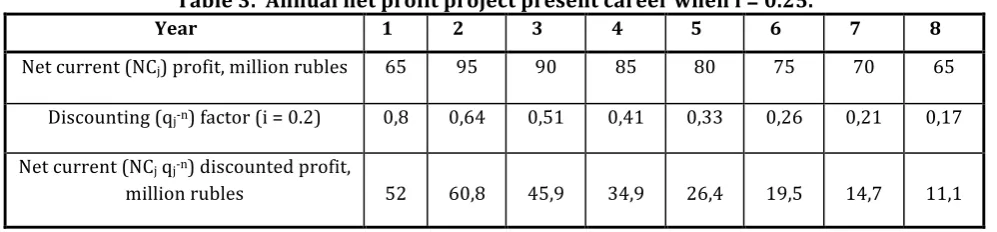
Thus obtained a negative result and net current profit may not be discount further, therefore, as a next step, take a larger interest rate, i = 0.25. In the table 3 presents the results of a calculation of discounted net current profit at i = 0.25.
Based on the results of the calculations presented in the table 3 determine the rate of return of the project career when i = 0.25.
(
)
∑
=
−
⋅ 8
1
j
n j j q
NC = 265,3 million rubles
Therefore,
∑
(
)
=
−
⋅ −
8
1
j
n j j q
NC
I = 280 - 265,3 = + 14,7 million rubles , equality has a positive.
In this case the net present profit to discount too much.
Table 3. Annual net profit project present career when i = 0.25.
Year 1 2 3 4 5 6 7 8
Net current (NCj) profit, million rubles 65 95 90 85 80 75 70 65
Discounting (qj-n) factor (i = 0.2) 0,8 0,64 0,51 0,41 0,33 0,26 0,21 0,17
Net current (NCj qj-n) discounted profit,
million rubles 52 60,8 45,9 34,9 26,4 19,5 14,7 11,1
Project rate of return is determined when performing equality
(
)
∑
= =
− ⋅ − N
j
n j q j NC I
1 0
For the project rate of return of the project lies between 20 and 25%. A solution might be found simple interpolation both graphically and analytically.
Rate of return for the project, the open development of the field is determined by the sum of the discounted net current profit, equal to the largest investment in the project.
operating costs and communication costs pits perhaps the assumption of their permanence in time of construction career, until the project discontinued productivity.
The interest rate, and as a result taxes always are unevenly distributed by operating time career, so inevitably the assessment project career involved uneven annual current profit. However, if we assume the magnitude of annual profit from the production activities of fourteen permanent, the rate of return can be determined from the expression
c n
OP I
b = , (9)
OPС - profit from production activities (conditionally net profit);
bn - annual present value factor-factor rents.
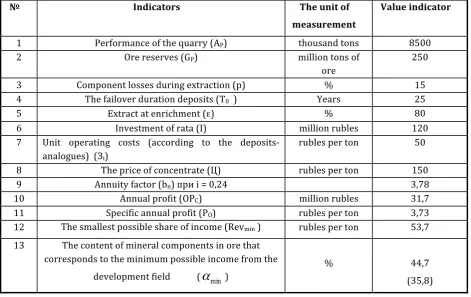
Consider the methods of determining the lowest possible (edge) medium mineral constituents in the ore, providing necessary under the terms of the mineral market rate of return of the project. Consideration of this technique feasible to assess the real example of ore deposit.
Evaluation procedure methodically following may be adopted:
1. Defines the possible annual performance according to the ore-career (АР)
o p p
T p G
A = ⋅ ʹ , (10)
2. Annual present value factor (for i = 0.24) is determined by the formula (5) 3. Annual profit from production activities (formula (9)).
4. Specific annual profit
т
„ o
А мт
P = , rubles per ton (11)
5. The smallest possible share of income, taking into account the boundary of operating costs covering operating costs and provides the necessary profit
Revmin = P0 + Зi , rubles per ton (12)
6. The content of mineral components in ore that corresponds to the minimum possible income from the development deposit,
Ц
vmin min
Re
=
α , (13)
7. When retrieving the enrichment process ε ,ore at the site of occurrence should have the
minimum possible content (
α
minʹ ), providing a minimal profit and economic feasibility of opencast
ε α αminʹ = min
URL: http://dx.doi.org/10.14738/abr.55.3140. 102
Table 4. Baseline data and results indicators to determine the lowest possible average mineral constituents in the ore.
№ Indicators The unit of
measurement
Value indicator
1 Performance of the quarry (АР) thousand tons 8500
2 Ore reserves (GР) million tons of
ore
250
3 Component losses during extraction (p) % 15
4 The failover duration deposits (T0 ) Years 25
5 Extract at enrichment (ε) % 80
6 Investment of rata (I) million rubles 120
7 Unit operating costs (according to the deposits-analogues) (Зi)
rubles per ton 50
8 The price of concentrate (Ц) rubles per ton 150
9 Annuity factor (bn) при i = 0,24 3,78
10 Annual profit (ОРС) million rubles 31,7
11 Specific annual profit (РО) rubles per ton 3,73
12 The smallest possible share of income (Revmin ) rubles per ton 53,7
13 The content of mineral components in ore that corresponds to the minimum possible income from the
development field (
α
min )% 44,7
(35,8)
RESULT
Described method allows fast enough to take the following decisions:
• on the feasibility of developing an deposit in this average content of useful components in ore;
• about the size of the possible changes in productivity and boundaries to ensure profitability quarries design with low content of useful components.
By analogy to the technique, maybe the definition of the minimum possible, economically expedient performance career for fixed content of minerals in the ore deposits under development.
Among professionals in the mining industry, designers extended fairly dismissive attitude to mining taxes. However, in the context of a market economy, taxes are a heavy burden in expensive parts of the mines affecting the results justify the investment in construction careers.
High taxes on mineral content in extracted ore must be greater than low taxes or lack thereof. Often the subsoil rents payable regardless of profits, is a significant cost element largest career, this applies particularly to energy (e.g., coal).
lump-sum payments for the right production, for environmental pollution, for reproduction of mineral-raw-material base.
To encourage investments in new mines should impose taxes, which encourages investment, increase or accelerate the rate of depreciation. All major mining countries carried out deductions for exhaustible minerals. The amount of rent for the bowels should be determined by the national mining law. To predict the level of taxes on enterprises and deposits-equivalents should access national mountain legislation that provided the consulates and embassies of foreign countries.
THE DISCUSSION OF THE RESULTS
When designing career, most of the original data is stochastic in nature, including rules and tax payments. If the project starts to be interesting only because there are tax concessions or loopholes in the tax laws, sharply increases the risk of financial and economic decisions on the likelihood of profit from the development.
May reduce tax expenditures deductibility of certain parts of the capital investment of the basic tax rules, i.e. depreciation. Depreciation rates are developed mining countries part of tax legislation, as a rule, these data in detail can be obtained from the above-mentioned sources and publications.
There are two main method of determining depreciation-calculation of linear and non-linear depreciation:
a) If you define straight-line depreciation total investment in mining should be divided by the number of years in the period of depreciation. The result is the annual depreciation rate.
b) when calculating the nonlinear depreciation (depreciation with reduced balance sheet)
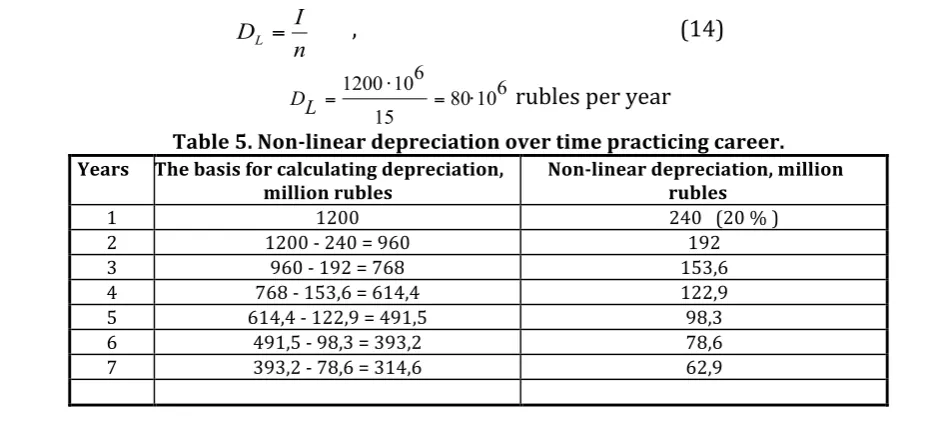
the depreciation rate is decreasing from year to year, table 5.
For example, consider the total investment in mining in the amount I = 1200 million rubles. Depreciation rate D = 20%, with the declining balance. Annual depreciation values develop along progressive depression, table 5.
If straight-line depreciation and the same source data (for n = 15 years practicing career) depreciation rate
n I
DL = , (14)
6 10 80 15
6 10 1200
⋅ = ⋅ = L
D rubles per year
Table 5. Non-linear depreciation over time practicing career. Years The basis for calculating depreciation,
million rubles
Non-linear depreciation, million rubles
URL: http://dx.doi.org/10.14738/abr.55.3140. 104
The data presented in the table. 5 show that nonlinear depreciation the first five years the amount of depreciation more than linear. As noted above, current profit in the first years of operation of the quarry is especially powerful effect across the economy project. Higher depreciation reduces the costs of depreciation and thus increase the net current profit (NC) improves the economic performance of the project. Because nonlinear depreciation never reaches 100%, then the residue depreciation was postponed to the last year of the operation of the quarry.
Another important aspect of holding investments in building career justification is a form of financing design, construction and development of career. Equity ratio (equity) to borrowed funds is the utilization of the funds borrowed [10, 11]. To analyze the impact of funding
modalities to assess the feasibility of developing the following example we use the: Project open pit mining has a rate of return IRR = 15% for the whole period of refining offshore. The ratio of its own (equity) capital to borrowed funds taken as (1/3) k (2/3) and interest payments only 10%. The difference between 15% interest (interest rate) and 10% perspiration spent to service loan funds earned in this case is added to the equity. Thus have increased the triumphs of rate of return (IRR) approximately (2 (5%) = 10% to 25%. Leverage ratio may also have the effect of reserve. If the project has a low rate of return, such as 6%, with 2/3 leveraged funding and 10% interest, the interest must be paid, despite this low level. The difference (I-IRR) = 10-6 = 4% should be deducted from equity (1/3 of the total capital). Therefore, the rate of return of the native (equity) capital approximately can be defined as 6-(2 (4) =-2%, i.e. project can be estimated as the loss in data conditions in different contexts.
CONCLUSION
The following example shows that the variation coefficient of leverage can significantly improve the economic performance of their own (equity) funds. In special cases (when the proportion of equity approaching zero) it is possible to achieve infinitely large values for the coefficient of use of borrowed funds, provided that the project rate of return (IRR) is greater than the cost of borrowed funds. It is therefore advisable to calculate the original rate of return (IRR) without IP coefficient of use of borrowed funds. If the implementation of a mining project on a 100% funded by equity, the computation of the rate of return on equity is not necessary.
References
Arsentiev, A.I., Performance quarries. Saint-Petersburg: State mining institute(technical university, 2010. pp: 85. Burenina, G., analysis of the risks of industrial enterprise. Saint-Petersburg: SPBGUEF.. 2009.
Kerzner, H., Project management a systems approach to planning, scheduling, and controlling. New York: John Wiley. 2009.
Kruk M.N. ,Nikulina A.U. Economic estimation of project risks when exploring sea gas and oil deposits in the Russian arctic / International Journal of Economics and Financial Issues, № 6, V 2, 2016, pp. 138 - 150. A Guide to the Project Management Body of Knowledge, (2010). In Project Risk Management (Vol. 11). Project Management Institute. ISBN: 1933890711
Surface and underground mining. (2013). In Bureau of Mines cost estimating system handbook (p. 631). U. S. Bureau of Mines.
Meredith, J.. & Mantel, S. Project management a managerial approach (8th ed.), Hoboken. N.J.:Wiley. 2012, 589. ISBN: 0470533021, 9780470533024, LCCN: 2011292704
Hill J.H. Geological and economical estimate of mining projects. London.1993
Semenov A. S. ,Kuznetsov V. S. Assessment of level of risk in decision-making in terms of career exploitation / International Journal of Economics and Financial Issues, № 5, V 1, 2016. pp. 165 - 172.