Novel method for hurricane trajectory prediction based on
data mining
X. Dong and D. C. Pi
College of Computer Science and Technology, Nanjing University of Aeronautics and Astronautics, Nanjing, China Correspondence to: X. Dong ([email protected]) and D. C. Pi ([email protected])
Received: 26 March 2013 – Published in Nat. Hazards Earth Syst. Sci. Discuss.: 11 September 2013 Revised: – Accepted: 11 November 2013 – Published: 10 December 2013
Abstract. This paper describes a novel method for hurri-cane trajectory prediction based on data mining (HTPDM) according to the hurricane’s motion characteristics. Firstly, all frequent trajectories in the historical hurricane trajectory database are mined by using association analysis technol-ogy and their corresponding association rules are generated as motion patterns. Then, the current hurricane trajectories are matched with the motion patterns for predicting. If no association rule is found for matching, a predicted result ac-cording to the hurricane current movement trend would be returned. All experiments are conducted with the Atlantic weather Hurricane/Tropical Data from 1900 to 2008. The ex-perimental results show that if the matching failure part is contained, the prediction accuracy is 57.5 %. Whereas, the valve would be to 65 % provided all matches are successful.
1 Introduction
With the rapid development of Word Wide Web (WWW) and wireless communication technologies, mobile communica-tion and mobile computing technologies have been widely used in various fields. Mobile communication equipment, an-imal migrations, traffic and transportation and clouds clus-ter tracking are all moving object instances in specific ap-plication areas (Morzy, 2007). Some correlative technolo-gies, such as sensor networks, global positioning systems and satellite data services collect and provide a large amount of behavioural data of moving objects, which have brought huge challenges to analyse their inherent regularities. The mobile path prediction has become a hot topic in many re-search areas.
Hurricanes are tropical cyclones with sustained winds of at least 64 kt (119 km h−1, 74 mph). On an average, more than 5 tropical cyclones become hurricanes in the United States each year causing great human and economic losses (Su et al., 2010). In respect to this fact, the trajectory prediction as the most important measure to reduce losses has become a hot issue in the field of mobile path prediction.
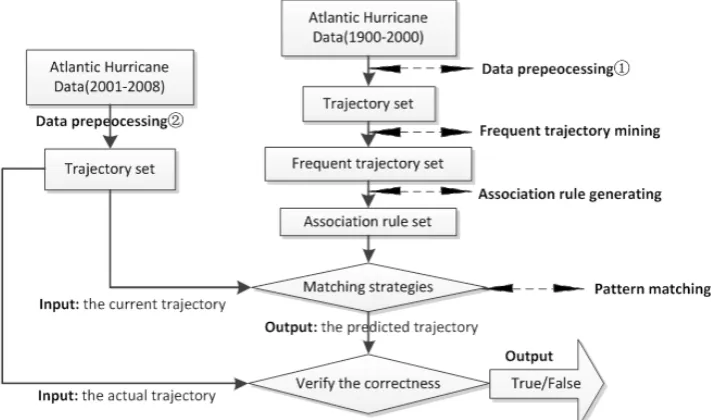
In this paper, we emphasise on the study of a hurricane tra-jectory prediction method based on data mining. The predic-tion method we propose gives up the complex modelling pro-cess in the traditional objective forecast method. Instead, it identifies the effective motion patterns in the historical trajec-tory database by using association analysis technology, and then predicts their future trajectories with pattern matching. The overall framework of the hurricane trajectory prediction method is shown as Fig. 1. After data pre-processing, all fre-quent trajectories from 1900 to 2000 in the historical hur-ricane trajectory database are mined according to the given minimum support and then generate all corresponding asso-ciation rules as motion patterns. Secondly, the current hurri-cane trajectories from 2001 to 2008 are matched with the mo-tion patterns for predicting. If no associamo-tion rule is returned, the one according to the hurricane current movement trend would be returned. At last, the correctness of this method would be verified.
Instructions
Data preprocessing 1: the data in this stage is for fre-quent trajectory mining.
Fig. 1. Prediction system framework.
2 Related work
According to different behavioural characteristics of moving objects, many new ideas for mobile path prediction with data mining are constantly emerging.
The one based on association analysis is concerned by more and more researchers. Zhao et al. (2008) proposed a mobile device location prediction algorithm MPP based on the AprioriAll algorithm, which avoids the state space expan-sion problem in K order Markov predictor. Long et al. (2009) proposed an effective and simple trajectory prediction algo-rithm (E3TP), which mines frequent path model based on FP-Growth algorithm, and introduces speed, one of the most important characteristics into it. Otherwise, FP-Growth re-quires large storage space. So the effect is not very ideal in the case of a large amount of data. Moreover, E3TP is appro-priate for unordered sequences, not for ordered time series. Kim et al. (2007) proposed a novel method for predicting a future path of an object in an efficient way by analysing past trajectories whose changing pattern is similar to that of a current trajectory of a query object. However, this method is only adapt for the road network, and has many limited conditions. Morzy (2007) mines the database of moving ob-ject locations to discover frequent traob-jectories and movement rules, and then matches the moving object trajectory with the movement rule database to establish a probabilistic model of object location.
Hurricane is a kind of strong and deep tropical cyclone generated in the Eastern Atlantic and the North Pacific re-gion, also known as typhoon, cyclone. Hurricane movement is regarded as disengaged motion, which is generally ac-companied by strong wind and heavy rain. For a long time,
the formation of hurricane has been concerned by many researchers in various disciplines (Rozanova, 2004). Much progress has been made over the last decade in the un-derstanding of physical processes and the quality of oper-ational prediction of hurricane (Chan, 2005; Weber, 2005). The present prediction methods mainly include the numeri-cal prediction, the objective forecast and the comprehensive forecast, where the objective forecast method based on sta-tistical dynamics, due to its higher precision, has been more and more popular in recent years. Currently, the objective forecast method is commonly used in the hurricane trajec-tory prediction:
1. Persistence and Climatology Method (i.e. PC method). It is one of the most widely used forecast methods, which has the advantages of simple calculation and high prediction precision.
2. Integrated Forecast Method. It is a comprehensive forecast method, which is integrated by many tech-niques’ calculations, such as stepwise regression, multiple regression, stepwise multilevel discriminant, analysis of variance, fitting error analysis, autoregres-sive, etc. This method has a so short running time and can forecast many items.
3. Probability Forecast Method. It includes some tech-niques, such as REEP, discrete likelihood estimation, uncertain consumption, Bayesian, Markov chain expe-rience statistics, etc.
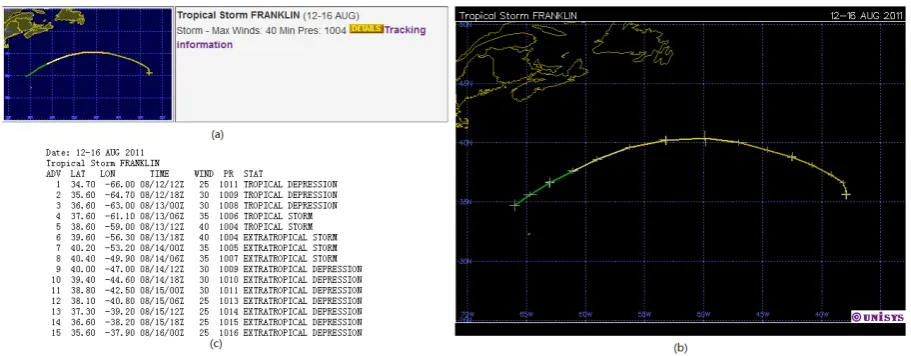
Fig. 2. A certain hurricane. (a) the summary information; (b) the schematic diagram of its trajectory; (c) the trajectory information.
assumptions for the understanding of the underlying phys-ical process, to simplify the complexity of the original sys-tem, often ignore some important properties (Rozanova et al., 2010). For example, due to using multiple regression analy-sis, PC method should select predictors from many factors according to the F value to construct prediction model. How-ever, these selected predictors inevitably affect the prediction model itself.
Therefore, some researchers begin to use data mining tech-nology to predict hurricanes trajectories. Zou et al. (2008) established a model, which is developed based on the simi-larities of key points on typhoon tracks to forecast typhoon tracks using historical data. The centres of active typhoons are compared with historical records of similar typhoons. The typhoon tracks are weighted based on their similarity. The centre positions are then quickly forecasted based the similarity weights. Kim et al. (2011) introduced the feasi-bility of a straightforward metric to incorporate the entire shapes of all tracks into the fuzzy c-means clustering method. This method is suitable for the data where cluster boundaries are ambiguous. Kim et al. (2012) proposed a seasonal tropi-cal cyclone forecast model based on the tracking mode. This model combines fuzzy C-means clustering method with sta-tistical dynamics. In addition, some concepts, such as grey theory, neural network, etc. are also introduced into the hur-ricane weather forecast.
Others are committed to examine the problem of forecast-ing the intensification of hurricanes usforecast-ing data minforecast-ing tech-niques, and have got some achievements. Su et al. (2010) proposed a new hurricane intensity prediction model, WFL-EMM, which is based on the data mining techniques of fea-ture weight learning (WFL) and Extensible Markov Model (EMM). Chatzidimitriou et al. (2005) formulated tropical storm intensification prediction as a supervised data mining problem; the objective being to produce accurate early warn-ings with respect to changes in wind speed of a particular
storm. They examined two alternative approaches to discover classification rules on current hurricane data: particle swarm optimisation and class association rules.
3 Region discretization
The raw hurricane trajectory data is the Atlantic weather Hurricane/Tropical Data (1900–2008), got from the website http://weather.unisys.com/hurricane/. The data from 1900 to 2000 is used to mine the motion patterns, and the rest is for predicting and verifying.
Figure 2 shows the raw information of a certain hurricane. Unfortunately, the domain of position coordinates is contin-uous and the granularity level of raw data is very low. There-fore, any pattern discovered from raw data cannot be gen-eralised. To overcome this problem we choose to transform original paths of moving objects into trajectories expressed on a coarser level (Morzy, 2007).
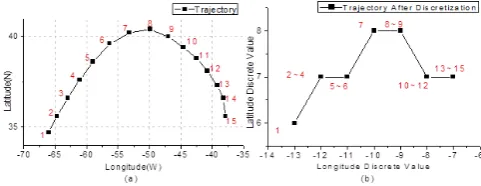
The moving region can be divided into many square ar-eas with same size. Each trajectory is converted to an area sequence.
Fig. 3. An original path of a moving object.
4 Frequent trajectory mining
The pseudo code for the HTPDM algorithm is given in the annex for a transaction database TD, a support threshold of minsup and a confidence threshold of minconf. Frequent tra-jectory mining as the first step is to mine all frequent trajec-tories based on the Apriori algorithm, according to the user-defined minimum support threshold.
The Apriori algorithm (Agrawal and Srikant, 1994) is a classical algorithm for association rules mining. The name of the algorithm comes after a prior knowledge about fre-quent itemsets was used. The prior knowledge is that any non-empty subset of a frequent itemset is also frequent. Apri-ori algApri-orithm uses a level-wised and iterative approach, it first generates the candidates then test them to delete the non-frequent item sets. Most of previous studies adopted an Apriori-like candidates generation-and-test approach. The hurricane trajectory is different from the traditional item sets, but a time series that change with time (Qin and Shi, 2006). The frequent trajectory mining problem from single series can be viewed as the mining problem of sequential patterns. Before introducing the algorithm, we first give some related concepts.
Trajectory length. The length of the trajectory t1 is the number of elements < lat, lon > in the trajectory sequence, denoted|t1|or length (t1). We refer to a trajectory of length
xasxsequence. Whenxequals one, the trajectory is called unit trajectory, i.e. 1 sequence.
Adjacent unit trajectories. Lett1= {P1},t2= {P2}be unit trajectories. If the square regions they represent share an edge, or at least one of the sequences{P1, P2}and{P2, P1} is the sub-trajectory of a certain trajectory,t1andt2would be said to be adjacent.t1andt2can be merged into a 2-sequence trajectory, denotedt1∧t2= {P1, P2}ort2∧t1= {P2, P1}.
Trajectory connection. Lett1=
P11, P21, P31, . . .Pk1 , t2=
P12, P22, P32, . . .Pk2 be two non-unit trajectories with same length. If the laterk−1 items oft1and the formerk−1 items oft2are identical, i.e.P21, P31, . . .Pk1 =P12, P22, . . .Pk2−1 ,
t1 andt2 can be connected. The connection oft1 andt2 is denotedt1||t2, i.e.t1||t2=P11, P21, P31, . . .Pk1, Pk2 .
Fig. 4. The trajectory after discretization.
Support of trajectory. Given a database of trajectories TD ={T1, T2, . . ., Tn}. The support of a trajectorytiis the per-centage of trajectories in TD that support the trajectoryti.
support(ti)= n P
k=1
{count(ti⊆Tk)}
|TD| , (1)
where|TD| is the trajectory number in TD, and count (ti ⊆
Tk) expresses the number ofTkcontainingti. For example, if
T1= {a, b, c, a, b}, t1= {a, b}, then count (t1⊆T1)=2. Frequent trajectory set.
A trajectory t is frequent if its support exceeds user-defined threshold of minimum support (a real numbers be-tween 0 and 1), denoted minsup. The set of allk frequent trajectories is denotedFk. The collection of all frequent tra-jectories is called frequent trajectory set, denoted FreTraSet. Priori principle. If a trajectory is frequent, then all its sub-trajectories must also be frequent. Conversely, if a trajectory is a non-frequent, then all its sub-trajectories also must be non-frequent.
Frequent trajectory mining is the first step of the HTPDM algorithm we proposed. Firstly, it scans the database TD for the first time for calculating all supports of the unit trajecto-ries, and selects 1-frequent trajectory setF1through the com-parison with minsup. Then it generates candidate frequent trajectory sets of lengthk Ckfrom frequent trajectory sets of lengthk−1Fk−1, and prunes the candidates which have an infrequent sub pattern. After that, it scans the database TD to determine frequent trajectory setFkamong the candidates.
5 Association rule generating
his the conditional probability oft−hgivenh. confidence(h⇒t−h)=P (t−h|h)= support(t )
support(h). (3)
Association rule generating is the second step of the HT-PDM algorithm we proposed. The objective is to generate all corresponding association rules, which confidence exceeds user-defined threshold of minimum confidence.
A k-frequent trajectory can generate k−1 associa-tion rules (hx→t−hx). For example, let a trajectory
t be {a, b, c, d}, it can be decomposed into three rules: {a} → {b, c, d},{a, b} → {c, d},{a, b, c} → {d}. Take each rule hx→t−hx into account, if its conf (=sup (t )/sup
(hx))is greater than minconf, this rule would be stored in the database.
6 Pattern matching for predicting
This part is the last step of the HTPDM algorithm. It firstly matches the hurricane trajectories, which are used to predict after pre-processing, with each rule generated in the previ-ous step and chooses the optimal one according to the eval-uation function. If any association rule can not be found, a predicted point depend on the movement trend would be re-turned. Then the hurricane actual future trajectory and the predicted one by pattern matching would be compared to de-termine whether the predicted result is correct by computing the centre points’ distance. Some related concepts are as fol-lows.
Matching Length. Let t1= {P11, P21, P31, . . . Pn1}, t2= {P12, P22, P32, . . . Pk2} be two trajectories. We say that the matching length oft1 andt2 is c, if there exists a positive integerc, so thatPn1=Pk2∧Pn1−1=Pk2−1∧. . .∧Pn1−c+1=
Pk2−c+1(c < n, c < k). Otherwise, the matching length is 0. Evaluation Function. The evaluation function’s value re-flects the matching degree of current trajectory with motion patterns quantitatively. The higher the evaluation function’s value is, the higher the matching degree would be. The impact factors are the rule’s confidence and the matching length. Evaluation function is defined as follows.
f =conf×(1−e−lmatch), (4)
where conf is the rule’s confidence, andlmatchis the matching length of the current trajectory with the rule’s premise.
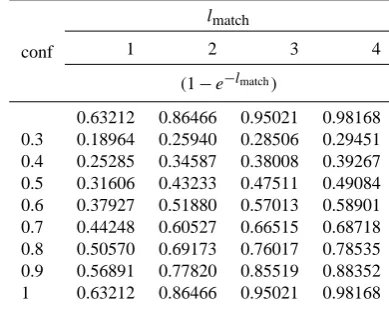
According to Eq. (4), we can calculate its value in dif-ferent cases. Seen in Table 1, we find that the influence of
0.4 0.25285 0.34587 0.38008 0.39267 0.5 0.31606 0.43233 0.47511 0.49084 0.6 0.37927 0.51880 0.57013 0.58901 0.7 0.44248 0.60527 0.66515 0.68718 0.8 0.50570 0.69173 0.76017 0.78535 0.9 0.56891 0.77820 0.85519 0.88352
1 0.63212 0.86466 0.95021 0.98168
lmatchis more and more obvious as the increase of the con-fidence. Under the condition of the same evaluation function value, i.e. two different rules’ conf andlmatch are the same, we would select the one, which conclusion’s length is longer, for pattern matching.
If no association rule is found for matching, a pdicted point depend on the movement trend would be re-turned. For example, lett= {P1, . . . , Pk−1, Pk{(k >2)be a current trajectory, wherePk−1=<latk−1,lonk−1>,Pk=< latk,lonk>, then the predicted trajectory tp= {2×latk− latk−1,2×lonk−lonk−1}.
Standard For Correct Prediction Select the minimumm, according to the actual future trajectory’s length and the pre-dicted trajectory’s length with pattern matching. Cut out the former m items of the two trajectories, and get their centre points. If the distance of the two points is not greater than 1, we would say that the prediction is correct.
7 Experiment
All experiments were conducted on a PC equipped with Pen-tium T2390 CPU, 1G RAM, and a SATA hard drive running under Windows XP SP2 Home Edition. Algorithms and the front-end application were implemented in C# and run within Microsoft .NET 2.0 platform. The experimental data is stored in Microsoft SQL Server 2000.
1. Data preprocessing 1:
The data in this stage is from 1900 to 2000.
a. Set the region size to 5×5, making the most of the processed trajectory points with single coor-dinate value within 1 unit jump;
Data
. . . .
1961 7 498 FRANCES 3,11;3,12;3,13;4,13;4,14;5,14;6,13;7,12;8,13;9,12;9,11 11 0
1961 8 499 GERDA 3,15;4,15;5,15;5,14;6,14;7,13;8,13;8,12;8,11;8,10;8,9 11 0
1961 9 500 HATTIE 2,16;3,16;3,17;3,18 4 0
1961 10 501 JENNY 3,12;4,12;4,11;5,11;5,10;5,9;5,8;5,9;5,10;6,10;6,9 11 0
1961 11 502 INGA 4,18;4,19;4,18;3,18 4 0
1962 1 503 ALMA 5,15;5,16;6,15;7,15;7,14;8,14;8,13;8,12;7,12;7,13;8,12;9,11 12 0
. . . .
Table 3. The datum in experiment_data table.
Field id former_traj next_traj
Data
. . . .
121 3,9;4,9;4,10;5,10;5,11;6,11;6,10;7,10;7,9;7,8;8,8;8,7;9,7 10,6;11,6;11,5;12,4;12,3;12,2;12,0 122 3,9;4,9;4,10;5,10;5,11;6,11;6,10;7,10;7,9;7,8;8,8;8,7;9,7;10,6;11,6 11,5;12,4;12,3;12,2;12,0 123 5,13;6,13;6,12;6,11;6,10;6,9;6,8;7,8 7,7;8,6;8,5;9,5 124 5,13;6,13;6,12;6,11;6,10;6,9;6,8;7,8;7,7 8,6;8,5;9,5
125 5,15;6,15;6,14;7,14;8,13;8,12;9,11;9,10;9,9;10,8;10,7;10,6;10,5 10,4;11,3;11,2;12,1;12,0;13,0;13,1 126 5,15;6,15;6,14;7,14;8,13;8,12;9,11;9,10;9,9;10,8;10,7;10,6;10,5;10,4;11,3 11,2;12,1;12,0;13,0;13,1
. . . .
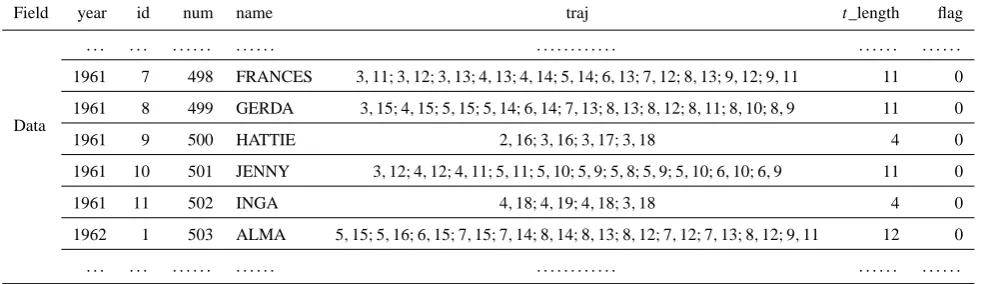
c. Deposit each hurricane’s information (including name, ID number, serial number, year, trajec-tory, trajectory length, flag) in the raw_data ta-ble. Preprocessing result is shown in Tata-ble. 2. 2. Data preprocessing 2:
The data in this stage is from 2001 to 2008.
a. Preprocess the trajectories as mentioned above; b. Cut each trajectory into the head and the tail
sec-tion. The head section is used for pattern match-ing and choosmatch-ing the optimum association rule. The tail section is used for correctness verifica-tion;
c. Deposit each trajectory’s information into the experiment_data table. Preprocessing result is shown in Table 3.
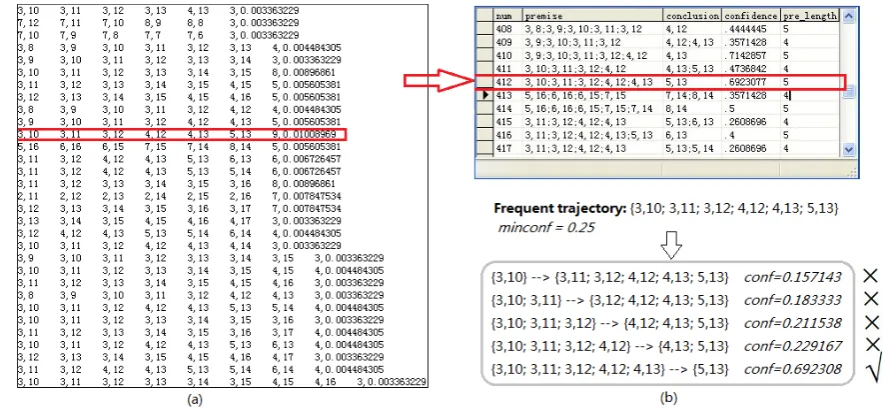
Depend on the HTPDM algorithm, the results of frequent trajectory mining and association rules generating are shown in Fig. 5. The predicted results are shown in Fig. 6.
Take for example the record with the id of 126 in Table 3. The current trajectory for predict-ing is {5,15;6,15;6,14;. . . .;10,4;11,3}, and the future trajectory for verifying is expressed as
{11,2;12,1;12,0;13,0;13,1}. We get its predicted trajectory by HTPDM algorithm, and the result is {11,2;12,2;12,1;13,1}. According to the standard for correct prediction mentioned in Sect. 6, the two centre points are (12,0.75) and (12,1.5). Their distance is 0.75, lower than 1, so we think that the predicted result is true. Details are seen in Fig. 7.
8 Analysis
Throughout the process of prediction, minsup (minimum support) and minconf (minimum confidence) are the most important parameters for impacting prediction accuracy. minsup directly control the frequent trajectory mining, and minconf indirectly control the generation of association rules under the premise of frequent trajectories.
8.1 Minconf and the prediction accuracy
Fig. 5. Mining motion patterns. (a) frequent trajectory mining; (b) association rules generating.
Fig. 6. Predicted results (Console output).
1.
correct_rate1=Tnum(PatternMatching_True)
Tnum(PatternMatching_All) Tnum(PatternMatching_True): the number of the correct predicted results by pattern matching;
Tnum(PatternMatching_ALL): the number of the total predicted results by pattern matching.
2.
correct_rate2=Tnum(PatternMatching_True)
Tnum(All)
Tnum(All): the total trajectory number.
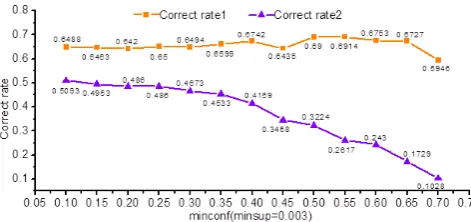
The first correct rate reflects the accuracy of data mining technology for itself. With the increase of minconf, remove the last abnormal point, the correct rate overall presents a ris-ing trend, and always maintain above 60 %. Because minconf
is larger, the credibility of the generated association rules is higher; the error rate would be smaller. When minconf con-tinues to increase, because the number of the generated asso-ciation rules is less, the accuracy would present an unstable state, and would appear abnormal points as shown in Fig. 8.
The second correct rate reflects the efficiency of data min-ing technology for the prediction system. With the increase of minconf, the correct rate is stable at the beginning and remains above 45 %. When minconf continue to increase from 0.4, however, the correct rate decreases rapidly to about 10 %. This is because, for the whole prediction system, if the system can not find the matching pattern, it would return a result according to the movement trend, and the accuracy of this speculation is fairly low.
8.2 Minsup and the prediction accuracy
Figure 8 shows that when minconf=0.25, the prediction ac-curacy is the best. Therefore, we let minconf value to be 0.25. Figure 9 shows the prediction accuracy with respect to the varying value of the minsup threshold for a set value of minconf=0.25. With the increase of minsup threshold, two correct rates fluctuate by small degrees partly, but decrease generally. Under the condition of the same minconf value, the increase of minsup leads to the decrease of the frequent trajectory number, as well as the number of association rules. All these reasons result in the decrease of prediction accu-racy.
Fig. 7. The predicted result of the trajectory with the id number of 126. The black part is the current trajectory for predicting; the blue part is the actual future trajectory for verifying; The red part is the predicted trajectory by data mining.
Fig. 8. Minconf and the correct rate when minsup=0.003.
trajectories and 56 incorrect predicted trajectories. The accu-racy is 65 %. The other 54 trajectories fail to match the pat-terns, including 19 correct predicted trajectories and 35 in-correct predicted trajectories. The accuracy is 35.2 %. In the whole 214 trajectories, the number of the correct predicted trajectories is 123 and the number of the incorrect ones is 91, the accuracy of the whole prediction system is 57.5 %.
9 Conclusions
This paper proposes a novel method for hurricane trajec-tory prediction based on data mining by integrating associ-ation analysis technology and using the real American At-lantic hurricane data. This method is different from the tradi-tional dynamics modelling forecast affected by multiple fac-tors. Firstly, all frequent trajectories in the historical hurri-cane trajectory database are mined by using association anal-ysis technology and their corresponding association rules are generated as motion patterns. Then, the current hurricane tra-jectories are matched with the motion patterns for predicting. If no association rule is found for matching, a predicted result according to the hurricane current movement trend would be returned. The experiments show that the prediction accuracy is ideal and satisfactory.
Fig. 9. Minsup and the correct rate when minconf=0.25.
Our future work includes:
1. Replacing uniform moving regions with differently sized areas that divide the movement area based on the density and congestion of moving objects;
2. Including spatial information into the movement rules; 3. Developing more effective matching strategies and
finding more useful evaluation functions.
Appendix A
The pseudo-code of the HTPDM algorithm
Algorithm Hurricane Trajectory Prediction Based On Data Mining
Input: (1) Moving trajectory database TD, minimum sup-port threshold minsup, minimum confidence threshold min-conf
Output: (1) Predicted trajectorytp (2) True/False
Algorithm:
//Step1: Mining frequent trajectory set FreTraSet 01: Scan the tableT1containing the all history trajectories; 02:C1= {all different trajectory points};
03:F1= {c∈C1|c.sup≥minsup}; 04: FreTraSet=F1;
05: max_length=the maximum trajectory length inT1; 06: FOR (k=2;k≤max_lentgh;k+ +)
07: Ck=get_candidate (Fk−1); 08: IF (Ckis null)
09: Break;
10: FOR all trapsactionst∈T1; 11: flag=1;
12: IF (t.flag==0)
13: FOR all trajectoriesc∈Ck;
14: IF (c ∈t )
15: flag=0;
25: c.sup=c.count / |D|; 26: END FOR;
27: Fk ={c∈Ck|c.sup≥minsup }; 28: IF (Fkis null)
29: Break;
30: FreTraSet=FreTraSet∪Fk; 31: END FOR;
//Step2: Generating the table T3 containing all associa-tion rules
32: FOR (k=2;k<FreTraSet.count+1; i++)
33: FOR all trajectoriest∈Fk; 34: h1=gettail (t );
35: CALL rules_generation (t,h1); 36: END FOR;
37: END FOR;
//Step3: Predicting and verifying the results
38: FOR each trajectorytfor predicting in tableT2 contain-ing all experimental data
39: f =0; 40: Idr=-1;
41: FOR all rulesr∈T3;
42: Calculate the evaluation function’s valuefr; 43: IF (fr>f )
44: f =fr; 45: Idr =r.num;
46: Record the conclusion’s length of the new rule; 47: tp =r.conclusion;
48: ELSE IF (fr =f )
49: Idr =the ID number of the one which has a longer conclusion;
50: Record the conclusion’s length of the new rule; 51: tp =r.conclusion;
52: END IF; 53: END FOR; 54: IF (Idr== −1)
55: tp= a predicted point depend on the movement trend;
56: END IF;
57: m= min (tp_length, tn_length) >5? 5: min (tp_length, tn_length);
58: Capture their formermitems respectively, and calcu-late their centre
points:ppm,pnm; 59: IF (ppm−pnm>1) 60: RETURN (tp, FALSE); 61: ELSE RETURN (tp, TURE); 62: END IF;
63: END FOR;
Sect. 4. Otherwise, all trajectories inFk−1, which can be connected, would be connected to ksequence tra-jectories according to the concept of “Trajectory Con-nection” in Sect. 4.
2. Line 10–23. Every time the tableT1 is scanned, the transaction’s flag, which does not contain any trajec-tory in Ck, would be set to 1. The transactions inT1, which flag is 1, would not be considered in the next scanning. It would reduce the complexity of the algo-rithm. The theory basis is that the one does not contain any trajectory inCk, would not likely to contain any frequent trajectory with length greater than k (Priori Principle in Sect. 4).
3. Line 32–37. Ak frequent trajectory can generate k-1 association rules (hx→t−hx). For example, let a tra-jectorytbe{a, b, c, d}, it can be decomposed into three rules:{a} → {b, c, d},{a, b} → {c, d},{a, b, c} → {d}. Take each rule hx→t−hx into account, if its conf (=sup(t )/sup(hx)) is greater than minconf, this rule would be stored in the tableT3. rules_generation(t,hx) is a recursive procedure, the algorithm is described as follow.
01: Generate a rule, the tail (the premisehx), the head (the conclusiont−hx);
02: rule.conf =sup (t)/sup (hx); 03: IF (rule.conf ≥minconf ); 04: Put it into the tableT3; 05: END IF;
06:hx+1 =getnexttail (t,hx); 07: CALL rules_generation (t,hx+1);
Supplementary material related to this article is available online at
http://www.nat-hazards-earth-syst-sci.net/13/3211/2013/ nhess-13-3211-2013-supplement.pdf.
Acknowledgements. This paper is supported by the Fundamental Research Funds for the Central Universities (NZ2013306), Qing Lan Project, the 333 project of Jiangsu Province, the Technology Foundation of China (JSJC2013605C009).
Edited by: R. Lasaponara
rules, in: Proc. of the 20th Int’l Conf on Very Large DataBases (VLDB’94), edited by: Bocca, J., M. and Zaniolo, C., Santiago, Morgan Kaufmann, 487–499, 1994.
Chan, J. C. L.: The physics of tropical cyclone motion, Ann. Rev. Fluid Mech., 37, 99–128, 2005.
Chatzidimitriou, K. and Sutton, A.: Alternative Data Mining Tech-niques for Predicting TropicalCyclone Intensification, American Association for Artificial Intelligence, 200, edited by: Chan, J. C. L., The physics of tropical cyclone motion, Ann. Rev. Fluid Mech., 37, 99–128, 2005.
Kim, H.-S., Kim, J.-H., Ho, C.-H., and Chu, P.-S.: Pattern Classi-fication of Typhoon Tracks Using the Fuzzy c-Means Clustering Method, J. Climate, 24, 488–508, 2011.
Kim, H.-S., Ho, C.-H., Kim, J.-H., and Chu, P.-S.: Track-Pattern-Based Model for Seasonal Prediction of Tropical Cyclone Ac-tivity in the Western North Pacific, J. Climate, 25, 4660–4678, 2012.
Kim, S.-W., Won, J.-I., Kim, J.-D., Shin, M., Lee, J., and Kim, H.: Path prediction of moving objects on road networks through an-alyzing past trajectories, in: KES’07/WIRN’07 Proceedings of the 11th international conference, KES 2007 and XVII Italian workshop on neural networks conference on Knowledge-based intelligent information and engineering systems: Part I, edited by: Apolloni, B., Heidelberg, Springer-Verlag Berlin, 379–389, 2007.
Long, T., Qiao, S., Tang, C., Liu, L., Li, T., and Wu, J.: E3TP: A novel trajectory prediction algorithm in moving objects databases[A], in: PAISI ’09 Proceedings of the Pacific Asia Workshop on Intelligence and Security Informatics, edited by: Chen, H., Heidelberg, Springer-Verlag Berlin, 76–88, 2009.
Pattern Recognition, edited by: Perner, P., Heidelberg, Springer-Verlag Berlin, 667–680, 2007.
Qin, L. X. and Shi, Z. Z.: Efficiently mining association rules from time series, Int. J. Inf. Technol., 12, 30–38, 2006.
Rozanova, O. S.: Note on the typhoon eye trajectory, Regular and Chaotic Dynamics, 9, 129–142, 2004.
Rozanova, O. S., Yu, J.-L., and Hu, C.-K.: Typhoon eye trajectory based on a mathematical model: Comparing with observational data, Nonlinear Analysis: Real World Applications, 11, 1847– 1861, 2010.
Su, Y., Chelluboina, S., Hahsler, M., and Dunham, M. H.: A New Data Mining Model for Hurricane Intensity Prediction[A], in: Data Mining Workshops (ICDMW), 2010 IEEE International Conference, 98–105, doi:10.1109/ICDMW.2010.158, 2010. Weber, H. C.: Probabilistic prediction of tropical cyclones, Part I:
Position, Mon. Weather Rev., 133, 1840–1852, 2005.
Zhao, Y., Liu, Y.-H., Yu, X.-G., Wei, D., Shan, C.-W., and Zhao, Y.: Method for mobile path prediction based on pattern mining and matching, Journal of Jilin University (Engineering and Technol-ogy Edition), 38, 1125–1130, 2008.