159 | P a g e
A PROTECTED KIND OF A SERVICES IN CLOUD
BASED ON ACCUMULATION DEVELOPMENT
SCHEME
1
Dange Vishakha I Jay
,
2T. Ramyasri,
3Dr. Bhaludra Raveendranadh Singh
1
Pursuing M. Tech (CSE),
2Associate Professor (CSE)
,
3Professor & Principal
1,2,3Visvesvaraya College Of Engineering And Technology, M.P Patelguda, Ibrahimpatnam
(M),Ranga Reddy (D)
, Telangana, (India)
ABSTRACT
As a powerful and proficient approach to give figuring assets and administrations to clients on interest,
distributed computing has turned out to be increasingly prevalent. From cloud administration suppliers'
viewpoint, benefit is a standout amongst the most imperative contemplations, and it is for the most part dictated
by the design of a cloud administration stage under given business sector request. Nonetheless, a solitary long
haul leasing plan is generally received to design a cloud stage, which can't promise the administration quality
yet prompts genuine asset waste. In this paper, a twofold asset leasing plan is planned firstly in which transient
leasing and long haul leasing are consolidated going for the current issues.
This twofold leasing plan can adequately ensure the nature of administration of all solicitations what's more,
lessen the asset squander enormously. Also, an administration framework is considered as a M/M/m+D lining
model and the execution pointers that influence the benefit of our twofold leasing plan are examined, e.g., the
normal charge, the proportion of solicitations that need brief servers, et cetera. Thirdly, a benefit amplification
issue is defined for the twofold leasing plan and the improved setup of a cloud stage is acquired by taking care
of the benefit augmentation issue. At long last, a progression of estimations is directed to think about the benefit
of our proposed plan with that of the single leasing plan.
The outcomes demonstrate that our plan cannot just ensure the administration nature of all solicitations,
additionally get more benefit than the last mentioned.
Index Term: Cloud computing, multi-server system, profit maximization, queuing model,
service-level agreement, waiting time
I. INTRODUCTION
As an compelling and proficient approach to combine figuring assets and processing administrations,
obfuscating figuring has turned out to be increasingly prevalent. Distributed computing brings together
administration of assets and administrations, furthermore, conveys facilitated administrations over the Internet.
The equipment, programming, databases, data, and all assets are focused and gave to buyers on-interest.
160 | P a g e
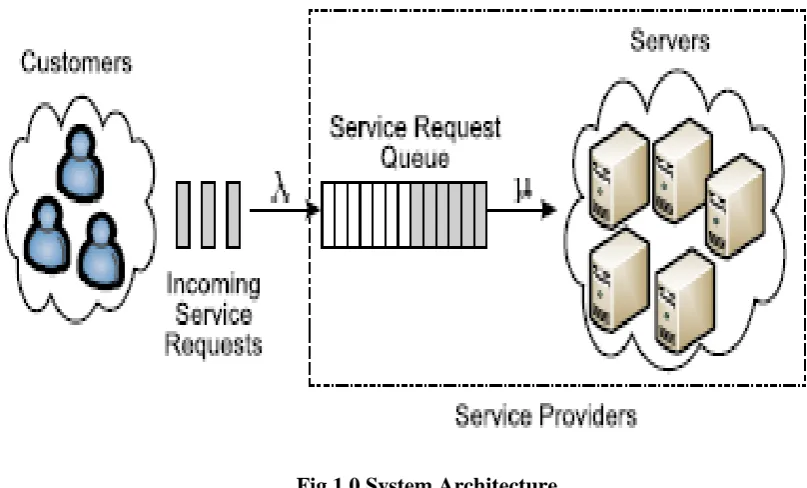
evaluating model . In a distributed computing environment, there are constantly three levels, i.e., base suppliers,
administrations suppliers, and clients (see Fig. 1 and its elaboration in Segment 3.1). A foundation supplier
keeps up the fundamental equipment and programming offices. An administration supplier rents assets from the
framework suppliers and gives administrations to clients. A client presents its solicitation to a administration
supplier and pays for it in light of the sum and the nature of the gave administration. In this paper, we go for
inquiring about the multi-server setup of an administration supplier such that its benefit is amplified.
Like all business, the benefit of an administration supplier in cloud processing is identified with two sections,
which are the expense and the income. For an administration supplier, the expense is the leasing cost paid to the
foundation suppliers in addition to the power taken a toll brought about by vitality utilization, and the income is
the administration charge to clients. By and large, an administration supplier rents a specific number of servers
from the base suppliers and assembles distinctive multi-server frameworks for various application areas. Each
multi-server framework is to execute a unique sort of administration solicitations and applications. Henceforth,
the leasing expense is corresponding to the quantity of servers in a multi-server framework . The force
utilization of a multi-server framework is directly relative to the number of servers and the server usage, and to
the square of execution speed. The income of an administration supplier is identified with the measure of
administration and the nature of administration. To condense, the benefit of an administration supplier is
essentially dictated by the arrangement of its administration platform. To design a cloud administration stage, an
administration supplier generally embraces a solitary leasing plan. That is to say, the servers in the
administration framework are all long haul leased. Since of the predetermined number of servers, a portion of
the approaching administration demands can't be prepared instantly. So they are initially embedded into a line
until they can took care of by any accessible server. Be that as it may, the holding up time of the administration
demands can't be too long. Keeping in mind the end goal to fulfill nature of-administration prerequisites, the
holding up time of each approaching administration solicitation ought to be constrained inside a certain range,
which is controlled by an administration level.
161 | P a g e
Understanding (SLA). On the off chance that the nature of administration is ensured, the administration is
completely charged, something else, the administration supplier serves the demand for nothing as a punishment
of low quality. To acquire higher income, an administration supplier ought to lease more servers from the
framework suppliers or scale up the server execution velocity to guarantee that more administration solicitations
are prepared
with high administration quality. Be that as it may, doing this would prompt sharp increment of the leasing cost
or the power cost. Such expanded expense may stabilizer the addition from punishment diminishment. All in all,
the single leasing plan is not a great plan for administration suppliers. In this paper, we propose a novel leasing
plan for administration suppliers, which not just can fulfill nature of-administration necessities, additionally can
get more benefit.
We present the related models utilized as a part of this paper, including a multi-server framework display, an
income Modeland a cost model.
A Cloud System Model
The cloud structure (see Fig. 1) comprises of three run of the mill parties, i.e., framework suppliers,
administration suppliers and clients. This three-level structure is utilized regularly as a part of existing writings.
In the three-level structure, a framework supplier the essential equipment and programming offices. An
administration supplier rents assets from framework suppliers and readies an arrangement of administrations as
virtual machine (VM). Framework suppliers give two sorts of asset leasing plans, e.g., long haul leasing and
fleeting leasing. In general, the rental cost of long haul leasing is much less expensive than that of fleeting
leasing. A client presents an administration solicitation to an administration supplier which conveys
administrations on interest. The client gets the coveted result from the administration supplier with certain The
measure of the administration furthermore, the administration quality. Administration suppliers pay foundation
suppliers for leasing their physical assets, and charge clients for preparing their administration demands, which
creates expense and income, separately. The benefit is produced from the crevice between the income and the
162 | P a g e
A Multi-Server Model
In this paper, we consider the cloud administration stage as a multi-server framework with an administration
demand line.
In a real distributed computing stage, for example, Amazon EC2, IBM blue cloud, and private mists, there are
numerous work hubs oversaw by the cloud supervisors, for example, Eucalyptus, OpenNebula, and Nimbus.
The mists give assets for employments as virtual machine (VM). In expansion, the clients present their business
to the cloud in which an occupation lining framework, for example, SGE, PBS, or Condor is utilized. All
employments are booked by the occupation scheduler and doled out to various VMs centralized. Henceforth, we
can consider it as an administration demand line. For instance, Condor is a specific workload administration
framework for compute intensive employments and it gives work queuing system, planning arrangement, need
plan, asset observing, what's more, and asset administration. Clients present their business to Condor, what's
more, Condor spots them into a line, picks when what's more, where to run them based upon an arrangement.
Subsequently, it is sensible to extract a cloud administration stage as a multi-server model with an
administration demand line, and the model is broadly received in existing writing.
Revenue Modeling
In a real distributed computing stage, for example, Amazon EC2, IBM blue cloud, and private mists, there are
numerous work hubs oversaw by the cloud supervisors, for example, Eucalyptus, OpenNebula, and Nimbus.
The mists give assets for employments as virtual machine (VM). In, the clients present their business to the
cloud in which an occupation lining framework, for example, SGE, PBS, or Condor is utilized. All employments
are booked by the occupation scheduler and doled out to various VMs centralized. Henceforth, we can consider
it as an administration demand line. For instance, Condor is a specific workload administration framework for
compute intensive employments and it gives work queuing system, planning arrangement, need plan, asset
observing, what's more, and asset administration. Clients present their business to Condor, what's more, Condor
spots them into a line, picks when what's more, where to run them based upon an arrangement. Subsequently, it
is sensible to extract a cloud administration stage as a multi-server model with an administration demand line,
and the model is broadly received in existing writing.
II. RELATED WORK
In this segment, we audit late works important to the benefit of cloud administration suppliers. Benefit of
administration suppliers are related with numerous components, for example, the value, the business sector
request, the framework design, the consumer loyalty et cetera. Administration suppliers actually wish to set a
higher cost to get higher overall revenue; however doing as such would diminish the consumer loyalty, which
prompts a danger of demoralizing interest later on. Thus, selecting a sensible valuing technique is critical for
administration providers.The estimating methodologies are partitioned into two classifications, i.e., static
valuing and element estimating. Static estimating implies that the cost of an administration solicitation is settled
and known ahead of time, and it doesn't change with the conditions. With element evaluating an administration
supplier defers the estimating choice until after the client interest is uncovered, so that the administration
supplier can change costs likewise [9]. Static estimating is the prevailing system which is broadly utilized as a
163 | P a g e
all solicitations, however Odlyzko in contended that the prevalent level rate estimating empowers squander and
is contrary with administration separation. Other sort of static evaluating methodologies are utilization based
estimating. For instance, the cost of an administration solicitation is relative to the administration time and
undertaking execution prerequisite (measured by the quantity of guidelines to be executed) , separately. Use
based valuing uncovers that one can utilize assets more productively. .
Dynamic estimating rises as an alluring option to better adapt to flighty client request . Mac'ıas et al. utilized a
hereditary calculation to iteratively improve the valuing approach. Amazon EC2 has presented a "spot
estimating" highlight, where the spot cost for a virtual occasion is powerfully overhauled to match supply what's
more, request. In any case, shoppers detest costs to change, particularly in the event that they see the
progressions to be "unjustifiable" . After correlation, we select the utilization based evaluating technique in this
paper since it concurs with the idea of cloud registering mostly.The second element influencing the benefit of
administration suppliers is consumer loyalty which is dictated by the quality of administration and the charge.
Keeping in mind the end goal to enhance the client fulfillment level, there is an administration level
understanding (SLA) between an administration supplier and the clients. The SLA receives a value
remuneration component for the clients with low administration quality. The instrument is to ensure the
administration quality and the consumer loyalty so that more clients are pulled in. In past examination,
distinctive SLAs are received. Ghamkhari et al. embraced a stepwise accuse capacity of two phases. In the
event that an administration solicitation is taken care of before its due date, it is typically charged; yet on the off
chance that an administration solicitation is not took care of before its due date, it is dropped and the supplier
pays for it because of punishment. In, accuse is diminished consistently of the expanding holding up time until
the charge is free. In this paper, we utilize a two-stage charge capacity, where the administration demands
presented with high caliber are typically charged, something else, are served for nothing.
III. EXISTING SYSTEM
In general, an administration supplier leases a specific number of servers from the framework suppliers and
constructs distinctive multi-server frameworks for various application spaces. Each multi-server framework
is to execute an uncommon sort of administration solicitations and applications. Consequently, the leasing
expense is corresponding to the quantity of servers in a multi-server framework. The force utilization of a
multi-server framework is straightly corresponding to the quantity of servers and the server usage, and to
the square of execution velocity. The income of an administration supplier is identified with the measure of
administration and the nature of administration. To outline, the benefit of an administration supplier is for
the most part controlled by the design of its administration stage.
To arrange a cloud administration stage, an administration supplier normally receives a solitary leasing
plan. That is to say, the servers in the administration framework are all long haul leased. In view of the set
number of servers, a portion of the approaching administration demands can't be handled promptly. So they
are initially embedded into a line until they can deal with by any accessible server.
IV. PROBLEM DEFINITION
As an effective and gainful way to deal with give figuring resources and organizations to customers on interest,
164 | P a g e
perspective, advantage is a champion amongst the most key examinations, and it is fundamentally controlled by
the outline of a cloud organization stage under given business division demand. Regardless, a singular whole
deal renting arrangement is by and large grasped to compose a cloud stage, which can't promise the association
quality however prompts honest to goodness resource waste. In this paper, a twofold asset leasing game plan is
portrayed firstly in which transient renting and whole deal renting are joined going for the present issues. This
twofold leasing course of action can sufficiently guarantee the way of organization of all sales and diminishing
the advantage misuse altogether. Additionally, an organization system is considered as a M/M/m+D lining
model and the execution pointers that effect the upside of our twofold renting arrangement are researched, e.g.,
the normal charge, the degree of asking for that need interval servers, and so on. Thirdly, an advantage
development issue is figured for the twofold renting arrangement and the upgraded setup of a cloud stage is
procured by dealing with the advantage increase issue. Finally, a movement of figuring's directed to take a
gander at the formal of our proposed arrangement with that of the single leasing course of action. The outcomes
display that our arrangement can't simply guarantee the organization way of all requesting, furthermore get more
advantage than the last said.
V. PROPOSED SYSTEM
In this paper, we propose a novel leasing plan for administration suppliers, which can fulfill nature
of-administration necessities, as well as can get more benefit.
A novel twofold leasing plan is proposed for administration suppliers. It joins long haul leasing with
fleeting leasing, which cannot just fulfill nature of-administration necessities under the differing framework
workload, additionally diminish the asset squander incredibly.
A multi-server framework received in our paper is demonstrated as a M/M/m+D lining model and the
execution pointers are investigated, for example, the normal administration charge, the proportion of
solicitations that need shortterm servers, et cetera.
The ideal arrangement issue of administration supplier’s revenue driven amplification is defined and two
sorts of ideal arrangements, i.e., the perfect arrangements and the real arrangements, are gotten individually.
A arrangement of correlations are given to confirm the execution of our plan. The outcomes demonstrate
that the proposed Double-Quality-Guaranteed (DQG) leasing plan can accomplish more benefit than the
looked at Single-Quality-Unguaranteed (SQU) leasing plan in the reason of ensuring the administration
quality totally.
VI. POINTS OF INTEREST OF PROPOSED SYSTEM
Since the solicitations with holding up time D are all allocated to interim servers, it is clear that all
administration solicitations can promise their due date and are charged taking into account the workload as
per the SLA. Consequently, the income of the administration supplier increments.
Increase in the nature of administration demands and augment the benefit of administration suppliers.
This plan joins transient leasing with long haul leasing, which can lessen the asset squander extraordinarily
165 | P a g e
VII. CONCLUSIONS
Keeping in mind the end goal to ensure the nature of administration solicitations and augment the benefit of
administration suppliers, this paper has proposed a novel Double-Quality-Guaranteed (DQG) leasing plan for
administration suppliers. This plan joins transient leasing with long haul leasing, which can diminish the asset
squander extraordinarily and adjust to the dynamical interest of figuring limit. A M/M/m+Dqueuing model is
work for our multi-server framework with changing framework size. And after that, an ideal design issue of
benefit augmentation is detailed in which numerous elements are taken into contemplations, for example, the
business sector request, the workload of solicitations, the server-level understanding, the rental expense of
servers, the expense of vitality utilization, and so forward. The ideal arrangements are understood for two
distinctive circumstances, which are the perfect ideal arrangements and the genuine ideal arrangements. What's
more, a progression of computations?Are directed to look at the benefit got by the DQG leasing plan with the
Single-Quality-Unguaranteed (SQU) leasing plan. The outcomes demonstrate that our plan beats the SQU plan
regarding both of administration quality and benefit.
VIII. FUTURE ENHANCEMENTS
We can implement the concept of graph representation to actual visualization of data values. What kind of data
and how much amount of data is used and by whom? We don’t have any clear visualization. So to represent in a
visualized graph image we can take the one bar graph algorithm for visualization. Secondly we can use
enhancement in storing the data in database safely.
REFERENCES
[1] K. Hwang, J. Dongarra, and G. C. Fox, Distributed and Cloud Computing. Elsevier/Morgan Kaufmann,
2012.
[2] J. Cao, K. Hwang, K. Li, and A. Y. Zomaya, “Optimalmulti-server configuration for profit maximization
in cloudcomputing,” IEEE Trans. Parallel Distrib. Syst., vol. 24, no. 6,pp. 1087–1096, 2013.
[3] A. Fox, R. Griffith, A. Joseph, R. Katz, A. Konwinski,G. Lee, D. Patterson, A. Rabkin, and I. Stoica,
“Above
[4] The clouds: A berkeley view of cloud computing,” Dept. Electrical Eng. and Comput. Sciences, vol. 28,
2009.
[5] R. Buyya, C. S. Yeo, S. Venugopal, J. Broberg, and I. Brandic, “Cloud computing and emerging it
platforms: Vision, hype, and reality for delivering computing as the 5th utility,” Future Gener. Comp.
Sy., vol. 25, no. 6, pp. 599– 616, 2009.
[6] P. Mell and T. Grance, “The NIST definition of cloud computing national institute of standards and
technology,” Information Technology Laboratory, vol. 15, p. 2009, 2009.
[7] Chen, C. Wang, B. B. Zhou, L. Sun, Y. C. Lee, and A. Y. Zomaya, “Tradeoffs between profit and
customer satisfaction for service provisioning in the cloud,” in Proc.20th Int’l Symp. High Performance
Distributed Computing.ACM, 2011, pp. 229–238.
[8] J. Mei, K. Li, J. Hu, S. Yin, and E. H.-M. Sha, “Energyawarepreemptive scheduling algorithm for
166 | P a g e
[9] P. de Langen and B. Juurlink, “Leakage-aware multiprocessor scheduling,” J. Signal Process.Sys., vol.
57, no. 1, pp.73–88, 2009.
[10] G. P. Cachon and P. Feldman, “Dynamic versus static pricing in the presence of strategic consumers,”
Tech. Rep.,2010.
[11] Y. C. Lee, C. Wang, A. Y. Zomaya, and B. B. Zhou, “Profitdrivenscheduling for cloud services with data
access awareness,” J. Parallel Distr. Com., vol. 72, no. 4, pp. 591–602, 2012.
[12] M. Ghamkhari and H. Mohsenian-Rad, “Energy and performance management of green data centers: a
profit maximization approach,” IEEE Trans. Smart Grid, vol. 4, no. 2, pp. 1017–1025, 2013.
[13] A. Odlyzko, “Should flat-rate internet pricing continue,”IT Professional, vol. 2, no. 5, pp. 48–51, 2000.
[14] G. Kesidis, A. Das, and G. de Veciana, “On flat-rate and usage-based pricing for tiered commodity
internet services,” in 42nd Annual Conf. Information Sciences and Systems. IEEE, 2008, pp. 304–308.
[15] [S. Shakkottai, R. Srikant, A. Ozdaglar, and D. Acemoglu, “The price of simplicity,” IEEE J. Selected
Areas in Communications,vol. 26, no. 7, pp. 1269–1276, 2008.
[16] H. Xu and B. Li, “Dynamic cloud pricing for revenue maximization,” IEEE Trans. Cloud Computing,
vol. 1, no. 2, pp. 158–171, July 2013.
[17] M. Mac´ıas and J. Guitart, “A genetic model for pricing in cloud computing markets,” in Proc. 2011
ACM Symp.Applied Computing, 2011, pp. 113–118. “Amazon EC2,” http://aws.amazon.com, 2014.
[18] Amazon EC2 spot instances,”http://aws.amazon.com/ec2/spot-instances, 2014.
[19] R. L. Hall and C. J. Hitch, “Price theory and business behaviour,” Oxford economic papers, no. 2, pp.
12–45, 1939.
[20] D. Kahneman, J. L. Knetsch, and R. Thaler, “Fairness as a constraint on profit seeking: Entitlements in
the market,”The American economic review, pp. 728–741, 1986.
AUTHOR DETAILS
VISHAKHA DANGE
Pursuing M.Tech in Visvesvaraya College of Engineering and Technology, M.P
Patelguda, Ibrahimpatnam (M), Ranga Reddy (D), and India
MRS. T. RAMYASRI
Mrs. T. Ramyasri completed Bachelor of Technology from Sree VisVesvaraya institute
of science and information technology and Post Graduation from Sree VisVesvaraya
institute of science and information technology and is having 8 years of teaching
167 | P a g e
SRI. DR. BHALUDRA RAVEENDRANADH SINGHM.Tech,Ph.D.(CSE),MISTE,MIEEE(USA),MCSI
Professor & Principal. He obtained M.Tech, Ph.D(CSE)., is a young, decent, dynamic
Renowned Educationist and Eminent Academician, has overall 23 years of teaching
experience in different capacities. He is a life member of CSI, ISTE and also a
member of IEEE (USA). For his credit he has more than 50 Research papers
published in Inter National and National Journals. He has conducted various seminars,
workshops and has participated several National Conferences and International
Conferences. He has developed a passion towards building up of young Engineering
Scholars and guided more than 300 Scholars at Under Graduate Level and Post
Graduate Level. His meticulous planning and sound understanding of administrative
issues made him a successful person.