Sustainability Commitment
In Saudi Arabia And Need For Educational
Reforms For The Jobs Of The Future
M. Anaam Hashmi, Minnesota State University, USA Nadia Abdulghaffar, King Abdulaziz University, Saudi Arabia
Iman Edinat, King Abdulaziz University, Saudi Arabia
ABSTRACT
Saudi Arabia is an important country among the Middle Eastern nations and a pivotal one because of its key position in international petroleum production. Sustainable practices are becoming prominent considerations among public and private sector Saudi Arabian business enterprises. Secondary and primary data pertaining to sustainability and carbon management practices in Saudi Arabia and its business enterprises were analyzed in this study. Saudi Arabian government has been serious in tackling the environmental problems. Primary data revealed private sector managers were better prepared and eager to deal with sustainability and carbon management problems compared to public sector enterprises. Surveyed Saudi managers reported hope that their employers would start rewarding positive sustainability actions and focus on educating managers about carbon management practices. There is a need to reform the educational system to prepare future managers who are ready to implement sustainability policies in their organizations. The findings of this project can assist Saudi Arabian policymakers and leadership of public and private sector universities to restructure the higher education sector to prepare students for the jobs of the future and help Saudi Arabia in pursuing sustainability goals.
Keywords: Sustainability; Jobs Of The Future; Higher Education; Employment Market; Saudi Managers; Private Sector; Public Sector
INTRODUCTION
he purpose of this study is to analyze sustainability practices in Saudi Arabia, commitment level of Saudi Arabian managers, and the need for educational reforms for the jobs of the future. This study summarizes sustainability concepts, investigates the current status of sustainability knowledge and practices in Saudi Arabia, analyzes the Saudi Arabian government’s position with respect to global and domestic carbon management policies, and outline educational reforms to prepare managers of the future. Primary data collected through a survey of Saudi managers in public and private sectors are analyzed to shed light on the current sustainability knowledge and practices in Saudi Arabia. Policy recommendations are made to prepare a new generation of Saudi managers to lead Saudi Arabia toward a sustainable path.
LITERATURE REVIEW
There is no single authoritative definition of sustainability or sustainable enterprise. The Brundtland thesis in 1987 introduces the de facto standard definition of sustainability: “Sustainable development is development that meets the needs of the present without compromising the ability of future generations to meet their own needs” (Tietenberg and Lewis 2009). According to Hart (1997), “the road to sustainable enterprise” started in the 1950s with pollution denial, which shifted to end-of-pipe regulation in the 1970s, to “greening” in the 1980s, and beyond greening by the 1990s. Each of these key studies contributed to the development of a growing movement of environmental concern, preparing the groundwork for modern sustainability theories and their definitions.
According to the model, a sustainable enterprise is one that promotes sustainable living through sustainable production of goods and services, to provide solutions for fulfilling elementary needs to improve the lives of people now and in the future with the least possible environmental impact and the highest possible economic and social yield. Basically, a sustainable enterprise is an initiative to provide for the present without limiting resources or the ability of future generations to provide and survive indefinitely. According to a recent report from the American Management Association (AMA), “The primary goal of sustainability is ensuring that whole systems remain healthy so that people—as individuals, societies, and organizations—improve their overall chances of well-being” (American Management Association [AMA], 2007).
Carroll (1979) possibly shapes one of the first models for social responsibility - focused decision-making. Carroll advocated that managers should be provided with a clear concept of social responsibility and a list of reasons justifying its existence. Hawken (1993) not only identifies sustainability problems but also discusses business-related solutions, which he asserted could transform both companies and the economy, and possibly improve profitability. Elkington (1998) introduces the widely used term “triple bottom line” (TBL) to define sustainability, referring to the economic bottom line (profit), the social bottom line (people), and the environmental bottom line (planet).
Christmann and Taylor (2001) tested the hypothesis that globalization will encourage global corporations to be environmentally sensitive and may not pollute developing countries (or relaxed environmental regulation countries). In other words, it is assumed that global corporations will self-regulate themselves contrary to the risk that global corporations will move their polluting industrial operations to countries with less stringent environmental regulations. Christmann and Taylor (2001) studied a sample of 118 Chinese firms to analyze whether international ownership and customer linkage contribute to environmental self-regulation. The findings of the study were contradictory to common belief and it was found that global corporations are self-regulating and employing environmentally-friendly measure, not adopted by the domestic corporations and eventually encouraging domestic corporations to be more environmental friendly. Multinational ownership, multinational customers, and exports to developed countries (countries with stringent environmental regulation) increase the likelihood of self-regulation of environmental performance. Drezner (2000) also supports environmental self-regulation hypothesis while investing in developing countries with relaxed environmental regulations, because International corporations are often importing advance and environmental-friendly technology and may be facing pressure from home-country interest groups to protect the environment in developing countries.
Sustainability And Carbon Management Efforts In Saudi Arabia
Sustainability and carbon management practices are gaining attention in the formulation of business strategies within most public and private sector enterprises in Saudi Arabia and across the globe. The main catalysts of this trend include legislative pressures in many countries and the Kyoto Protocol to the United Nation Framework Convention on Climate Change (UNFCCC). The Kyoto Protocol - an international agreement linked to the United Nations Framework Convention on Climate Change (UNFCCC) - was adopted in Kyoto, Japan, on December 11, 1997 and entered into force on February 16, 2005 (UNFCC, 2013). The major feature of the Kyoto Protocol is that it sets binding targets for 37 industrialized countries and the European Union (EU) for reducing greenhouse gas (GHG) emissions. Recognizing that developed countries are principally responsible for current high levels of GHG emissions in the atmosphere as a result of more than 150 years of industrial activity, the Protocol places a heavier burden on developed nations under the principle of “common but differentiated responsibilities.” Developed countries are classified as Annex I, while developing countries and economies in transition (former Soviet bloc) are classified as non-Annex I countries (UNFCCC, 2013). Saudi Arabia is considered to be a non-Annex I country.
Besides participating in global environmental forums and emphasizing sustainability issues at home, there has been criticism to various Saudi government positions. Depledge (2008) has criticized the Saudi Arabian position in global environmental treaty negotiations by categorizing the Saudi Arabian role to be obstructionist. Depledge (2008) asserted Saudi Arabia is not serious in any global treaty mandating GHG emissions reduction because the Saudi government believes GHG emissions reduction will lead to lower demand for petroleum, which will thus lead to lost revenue for oil exporting countries. Depledge concluded Saudi Arabia and other oil exporters only joined the Kyoto Protocol once it became clear that the document was going to become a reality—and therefore able to fully influence global environmental treaties.
Barnett (2008) also suggested the Organization of Petroleum Exporting Countries (OPEC) member nations—led by Saudi Arabia—has not been helpful in global climate negotiations and OPEC members are coordinating their opposition through the Group of 77 (G-77) developing countries. Saudi Arabian oil revenue constitutes more than 70 percent of the nation’s budget, and a $10 rise in the price of a barrel of oil results in a 14 percent rise in Gross Domestic Product. OPEC oil exporters consider GHG emissions reduction policies and carbon taxation in developed countries to be a mechanism for transferring wealth from oil producing countries to governments in oil consuming developed countries. Barnett (2008) considered OPEC and Saudi Arabian government roles to be obstructionist in reaching a global environmental treaty.
Swazo (2010) has defended Saudi Arabian government’s position regarding global environmental treaties and explained in detail the moral and practical nature of the Saudi Arabian position. Swazo (2010) explained the Saudi Arabian position in light of distributive justice and pursuit of national interest. Distributive justice is defined as fair disbursement of common advantages and common burdens by a community to its members. In carbon management debate, it has been argued that countries polluting environment for longer period must take a bigger responsibility and emissions reduction goals should not be detrimental to any country’s economic survival.
Swazo (2010) explained that all countries are seeking to advance national interest as they may have concerns about the global environmental policies and that is why distributive justice is a necessary component of global environmental negotiations. A substantial portion of Saudi Arabian government’s revenue source is fossil fuel export. The Saudi Arabian government views reduction of fossil fuel use to be detrimental to their economic prosperity and social development; therefore, they wish to be compensated as a result of any environmental treaty. No such compensation has been offered to Saudi Arabia and other oil exporting countries. Swazo (2010) contradicted the opinions of Depledge (2008) and Barnett (2008) by concluding, "…the Saudi position is defensible and reasonable. It cannot fairly be said that the Saudis are merely negotiating for "no" and seeking to obstruct progress." Swazo (2010) also considered the Saudi Arabian position to be consistent with other developing countries’ position, currently governing international law and international norms of morality.
Over the 20-year period (1990-2010), total CO2 emissions have increased from 160 to 380 million tons (137%). The increase is gradual, but the upward trend appears continuous and unstoppable. This increase in CO2 emissions is greater than most countries, with the exception of China and India, but both of those nations began with very low emissions levels and support particularly large populations. Some likely reasons for Saudi Arabian emissions increases are population growth, prosperity, and lack of coherent carbon management policies.
Energy sustainability-related global data are presented in Tables 1-a and Table 1-b, with special focus on the Gulf Cooperation Council (GCC) member countries and the United States. Overall energy sustainability index (based on 2013 data) ranks countries based on their sustainable energy policies based on three dimensions:
Energy security (effective management of primary energy source to meet the current and future demand)
Energy equity (accessibility of energy throughout the population)
Table 1-A: Overall Global Energy Sustainability Index (2013) Of Top Performing And GCC Member Countries
Global Rank Countries Global Score
1 Switzerland AAA
2 Denmark AAA
3 Sweden AAA
4 Austria AAB
5 United Kingdom AAA
6 Canada AAB
7 Norway AAB
8 New Zealand AAB
9 Spain AAA
10 France AAB
15 United States AAC
18 Qatar AAC
38 Bahrain AAD
44 U.A.E. BBD
51 Saudi Arabia ABD
62 Oman ACD
66 Kuwait BCD
Source: Wyman (2014)
Global ranking of all GCC member countries and the United States based on three sub-categories of overall sustainability ranking is summarized in Table 1-B Globally, Saudi Arabia ranked 45th on energy security (effective management of primary energy source to meet the current and future demand), 12th on energy equity (accessibility of energy throughout the population), and 124th on environmental sustainability (energy efficiencies and development of renewable/low-carbon sources). The poor Saudi Arabian ranking on the environmental sustainability index is quite alarming and emphasizes the importance of energy efficiency, renewable energy and low-carbon industries to create new jobs of the future.
Table 1-B: Detailed Global Sustainability Rankings Of GCC Member Countries
Energy
Security Rank Countries
Energy
Equity Rank Countries
Environmental
Sustainability Rank Countries
8 Qatar 1 United States 86 United States
12 United States 9 Qatar 95 Qatar
23 Bahrain 12 Saudi Arabia 102 U.A.E.
45 Saudi Arabia 19 Bahrain 120 Oman
49 U.A.E. 20 Oman 122 Kuwait
73 Kuwait 28 Kuwait 124 Saudi Arabia
78 Oman 37 U.A.E. 125 Bahrain
Source: Wyman (2014)
The first ever large scale symposium emphasizing carbon management and mitigation policies in Saudi Arabia was held in May 2006. The symposium was hosted by Saudi Aramco in the city of Dammam and an estimated 400 participants representing over 100 institutes and companies from 24 countries attended with the common goal of finding ways to meet the world’s growing energy demands while reducing emissions. Ministry of Petroleum and Mineral Resources also played a pivotal role in early awareness of carbon management. Participants discussed regulatory, environmental, and economic aspects of carbon management, the latest advances in technologies targeting CO2 capture from fixed and mobile sources, and CO2 sequestration (Saudi Aramco, 2006). However, it is unclear what has been accomplished by Saudi Aramco and other Saudi business enterprises since this historic event.
Research (CECCR) at the King Abdul Aziz University, Jeddah has been commissioned by the World Bank to study and work on climate change in the Arab world. CECCR is also working on compiling detailed climate data for Saudi Arabia that can be used for policy formation in the future. Some of the other newly established institutions charged with reducing carbon emissions are the King Abdullah Petroleum Studies and Research Center (KAPSARC) and King Abdullah City for Atomic and Renewable Energy (K.A.CARE). KAPSARC is a research and policy center committed to energy and environmental exploration in Saudi Arabia. The main focus of the center is to ensure sustainable energy resources with special focus on fossil fuels. On the other hand, K.A.CARE, created in April 2010, is contributing to a sustainable future for Saudi Arabia by developing alternative energy capacity and renewable fuels from indigenous sources (A New Era of Sustainable Energy, 2013; KAPSARC, 2012).
Saudi Arabia has already created their Designated National Authority (DNA) to certify Clean Development Mechanism (CDM) projects—low-carbon projects in a developing country (such as Saudi Arabia) designed to generate carbon credits that can be traded on a global climate exchange. Saudi CDM projects must be certified by the DNA before carbon credits can be traded through a global exchange. The Saudi Arabian DNA is called the National Committee for the Clean Development Mechanism and it is presided over by a representative of the Ministry of Petroleum and Mineral Resources (CDM, 2013).
Research Questions
1. What is the knowledge level of public and private sector enterprises’ managers regarding sustainability and carbon management policies?
2. What can be done to prepare managers for the jobs of the future and lead Saudi Arabia to the path of sustainability and economic progress?
RESEARCH METHODS
A number of secondary and primary sources were consulted to analyze the official Saudi Arabian position regarding sustainability and carbon management practices. Secondary sources shed light on Saudi Arabian efforts to incorporate sustainability in public and private sector in comparison with other major carbon-emitting countries.
A questionnaire was designed to assess their opinions about their employers’ practices related to these topics. The questionnaire included questions pertaining to personal beliefs and official policies of the surveyed Saudi enterprises. Business enterprise is an entity where the primary purpose is profit generation and these entities may have different ownership and organizational structure. In this study, an enterprise includes all governmental, semi-government and private Saudi Arabian entities along with Saudi subsidiaries of multinational corporations. A seven-point Likert scale was used wherein 1 indicated strongly disagree and 7 indicated strongly agree. The last section of the questionnaire covered demographic and corporation-specific information.
The study sample was based on 150 randomly selected mid-level managers who were selected because all of them were college graduates, proficient in English language, and they were sharing opinions without much hesitation. A total of 127 completed questionnaires were collected over a span of two months from participating managers. Of these, 117 questionnaires were usable and included for data analysis. The age of surveyed managers varies from 30 to 42 years. The data were analyzed by tabulating mean importance scores and using t-tests. SPSS-15 software was used for analysis.
PRIMARY DATA ANALYSES
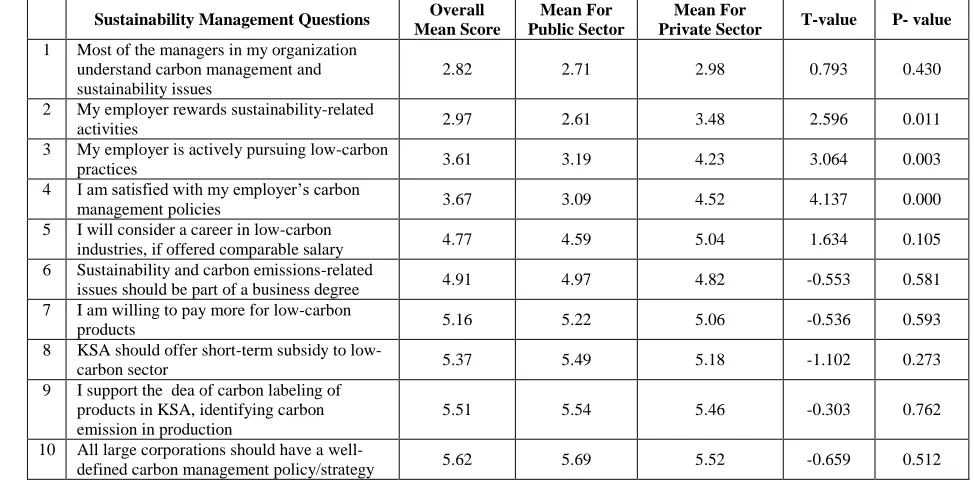
The satisfaction level with employers’ policies received a comparable score of 3.67. One of the possible explanations of low scores is the effectiveness of internal reward system implemented by the surveyed Saudi enterprises. The question, “My employer rewards sustainability-related activities” received a low score of 2.97, indicating a lack of positive reinforcement by business enterprises in Saudi Arabia. Managers appear to not be supported and appreciated if they try to pursue sustainability and carbon management policies, despite the fact these policies are officially supported by their employers. The results indicate lack of commitment to environmental issues by top management within these enterprises.
Another possible explanation for lack of coherent sustainability and carbon management policies is a relatively low score of 2.82 to the question, “Most of the managers in my organization understand carbon management and sustainability issues.” Saudi managers need to be educated about environmental challenges related to their enterprises. Managers also need guidance in formulating strategies to lower their corporations’ carbon emissions and move toward a path of sustainability. Saudi enterprises can organize educational seminars and courses for their managers. Without bringing all managers to the same level of awareness, low-carbon strategies cannot be implemented. There is a need for structural reforms in the higher educational system, particularly in business and engineering education. Despite disappointing lower scores about the current status of sustainability in Saudi Arabian business organizations, a lot of Saudi Arabian managers are willing to “consider a career in low-carbon industries if they are offered a comparable salary.” One of the most interesting findings is the high score (4.91) of the query, “Sustainability and carbon emissions-related issues should be part of a business degree.” These managers understood the need for more focused education and related the poor sustainability record to lack of sustainability education of current managers in private and public sectors.
Saudi managers strongly believe that “all large corporations should have a well-defined carbon management policy/strategy” because this question got the highest agreement score (5.62). Saudi managers also supported the idea of carbon-labeling so consumers can make informed decisions (mean score 5.51). The positive commitment of Saudi Arabian managers is also supported by the relatively high score (5.16) of the query, “I am willing to pay more for low-carbon product.” Finally, the surveyed managers hope the government will support Saudi Arabian organizations in their attempts to implement sustainability-related policies with a score of 5.37 to the question, “KSA should offer short-term subsidy to the low-carbon sector.”
The public and private sector manager’s data and the t-test results are presented in Table 2. In general, mean importance scores of public-sector managers are slightly higher than private-sector managers, but the difference of the mean importance scores of the following four questions is statistically significant between these two groups of managers:
1. My employer rewards sustainability-related activities. 2. My employer is actively pursuing low-carbon practices. 3. I am satisfied with my employer’s carbon management policies.
Table 2: Mean Importance Score Of Sustainability Strategies And Managers Commitment In Public And Private Sector Enterprises Sustainability Management Questions Overall
Mean Score
Mean For Public Sector
Mean For
Private Sector T-value P- value
1 Most of the managers in my organization understand carbon management and sustainability issues
2.82 2.71 2.98 0.793 0.430 2 My employer rewards sustainability-related
activities 2.97 2.61 3.48 2.596 0.011 3 My employer is actively pursuing low-carbon
practices 3.61 3.19 4.23 3.064 0.003 4 I am satisfied with my employer’s carbon
management policies 3.67 3.09 4.52 4.137 0.000 5 I will consider a career in low-carbon
industries, if offered comparable salary 4.77 4.59 5.04 1.634 0.105 6 Sustainability and carbon emissions-related
issues should be part of a business degree 4.91 4.97 4.82 -0.553 0.581 7 I am willing to pay more for low-carbon
products 5.16 5.22 5.06 -0.536 0.593 8 KSA should offer short-term subsidy to
low-carbon sector 5.37 5.49 5.18 -1.102 0.273 9 I support the dea of carbon labeling of
products in KSA, identifying carbon emission in production
5.51 5.54 5.46 -0.303 0.762 10 All large corporations should have a
well-defined carbon management policy/strategy 5.62 5.69 5.52 -0.659 0.512
Note:Mean scores are derived from a 7-point Likert scale where 1 = strongly disagree and 7 = strongly agree. N for public sector = 70 and for private sector = 48.
CONCLUSIONS AND IMPLICATIONS
The results of this study shed new light on the current status of practices of Saudi Arabian government, business enterprises and perceptions of Saudi managers. The findings highlight subtle differences between the Saudi Arabian enterprises’ stated goals, readiness of Saudi Arabian enterprises, and perceptions of managers within these enterprises.
Lower mean scores about current status of sustainability practices in Saudi Arabian enterprises, lower mean scores about managers’ knowledge level, and higher mean scores about proactive actions leading to the path of sustainability clearly suggest a need for reforming the higher education system by redesigning or adding relevant courses in business and engineering degrees. This conclusion is strongly supported by a relatively higher score of the query, “sustainability and carbon emissions-related issues should be part of a business degree.” In general, Saudi Arabian universities and enterprises need to focus on educating their managers and citizens about sustainability and carbon management policies. Commitment level of Saudi Arabian managers is satisfactory as evident by the managers’ responses, but these issues have not received full attention from either senior management or by institutions of higher learning.
Institutions of higher learning can decide either by adding specific courses or incorporating sustainability concepts in all relevant business and engineering courses. Administrators and professors must decide an appropriate strategy for their institution. A better prepared student will be employable in the enterprises of the future where the sustainability goal is no longer a choice. Better prepared students will also help their future employers to implement sustainability policies.
AUTHOR INFORMATION
consulted a number of businesses in formulating their foreign market entry strategies and cross-cultural training programs. Dr. Hashmi has travelled to over forty countries for professional reasons. Email: [email protected].
Nadia Abdulghaffar is working as an Assistant Professor at King Abdulaziz University. Her research is focused on Saudi Arabian enterprises. Email: Email: [email protected].
Iman Edinat is working as an Assistant Professor at King Abdulaziz University. Her research is focused on Saudi Arabian enterprises and entrepreneurship. Email: [email protected].
REFERENCES
1. American Management Association. (2007). Creating a Sustainable Future: A Current Study of Current Trends and Possibilities 2007-2017. Retrieved from http://view.fdu.edu/files/ amawebcastreport.pdf. 2. Barnett, Jon. (2008). “The Worst of Friends: OPEC and G77 in the Climate Change,” Global
Environmental Politics, Volume 8, No. 4, November 2008, 1-8.
3. Carroll, A. B. (1979). “A Three-Dimensional Conceptual Model of Corporate Social Performance”, Academy of Management Review. 4 (4), 497-505.
4. Christmann, Petra and Glen Taylor. (2001). Globalization and the Environment: Determinants of Firm Self-regulation in China. Journal of International Business Studies; Third Quarter 2001, Volume 32, Issue 3, 439-458.
5. Clean Development Mechanism (CDM). 2013. “DNA Saudi Arabia,” http://www.cdmdna.gov.sa/dnaksa.aspx, (accessed on May 2, 2013)
6. Depledge, Joanna. (2008). "Striving for No: Saudi Arabia in the Climate Change Regime," Global Environmental Politics, Volume 8, No. 4, November 2008, 9-35.
7. Drezner, Daniel. (2000). Bottom Feeders. Foreign Policy. 122 (1), 64-73.
8. Elkington, J. (1998). Cannibals with Forks: The Triple Bottom Line of 21st Century Business. Philadelphia: New Society.
9. Hart, Stuart L. (1997). Beyond Greening: Strategies for a Sustainable World. Harvard Business Review., 76 (1), 66-76.
10. Hawken, P. (1993). The Ecology of Commerce. New York: HarperCollins. 11. Ing, C. (2009). Sustainable Enterprise Model. May 26, 2009,
http://www.centreforsmart.co.uk/smp/files/Sustain/Sustainable%20Enterp se%20Model.pdf
12. “A New Era of Sustainable Energy,” King Abdullah City for Atomic and Renewable Energy (K.A.CARE). 2013. http://www.energy.gov.sa/default-en.htm
13. National Energy Efficiency Program (NEEP). 2011.
http://www.neep.org.sa/en/index.php?option=com_frontpage&Itemid=1. Accessed on April 17, 2013. 14. Saudi Aramco. (2006). “First Regional Symposium on Carbon Management,” Sponsored by Saudi Aramco, 15. Dhahran, Saudi Arabia.
16. Swazo, Norman K. (2010). “Negotiating the Climate Change Regime: The Case of Saudi Arabia,” The Middle East Review of International Affairs, Volume 14, No. 4, December 2010.
17. The King Abdullah Petroleum Studies and Research Center (KAPSARC). 2012. http://www.kapsarc.org/careers/overview
18. Tietenberg, T., & Lewis, L. (2010). Environmental Economics & Policy (Sixth Ed.). Pearson Education, Inc.
19. United Nations Framework Convention on Climate Change (UNFCCC). 2013. http://unfccc.int/2860.php (Accessed on May 19, 2013).