Themed Section: Science and Technology
Content Analysis in Social Network Analysis using Sentiment
Analysis
M. Thangaraj1, S. Amutha2
*1Department of Computer Science, Madurai Kamaraj University, Madurai, Tamilnadu, India
2Department of Computer Science, Manonmanaiam Sundaranar University, Tirunelveli, Tamilnadu, India
ABSTRACT
This paper shows about content from social network tools sites or social media tools like twitter or face book user document are analyzed with the help of Social network Analysis tools like Gephi, NodeXL and Pajek using positive, negative, neutral and emoticons. In Sentiment Analysis the text are classified in to various levels like word, sentence, phrase, and feature and document level. The content mining is divided into five categories. The major analysis is Sentiment Annotation, Sentiment Classification, Sentiment Detection, Sentiment Determination, Sentiment Extraction and Sentiment Lexicon.
Keywords: Social network Analysis, Sentiment Analysis, Sentiment Annotation, Content Analysis, Sentiment Classification
I.
INTRODUCTION
Social Network (SN) is a term used to express web-based services that let individuals to make a public / semi-public profile inside a domain such that they can communicatively bond with others users within the network through the text or images. It is enabling the structure and exchange of user –generated content. SN is a graph consisting of nodes and links used to represent Social relationship on Social Sites. SNs are important foundations of online interactions and contents sharing, subjectivity, assessments, approaches, evaluation, influences, observations, feelings, opinions and sentiments expression allow out in text, reviews, blogs, discussions, news, remarks, reactions or some other documents[1].
SN data is varying in size, noise and dynamism. SN sites are commonly known for information dissemination personal activates posting, product reviews, online pictures sharing, professional profiling, advertisements and opinion/ sentiment expression.
Mostly current news alerts updates, breaking news political debates and government policy are also posted and analysed on SN sites. It allows users to express their views be it positive, negative, neutral or emoticons. SN based on virtual communities has begun to publish members’ public profile information, including social links, using the semantic web language like resource description framework (RDF).
II.
SEMANTIC WEB
frequency of key words in target resource and/or trustworthiness of the resource publishers. Algorithms for full-text searches are among the most important collective intelligence algorithms and a deciding factor for the success of search engines.
Web 3.0 or semantic web desires to decrease human tasks and decisions and leave them to machines by providing machine readable contents on the web. It is included two main platforms, semantic technologies and social computing environment. The semantic technologies represent open standards that can be applied on the top of the web. The social computing environment allows human machine co-operations and organizing a large number of the social web communities. The semantic web offers an ambitious vision of an internet populated with intelligent agents and services able to exchange information, tasks and knowledge using simple protocols coupled with a rich knowledge representation language. Exploring the roadmap leading toward this vision will take some time.
III.
SENTIMENT ANALYSIS
Sentiment is called mental feeing. It is tender emotion which is expressed by human being whether in positive, negative, or neutral. Sentiment is naturally a localized phenomenon that is more correctly computed at the paragraph, sentence or entity level.Sentiment Analysis (SA) is named with other names are Opinion extraction, Opinion mining,
Sentiment mining and Subjectivity analysis.
Sentiment Analysis aims to detect positive, neutral, or negative feelings from text, whereas Emotion Analysis aims to detect and recognize types of feelings through the expression of texts, such as anger, disgust, fear, happiness, sadness,andsurprise [5].
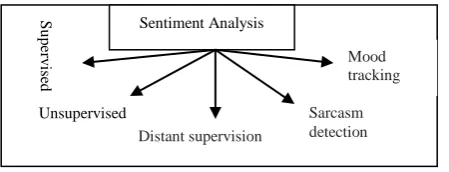
Figure 1. Content Mining is divided into Sentiment Analysis.
The content from social sites is in under the SA words like positive, negative and neutral. It is divided five categories are supervised, unsupervised, Distant supervision, sarcasm detection and mood tracking. In Supervised Sentiment Analysis is analysing media
with very informal language benefits from involving novel features, such as emoticons without employing any external information and resources in social sites [4].
In unsupervised Sentiment Analysis the words excellent and poor as a beginning set. The emotion correlation and emotion indication are calculated in this term. The Distant supervision data consists of tweets with emoticons serve as noisy labels and it also had positive and negative words. Sarcasm detection produces a negative opinion using with positive words and express the message in a hidden way [3]. The last category Mood tracking is to find the different way of thinking of human being and lot of emotional experience collections to analyse the problem of public issues.
SA is the computational study of people’s opinions, attitudes, and emotions towards individuals, events, or topics covered by reviews or news. The target of SA is to find opinions, identify the sentiments they express, and then classify their polarity.SA can be considered also a classification process which is the task of classifying text to represent a positive or negative sentiment. For most rich content sources, it’s a lot added important to compute and compare the sentiment of an individual entity than it is to get the on the whole sentiment of the document [10].
SA is useful to a wide range of problems that are of interest to human-computer interaction practitioners and researchers, as well as those from fields such as Sentiment Analysis
S
u
p
er
v
ise
d
Unsupervised
Distant supervision
Sarcasm detection
sociology, marketing and advertising, psychology, economics, and political science. Its processes are opinions in order to learn about public perception. It uses natural language processing (NLP) to collect and examine opinion or sentiment words. SA has various sub streams including emotion analysis, trend analysis and bias analysis etc.
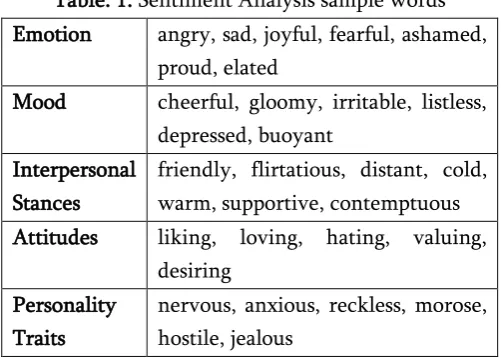
Table. 1. Sentiment Analysis sample words
Emotion angry, sad, joyful, fearful, ashamed,
proud, elated
Mood cheerful, gloomy, irritable, listless,
depressed, buoyant Interpersonal
Stances
friendly, flirtatious, distant, cold, warm, supportive, contemptuous
Attitudes liking, loving, hating, valuing,
desiring Personality
Traits
nervous, anxious, reckless, morose, hostile, jealous
By the collections of sentiment Analysis words or contents were taken from the social media or social network sites like twitter and Face book where analysed in different methods. The major analysis is Sentiment Annotation, Sentiment Classification, and Sentiment Detection [9].
Semantic Annotation is where one is to label instances as +ve, -ve and neutral. It is more specific and more involved, than the simple sentiment questionnaire approach. Aspects of annotation- good practices in crowd sourcing how to aggregate information from multiple annotations, and how to automatically detect and discard poor annotations are beyond the collections of words. Semantic Annotation and search tools are at the core of semantic web technology. Annotations involve tagging of data with concepts so that data becomes meaningful. Annotating data can help to search for information by keyword based search and well-defined general concepts [6].
Sentiment Classification Once the task of finding whether a sentence is opinionated is done, we have to
find the polarity of the sentence i.e., whether it expresses a positive or negative opinion. Sentiment classification can be a binary classification, multi-class classification (extremely negative, negative, neutral, positive or extremely positive), regression or ranking. Depending upon the application of sentiment analysis, subtasks of opinion holder extraction and object feature extraction can be treated as optional [8].
Sentiment detection” means to find the polarity (positive, negative, or neutral) of a given text. The texts are single sentences or very short texts from a single source. This includes the special case of Twitter documents. There exist several other types and tasks in the realm of sentiment detection, e.g. emotion detection, document-based sentiment detection,
target-specific sentiment detection, or rating
prediction, where the number of stars for product reviews is predicted from the text. In general a good overview of sentiment detection and its variants are in positive, negative or neutral words.
Sentiment detection is an integral element of social media monitoring tools. For this explanation, comparisons of social media monitoring tools typically also explore their sentiment detection abilities. In Freshnetworks.com’s comparison of 7 social media monitoring tools prove that on common they coded positive and negative sentiment correctly for about 30% of the texts messages containing overlapping subjective phrases [7].
IV.
RESULTS AND DISCUSSION
Table 2. shows the Filtering process mGephi Framework
Attributes Nodes Edges Nodes
in %
Edges in % Betweeness
centrality
31 21 2.33 0.96
Degree 234 32 12.55 1.46
Eccentricity 60 56 4.5 2.55
In-degree 138 34 10.36 1.55
Modularity class
145 157 10.89 7.16
Out-degree 51 21 3.83 0.96
Weighted degree
166 0 12.46 0
Weighted in-degree
129 76 9.68 3.47
Weighted out-degree
61 50 4.58 2.28
Queries self
loop
1332 2192 90.8 96.8
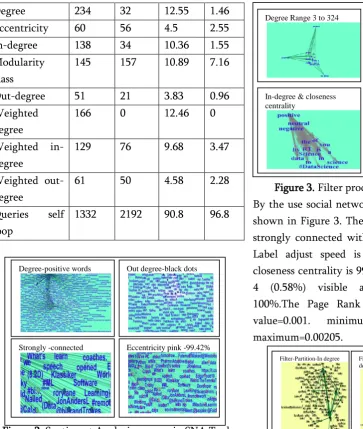
Figure 2. Sentiment Analysis process in SNA Tool
Figure 2. Shows that 2600 positive words edges and nodes how the degree is calculated and strongly connected elements are mentioned in Gray colour dots. The out-degree is showed in Black Dots and Eccentricity is indicated in pink dots which is 99.42%
Figure 3. Filter process in Sentiment Analysis By the use social network analysis tools the output is shown in Figure 3. The Degree range is 3 to 324 and strongly connected with nodes 17, edges 42 and the Label adjust speed is 1.0. In node attribute the closeness centrality is 99.42%.In degree range Node is 4 (0.58%) visible and Betweenness centrality 100%.The Page Rank double value is calculated,
value=0.001. minimum value =0.00144 and
maximum=0.00205.
Figure 4. Output of Filter process in SNA tool Degree Range 3 to 324 In-degree range
In-degree & closeness centrality
Page rank nodes-4
Filter-Partition-In degree Filter- partition -Out degree
Filter- partition- weighted degree
Filter-Partition-Weighted –in-degree
Filter-Partition-Weighted-out degree
Filter-Self Loop
Degree-positive words Out degree-black dots
Figure 5. Shows output in Data table.
The Data table gives the output of process using nodes in dataset. It completely calculates the In-Out-Degree, Weighted –In-out Degree, Eccentricity, closeness, Harmonic closeness, Betweeness, Modularity, page rank, Component ID, Strongly connected and clustering Coefficient.
V.
CONCLUSION
In this the content analysis process is done by using Social Network Analysis tools mGephi framework to find the relationship between the sentiment text (positive, negative, neutral and emoticons). The various sentiment process like sentiment Annotation, sentiment classification, sentiment detection are find out the text taken from the twitter dataset. The filtering operations are done in within the collection of nodes. Labels are display in degree and concluded with the data table. It shows the public or common profile updater text about the public issues and results are in Positive, Negative, Netural or Emoticons.
VI.
REFERENCES
[1]. Md. Abdur Rahman & Heung-Nam Kim
&Abdulmotaleb El Saddik &Wail Gueaieb, A context-aware multimedia framework toward personal social network services, International Journal in Multimedia Tools Applications (2014) 71:1717–1747
[2]. Ahmed Al-Dhanhani, Rabeb Mizouni, Hadi
Otrok, Ahmad Al- Rubaie, Analysis of collaborative learning in social network sites used in education, International journal of Social Network Analysis and Mining. (2015) 5:65
[3]. Anuradha Goswami, Ajey Kumar, Challenges in
the Analysis of Online Social Networks: A Data Collection Tool Perspective, Wireless Personal Communications 18 August 2017,97:4015–4061
[4]. Cheng-Chung Chen Xiaoxi Fu Che-Yuan Chang,
A terms mining and clustering technique for surveying network and content analysis of academic groups exploration, International Journal of Cluster Computing (2017) 20:43–52
[5]. E. Fersini1 F. A. Pozzi1 E. Messina1, Approval
network: a novel approach for sentiment analysis in social networks, International journal of World Wide Web (2017) 20:831–854
[6]. Goran Putnik, Eric Cost, Catia Alves, Helio
Castro, Leonilde Varela, Vaibhav Shah, Analysing the correlation between social network analysis measures and performance of students in social network-based engineering education, International Journal of Technology and Design Education, (2016) 26:413–437
[7]. Jong-Soo Sohn Un-Bong Bae In-Jeong Chung,
Contents Recommendation Method Using Social Network Analysis,international journal of Wireless Personal Communications (2013) 73:1529–1546
[8]. Kawaljeet Kaur Kapoor & Kuttimani Tamilmani
& Nripendra P. Rana2 & Pushp Patil &Yogesh K. Dwivedi & Sridhar Nerur , Advances in Social Media Research: Past, Present and Future, Information Systems Frontiers - Springer Nov 6, 2017
[9]. S. Venkatesan, Vladimir A. Oleshchuk. C.
[10]. Vishal A. Kharde, S.S. Sonawane,, Sentiment