Psychology Research and Behavior Management 2018:11 267–278
Psychology Research and Behavior Management
Dove
press
submit your manuscript | www.dovepress.com 267
O R i g i n a l R e s e a R c h
open access to scientific and medical research
Open Access Full Text Article
affective commitment foci as parallel mediators
of the relationship between workplace romance
and employee job performance: a cross-cultural
comparison of the People’s Republic of china and
Pakistan
Muhammad aamir shafique
Khan1
Du Jianguo1
ahmed abdul hameed2
Tehseen Ul Mushtaq2
Muhammad Usman2
1school of Management, Jiangsu
University, Zhenjiang, People’s Republic of china; 2Department of
Management sciences, cOMsaTs University islamabad, lahore, Pakistan
Purpose: The purpose of the present study is twofold. First, we examined the relationship between workplace romance and employee job performance and tested the role of affective commitment foci – namely, affective coworker commitment, affective supervisor commitment, and affective organizational commitment – as parallel mediators in the relationship between workplace romance and employee job performance. Second, we tested the moderating role of culture on the interrela-tionships between workplace romance, affective commitment foci, and employee job performance.
Methods: A two-wave (3-month interval) survey data were collected from 312 paramedics – 162 and 150 from Pakistani and Chinese public-sector hospitals, respectively. The first and second waves of data collection took place in January and May 2017, respectively. Structural equation modeling (SEM), bootstrapping technique, and multigroup analysis were used to test the interrelationships between workplace romance, affective commitment foci, and employee job performance and to examine the cross-cultural differences in these interrelations.
Results: Results obtained using SEM show that workplace romance positively influences employee performance. Importantly, the study revealed that the three foci of affective com-mitment – namely, coworker affective comcom-mitment, supervisor affective comcom-mitment, and organizational affective commitment – as parallel mediators fully mediate the relationship between workplace romance and employee performance. Moreover, national culture moderates the indirect relationship between workplace romance and employee job performance, where workplace romance is stronger for the Chinese data sample.
Conclusion: It is concluded that workplace romance is positively related to employee job performance and that affective commitment foci fully mediate the positive relationship between workplace romance and employee job performance. Moreover, culture moderates the indirect relationship between workplace romance and employee job performance. The study contributes to theory and practice by studying an essential but largely ignored aspect of the workplace and portraying it as a constructive influence on employee job performance and their affective com-mitment to coworkers, supervisor, and organization.
Keywords: workplace romance, job performance, affective commitment, paramedical staff, health sector, cross-cultural comparison, People’s Republic of China, Pakistan
Introduction
Workplace romance is defined as a mutually consensual and committed relationship
that can entail dating, touching, hugging, kissing, and sexual intercourse.1–4 Workplace
correspondence: Muhammad Usman Department of Management sciences, cOMsaTs University islamabad, lahore campus, 1.5 KM Defence Road, Off Raiwind Road, lahore 54000, Pakistan Tel +92 42 111 001 007
Fax +92 42 9920 3100 email [email protected]
Journal name: Psychology Research and Behavior Management Article Designation: Original Research
Year: 2018 Volume: 11
Running head verso: Khan et al
Running head recto: Mediators of workplace romance and job performance DOI: http://dx.doi.org/10.2147/PRBM.S168542
Psychology Research and Behavior Management downloaded from https://www.dovepress.com/ by 118.70.13.36 on 26-Aug-2020
For personal use only.
Dovepress
Khan et al
romance can be hierarchical (between an employee and his/ her supervisor/manager or subordinate), lateral (between peers), heterosexual (between opposite sexes), and
homo-sexual (between same-sex individuals).1–3 Research data
are growing with regard to workplace romance and its out-comes discourse. The increased interest is mainly due to the acknowledgment that it can have pivotal implications – con-structive and decon-structive – for employee job performance, job
satisfaction, wellbeing, and organizational commitment.1,5–8
Literature proposes that workplace romance can have constructive effects on employee job performance, as participants of workplace romance work hard to improve their impression and performance to compensate for any negative perceptions related to their involvement in romantic
relations.6,9–11 Workplace romance can be a source of
happi-ness for the participants of workplace romance.6 The happy/
productive worker hypothesis suggests that happy workers
can exhibit improved job performance.12 Moreover, Khan
et al empirically showed that employees involved in
work-place romance exhibit improved performance.1 As partners
in a workplace romance feel psychologically safe, they are more open to new ideas and experimentation that can
improve their job performance.7 Moreover, as participants
of workplace romance have satisfied their companionship needs, they have more energy available to perform their jobs
that is likely to improve their productivity and performance.9
However, workplace romance can have destructive effects on the performance and productivity of employees and organizations, as participants of workplace romance may devote their time at work to romance-related activities and
ignore their job activities.8,13 Similarly, workplace romance
can have destructive effects on participants in the romance that can manifest in the form of sexual exploitation,
harass-ment, litigations, stress, and negative publicity.8,13 Destructive
effects such as sexual exploitation, harassment, and litigation are often linked with hierarchical and dissolved workplace
romances.2,10 However, in accordance with the
happy/produc-tive worker hypothesis11 and impression management theory,6
we expect that workplace romance is positively related to employee job performance.
Moreover, literature is indicative of the influence of
workplace romance on employee affective commitment.6,10,11
We understand affective commitment as employee emotional involvement with their organization, coworkers, and supervi-sors that encourages them to commit time and energy to their
work and go beyond performance norms.14,15 This
concep-tualization of affective commitment suggests that affective commitment is a multidimensional construct that can have
different foci (can be directed toward different targets) such
as organization, supervisor, and colleagues.14,15 Additionally,
a plethora of studies posits a positive relationship between
affective commitment and employee performance.15–17 This
suggests affective commitment can mediate the relationship between workplace romance and employee job performance.
In addition, the literature suggests that the nature of effects of romantic relationships can vary across cultures, as culture is one of the fundamental factors that shape emotions,
thoughts, feelings, behaviors, and romantic relationships.18–20
Thus, we propose that the national culture can moderate the behavioral and performance outcomes of a workplace romance. However, empirical studies comparing cross-cultural differences in the relationship between workplace romance and employee job performance are nonexistent.
Thus, the aim of this study is to, first, examine the rela-tionship between workplace romance and employee job per-formance and test the mediating role of affective commitment in the relationship between workplace romance and employee job performance. Then, we aim to examine the moderating role of national culture on the relationship between work-place romance and employee work-related behaviors and performance outcomes. Based on a two-wave survey of 312 paramedical staff from 13 public sector hospitals operating in two countries – Pakistan and People’s Republic of China – we used structural equation modeling (SEM), bootstrapping and multigroup analysis to test these relationships.
This study is important in terms of theoretical and practi-cal implications. Studying workplace romance is imperative because workplace romance is argued to be an important part
of the social fabric of the workplace.1,6,7 Moreover, empirical
literature on the relationship between workplace romance and employee job performance is scarce. Therefore, by providing empirical evidence of the relationship between workplace romance and employee job performance and showing the significant mediating role of affective commitment foci in this relationship, this study makes imperative contributions to the literature on workplace romance. A key contribution of our study is the cross-cultural comparison of the interrelation-ship between workplace romance, affective commitment foci and employee job performance relationship. Studying these relationships carries important implications for health-care service provision, given the vitality of the roles of paramedics in the provision of these services.
This paper is organized into five sections. In Section 2, hypotheses are developed. Section 3 presents research meth-ods. The results are presented in Section 4. In Section 5, results are discussed, and the conclusions are presented.
Psychology Research and Behavior Management downloaded from https://www.dovepress.com/ by 118.70.13.36 on 26-Aug-2020
Dovepress Mediators of workplace romance and job performance
hypothesis development
Workplace romance and employee job performance
Historically, the emphasis of the literature has been on
sexual behavior and different forms of sexual activity.1,2
Consequently, workplace relationships that entail any form of sexual activity have been portrayed through negative – rather abhorred – connotations and destructive effects such as sexual exploitation and harassment, litigations, cynicism,
disapproval from colleagues, and negative publicity.2,6,7,21,22
However, following Wilson,2 we argue that the literature
that only focuses on the destructive effects of workplace romance is founded on the notion which portrays organiza-tions as enforcing instrumental rationality, control, and the suppression of emotions. We argue that such a negative con-ceptualization of workplace romance is based on a restrictive view that assumes romantic relations to be utilitarian sexual relations and portrays them as inherently destructive for employee behaviors and performance.
Additionally, workplace romance literature mainly focuses
on sexual relations, forced sex, and sexual behavior.6,8,13,21,23,24
The definition of workplace romance by Quinn5 (p. 30)
“rela-tionship between two members of the same organization that is perceived by a third party to be characterized by sexual attraction” is indicative of such a focus of the literature. In doing so, the literature has not exclusively focused on com-mitted romantic relationships. Moreover, as noted by Khan et al, such a conceptualization of workplace romance has created issues that are particularly relevant to the operationalization
of the concept.1
Moreover, the literature has used a single-item
mea-sure.13,23 Pierce and Aguinis23 measured workplace romance
by asking the respondents to report their involvement in workplace romance by responding to the single-item mea-sure – “I am currently romantically involved with (e.g.,
dating, married to) a member of my organization (1=Yes,
0=No)”. Salvaggio et al used third-party reports and the
single-item measure – “Have you ever observed a romance
at your current workplace?” (1=Yes, 0=No)” – to measure
workplace romance.13 We follow Khan et al to suggest that
the single-item measure of workplace romance limits the workplace romance to sexual or romance-related activities
such as dating, hugging, or kissing.1 These measures do not
capture the intensity of love, passion, or the level of com-mitment involved in the relationship. Similarly, these mea-sures cannot foreground the future intention of romantically involved participants and the future of their relationship. The problem is more evident in the third-party romance reports, as the observer can observe and witness only a few of the
clearly visible aspects of the relationship such as kissing or hugging. Thus, we propose the need to revisit the concept of workplace romance and its relationship and measures to bring to the fore the intensity, depth, and commitment involved in workplace romantic relationships and its performance and behavioral outcomes. Moreover, building on Khan et al, we expect that a consensual and committed workplace romantic relationship can have positive effects on employee behaviors
and performance outcomes.1
We acknowledge that romantic relations in the workplace can have detrimental consequences for organizations and employees. However, we argue that romantic relations can have different motives such as ego satisfaction, exploitation, sexual intercourse, and long-term committed love
relation-ships.2,4,25,26 The effects may vary depending on the motive
to involve in the relationship.2,4 The effect of consensual and
committed relations on the behavior of romance participants
is usually positive.1,4 According to Hatfield and Sprecher27
(p. 387), “the joy of love generally spills over and adds sparkle
to everything else in life”.27 Thus, we propose that there can
be an alternative – constructive side – particularly in mutually
welcomed and committed workplace romances.4,25
Furthermore, the impression management hypothesis sug-gests that participants in a workplace romance work hard to improve their performance in order to counteract any negative perceptions and repercussions related to their involvement in
workplace romances.23,28 Moreover, the literature provides
empirical support to the impression management hypothesis by revealing a positive relationship between workplace romance
and employee performance.1,23 Similarly, the happy/productive
worker hypothesis also suggests that workplace romance can have positive effects on employee job performance.
Finally, the general romantic relationship literature suggests that committed romantic relationships and their manifestations in the form of love, long-term commitment, dating, affectionate touch, and kissing positively affect the
behaviors and life satisfaction of romance participants.4,25,29,30
Thus, we follow the constructive effect premise of workplace romance to develop the following hypothesis.
Hypothesis 1: workplace romance will be positively related to employee job performance.
affective commitment as a mediator
of the relationship between workplace
romance and employee job performance
A number of studies have suggested a positive relationship
between workplace romance and affective commitment.6,10,11,23
Psychology Research and Behavior Management downloaded from https://www.dovepress.com/ by 118.70.13.36 on 26-Aug-2020
Dovepress
Khan et al
Workplace romantic relationships create a happy and relaxed environment that can lead to affective feelings for coworkers
and the organization.7 Pierce and Aguinis23 argue that positive
emotions experienced in romantic relations can have affec-tive spillover effects in the form of emotional bonding with
organization and coworkers. Kark31 suggests that intimate
relationships can create emotional bonding with leaders, colleagues, and organization. The positive experience of romantic relation creates feelings of affection toward the organization and organizational members that may be recip-rocated and shape an organizational culture based on mutual
affection, love, and commitment. 7,9,11 Emotional bonding
refers to a committed long-term and stable relationship that includes a sense of belongingness, a sense of security, care
and warmth, heartfelt emotions, and mutual interaction.32
Thus, it is likely that committed romantic relationships positively contribute to the affective commitment of romance participants to the organization, coworkers, and supervisors.
Additionally, a plethora of studies have theorized and pro-vided empirical evidence about a positive relationship between
affective commitment and employee job performance.15,33,34
Sharma and Dhar33 show that affectively committed
employ-ees perform beyond the expected performance standards. Seen in this light, the affective commitment of health-care professionals is particularly important, as affection toward organization, profession, and patients is a key aspect of the
quality of health-care services and patient satisfaction.33
Literature shows that affectively committed employees are pro-social and develop affective relationships with
coworkers, seniors, subordinates, and organization.16,17
Affectively committed employees demonstrate voluntary knowledge sharing and joint problem-solving behavior that
lead to improved performance.16,17,32 In essence, workplace
romances give rise to emotional reactions that can cre-ate emotional bonding – affective commitment – with the organization, supervisors, and coworkers – that are likely to positively contribute to improved performance. Thus, we propose that affective commitment mediates the effect of lateral workplace romance on employee performance.
According to Wasti and Can,15 we understand that
work-place romance affects different foci of affective commit-ment – affective coworker commitcommit-ment, affective supervisor commitment, and affective organizational commitment – that in turn are positively related to employee performance.
More-over, we followed Wasti and Can15 to use them as parallel
mediators of the relationship between workplace romance and employee performance. This informs the following hypotheses.
Hypothesis 2: affective coworker commitment, affective supervisor commitment, and affective organizational com-mitment act as parallel mediators to significantly mediate the relationship between workplace romance and employee job performance.
Moderated mediation – culture as a
moderator
National culture can significantly influence workplace romance and its effects on employee work-related behaviors and performance because it plays a vital role in shaping individuals’ attitudes and behaviors and the dynamics of
their social relationship.18,35 Culture is one of the important
factors that shape individuals’ thoughts, feelings, behaviors,
and romantic relationships.18 Romantic relationships may be
approved or disapproved in a culture depending on its social
organization and ideology.35 Several scholars have extensively
used Hofstede’s36 cultural dimensions such as
individual-ism and collectivindividual-ism to study the dynamics of the general
romantic relationship in different cross-cultural studies.37–43
These studies show that individual attitudes toward romance and romantic relationship behaviors are different in
individu-alistic and collectivist cultures.39,43 Although both Chinese
and Pakistani culture are high on Hofstede’s36 collectivist
cultural dimension, the difference in these cultures can be established in several ways. Family values in both Chinese
and Pakistani cultures are strong.24,44 However, close
relation-ships in Chinese culture extend beyond family to include the Guanxi – a wider network of relationship – whose support and maintenance is one of the key priorities both in general social life and work life. Therefore, in terms of workplace romance, Chinese employees ensure that their workplace romance partner’s face is respected to avoid any harm to their wider network of social relations as a part of Guanxi.
Additionally, the literature suggests that cultural varia-tions in the form of social, economic, and technological developments as well as ethnocultural diversity explain the difference in experiences of workplace romance and its effects on employee behavioral and performance outcomes
of workplace romance.19,20 Rapid technological and economic
development, globalization, and modern tools of commu-nication have shaped the new outlook of Chinese society with a liberal worldview toward romantic relationships and
sexuality.18 Romantic relationship and sexuality are no longer
taboo in People’s Republic of China.
On the other hand, the strong family institution as well as cultural, religious, and societal taboos in Pakistani culture may not provide enough space for romantic relationships,
Psychology Research and Behavior Management downloaded from https://www.dovepress.com/ by 118.70.13.36 on 26-Aug-2020
Dovepress Mediators of workplace romance and job performance
particularly at the workplace.44 Although globalization
and economic integration have had significant impact on women’s development and enhanced participation of women at the workplace in Pakistan, women’s freedom and respect in male-dominant national and workplace cultures remain
skewed.45,46 Therefore, although we follow Khan et al who
showed a positive relationship between workplace romance and performance for a sample of doctors working in Pakistan, we propose that culture moderates the relationship between workplace romance and employee performance, where the
relationship is stronger in the People’s Republic of China.1
Hypothesis 3: national culture moderates the indirect relationship between workplace romance and employee performance, where the relationship is stronger in the People’s Republic of China.
Methods
Data collection and analysis
We collected two-waved survey data from 312 (64% return rate) paramedical staff working in six Chinese and seven Pakistani public-sector hospitals. Of the 312 respondents, 162 were from Pakistan and 150 from the People’s Republic of China. The sample included 174 males and 138 females. The average age of the respondents was 36 years and the average work experience was 6.54 years. Before starting the survey, we tested the questionnaire in a pilot study with 20 respondents and five academicians.
Initially, we contacted 1,000 paramedical staff in person and provided them with an information sheet that contained information about the purpose of the study, the definitions of the constructs of the study, and a promise of confidentiality. In addition, the information sheet contained participation criteria that included the following three questions. Are you currently involved in a workplace romance? Are you willing to participate in the two rounds of the survey? Would you introduce us to your immediate supervisors to gain some information about your general job performance? After sev-eral reminders and requests, 392 paramedical staff responded positively about participating in the survey.
The purpose of data collection in two waves was to reduce the common method bias. A code was placed on each ques-tionnaire to match the data collected in different rounds and from different sources. The present study was conducted as a part of a project that was aimed to examine different forms of social relations and social capital, including bonding capital, bridging capital, and friendship and workplace romance. In the first round, data about workplace romance and other forms
of social relations were collected. Data about age, tenure, culture, type of romantic relations (heterosexual/homosexual and hierarchical/lateral) were also collected in the first round. In accordance with Chan et al, we used the nationality of
respondents as a proxy measure for national culture.47 Data
about romance type were collected by asking the respondents whether they were involved in heterosexual or homosexual romance, and, then, whether they were involved in a hierar-chical or lateral romance. Data about culture were collected by asking the respondents about their nationality. In total, 355 employees responded in the first round.
After 3 months, data about the mediators (the foci of affective commitment) were collected, and 340 employees responded in the second round. Data about the outcome variable (job performance) were based on the supervisors’ perception of the respondent’s performance. Supervisor performance ratings are viewed to be more accurate and
reliable than self-ratings.48 In total, 141 supervisors
(imme-diate bosses) rated the performance of respondents who had responded in both the data collection rounds. One supervi-sor, on average, rated the performance of 2.41 respondents (ranging from one to four respondents). The first and second waves of data collection took place in January 2017 and May 2017, respectively. Supervisors rated the performance of the respondents who responded in both the data collection waves in June 2017. In addition, data from two different sources
reduces common method bias.49 Moreover, we used already
developed and validated measurement scales for all the variables of our study. Overall, we received 320 responses that matched both data collection rounds and sources. Eight responses were discarded due to missing data. Therefore, 312 responses (162 from Pakistan and 150 from People’s Republic of China) were used in data analysis.
We used AMOS 24.0 for data analysis. SEM and boot-strapping were used to test the hypotheses. To evaluate the goodness of fit of our measurement and structural models,
we adopted chi-square statistic (χ2), χ2/df, the root mean
square error of approximation (RMSEA), Tucker–Lewis
Index (TLI), and the comparative fit index (CFI).49
ethics/copyright
The protocol was approved by the employee councils of the participating organizations as well as the ethics committees of the School of Management, Jiangsu University, Zhenjiang, People’s Republic of China, and the Department of Manage-ment Sciences, COMSATS University, Islamabad, Lahore Campus, Lahore, Pakistan. All participants gave written informed consent.
Psychology Research and Behavior Management downloaded from https://www.dovepress.com/ by 118.70.13.36 on 26-Aug-2020
Dovepress
Khan et al
Measures and variables
We adapted a seven-item scale (α=0.91) from Rusbult et al50
to measure workplace romance. The scale measures the commitment level of the romance participants. We used this scale, as we understand romantic relations to be consensual
and committed relations.1,6,50 “I want my relationship with
my colleague to last for a very long time” and “I am com-mitted to maintaining my relationship with my colleague” are examples of the scale items. The responses were mea-sured on five points ranging from 1 (strongly disagree) to 5 (strongly agree).
Affective – organizational, coworkers, and supervisor
– commitment scales (α>0.70) were adopted from Wasti
and Can.15 All three adopted scales for measuring affective
commitment comprised five items. “I would be very happy to spend the rest of my career with my current co-workers” and “I really feel as if my co-worker’s problems are my own” are examples of the items of the scale that we used to measure affective coworker commitment. “I would be very happy to spend the rest of my career with my current supervisor” and “I really feel as if my supervisor’s problems are my own” are examples of the items of the scale that we used to measure affective supervisor commitment. “I would be very happy to spend the rest of my career with this organization” and “I really feel as if this organization’s problems are my own” are examples of the items of the scale that we used to measure affective organizational commitment. The responses were measured on five points ranging from 1 (strongly disagree) to 5 (strongly agree).
To measure job performance, a four-item scale (α=0.86)
was adapted from Baird.48 “How do you evaluate his/her work
effort?” and “How do you evaluate the quantity of his/her work?” are examples of the scale items. Job performance was measured on a five-point scale from 1 (performance below the minimum acceptable level) to 5 (performance consistently far exceeded expectations). The scale items of all the variables are presented in Table 1.
control variables
Hierarchical and lateral workplace romances are argued to have different effects on employee work-related behaviors
and performance.7,10 However, our data show that 11 of the
respondents were involved in hierarchical (with a subordinate or a supervisor) workplace romances. Therefore, hierarchical/ lateral romances may not confound our results. Moreover, the literature suggests that homosexual romances are more
detrimental than heterosexual romances.2,6 The sample used
in this study shows little variance in terms of homosexual/ heterosexual romances as only seven out of 312 reported involvement in a homosexual relationship. Therefore, hetero-sexual/homosexual romances may not confound our results. Thus, we did not control for romance types (hierarchical/ lateral and heterosexual/homosexual).
Furthermore, age, gender, and work experience can
confound the results.1,6,7 However, age and experience are
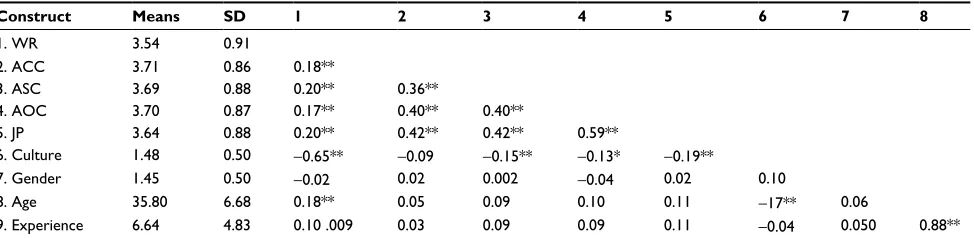
highly correlated (r=0.88, p<0.01) in our sample data. We
intended to use work experience as a control variable, because we perceive that work experience has more relevance as far
Table 1 scale items
Workplace romance (WR)
WR1: i want my relationship with my colleague to last for a very long time. WR2: i am committed to maintaining my relationship with my colleague.
WR3: i would not feel very upset if my relationship with my colleague were to end in the near future (reverse coded). WR4: it is likely that i will date someone other than my current partner at workplace within the next year (reverse coded). WR5: i feel much attached to our relationship – very strongly linked to my colleague.
WR6: i want my relationship with my colleague to last forever.
WR7: i am oriented toward the long-term future of my relationship with my colleague.
Affective organizational commitment (AOC)a
aOc1: i would be very happy to spend the rest of my career with this organization. aOc2: i do not feel emotionally attached to this organization (reverse coded). aOc3: i really feel as if this organization’s problems are my own.
aOc4: i do not feel a strong sense of belongingness to my organization (reverse coded). aOc5: This organization has a great deal of personal meaning for me.
Job performance (JP)
JP1: how do you evaluate his/her work effort? JP2: how do you evaluate the quantity of his/her work? JP3: how do you evaluate the quality of his/her work? JP4: how do you evaluate his/her overall performance?
Note:aWe replaced the term “organization” with “supervisor” and “coworkers” to measure affective commitment with supervisor and coworkers, respectively.
Psychology Research and Behavior Management downloaded from https://www.dovepress.com/ by 118.70.13.36 on 26-Aug-2020
Dovepress Mediators of workplace romance and job performance
as its effect on employee job performance is concerned. However, as Table 1 depicts, the correlation of work experi-ence with the outcome variable – job performance – is not significant. Thus, following Becker, we did not control for work experience. Similarly, the correlation between gender
and job performance is not significant.51 Therefore, we
fol-lowed Becker and did not control for gender.51
Results
Means and correlations
Means, SDs, and correlations among the constructs are presented in Table 2.
Measurement models
We used confirmatory factor analysis to test the model fitness with the data. Our measurement Model 1 comprised five latent constructs – workplace romance (WR), affective organizational commitment (AOC), affective supervisor com-mitment (ASC), affective coworker comcom-mitment (ACC), and employee job performance (JP) – and 27 observed variables. The observed variables (WR3, ASC3, and AOC5) that showed suboptimal loading or high correlation with other items were dropped. The fit indices (after dropping the
problem-atic items) – χ2=324.976, df=220, χ2/df=1.477, GFI=0.92,
IFI=0.977, TLI=0.972, CFI=0.977, and RMSEA=0.039
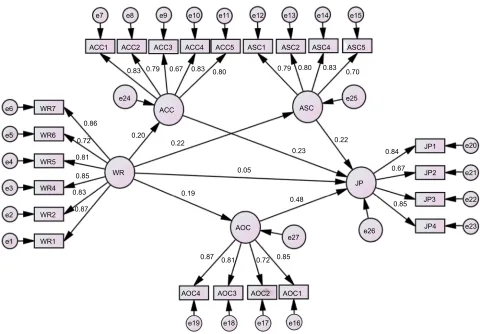
– show that the model has a very good fit with the data. The standardized outer loadings shown in Figure 1 were
significant (p<0.001).
Moreover, as the aim of the study was also to test the moderating effect of culture on the interrelationships between workplace romance, affective commitment, and employee job performance, CFA was conducted for the cul-tures of the two countries – Pakistan and People’s Republic of China – in measurement model 2. In addition, the items retained in the measurement Model 1 were retained in the
measurement model 2 for both the countries – Pakistan and People’s Republic of China – as they showed significant
loading (p<0.001). The fit indices – χ2=594.018, df=440,
χ2/df=1.35, GFI=0.87, IFI=0.961, TLI=0.955, CFI=0.961,
and RMSEA=0.034 – show that the model has a good fit
with the data.
Cronbach’s (α) values, composite reliability (CR),
maximum shared variance (MSV), average variance extracted (AVE), and average shared variance (ASV) of WR, AOC, ASC, ACC, and JP for the measurement models 1 and 2
are presented in Table 3. The values of Cronbach’s α>0.70
(Table 3) and CR>0.70 (Table 3) show that the internal
consistency and reliability are satisfactory, respectively. Further, convergent validity is satisfactory with AVE values
>0.50 (Table 3).
Discriminant validity was examined using the Fornel– Lacker test. The square root values of AVE (on the diagonal of columns 2–6 in Table 3) of WR, ACC, ASC, and AOC (Table 3) are greater than correlations of their inter-constructs (values other than on the diagonals columns 2–6 in Table 3).
In addition, ASV and MSV < AVE. Thus, the discriminant
validity of all the measurement scales is satisfactory.
structural model
To evaluate the structural Model 1, we first tested the direct effect of workplace romance on employee job performance.
The direct effect of workplace romance (β=0.216, p<0.001)
was found to be significant. The indices of this initial Model
1 – χ2=72.751, df=34, χ2/df=2.14, GFI=0.956, IFI=0.981,
TLI=0.975, CFI=0.981, and RMSEA=0.061 – showed that
the model has a very good fit with the data. Thus, Hypoth-esis 1 – “workplace romance will be positively related to employee job performance” – is supported.
In Model 2 presented in Figure 1, we included three parallel mediators – affective coworker commitment,
affec-Table 2 Means and correlations
Construct Means SD 1 2 3 4 5 6 7 8
1. WR 3.54 0.91
2. acc 3.71 0.86 0.18**
3. asc 3.69 0.88 0.20** 0.36**
4. aOc 3.70 0.87 0.17** 0.40** 0.40**
5. JP 3.64 0.88 0.20** 0.42** 0.42** 0.59**
6. culture 1.48 0.50 −0.65** −0.09 −0.15** −0.13* −0.19**
7. gender 1.45 0.50 −0.02 0.02 0.002 −0.04 0.02 0.10
8. age 35.80 6.68 0.18** 0.05 0.09 0.10 0.11 −17** 0.06
9. experience 6.64 4.83 0.10 .009 0.03 0.09 0.09 0.11 −0.04 0.050 0.88**
Note: n=312, *p<0.05, **p<0.01 level (two-tailed).
Abbreviations: WR, workplace romance; acc, affective colleague commitment; asc, affective supervisor commitment; aOc, affective organizational commitment; JP, job performance.
Psychology Research and Behavior Management downloaded from https://www.dovepress.com/ by 118.70.13.36 on 26-Aug-2020
Dovepress
Khan et al
Figure 1 structural Model 2 – Mediation model: this model shows the mediation of the relationship between work romance and employee job performance through three foci of affective commitment.
Abbreviations: WR, workplace romance; acc, affective colleague commitment; asc, affective supervisor commitment; aOc, affective organizational commitment; JP, job performance.
e7
ACC1 ACC2 ACC3 ACC4
ACC
WR
JP
AOC
AOC4 AOC3 AOC2 AOC1
JP1 e20
e21
e22
e23 e26
e27 e6
e5
e4
e3
e2
e1
e19 e18 e17 e16
JP2
JP3
JP4 WR7
WR6
WR5
WR4
WR2
WR1
ASC
ACC5 ASC1 ASC2 ASC4 ASC5 e8 e9 e10 e11
0.83 0.79 0.67 0.83 0.80 0.79 0.80 0.83 0.70
0.23
0.48 0.05
0.86
0.72
0.81
0.85
0.83
0.87
0.22
0.19
0.87 0.81 0.72 0.85
0.20 0.22
0.84
0.67
0.85 e25
e24
e12 e13 e14 e15
Table 3 Discriminant validity, convergent validity, and internal consistency
Construct overall
1 2 3 4 5 a CR AVE MSV ASV
1. WR 0.82 0.93 0.93 0.68 0.05 0.04
2. acc 0.19 0.79 0.89 0.89 0.62 0.22 0.15
3. asc 0.21 0.39 0.78 0.89 0.86 0.61 0.20 0.14
4. aOc 0.17 0.44 0.40 0.81 0.88 0.89 0.66 0.37 0.19
5. JP 0.22 0.47 0.45 0.61 0.80 0.87 0.88 0.64 0.37 0.21
Pakistan
1. WR 0.71 0.86 0.50 0.02 0.01
2. acc 0.06 0.77 0.88 0.60 0.24 0.12
3. asc 0.15 0.37 0.77 0.85 0.59 0.17 0.11
4. aOc 0.03 0.33 0.33 0.83 0.90 0.69 0.21 0.11
5. JP 0.05 0.49 0.41 0.46 0.77 0.86 0.60 0.24 0.16
People’s Republic of china
1. WR 0.77 0.90 0.59 0.06 0.04
2. acc 0.24 0.79 0.89 0.63 0.27 0.17
3. asc 0.14 0.37 0.80 0.87 0.64 0.21 0.14
4. aOc 0.19 0.52 0.43 0.79 0.87 0.63 0.56 0.26
5. JP 0.16 0.45 0.46 0.75 0.82 0.89 0.67 0.56 0.25
Note: Bold values =2AVE
Abbreviations: WR, workplace romance; acc, affective colleague commitment; asc, affective supervisor commitment; aOc, affective organizational commitment; JP, job performance; aVe, average variance extracted; MsV, maximum variance shared; asV, average variance shared; cR, composite reliability; a, cronbach’s alpha.
Psychology Research and Behavior Management downloaded from https://www.dovepress.com/ by 118.70.13.36 on 26-Aug-2020
Dovepress Mediators of workplace romance and job performance
tive supervisor commitment, and affective organizational
commitment. The fit indices – χ2=454.196, df=245, χ2/
df=1.854, GFI=0.892, IFI=0.953, TLI=0.947, CFI=0.953,
and RMSEA=0.052 – show that the model has a good fit
with the data. These results suggest that the role of affective coworker commitment, affective organizational commitment, and affective supervisor commitment as parallel mediators is important in the relationship between workplace romance and employee performance.
The significance of the role of parallel mediators – affective coworker commitment, affective organizational commitment, and affective supervisor commitment – in the relationship between workplace romance and employee performance was tested using AMOS bootstrapping by specifying a sample of 2,000. The results obtained through bootstrapping are shown in Table 4.
Table 4 shows that, after the inclusion of the parallel mediators, the direct effect of workplace romance on an employee’s job is non-significant whereas the indirect of workplace romance on job performance is significant. More-over, the effect of a control variable (evident from Figure 1) on job performance is non-significant. Thus, it is concluded that, as parallel mediators, affective coworker commitment, affective organizational commitment, and affective super-visor commitment fully mediate the positive relationship between workplace romance and employee performance. Thus, Hypothesis 2 is supported.
Moderated mediation – the moderating
role of culture
To test the moderating effect of culture in an indirect effect on workplace romance on employee job performance, a
χ2 difference test was used. For this purpose, multigroup
analysis with bootstrapping (specifying a sample of 2,000 at a 95% CI) was conducted using AMOS 24.0. Data were divided into two groups – Pakistan and People’s Republic of
China. The multigroup function in AMOS estimates the χ2
difference between the constrained (all paths of interest are constrained for the equality of structural weights) and
uncon-strained models. The comparison showed that the χ2
differ-ence between the unconstrained (χ2=691.033, df=446) and
constrained (χ2=738.775, df=471) models was significant (χ2
difference=47.742, df difference=25, p≤0.01), suggesting that
culture moderates the indirect effect of workplace romance
on employee job performance. The fit indices – χ2=691.033,
df=446, χ2/df=1.549, GFI=0.85, IFI=0.938, TLI=0.929,
CFI=0.938, and RMSEA=0.042 – showed that the model
has a good fit with the data.
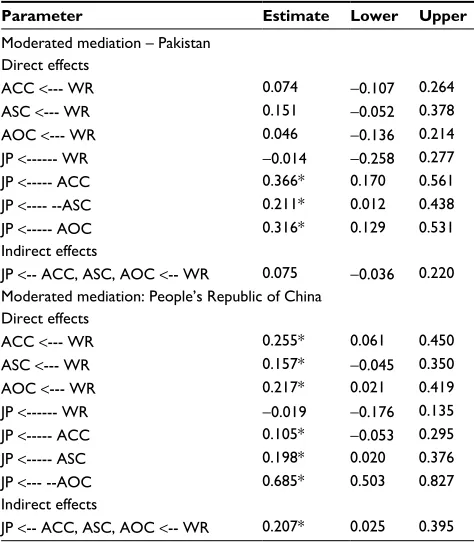
Bootstrapping results presented in Table 5 show that the three parallel mediators fully mediate the relationship between workplace romance and employee job perfor-mance for the Chinese sample whereas, in the Pakistani sample, these mediators do not mediate the relationship between workplace romance and employee job performance. Therefore, we conclude that culture moderates the indirect
Table 4 Direct and indirect effects and 95% cis
Parameter Estimate Lower Upper
Model 2 – Mediation Model Direct effects
acc <--- WR 0.201* 0.058 0.354
asc <--- WR 0.221* 0.083 0.363
aOc <--- WR 0.188* 0.052 0.327
JP <--- WR 0.055 −0.057 0.172
JP <--- acc 0.230* 0.103 0.366
JP <--- asc 0.216* 0.078 0.343
JP <--- aOc 0.481* 0.331 0.616
indirect effects
JP <-- acc, asc, aOc <-- WR 0.184* 0.078 0.286
Note: *empirical 95% ci does not overlap with zero.
Abbreviations: WR, workplace romance; acc, affective colleague commitment; asc, affective supervisor commitment; aOc, affective organizational commitment; JP, job performance.
Table 5 Direct and indirect effects and 95% cis
Parameter Estimate Lower Upper
Moderated mediation – Pakistan Direct effects
acc <--- WR 0.074 −0.107 0.264
asc <--- WR 0.151 −0.052 0.378
aOc <--- WR 0.046 −0.136 0.214
JP <--- WR −0.014 −0.258 0.277
JP <--- acc 0.366* 0.170 0.561
JP <---- --asc 0.211* 0.012 0.438
JP <--- aOc 0.316* 0.129 0.531
indirect effects
JP <-- acc, asc, aOc <-- WR 0.075 −0.036 0.220 Moderated mediation: People’s Republic of china
Direct effects
acc <--- WR 0.255* 0.061 0.450
asc <--- WR 0.157* −0.045 0.350
aOc <--- WR 0.217* 0.021 0.419
JP <--- WR −0.019 −0.176 0.135
JP <--- acc 0.105* −0.053 0.295
JP <--- asc 0.198* 0.020 0.376
JP <--- --aOc 0.685* 0.503 0.827
indirect effects
JP <-- acc, asc, aOc <-- WR 0.207* 0.025 0.395
Note: *empirical 95% ci does not overlap with zero.
Abbreviations: WR, workplace romance; acc, affective colleague commitment; asc, affective supervisor commitment; aOc, affective organizational commitment; JP, job performance.
Psychology Research and Behavior Management downloaded from https://www.dovepress.com/ by 118.70.13.36 on 26-Aug-2020
Dovepress
Khan et al
relationship between workplace romance and employee job performance. Thus, Hypothesis 3 is supported.
Discussion and conclusion
Theoretical contributions
This study first examined the relationship between workplace romance and employee job performance and then tested the mediating role of three foci of affective commitment in this relationship. Based on a two-wave survey data collected from 312 paramedical staff from Pakistani and Chinese public-sector hospitals, our study shows that mutually consensual and committed workplace romance is positively related to employee job performance. This result is consistent with the research that emphasizes the importance of constructive aspects and outcomes of workplace romance for employee
work-related attitudes and behaviors.1,5,6,10,11 The finding
supports the theories proposed by Quinn, Cole, Pierce et al, and Wright and Cropanzano who suggested that workplace
romance can improve employee job performance.5–7,12 For
example, Cole suggested that, having satisfied their compan-ionship needs, participants of workplace romance can have more time and energy available to perform their jobs and that
can improve their job performance.7 Pierce et al proposed
the impression management hypothesis which suggests that participants of a workplace romance work hard to improve their performance to counter any negative perceptions arising
because of their involvement in workplace romances.6 Wright
and Cropanzano’s happy/productive worker hypothesis also suggests a positive relationship between workplace romance
and employee job performance.12 Our finding is also in line
with that of Khan et al, who empirically showed that con-sensual and committed workplace romantic relationships are
positively related to employee job performance.1
However, the finding contradicts results reported by Salvaggio et al and Baker who suggested that workplace romances can have destructive effects on the participants of workplace romance in the form sexual exploitation, harass-ment, litigations, stress, and negative publicity and can
nega-tively affect employee job performance.8,13 This difference in
findings can be attributable to the reason that our findings are mainly based on lateral intact workplace romances (our sample comprised only 11 hierarchical workplace romances) whereas destructive effects are usually linked with hierarchi-cal and dissolved workplace romances.
As an important addition to previous studies such as those by Pierce and Aguinis, Cole, Biggs et al, and Khan et al, we introduced the three foci of affective commitment as three parallel mediators of the relationship between workplace
romance and employee performance.1,7,11,23 The results
revealed that affective commitment foci fully mediate the relationship between workplace romance and employee job performance. Thus, our study extends the workplace romance literature by showing that workplace romance, in the form of a consensual and committed relationship, is positively related to the three foci of affective commitment that, in turn, positively contribute to employee job performance. This contribution is not only important because it brings to the fore the significant role of workplace romance in employee performance and in making them affectively committed to coworkers and supervisors, but also because it can be linked with other work-related attitudes and behaviors such as
turn-over intentions and turn-overall productivity.2,6,12,52
The key addition to the literature on workplace romance is the cross-cultural comparison of the interrelationships between workplace romance, affective commitment foci, and employee job performance. To the best of our knowledge, this is the first study that has examined the moderating role of national culture on the interrelationships between work-place romance, affective commitment foci, and employee job performance. In this light, our study suggests that cultural values and belief system can be an important influence on the workplace romance experiences as well as on employee work-related behaviors and performance outcomes. The finding supports theories which suggest that technological and economic development, globalization, and modern tools of communication have made Chinese society liberal as far as its views toward romantic relationships and sexuality are
concerned.18–20 Similarly, the finding seems to support the
argument that strong family institution as well as cultural, religious, and societal taboos may not provide enough space
for romantic relationships, particularly at the workplace.44
Practical implications
Our study suggests that workplace romance should not be a necessarily problematic and disorderly factor for employee behaviors and performance. That is, managers can see work-place romance – the consensual and committed relationship – as an antecedent of affective commitment that can lead to improved employee job performance. Paramedical staff deal with human life and, if workplace romantic relations can make them affectively committed to their workplace, coworkers, and supervisors as well as improve their perfor-mance, it can contribute to better health-care service provi-sion. However, as our study is not without limitations, the practical implications should not be seen in isolation from the limitations presented in the following subsection.
Psychology Research and Behavior Management downloaded from https://www.dovepress.com/ by 118.70.13.36 on 26-Aug-2020
Dovepress Mediators of workplace romance and job performance
Limitations and future research
Our findings need careful attention, as workplace romance may not be consistent with ethical, moral, societal, and
reli-gious guidelines and norms.21,26 Our findings are based on a
small sample that is limited to the health-care sector. Future studies based on larger samples from different contexts and industries can enhance our understanding of workplace romance and the discourse on its effects. Workplace romance outcomes can be different for professions and organizations. Another limitation of our study is that we focused only on intact workplace romances; we did not study dissolved work-place romances and extramarital romances that are argued to be detrimental for different work-related behaviors and
employee performance.9 If workplace romance is dissolved,
if can negatively affect employee wellbeing and commitment and can have detrimental effects on employee job perfor-mance. Moreover, workplace romance as an extramarital affair can also be an important area for future studies.
Author contributions
Muhammad Aamir Shafiq Khan, Tehseen UL Mushtaq, Ahmed Abdul Hameed, and Muhammad Usman designed this study. Muhammad Aamir Shafiq Khan, Tehseen UL Mushtaq, and Du Jianguo collected and analyzed data. Muhammad Aamir Shafiq Khan, Ahmed Abdul Hameed, and Muham-mad Usman wrote the English version of this manuscript. Du Jianguo participated in drafting the paper and revised it critically for important intellectual content. All authors contributed toward data analysis, drafting and revising the paper, and agree to be accountable for all aspects of the work.
Disclosure
The authors report no conflicts of interest in this work.
References
1. Khan MAS, Jianguo D, Usman M, Ahmad MI. Moderated mediation model of interrelations between workplace romance, wellbeing, and employee performance. Front Psychol. 2017;8:2158.
2. Wilson F. Romantic relationships at work: why love can hurt. Int J Manag Rev. 2015;17(1):1–19.
3. Mainiero LA, Jones KJ. Sexual harassment versus workplace romance: social media spillover and textual harassment in the workplace. Acad Manag Perspect. 2013;27(3):187–203.
4. Diamond LM, Savin-Williams RC, Dubé EM. Sex, dating, passionate friendships, and romance: intimate peer relations among lesbian, gay, and bisexual adolescents. In: Furman W, Brown BB, Feiring C, editors. The Development of Romantic Relationships in Adolescence. New York: Cambridge University Press; 1999:175–201.
5. Quinn RE. Coping with cupid: the formation, impact, and management of romantic relationships in organizations. Adm Sci Q. 1977:30–45. 6. Pierce CA, Byrne D, Aguinis H. Attraction in organizations: a model
of workplace romance. J Organ Behav. 1996;17(1):5–32.
7. Cole N. Workplace romance: a justice analysis. J Bus Psychol. 2009;24(4):363–372.
8. Baker AN. Antecedents and consequences of observing workplace sexual behavior. J Manag Psychol. 2016;31(1):265–279.
9. Powell GN, Foley S. Something to talk about: romantic relationships M organizational settings. J Manag. 1998;24(3):421–448.
10. Davis J. Title VII and the workplace romance. Mun Law. 2012;53:6–10. 11. Biggs D, Matthewman L, Fultz C. Romantic relationships in organisa-tional settings: Attitudes on workplace romance in the UK and USA. Gender Manag Int J. 2012;27(4):271–285.
12. Wright TA, Cropanzano R. The happy/productive worker thesis revisited. In: Kane-Frieder RE, Hochwarter WA, Hampton HL, Ferris GR, editors. Research in Personnel and Human Resources Management. Bingley: Emerald Group Publishing Limited; 2007:269–307.
13. Salvaggio AN, Streich M, Hopper JE, Pierce CA. Why do fools fall in love (at work)? Factors associated with the incidence of workplace romance. J Appl Soc Psychol. 2011;41(4):906–937.
14. Meyer JP, Maltin ER. Employee commitment and well-being: a criti-cal review, theoreticriti-cal framework and research agenda. J Vocat Behav. 2010;77(2):323–337.
15. Wasti SA, Can Ö. Affective and normative commitment to organization, supervisor, and coworkers: do collectivist values matter? J Vocat Behav. 2008;73(3):404–413.
16. Casimir G, Lee K, Loon M. Knowledge sharing: influences of trust, commitment and cost. J Knowl Manag. 2012;16(5):740–753. 17. Van Steenbergen EF, Ellemers N. Feeling committed to work: how
spe-cific forms of work-commitment predict work behavior and performance over time. Hum Perform. 2009;22(5):410–431.
18. Hatfield E, Rapson RL, Martel LD. Passionate love and secxual desire. In: In Kitayama S, Cohen D, editors. Handbook of Cultural Psychology. New York: Guilford Press; 2007:760–779.
19. Dion KK, Dion KL. Cultural perspectives on romantic love. Pers Relatsh. 1996;3(1):5–17.
20. Yang KS. Chinese personality and its change. In: Bond MH, editor. The Psychology of the Chinese People. Hong Kong: Oxford University Press; 1986:106–170.
21. Burke RJ, Cooper CL. Psychologically intimate, romantic, and sexually intimate relationship in the workplace. In: Burke RJ, Cooper CL, editors. Risky Business: Psychological, Physical and Financial Costs of High Risk Behavior in Organizations. Farnham: Gower; 2010:205–238. 22. Williams CL, Giuffre PA, Dellinger K. Sexuality in the workplace:
organizational control, sexual harassment, and the pursuit of pleasure. Annu Rev Sociol. 1999;25(1):73–93.
23. Pierce CA, Aguinis H. Romantic relationships in organizations: a test of a model of formation and impact factors. Manage Res. 2003;1(2):161–169.
24. Mano R, Gabriel Y. Workplace romances in cold and hot organi-zational climates: the experience of Israel and Taiwan. Hum Relat. 2006;59(1):7–35.
25. Diamond LM, Dubé EM. Friendship and attachment among hetero-sexual and hetero-sexual-minority youths: does the gender of your friend matter? J Youth Adolesc. 2002;31(2):155–166.
26. Anderson CJ, Fisher C. Male-female relationships in the workplace: per-ceived motivations in office romance. Sex Roles. 1991;25(3–4):163–180. 27. Hatfield E, Sprecher S. Measuring passionate love in intimate
relation-ships. J Adolesc. 1986;9(4):383–410.
28. Dillard JP, Broetzmann SM. Romantic relationships at work: per-ceived changes in job-related behaviors as a function of participant’s motive, partner’s motive, and gender. J Appl Soc Psychol. 1989;19(2): 93–110.
29. Debrot A, Schoebi D, Perrez M, Horn AB. Touch as an interpersonal emotion regulation process in couples’ daily lives: the mediating role of psychological intimacy. Pers Soc Psychol Bull. 2013;39(10):1373–1385. 30. Koole SL, Tjew A Sin M, Schneider IK. Embodied terror management: interpersonal touch alleviates existential concerns among individuals with low self-esteem. Psychol Sci. 2014;25(1):30–37.
Psychology Research and Behavior Management downloaded from https://www.dovepress.com/ by 118.70.13.36 on 26-Aug-2020
Dovepress
Psychology Research and Behavior Management
Publish your work in this journal
Submit your manuscript here: https://www.dovepress.com/psychology-research-and-behavior-management-journal Psychology Research and Behavior Management is an international,
peer-reviewed, open access journal focusing on the science of psychology and its application in behavior management to develop improved outcomes in the clinical, educational, sports and business arenas. Specific topics covered in the journal include: Neuroscience, memory and decision making; Behavior
modification and management; Clinical applications; Business and sports performance management; Social and developmental studies; Animal studies. The manuscript management system is completely online and includes a very quick and fair peer-review system, which is all easy to use. Visit http://www. dovepress.com/testimonials.php to read real quotes from published authors.
Dove
press
Khan et al
31. Kark R. Workplace intimacy in leader–follower relationships. In: Cameron K, Spreitzer G, editors. Oxford Handbook of Positive Organizational Scholarship. Oxford: Oxford University Press; 2011: 423–438.
32. Zhang X, Long C, Wang Y, Tang G. The impact of employees’ relation-ships on tacit knowledge sharing. Chin Manag Stud. 2015;9(4):611–625. 33. Sharma J, Dhar RL. Factors influencing job performance of nursing staff:
mediating role of affective commitment. Pers Rev. 2016;45(1):161–182. 34. Schoemmel K, Jønsson TS. Multiple affective commitments: quitting
intentions and job performance. Empl Relat. 2014;36(5):516–534. 35. Jankowiak WR, Fischer EF. A cross-cultural perspective on romantic
love. Ethnology. 1992;31(2):149–155.
36. Hofstede G. Culture and organizations. Int Stud Manag Organ. 1980;10(4):15–41.
37. Dion KK, Dion KL. Psychological individualism and romantic love. J Soc Behav Pers. 1991;6(1):17–33.
38. Dion KK, Dion KL. Individualistic and collectivistic perspectives on gender and the cultural context of love and intimacy. J Soc Issues. 1993;49(3):53–69.
39. Dion KL, Dion KK. Culture and relationships: the downside of self-contained individualism. In: Sorrentino RM, Cohen D, Olson JM, Zanna MP, editors. Culture and Social Behavior: the Ontario Symposium. Mahwah, NJ: Lawrence Erlbaum Associates; 2005.
40. Kephart WM. Some correlates of romantic love. J Marriage Fam. 1967;29(3):470–474.
41. Goode WJ. The theoretical importance of love. Am Sociol Rev. 1959;24(1):38–47.
42. Rosenblatt PC. Marital residence and the functions of romantic love. Ethnology. 1967;6(4):471–480.
43. Simmons CH, vom Kolke A, Shimizu H. Attitudes toward romantic love among American, German, and Japanese students. J Soc Psychol. 1986;126(3):327–336.
44. Yasmin S. Impact of Higher Education in Understanding of Social Recognition in Women [Ph D thesis]. Islamabad: Pakistan Research Repository, HEC, web site; 2005.
45. Hyder A, Behrman JR. International trade openness and gender gaps in Pakistani labor force participation rates over 57 years. J Asia Pac Econ. 2012;17(3):367–382.
46. Siddiqui R. Modeling gender effects of Pakistan’s trade liberalization. Femin Econ. 2009;15(3):287–321.
47. Chan AW, Tong-qing F, Redman T, Snape E. Evaluating the multi-dimensional view of employee commitment: a comparative UK–Chinese study. Int J Hum Res Manag. 2006;17(11):1873–1887.
48. Baird LS. Self and superior ratings of performance: as related to self-esteem and satisfaction with supervision. Acad Manag J. 1977;20(2):291–300.
49. Hu Lt, Bentler PM. Cutoff criteria for fit indexes in covariance struc-ture analysis: conventional criteria versus new alternatives. Struct Equ Model. 1999;6(1):1–55.
50. Rusbult CE, Martz JM, Agnew CR. The investment model scale: mea-suring commitment level, satisfaction level, quality of alternatives, and investment size. Pers Relatsh. 1998;5(4):357–387.
51. Becker TE. Potential problems in the statistical control of variables in organizational research: a qualitative analysis with recommendations. Organ Res Methods. 2005;8(3):274–289.
52. Dillard JP, Hale JL, Segrin C. Close relationships in task environ-ments: perceptions of relational types, illicitness, and power. Manag Commun Q. 1994;7(3):227–255.
Psychology Research and Behavior Management downloaded from https://www.dovepress.com/ by 118.70.13.36 on 26-Aug-2020