IJEDR1702249
International Journal of Engineering Development and Research (www.ijedr.org)1587
Content Based Audio Retrieval using Chord
1Priyanka Gaonkar, 2Dr. Satishkumar Varma, 3Rupali Nikhare 1M.E. Student, 2Professor, 3Assist. Professor
1Department of Computer Engineering,
1Pillai College of Engineering, New Panvel, Navi Mumbai, India
________________________________________________________________________________________________________
Abstract—Music information retrieval (MIR) is a science of retrieving information from music signal. Extracting
high-level features of music such as melody, harmony or rhythm from the raw music signal is a critical and challenging process in Music Information Retrieval (MIR) systems. Using one of such feature will be helpful in searching and retrieving relevant musical audio track effectively and efficiently from large collection of musical audio tracks. Content-based concept is based on the content of a given audio document and extracting the necessary information from it. The proposed content based audio retrieval system retrieves relevant songs from a large dataset of music audio tracks based on melody similarity. Relevant song retrieval is done by recognizing and extracting chord progressions (CPs). Chord progressions means transitions between adjacent chords which contains music information related to tonality and harmony which is helpful in effectively distinguishing whether music audio tracks are similar to each other or not. Various combination of features (4, 6 and 9) are used which consist of features like audio spectral centroid, spectral projection, audio spectrum flatness, audio spectrum spread, spectral crest factor, spectral decrease, spectral flux, spectral kurtosis, spectral Mfcc. Then supervised statistical machine learning model such as Support Vector Machine (SVM) and Hidden Markov Model (HMM) is used for recognizing and extracting CPs from music signals. Input to the system is music audio file and output is relevant list of ordered similar audio file from the database along with their emotions like joyful, angry, depression, content or normal. Music file here belongs to any one of 5 different emotion categories. This database consists of stored predefined audio file emotions and their features vector values. There are total 300 audio files in the database out of which 70% of audio files are used for pre-storage and 30% are used for testing. Finally, based on similarity between CPs of input audio track and CPs of all songs in the database, relevant songs are returned to the user in a ranked list as the retrieval results.
IndexTerms—Audio retrieval, Support Vector Machine (SVM), Hidden Markov Model (HMM), Audio Features
________________________________________________________________________________________________________
I. INTRODUCTION
Content Based Audio Retrieval (CBAR) is one of the most popular research areas on social web sites but it is critical research topic. On internet, there are many music soundtracks, with the same or similar melody but sung and recorded by different people. It is very complex to find out the particular song from the multiple copies of music files having same name. For that we are developing mechanism to quickly and reliably retrieve relevant songs from a large dataset of music audio tracks based on melody similarity. A melody is a linear succession of music tones. CBAR, in terms of melody similarity, has several applications such as near duplicate audio detection, relevant song retrieval and recommendation, etc. In typical scenarios, a user can find audio tracks similar to his favorite melody using an audio example, or music companies can recommend to user’s new music albums with similar melodies according to listening records. These applications need large-scale CBMIR techniques.
IJEDR1702249
International Journal of Engineering Development and Research (www.ijedr.org)1588
II. THEORETICAL BACKGROUNDA. Audio Features
Different Audio features are described in this section
1) Audio Spectral Centroid (ASC), which is the midpoint of the spectral energy distribution of that sound. It acts as the "balance point" of the spectrum.
2) Spectral projection is obtained by multiplying the NASE matrix with a set of extracted basis functions. This spectrum projection is used to represent features of a spectrum after projection onto a reduced rank basis.
3) Audio Spectrum flatness (ASF) is a measure, which is used in digital signal processing, to characterize an audio spectrum. This is measure in decibel.It is measure of noisiness of the spectrum; hence high flatness values indicate noisiness. Low flatness values generally indicate the presence of harmonic components.
4) Audio Spectrum spread (ASS) is describes concentration of the spectrum around the centroid Lower spread values would mean that the spectrum is highly concentrated near the centroid and higher values mean that it is distributed across a wider range at both sides of the centroid.
5) Spectral Crest factor is used to measure of a waveform such as sound. It is also called as the ratio of peak values to the effective value.
6) Spectral Decrease represents the amount of decreasing of the spectral amplitude.
7) Spectral Flux is defined as the squared difference between the normalized magnitudes of successive spectral distributions that correspond to successive signal frames.
8) Spectral Kurtosis is pointedness of a spectrum can be used to indicate "pitchiness".
9) Mel-frequency cepstrum centroid (MFCC) is a representation of the short-term power spectrum of a sound, based on a linear cosine transform of a log power spectrum on a nonlinear mel scale of frequency.Mfccs are used as an excellent feature vector for representing musical signal.
B. Hidden Markov Model and Support Vector Machine
In this paper, Hidden Markov Model(HMM) and Support Vector Machines (SVM) method are proposed for content-based audio classification and retrieval. HMM has shown to be one of the powerful classifier in Audio retrieval and classification processing. The features extracted from the test’s audio are considered to be a sequence of events and then used as the input for the HMM. It represents a set of states and the probabilities of making a transition from one state to another state.The typical usage in audio classification is to train one HMM for each class.SVM models the boundary between the different classes instead of modeling the probability density of each class. SVM algorithm is a classification algorithm that provides state-of-the-art performance in a wide variety of application domains.
III. LITERATURE SURVEY
In this section, we refer to the relevant past literature that use the various chord recognition methods which are used for Music information retrieval (MIR) task.
Heng-Tze Cheng, Yi-Hsuan Yang, Yu-Ching Lin, I-Bin Liao and Homer H. Chen [1] proposed in Automatic Chord Recognition for Music classification and retrieval propose a new method to construct chord features for music emotion classification and evaluate its performance on commercial song recordings. They also investigated mid-level music feature construction and its applications to music classification and retrieval. With recognition accuracy as competitive as existing systems and simplicity and time-efficiency advantages, the proposed N-gram-based chord recognition system is particularly attractive for practical applications. The two proposed new chord features, longest common chord subsequence and chord histogram, are useful for music analysis, management, and retrieval. With these two mid-level music features, this system able to achieve good improvement over existing approaches that use only low level features for emotional valence prediction.
Jingzhou Yang, Jia Liu, Wei-Qiang Zhang [2], this paper present Query by humming (QBH) is an efficient way to search the song from a large database. We proposed a note-based system, which consists of noted-based linear scaling (NLS) and noted-based recursive align (NRA), and makes use of both note information and the difference among the distributions of humming. Comparison experiments against several other widely-used algorithms in QBH reveal that our proposed system can get a good balance between computation time and recognition rate.
Laurent Oudre, CédricFévotte [3], this paper describes a probabilistic approach to template-based chord recognition in music signals. The algorithm only takes Chroma gram data and a user-defined dictionary of chord templates as input data. No training or musical information such as key, rhythm, or chord transition models is required. The chord occurrences are treated as probabilistic events, whose probabilities are learned from the song using an expectation–maximization (EM) algorithm. The systems are tested on two evaluation corpuses; the first one is composed of the Beatles catalog (180 pop-rock songs) and the other one is constituted of 20 songs from various artists and music genres. The chord transcription output by our automatic chord transcriber is a sequence of chord labels with their respective start and end times. This output can be used for song playback—which constitutes the main aim of our system—but also in other applications such as song identification, query by similarity or structure analysis.
IJEDR1702249
International Journal of Engineering Development and Research (www.ijedr.org)1589
R.Thiruvengatanadhan,P.Dhanalakshmi [5], this paper present music classification using SVM and GMM. Accuracy of system is based on features and classification model. In this paper both Time domain and Frequency domain features are extracted from audio signal.Time domain features are Zero Crossing Rate (ZCR) and Short Time Energy (STE). Frequency domain features are spectral centroid, spectral entropy and spectral roll-off. After extracting feature, classification is carried out, using Support Vector Machine (SVM) and Gaussian Mixture Model (GMM). SVM is trained and tested for different kernel function and performance. Both SVM and GMM are comparing based on performance. But GMM are providing better performance compared to SVM.S.Suguna, J.BeckyElfreda [6], this paper present cepstral Features for audio retrieval. Audio information retrieval has been performed on GTZAN datasets using weighted Mel-Frequency Cepstral Coefficients (WMFCC) feature which is a kind of cepstral feature. The results obtained for the various stages of feature extraction WMFCC and retrieval performance plot has been presented. The use of Distance-from-Boundary (DFB) and Support vector machine (SVM), audio retrieval and classification task which use Mel cepstral feature had been performed on a database which consists of 409 sounds of 16 classes. The results for the various stages of WMFCC feature extractions have been obtained. With the help of WMFCC feature, audio retrieval task has been performed on the GTZAN database.
ShrutiVaidya,Kamal Shah [7], proposed application for vector quantization for audio retrieval. In this paper, study of audio content analysis for classification is presented, in which an audio signal is classified according to audio type. Different features like, zero-crossing rate (ZCR), low short-time energy ratio (LSTER), spectrum flux (SF), spectrum roll off (SR) are used with K-nearest-neighbor (KNN) and Fast Fourier Transform (FFT). Reducing number of audio features reduces the accuracy levels. IV. CONTENT BASES AUDIO RETRIEVAL SYSTEM (CBARS)
A. System Architecture
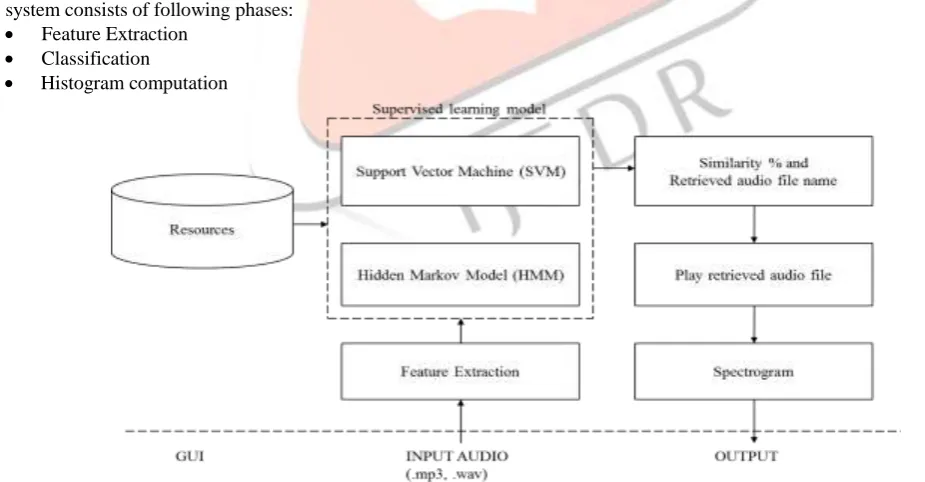
The basic operation performed by this system is as follows. First, the feature vectors are estimated for each and every signal from the database. Then, feature vectors are estimated for each input signal from the user. The feature vectors of input signal from the user are compared to each feature vectors of audio signal form the database. This database consists of predefined audio file emotions and their features vectors are calculated and store in matrix. If majority of the features of input test audio file matches with the stored database then that audio file is retrieved. Here we are extracting top 10 similar audio files which are available in the database. When we search something from any search engine then we get top 10 results on first search. These top 10 retrieved webpages are ranked according to various factors like number of users visited or like number of time spent on particular website or particular page of that website. This system is designed so that we obtain top 10 similar audio files based on the audio features and emotion of the audio. Then supervised learning model is used for recognizing CPs from each Feature vector from input audio track and all audio tracks in the database. System uses Support Vector Machine (SVM) and Hidden Markov Model (HMM) supervised machine learning algorithm. Finally, based on similarity between CPs of input audio track and CPs of all songs in the database, relevant songs are returned to the user in a ranked list as the retrieval results. The system architecture of this system is shown in figure 1, which represents how the Content based audio retrieval system proceeds.
The system consists of following phases: Feature Extraction
Classification
Histogram computation
Figure1System Architecture for CBARS
B. Working of CBAR System
Following figure shows, working of the CBAR System User Interface
IJEDR1702249
International Journal of Engineering Development and Research (www.ijedr.org)1590
Figure 2Audio input displayed in graphAudio Feature Extraction
After selecting audio file, then next step
is
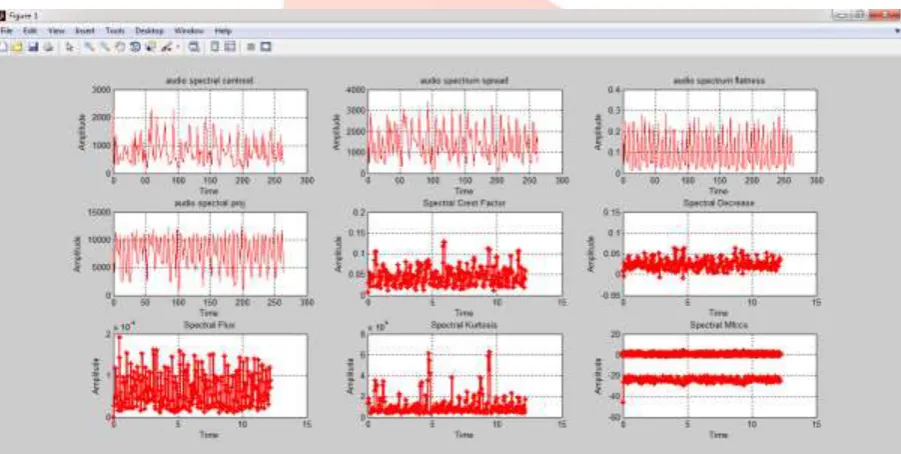
feature extraction is shown in figure 3 where all features for selected audio is calculated and displayed to the user. There are 9 features calculated for 1 audio input.Figure 3Audio Feature Extraction
Calculating similarity % using SVM Classifier
IJEDR1702249
International Journal of Engineering Development and Research (www.ijedr.org)1591
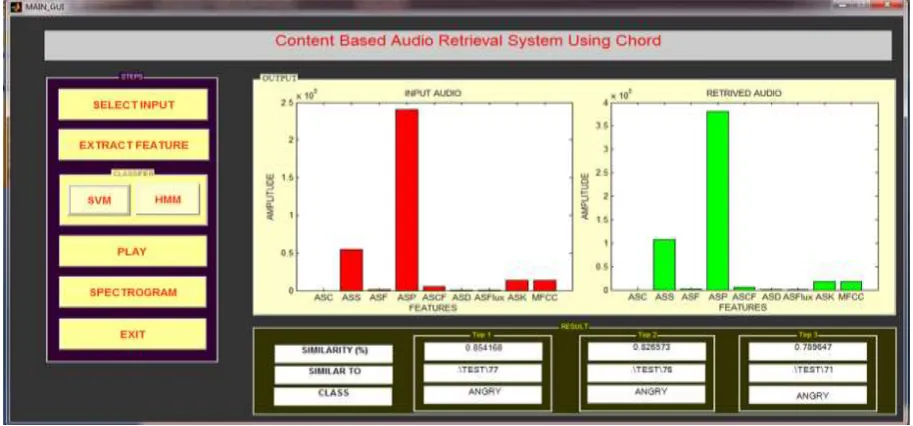
Figure 4Calculation of similarity % using SVM ClassifierList of top 10 audio files names retrieved are displayed to the user in the background which is shown in figure 5.
Figure 5Top 10 audio files retrieved using SVM
Calculating similarity % using HMM Classifier
IJEDR1702249
International Journal of Engineering Development and Research (www.ijedr.org)1592
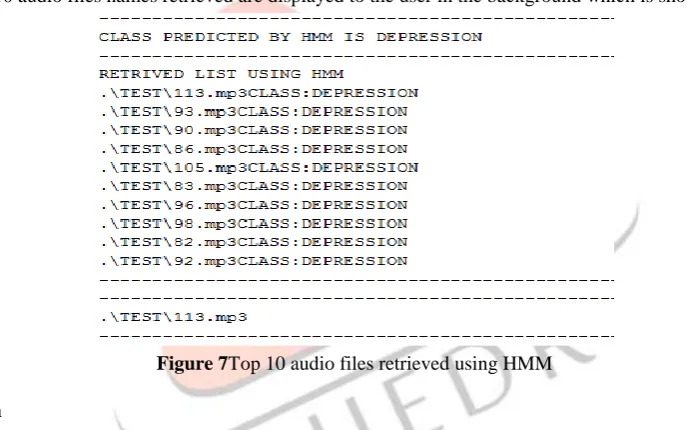
Figure 6Calculation of similarity % using SVM ClassifierList of top 10 audio files names retrieved are displayed to the user in the background which is shown in figure 7.
Figure 7Top 10 audio files retrieved using HMM
Audio Spectrogram
Input audio spectrogram is shown in figure 8 where x-axis is having normalized frequency and y-axis is having time factor. Exit button from the GUI is shown is figure 8 where user can come out of the GUI by terminating the GUI process.
IJEDR1702249
International Journal of Engineering Development and Research (www.ijedr.org)1593
Feature ValueFeature value matrix is shown in Figure 9 for the trained files. Here rows specify feature values and column specify features for particular trained file.
Figure 9Feature Value
V. RESULT ANALYSIS
A result obtained from the various runs of the experiments conducted is shown in table 1. There are 4 sets of data files taken. First set is 75 audio files, second is 150 audio files, and third is 225 audio files and finally 300 audio files. All these sets are manually divided for training and testing process into 70% by 30 % ratio. Correct file classification means total number of files correctly classified as similar by the system by using different features. Incorrect file classification means total number of files incorrectly classified as non-similar by the system. Numbers of features taken for experimentations are 4, 6, and 9 respectively for each data set. Features for training audio files are calculated and stored for testing later on. Set of 4 features considered are: Audio Spectral centroid (ASC), Spectral projection, Audio Spectrum Flatness (ASF) and Audio Spectrum Spread (ASS). Set of 6 features considered are: Audio Spectral centroid (ASC), Spectral projection, Audio Spectrum Flatness (ASF), Audio Spectrum Spread (ASS), Spectrum Crest Factor and Spectral Decrease. Set of 9 features considered are: Audio Spectral centroid (ASC), Spectral projection, Audio Spectrum Flatness (ASF), Audio Spectrum Spread (ASS), Spectrum Crest Factor, Spectral Decrease, Spectral Flux, Spectral Kurtosis and Spectral Mfcc.
In table 1, similarity % using SVM and HMM classifier with 9, 6 and 4 features is shown. Total numbers of audio files used are 300 for experimentation. Set of 75 and total 4 sets of data is used. Out of which 70% is used for predefining the data, also called as training and 30 % is used for testing. Here we will use the word defined or train simultaneously. In serial number 1, total numbers of audio files selected are 75. Out of which manually selected 56 audio files are used for predefining or labeling, also called as training and 19 audio files are used for testing. 19 files are tested under combination of features (9, 6 and 4). Similarly, the data in training and testing set are incremented.
Table 1Results obtained from the various runs of the experiments
SN Total No. of audio files Similarity % for SVM and HMM
9 features 6 features 4 features
SVM HMM SVM HMM SVM HMM
1 75, Defined: 56, Test: 19 53.26 27.53 45.70 25.23 37.39 20.20
2 150, Defined: 112,Test: 38 59.66 38.73 51.88 33.15 42.64 26.72
3 225, Defined: 168, Test: 57 65.44 46.29 56.84 39.07 47.44 31.56 4 300, Defined: 210, Test: 90 68.94 50.86 59.96 42.94 50.59 35.08
IJEDR1702249
International Journal of Engineering Development and Research (www.ijedr.org)1594
Figure 9Average Similarity % for SVMand HMM classifierwith 4, 6 and 9featuresVI. CONCLUSION
The use of content-based approaches has always been a common strategy in the music information retrieval area. Content Based Audio Retrieval (CBAR) is one of the most popular research areas on social web sites. The algorithm consists of two key points: recognizing chord progressions from a music audio track based on a supervised learning model related to musical knowledge and computing a summary of the audio track from the recognized chord progressions by locality sensitive hashing (LSH). Statistical approaches for extraction of chord progressions using SVM and HMM based framework is proposed. This system takes predefined/pre-stored, also called labeled data or resources. System predicts and displays the emotion of the input test audio file, calculates and displays Similarity% and name of retrieved audio file (which is most similar) is displayed on the screen. A list of 10 audio files is displayed to the user in the background of this system. As user is not interested in only one audio file which is most similar to the input test audio file but instead of list of top 10 or more audio file names similar to any search engine output results. Then users also have option to hear the retrieved output file by clicking on play button on the user interface. The user can see the spectrogram and finally can close the interface by clicking on exit button. This terminates the working of the system. Else user can continue using the system and start the process again by selecting an audio input test file. And the process repeats. Maximum average similarity % is obtained by 9 features using SVM classifier as compared to HMM classifier model. VII. ACKNOWLEDGMENT
I am using this opportunity to express my gratitude to thank all the people who contributed in some way to the work described in this paper. My deepest thanks to my project guide for giving timely inputs and giving me intellectual freedom of work. I express my thanks to the head of computer and IT department, M.E. coordinator and to the principal of Pillai College of Engineering, New Panvel for extending their support.
REFERENCES
[1] Heng-Tze Cheng, I-Bin Liao and Homer H. Chen, “Automatic Chord recognition for music classification and retrieval”, ICME 2008, pp. 1505-1508.
[2] Jingzhou Yang, Jia Liu, Wei-Qiang Zhang “A Fast Query by Humming System Based on Notes”, In Proc. ISCA, September 2010, pp. 2898-2901.
[3] Laurent Oudre,CedricFevotte, “Probabilistic Template-Based Chord Recognition”, IEEENovember 2011, pp.2249 – 2259.
[4] J. Osmalskyj, J.J. Embrechts, S. Pierard, M. Van Droogenbroeck, “NEURAL NETWORKS FOR MUSICAL CHORDS RECOGNITION”, Actes des Journées d’Informatique Musicale (JIM 2012), Mons, Belgique, 9-11, May 2012.
[5] R.Thiruvengatanadhan,P.Dhanalakshmi[7],”Speech/Music Classification using SVM and GMM”, IJARCSSE, September 2013, pp. 793-801.
[6] S.Suguna,J.BeckyElfreda, “Audio Retrieval based on Cepstral Feature”,In Proceeding of International Journal of Computer Applications (IJCA), December 2014, pp. 28-33.
[7] ShrutiVaidya, KamalShah,“Application of Vector Quantization for Audio Retrieval”,Volume 88, February 2014, pp. 0975 – 8887.
[8] J. T. Foote, “Content-Based Retrieval of Music and Audio.” In Proc. SPIE, vol.3229, 1997, pp. 138-147.
[9] Wang. A “Automatic Identification of Musical Versions Using Harmonic Pitch Class Profiles”, PhDthesis,September 2011.
[10] MaksimKhadkevich, “Music signal processing for automatic extraction of harmonic and rhythmic information”, PhD thesis, December 2011.
[11] T. E. Ahonen, “Combing chroma features for cover version identification,” In Proc. ISMIR, 2010, pp. 165–170. 0.00% 10.00% 20.00% 30.00% 40.00% 50.00% 60.00% 70.00% 80.00%
56 112 168 210
A vg . Si m ilar ity (i n % )
No. of defined/trained files
Average Similarity % for SVM and HMM classifier with 9, 6 and 4 features
9 features SVM Classifier
9 features HMM classifier
6 features SVM classifier
6 features HMM classifier
4 features SVM classifier
IJEDR1702249
International Journal of Engineering Development and Research (www.ijedr.org)1595
[12] Y. Yu,M. Crucianu, V. Oria, and E. Damiani, “Combing multi-probing histogram and order-statistics based LSH for scalable audiocontent retrieval,” In Proc. ACM MM, 2010, pp. 381–390.