R E S E A R C H A R T I C L E
Open Access
Using differential item functioning to
evaluate potential bias in a high stakes
postgraduate knowledge based assessment
David Hope
1*, Karen Adamson
2, I. C. McManus
3, Liliana Chis
4and Andrew Elder
4Abstract
Background:Fairness is a critical component of defensible assessment. Candidates should perform according to ability without influence from background characteristics such as ethnicity or sex. However, performance differs by candidate background in many assessment environments. Many potential causes of such differences exist, and examinations must be routinely analysed to ensure they do not present inappropriate progression barriers for any candidate group. By analysing the individual questions of an examination through techniques such as Differential Item Functioning (DIF), we can test whether a subset of unfair questions explains group-level differences. Such items can then be revised or removed.
Methods:We used DIF to investigate fairness for 13,694 candidates sitting a major international summative postgraduate examination in internal medicine. We compared (a) ethnically white UK graduates against ethnically non-white UK graduates and (b) male UK graduates against female UK graduates. DIF was used to test 2773 questions across 14 sittings.
Results:Across 2773 questions eight (0.29%) showed notable DIF after correcting for multiple comparisons: seven medium effects and one large effect. Blinded analysis of these questions by a panel of clinician assessors identified no plausible explanations for the differences. These questions were removed from the question bank and we present them here to share knowledge of questions with DIF. These questions did not significantly impact the overall performance of the cohort. Group-level differences in performance between the groups we studied in this examination cannot be explained by a subset of unfair questions.
Conclusions:DIF helps explore fairness in assessment at the question level. This is especially important in high-stakes assessment where a small number of unfair questions may adversely impact the passing rates of some groups. However, very few questions exhibited notable DIF so differences in passing rates for the groups we studied cannot be explained by unfairness at the question level.
Keywords:Assessment, Fairness, Bias
Background
Promoting fairness in assessment is an important prior-ity. Entrance to medical school and progression as a doctor should be determined by ability, not ethnicity or sex [1]. Recognising this, many governing bodies now explicitly require educational processes to be fair in re-spect to“protected characteristics”such as ethnicity and
sex [2]. The need for fairness is now formally identified in key reference guides on test construction, whereby unfairness is seen as irrelevant variance threatening the validity of the construct, which must therefore be identi-fied and removed. [3] Developing assessment practices that differentiate candidates by ability without acting in a discriminatory way in relation to protected characteris-tics is a particular necessity for those running profes-sional assessments [4].
Despite such aspirations, protected characteristics re-main influential predictors of outcome at every stage of * Correspondence:[email protected]
1Centre for Medical Education, The Chancellor’s Building, College of Medicine and Veterinary Medicine, The University of Edinburgh, 49 Little France Crescent, Edinburgh, Scotland EH16 4SB, UK
Full list of author information is available at the end of the article
medical training. A meta-analysis of 22 studies found moderate (d= 0.42) effects whereby ethnically non-white UK graduates underperformed relative to white UK graduates in assessments at both undergraduate and postgraduate levels. Nor is it merely an assessment issue – questionnaires evaluating the postgraduate working experience find ethnically non-white trainees experience lower levels of satisfaction [5]. In relation to sex, there is evidence that men and women prefer different types of assessment and in at least one case – true/false MCQs (Multiple Choice Questions) where candidates are pena-lised for incorrect answers – the format of the assess-ment can produce significant sex differences [6].
The overall underperformance of candidates from a particular group is generally referred to as Differential Attainment(DA), and it can have multiple and complex origins – as seen for instance in ethnic and sex differ-ences in school level attainment in UK students [7]. In postgraduate assessment concerns over potential bias have often focused on clinical examinations where ex-aminers are in direct contact with the candidate. DA re-lating to ethnicity and sex have been identified in many postgraduate examinations, but examiner bias has not been found to explain these differences in, for instance, either MRCP(UK) [8,9] or MRCGP [10]. Despite signifi-cant professional and public interest and a judicial re-view the causes of such differences remain unclear, and the possibility that they relate to as yet unidentified char-acteristics of the candidates or their training experience and environment, rather than identifiable characteristics of the examinations, is under active exploration [9,11,12]. Proposed explanations have included subconscious bias, varying standards at different educational facilities, or ex-perts favouring those similar to themselves [11,12]. These explanations are speculative or, in some cases, have not been borne out by research, but all sources we are familiar with accept that differential attainment is not due to in-herent ethnic or sex differences [11].
Differential attainment also exists in written post-graduate assessments [9,13], further suggesting that fac-tors other than the influence of direct examiner bias are in operation, not the least since most of these assess-ments are comprised of machine marked MCQ ques-tions. Again, however, the precise reasons for the differences are not fully understood. A possible con-tributor may be the relative degree of difficulty of spe-cific questions or groups of questions for candidates with different characteristics. A simple example may be that candidates who practice in a country where a given condition is rarely encountered, may have more diffi-culty with questions regarding the condition. However, even in situations where candidates have received their primary medical qualification in the same country, in this case the UK, differences in overall performance in
examinations between candidates with different pro-tected characteristics (e.g. sex, ethnicity) can be identi-fied, and the possibility that this could relate to inadvertent differential item functioning explored.
The identification of differential attainment in many types of assessment and levels of training supports the ab-sence of a single, readily identifiable root cause and im-plies a multifactorial problem [13]. A key responsibility of all providers of high stakes assessments is to seek and identify any sources of bias in their examination, and to evaluate the cause, extent and implication of any bias that is identified. Solutions can then be proposed on a case-by-case basis. As one part of this process, MCQs must be carefully evaluated to explore whether particular special-ties, topics, or question structures exhibit bias [14,15]. By doing this we can better understand the causes of bias in written assessment and prevent such bias in the future.
Simple tests for bias may be uninformative. A compari-son of mean scores (e.g.“on question 7, do males perform differently from females?”) provides a useful diagnostic but only compares average performance level in different groups. This may conceal performance differences at the lower end of the ability curve (important as such candi-dates are at risk of failure) and the upper end (where can-didates are in contention for merits and awards).
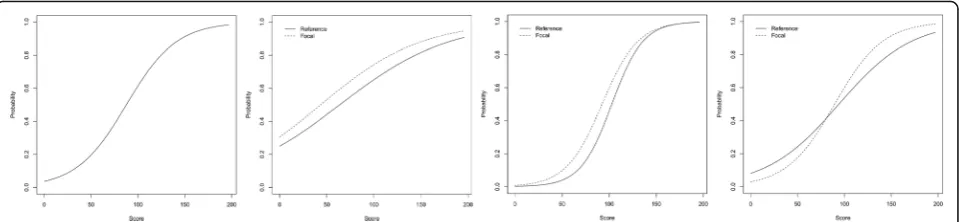
A more robust method for evaluating item-level bias is to test for Differential Item Functioning (DIF), which takes into account differences at every level of candidate ability [16, 17]. Tests for DIF compare two (or more) groups of interest: whites vs. non-whites, for instance, or males vs. females. The test compares performance for these groups on each test question at every stage of the overall ability curve. It therefore allows exploration of whether bias is concentrated in particular areas (border-line or excellent candidates) and how the bias interacts with ability. DIF can defineno bias, uniform differences (group A outperforms group B across the ability curve), non-uniform differences (group A outperforms group B, but the size of the gap varies), or even crossing differ-ences (group A outperforms group B on some parts of the curve, but the opposite is true at other parts of the curve). Figure 1illustrates an example. After identifying questions with these characteristics, test setters and question writers can then review or remove those ques-tions from future forms of the examination.
In summary, tests for DIF can accurately detect poten-tial bias across the ability curve at the question level and identify problem questions for evaluation or revision. Although many free online tools exist to test for DIF and can be used by any interested party [18, 19] they have yet to be widely applied in medical education or the academic governance of high stakes postgraduate examinations in the UK.
In this study, we investigated the performance of 13,694 candidates sitting the [MRCP(UK) Part 1 examin-ation], a high stakes postgraduate assessment in internal medicine and we compare (a) ethnically white UK grad-uates against ethnically non-white UK gradgrad-uates and (b) male UK graduates against female UK graduates. DIF was used to test 2773 questions across 14 sittings, each initially comprising two three hour papers of 100 ques-tions each. We report the results of the DIF analysis alongside a review of questions exhibiting DIF.
Methods
Participants
All analyses were carried out on different diets (forms) of the same high stakes postgraduate examination. The examination is a criterion-referenced written examin-ation comprised of 200 questions, sat in two separate 3 hour papers of 100 questions each, designed to assess core clinical knowledge. Blueprinting, item content and standard setting are all developed and determined by panels of experts with relevant clinical backgrounds.
Fourteen sittings were included in this analysis: three each for 2011, 2012, 2013 and 2014, and two for 2015. In total, there were 47,048 candidate entries across the fourteen sittings, which included candidates who had not qualified in the UK. Candidates had been invited to provide information on their protected characteristics, which included sex, whether their primary medical qualification was from the UK or not and whether they were ethnically white or ethnically non-white, as part of the routine application process for the examinations. 6047 candidates failed to provide information on any or
all of these questions, and a further 27,307 sittings were excluded due to the candidate not having a UK PMQ. This left 13,694 candidate sittings – all UK graduates– in the present study with graduates who were resitting being included as separate entries for the purpose of the present study. Consequently, some candidates had mul-tiple entries in the analysis, with each entry being a sin-gle attempt at the examination, sat during different diets. No candidate had multiple entries for any individ-ual diet. Candidates routinely provided consent for anonymised analysis of examination results, and ap-proval was granted by the MRCP(UK) board for the work to be undertaken.
Statistical analyses
All analyses were carried out inR[20]. For step-by-step guides on how to replicate the analyses described here see the guidance notes provided in the packagedifR[19] or for an alternative see thelordifpackage [18]. We ran a DIF analysis separately on each of the 14 datasets. Ini-tially, there were 200 questions in each sitting. Post-hoc analysis of question quality (including discrimination and facility) led to 27 questions being discounted over the 14 sittings. These were not included in the DIF ana-lysis. The passing standard for each diet was determined through statistical equating, a process designed to ensure comparable standards across different diets [21]. The DIF analysis used the probability of getting the item correct as the dependent variable.
For each question we calculated DIF using the logistic regression method [16] which can detect uniform and non-uniform effects, and significance was evaluated via the Wald test. Sex and ethnicity were modelled separ-ately. In total, 2773 tests were run for sex and 2773 tests were run for ethnicity for a total of 5546 tests: one test per question per characteristic of interest. Inevitably this raises the prospect of a significant number of false posi-tives and DIF procedures routinely correct for this possi-bility. With no corrections, 139 “significant” results would be expected for sex and 139 for ethnicity: a total
of 278“significant” results in a random dataset with no genuine DIF results [22, 23]. In our DIF procedure we adjusted the alpha level to .01 and report on tests signifi-cant at that level as a compromise between being too stringent (and so missing signs of DIF) and too lenient (reporting DIF where none occurs). The choice between being too lenient and too stringent when making statistical adjustments is to a great extent a matter of judgment. We note however that a strict Bonferroni cor-rection–which fully adjusts for the problem of multiple comparisons – for the conventional p< .05 would, with 5546 tests, require p < .05/5546 = 9.01 × 10⁻⁶for signifi-cance after adjusting for multiple testing.
We report the number of questions identified as exhi-biting DIF. We further investigated any questions with either a medium or large effect size as measured by Nagelkerke’s R2
[19]. All eight such questions were passed to a ten-member panel of clinicians with varying types of involvement with postgraduate examinations (question writers, standard setters, clinical examiners) who were informed only that the questions exhibited DIF, but not the nature of the DIF effect, its strength, or which group was disadvantaged.
Results
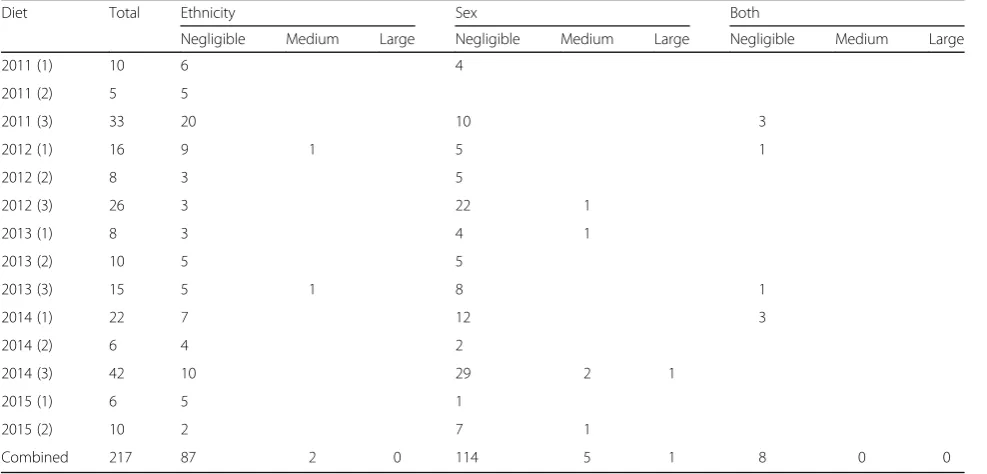
Table 1 shows the distribution of DIF questions in the diets studied, and their effect and direction according to sex and ethnicity. In total, 217 questions exhibited DIF using the .01 alpha level (as opposed to an expected 645 to occur by chance using a .05 alpha level) but the
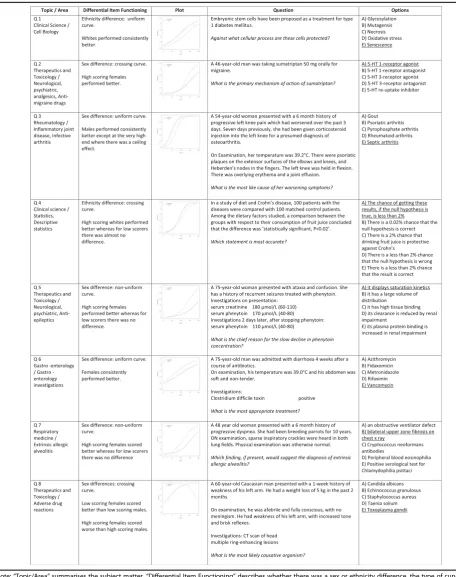
effects were almost always negligible: that is, the DIF has only a very small impact on group-level differences [19]. The frequency of DIF questions per paper varied over time using the .01 alpha level, from a minimum of five to a maximum of 42. Eight medium or large DIF effects were identified, and received further analysis. For com-parison, using a too-liberal procedure that did not cor-rect for multiple comparisons yielded a total of 645 significant results. None of the nominally significant ef-fects reached a Bonferroni corrected level of 9.01 × 10⁻⁶. Table 2 reports the detailed breakdown of the eight notable DIF cases that had either medium or large ef-fect sizes, provides a visual overview of the DIF efef-fect, the question text and the options. In summary, most of the questions showed DIF with regards to sex, not eth-nicity. All types of DIF (uniform, non-uniform and crossing) were found. For the two questions showing notable DIF with regards to ethnicity, white UK gradu-ates were advantaged in both cases. One item exhibited a uniform curve and one a crossing curve. For the six questions showing notable DIF with regards to sex, the picture was mixed but female graduates tended to be advantaged over male graduates. Two items exhibited uniform curves, two non-uniform curves and two crossing curves.
Expert review
Following this analysis, the eight questions were reviewed by an expert panel comprised of ten clinicians of diverse backgrounds (UK trained and non-UK trained, male and
Table 1A summary of items with Differential Item Functioning
Diet Total Ethnicity Sex Both
Negligible Medium Large Negligible Medium Large Negligible Medium Large
2011 (1) 10 6 4
2011 (2) 5 5
2011 (3) 33 20 10 3
2012 (1) 16 9 1 5 1
2012 (2) 8 3 5
2012 (3) 26 3 22 1
2013 (1) 8 3 4 1
2013 (2) 10 5 5
2013 (3) 15 5 1 8 1
2014 (1) 22 7 12 3
2014 (2) 6 4 2
2014 (3) 42 10 29 2 1
2015 (1) 6 5 1
2015 (2) 10 2 7 1
Combined 217 87 2 0 114 5 1 8 0 0
Note: Following the convention on effect sizes for DIF described by Magis et al., effect sizes below the medium threshold are classed as negligible rather than
small. Blanks indicate no items of that magnitude.“Total”refers to total number of significant DIF tests. As some items exhibited DIF for both ethnicity and sex,
Table 2Eight items exhibiting medium- or large- effects of Differential Item Functioning
Note:“Topic/Area”summarises the subject matter.“Differential Item Functioning”describes whether there was a sex or ethnicity difference, the type of curve
observed, and gives a description of the trend. For“plot,”probability indicates the probability of answering the item correctly. Score indicates the candidate’s
performance overall. Typically, candidates who score well on the exam should be more likely to answer the item correctly, but this is not always the case. The
solid“reference”line refers to males, or ethnically white UK graduates, depending on whether a sex or ethnicity difference was found. The dashed line refers to
females or ethnically non-white UK graduates. See Fig.1for more details about curve types.“Question”is the text of the question as seen by candidates.“Options”
lists the five available options. The keyed answer is underlined
female, ethnically white and ethnically non-white) to evaluate the possible causes of DIF. The analysis was blinded. Reviewers were not able to consult with other panel members, and knew only that DIF was present – not the type or magnitude. No reviewer was able to suggest any cogent explanation for the DIF for any item.
Discussion
This paper presents the first evaluation of DIF in the context of a large postgraduate medical examination, the MRCP(UK). In this dataset, which relates to a single high stakes postgraduate knowledge based assessment of single best answer MCQ design, and is comprised of an extremely large sample size of test takers and ques-tions, DIF was detected using simple software and stat-istical tools. Importantly however the analysis shows most such effects are negligible and only a very small number of questions exhibit DIF of a medium or large effect size. Furthermore, no clear cause of the observed DIF can be derived from analysis of independent blinded panel review.
This research shows that methods to evaluate DIF suc-cessfully used in other fields can be applied to medical education [16,17]. Differential attainment in postgradu-ate examinations cannot primarily be explained by bias at the question level.
We believe that this analytical strategy is simple, ad-vantageous and suggests that DIF evaluation can be one of a range of measures to test fairness. Routine analysis will identify the–apparently rare–cases of notable DIF and so promote fairness at the borderline of pass/fail de-cisions. Connecting such psychometric analyses with ex-pertise in question writing allows for the development of better training in question-writing, promotes awareness of the possibility of bias in written assessment, and al-lows for the development of a body of knowledge around questions most likely to produce bias. The not-able DIF questions have all been withdrawn from the question bank and publicised amongst question writers, even though the reason for their differential functioning is unclear. As more items are identified in future ana-lyses it may be that common structural or content issues will emerge as explanations.
The study had some limitations. Replications on novel datasets are required to evaluate how common DIF effects are in other areas of assessment. As some candidates are prone to resitting, and therefore will have appeared in multiple datasets, exploring whether resitting candidates exhibit DIF compared to non-resitters of similar ability levels would be useful in ex-tending this analysis. Furthermore, evaluation at the undergraduate level would be very helpful given the im-portance of differential attainment in application to medical school and performance at medical school.
While we were able to evaluate possible reasons for question bias, we consulted experts, rather than nov-ices, and work with candidates applying to sit assess-ment would be a useful comparator to identify why questions might (or might not) be considered biased. Exploring other features of the items –such as length, item type, language complexity and so on – may be a useful avenue of exploration. Furthermore, Identifying and publicising problem questions could be a powerful tool for advancing fairness if other organisations re-peated this analysis and pooled the results. Importantly, the causes of DIF were unexplained and whether they are false positives or due to some yet unstudied factor remains open. Relatedly, this method was only one of a family of DIF procedures, and comparing it against other techniques (e.g. Mantel-Haenszel) may yield slightly different results.
This research has provided a model for the monitoring and removal of questions with DIF in high stakes assess-ment. By making such analyses routine, we can promote fairness at the question level and ensure that assessment is based solely on candidate ability. Questions showing DIF were rare, and there was usually little clear relation-ship of the substantive content of the questions to the DIF found, suggesting that in most cases the DIF was of little meaning in relation to the overall performance of the candidates.
Our expert review was blinded to the nature or direc-tion of DIF, but the reviewers knew that DIF was present. A more exacting test, perhaps to be carried out in the future, would be to give examiners a balanced set of questions and say that a third showed DIF evidence of sex differences, a third showed DIF evidence of ethnicity differences, and a third showed no evidence of DIF by sex or ethnicity, and ask them to judge which question was in each type. Our feeling is that examiners probably would be unable to do that task correctly, suggesting that there are few obvious features about these questions which are related to the presence of DIF.
Conclusions
Overall it seems highly unlikely that any candidates were disadvantaged by the small effects that were found. The differential attainment of candidates in the various groups does however remain, and remains unexplained, but can-not be attributed to differential item functioning in relation to sex or ethnicity of particular questions in this multiple choice assessment across the range of diets analysed.
Additional file
Abbreviations
DA:Differential Attainment; DIF: Differential Item Functioning; MCQ: Multiple Choice Question; MRCGP: Membership of the Royal College of General Practitioners; MRCP(UK): Membership of the Royal Colleges of Physicians (United Kingdom); PMQ: Primary Medical Qualification
Acknowledgements None.
Funding
Funding was provided by MRCP(UK) to conduct the work.
Availability of data and materials
The dataset was extracted from the MRCP(UK) database of assessment. Due to its confidentiality, the data cannot be made publicly available. Therefore public data sharing is not possible.
Authors’contributions
DH: Primary author, conducted core analyses, wrote paper, and managed day to day research contributing to the paper. Approved the manuscript and is accountable for all of the work. KA: Contributing author, conducted analyses (organising work done by the expert panel, summarising the results, and contributing to the conclusions from that part of the project). Revised the manuscript, approved its content and is accountable for all of the work. ICM: General oversight of psychometrics. Proposed revisions to core analyses during development of the paper. Contributed to interpretation of results and conclusions from the work. Revised the manuscript, approved its content and is accountable for all of the work. LC: Supported development of the dataset, advised on preparing the data for analysis, commented on results and theoretical framework. Revised the manuscript, approved its content and is accountable for all of the work. AE: Commissioned project, proposed initial analyses and assisted with interpretation of results and conclusions. Revised the manuscript, approved its content and is accountable for all of the work. All authors read and approved the final version of the manuscript.
Ethics approval and consent to participate
Candidates routinely provided consent for anonymised analysis of examination results, and approval was granted by the MRCP(UK) Academic, Quality Management and Research Committee (AQMRC) for the work to be undertaken.
Consent for publication Not applicable.
Competing interests
The authors declare that they have no competing interests.
Publisher’s Note
Springer Nature remains neutral with regard to jurisdictional claims in published maps and institutional affiliations.
Author details
1Centre for Medical Education, The Chancellor’s Building, College of Medicine and Veterinary Medicine, The University of Edinburgh, 49 Little France Crescent, Edinburgh, Scotland EH16 4SB, UK.2Medical Unit, St John’s Hospital, Livingston, Scotland EH54 6PP, UK.3Research Department of Medical Education, The Medical School, University College London, Gower Street, London WC1E 6BT, UK.4MRCPUK Central Office, 11 St Andrew’s Place, Regent’s Park, London NW1 4LE, UK.
Received: 19 April 2017 Accepted: 8 March 2018
References
1. Tsouroufli M, Malcolm I. Equality, diversity and fairness in medical education: international perspectives. Med Educ. 2015;49:4–6.https://doi.org/10.1111/ medu.12601.
2. General Medical Council. Tomorrow’s doctors. London: GMC; 2009. 3. American Educational Research Association, American Psychological
Association, National, Council on Measurement in Education, Joint Committee
on Standards for Educational and, Psychological Testing (U.S.). Standards for educational and psychological testing. Washington, DC: AERA; 2014. 4. Eva KW. Moving beyond childish notions of fair and equitable. Med Educ.
2015;49:1–3.https://doi.org/10.1111/medu.12640.
5. Gill D. The association between trainee demographic factors and self-reported experience: analysis of general medical council National Training Survey 2014 and 2015 data. JRSM Open. 2016;7:2054270416632705.
https://doi.org/10.1177/2054270416632705.
6. Kelly S, Dennick R. Evidence of gender bias in true-false-abstain medical examinations. BMC Med Educ. 2009;9:32.https://doi.org/10.1186/1472-6920-9-32. 7. McManus IC, Woolf K, Dacre J. The educational background and
qualifications of UK medical students from ethnic minorities. BMC Med Educ. 2008;8:1.
8. McManus IC, Elder AT, Dacre J. Investigating possible ethnicity and sex bias in clinical examiners: an analysis of data from the MRCP(UK) PACES and nPACES examinations. BMC Med Educ. 2013;13:103.https://doi.org/10.1186/ 1472-6920-13-103.
9. Dewhurst N, McManus C, Mollon J, Dacre J, Vale A. Performance in the MRCP(UK) examination 2003-4: analysis of pass rates of UK graduates in relation to self-declared ethnicity and gender. BMC Med. 2007;5:8. 10. Wakeford R, Farooqi A, Rashid A, Southgate L. Does the MRCGP
examination discriminate against Asian doctors? BMJ. 1992;305:92–4.
https://doi.org/10.1136/bmj.305.6845.92.
11. Denney ML, Freeman A, Wakeford R. MRCGP CSA: are the examiners biased, favouring their own by sex, ethnicity, and degree source? Br J Gen Pr. 2013; 63:e718–25.https://doi.org/10.3399/bjgp13X674396.
12. The Queen on the application of Bapio Action Ltd [Cliamant] v Royal College of General Practitioners [First Defendant] and General Medical Council [Second Defendant], in the High Court of Justice, Queen’s Bench Division, The Administrative Court. 10th April 2014. EWHC 1416 (Admin) 2014, Available athttp://www.rcgp.org.uk/news/2014/may/~/media/Files/ News/Judicial-Review-Judgment-14-April-2014.ashx. n.d.
13. Woolf K, Potts HWW, McManus IC. Ethnicity and academic performance in UK trained doctors and medical students: systematic review and meta-analysis. BMJ. 2011;342:d901.https://doi.org/10.1136/bmj.d901. 14. McCoubrie P. Improving the fairness of multiple-choice questions: a
literature review. Med Teach. 2004;26:709–12.https://doi.org/10.1080/ 01421590400013495.
15. Downing SM. Validity: on the meaningful interpretation of assessment data. Med Educ. 2003;37:830–7.https://doi.org/10.1046/j.1365-2923.2003.01594.x. 16. Swaminathan H, Rogers HJ. Detecting differential item functioning using
logistic regression procedures. J Educ Meas. 1990;27:361–70.
https://doi.org/10.1111/j.1745-3984.1990.tb00754.x.
17. Clauser BE, Mazor KM. Using statistical procedures to identify differentially functioning test items. Educ Meas Issues Pract. 1998;17:31–44.
https://doi.org/10.1111/j.1745-3992.1998.tb00619.x.
18. Choi SW, Gibbons LE, Crane PK. Lordif: an R package for detecting differential item functioning using iterative hybrid ordinal logistic regression/item response theory and Monte Carlo simulations. J Stat Softw. 2011;39:1–30.
19. Magis D, Béland S, Tuerlinckx F, Boeck PD. A general framework and an R package for the detection of dichotomous differential item functioning. Behav Res Methods. 2010;42:847–62.https://doi.org/10.3758/BRM.42.3.847. 20. Ihaka R, Gentleman R. R: a language for data analysis and graphics. J
Comput Graph Stat. 1996;5:299–314.
21. McManus IC, Chis L, Fox R, Waller D, Tang P. Implementing statistical equating for MRCP (UK) parts 1 and 2. BMC Med Educ. 2014;14:204. 22. Abdi H. The Bonferonni andŠidák corrections for multiple comparisons.
Encycl Meas Stat. 2007;3:103–7.