Open Access
Research article
A descriptive study of medical educators' views of problem-based
learning
Mohsen Tavakol*
1, Reg Dennick
1and Sina Tavakol
2Address: 1Medical Education Unit, The University of Nottingham, Queen's Medical Centre, UK and 2School of Biomedical Sciences, The University of Nottingham, Queen's Medical Centre, UK
Email: Mohsen Tavakol* - [email protected]; Reg Dennick - [email protected]; Sina Tavakol - [email protected]
* Corresponding author
Abstract
Background: There is a growing amount of literature on the benefits and drawbacks of Problem-Based Learning (PBL) compared to conventional curricula. However, it seems that PBL research studies do not provide information rigorously and formally that can contribute to making evidence-based medical education decisions. The authors performed an investigation aimed at medical education scholars around the question, "What are the views of medical educators concerning the PBL approach?"
Methods: After framing the question, the method of data collection relied on asking medical educators to report their views on PBL. Two methods were used for collecting data: the questionnaire survey and an online discussion forum.
Results: The descriptive analysis of the study showed that many participants value the PBL approach in the practice and training of doctors. However, some participants hold contrasting views upon the importance of the PBL approach in basic medical education. For example, more than a third of participants (38.5%) had a neutral stance on PBL as a student-oriented educational approach. The same proportion of participants also had a neutral view of the efficiency of traditional learning compared to a PBL tutorial. The open-ended question explored the importance of faculty development in PBL. A few participants had negative perceptions of the epistemological assumptions of PBL. Two themes emerged from the analysis of the forum repliers: the importance of the faculty role and self-managed education.
Conclusion: Whilst many participants valued the importance of the PBL approach in the practice and training of doctors and agreed with most of the conventional descriptions of PBL, some participants held contrasting views on the importance of the PBL approach in undergraduate medical education. However there was a strong view concerning the importance of facilitator training. More research is needed to understand the process of PBL better.
Background
PBL is possibly one of the most innovative themes in medical education; it has raised extreme debate and still
continues to generate passionate discussions. There is a growing amount of literature on the benefits and draw-backs of PBL compared to conventional curricula. The
Published: 4 November 2009
BMC Medical Education 2009, 9:66 doi:10.1186/1472-6920-9-66
Received: 28 May 2009 Accepted: 4 November 2009
This article is available from: http://www.biomedcentral.com/1472-6920/9/66
© 2009 Tavakol et al; licensee BioMed Central Ltd.
experimental studies reported in the three reviews pub-lished in 1993 [1-3] showed that there is a dearth of good quality studies and evidence available regarding the hypothesis that PBL produces learners different to or supe-rior to those derived from traditional methods [4]. This has led supporters and detractors to continue to investi-gate further the epistemological and ontological issues arising from the processes and outcomes of PBL. How-ever, it has been asserted that the quality of medical edu-cation research is poor, repetitive, not informed by theory, methodologically weak and does not pay attention to validity threats in quasi-experimental designs [5,6]. A crit-ical reading of studies on the methods and findings of PBL showed that they had not provided an evidence-base indi-cating the educational superiority of PBL despite the fact that such studies underpinned the effectiveness of PBL on attitudes, perceptions, self-rating and opinions [7]. It has also been argued that all forms of research involving sub-jectivity such as ethnography, grounded theory and phe-nomenology have been "unscientific" due to a lack of explicability, repeatability and replicability [8]. Therefore, qualitative studies, which explored the experiences and perceptions of students and tutors in programs that incor-porated student-centred problem-based pedagogy, may not provide the best available evidence for the effective-ness of PBL curricula. Similarly, quantitative studies which compared the PBL approach with conventional teaching, might not illustrate the potential impact that it can have, if statistical effect size measures are not reported [9].
With respect to learning theories, PBL arose from the per-sonal experiences and beliefs of a few medical educators [10] and it was arguably non-theoretical in its develop-ment. However, as PBL has evolved, some learning theo-ries were claimed to support PBL [11]. In medical education, PBL has its roots in constructivist theories of learning [12]. However, Colliver has asserted that con-structivism is not a theory of learning. "It provides a fleet-ing insight into the learnfleet-ing process, but it is not a theory of learning. It confuses epistemology and learning, and it would seem to offer little of value to medical education" [13]. Furthermore, when appraising some PBL quantita-tive papers, we noticed that the studies were not based on any learning theory or were not testing predictions from a learning theory. If a study tests a prediction or hypothesis based on a theory and the findings are consistent with the theory, then the findings are considered to support that theory [14]. Learning theory has not been used to design quantitative PBL studies and data from studies has not been used to support theory. Perhaps corruptions of quantitative inquiry approaches in recent years place the credibility of PBL at stake, and it may be argued that the findings generated are trivial or obvious.
Taken together, these ideas seem to indicate that PBL research studies do not provide information rigorously and formally that contribute to making evidence-based medical education decisions. Perhaps for this reason med-ical education scholars are still uncertain whether the PBL approach creates better physicians compared with tradi-tional learning, or whether the PBL approach is superior to didactic basic and clinical teaching. Is "the glass half-full"? [15] or just "half empty?" [16]. While the benefits of curriculum reform are strongly cited, especially the increased use of PBL, there is a dearth of research assessing the effects of various curricula including PBL on preclini-cal and clinipreclini-cal measures of student performance. The exception to this is the longitudinal study on the impact of various curricula (including PBL) on student learning once they begin clinical practice. The authors concluded that changing curricula in medical education reform is not likely to have an impact on improvements in student achievement [17]. We do agree with Wood who stated that "performing outcomes based research in education is difficult because of the large range of confounding fac-tors" [18]. Contrary to the conclusion of Wood, it seems that, for PBL, we do need to continue "arguing about the process and examine outcomes". This may bolster the promise of replication studies, which are necessary for the formation of a body of best evidence-based medical edu-cation practice, particularly for PBL.
We felt it important, therefore, to conduct a study, which is grounded in the benefits and drawbacks of current PBL research findings. We asked ourselves: What are the views of medical educators concerning the PBL approach? This study provides a new picture that may add to our overall understanding of PBL.
Methods
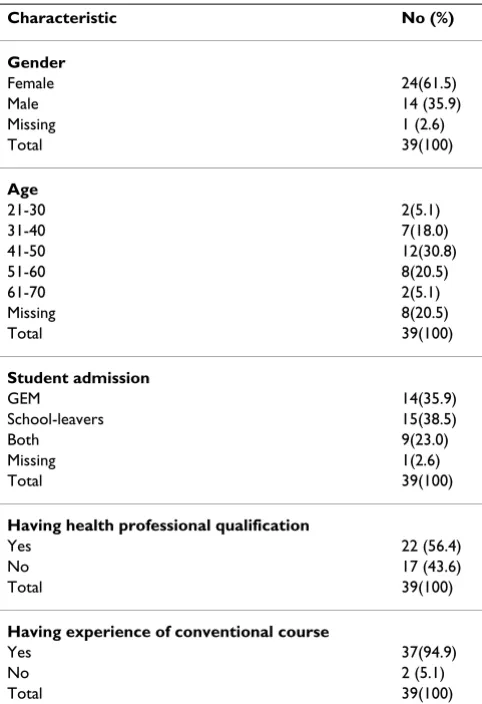
accessi-ble through a confidential hyperlink. After a list of poten-tial respondents was created (n = 27), an email including the hyperlink was sent out to the members of that list inviting them to participate in this study. The use of fol-low up reminders was ineffective in achieving higher response rate for the web-based survey. Six medical educa-tors filled in the web-based survey. Table 1 shows the characteristics of participants.
The second method for collecting data was a discussion forum entitled "What have we learned from the PBL approach?" An email was forwarded to the members of the Evidence Based Medical Education (EBME) collabora-tion in order to ascertain their view on PBL. We asked medical educators who have experienced PBL to discuss their views on the PBL approach. Six members com-mented regarding the above question in a forum discus-sion. Therefore, in this study the purposive sample consisted of 39 medical education scholars and 6 forum repliers, with firsthand experience of PBL.
The design of the questionnaire was based on a thorough review of the literature relating to PBL studies. The PBL
scale consists of 17 items about the conditions that hinder and support PBL. To reduce the bias of the questionnaire, some items were written negatively, so that not all ques-tions reflected positive views towards PBL. Each item was accompanied by a 5-point Likert scale, ranging from 1 (strongly disagree) to 5 (strongly agree). An open-ended question was provided to find out the medical educator's experience concerning the PBL approach. Medical educa-tors also provided demographic information, which included items on their age, gender, and experience. A brief instruction for the completion of the study instru-ment was provided to ensure that it could be self-admin-istered.
Prior to conducting the survey, the content validity of the instrument was established by subjecting it to review by two PBL experts. The experts were selected based on their deep experiences of PBL and their knowledge of the PBL process in their own school. We asked them to criticise the statements if they did not make sense or cover the purpose of the study. We took their comments on the question-naire design into consideration, and we made appropriate modifications to clarifying meaning. We then tested the questionnaire for reliability with data from a group of individual participants (n = 20). The reliability of the tool was determined by computation of Chronbach's alpha using SPSS, which gave a value of 0.68, indicating an acceptable degree of internal consistency.
Because this study was primarily descriptive, descriptive information was presented for numerical data analysis. Words or sentences provided by participants in the open-ended questions have been reported in a table. The forum replies were also read and re-read in order to identify emerging themes as headings under which we can catego-rise most of the data.
Results
The results of this study can best be treated under three headings: the PBL scale, open-ended question, and forum repliers.
The PBL scale
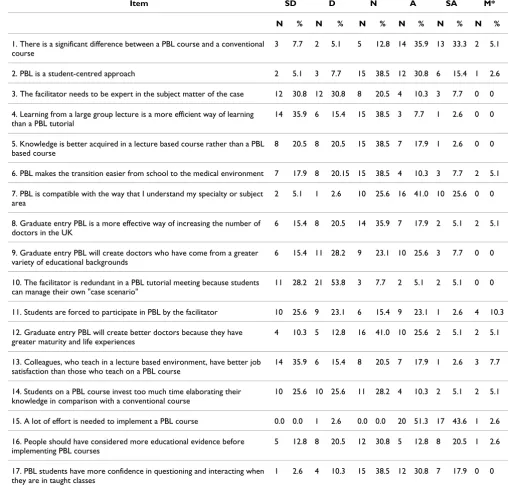
A sample of 39 medical educators from an accessible pop-ulation was recruited (Table 1). The mean number of years work experience with facilitating was 7 years (SD 6.3, minimum 1 year, and maximum 30 years). Partici-pants were asked to rate the extent to which they perceived each of 17 items. Responses to agree and strongly agree were combined as "agree" and to disagree and strongly disagree were combined as "disagree". Most (69.2%) of respondents agreed that there is a difference between a PBL course and a conventional course. When asked to report whether they experienced PBL as a student- centred approach, more than a third of the respondents (36.2%) agreed. In response to the item, 'the facilitator needs to be Table 1: Demographic characteristics of study participants
(n = 39)
Characteristic No (%)
Gender
Female 24(61.5) Male 14 (35.9) Missing 1 (2.6) Total 39(100)
Age
21-30 2(5.1) 31-40 7(18.0) 41-50 12(30.8) 51-60 8(20.5) 61-70 2(5.1) Missing 8(20.5) Total 39(100)
Student admission
GEM 14(35.9) School-leavers 15(38.5) Both 9(23.0) Missing 1(2.6) Total 39(100)
Having health professional qualification
Yes 22 (56.4) No 17 (43.6) Total 39(100)
Having experience of conventional course
expert in the subject matter of the case', the majority of respondents (61.6%) disagreed. More than a half of the respondents (51.3%) disagreed that 'Learning from a large group lecture is a more efficient way of learning than a PBL tutorial. Some respondents (35.9%) felt 'neutral' about increasing the number of doctors in the UK using graduate entry PBL. Most educators (62%) disagreed that the facilitator is not redundant in a PBL tutorial meeting. More than one fourth of respondents (25.7%) agreed that students are forced to participate in PBL by the facilitator. Few respondents (15.4%) had a neutral view on this. When asked to report if a lecture-based environment makes for better job satisfaction compared with a PBL course, more than a half of the respondents (51.3%) dis-agreed. The majority of participants (51.2%) disagreed that the students on a PBL course spend too much time elaborating their knowledge in comparison with a con-ventional course. As Table 2 shows, many participants val-ued the importance of the PBL approach in the practice and training of doctors. However, some participants held contrasting views upon the importance of the PBL approach in undergraduate medical education. For exam-ple, the scores showed that most participants had a neu-tral view of the efficiency of lecture-based learning compared to a PBL tutorial.
The open-ended question
Respondents were asked in an open ended question for their opinions on lessons they have learned or experi-enced during PBL tutorials. Of note was the low response to this question. For this reason, we analysed words and terms provided by the participants (Table 3). It is apparent from this table that the participants had concerns about issues relating to facilitators (items 3, 5, 6). The findings also indicated the importance that participants placed on student learning in PBL. One participant had concerns about the use of the PBL approach for Graduate Entry Medicine.
The forum repliers
Two general themes emerged from the forum repliers con-cerning medical educators' experiences of the PBL approach. They are: faculty role and self-managed educa-tion. We will now look at each of these in turn.
Faculty role
Participants in the forum had different views with respect to the PBL approach. One participant, who had graduated in medicine and experienced PBL, reflected that the PBL approach was useful in teaching 3rd year medical students who are just entering their clinical training. This is because students integrate basic science with clinical application. Although one of the principal ideas behind PBL is that stu-dents aim their learning at the areas in which their knowl-edge is more deficient, one participant asserted that
students sometimes "do not know what they don't know". This finding may show that students are 'unconsciously incompetent', on the first stage of the conscious-compe-tence framework in PBL. The participant described the facilitator role as crucial to effective learning in the PBL tutorial. He continued that students who had a process expert in discussion failed to catch key concepts and key pieces of information in their literature searching, or key insights in terms of understanding the questions they are addressing. The situation described below exemplifies this behaviour:
"...on the one hand clear objectives and faculty development are necessary so students are properly advised through the PBL exer-cise, such that they take ownership of their own learning and true self-directed learning can happen. Especially early in med-ical training, students cannot know what they need to learn in order to solve the problem. On the other hand, affirmation from a tutor that students are on the right track can very easily turn into direction from the tutor, and that can turn into teaching by the tutor."
A consultant stressed the importance of the faculty role in the PBL approach and strategies for successful facilitation. He found that the main barrier to implementation of PBL is the lack of preparation of faculty members to facilitate self-directed learning.
Self-managed education
In terms of the student-centred nature of the PBL approach, with its emphasis on self-directed learning, one respondent stated that the learning objectives of a PBL course do not provide the opportunity to encourage stu-dents to take greater ownership of their work, and hence greater responsibility for their learning. A participant replied:
"If clear learning objectives are prepared (not a list of subjects or objectives that use ambiguous words such as 'to understand'), and a series of concepts or principles are identified (those that the faculty think can be missed by the students), then the stu-dents can become truly a self-directed learner exerting a high degree of autonomy."
Another participant reflected on this situation:
"For me, the key question is, to what degree we believe in self-directed learning and convey to the students the message that they can take responsibility for their learning without our inter-vention?"
not have control over all elements of the PBL process. Stu-dents, for example, have no control over the scenario, although the nature of self-directed learning of PBL is acknowledged.
Discussion
This study has methodological limitations that must be taken into consideration when interpreting the findings. One cannot over-emphasise the limitations of self-report
as this may limit the validity of findings. Respondents for various reasons may under, or overestimate their practice. A methodological problem frequently associated with the use of self-reports in questionnaires, which may have been evident in the present study, is the inability to deter-mine the extent to which responses accurately reflect the respondents' experiences and expectations of their PBL tutorial sessions. This warrants further research to exam-ine the actual PBL process. It is also possible that medical Table 2: Responses of medical educators to PBL views statements
Item SD D N A SA M*
N % N % N % N % N % N %
1. There is a significant difference between a PBL course and a conventional course
3 7.7 2 5.1 5 12.8 14 35.9 13 33.3 2 5.1 2. PBL is a student-centred approach 2 5.1 3 7.7 15 38.5 12 30.8 6 15.4 1 2.6 3. The facilitator needs to be expert in the subject matter of the case 12 30.8 12 30.8 8 20.5 4 10.3 3 7.7 0 0 4. Learning from a large group lecture is a more efficient way of learning
than a PBL tutorial
14 35.9 6 15.4 15 38.5 3 7.7 1 2.6 0 0 5. Knowledge is better acquired in a lecture based course rather than a PBL
based course
8 20.5 8 20.5 15 38.5 7 17.9 1 2.6 0 0 6. PBL makes the transition easier from school to the medical environment 7 17.9 8 20.15 15 38.5 4 10.3 3 7.7 2 5.1 7. PBL is compatible with the way that I understand my specialty or subject
area
2 5.1 1 2.6 10 25.6 16 41.0 10 25.6 0 0 8. Graduate entry PBL is a more effective way of increasing the number of
doctors in the UK
6 15.4 8 20.5 14 35.9 7 17.9 2 5.1 2 5.1 9. Graduate entry PBL will create doctors who have come from a greater
variety of educational backgrounds
6 15.4 11 28.2 9 23.1 10 25.6 3 7.7 0 0 10. The facilitator is redundant in a PBL tutorial meeting because students
can manage their own "case scenario"
11 28.2 21 53.8 3 7.7 2 5.1 2 5.1 0 0
11. Students are forced to participate in PBL by the facilitator 10 25.6 9 23.1 6 15.4 9 23.1 1 2.6 4 10.3 12. Graduate entry PBL will create better doctors because they have
greater maturity and life experiences
4 10.3 5 12.8 16 41.0 10 25.6 2 5.1 2 5.1 13. Colleagues, who teach in a lecture based environment, have better job
satisfaction than those who teach on a PBL course
14 35.9 6 15.4 8 20.5 7 17.9 1 2.6 3 7.7 14. Students on a PBL course invest too much time elaborating their
knowledge in comparison with a conventional course
10 25.6 10 25.6 11 28.2 4 10.3 2 5.1 2 5.1
15. A lot of effort is needed to implement a PBL course 0.0 0.0 1 2.6 0.0 0.0 20 51.3 17 43.6 1 2.6 16. People should have considered more educational evidence before
implementing PBL courses
5 12.8 8 20.5 12 30.8 5 12.8 8 20.5 1 2.6 17. PBL students have more confidence in questioning and interacting when
they are in taught classes
1 2.6 4 10.3 15 38.5 12 30.8 7 17.9 0 0
educators in this study were not representative of PBL edu-cators.
The response rate was low, despite our efforts to maximise it and this means that the findings should be interpreted with caution. Reasons for non-response are not known. Non-respondents to the survey may also be less interested or involved in PBL, and therefore the reported extent of the PBL approach in this study may be higher than in real-ity.
Regarding forum repliers, this was a convenience sample consisting of only 6 medical educators. The online forum discussions were convenient and provided a transcribed record. Drawbacks to participation in online discussions may be the same as for online education in general, that is, the inability to capture the richness and depth of mean-ing without visual and verbal clues.
To overcome these methodological limitations we sug-gest, therefore, randomised experiments which focus on the performance of PBL graduates and non-PBL graduates in the clinical workplace. This may optimise the accuracy of inferences about the PBL approach. Clearly, an impor-tant task facing researchers is the identification and con-trol of those factors that may give rise to alternative explanations for the effects of PBL compared to non-PBL methods. Factors such as the educational background of the students, methods of student selection and the learn-ing culture of the institution are all potentially important. In addition perhaps more emphasis should be placed on researching the comparative learning processes that PBL and non-PBL students engage in. For example PBL stu-dents engage in considerably more verbal discourse, ques-tioning and reasoning episodes than traditional students. Perhaps this develops additional cognitive and interper-sonal skills not necessarily acquired to the same extent by more didactic and teacher-centred learning methods.
The descriptive analysis of this study showed that many participants valued the PBL approach in the practice and training of doctors. However, some medical education scholars held contrasting views upon on the importance
of the PBL approach in undergraduate medical education. Among the medical educators surveyed, 38.5% had a neu-tral experience of PBL as a student-oriented educational approach. This finding is not consistent with the common characteristic of the PBL approach, indicating its student-centred nature [19]. Although 46.2% of participants val-ued PBL as a student-oriented approach, the question that comes to mind is why do a group of medical educators feel so uncertain about it? Further research should exam-ine this. What is surprising is that more than 61% of med-ical educators disagreed that the facilitator needs to be an expert in the subject matter of the case despite the fact that the majority of participants had a medical health profes-sional qualification. The issue of content knowledge com-pared to process expertise is still challenging. Some evidence shows differences in favour of content experts when compared with process expertise [20]. For example, Eagle et al. concluded that twice as many learning issues were identified by groups led by content experts [21]. Consistent with the results of these studies, Schmidt et al
concluded that students guided by subject experts spent more time on self-directed learning and achieved some-what better scores on high stakes tests than students guided by non-expert facilitators [22]. However, a study by Silver and Wilkerson indicated that content expertise resulted in more tutor-directed discussion in a PBL course [23]. Taken together, these studies may suggest that both subject and process expertise are required by facilitators.
The results of this study indicate that the participants had a neutral view of the efficiency of traditional learning compared to a PBL tutorial. As such, participants had a neutral view of the claim that knowledge is better acquired in PBL-based course rather than a lecture-based one. These findings add to most previous research studies by demonstrating that there is no difference between the knowledge that PBL students and non-PBL students acquire about medical sciences [24]. Although studies show that group learning in PBL may have positive effects, much more empirical evidence is needed to obtain deeper insight into the productive group learning of a PBL tuto-rial [25]. One may argue that the process of PBL needs to be rigorously investigated in order to offer reasons for Table 3: Words or phrases that participants used to describe the lessons learned from the PBL approach by 8 participants
1. PBL is still unclear in GEM
2. Need to ensure students are fully aware before studying the course regarding education, using PBL and its implementations, especially in regard to their learning style. Need to give students guidance on the boundaries of knowledge they need to have to allow PBL to operate efficiently and then to feel secure.
3. Make sure the facilitators are well trained and follow the proper methods so all students get same experience.
4. Have seen shy students coming out of their shell as they progress. Have seen them becoming more confident and develop social skills. 5. Revisit group rules- when things aren't going well. Train the facilitator to confront blocks in groups. Good facilitators are more important than
subject experts.
believing that it is designed to help student construct an extensive knowledge base and to become doctors dedi-cated to lifelong-learning. It is therefore important to fur-ther explore the nature of the learning acquired from PBL courses compared to traditional instruction courses.
With respect to graduate entry PBL, this study did not show that the policy of admitting graduates versus school-leavers to medical programmes was perceived as effective in creating better doctors. Interestingly, no previous PBL studies have explored differences between graduate entry PBL and school leaver programmes, although this study revealed that graduate entry PBL is not perceived as a more effective way of increasing the number of doctors in the UK by the majority of responders. In addition, this study revealed that there was a majority perception that gradu-ate entry PBL will produce doctors who have come from a greater variety of educational backgrounds. However, will graduate entry PBL create better doctors compared to school leaver programmes? Sophisticated methodological approaches are required to answer this question.
The descriptions of medical educators about the PBL approach focused on the process of PBL, the characteris-tics of a good PBL facilitator and the advantages and dis-advantages of PBL. It has been well documented that the facilitator role is central to PBL. The adoption of the role requires an understanding of epistemological and onto-logical issues about teaching and learning in medicine. In the epistemological sense PBL students are novices and the knowledge facilitator should assist them in restructur-ing new knowledge based on their prior declarative and procedural knowledge. In the ontological sense perceiving a new reality by students is important and the role of the facilitator is to assist students to explore reality in different ways. As the importance of faculty development in PBL was valued by participants in the forum discussion this may suggest more facilitator development workshops to help achieve competence as skilled facilitators of the PBL process. Such workshops may uncover conflicting roles of tutors in the steps of the PBL process. As Irby indicated, identifying and practicing these roles (mediator, chal-lenger, negotiator, director, evaluator and listener) is a key skill of effective facilitation [26].
In addition to this, one medical educator had a negative approach about PBL, and reflected: "PBL is still unclear in GEM". It seems that some medical educators have nega-tive perceptions of the ontological assumptions of PBL. For instance, a qualitative study was conducted to explore how a cohort of tutors made sense of PBL. In this study, one participant stated: "absolutely not, no views not really changed at all. I'm still not convinced that PBL, despite the fact that [I will tutor again] is the proper way of teaching" [27].
Altogether these findings concerning academic achieve-ment are slightly in favour of non-PBL programmes.
When asked about their experience in a PBL tutorial course, medical educators indicated they had few negative feelings with respect to facilitating self-directed learning and student learning. There are several possible reasons for this. Firstly, in the beginning of the course, it seems that the students find adopting a self-directed problem-based approach to learning difficult as they "do not know what they do not know". This may be attributed to the fact that students may have a restricted personal knowledge of the complexity of the "case". Secondly, students may not have clear objectives for the behaviour that they have to achieve, particularly in clinical settings, as mentioned by one participant. Thirdly, learning styles, both deep, sur-face and 'strategic', are determined at secondary school, and it is also difficult to influence learning styles even with a PBL curriculum [28,29].
In this study, a few participants suggested combinations of pedagogical strategies, where several PBL courses are offered along with courses presented in a more traditional way. There is no evidence that indicates how a hybrid cur-riculum can make students better doctors compared to other approaches. However, a recent study concluded that changing curricula in medical education reform is not likely to have an impact in improvement in student achievement [17]. The authors suggested that further work ought to focus on student characteristics and teacher characteristics such as teaching competency.
Conclusion
Whilst many participants valued the importance of the PBL approach in the practice and training of doctors and agreed with most of the conventional descriptions of PBL, some participants held contrasting views upon the impor-tance of the PBL approach in undergraduate medical edu-cation. For example, most participants had a neutral view of the efficiency of lecture-based learning compared to a PBL tutorial. However there was a strong view concerning the importance of facilitator training. We need to under-stand the process of PBL better.
Competing interests
The authors declare that they have no competing interests.
Authors' contributions
Publish with BioMed Central and every scientist can read your work free of charge
"BioMed Central will be the most significant development for disseminating the results of biomedical researc h in our lifetime."
Sir Paul Nurse, Cancer Research UK
Your research papers will be:
available free of charge to the entire biomedical community
peer reviewed and published immediately upon acceptance
cited in PubMed and archived on PubMed Central
yours — you keep the copyright
Submit your manuscript here:
http://www.biomedcentral.com/info/publishing_adv.asp
BioMedcentral
Additional material
Acknowledgements
The authors would like to express their gratitude to all the medical educa-tors who participated in this study. Thanks also to the two reviewers whose comments allowed us to improve on our previous draft.
References
1. Albanese MA, Mitchell S: Problem-based learning: a review of literature on its outcomes and implementation issues. Acad Med 1993, 68(1):52-81.
2. Vernon DT, Blake RL: Does problem-based learning work? A meta-analysis of evaluative research. Acad Med 1993,
68(7):550-563.
3. Berkson L: Problem-based learning: have the expectations been met? Acad Med 1993, 68(10 Suppl):S79-88.
4. Wolf FM: Problem-based learning and meta-analysis: can we see the forest through the trees? Acad Med 1993,
68(7):542-544.
5. Albert M, Hodges B, Regehr G: Research in medical education: Balancing services and science. Advances in Health Sciences Edu-cation 2006, 12:103-115.
6. Colliver JA: The reputation of medical education research: Quasi-experimentation and unsolved threats to validity.
Teach Learn Med 2008, 20:101-103.
7. Colliver JA, Markwell SJ: Research on problem-based learning: the need for critical analysis of methods and findings. Med Edu 2007, 41:533-535.
8. Watson R: Scientific methods are the only credible way for-ward for nursing research. Journal of Advanced Nursing 2003,
43:219-220.
9. Colliver JA, Robbs SR: Evaluating the effectiveness of major educational interventions. Acad Med 1999, 74:859-860. 10. Barrows HS: Problem-based learning in medicine and byond.
In Bringing problem-based learning to higher education: Theory and practice
Edited by: Wilkerson L, Gijselaers WH. San Francisco: Jossey-Bass; 1996.
11. Rideout E, Carpio B: The problem-based learning model of nursing education. In Transformaing nursing education through prob-lem-based learning Edited by: Rideout E. Boston: Jones and Bartlett Publishers; 2001.
12. Loyens SM, Rikers RM, Schmidt HG: Students' conceptions of constructivist learning: a comparison between a traditional and a problem-based learning curriculum. Adv Health Sci Educ Theory Pract 2006, 11(4):365-379.
13. Colliver JA: Constructivism: The view of knowledge that ended philosophy or a theory of learning and instruction.
Teach Learn Med 2002, 14:49-51.
14. Macnee C, McCabe S: Understanding nursing research London: Lippin-cott Williams & Wilkins; 2008.
15. Distlehorst LH, Dawson E, Robbs RS, Barrows HS: Problem-based learning outcomes: the glass half-full. Acad Med 2005,
80(3):294-299.
16. Shanley PF: Viewpoint: leaving the "empty glass" of problem-based learning behind: new assumptions and a revised model for case study in preclinical medical education. Acad Med
2007, 82(5):479-485.
17. Hecker K, Violato C: How much do differences in medical schools influnce student performance? A longitudinal study employing hierarchical linear modeling. Teach Learn Med 2008,
20:104-113.
18. Wood DF: Problem-based learning. BMJ 2008, 336:971.
19. Glasgow N: New curriculum for new times: A guide to student centred, problem-based learning Thousand Oaks, CA: Corwin Press; 1997. 20. Davis WK, Narin R, Paine ME, Andrson RM, OH MS: Effects of
expert and non-expert facilitators on the small-group proc-ess and on student performance. Acad Med 1992, 67:4780-4774. 21. Eagle CJ, Harasym PH, Mandin H: Effects of tutors with case expertise on problem-based learning issues. Acad Med 1992,
67(7):465-469.
22. Schmidt HG, Arend A van der, Moust JH, Kokx I, Boon L: Influence of tutors' subject-matter expertise on student effort and achievement in problem-based learning. Acad Med 1993,
68(10):784-791.
23. Silver M, Wilkerson L: Effects of tutors with subject expertise on student effort and achievement in problem-based learn-ing. Acad Med 1991, 68:748-791.
24. Major CH, Palmer B: Assessing the effectiveness of problem-based learning in higher education: Lessons from the litera-ture. Academic exchange quarterly 2001, 5:134-140.
25. Dolmans DH, Schmidt HG: What do we know about cognitive and motivational effects of small group tutorials in problem-based learning? Adv Health Sci Educ Theory Pract 2006,
11(4):321-336.
26. Irby DM: Models of faculty development for problem-based learning. Advances in health sciences 1996, 1:69-81.
27. Maudsley G: Making sense of trying not to teach: an interview study of tutors' ideas of problem-based learning. Acad Med
2002, 77(2):162-172.
28. Carter YH, Peile E: Graduated entry medicine: Curriculum considerations. Clinical Medicine 2007, 7:253-256.
29. Reid WA, Duvall E, Evans P: Can we influence medical students' approach to learning. Med Teach 2005, 27:401-407.
Pre-publication history
The pre-publication history for this paper can be accessed here:
http://www.biomedcentral.com/1472-6920/9/66/prepub
Additional file 1
The study instrument. Click here for file