R E S E A R C H A R T I C L E
Open Access
Avoidable mortality from giving tranexamic acid
to bleeding trauma patients: an estimation based
on WHO mortality data, a systematic literature
review and data from the CRASH-2 trial
Katharine Ker
*, Junko Kiriya, Pablo Perel, Phil Edwards, Haleema Shakur and Ian Roberts
Abstract
Background:The CRASH-2 trial showed that early administration of tranexamic acid (TXA) safely reduces mortality in bleeding in trauma patients. Based on data from the CRASH-2 trial, global mortality data and a systematic literature review, we estimated the number of premature deaths that might be averted every year worldwide through the use of TXA.
Methods:We used CRASH-2 trial data to examine the effect of TXA on death due to bleeding by geographical region. We used WHO mortality data (2008) and data from a systematic review of the literature to estimate the annual number of in-hospital trauma deaths due to bleeding. We then used the relative risk estimates from the CRASH-2 trial to estimate the number of premature deaths that could be averted if all hospitalised bleeding trauma patients received TXA within one hour of injury, and within three hours of injury. Sensitivity analyses were used to explore the effect of uncertainty in the parameter estimates and the assumptions made in the model. Results:There is no evidence that the effect of TXA on death due to bleeding varies by geographical region (heterogeneityp = 0.70). Based on WHO data and our systematic literature review, we estimate that each year worldwide there are approximately 400,000 in-hospital trauma deaths due to bleeding. If patients received TXA within one hour of injury then approximately 128,000 (uncertainty range [UR]≈72,000 to 172,000) deaths might be averted. If patients received TXA within three hours of injury then approximately 112,000 (UR≈68,000 to 148,000) deaths might be averted. Country specific estimates show that the largest numbers of deaths averted would be in India and China.
Conclusions:The use of TXA in the treatment of traumatic bleeding has the potential to prevent many premature deaths every year. A large proportion of the potential health gains are in low and middle income countries.
Background
Trauma is a leading cause of death and disability. Each year, worldwide, an estimated 5.8 million people die as a result of trauma [1], many after reaching hospital. Among trauma patients who survive to reach hospital, bleeding is a common cause of death, accounting for around 40% of in-hospital trauma deaths [2].
The CRASH-2 trial was an international randomised controlled trial of the early administration of tranexamic acid (TXA) to bleeding trauma patients. The trial recruited 20,211 patients from 274 hospitals in 40 coun-tries. The results show that TXA reduces mortality in trauma patients with or at risk of bleeding, with no apparent increase in side effects [3]. If given within three hours of injury, TXA reduces the risk of death due to bleeding by about a third [4]. TXA administra-tion has been shown to be highly cost-effective in high, middle or low income countries [5]. On the basis of the * Correspondence: [email protected]
Clinical Trials Unit, Faculty of Epidemiology & Population Health, London School of Hygiene & Tropical Medicine, Keppel Street, London WC1E 7HT, UK
results of the CRASH-2 trial, TXA has been included on the WHO Essential Medicines List [6].
Since publication of the trial results, TXA has been included into trauma care guidelines in many high income countries. In March 2010, the British Army incorporated TXA into combat care treatment protocols [7] and in July 2011 the UK NHS ambulance service agreed that TXA would be given to all adults and teen-agers who suffer major injury in the UK. In 2011, the US Army reviewed the evidence from the CRASH-2 trial and included TXA into its trauma treatment proto-cols. However, bearing in mind that 90% of trauma deaths are in low and middle income countries [8], the potential of TXA to reduce premature mortality is likely to be much greater in these settings. An estimation of the number of deaths that could be averted through the use of TXA for in traumatic haemorrhage would allow better targeting of dissemination and implementation activities. In this study we used data from the CRASH-2 trial, WHO mortality database and a systematic review of the recent literature, to estimate the potential number of deaths that could be averted through the early admin-istration of TXA to bleeding trauma patients.
Methods
Estimation of effect of TXA on death due to bleeding by geographical region
We used individual patient data from the CRASH-2 trial to assess the extent to which the effect of TXA on death due to bleeding varied according to geographical region. Hospitals participating in the CRASH-2 trial were grouped into four geographical regions: (1) Africa, (2) Asia, (3) Europe, Australia, North America, and (4) Central & South America. Heterogeneity in treatment effect by geographical region was assessed by ac2 test. We pre-specified that unless there was strong evidence against the null hypothesis of homogeneity of effects (i. e. p< 0.001), the overall risk ratio (RR) would be con-sidered to be the most reliable guide to the approximate RRs in all regions.
Estimation of number of in-hospital trauma deaths due to bleeding per year
The number of in-hospital trauma deaths that are due to bleeding and thus potentially avoidable through the early administration of TXA was estimated in three steps.
First, we obtained estimates of the number of trauma deaths (NT) by country. Since the risk of death due to
bleeding may vary according to type of injury (i.e. blunt or penetrating) [9], we classified deaths as being a result of blunt trauma (NBT) or penetrating trauma (NPT).
Sec-ond, we obtained data on the proportion of trauma deaths that occur in hospital (PH). The numbers of
in-hospital blunt trauma deaths (NH, BT) and in-hospital
penetrating trauma deaths (NH, PT) were then estimated
according to the following equations:
NH,BT= NBT×PH
NH,PT= NPT×PH
Third, we obtained data on proportion of in-hospital blunt trauma deaths caused by bleeding (PH, BT, BL) and
the proportion of in-hospital penetrating trauma deaths caused by bleeding (PH, PT, BL). Using these estimates we
derived the number of in-hospital trauma deaths caused by bleeding (NH, T, BL) as follows;
NH,T,BL= (NH,BT×PH,BT,BL) + (NH,PT×PH,PT,BL)
The number of premature deaths potentially averted by TXA was then estimated by applying the relative risk reduction from the CRASH-2 trial to the number of in-hospital deaths due to bleeding as follows:
Premature deaths averted = NH,T,BL×(1−RR)
Data sources
Data from the WHO, the CRASH-2 trial and a systema-tic review of literature published since 2004 were used to parameterise the equations. The number of trauma deaths for each country, were obtained from the WHO for the year 2008, the most recent year for which data were available. Blunt trauma deaths were estimated by adding the number of deaths from road traffic crashes, falls and other unintentional injuries. Penetrating trauma deaths were estimated by adding the number of deaths from violence and war. Deaths from drowning, poison-ing, self-inflicted injuries or burns were not included as these injuries are not usually associated with life-threa-tening bleeding. Estimates of the proportion of trauma deaths that are in-hospital and the proportion caused by bleeding were based on data from the CRASH-2 trial and from studies identified through a systematic review.
Systematic review methods
Record screening, full text review and data extraction were performed independently by two authors (KK and JK), with any disagreements resolved through discussion. Data were extracted on study design, setting, sample size, the proportions of deaths occurring in hospital and due to bleeding, using a pre-designed form. Studies that did not provide data on any of the parameters of inter-est were excluded.
To obtain a summary estimate for each parameter, the study proportions were transformed according to the Freeman Tukey variant of the arcsine square root trans-formed proportions to correct for over-dispersion [10]. Pooled proportions were calculated as the back-transfor-mation of the weighted mean of the transformed pro-portions using the random effects model [11].
Data analysis
For each country, the number of in-hospital trauma deaths due to bleeding was calculated by applying the corresponding estimated proportions to the mortality data, as described above. For the primary analysis, the relative risk reduction from the CRASH-2 trial was applied to estimate the number of premature deaths that could be averted (1) if all patients received TXA within one hour of injury, and (2) if all patients received TXA within three hours of injury. The numbers of deaths averted in each country were combined to give an overall global estimate. To identify the countries with the greatest potential for benefit from TXA, countries were ranked in order of the estimated number of pre-mature deaths averted.
To investigate the impact on the results of uncertainty in the parameter estimates used in the modelling, a number of sensitivity analyses were conducted. First, the analysis was repeated using the lower and upper bounds of the 95% confidence intervals for the parameter esti-mates to explore the effect of parameter uncertainty. Second, we repeated the analysis using the relative risk estimate for all-cause mortality rather than death due to bleeding. This analysis was conducted to take account of the possibility that some patients who do not die from bleeding because of TXA administration would nevertheless die of other causes such multi-organ failure or brain injury. Third, we repeated the analyses using the relative risk estimate for all-cause mortality with TXA when given at any time within eight hours of injury. Although, previously published subgroup analyses show that early treatment is more effective it is possible that treatment within three hours is not possible in some settings.
For each estimate, to reflect statistical uncertainty around the relative risks of TXA, an uncertainty range was estimated by calculating the numbers of deaths averted based on the 95% confidence intervals for the
relative risks. The analyses were conducted using Micro-soft Excel and STATA 11 (TX: StataCorp LP) Micro-software.
Results
Estimation of the effect of TXA on death due to bleeding by geographical region
Figure 1 shows the effect of TXA given within three hours of injury on death due to bleeding by geographical region. There was no evidence for heterogeneity in the effect of TXA by region (c2 = 1.445; p = 0.70). The overall RRs for the effect of TXA on death due to bleed-ing when given within one hour (RR = 0.68; 95% CI 0.57 to 0.82) and within three hours (RR = 0.72; 95% CI 0.63 to 0.83) of injury were therefore taken as the most reli-able guide as to the approximate RRs in all regions, and were used to estimate the number of deaths that could be averted with TXA.
Estimation of the annual number of in-hospital trauma deaths due to bleeding
We identified 18 studies, described in 17 reports [12-28], which presented data on the parameters of interest and were included in the systematic review. Stu-dies were conducted in 13 countries; USA, Canada, UK, Australia, Brazil, Denmark, Norway, Mozambique, South Africa, Italy, France, Spain and India. In addition, we obtained data collected as part of the CRASH-2 trial, which recruited patients from hospitals in 40 countries throughout the world. The study selection process is summarised in Figure 2. Data extracted from the studies are summarised in Additional File 1.
Fourteen studies [13-15,17,19-27] involving 24,831 trauma deaths provided data on the proportion of deaths occurring in-hospital; the pooled proportion was 44% (95% CI 33 to 56%). Five studies [3,12,16,18,28] involving 9684 deaths presented data on the proportion of blunt trauma deaths due to haemorrhage; the pooled proportion was 18% (95% CI 13 to 23%). Four studies [3,12,16,28] involving 2256 deaths presented data on the proportion of penetrating trauma deaths due to
n/N Riskratio(95%CI)
Africa 208/3,927 Asia 196/3,688 95/1,960
Central&SouthAmerica316/3,909 Overall 815/13,484
ɍ2= 1.445;p=0.70
0.4
0.2 0.6 0.8 1 1.21.4 Europe,Australia&
NorthAmerica
0.68(0.52Ͳ0.90) 0.81(0.62Ͳ1.08) 0.63(0.42Ͳ0.94)
0.72(0.58Ͳ0.90) 0.72(0.63Ͳ0.83)
haemorrhage; the pooled proportion was 55% (95% CI 49 to 62%).
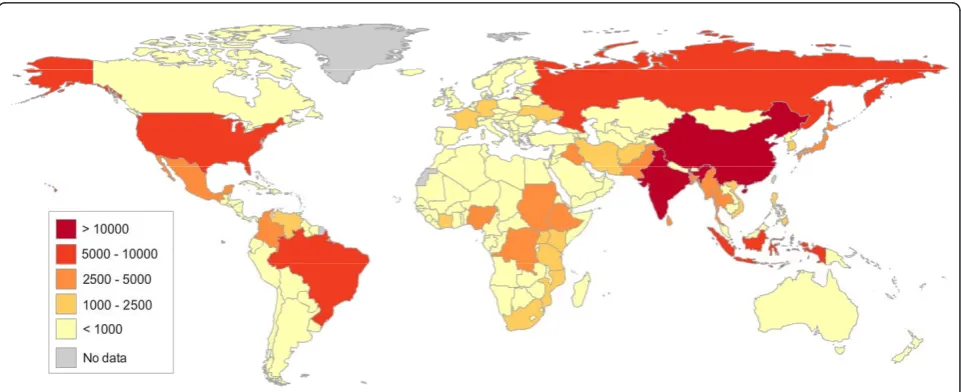
After applying these parameter estimates to the WHO data, we estimate that worldwide every year approxi-mately 400,000 trauma patients die in-hospital from bleeding. If all of these patients receive TXA within one hour of injury the about 128,000 (uncertainty range [UR]≈72,000 to 172,000) deaths could be averted. If all of these patients receive TXA within three hours of injury about 112,000 (UR≈ 68,000 to 148,000) deaths could be averted. The global distribution of number of premature deaths averted by TXA when administered within three hours of injury is shown in Figure 3.
Results for the countries where more than 1000 deaths could be averted are shown in Table 1. The largest numbers of deaths from haemorrhage and consequently
the largest numbers of deaths averted are in Asia. The largest numbers of premature deaths averted are in India (TXA≤1 hr≈19,000;TXA≤3 hrs≈16,500) and China (TXA ≤ 1 hr ≈ 17,000;TXA ≤ 3 hrs ≈ 15,000). When ranked by the number of premature deaths potentially averted, nine of the top ten countries are low or middle income, the exception being the USA where approximately 4,000 and 3,500 deaths would be averted by TXA given within one hour and three hours of injury, respectively.
Sensitivity analyses
When the analyses were repeated using the values of the lower and upper 95% CIs of the pooled parameter esti-mates, the global number of deaths averted ranged from approximately 76,000 to 198,000 if TXA is given within one hour of injury and from 67,000 to 173,000 if given with three hours of injury. When the analysis was car-ried out using the relative risk estimate for all-cause mortality if TXA is given within one hour (RR = 0.87; 0.78 to 0.97) and within three hours (RR = 0.87; 0.80 to 0.94) of injury, the number of premature deaths averted was 52,000 (TXA≤ 1 hr≈ 12,000 to 88,000; TXA ≤ 3 hrs≈24,000 to 80,000). When the analysis was repeated using relative risk estimate for death due to bleeding when TXA is given at any time within eight hours of injury (RR = 0.85; 0.76 to 0.96), the number of prema-ture deaths averted was 60,000 (UR ≈16,000 to 96,000). Finally, using the relative risk estimate for all-cause mortality when TXA is given within eight hours of injury (RR = 0.91; 0.85 to 0.97), an estimated 36,000 (UR ≈ 12,000 to 60,000) premature deaths could be averted.
R d id tifi d th h Additi l d id tifi d Recordsidentifiedthrough
databasesearching(n=1114)
Additionalrecordsidentified
throughothersources(n=6)
Recordsexcluded Recordsafterduplicates
removed and screened
(n=1041) removedandscreened
(n=1120)
FullͲtextarticlesassessedfor
eligibility(n=72) (7 f ll il bl )
FullͲtextarticlesexcluded (n = 53) (7fulltextsunavailable) (n=53)
Studiesprovidingeligibledata
andincludedinpooled
analyses(n=19)
Figure 2Flow diagram of the study selection process for systematic review.
Discussion
Based on WHO mortality data and a systematic review of the literature we estimate that there are about 400,000 in-hospital deaths from bleeding each year worldwide. If all hospitalised bleeding trauma patients could be treated with TXA within an hour of injury then up to 128,000 of these premature deaths could be averted. If they could be treated within three hours of injury then up to 112,000 premature deaths could averted. Although there is considerable uncertainty in the estimates even the most conservative suggest that tens of thousands of deaths could be averted every year.
We found no compelling evidence that the effect of TXA on death due to bleeding varies by geographical region. Our conclusion is based on a statistical test of interaction which is considered to be the most appropri-ate way to evaluappropri-ate subgroup effects [29]. As recom-mended by methodologists, we pre-specified that unless there was strong evidence against the null hypothesis of homogeneity of effects (i.e. p< 0.001), that the overall risk ratio (RR) would be considered to be the most
reliable guide to the approximate RRs in all regions. We found no statistical basis to reject the null hypothesis.
The data sources used to parameterise the model are subject to a number of limitations which may have affected our results. First, although the WHO database provides the best available country-level mortality data, poor coverage and coding of mortality registration sys-tems may affect the accuracy of the number of trauma deaths for some countries. Second, our classification of trauma deaths into blunt or penetrating trauma based on the cause of death categories in the WHO data was somewhat arbitrary and would have resulted in some misclassification. However, in the absence of accurate country-specific data, we judged that this approach would provide the most reliable estimates. Third, due to the absence of country-specific data for the proportions of deaths occurring in hospital and the proportion of deaths caused by haemorrhage, we chose to apply aver-age global estimates. We were therefore unable to incor-porate between-country variations in these parameter estimates into our analysis. Nevertheless, our estimates were derived from a systematic review of the recent
Table 1 Estimated number of premature trauma deaths averted by TXA per year
In-hospital trauma deaths from bleeding Deaths averted TXA≤1 hour Deaths averted TXA≤3 hours
Worldwide 400,467 128,149 112,131
Countries with > 1000 deaths averted
India 58,801 18,816 16,464
China 54,241 17,357 15,187
Brazil 19,187 6,140 5,372
Russian Federation 16,731 5,354 4,685
Myanmar 13,193 4,222 3,694
Iraq 12,786 4,091 3,580
USA 12,489 3,996 3,497
Indonesia 11,033 3,531 3,089
DR Congo 9,373 2,999 2,624
Sri Lanka 8,979 2,873 2,514
Pakistan 8,770 2,806 2,456
Ethiopia 8,768 2,806 2,455
Nigeria 8,258 2,643 2,312
Colombia 7,348 2,352 2,058
Sudan 7,292 2,334 2,042
Bangladesh 7,210 2,307 2,019
Mexico 7,059 2,259 1,976
Philippines 6,119 1,958 1,713
Thailand 5,572 1,783 1,560
Afghanistan 4,774 1,528 1,337
Uganda 4,620 1,478 1,294
South Africa 4,245 1,359 1,189
Venezuela 4,172 1,335 1,168
Kenya 4,029 1,289 1,128
Tanzania 3,969 1,270 1,111
literature and data from the CRASH-2 trial, and thus represent the most accurate estimates available. We also performed sensitivity analyses to assess the impact of uncertainty around the parameter estimates.
Since many deaths from self-inflicted injuries are not usually associated with life-threatening haemorrhage (e. g. self-poisoning, hanging) we excluded this category to avoid over-estimating the number of deaths due to bleeding. However, this is likely to have led to the exclu-sion of some self-inflicted deaths that were associated with haemorrhage, in which case we may have underes-timated the potential of TXA administration.
Our analysis was based on a number of assumptions. We have assumed that there was no use of TXA as a treatment for traumatic bleeding prior to publication of the CRASH-2 trial results. It is possible that a small proportion of the trauma deaths in our sample did receive TXA prior to their death, which may over-esti-mate the number of deaths averted. However, given that any such prior use of TXA would have been minimal it is unlikely to have greatly affected our overall estimates.
The objective of our analysis was to estimate the potential number of deaths that could be averted assum-ing TXA use under optimal conditions, that is, when administered appropriately and within three hours of injury, to all eligible bleeding trauma patients. It is unrealistic that such conditions are consistently and fully achieved in clinical practice. For example, the opportunity to treat some eligible patients will be missed and errors in the dose used or its administration may reduce the beneficial effect of TXA.
We assumed that the results of the CRASH-2 trial could be extrapolated to all hospitalised bleeding trauma patients. The CRASH-2 trial used clinical criteria to recruit a large number of patients from 274 hospitals in 40 countries, which helps the results to be generalised widely. Whilst we acknowledge that the underlying risk of death will vary in different settings, this does not necessarily imply that that the relative effect will vary. Indeed, relative effects are often remarkably homogeneous despite differ-ences in underlying risk. This is supported by empirical evidence from a range of trials in which the relative effects are constant across variations in baseline risk [30]. Furthermore, there is no reason to suppose that the mechanism of action of TXA would vary in different populations. However, we acknowledge that the appropri-ateness of such extrapolation is a matter of judgement.
A further assumption is that all trauma patients reached hospital in time to receive early treatment with TXA; that is either within one hour or within three hours of injury. Such a time frame is unlikely to be rea-listic in many settings where long distances and other logistical difficulties may delay arrival at hospital. For this reason we performed sensitivity analyses based on
the relative effect of TXA from a more conservative esti-mate of time-to-treatment of within eight hours of injury, the results of which still suggest that up to 60,000 deaths could be averted. Besides, there is reason to predict that time between injury and treatment would be shorter in clinical practice than in the CRASH-2 trial as delays caused by consent procedures would be avoided [31].
In applying the RR of death due to bleeding in our primary analysis we assumed that all deaths in this group would be avoided. However, it is possible that whilst TXA may prevent death due to bleeding, some patients would die from other causes instead. If this is the case, then our primary analysis would over-estimate the number of death averted. To address this we per-formed a sensitivity analysis in which the effect of TXA on all-cause mortality was used. Even using this smaller relative reduction, up to 50,000 deaths could be averted.
We restricted our analysis to the potential benefit of in-hospital use of TXA. However, our parameter esti-mate of the proportion of in-hospital trauma deaths indicates that most trauma deaths occur before arrival at hospital. TXA is a practicable treatment suitable for use in a range of health-care settings, including pre-hos-pital. If TXA was used in the pre-hospital setting then many more premature deaths might be averted.
Conclusions
Our analysis shows the potential of TXA to reduce trauma deaths worldwide. Realisation of this potential is likely to require further efforts in dissemination and implementation, particularly in low and middle income settings.
Additional material
Additional file 1: Summary of data extracted from studies included in systematic review.
Acknowledgements
The CRASH-2 trial was funded by the UK NIHR Health Technology Assessment programme, Pfizer, BUPA Foundation, and JP Moulton Charitable Foundation.
Authors’contributions
KK, JK and IR designed the study. KK, JK and PP obtained the data and conducted all analyses with advice from PE and IR. KK wrote the paper with input from all other authors. All authors had full access to all the data in the study and had final responsibility for the decision to submit for publication. All authors read and approved the final manuscript.
Competing interests
The authors declare that they have no competing interests.
References
1. WHO:Injuries & violence: the factsGeneva; 2010.
2. Sauaia A, Moore FA, Moore EE, Moser KS, Brennan R, Read RA, Pons PT: Epidemiology of trauma deaths: a reassessment.J Trauma1995, 38(2):185-193.
3. The CRASH-2 Collaborators:Effects of tranexamic acid on death, vascular occlusive events, and blood transfusion in trauma patients with significant haemorrhage (CRASH-2): a randomised, placebo-controlled trial.Lancet2010,376(9734):23-32.
4. The CRASH-2 Collaborators:The importance of early treatment with tranexamic acid in bleeding trauma patients: an exploratory analysis of the CRASH-2 randomised controlled trial.Lancet2011,
377(9771):1096-1101, 1101 e1091-1092.
5. Guerriero C, Cairns J, Perel P, Shakur H, Roberts I:Cost-effectiveness analysis of administering tranexamic acid to bleeding trauma patients using evidence from the CRASH-2 trial.PLoS One2011,6(5):e18987. 6. WHO:Summary of the report of the 18th meeting of the WHO Expert
Committee on the Selection and Use of Essential MedicinesGeneva; 2011. 7. British Forces News:Injured soldiers in Afghanistan saved by
blood-clotting drug 19.01.11.2011 [http://www.youtube.com/watch? v=oj6P2cwwRYw].
8. Peden M, McGee K, Sharma G:The injury chart book: a graphical overview of the global burden of injuriesGeneva: World Health Organization; 2002. 9. Kauvar DS, Wade CE:The epidemiology and modern management of
traumatic hemorrhage: US and international perspectives.Crit Care2005, 9(Suppl 5):S1-S9.
10. Trinquart L, Touze E:Pitfalls in meta-analysis of observational studies: lessons from a systematic review of the risks of stenting for intracranial atherosclerosis.Stroke2009,40(10):e586-e587, author reply e590. 11. DerSimonian R, Laird N:Meta-analysis in clinical trials.Control Clin Trials
1986,7(3):177-188.
12. Boulanger L, Joshi AV, Tortella BJ, Menzin J, Caloyeras JP, Russell MW: Excess mortality, length of stay, and costs associated with serious hemorrhage among trauma patients: findings from the National Trauma Data Bank.Am Surg2007,73(12):1269-1274.
13. Demetriades D, Kimbrell B, Salim A, Velmahos G, Rhee P, Preston C, Gruzinski G, Chan L:Trauma deaths in a mature urban trauma system: is “trimodal”distribution a valid concept?J Am Coll Surg2005,
201(3):343-348.
14. Demetriades D, Murray J, Charalambides K, Alo K, Velmahos G, Rhee P, Chan L:Trauma fatalities: time and location of hospital deaths.J Am Coll Surg2004,198(1):20-26.
15. Di Bartolomeo S, Sanson G, Michelutto V, Nardi G, Burba I, Francescutti C, Lattuada L, Scian F:Epidemiology of major injury in the population of Friuli Venezia Giulia-Italy.Injury2004,35(4):391-400.
16. Dutton RP, Stansbury LG, Leone S, Kramer E, Hess JR, Scalea TM:Trauma mortality in mature trauma systems: are we doing better? An analysis of trauma mortality patterns, 1997-2008.J Trauma2010,69(3):620-626. 17. Evans JA, van Wessem KJ, McDougall D, Lee KA, Lyons T, Balogh ZJ:
Epidemiology of traumatic deaths: comprehensive population-based assessment.World J Surg2010,34(1):158-163.
18. Gilroy D:Deaths from blunt trauma, after arrival at hospital: plus ca change, plus c’est la meme chose.Injury2005,36(1):47-50. 19. Gomez D, Berube M, Xiong W, Ahmed N, Haas B, Schuurman N,
Nathens AB:Identifying targets for potential interventions to reduce rural trauma deaths: a population-based analysis.J Trauma2010, 69(3):633-639.
20. Gomez JLde Segura Nieva, Boncompte MM, Sucunza AE, Louis CL, Segui-Gomez M, Otano TB:Comparison of mortality due to severe multiple trauma in two comprehensive models of emergency care: Atlantic Pyrenees (France) and Navarra (Spain).J Emerg Med2009,37(2):189-200. 21. Masella CA, Pinho VF, Costa Passos AD, Spencer Netto FA, Rizoli S,
Scarpelini S:Temporal distribution of trauma deaths: quality of trauma care in a developing country.J Trauma2008,65(3):653-658.
22. Meel BL:Pre-hospital and hospital traumatic deaths in the former homeland of Transkei, South Africa.J Clin Forensic Med2004,11(1):6-11. 23. Meisler R, Thomsen AB, Abildstrom H, Guldstad N, Borge P, Rasmussen SW,
Rasmussen LS:Triage and mortality in 2875 consecutive trauma patients.
Acta Anaesthesiol Scand2010,54(2):218-223.
24. Nizamo H, Meyrowitsch DW, Zacarias E, Konradsen F:Mortality due to injuries in Maputo City, Mozambique.Int J Inj Contr Saf Promot2006, 13(1):1-6.
25. Potenza BM, Hoyt DB, Coimbra R, Fortlage D, Holbrook T, Hollingsworth-Fridlund P:The epidemiology of serious and fatal injury in San Diego County over an 11-year period.J Trauma2004,56(1):68-75. 26. Singh B, Palimar V, Arun M, Mohanty MK:Profile of trauma related
mortality at Manipal.Kathmandu Univ Med J (KUMJ)2008,6(23):393-297. 27. Soreide K, Kruger AJ, Vardal AL, Ellingsen CL, Soreide E, Lossius HM:
Epidemiology and contemporary patterns of trauma deaths: changing place, similar pace, older face.World J Surg2007,31(11):2092-2103. 28. Tien HC, Spencer F, Tremblay LN, Rizoli SB, Brenneman FD:Preventable
deaths from hemorrhage at a level I Canadian trauma center.J Trauma
2007,62(1):142-146.
29. Rothwell PM:Treating individuals 2. Subgroup analysis in randomised controlled trials: importance, indications, and interpretation.Lancet2005, 365(9454):176-186.
30. Furukawa TA, Guyatt GH, Griffith LE:Can we individualize the‘number needed to treat’? An empirical study of summary effect measures in meta-analyses.Int J Epidemiol2002,31(1):72-76.
31. Roberts I, Prieto-Merino D, Shakur H, Chalmers I, Nicholl J:Effect of consent rituals on mortality in emergency care research.Lancet2011,
377(9771):1071-1072.
Pre-publication history
The pre-publication history for this paper can be accessed here: http://www.biomedcentral.com/1471-227X/12/3/prepub
doi:10.1186/1471-227X-12-3
Cite this article as:Keret al.:Avoidable mortality from giving tranexamic acid to bleeding trauma patients: an estimation based on WHO mortality data, a systematic literature review and data from the CRASH-2 trial.BMC Emergency Medicine201212:3.
Submit your next manuscript to BioMed Central and take full advantage of:
• Convenient online submission
• Thorough peer review
• No space constraints or color figure charges
• Immediate publication on acceptance
• Inclusion in PubMed, CAS, Scopus and Google Scholar
• Research which is freely available for redistribution