BioMedCentral
Decision Making
Open Access
Research article
A review of randomized controlled trials comparing the
effectiveness of hand held computers with paper methods for data
collection
Shannon J Lane
1, Nancy M Heddle
1,2, Emmy Arnold
1and Irwin Walker*
1Address: 1Department of Medicine, McMaster University, Hamilton, Canada and 2Canadian Blood Services, Hamilton, Canada
Email: Shannon J Lane - [email protected]; Nancy M Heddle - [email protected]; Emmy Arnold - [email protected]; Irwin Walker* - [email protected]
* Corresponding author
Abstract
Background: Handheld computers are increasingly favoured over paper and pencil methods to capture data in clinical research.
Methods: This study systematically identified and reviewed randomized controlled trials (RCTs) that compared the two methods for self-recording and reporting data, and where at least one of the following outcomes was assessed: data accuracy; timeliness of data capture; and adherence to protocols for data collection.
Results: A comprehensive key word search of NLM Gateway's database yielded 9 studies fitting the criteria for inclusion. Data extraction was performed and checked by two of the authors. None of the studies included all outcomes. The results overall, favor handheld computers over paper and pencil for data collection among study participants but the data are not uniform for the different outcomes. Handheld computers appear superior in timeliness of receipt and data handling (four of four studies) and are preferred by most subjects (three of four studies). On the other hand, only one of the trials adequately compared adherence to instructions for recording and submission of data (handheld computers were superior), and comparisons of accuracy were inconsistent between five studies.
Conclusion: Handhelds are an effective alternative to paper and pencil modes of data collection; they are faster and were preferred by most users.
Background
The use of portable handheld computer technology in the field of health care and clinical research is on the rise, with a corresponding increase in publications. A search of Medline, using the MeSH term "computers, handheld" and text words "handheld computer(s)" combined as "or", revealed a steady increase in the yearly number of
publications from none in 1995 to 209 publications in 2003.
The use of handheld computers has been described in a variety of subjects and clinical settings, including: analge-sic headache treatments[1]; pain research[2]; bipolar dis-order research[3]; asthma research[4,5]; tobacco use research[6]; orthopedic research[7]; urinary incontinence
Published: 31 May 2006
BMC Medical Informatics and Decision Making 2006, 6:23 doi:10.1186/1472-6947-6-23
Received: 21 June 2005 Accepted: 31 May 2006
This article is available from: http://www.biomedcentral.com/1472-6947/6/23 © 2006 Lane et al; licensee BioMed Central Ltd.
research[8,9]; smoking cessation research [10,11]; brain injury research [12,13]; menstrual symptom research[14]; field data collection research[15,16]; diabetes research[17]; eating disorder research[18]; respiratory care research[19]; blood donor research[20]; and adolescent anxiety research[21]. Many of these studies have suggested that handheld technology has several advantages over tra-ditional paper and pencil modes of data capture including but not limited to: data accuracy; timeliness of data cap-ture; and adherence to protocols for data collection.
There are a number of published reviews on the use of handheld computers in the health care setting that focus on design aspects of the handheld device, advantages compared with paper methods, and the clinical applica-tions in which they have been used [22-30]. These reviews provide the reader with much insight but they have limi-tations when comparing the actual performance of hand-held computers with paper methods. Most of the literature is descriptive rather than comparative, focusing on the technology, the methods and/or the experience. When comparing the effectiveness of two methods, descriptive studies have limitations as they lack a compar-ative control group, and they are prone to publication bias and subject selection bias [31].
Despite the proliferation of literature describing the appli-cations of handheld computers, the number of evidence based publications addressing the efficacy of this technol-ogy compared with the traditional method remains few. The purpose of this manuscript is to summarize the liter-ature on randomized controlled trials focusing on the use of handheld computers compared to traditional paper and pencil methods, where at least one of the following outcomes was assessed: data accuracy; timeliness; adher-ence to protocols; and/or patient preferadher-ence.
Methods
Literature search
NLM Gateway, a single interface that searches in "multiple retrieval systems", including MEDLINE®/PubMed®, was searched using the following text words, both separately, and combined with "OR": "palm top computer," "PDA," "personal digital assistant," "pocket computer," "elec-tronic diary," "diary keeping," "diary keeping methods," "electronic forms and data collection," "microcomputer," "palm pilot," "handheld computer," and the MeSH head-ings "data collection/*instrumentation" and "computers, handheld". The search was performed during the period May 1st 2003 until June, 2005 and was restricted to pub-lications in English. Two reviewers independently reviewed the citations and abstracts of all articles retrieved from the search (I.W. and S.L.) according to the inclusion criteria. Studies that met the following inclusion criteria were included in this review: study design was a
rand-omized controlled trial (RCT); the study compared the use of handheld computer to paper and pencil as data col-lection devices; and at least one of the following outcomes was assessed – user preference, data accuracy, adherence, and timeliness. All potentially relevant articles were retrieved and reviewed. The bibliographies and reference lists of these documents were reviewed by one researcher (S.L.) to identify other potentially relevant articles that fit the inclusion criteria. Two reviewers independently classi-fied the potentially relevant articles and then met to dis-cuss discrepancies in classification. Articles in disagreement were discussed using consensus until both reviewers agreed upon the classifications. Data were extracted from each of the eligible studies by one of the authors (SL), under the following headings: study pur-pose; study design; duration of follow up; location; patient population; number of subjects; instrument and mode of entry; and outcome measures. Duration of fol-low up was considered important because preferences for new technologies might conceivably lack durability, ini-tial enthusiasm and 'halo' effects clouding other issues of acceptability. The accuracy of the data extracted was con-firmed by two of the authors (IW, and NH).
Results
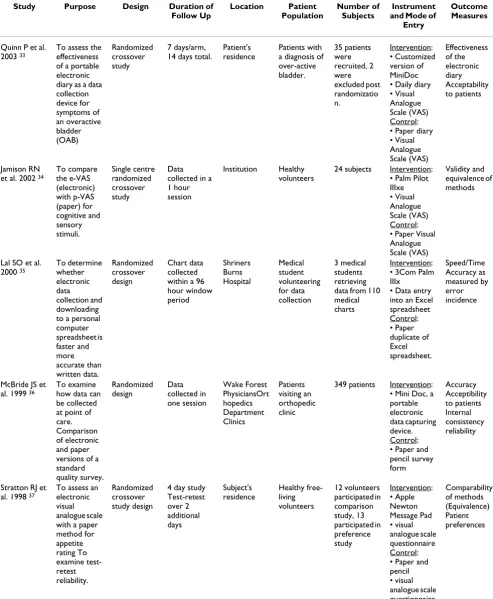
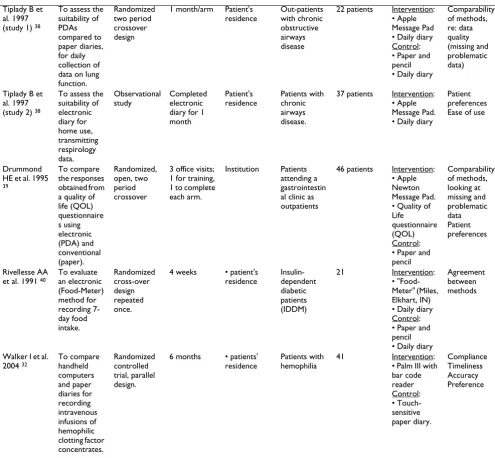
There were a total of 201 potentially relevant studies iden-tified by the search strategy. After a review of the titles and abstracts 141 articles were retrieved of which 9 met the inclusion criterion for review in this study [32-40]. Table 1 provides a summary of the information extracted from each of the eligible RCTs included in this review.
Table 1: Summary of randomized controlled trials comparing handheld computers to paper and pen.
Study Purpose Design Duration of
Follow Up Location Patient Population Number of Subjects Instrument and Mode of
Entry
Outcome Measures
Quinn P et al. 2003 33
To assess the effectiveness of a portable electronic diary as a data collection device for symptoms of an overactive bladder (OAB) Randomized crossover study 7 days/arm, 14 days total.
Patient's residence
Patients with a diagnosis of over-active bladder. 35 patients were recruited, 2 were excluded post randomizatio n. Intervention: • Customized version of MiniDoc • Daily diary • Visual Analogue Scale (VAS) Control: • Paper diary • Visual Analogue Scale (VAS) Effectiveness of the electronic diary Acceptability to patients Jamison RN et al. 2002 34
To compare the e-VAS (electronic) with p-VAS (paper) for cognitive and sensory stimuli. Single centre randomized crossover study Data collected in a 1 hour session
Institution Healthy volunteers
24 subjects Intervention: • Palm Pilot IIIxe • Visual Analogue Scale (VAS) Control: • Paper Visual Analogue Scale (VAS)
Validity and equivalence of methods
Lal SO et al. 2000 35
To determine whether electronic data collection and downloading to a personal computer spreadsheet is faster and more accurate than written data. Randomized crossover design Chart data collected within a 96 hour window period Shriners Burns Hospital Medical student volunteering for data collection 3 medical students retrieving data from 110 medical charts
Intervention: • 3Com Palm IIIx
• Data entry into an Excel spreadsheet Control: • Paper duplicate of Excel spreadsheet. Speed/Time Accuracy as measured by error incidence
McBride JS et al. 1999 36
To examine how data can be collected at point of care. Comparison of electronic and paper versions of a standard quality survey. Randomized design Data collected in one session Wake Forest PhysiciansOrt hopedics Department Clinics Patients visiting an orthopedic clinic
349 patients Intervention: • Mini Doc, a portable electronic data capturing device. Control: • Paper and pencil survey form Accuracy Acceptibility to patients Internal consistency reliability
Stratton RJ et al. 1998 37
To assess an electronic visual analogue scale with a paper method for appetite rating To examine test-retest reliability. Randomized crossover study design
The electronic forms of data entry were variable, utilizing push button technology[33,36], or touch sensitive screens using a stylus pen [34,37-39]. In one study data were entered via bar codes and an optical reading system[40], while the mode of entry for one study was not clearly spec-ified [35]. In the remaining study [32] data was entered into a handheld computer by a combination of an inte-grated bar code reader and stylus pen.
Handheld computers and paper and pencil technologies were compared using a variety of applications. In three of the studies subjects were asked to rate some kind of sub-jective symptom or experience using visual analogue scales (VAS) [33,34,37]; whereas in a study of patients
with asthma daily symptoms were recorded using custom software[38]. In two of the studies, questionnaires regard-ing quality of life [39]and quality of care [36] were admin-istered in paper and electronic forms. Three studies examined the abilities of both devices to record objective data such as burn variables[35], daily food intake [40]and intravenous infusions of hemophilic clotting factor con-centrates[32].
In three of the studies healthy volunteers/medical stu-dents participated to evaluate the two methods of data collection: electronic using a handheld or paper based manual collection [34,35,37]. The remaining six studies involved a variety of patient populations including
Tiplady B et al. 1997 (study 1) 38
To assess the suitability of PDAs compared to paper diaries, for daily collection of data on lung function.
Randomized two period crossover design
1 month/arm Patient's residence Out-patients with chronic obstructive airways disease
22 patients Intervention: • Apple Message Pad • Daily diary Control: • Paper and pencil • Daily diary
Comparability of methods, re: data quality (missing and problematic data)
Tiplady B et al. 1997 (study 2) 38
To assess the suitability of electronic diary for home use, transmitting respirology data. Observational study Completed electronic diary for 1 month Patient's residence Patients with chronic airways disease.
37 patients Intervention: • Apple Message Pad. • Daily diary
Patient preferences Ease of use
Drummond HE et al. 1995
39
To compare the responses obtained from a quality of life (QOL) questionnaire s using electronic (PDA) and conventional (paper). Randomized, open, two period crossover
3 office visits; 1 for training, 1 to complete each arm.
Institution Patients attending a gastrointestin al clinic as outpatients
46 patients Intervention: • Apple Newton Message Pad. • Quality of Life questionnaire (QOL) Control: • Paper and pencil Comparability of methods, looking at missing and problematic data Patient preferences Rivellesse AA et al. 1991 40
To evaluate an electronic (Food-Meter) method for recording 7-day food intake. Randomized cross-over design repeated once.
4 weeks • patient's residence Insulin-dependent diabetic patients (IDDM) 21 Intervention: • "Food-Meter" (Miles, Elkhart, IN) • Daily diary Control: • Paper and pencil • Daily diary
Agreement between methods
Walker I et al. 2004 32
To compare handheld computers and paper diaries for recording intravenous infusions of hemophilic clotting factor concentrates. Randomized controlled trial, parallel design.
6 months • patients' residence
Patients with hemophilia
41 Intervention: • Palm III with bar code reader Control: • Touch-sensitive paper diary. Compliance Timeliness Accuracy Preference
patients with: bladder disorders[33], orthopedic prob-lems[36], chronic obstructive airway disease[38], gas-trointestinal problems,[39] diabetes [40] and hemophilia [32]. Summaries of the different studies are given in Table 1.
All, but one of the studies in this review have explored more than one outcome measure[40]. Three studies eval-uated the acceptability of handheld computers to patients [32,33,36]. In one of these studies acceptability was deter-mined by comparing percentages of positive features reported for each device [36]; the second study measured acceptability using an ease-of-use scale and a face-to-face interview questionnaire to elicit subject's opinions [33]; in the third study [32], acceptability was not assessed but ten (50%) of the patients who had used both paper diary and handheld computer methods subsequently took part in a subsequent qualitative study [41]. Three studies looked at the comparability of handheld computers to paper and pencil devices: two of the studies compared missing and problematic data points [38,39]; and one study compared results obtained using both paper and electronic visual analogue scales [37]. Two studies
explored the equivalence of data obtained by electronic and paper and pencil methods, one used VAS [34], and the other explored differences between group scale scores using the Wilcoxon test [36]. Two studies assessed the validity of electronic modes of data capture: one study attempting to validate an electronic VAS [34]; the other study measuring agreement between conventional and electronic devices in order to validate an innovative device used for data capture pertaining to food intake [40]. The speed and accuracy of both methods were measured in one study [35], as was effectiveness [33] in another. The final study [32] compared adherence to a set schedule for sub-mission of data, accuracy of data, and lag time between data entry in the home and receipt of data at the clinic. Reminder phone calls were made according to a strict pro-tocol.
Data accuracy
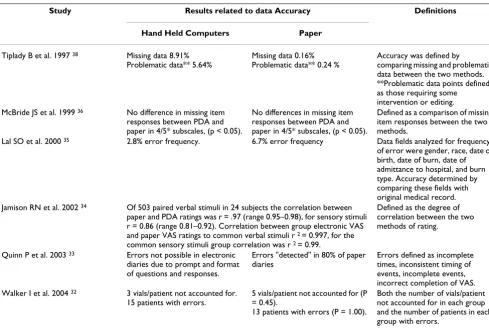
The findings related to an outcome of accuracy are sum-marized in Table 2. Six out of nine studies [32-36,38]com-pared data accuracy obtained by handheld technology to that of paper and pencil devices. Measurements of accu-racy differed between studies. In two trials [34,36] data
Table 2: Summary of the results of data accuracy assessed in six randomized controlled trials
Study Results related to data Accuracy Definitions
Hand Held Computers Paper
Tiplady B et al. 1997 38 Missing data 8.91%
Problematic data** 5.64%
Missing data 0.16% Problematic data** 0.24 %
Accuracy was defined by comparing missing and problematic data between the two methods. **Problematic data points defined as those requiring some intervention or editing. McBride JS et al. 1999 36 No difference in missing item
responses between PDA and paper in 4/5* subscales, (p < 0.05).
No differences in missing item responses between PDA and paper in 4/5* subscales, (p < 0.05).
Defined as a comparison of missing item responses between the two methods.
Lal SO et al. 2000 35 2.8% error frequency. 6.7% error frequency Data fields analyzed for frequency
of error were gender, race, date of birth, date of burn, date of admittance to hospital, and burn type. Accuracy determined by comparing these fields with original medical record. Jamison RN et al. 2002 34 Of 503 paired verbal stimuli in 24 subjects the correlation between
paper and PDA ratings was r = .97 (range 0.95–0.98), for sensory stimuli r = 0.86 (range 0.81–0.92). Correlation between group electronic VAS and paper VAS ratings to common verbal stimuli r 2 = 0.997, for the
common sensory stimuli group correlation was r 2 = 0.99.
Defined as the degree of correlation between the two methods of rating.
Quinn P et al. 2003 33 Errors not possible in electronic
diaries due to prompt and format of questions and responses.
Errors "detected" in 80% of paper diaries
Errors defined as incomplete times, inconsistent timing of events, incomplete events, incorrect completion of VAS. Walker I et al. 2004 32 3 vials/patient not accounted for.
15 patients with errors.
5 vials/patient not accounted for (P = 0.45).
13 patients with errors (P = 1.00).
Both the number of vials/patient not accounted for in each group and the number of patients in each group with errors.
*The subscale in which differences in missing item responses were found was the 1st response choice on PDA, authors suggest this could be
accuracy was measured by comparing the equivalence of responses obtained using both paper and pencil and hand-held microcomputer data collection modes. The authors found a similar degree of accuracy between results recorded on a paper and pencil visual analogue scale and VAS administered via a handheld microcomputer. Simi-larly, a comparison of paper and pencil and handheld microcomputer versions of the PRESS, GANEY™ outpa-tient survey questionnaire determined that both modes of data capture produced comparable results. In two other studies, data quality/accuracy were measured by compar-ing the percentages of errors obtained by each device [33,35]. Both studies found that data collected electroni-cally were more accurate and contained fewer errors than data captured manually with paper and pencil. In one case, the paper and pencil mode of data collection pro-duced a 6.7% error frequency, compared with a signifi-cantly lower 2.8% error frequency obtained by patients using the microcomputer technology [35]. The other study [32] detected errors in 80% of the paper diary data, but found the error rates of electronic diaries to be low, hypothesizing that the prompts and structures of ques-tions and responses guide the user towards greater accu-racy. Another study [38] measured data accuracy by comparing the proportions of 'missed' and/or 'problem-atic data' points between the two methods; detecting a higher proportion of missing and/or problematic data in the PDA diaries. The final study [32] compared the number of medication vials unaccounted for and also the proportion of individuals having errors in the number of vials not accounted for; the error rate was similar for the two methods.
Timeliness
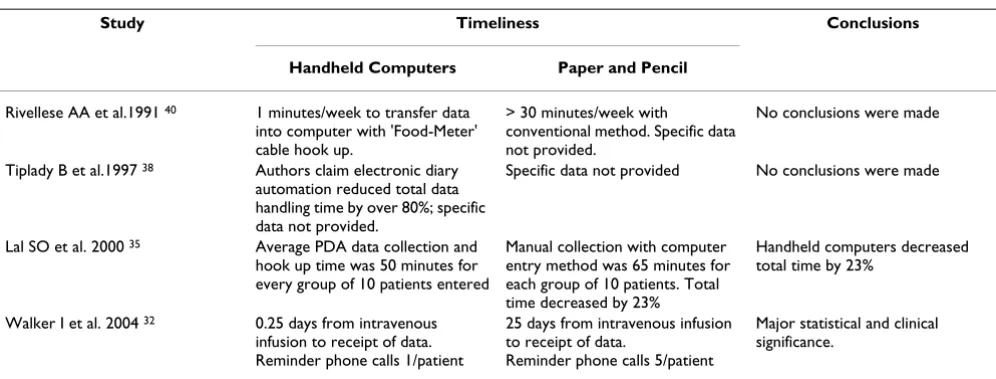
Table 3 provides a summary of findings related to the timeliness of data collection. Four out of the nine RCTs report outcomes comparing the timeliness of electronic
portable microcomputer technology to paper and pencil data collection devices [32,35,38,40]. One of the three tri-als [35] directly measured data entry time between elec-tronic and paper and pencil devices. In this study [32] the use of electronic instruments reduced data entry and transfer time by 23%. A second study [32] compared the interval between the times of intravenous infusions and the receipt of data; the interval from those using handheld computers was greatly reduced (0.25 vs. 25 days, p < 0.0001). The remaining two studies [38,40] reported that electronic instruments reduced the time required for data handling and transfer but did not provide time estimates.
Adherence
Three of the nine studies addressed the issue of adherence [32,33,38] but only one provided objective data [32]. In this latter study a schedule for submission of data was pro-vided prospectively to the patients; adherence by users of handheld computers was 86% versus 48% for paper diary users (P < 0.0001) despite an increased number of reminder phone calls to users of paper diaries compared to the users of handheld computers (5 versus 1, P < 0.0001). Neither of the other two studies [33,38] made direct measurements of adherence between electronic and paper/pencil modes of data collection. In one trial [33] adherence was evaluated for electronic data capture but not for paper and pencil data collection. In the same study where patients were instructed to complete diaries daily, recording events as soon as possible after occurrence, 73% of the cases entered data into the diaries within two hours of the event occurring. In one study, where adherence was not measured [38] the authors report unconfirmed suspi-cions of retrospective data entry in paper diaries, which relates specifically to the issue of adherence.
Table 3: Summary of the findings related to timelines in the four studies reporting this outcome.
Study Timeliness Conclusions
Handheld Computers Paper and Pencil
Rivellese AA et al.1991 40 1 minutes/week to transfer data
into computer with 'Food-Meter' cable hook up.
> 30 minutes/week with conventional method. Specific data not provided.
No conclusions were made
Tiplady B et al.1997 38 Authors claim electronic diary
automation reduced total data handling time by over 80%; specific data not provided.
Specific data not provided No conclusions were made
Lal SO et al. 2000 35 Average PDA data collection and
hook up time was 50 minutes for every group of 10 patients entered
Manual collection with computer entry method was 65 minutes for each group of 10 patients. Total time decreased by 23%
Handheld computers decreased total time by 23%
Walker I et al. 2004 32 0.25 days from intravenous
infusion to receipt of data. Reminder phone calls 1/patient
25 days from intravenous infusion to receipt of data.
Reminder phone calls 5/patient
Patient preference
Table 4 provides a summary of the data related to patient preferences. Four of the nine RCTs evaluated patient pref-erence as a secondary outcome measure, using patient sur-veys [32,37-39] while ten of the twenty-two patients in a fourth study who had been randomized to handheld computers but who had previously used paper diaries took part in a subsequently published qualitative study [41]. Three out of four trials found that subjects preferred portable handheld devices to paper and pencil [32,38,39], while in the fourth study a small majority of subjects pre-ferred a paper and pencil questionnaire [37]. In total, 54/ 91 (59%) of subjects favored the used of the PDA, 17/91 subjects (19%) favored paper methods of data capture. Twenty out of 91 subjects, (22%) indicated "no prefer-ence".
Discussion
Despite the numerous investigations describing the potential advantages that hand-held computers offer in research and health care settings compared to traditional paper data collection methods [2,4,6,8,9,15,16,42,43] only a handful of these studies adhered to the ideal, exper-imental method for the evaluation of effectiveness – the RCT (Randomized Controlled Trial)[44]. However, we were able to identify nine studies that comparatively eval-uated handheld computers and pencil and paper methods using an RCT crossover or parallel design. The results of this review suggest that handheld computers have the potential not only to overcome some of the limitations of conventional paper and pencil devices but to supersede them, particularly with respect to improving timeliness of data handling. In addition, the preference by research sub-jects for handheld computers could result in improved adherence to data collection protocols for long-term stud-ies, as evidenced by the markedly improved adherence and patient preference for the handheld computer group in the study having the longest observation period [32].
The importance of data quality from investigator's and sponsors' perspectives has been highlighted elsewhere as the most important issue in considering new data capture technologies [45]. On the other hand an increased
accu-racy of data entry cannot be assumed for either method. In this review only two of the six studies found handheld computers to be more accurate, in three studies accuracy was similar and in one study the paper method was more accurate. Data entry with handheld computers can in some cases be made relatively foolproof by carefully struc-turing the questions to allow only determinate types of responses and by the use of prompts to ensure that ques-tions are followed in sequence and cannot be skipped. However, handheld computers will not result in greater accuracy of data where the performance of the paper method is already at a high level or where the source of error is in data collection rather than in data entry or transmission.
Recently, the utility and validity of paper and pencil dia-ries has been called into question by the findings of Stone et al's [46] suggesting high levels of faked compliance in paper diaries. The same study also demonstrates the capacity of handheld computers to improve and provide objective measures of adherence to protocols by time and date stamping data entries [47]. The authors of one study in this review made similar speculations about retrospec-tive data entry after finding high rates of missing data using handheld computers (designed not to permit retro-spective entry) but low rates of missing data in paper dia-ries [38]. Despite Stone et al's invention and validation of a paper diary equipped with a photo sensor and capable of detecting opening and closing of the diary [47] only one of the studies in this review evaluated direct compar-isons of adherence between methods[32]. This latter study evaluated adherence to a set schedule for data trans-mission rather than evaluating adherence to timely data entry. Future research should be directed towards the endeavor of making direct comparisons of adherence between methods as part of the larger project of validating handhelds for data capture among patient populations.
Differences between the handheld and paper and pencil instruments in data entry, in data handling and transfer times, were seldom evaluated in these studies, yet, theo-retically handheld computers offer enormous temporal and financial benefits that deserve further exploration in
Table 4: Summary of RCTs assessing patient preference
Study (Author, Year) Proportion of Patients with a Preference (# [%])
PDA Paper No Preference
Drummond HE et al., 1995 39 26/46 (57) 6/46 (13) 14/46 (30)
Tiplady B et al., 1997 38 13/22 (59) 4/22 (18) 5/22 (23)
Stratton RJ et al., 1998 37 5/13 (38) 7/13 (54) 1/13 (8)
Walker I et al.,2004 Arnold E et al., 2005 32
(Follow-up qualitative study)
clinical research. Typically in research vast quantities of data must be collected, organized, and transcribed by key entry into a file using computer software. Often this is done twice (double-data entry) to ensure accuracy and reduce the potential for human error. Using a handheld computer for data collection can eliminate these proc-esses, which are costly and time consuming, resulting in a superior method to conventional paper and pencil devices.
As care and treatment strategies become increasingly patient centered, patient preferences are taken into greater consideration. Preference is defined as the level of desira-bility that a person associates with a particular health state, treatment process or level of participation [48]. Accordingly, 4 of the 9 studies summarized in this review evaluated patient preferences for either electronic or paper and pencil data capture at the end of the studies. In three out of four of these studies a larger percentage of patients preferred handheld computers to paper and pencil for data capture (Table 4). These findings are important because research has shown that patient satisfaction can influence the efficacy of interventions and levels of com-pliance [48]; therefore it seems in the interests of the investigator to consider and incorporate patient prefer-ences when choosing a data collection tool. A recent study from our centre has also shown that method of record keeping is an important factor contributing to adherence of reporting [41].
The analysis of these studies provides evidence that hand-held computer devices are an effective technology for data collection in the health care setting and in health related research. When compared to paper and pencil methods of data recording the handheld computers appear to be faster and preferred by most patients. The accuracy of the data collected may be greater with handheld computers in some circumstances but not all and the definitions of accuracy varied between studies. Future studies in this area would benefit from a more standardized definition of accuracy to allow for inter-study comparisons of results. As well, additional information to assess adherence to data collection requirements would also be useful as part of the overall assessment of the usefulness of handheld computer technology for data collection in the health care setting.
Recently, a number of authors have stressed the limita-tions of randomized trials in assessing the role of compu-ter systems, indicating that questions such as how and why computer systems are used and explanations of vari-ous phenomena are best answered by studies based on qualitative, technical, psychological and other methods [49-51]. None of these authors are however suggesting that randomized trials be abandoned, and in fact are
sug-gesting an integrated approach involving both quantita-tive and qualitaquantita-tive methods. Our opinion is that the randomized trial is best suited for comparing the ultimate performance of two or more methods in their actual clin-ical settings. Questions of generalizability to situations outside the actual test conditions will arise, but this is well understood. We suggest that the emphasis, though not the only role, of other methods is in the explanation of observed phenomena and in the actual development of systems. In deciding on a method of data collection, researchers could reasonably consider that handheld computers will likely be acceptable to patients and have the potential to provide more rapid data handling. On the other hand, improved compliance and accuracy of data recording should not be assumed and may depend on the particular conditions of the study, the origin of these aspects may lie outside the nature of the recording device, such as in training, understanding and motivation.
Conclusion
These studies illustrate many of the technical qualities of handheld computers described in previous reviews and are highlighted by their direct comparison with those of the paper standard when these methods are used side by side. Handheld computers can be programmed to provide determinate responses, date stamped to document times of data entry, restrict times of data entry, prevent retroac-tive data entry, limit 'look back' to previous data, prevent omissions of data entry, and can save considerable time and labor incurred in data handling. Handheld computers are well accepted, and are more likely than paper methods to be the choice of the user. The ultimate results with handheld computers have in most trials been similar to those of the paper method, particularly when the per-formance of the paper method is already high, and there-fore improved accuracy cannot be assumed. The potential advantages of handheld computers lie in their technical advantages which should be carefully considered when designing the software programs to match the task.
Competing interests
The author(s) declare that they have no competing inter-ests.
Authors' contributions
Acknowledgements
We are grateful to Jeanette Button for providing administrative support on this manuscript. This study was funded by McMaster University and Cana-dian Blood Services (Kenneth J. Fyke Award).
References
1. van Gerven JM, Schoemaker RC, Jacobs LD, Reints A, MJ OM, Hoede-maker HG, Cohen AF: Self-medication of a single headache epi-sode with ketoprofen, ibuprofen or placebo, home-monitored with an electronic patient diary. Br J Clin Pharmacol
1996, 42:475-481.
2. Jamison RN, Raymond SA, Levine JG, Slawsby EA, Nedeljkovic SS, Katz NP: Electronic diaries for monitoring chronic pain: 1-year validation study. Pain 2001, 91:277-285.
3. Scharer LO, Hartweg V, Hoern M, Graesslin Y, Strobl N, Frey S, Bie-dermann C, Walser S, Walden J: Electronic diary for bipolar patients. Neuropsychobiology 2002, 46 Suppl 1:10-12.
4. Hyland ME, Kenyon CA, Allen R, Howarth P: Diary keeping in asthma: comparison of written and electronic methods. BMJ
1993, 306:487-489.
5. Caro JJS, Caro I, Caro J, Wouters F, Juniper EF: Does electronic implementation of questionnaires used in asthma alter responses compared to paper implementation? Qual Life Res
2001, 10:683-691.
6. Gupta PC: Survey of sociodemographic characteristics of tobacco use among 99,598 individuals in Bombay, India using handheld computers. Tob Control 1996, 5:114-120.
7. Saleh KJ, Radosevich DM, Kassim RA, Moussa M, Dykes D, Bottolfson H, Gioe TJ, Robinson H: Comparison of commonly used ortho-paedic outcome measures using palm-top computers and paper surveys. J Orthop Res 2002, 20:1146-1151.
8. Rabin JM, McNett J, Badlani GH: A computerized voiding diary. J Reprod Med 1996, 41:801-806.
9. Rabin JM, McNett J, Badlani GH: "Compu-Void II": the compu-terized voiding diary. J Med Syst 1996, 20:19-34.
10. Shiffman S, Hufford M, Hickcox M, Paty JA, Gnys M, Kassel JD:
Remember that? A comparison of real-time versus retro-spective recall of smoking lapses. J Consult Clin Psychol 1997,
65:292-300.
11. Shiffman S, Elash CA, Paton SM, Gwaltney CJ, Paty JA, Clark DB, Liu KS, Di Marino ME: Comparative efficacy of 24-hour and 16-hour transdermal nicotine patches for relief of morning craving. Addiction 2000, 95:1185-1195.
12. Wright P, Rogers N, Hall C, Wilson B, Evans J, Emslie H, Bartram C:
Comparison of pocket-computer memory aids for people with brain injury. Brain Inj 2001, 15:787-800.
13. Wright P, Rogers N, Hall C, Wilson B, Evans J, Emslie H: Enhancing an appointment diary on a pocket computer for use by peo-ple after brain injury. Int J Rehabil Res 2001, 24:299-308. 14. Johannes CB, Crawford SL, Woods J, Goldstein RB, Tran D,
Mehro-tra S, Johnson KB, Santoro N: An electronic menstrual cycle cal-endar: comparison of data quality with a paper version. Menopause 2000, 7:200-208.
15. Selanikio JD, Kemmer TM, Bovill M, Geisler K: Mobile computing in the humanitarian assistance setting: an introduction and some first steps. J Med Syst 2002, 26:113-125.
16. Fletcher LA, Erickson DJ, Toomey TL, Wagenaar AC: Handheld computers. A feasible alternative to paper forms for field data collection. Eval Rev 2003, 27:165-178.
17. Clarke WL, Cox DJ, Gonder-Frederick LA, Kovatchev B: Hypoglyc-emia and the decision to drive a motor vehicle by persons with diabetes. JAMA 1999, 282:750-754.
18. Wegner KE, Smyth JM, Crosby RD, Wittrock D, Wonderlich SA, Mitchell JE: An evaluation of the relationship between mood and binge eating in the natural environment using ecological momentary assessment. Int J Eat Disord 2002, 32:352-361. 19. Iregui M, Ward S, Clinikscale D, Clayton D, Kollef MH: Use of a
handheld computer by respiratory care practitioners to improve the efficiency of weaning patients from mechanical ventilation. Crit Care Med 2002, 30:2038-2043.
20. Sellors JW, Hayward R, Swanson G, Ali A, Haynes RB, Bourque R, Moore KA, Lohfeld L, Dalby D, Howard M: Comparison of defer-ral rates using a computerized versus written blood donor questionnaire: a randomized, cross-over study [ISRCTN84429599] 25. BMC Public Health 2002, 2:14.
21. Henker B, Whalen CK, Jamner LD, Delfino RJ: Anxiety, affect, and activity in teenagers: monitoring daily life with electronic diaries. J Am Acad Child Adolesc Psychiatry 2002, 41:660-670. 22. Fischer S, Stewart TE, Mehta S, Wax R, Lapinsky SE: Handheld
com-puting in medicine. J Am Med Inform Assoc 2003, 10:139-149. 23. Miller SM, Beattie MM, Butt AA: Personal digital assistant
infec-tious diseases applications for health care professionals. Clin Infect Dis 2003, 36:1018-1029.
24. MM W, R S, C H, WP M, JL W: Clinical documentation: the handheld computer as a survival tool. MD Computing 1998,
15:356-358.
25. W G, A H, Gillies: Hand-held computers in healthcare: what software programs are available? New Zealand Medical Journal
2002, 115:U180.
26. Keplar KE, Urbanski CJ: Personal digital assistant applications for the healthcare provider. Ann Pharmacother 2003, 37:287-296. 27. Lehman K: Clinical nursing instructors' use of handheld com-puters for student recordkeeping and evaluation. J Nurs Educ
2003, 42:41-42.
28. Usatine R: Teaching and practicing medicine with handheld computers. Fam Med 2002, 34:719-720.
29. Adatia F, Bedard PL: "Palm reading": 2. Handheld software for physicians. CMAJ 2003, 168:727-734.
30. Koop A, Mosges R: The use of handheld computers in clinical trials. Control Clin Trials 2002, 23:469-480.
31. DL S, GR N: PDQ Epidemiology 2nd edition edition. St Louis, Mosby-Year Book Inc.; 1996:48-78.
32. Walker I, Sigouin C, Sek J, Almonte T, Carruthers J, Chan A, Pai M, Heddle N: Comparing hand-held computers and paper diaries for haemophilia home therapy: a randomized trial. Haemo-philia 2004, 10:698-704.
33. Quinn P, Goka J, Richardson H: Assessment of an electronic daily diary in patients with overactive bladder. BJU Int 2003,
91:647-652.
34. Jamison RN, Gracely RH, Raymond SA, Levine JG, Marino B, Her-rmann TJ, Daly M, Fram D, Katz NP: Comparative study of elec-tronic vs. paper VAS ratings: a randomized, crossover trial using healthy volunteers. Pain 2002, 99:341-347.
35. Lal SO, Smith FW, Davis JP, Castro HY, Smith DW, Chinkes DL, Bar-row RE: Palm computer demonstrates a fast and accurate means of burn data collection. J Burn Care Rehabil 2000,
21:559-561.
36. McBride JS, Anderson RT, Bahnson JL: Using a hand-held compu-ter to collect data in an orthopedic outpatient clinic: a rand-omized trial of two survey methods. Med Care 1999,
37:647-651.
37. Stratton RJ, Stubbs RJ, Hughes D, King N, Blundell JE, Elia M: Com-parison of the traditional paper visual analogue scale ques-tionnaire with an Apple Newton electronic appetite rating system (EARS) in free living subjects feeding ad libitum. Eur J Clin Nutr 1998, 52:737-741.
38. B T, GK C, MH D, FGE B, SP M, LM CA, D. B: The use of Electronic Diaries in Respiratory Studies. Drug Information Journal 1997,
31:759-764.
39. Drummond HE, Ghosh S, Ferguson A, Brackenridge D, Tiplady B:
Electronic quality of life questionnaires: a comparison of pen-based electronic questionnaires with conventional paper in a gastrointestinal study. Qual Life Res 1995, 4:21-26. 40. Rivellese AA, Ventura MM, Vespasiani G, Bruni M, Moriconi V, Pacioni
D, Sulpini MT, Borrelli R, Giacco A, Cangemi C, .: Evaluation of new computerized method for recording 7-day food intake in IDDM patients. Diabetes Care 1991, 14:602-604.
41. Arnold E, Heddle N, Lane S, Sek J, Almonte T, Walker I: Handheld computers and paper diaries for documenting the use of fac-tor concentrates used in haemophilia home therapy: a qual-itative study. Haemophilia 2005, 11:216-226.
42. Christiansen DH, Hosking JD, Dannenberg AL, Williams OD: Com-puter-assisted data collection in multicenter epidemiologic research. The Atherosclerosis Risk in Communities Study. Control Clin Trials 1990, 11:101-115.
43. Robinson D: Data capture using hand-held computers. J Psychi-atr Ment Health Nurs 1994, 1:126-127.
Publish with BioMed Central and every scientist can read your work free of charge "BioMed Central will be the most significant development for disseminating the results of biomedical researc h in our lifetime."
Sir Paul Nurse, Cancer Research UK
Your research papers will be:
available free of charge to the entire biomedical community
peer reviewed and published immediately upon acceptance
cited in PubMed and archived on PubMed Central
yours — you keep the copyright
Submit your manuscript here:
http://www.biomedcentral.com/info/publishing_adv.asp
BioMedcentral
45. A L, J W, .: Data capture from the sponsors' and investigator's perspective: Balancing quality, speed, and cost. Drug Informa-tion Journal 1998, 32:871-886.
46. Stone AA, Shiffman S, Schwartz JE, Broderick JE, Hufford MR: Patient non-compliance with paper diaries. BMJ 2002, 324:1193-1194. 47. Stone AA, Shiffman S, Schwartz JE, Broderick JE, Hufford MR: Patient compliance with paper and electronic diaries. Control Clin Trials
2003, 24:182-199.
48. Ricard N, Kind P, Christian S, Jensen M, Stewart J: Link between patient preferences and treatment outcomes in seasonal allergic rhinitis: an empiric investigation. Clin Ther 1999,
21:268-277.
49. Kaplan B: Evaluating informatics applications--some alterna-tive approaches: theory, social interactionism, and call for methodological pluralism. Int J Med Inform 2001, 64:39-56. 50. A S: Integrating quantitative and qualitative methods in
patient care information system evaluation: guidance for the organizational decision maker. Methods Inf Med 2003,
32:141-150.
51. Kushniruk A: Evaluation in the design of health information systems: application of approaches emerging from usability engineering. Comput Biol Med 2002, 32:141-149.
Pre-publication history
The pre-publication history for this paper can be accessed here: