R E S E A R C H A R T I C L E
Open Access
Use of the sit-to-stand task to evaluate
motor function of older adults using
telemetry
Akira Kanai
1,2*, Sachiko Kiyama
3, Hiroshi Goto
2, Hidehito Tomita
4, Ayuko Tanaka
3, Mitsunobu Kunimi
3,
Tsutomu Okada
5and Toshiharu Nakai
3Abstract
Background:Physical exercises are widely used in community programs, but not all older adults are willing to participate. Information and communication technology may solve this problem by allowing older people to participate in fitness programs at home. Use of remote instruction will facilitate physical exercise classes without requiring that participants gather at one place. The aim of this study was to examine use of a sit-to-stand task in evaluating motor function using conventional video communication in a telemetry system to enable real-time monitoring, and evaluation in physical performance of older adults at home.
Methods:The participants were 59 older individuals and 81 university students. Three physical exercise batteries were used: arm curl, figure-of-eight walk test, and functional reach. The knee extension maximum angular velocity (KEMAV) and the iliac elevation maximum velocity (IEMV) during standing up from a chair and the heel rise frequency were used in the motion-capture measurements. The results were assessed using multi-group structural equation modeling (SEM) for the young and older groups.
Results:Young participants consistently performed better than their older counterparts on all items. Analyses with multi-group SEM based on correlations between items yielded a good model-fit for the data. Among all path diagrams for IEMV and KEMAV in the older and young groups, paths from muscular strength to skillfulness showed significant effects. The path from the IEMV to muscular strength was also significant in the older group.
Conclusions:Multi-group SEM suggested that video-based measurements of IEMV during sit-to-stand motion can
estimate muscular strength, which suggests that remote monitoring of physical performance can support wellness of community-dwelling older adults.
Keywords:Older adults, Sit-stand-task, Physical batteries, Iliac elevation maximum velocity, Knee extension maximum angular velocity, Multi-group structural equation modeling, Remote motion capture
Background
Physical therapy in geriatrics has an important role as a prophylactic intervention using various physical exer-cises to maintain and improve motor function. In par-ticular, recovery of physical activity related to daily life is important for older adults because a high activity level is related to a high physical function [24]. Fall prevention
is also an important purpose of physical exercise inter-vention [2, 9, 23, 38]. A review of 17 studies concluded that exercise programs designed to prevent falls in older adults prevent injuries caused by falls and reduce the rate of falls requiring medical care [2].
Physical exercise courses are widely used in community programs, but problems include the effort required for continuation of learned exercises at home, and the lack of willingness of some older adults to participate in a course. Improvement in gait ability was observed after low-fitness older adults underwent 6-month low-strength muscular training such as chair exercise in a group; however, the * Correspondence:[email protected]
1
Graduate School of Health Sciences, Toyohashi SOZO University, 20-1 Matsusita, Ushikawa-cho, Toyohashi 440-8511, Japan
2Department of Physical Therapy, School of Health Sciences, Toyohashi SOZO University, 20-1 Matsusita, Ushikawa-cho, Toyohashi 440-8511, Japan Full list of author information is available at the end of the article
effects did not persist for more than 3 months after direct instruction was stopped, suggesting that the participants did physical exercises during the program period, but may not have continued these exercises at home [19]. There-fore, it would be beneficial to develop a system to monitor the physical status of older people after a course to main-tain connection to the program.
One solution for the problems above is to introduce in-formation and communication technology (ICT) that en-ables older people to participate in fitness programs at home. Rapid developments in processing power, data transmission, and data storage in interactive technologies have led to a continual evolution of eHealth interventions [26]. Physical exercises and nutrition programs using communication technologies have been designed using eHealth platforms. For example, the low cost and greater accessibility of computer-based telecommunication exer-cise interventions led to improvements in strength, balance, and depressive symptoms [40], and instruction in an online aftercare program for cardiac rehabilitation increased the physical activity of older patients [30]. These studies show that online programs can improve cardiac rehabilitation and indicate that physical exercise ICT programs can support self-management of various health disorders.
ICT programs allow instructions on physical exercise to be given without requiring the participants to gather at one place, and minimize or eliminate the cost and time of instructors visiting community-dwelling older adults door-to-door. However, valid remote monitoring of movement requires sufficient time, spatial resolution and quantitation. Therefore, the motions for such re-mote measurements should be as simple, reproducible, and safe as possible for older people to perform. In this study, we designed a telemetry approach to evaluate the relationship between performance of sit-to-stand move-ment, which mostly reflects the strength of the knee and hip joint, and physical activity of older subjects [3, 16, 22, 47, 48]. Yoshida et al. [46] compared the strength of the knee extension muscles and maximal gait speed in participants and non-participants in a physical exercise program, and found lower performance in male and fe-male non-participants. Sit-to-stand movement is com-mon in daily life and performance of this motion for measurement does not increase risk of accidents.
As a battery for physical activity, we used the protocol used by Shigematsu et al. [37], in which it was proposed that physical status that reflects daily life activity can be predicted using functional fitness tests such as the arm curl (AC), figure-of-eight walk (F8W) test, and func-tional reach (FR). The time and number of steps in the F8W test is significantly correlated with the time in the 10-m walking test and the Timed Up and Go test [37]. F8W is also correlated with other walking parameters in
older adults, such as gait speed, physical function, confi-dence in walking and movement control [18]. However, the F8W test is unsuitable for a telemetry system be-cause of the risk of falls, complexity of movement, and the space required for the test. From this point of view, the sit-to-stand task test may be a useful tool to assess balance and the risk of falls in older people [5]. Concen-tric strength at higher velocity, eccenConcen-tric strength, and rate of torque development are important contributors in sit-to-stand performance [7]. The rate of body rise is hypothetically a useful index of exercise capacity for older adults, and thus, the sit-to-stand task is appropri-ate for telemetry systems.
To evaluate the rate of rise by telemetry, we focused on two markers: (1) the knee extension maximum angu-lar velocity (KEMAV) as a marker of body rise, and (2) the iliac elevation maximum velocity (IEMV) to reflect the gravity center of the body. In addition, we measured the frequency of heel rise (HR) to reflect the strength of the lower limb muscles [17, 34]. The HR task can also be easily performed without relocating the position, similarly to the sit-to-stand task. Thus, the sit-to-stand and HR tasks can be performed within the monitoring range of a conventional webcam. Most physical exercises for fall prevention use gait, balance and functional train-ing to recover physical activity of the lower extremities [2, 9]. By comparing the performance on a sit-to-stand task by video-monitoring and the actual physical activity of the subjects, the potential of telemetry for home mon-itoring using a conventional video communication de-vice was investigated.
Methods
Participants
The participants were 59 older adults (26 males, 33 fe-males; mean age 74 ± 3.3 years) and 81 university students (44 males, 37 females; mean age 20.8 ± 0.9 years). The older participants were recruited in a physical exercise classroom at a local community club. All participants were neurologically normal and had no physical disabilities. Written informed consent was obtained from all partici-pants in accordance with the research protocol approved by the institutional review board of the National Center for Geriatrics and Gerontology (Protocol #495, Dec 2010) in accordance with the ethical standards laid down in the Declaration of Helsinki.
Physical test batteries and movement tasks
motion recorded was standing up from a chair to meas-ure KEMAV and IEMV. To start this motion, the height of the chair bench was adjusted manually based on the length of the individual’s lower extremity. The subject folded arms in front of the chest and was instructed to quickly start the stand up motion in response to a flash-ing light signal of 1 s duration that was placed 0.8 m above and 1 m in front of the chair. The second motion recorded was the HR to evaluate the strength of the lower limb muscles. The participants performed self-paced HR as fast as they could for 10 s in a standing position, and the number of repetitions was recorded. Arms were crossed on the chest during the HR task to standardize the center of gravity.
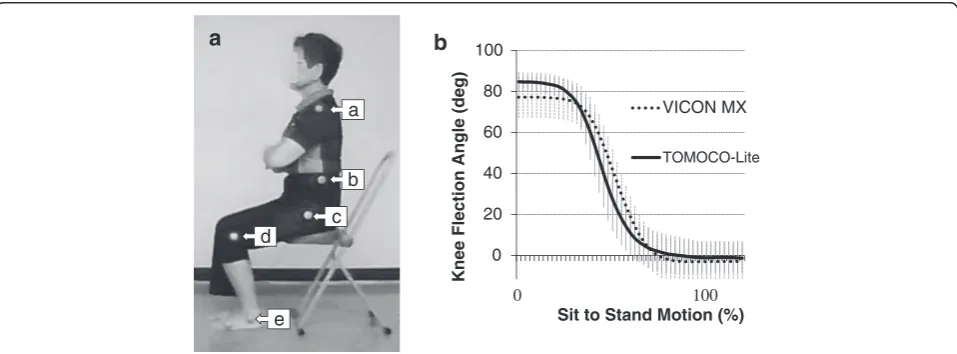
Motion-capture measurements and image analysis Color markers for motion tracking were attached to the left side of the acromion (red); iliac crest (green); greater tro-chanter (yellow); lateral epicondyle of the femur (red); and lateral malleolus (green) (Fig. 1). Motion was recorded using a network CCD webcam (CG-WLNCPTGL; Corega, Yokohama, Japan) and standard video-recording software (NC Monitor; Corega). The webcam was directly con-nected to a laptop PC to record via an ethernet port (100 Mbps). Motions were recorded at a resolution of 480 (vertical) × 640 (horizontal) pixels (30 frames/s, angle of view: 50° in horizontal and 37° in vertical directions, focal length = 4.0 mm,F= 1.8, compression: motion Joint Photo-graphic Experts Group (JPEG), recorded in Audio Video Interleave (AVI) format). The webcam was located 80 cm above the floor with its optical axis directed horizontally to
monitor the left side of the participant at a distance of 5 m. The length per pixel was calibrated by putting a rod (1 m) at the position the subjects were sitting.
To extract the trajectories of the color markers, video-recordings were analyzed using two-dimensional (2D) motion analysis software (Tomoko-Lite; Toso System, Saitama, Japan) [28]. On the first frame, an experienced operator manually assigned each color marker using manual-tracking mode to extract the gravity centers of the markers in the 2D coordinates. Then, the markers were automatically tracked from the second frame. To obtain IEMV (cm/s), the marker located at the center of iliac crest was selected and its maximum vertical velocity was calculated. To compute KEMAV, markers at the greater trochanter, lateral epicondyle and lateral malle-olus were selected and the maximum angular velocities (degree/s) between the greater trochanter-lateral epicondyle and lateral epicondyle-lateral malleolus were computed.
A benchmark test was performed to verify the reliabil-ity of measurement using the webcam. The knee angle change during sit-to-stand motion was compared be-tween this system and VICON MX (Vicon Motion Sys-tems, Oxford, UK). Fourteen young subjects (7 males, 7 females; age 20.4 ± 0.5 years) repeated sit-to-stand mo-tion 3 times and the change in temporal knee angle change was simultaneously recorded by the two systems.
Data analyses with multi-group structural equation modeling
The purpose of the analyses was to compare the applic-ability of video-recorded IEMV and KEMAV indices as
a
b
c d
e
a
0 20 40 60 80 100
K
n
ee Flection Angle (deg)
Sit to Stand Motion (%) VICON MX
TOMOCO-Lite
b
0 100
candidate predictors of intrinsic physical abilities of older adults. To achieve this, we first assumed two sets of path diagrams in which IEMV or KEMAV directly predicts muscular strength, which further predicts phys-ical skillfulness. The validity of this assumption was assessed by multi-group structural equation modeling (SEM) in the young and older groups. SEM is a tech-nique used to estimate causal relationships among mul-tiple variables, based on their covariance structures (Schumacker and Lomax [35]). In contrast to simply repeating statistical tests of regressions or correlations, the advantage of SEM is that it simultaneously evaluates the goodness-of-fit between the assumed model and the given data. Even if some regression weights are signifi-cant, the assumed model is not statistically acceptable unless the goodness-of-fit indices (GFIs) meet the con-ventional criteria, which support the robustness of the model as a whole. In addition, SEM permits multi-group analyses by direct comparisons of estimated parameters across groups [1]. AMOS 21 J software (SPSS, Chicago, IL, USA) was used to analyze the data using the max-imum likelihood estimation method.
Procedure for multi-group SEM Model assumption
Three variables were used to postulate each path dia-gram: skillfulness, muscular strength, and IEMV or KEMAV. SEM can take into account observed and latent (i.e. unobserved) variables. The first two variables were considered to be latent since they are inferred from an observed variable or variables; Thus, one set of observed variables, WF8 and FR, was used to infer skillfulness, and another set, AC and HR, was used to infer muscular strength. The third variable was used to determine whether IEMV or KEMAV is more predictive of the physical abilities of older adults. For this, each of the two indices was alternately entered into the path dia-grams as an observed variable with the other variables remaining constant.
Cross-group constraint for multi-group analysis
Performing multi-group SEM requires anticipating whether each path is equivalent across groups. If a path is anticipated to be equivalent, a cross-group constraint has to be imposed on the path. For the many possible cross-group constraints among the paths, four models were tested to find the one with the best GFI. Model 1 assumed a measurement equivalence in which cross-group con-straints were imposed on the paths between each latent variable and its constituent observed variables (i.e., the paths from WF8/FR to skillfulness and from AC/HR to muscular strength), whereas other paths were not con-strained. Model 2 added a constraint on the path between the two latent variables (i.e., muscular strength and
skillfulness) in Model 1, whereas the path from IEMV/ KEMAV to muscular strength was not constrained. Model 3 added a path from IEMV/KEMAV to muscular strength, instead of the path between the latent variables con-strained in Model 2. Model 4 imposed constraints on all parameters.
Model comparison
Comparisons were performed to find the best model for each diagram. Among the four candidate models, the Akaike information criterion (AIC) and Browne-Cudeck criterion (BCC) were evaluated because these criteria are indices for direct model comparisons. Their relative dif-ferences, rather than absolute values, indicate a better fit (the smaller, the better). In addition, the fit of the model to the data was tested using the chi-square (χ2) statistic, in which insignificance supports homogeneity (i.e. sup-ports fit). In addition to the chi-square test, the goodness-of-fit is evaluated by other indices, such as the GFI and the comparative fit index (CFI), which are con-ventionally required to exceed 0.95. The root mean square error of approximation (RMSEA) should also be <0.1 (Schumacker and Lomax [35]).
Inspection of the best model
Once we obtained the models that gave the best solution for each of the path diagrams (i.e., IEMV and KEMAV) for the young and older groups, we looked for significant pass coefficients. A path that had no cross-group con-straint indicated that the path value differed across groups. For such paths, pairwise parameter comparisons based on
z-scores were conducted to examine whether the path values differed significantly between the groups [1].
Results
A comparison of video-based measurements between the webcam and VICON MX is shown in Fig. 1b. The temporal change of the knee angle was interpolated using 51 points (2 % for each step) to cover the whole sit-to-stand motion procedure. A series of ANOVAs with repeated measures (the type of camera repetition of measurement) were applied for each of the 51 points. The angle of the knee joint depended on the type of camera from the first to the 30th point. However, no sig-nificant difference was found after the 31st point. No significant effect of repetition of measurement or inter-action between the two factors was throughout all 51 points. The correlation coefficient (r) between the two time series was 0.920 ± 0.089 (n= 42).
older groups (Table 1) indicated that young participants consistently performed better in comparison to their older counterparts (paired t-test). The results of the physical performance tests in the older group were con-sistent with results reported by Shigematsu et al. [36].
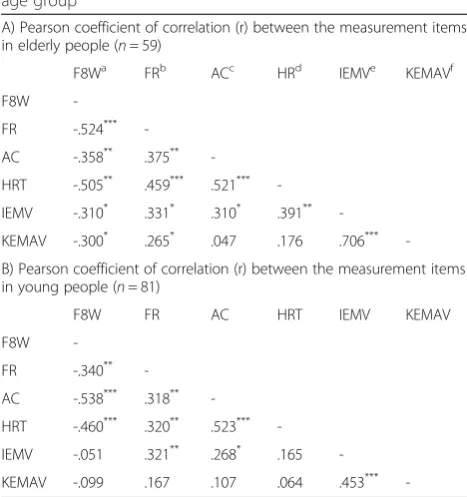
Analyses with multi-group SEM based on correlations between items (Table 2) yielded models with a good fit to the data (Table 3). For the path diagram with IEMV, Model 1 indicated the best fit, based on having the lowest AIC and BCC among the four candidate models. The strength of causal relationships among the three variables differed across the older and young groups because Model 1 imposed no cross-group constraints among IEMV, mus-cular strength, and skillfulness. On the other hand, Model 3 gave the best solution in the diagrams with KEMAV; this model imposed a cross-group constraint on the path from KEMAV to muscular strength, but not on the path from muscular strength to skillfulness. This finding indicates that the path from KEMAV to muscular strength is equivalent across the two groups, whereas the path from muscular strength to skillfulness is not.
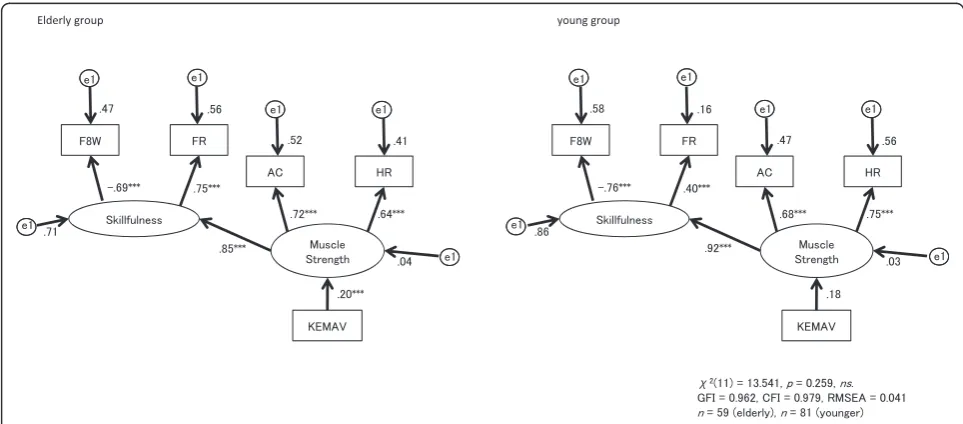
The best models for IEMV and KEMAV are shown in Figs. 2 and 3, respectively. Both models had adequate GFIs (IEMV,χ210= 17.917,p= 0.156,ns, GFI = 0.954, CFI = 0.943, RMSEA = 0.076; KEMAV, χ211= 13.541, p= 0.259, ns, GFI = 0.962, CFI = 0.979, RMSEA = 0.041). For all IEMV and KEMAV diagrams in the older and young groups, the paths from muscular strength to skillfulness had significant effects (p< 0.001). The path from IEMV to muscular strength in the older group was also significant (β= 0.51,
p< 0.001), but pairwise parameter comparison of this path between the two groups did not give a significant
z-score.
Discussion
Fall prevention is an important aim of group exercises as a health promotion program in local communities [2, 8, 9, 29]. For example, 12 weeks of incremental training of the lower limb was shown to improve fall-related gait kinematic parameters [29]. Having participants get
Table 1Physical characteristics of the participants and results of physical performance
Young (n= 81)
Elderly (n= 59)
t-value p-value
Age (years) 20.8 ± 0.9 74.1 ± 5.9 −79.4 p< 0.001
Height (cm) 165.9A ± 8.9 155.5 ± 8.4 6.8 p< 0.001
Weight (kg) 58.9 ± 10.4 54.8 ± 10.0 2.3 0.024
BMI (kg/m2) 21.3 ± 3.0 22.6 ± 3.4
−1.78 0.080 F8W test (sec) 18.0 ± 2.4 26.9 ± 5.1 −13.9 p< 0.001
Functional reach (cm) 35.7 ± 5.4 30.6 ± 5.2 5.7 p< 0.001
Arm curl (times) 32.6 ± 6.3 24.2 ± 4.8 8.6 p< 0.001
Heel rise test (times) 26.6 ± 6.1 24.3 ± 7.1 2.1 0.041
Illiac elevation maxmum velocity (cm/s)
151.1 ± 27.9 116.4 ± 22.8 7.8 p< 0.001
Knee extension maximal angular velocity (deg/s)
279.6 ± 52.3 239.3 ± 50.1 4.6 p< 0.001
The performance of young adults was significantly better than that of older adults for F8W, FR, AC, IEMV and KEMAV (p< 0.001). Values are shown as the mean ± standard deviation. The two age groups were compared using t-statistics. df = 138
Table 2Correlations among the 6 behavioral datasets in each age group
A) Pearson coefficient of correlation (r) between the measurement items in elderly people (n= 59)
F8Wa FRb ACc HRd IEMVe KEMAVf
F8W
-FR -.524***
-AC -.358** .375**
-HRT -.505** .459*** .521***
-IEMV -.310* .331* .310* .391**
-KEMAV -.300* .265* .047 .176 .706***
-B) Pearson coefficient of correlation (r) between the measurement items in young people (n= 81)
F8W FR AC HRT IEMV KEMAV
F8W
-FR -.340**
-AC -.538*** .318**
-HRT -.460*** .320** .523***
-IEMV -.051 .321** .268* .165
-KEMAV -.099 .167 .107 .064 .453***
-Correlations among the behavioral datasets were obtained in multi-group SEM analysis for each age group. *p< .05, **p< .01, ***p< .001, a: Figure-of-eight walk test, b: Functional reach, c: Arm curl, d: Heel rise, e: Iliac elevation maximum velocity, f: Knee extension maximal angular velocity
Table 3Fit indices for model comparisons
Model assumption AIC BCC
Models concerningIEMV
Model 1 (measurement equivalence) 57.917 61.865
Model 2 (constrained betweenmuscle strength
andskillfulnessin addition to Model 1)
58.903 62.635
Model 3 (constrained betweenIEMVand
muscle strengthin addition to Model 1)
59.373 62.925
Model 4 (fully constrained) 59.373 62.925
Models concerningKEMAV
Model 1 (measurement equivalence) 53.212 57.160
Model 2 (constrained betweenmuscle strength
andskillfulnessin addition to Model 1)
54.465 58.214
Model 3 (constrained betweenKEMAVand
muscle strengthin addition to Model 1)
51.541 55.291
Model 4 (fully constrained) 52.590 56.143
together in one place for group exercises, checking their physical activities, and giving them instructions is time-effective. However, some community-dwelling older adults are unwilling to join such programs [31]. Remote instruc-tion is likely to be useful for such people and for following up with older patients after a physical exercise program [30]. However, observation of physical activity using eHealth technologies has several limitations, such as re-striction in the spatial data dimension, risk management
to prevent falls during the session, and standardizing regu-lation of motor performance. Therefore, in this study, we designed a model for remote physical examination using the sit-to-stand task, which is an easy and safe movement controlled by simple instructions.
The sit-to-stand task has been used to evaluate knee muscular strength, which is associated with fall risk [3, 5, 7]. The physical dynamics and correlation between knee muscle strength and sit-to-stand motion Fig. 2Path diagrams for the iliac elevation maximum velocity (IEMV) in the older and young groups. Paths from muscular strength to skillfulness showed a significant effect in each group (p< 0.001). The path from IEMV to muscular strength was significant in the older group (β= 0.50,p< 0.001), but not in the young group (β= 0.28). GFI: goodness-of-fit index, CFI: confirmatory fit index, RMSEA: root mean square error of approximation
has been investigated using devices such as a leg press and knee extensors [3], flywheel [16], dyna-mometer [7, 21, 46], force plate [5, 20, 25, 47] and weightlifting analyzer [14]. The peak floor reaction force in sit-to-stand motion occurs during knee ex-tension movement soon after seat clearance [25]. The better the ability for the sit-to-stand task, the greater the muscle strength for pushing against the floor. Sit-to-stand velocity is related to lower limb muscular strength [3, 18, 22, 47, 48] and this tendency is clear in comparison of sit-to-walk velocity between older and young individuals Kouta and Shinkoda [20] Ap-plication of a weightlifting analyzer is a unique method Gray and Paulson [14] that combined a force plate and cinematography to calculate the change of center of mass during sit-to-stand motion more ac-curately, since it takes into account deficits in balance that cause an older adult to rise more slowly when performing a seated power movement. These methods showed clear relationships among indices obtained from sit-to-stand motions, but used three-dimensional (3D) motion capture systems with multiple high-resolution cameras and physical devices for muscular strength measurement. In contrast, we investigated the utility of a conventional network camera to moni-tor one or a few sit-to-stand motions at home or in a community meeting place.
We used three indices for physical activity of older adults (AC, FR, F8W) [36, 37] and one for lower limb muscle strength (HR), all of which can be obtained with-out special measurement devices, such as a dynamom-eter or force plate. AC and HR have been suggested to reflect muscular strength, while F8W and FR reflect skillfulness in motion [17, 18, 34, 36, 37]. The advantage of these four indices is that muscular power and skillful-ness, the two basic elements required to generate move-ment, can be used as latent variables in the SEM model. Using the four observable variables, the performances of IEMV and KEMAV, two image-based indices of sit-to-stand motion, were compared as predictors of muscular power and skillfulness. The SEM analysis suggested that IEMV better predicts muscular power (Fig. 2) than KEMAV (Fig. 3) in older adults and that muscular power predicts skillfulness in both age groups. Skillfulness of motion manifests as balance, motor coordination, flexi-bility and speed, and has a strong association with cogni-tive function [44]. Since balance is the key factor in fall risk evaluation Rubenstein [32], an evaluation model in-cluding both muscular power and skillfulness will be useful for future investigation of fall prevention in older adults with potential cognitive decline.
IEMV and KEMAV were utilized independently, rather than in one model, for two reasons. First, it would be useful to use just the better index for screening. Second,
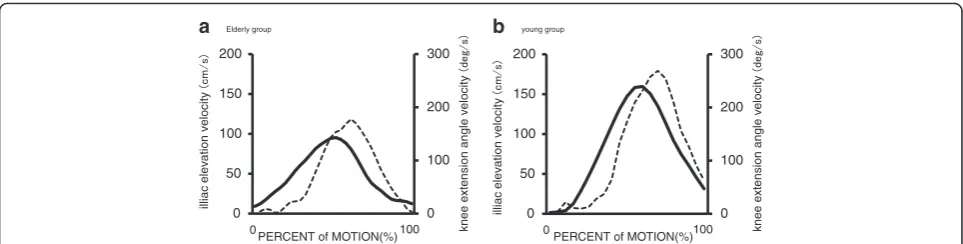
since IEMV and KEMAV both reflect the result of the same knee joint extension, but in a geometrically differ-ent view, it is reasonable to choose the better index ra-ther than using two replicated indices. KEMAV during sit-to-stand movement did not significantly predict mus-cular strength, although it reflects the same movement as IEMV. This discrepancy may be due to the difference in the temporal characteristics of the two indices in re-sponse to the movement. KEMAV directly depends on angular movement by knee muscle constriction in the 2D plane, whereas IEMV is a consequence of movement only in the perpendicular (cosine) projection at the distal end point of the angular movement (Fig. 1). Therefore, the temporal characteristics of the two velocity parame-ters can manifest differently depending on the phase of sit-to-stand motion (Fig. 4).
We included HR as a manual muscle test of the lower extremity, since the HR test is commonly used to evalu-ate the strength of the triceps surae muscles. HR may also be a useful index for evaluating exercise capacity due to its strong correlation with other physical battery tests (Table 2) and its reflection of muscular strength, as for AC (Figs. 2 and 3). However, HR is an unstable mo-tion with a potential risk of fall when performed by older adults without assistance. Therefore, sit-to-stand motion is preferable to HR for remote monitoring at home.
Another advantage of sit-to-stand motion is that it may reflect the general status of older adults, other than fall risk. In a study of nursing home residents with de-mentia, higher scores on the 30-s sit-to-stand task and the Berg Balance Scale were associated with a better quality of life (QOL) on the late-stage dementia scale [42]. It was also suggested that the chair stand test may be as useful as the complete Short Physical Performance Battery in estimating mortality risk [4]. In addition to evaluating the physical status of older adults, sit-to-stand motion can be used as a physical intervention. As a daily care routine, sit-to-stand activity in a nursing home maintained mobility and function and slowed functional decline of residents with dementia [39]. These studies suggest that analysis of sit-to-stand motion may provide information related to activities of daily living.
images. To remove these potential errors in remote monitoring, it will be necessary to establish a protocol to calibrate measurements within a reasonable time. Older adults will need support for initial setup of the measure-ment by trained personnel, including choice of webcam location, spatial calibration, and instructions for attach-ing markers and performattach-ing sit-to-stand movement. We set up the webcam 5 m from the subject to cover the whole body, but the minimum space for measurement can be smaller. This distance can be shortened by setting the webcam in vertical alignment and limiting the field of view to cover just the markers. By fixing the webcam at a constant location and setting markings on the floor, measurements will be reproducible. It may not be easy to attach markers at proper positions for older adults, but only a few markers are required to measure sit-to-stand motion. On-line instruction to adjust the marker positions will be a primary need for some people and visits by trained personnel may be needed.
Markerless motion capture [12, 13] with a 3D body model (Samantha et al. [33]) may be an alternative ap-proach, since subjects do not have to locate several markers precisely. There have been many attempts to apply Kinect, a motion sensing input device that pro-vides a user interface using gesture and spoken com-mands, to physical evaluation such as gait assessment [11, 41], Timed Up and Go [43], exergames for fall pre-vention at home [15], and balance tests for stroke pa-tients Clark et al. [6]. The accuracy of joint estimation by the Kinect skeleton tracking system is comparable to motion capture under controlled conditions of body posture Xu et al. [45], but the validity for general pos-tures or movements has yet to be established [27, 45]. Precise anthropometric measurements may still require direct reference to anatomical labeling of the skeletal system. The requirements for accuracy in sit-to-stand movement using telemetry for risk screening need fur-ther investigation in different subject populations.
A second limitation of this study is the potential for bias due to the physical background [10] or sex [16] of
the participants on clinical interpretation of the velocity of sit-to-stand motion. In a study of senior athletes, the weight transfer time and center of gravity sway were similar regardless of age or sex, while rising power dur-ing sit-to-stand motion decreased with increasdur-ing age [10]. This finding suggests that fall risk may be de-creased by training, even if the speed of sit-to-stand mo-tion is not improved. The lifespan history of physical training should also be considered in evaluation of sit-to-stand movements. Lastly, in this study, multi-group SEM was conducted in relatively few participants, due to difficulty recruiting male participants. Thus, careful in-terpretation of the results is required, even though the model evaluation revealed a very good fit to the data.
Practical use of sit-to-stand movement in telemetry will allow periodical evaluation of training outcomes at home to improve muscular strength and screen for the appearance of fall risk. It will be useful to share this in-formation among subjects, physical exercise instructors, and supporters or healthcare personnel for older adults to optimize the protocol of physical intervention and to prevent fall. In this study, both young and older healthy subjects were recruited to evaluate only age-related ef-fects on the evaluation model. All older subjects were active volunteers who were willing to participate in the community club for health promotion, and thus may be a relatively low-risk group for decline in physical activity. A future study is required to evaluate the potential of the method to detect high-risk subjects.
Conclusion
To develop a telemetry method to monitor physical activity of older adults, performance in sit-to-stand motion in young and older adults was measured using a conventional network camera and relationships with simple physical ac-tivity indices were investigated. Findings from multi-group SEM suggested that muscular strength of the lower limbs reflected ability in motion skills, and that IEMV may be a predictor of muscular strength. The results suggest that IEMV computed by image analysis of sit-to-stand motion
0 100 200 300
0 50 100 150 200
0 100
illiac
elev
a
tion v
elocity
knee e
x
te
nsion an
g
le v
e
locity
PERCENT of MOTION(%)
a
0 100
illiac
elev
ation v
elocity
knee e
x
te
nsion angle v
e
locity
PERCENT of MOTION(%)
b
0 100 200 300
0 50 100 150 200
Elderly group young group
Fig. 4Curves illustrating the iliac elevation velocity (IEMV, solid line) and knee extension angular velocity (KEMAV, broken line).aYoung group.b
recorded by a conventional webcam is sufficient to predict muscular strength in older adults. Therefore, remote video monitoring of sit-to-stand motion is a safe and effective ap-proach for older adults who are unwilling to participate in group-exercise programs, and will allow assistance with physical examinations and instructions to support wellness of community-dwelling older adults.
Abbreviations
2D, two-dimensional; 3D, three-dimensional; AC, arm curl; AIC, Akaike information criterion; AVI, Audio Video Interleave; BCC, Browne-Cudeck Criterion; CFI, comparative fit index; F8W, figure-of-eight walk; FR, functional reach; GFIs, goodness-of-fit indices; HR, heel rise; ICT, information and communication technology; IEMV, iliac elevation maximum velocity; JPEG, joint photographic experts group; KEMAV, knee extension maximum angular velocity; QOL, quality of life; RMSEA, root mean square error of approximation; SEM, structural equation modeling
Acknowledgements
We thank to Hisako Sato BA from the Handa City Association for Health Promotion, Aichi Prefecture, Japan, for supporting the measurement sessions. We also thank Prof. Junichi Hasegawa from Chukyo University for useful discussions for image processing.
Funding
This study was funded by the Japan Foundation for Aging and Health (FY 2010–12) for data collection, analysis and integration, and by the Japan Society for the Promotion of Science (JSPS), Grants-in-Aid for Scientific Research (KAKENHI) #24300186 (FY 2013–15) for interpretation of data and in writing the manuscript.
Availability of data and materials
Data files of video recordings are not available due to subjects’confidentiality. The other data supporting the conclusions of this article are included within the article.
Authors’contributions
AK designed and administered the measuring sessions, carried out the motion analysis and wrote the manuscript. HG, HT, MK and AT performed experiments. SK and TO participated in the design of the study performed the statistical analysis and wrote statistical sections of the article. TN performed experiments, gave technical support and conceptual advice and edited the manuscript. All authors discussed the results and implications and commented on the manuscript at all stages. All authors read and approved the final manuscript.
Competing interests
The authors declare that they have no competing interests.
Author details
1
Graduate School of Health Sciences, Toyohashi SOZO University, 20-1 Matsusita, Ushikawa-cho, Toyohashi 440-8511, Japan.2Department of Physical Therapy, School of Health Sciences, Toyohashi SOZO University, 20-1 Matsusita, Ushikawa-cho, Toyohashi 440-8511, Japan.3NeuroImaging & Informatics, National Center for Geriatrics & Gerontology, 7-430 Morioka-cho, Ohbu 474-8511, Japan.4Aichi Prefectural Hospital and Rehabilitation Center for Disabled Children, Dai-ni Aoitorigakuen, 5-1 Aza-yanagisawa, Okazaki 444-3505, Japan.5School of Humanities, College of Human and Social Science, Kanazawa University, Kakuma-machi, Kanazawa 920-1192, Japan.
Received: 9 November 2015 Accepted: 31 May 2016
References
1. Arbuckle JL. AMOS 21.0 user’s guide. Chicago: Smallwaters Corporation, Inc; 2012.
2. Arnold CM, Sran MM, Harrison EL. Exercise for fall risk reduction in community-dwelling older adults: a systematic review. Physiother Can. 2008;60:358–72.
3. Bean JF, Kiely DK, Herman S, et al. The relationship between leg power and physical performance in mobility-limited older people. J Am Geriatr Soc. 2002;50:461–7.
4. Cesari M, Onder G, Zamboni V, et al. Physical function and self-rated health status as predictors of mortality: results from longitudinal analysis in the ilSIRENTE study. BMC Geriatr. 2008;8:34.
5. Chen YY, Wei SH, Chen PY, et al. Can sit-to-stand lower limb muscle power predicts fall status? Gait Posture. 2014;40:403–7.
6. Clark RA, Vernon S, Mentiplay BF, et al. Instrumenting gait assessment using the Kinect in people living with stroke: reliability and association with balance tests. J Neuroeng Rehabil. 2015;12:15.
7. Crockett K, Ardell K, Hermanson M, et al. The relationship of knee-extensor strength and rate of torque development to sit-to-stand performance in older adults. Physiother Can. 2013;65:229–35.
8. Daniels R, van Rossum E, de Witte L, et al. Interventions to prevent disability in frail community-dwelling elderly: a systematic review. BMC Health Serv Res. 2008;8:27.
9. El-Khoury F, Cassou B, Charles MA, et al. The effect of fall prevention exercise programmes on fall induced injuries in community dwelling older adults: systematic review and meta-analysis of randomised controlled trials. BMJ. 2013;347:f6234.
10. Feland JB, Hager R, Merrill RM. Sit-to-stand transfer: performance in rising power, transfer time and sway by age and sex in senior athletes. Br J Sports Med. 2005;39:e39.
11. Geerse DJ, Coolen BH, Roerdink M. Kinematic Validation of a Multi-Kinect v2 Instrumented 10-Meter Walkway for Quantitative Gait Assessments. PLoS One. 2015;10:10.
12. Goffredo M, Schmid M, Conforto S, et al. Markerless human motion analysis in Gauss–Laguerre transform domain: an application to sit-to-stand in young and elderly adults. IEEE Trans Biomed Eng. 2002;13:843–51. 13. Goffredo M, Schmid M, Conforto S, et al. Markerless Human Motion Analysis
in Gauss–Laguerre Transform Domain: An Application to Sit-To-Stand in Young and Elderly People. IEEE Trans Inf Technol Biomed. 2009;13:207–16. 14. Gray M, Paulson S. Developing a measure of muscular power during a
functional task for older adults. BMC Geriatr. 2014;14:145.
15. Gschwind YJ, Schoene D, Lord SR, et al. The effect of sensor-based exercise at home on functional performance associated with fall risk in older people–a comparison of two exergame interventions. Eur Rev Aging Phys Act. 2015;12:11. 16. Hardy R, Cooper R, Shah I, et al. Is chair rise performance a useful measure
of leg power? Aging Clin Exp Res. 2010;22:412–8.
17. Hebert-Losier K, Newsham-West RJ, Schneiders AG, Anthony G. Raising the standards of the calf-raise test: A systematic review. J Sci Med Sport. 2009;12:594–602.
18. Hess RJ, Branch JS, Piva SR, et al. Walking Skill Can Be Assessed in Older Adults: Validity of the Figure-of-8 Walk Test. Phys Ther. 2010;90:89–99. 19. Kinugasa T, Haga S, Esaki K, et al. Exercise intervention study on the physical
fitness, functional capacity and health status of low-fit elderly adults living in the community. J Exerc Sports Physiol. 2007;12:63–73 (in Japanese). 20. Kouta M, Shinkoda K. Difference in biomechanical characteristics of
sit-to-walk motion between young and elderly males dwelling in the community. J Phys Ther Sci. 2008;20:185–9.
21. Lindemann U, Claus H, Stuber M, et al. Measuring power during the sit-to-stand transfer. Eur J Appl Physiol. 2003;89:466–70.
22. Lindemann U, Muche R, Stuber M, et al. Coordination of strength exertion during the chair-rise movement in very old people. J Gerontol. 2007;62A:636–40. 23. Moyer VA. Prevention of Falls in Community-Dwelling Older Adults: U.S.
Preventive Services Task Force Recommendation Statement. Ann Intern Med. 2012;157:197–204.
24. Marina M, Kieran FR, Renee M, et al. Habitual physical activity levels are associated with performance in measures of physical function and mobility in older men. J Am Geriatr Soc. 2010;58:1727–33.
25. Millington PJ, Myhlebust EM, Shambes GM. Biomechanical analysis of the sit-to-stand motion in elderly persons. Arch Phys Med Rehabil. 1992;73:609–17. 26. Norman GJ, Zabinski MF, Adams MA, et al. A review of ehealth interventions for physical activity and dietary behavior change. Am J Prev Med. 2007;33:336–45. 27. Obdrzalek S, Kurillo G, Ofli F, et al. Accuracy and Robustness of Kinect Pose Estimation in the Context of Coaching of Elderly Population. Conf Proc IEEE Eng Med Biol Soc. 2012;1188–1193.
29. Persch LN, Ugrinowitsch C, Pereira G, et al. Strength training improves fall-related gait kinematics in the elderly: A randomized controlled trial. Clin Biomech. 2009;24:819–25.
30. Reinwand D, Kuhlmann T, Wienert J, et al. Designing a theory- and evidence-based tailored eHealth rehabilitation aftercare program in Germany and the Netherlands: study protocol. BMC Public Health. 2013;13:1081. 31. Rogers A, Harris T, Victor C, et al. Which older people decline participation
in a primary care trial of physical activity and why: insights from a mixed methods approach. BMC Geriatr. 2014;14:46.
32. Rubenstein LZ. Falls in older people: epidemiology, risk factors and strategies for prevention. Age Ageing. 2006;35:S2.
33. Samantha N, Fakih A, Fourney A, et al. Towards a mobility diagnostic tool: tracking rollator users’leg pose with a monocular vision system. Conf Proc IEEE Eng Med Biol Soc. 2009;1220–1225.
34. Schmid S, Hilfiker R, Radlinger L. Reliability and validity of trunk accelerometry-derived performance measurements in a standardized heel-rise test in elderly subjects. J Rehabil Res Dev. 2011;48:1137–44. 35. Schumacker RE, Lomax RG. A Beginner’s Guide to Structural Equation
Modeling. 2nd ed. Mahwah: Lawrence Erlbaum; 2004.
36. Shigematsu R, Nishijima T, Komatsuzaki S, et al. Effects of functional fitness on physical independence for completing daily tasks in community-dwelling older women. Bulletin of Institute of Health and Sport Science, the University of Tsukuba. 2001;24:89–96.
37. Shigematsu R, Tanaka K, Watanabe Y, et al. Assessment of functional fitness required for activities parallel to daily living in older adult Japanese woman. Geriatr Med. 1998;36:927–32.
38. Skelton D, Dinan S, Campbell M, et al. Tailored group exercise (Falls Management Exercise - FaME) reduces falls in community-dwelling older frequent fallers (an RCT). Age Ageing. 2005;34:636–9.
39. Slaughter SE, Wagg AS, Jones CA, et al. Mobility of Vulnerable Elders Study: Effect of the Sit-to-Stand Activity on Mobility, Function, and Quality of Life. JAMDA. 2015;16:138–43.
40. Sparrow D, Gottlieb DJ, Demolles D, et al. Increases in muscle strength and balance using a resistance training program administered via a
telecommunications system in older adults. J GerontolSeries A: Biol Sci Med Sci. 2011;66A:1251–7.
41. Springer S, Seligmann GY. Validity of the Kinect for Gait Assessment: A Focused Review. Sensors. 2016;16(2):E194.
42. Telenius EW, Engedal K, Bergland A. Physical Performance and Quality of Life of Nursing-Home Residents with Mild and Moderate Dementia. Int J Environ Res Public Health. 2013;10:6672–86.
43. Vernon S, Paterson K, Bower K, et al. Quantifying Individual Components of the Timed Up and Go Using the Kinect in People Living With Stroke. Neurorehabil Neural Repair. 2015;29:48–53.
44. Voelcker-Rehage C, Godde B, Staudinger UM. Physical and motor fitness are both related to cognition in old age. Eur J Neurosci. 2010;31:167–76. 45. Xu X, McGorry RW, Chou LS, et al. Accuracy of the Microsoft Kinect for measuring
gait parameters during treadmill walking. Gait Posture. 2015;42:145–51. 46. Yoshida Y, Kwon J, Iwasa H, et al. Characteristics of geriatric
syndrome-subjects who did not participate in proffered intervention trial. Japanese J Geriatr. 2007;44:231–7 (in Japanese).
47. Yoshioka S, Nagano A, Hay DC, et al. Biomechanical analysis of the relation between movement time and joint moment development during a sit-to-stand task. BioMed Eng OnLine. 2009;8:27.
48. Yoshioka S, Nagano A, Himeno R, et al. Computation of the kinematics and the minimum peak joint moments of sit-to-stand movements. BioMedical Eng OnLine. 2007;6:26.
• We accept pre-submission inquiries
• Our selector tool helps you to find the most relevant journal • We provide round the clock customer support
• Convenient online submission • Thorough peer review
• Inclusion in PubMed and all major indexing services • Maximum visibility for your research
Submit your manuscript at www.biomedcentral.com/submit