ORIGINAL ARTICLE
IJPHY
ABSTRACT
Background: Premenstrual syndrome is a current condition characterized by troublesome symptoms as tension, irrita-bility, depression, headache, anxiety and loss of self-control, so the aim of this study was to investigate the effect of foot reflexology augmented with relaxation training on premenstrual syndrome in adolescent females.
Methods: A sample of 50 volunteers, virgin females diagnosed as premenstrual syndrome was selected from the stu-dents of Faculty of Physical Therapy, Cairo University. Their age was ranged between 19 to 23 years with mean value of (21.53±2.27 yrs) and BMI was ≤28 Kg/m² with mean value of (24.04±2.41 Kg/m²).A detailed medical history was obtained to screen other pathological conditions that may affect the results. Females were randomly assigned into two equal groups. Group (A) consisted of 25 subjects who received foot reflexology in addition to relaxation training techniques twice a week for 8 weeks. Group (B) consisted of 25 patients, who received relaxation training techniques only twice a week for 8 weeks. Assessment of all subjects in both groups was carried out before and after the treatment program through heart rate, respiratory rate in addition to plasma cortisol level and daily symptoms report chart. Results: Showed a statistical highly significant decrease (p<0.001) in heart rate, respiratory rate, plasma cortisol level as well as daily symptoms report score in group (A) while there was a statistical significant decrease (p<0.05) in all variables in group (B).
Conclusions: Adding foot reflexology to relaxation training had a great positive effect on premenstrual syndrome in adolescent females than relaxation training only.
Keywords: Reflexology, mental relaxation, physical relaxation, breathing exercises, premenstrual syndrome, adoles-cence.
Received 28th July 2016, revised 22nd August 2016, accepted 05th October 2016
www.ijphy.org
10.15621/ijphy/2016/v3i5/117433
CORRESPONDING AUTHOR
Int J Physiother. Vol 3(5), 522-528, October (2016) ISSN: 2348 - 8336
DO FOOT REFLEXOLOGY AND RELAXATION TRAINING
DECREASE PREMENSTRUAL SYMPTOMS IN ADOLESCENT
FEMALES
*1Marwa A. Mohamed, PT.D.
¹Asmaa M. El Bandrawy, PT.D. ²Amir A. Gabr, M.D.
*1Marwa A. Mohamed, PT.D.
Department of Physical Therapy for Gynecology & Obstetrics, Faculty of Physical Therapy, Cairo University, Giza, Egypt.
¹Lecturer in Department of Physical Therapy for Gynecology & Obstetrics, Faculty of Physical Therapy, Cairo University, Egypt.
²Department of Gynecology & Obstetrics, Faculty of Medicine, Cairo University, Giza, Egypt.
INTRODUCTION
Premenstrual syndrome (PMS) is classified by the World Health Organization (WHO) in the International Classi-fication of Disease (ICD) as gynecological disorder rather than mental disorder which usually start in the late teens or early twenties with gradually worsening manifestations [1].
Premenstrual syndrome (PMS) is the cyclic occurrence in the luteal phase of the menstrual cycle with a combina-tion of distressing physical, psychological and behavioral changes of sufficient severity to result in deterioration of interpersonal relationships, academic abilities and inter-ference with normal activities which remit upon onset or immediately after menstruation [2].
Nearly all women who regularly menstruate, experience some symptoms in the luteal phase of the cycle. In some women, these manifestations may be exaggerated and be-come a cause of misery, family disharmony, absenteeism and suicide [2].
Premenstrual syndrome is characterized by somatic symp-toms, such as fatigue, appetite-changes, and low energy, and psychological symptoms, such as irritability, depressed mood, anxiety, and impulsive behavior. Typically, symp-toms remit within a few days after the onset of menstru-ation. Approximately 10 percent of women with PMS ex-perience a very severe form called premenstrual dysphoric disorder (PMDD) [3].
Several other physical symptoms associated with the men-strual cycle, such as bloating, abdominal cramps, constipa-tion, swelling or tenderness of the breasts, cyclic acne and joint or muscle pain were recorded, but the most irritable prominent symptoms are irritability, tension,dysphoria and distress [4].
Distress disturbs the balance of sympathetic and parasym-pathetic nervous system leading to changes in heart rate and respiratory rate [5].
However, the etiology of PMS and PMDD is largely idio-pathic. Because PMS symptoms are closely related to the menstrual cycle and only affect women of reproductive age, sex hormones have been suggested to play a causative role. However, a large body of evidence indicates that women who are vulnerable to premenstrual mood changes do not have abnormal levels of sex hormones. Thus, it appears that women with PMS and PMDD show an abnormal response to normal sex hormone changes across the menstrual cycle [6].
An interesting line of work has implicated the stress hor-mone cortisol due to the observation of an altered timing of cortisol profiles in women with PMDD compared to women without PMDD during the follicular menstru-al cycle phases. Dysregulation of the hypothmenstru-alamic-pitu- hypothalamic-pitu-itary-adrenal axis has been demonstrated in major depres-sive disorder and has been speculated to have an important role in causing sadness and impair mood regulation. In a non-clinical population, cortisol levels have been shown to correlate with depressed mood and with poorer
perfor-mance in an emotional processing task [7].
Reflexology is considered to be a form of complementa-ry and alternative medicine (CAM). CAM refers to treat-ments used either as an adjunct to, or instead of conven-tional medical care. It became a popular treatment in the recent years as the public seek more non invasive ways to maintain good health and well-being. In fact CAM is in-creasingly being considered as a safe and effective way of reducing the causes and impacts of pain and disease [8]. Reflexology is a form of complementary medicine that involves using massage to reflex areas in the feet, stimu-lating and applying pressure to certain areas to increase blood circulation and promote specific bodily and muscu-lar functions. Foot reflexology can increase vagal modu-lation, decrease sympathetic modumodu-lation, and lower blood pressure in healthy volunteers and patients with coronary artery disease [9].
Reflexologyis a therapeutic modality that aims to promote harmony of mind, body, and soul. It considered being a safe,non-invasive and a cheap form of healthcare accessi-bleby the vast majority of the population including chil-dren, very elderly, terminally ill patients, and pregnant fe-males [10].
It has apositive effect on well-being and quality of life, stress, anxiety, and pain.However; few studies have attempted to correlate these results with any quantitative physiological or biochemical outcomes [11,12].
Relaxation therapy is an effective intervention for enhanc-ing immune function, alleviatenhanc-ing depression, and improv-ing quality of life. Maintenance and continued improve-ment of immune function and psychosocial variables at 2 months follow-up indicate that relaxation therapy may have long-term effects [13].
Relaxation is thought to exert a direct influence on auto-nomic nervous system, reducing levels of physiological arousal through re-establishing a balance between the sympathetic and parasympathetic nervous system [14], so the aim of this study was to investigate the effect of foot re-flexology augmented with relaxation training on premen-strual syndrome in adolescent females.
METHODS
This study was carried out upon a sample of 50 volunteers, virgin females diagnosed as premenstrual syndrome be-tween May and November 2014.They were selected from the students of Faculty of Physical Therapy, Cairo Univer-sity to investigate the effect of foot reflexology augmented with relaxation training on premenstrual syndrome in ad-olescent female. Their age ranged from 19 to 23 years with mean value of (21.53±2.27 yrs), while their body mass in-dex (BMI) was ≤28 Kg/m² with mean value of (24.04±2.41 Kg/m2)
Each subject must have 5 of the following symptoms before her menstrual blood flow begins (although not necessarily the same symptoms each month):(Adapted from
American psychiatric Association, 2014 [15].
- Markedly depressed mood or feelings of hopelessness. - Marked anxiety or tension, feeling keyed up or on edge. - Changes in mood (suddenly tearful, overly sensitive). - Persistent, marked anger or irritability, increased con-flicts.
- Loss of interest in usual activities (e.g., study, work, hob-bies).
- Difficulties in concentration and focusing attention. - Marked decrease in energy, feeling very easily tired out. - Marked change in appetite (overeating, or food cravings). - Sleeping too much or having a hard time to sleep. - Feeling overwhelmed or out of control.
- Physical symptoms (e.g., breast tenderness/swelling, headache, joint/muscle pain, bloated sensation, weight gain).
The symptoms must occur during most menstrual cycles and must interfere significantly with work, social activities or relationships.
Initial assessment of premenstrual tension symptoms was done in 2 consecutive months, and then the subjects were referred to the gynecologist to confirm the diagnosis. Subjects who had irregular menstrual cycles, past or pres-ent diagnosis of psychiatric illness,prescriptive medica-tions as (anti-inflammatory or antispasmodic drugs),trau-matic event in last 6 months were excluded from the study, they also didn’t participate in previous relaxation training program within the previous 6 months. Subjects with con-ditions that interfere with reflexology application such as skin diseases: acute psoriasis, eczema, severe bruises; skin infection or ulceration; open wound; recent burn or frac-ture; inflammatory conditions: acute rheumatoid arthritis, systemic lupus erythematosus; ankylosing spondylitis; car-diovascular conditions: history of deep vein thrombosis was also excluded from the study.
Each subject signed a consent form in order to participate in the study; then they were randomly assigned into two equal groups (A& B). Group (A) consisted of 25 females who received foot reflexology in addition to relaxation training techniques. Group (B) consisted of 25 patients, who received relaxation training techniques only.
Assessment of all subjects in both groups (A& B) was car-ried out before and after the treatment program through-out respiratory rate, heart rate, plasma cortisol level as well as daily symptoms report chart.
2.1. Foot reflexology technique for group (A):
All subjects were instructed briefly and clearly about the nature of treatment and its value in order to gain their con-fidence and co-operation all through the study. Each pa-tient was advised to wear light and comfortable clothes and assume a relaxed supine laying position in a quiet room. First, whole of the sole was washed by warm water then massage protocol involved a combination of 5 minutes of light stroking and light pressure using the whole hand to plantar and dorsal surfaces for each foot. Reflexology in-tervention was applied by using a combination of finger
pivot and thumb walking techniques to the base of the foot and the toes that correspond with reflex points. The pres-sure was exerted on related and specified zones with spe-cial concentration on the following points:
Genital zone which include ovarian reflex point and uter-ine reflex point which locatedat both feet under the lateral and medial malleolus respectively. Reflex point represents pituitary gland, exactly in the planter aspect of the center of hallux (big toe) of both feet, solar plexus point represents spleen reflex point in exterior edge of the planter aspect left foot and liver reflex point opposite of the spleen at right foot, Adrenal gland reflex point located between kidney re-flex points and. Kidney rere-flex point almost between width of planter aspect of four toes, under base of both feet and in the center of the foot, In addition to breasts reflex point from ankle joint, width wise line (wrinkle) to the junction of the toes. These cones are on the basis of sole division in the center of diaphragm line, and autonomic nervous sys-tem reflex point located at soles of both feet between heels and bases of the toes[16].
Reflexology sessions were provided for 30 min (each foot 15 min) twice a week for 8 weeks.
2.2. Relaxation training for both groups (A and B) Every subject was assuming a comfortable relaxed half lying position. Soft pillows and small cushions were used to support and accommodate her body curves, then sub-ject was asked to observe and listen to her own regular breathing (in, out and pause in between them) in order to achieve mental relaxation for 5 minutes then diaphragmat-ic breathing exercise ex’s was applied to gain physdiaphragmat-ical relax-ation by asking every subject to keep her shoulders relaxed and inhale slowly through the nose, feeling the air flow in, and raising her abdomen upward as a balloon, then she let the air slowly go out through her mouth with a sigh and feeling the tension going with the expired air. Also, Costal breathing exercise was applied by asking every subject to take deep inspiration from her nose, fill her chest by air, open out her ribs laterally and then expire the air from her mouth with a sigh. After three times of deep breathing ex’s, a period of rest equal to the period of breathing exercises was given to avoid hyperventilation.
In addition, relaxation training in the form of tens-relax technique as the subject was asked to flex her fingers, feel the tension and its site, then she relaxed and felt the ab-sence of tension. This was done for all movements (flexion, extension, abduction and adduction of the finger joints, and also flexion, extension, ulnar and radial deviations as well as circumduction of the wrist joints) of both right and left hands. Also this procedure was then repeated with breathing control for 20 minutes.
Relaxation training techniques were repeated twice a week for 8 weeks. Every subject was advised to repeat the previ-ous techniques daily as a home routine.
RESULTS
(SPSS), and paired t-test was used to compare between data before starting and after the end of the treatment program. Level of significant was set at (p <0.05) [17].
Table 1: Subjects’ Demographic Characteristics.
AGE(yrs) BMI (Kg/m2) X 21.53 24.04 SD 2.27 2.41 Maximum 23 26.45 Minimum 19 21.63
Regarding to respiratory rate (RR) assessment for group (A) the mean value±SD before starting the treatment was (18.12±1.62 B/min), while it was decreased to (14.96 ± 1.65 B/min) after the end of the treatment, representing a high-ly significance (P<0.001) decrease after the treatment pro-gram, with percentage of change (17.4 %). In group (B) the mean value ±SD was (17.84 ± 1.75 B/min) before starting the treatment, while it was decreased to (17.16 ± 1.97 B/ min) after the end of the treatment program, representing a significant (P<0.05) decrease after the treatment program, with percentage of change about (3.81%). On comparing the (RR) of both groups after the end of the treatment pro-gram, the results revealed a highly statistical difference be-tween groups favoring group (A), as shown in table (2).
Table 2: Statistical analysis of mean values of Respiratory Rate (R. R).
R. R Group A (n= 25) Group B (n= 25) value p-valuet-
Pre-treat-ment 18.12± 1.62 17.84 ± 1.75 058 0.55 0.0001
(H.S)
Post-treat-ment 14.96 ± 1.65 17.16 ± 1.97 4.30 Mean
dif-ference 3.16 0.68 %
improve-ment 17.4% 3.81% t-value 10.4 2.59 p-value 0.0001 (H.S) 0.016 (S)
*SD: standard deviation, P: probability, S: significance, H.S: highly-significant.
Regarding to Heart Rate (HR) assessment for group (A) the mean value ±SD before starting the treatment was (75.32± 4.30 b/min), while it was decreased to (70.08 ± 4.02 b/min) after the end of the treatment, representing a highly significance (P<0.001) decrease after the treatment program, with percentage of change (6.9 %). In group (B) the mean value ±SD was (75.60 ± 4.10 b/min) before start-ing the treatment, while it was decreased to (74.92 ± 4.32 b/ min) after the end of the treatment program, representing a significant (P<0.05) decrease in (HR) after the treatment program, with percentage of change about (1.0 %).On comparing the (HR) of both groups after the end of the treatment program, the results revealed a highly statistical difference between groups favoring group (A), as shown in table (3).
Table 3: Statistical analysis of mean values of Heart Rate (H. R).
H. R Group A (n= 25) Group B (n= 25) t val-ue p value
Pre-treat-ment 75.32± 4.30 75.60 ± 4.10 0.24 0.81
Post-treat-ment 70.08 ± 4.02 74.92 ± 4.32 4.10 0.0002 (H.S) Mean
dif-ference 5.24 0.68 %
im-provement 6.9% 1.0% t value 9.16 2.65 p value 0.0001(H.S) 0.014 (S)
*SD: standard deviation, P: probability, S: significance, H.S: highly-significant.
Assessment of plasma cortisol level at 10 o’clock at morn-ing revealed that, for group (A) the mean value ±SD be-fore starting the treatment was (16.77± 2.94 mg/dl), while it was decreased to (8.14 ± 3.07 mg/dl) after the end of the treatment, representing a highly significance (P<0.0001) decrease after the treatment program, with percentage of change (51.5%). In group (B) the mean value ±SD was (16.29 ± 2.69 mg/dl) before starting the treatment, while it was decreased to (10.46 ± 3.15 mg/dl) after the end of the treatment program, representing highly significance (P<0.001) decrease after the treatment program, with per-centage of change about (35.8 %). On comparing plasma cortisol level of both groups after the end of the treatment program, the results revealed a statistical difference be-tween groups favoring group (A), as shown in table (4).
Table 4: Statistical analysis of mean values of plasma cortisol level.
Contisol
level Group A (n= 25) Group B (n= 25) value p-valuet-
Pre-treat-ment 16.77± 2.94 16.29 ± 2.69 0.6 0.55
Post-treat-ment 8.14 ± 3.07 10.46 ± 3.15 2.6 0.01(S) Mean
dif-ference 8.63 5.83 %
im-provement 51.5% 35.8% t-value 10.41 8.56 p-value 0.0001 (H.S) 0.0001 (H.S)
*SD: standard deviation, P: probability, S: significance, H.S: highly-significant.
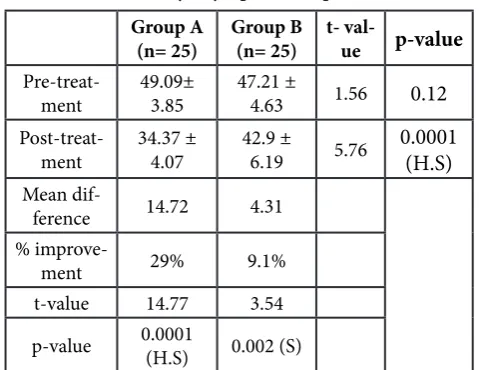
decreased to (42.9 ± 6.19) after the end of the treatment program, representing a significant (P<0.05) decrease after the treatment program, with percentage of change about (9.1%). On comparing the Daily Symptoms Report score of both groups after the end of the treatment program, the re-sults revealed a highly statistical difference between groups favoring group (A), as shown in table (5).
Table 5: Statistical analysis of mean values of Total Score of Daily Symptoms Report
Group A
(n= 25) Group B (n= 25) t- val-ue p-value
Pre-treat-ment 49.09± 3.85 47.21 ± 4.63 1.56 0.12
Post-treat-ment 34.37 ± 4.07 42.9 ± 6.19 5.76 0.0001 (H.S)
Mean
dif-ference 14.72 4.31 %
improve-ment 29% 9.1% t-value 14.77 3.54 p-value 0.0001 (H.S) 0.002 (S)
*SD: standard deviation, P: probability, S: significance, H.S: highly-significant.
DISCUSSION
Premenstrual syndrome (PMS)involves a worsening of mood that interferes significantly with the woman’s quality of life and may experience moodiness or anger that seems to be out of control, and may cause avoidance of friends or relatives during the week before menstruation [2].
Premenstrual syndrome is a current condition of women characterized by troublesome symptoms lasting even to 14 days before menstruation. These symptoms include ten-sion, irritability, depresten-sion, headache, anxiety and loss of self control [18].
Lifestyle changes-including dietary changes, exercise, vita-min B and calcium supplements, and stress reduction are the cornerstone of treatment for PMS. Massage and other relaxation methods offer considerable relief of symptoms [13].
Concerning the changes in respiratory rate (RR) and heart rate (HR), the results of this study showed a statistically significant reduction (P<0.05) in both groups, which came in accordance with Lu et al., [9] who conducted a study to investigate the effect of foot reflexology on the autonomic nervous modulation in patients with coronary artery dis-ease by using heart rate variability analysis. They found that foot reflexology may be used as an efficient adjunct to the therapeutic regimen to increase the vagal modulation and decrease blood pressure in both healthy people and Coronary Artery Disease patients.
The findings of an investigation using Colour Doppler So-nography showed a significant effect on blood flow to the kidney during reflexology [19].
Recent research has also indicated that changes in the der-mal layer structures and luminosity of the skin at specific reflex points on the feet may give rise to the changes felt by therapists during a treatment [20].
Currently, the most accepted theory suggests that reflexol-ogy may modulate the autonomic nervous system (ANS). The ANS regulates body systems that are under uncon-scious control such as breathing, heart rate, and blood pres-sure. These vital signs are sensitive to stressors and fluc-tuate according to the physical or psychological changes experienced by an individual, via vagal modulation which controls calming and restful changes and regular function-ing or sympathetic modulation, responsible for controllfunction-ing arousal and the “fight or flight” response [21].
This result came in agreement with the results of Paul et al., 2003 [22]who reported a significant reduction in RR in healthy subjects after doing relaxation technique.
This result was confirmed by that of Sivasankaran et al., 2006 [23], who conducted a study to examine the effects of yoga in addition to meditation on hemodynamic and laboratory parameters, and found significant reduction in (HR).
This reduction in (HR) could be attributed to a suggestion of an additional linkage between neural centers controlling both breathing and heart rate Millhorn et al.,1990 [24]in addition to the effect of relaxation in promoting parasym-pathetic activity [25].
With the fact that profound relaxation of the skeletal mus-cles would elicit relaxation response as it was proved that the release of tension in skeletal musculature had the effect of calming the mind. Relaxation response counteracted the effects of sympathetic activity by promoting the action of parasympathetic nervous system, thereby exploiting the reciprocal nature of the two parts of the autonomic ner-vous system [25].
The decrease in the plasma cortisol level revealed by the current study as a respond to the use of relaxation and\ or reflexology is supported by Tiran and Mackereth, 2010 [26]who stated that Swedish massage to the feet has been shown to reduce stress by activation of the subgenual an-terior cingulate cortex region of the brain and this may go some way to explain how reflexology assist in reducing stress levels. Also they stated that reflexology may work by stimulating the release of endorphins and in turn sup-presses cortisol levels in normal human subjects, in this way may help to reduce pain and stresses as well as increase feelings of wellbeing and relaxation.
which is to decrease the intensity of PMS symptoms by teaching this simple technique which doesn’t need special-ists in order to be done.
Relaxation techniques can be effective for reducing anxiety that in turn will improve quality of life especially in the examination periods [29].
These results were confirmed by Choi, (2010) [30]who said that control and progressive muscle relaxation promoted a significant decrease in anxiety and improvement in quality of life scores. So,there was a significant correlation between anxiety and quality of life.
These results were supported by Rapaport et al.,(2005) [31] who stated that mood disorders had been reduced by re-laxation training in patients suffering from depressive dis-orders.
These results were also supported by Rosenzweings et al., (2003) [32]who stated that tension, anxiety and confusion had been significantly reduced on a study examining the effect of relaxation technique on medical students. Also, these results were in agreement with Baptiste (2007), [33] who found that general illness, confusion, social dysfunc-tion had been reduced after practicing relaxadysfunc-tion training. CONCLUSION
Finally, it could be concluded that foot reflexology aug-mented with relaxation exercises decrease heart rate, respi-ratory rate, plasma cortisol level in addition to daily symp-toms report score. So, it considered as effective, safe, cheap and successful adjunct treatment methods in reducing pre-menstrual syndrome in adolescent female hence improve self-acceptance.
Conflict of interest
Authors declare that no conflict of interest
REFERENCES
[1] Hans-JürgenMöller.T he consequences of DSM-5 for psychiatric diagnosis and psychopharmacotherapy. International Journal of Psychiatry in Clinical Prac-tice.2014; 18(2): 78-85.
[2] Awrence L,Ikeako C,yginus, H, Michael I. Premen-strual Symptoms.Orient Journal of Medicine. 2014; 26 (1-2): 8-14.
[3] Hartlage S, Freels, S, Gotman, N, Yonkers, K.
Crite-ria for premenstrual dysphoric disorder: secondary analyses of relevant data sets. Arch Gen Psychiatry. 2012;69:300–305.
[4] LakshmiS, Priy, M, Salaswath A , Ramamchandran C.
Prevalence of Premenstrual Syndrome and Dysmen-orrhea among female medical students and its asso-ciation with College absenteeism. Int J Biol Med Res. 2011;2:1011-1016.
[5] Padmavathi P, Raja Sanka S,Kokilavani N.
Premen-strual Symptoms and Academic Performance among Adolescent Girls. International Journal of Health Sci-ences and Research (IJHSR).2014;(2): 116-123.
[6] Epperson C, Steiner, M, Hartlage, S, Eriksson, E, Schmidt P. Premenstrual dysphoric disorder:
evi-dence for a new category for DSM-5.Am J Psychiatry. 2012;169:465–475.
[7] Hoyer J, Burmann I,Kieseler L,Vollrath, F. Hellrung L.Menstrual Cycle Phase Modulates Emotional Con-flict Processing in Women with and without Pre-menstrual Syndrome (PMS) – A Pilot Study. PLoS ONE.2013; 8(4): e59780.
[8] Lee M, Han Y, Chung J, Choi J.Effects of foot reflexolo-gy on fatigue, sleep and pain: a systematic review and-meta-analysis. Journal of Korean Academy of Nurs-ing.2011; 41(6): 821–833.
[9] Lu Wan-An, Gau-Yang Chen, Cheng-Deng Kuo. Foot reflexology can increase vagal modulation, decrease sympathetic modulation, and lower blood pressure in healthy subjects and patients with coronary artery dis-ease. AlternTher Health Med.2011; 17(4): 8-14.
[10] Tiran P. Reflexology in Pregnancy and Childbirth.
ChurchillLivingstone Elsevier, London, UK, 2010.
[11] Wyatt A,Sikorskii M, Rahbar D,Victorson A , YouM.
Health-related quality-of-life outcomes: a reflexology trial withpatients with advanced stage breast cancer. Oncology NursingForum. 2012; 39(6):568–577.
[12] Green A, Walker V. Alterations in the Th1/Th2
bal-ance in breast cbal-ancer patients using reflexology and scalp massage. Experimental and Therapeutic Medi-cine.2010; 1(1): 97–108.
[13] Bosarge P. Penelope M.Understanding and treating
PMS/PMDD” Nursing. 2003;33 (13):14 –17.
[14] Shankar G. Role of Yogic attitudes for mental
wellbe-ing. World Journal Psychotherapy. 2014;1 (7): 8-15.
[15] Black W, Jon E.DSM-5® Guidebook: The Essential
Companion to the Diagnostic and Statistical Manual of Mental Disorders. American Psychiatric Pub, 2014.
[16] Fard S, Dolatian M, Heshmat R, Majd H. The effect of
foot reflexology on premenstrual syndrome. Archives Des Sciences. 2012;65(140):1661-464.
[17] Ingelfinger J, Mouskeller F, Thibadeou L, Wave J.
Bio-statistics in clinical medicine, 1st edition; 1994.
[18] Thwe T. Premenstrual Dysphoric Disorder. http:// emedicine.medscape.com/article/293257-overview
[19] Sudmeier I,Bodner G, Egger I, Mur E, Ulmer
H,Her-old M. Changes of renal blood flow during organ-as-sociated foot reflexology measured by colour Dop-pler sonography. ForschendeKomplementarmedizin. 1999; 6(3):129–134.
[20] Dalal K, Das R. Noninvasive characterization of foot
reflexology areas by swept source-optical coherence tomography in patients with low back pain. Evi-dence-Based Complementary and Alternative Medi-cine.2013; Article ID 983769:1-11.
[21] Hughes C, Krirsnakriengkrai S, McDonough S. The
effect of reflexology on the autonomic nervous system in healthy adults: a feasibility study. Alternative Ther-apies in Health and Medicine. 2011. 17(3): 32–37.
[22] Paul M, Evgeny V, Bronya V, Shout L, Dwain L,
gain and peak expiratory flow. Psychosomatic Medi-cine. 2003; 65(5):796-805.
[23] Sivasankaran S, Pollard-Quintner S, Sachdeva R, Pugeda, J, Hoq S, Zarich, S.The effect of a six-week program of yoga and meditation on brachial artery reactivity: Do psychosocial interventions affect vas-cular tone?.ClinCardiol. 2006; 29(9):393-398.
[24] MillhornD,Guyenet P,Kiley J. Neurobiology of
brain-stem cardiopulmonary control mechanism. J Appl Physiol. 1990; 69(5):1916-1920.
[25] Rosemary A. Payne. Relaxaion technique. A practical
hand book for the health care professional.2nd
edi-tion;2000.
[26] Tiran, Mackereth A. Clinical Reflexology: A Guide
for Integrated Practice, Churchill Livingstone Elsevi-er, Edinburgh,Scotland, 2010.
[27] JonesD, Kumar M, Cook R, Weiss S. The effect of re-laxation interventions on cortisol levels in HIV-sero-positive women. J IntAssocProvid AIDS Care. 2014 ; 13(4):318-23.
[28] Sareh A., Mahrokh D, Reza H, Hamid A. Effect of foot
reflexology on physical and psychological symptoms of premenstrual syndrome. Pajoohandeh Journal. 2013; 18 (1):8-15.
[29] Dehghan-Nayeri N, Adib-Hajbaghery M. Effects of
progressive relaxation on anxiety and quality of life in female students: a non-randomized controlled trial. Complement Ther Med. 2011; 19 (4):194-200.
[30] Choi Y. The effect of music and progressive muscle re-laxation on anxiety, fatigue, and quality of life in fam-ily caregivers of hospice patients. J Music Ther Spring. 2010; 47(1):53-69.
[31] Rapaport A, Mark H, Clary V, CathrynC,Fayyad F,
RanaW,Endicott G, Jean R.Quality-of-Life Impair-ment in Depressive and Anxiety Disorders. CliniOb-stet and Gynecol. 2005. 162(6): 1171–1178.
[32] Rosenzweig S, Reibel D, Greeson J, Brainard G,Hojat M, Mindfulness-based stress reduction lowers psy-chological distress in medical students. Teach Learn Med Spring. 2003; 15(2):88-92.
[33] Baptiste S. The power and potential of yoga,
medita-tion, and breathing for the caregiver. Career Planning and Adult Development Journal.2007; 23(4): 115.
Citation