Page 306
HEALTH LITERACY ASSESSMENT TOOLS FOR PATIENTS WITH HYPERTENSION: SCOPING REVIEW
Ivana Olecka*, Petra Jurenikova
Department of Health Care Sciences, Faculty of Humanities, Tomas Bata University in Zlín, Czech Republic
Abstract
Objective: The aim of this study is to find out how the health literacy of patients with hypertension is examined. The intention of the study is to identify, appraise, and synthesize available health literacy assessment instruments used in patients with hypertension.
Methods: In the electronic databases Ebsco Academic Search Complete were searched for primary studies that used validated measures to assess health literacy in patients with hypertension. The search for the research studies was based on a combination of the following keywords: health literacy, hypertension, measurement, information, and knowledge. Exclusion criteria: not a primary study, does not concern research on hypertension, unrelated to health literacy research or obtaining of information and acquiring of knowledge, not available in full-text, or clear research methodology description not available. The data were processed using thematic analysis based on the sorting method.
Results: The health literacy in patients with hypertension are not widely studied. The majority of studies used quantitative methods of research with standardized tools. Fourteen studies were included. Six health literacy assessment instruments were identified, of which only one was disease-specific. The Health Literacy Survey (HLS) and The Test of Functional Health Literacy in Adults (S-TOFHLA) were found to be the most commonly used instrument to assess health literacy in hypertension.
Conclusions: The standardized instrument are the most widely used to evaluate health literacy in hypertension population. There is a lack of hypertension-specific health literacy screening instruments. Keywords: health literacy, hypertension, knowledge, information, measurement, standardized instrument
1. INTRODUCTION
Based on office blood pressure, the global prevalence of hypertension was estimated to be 1.13 billion in 2015 (Thomopoulos et al 2014) with a prevalence of over 150 million in Central and Eastern Europe. The overall prevalence of hypertension in adults is around 30 - 45%. This high prevalence of hypertension is consistent across the world, irrespective of income status, i.e. in lower, middle, and higher income countries. Hypertension becomes progressively more common with advancing age, with a prevalence of >60% in people aged >60 years. (Chow et al 2013) It is expected that the number of persons with hypertension will have increased by 15-20% by 2025 reaching almost 1.5 billion persons. (Kearney et al 2005)
The aim of hypertension treatment is to decrease the blood pressure below 140/90 mm Hg, to influence the risk factors by regimen and medicaments. (Widimský et al 2018) Numerous studies document that the blood pressure reduction can substantially decrease premature morbidity and mortality. (Emdin et al 2015, Ettehad et al 2016, NCD 2017, Rapsomaniki et al 2014) Education on the regimen measures and using medicaments are an indispensable part of the hypension treatment. Regular visits to the doctor are taken for granted. A crucial role in self-management of hypertension plays health literacy. The level of patient health literacy is a significant component of effective health communication and self-management of chronic diseases including cardiovascular diseases. (Elbashir et al. 2019)
Page 307
understanding of health information everybody gets the empowerment to maintain a lifestyle that contribute to the maximation of human health in both personal and public contexts. (Ivanová et al 2018). However, it may be difficult to identify an individual with a low health literacy since there is no correlation between socio-demographic characteristics and health literacy. A number of standardized assessment scales have been developed to assess health literacy in general and in various social groups (Desai, Soumya 1998). The assessment scales have been prevailingly developed at US universities, and are used for studying various functions associated with the understanding of a written text. (Dewaltet al 2004, Parker et al 1995).
Baker (2006) stated REALM (Rapide Estimate of Adult Literacy in Medicine) and TOFHLA (Test of Functional Health Literacy in Adults) to be the most frequently used tools. Nevertheless, both tests only measure selected domains, such as correct reading and pronouncing the terms, understanding the text which is read, and mathematical problems, which are regarded to be reliable indicators of the individual`s general capacity. Nutbeam (2009) considers HALS (Health Activities Literacy Scale) to be a more complex tool for health literacy assessment. The test distinguished five domains relating to health competences: (1) Health promotion, (2) Health protection, (3) Prevention of diseases, (4) Care of one`s health, (5) Orientation in the healthcare system. NAAL (National Assessment of Adult Literacy) is also a tool which is frequently used. Health literacy is assessed using three scales: (1) Text literacy, (2) Document literacy and (3) Numeric literacy. (Kutneret al 2006). The NVS (Newest Vital Sign) is the last of the five main tools. Respondents are provided with information on nutritional values of ice cream and 6 questions explore their ability to read and understand the information (Weiss et al 2005). The latest assessment method is HLQ (Health literacy questionnaire) method, which measures health literacy in nine independent domains trying to document the individuals` experience of the access to health information and the use of healthcare system (Hawkins 2017). The Health Literacy Questionnaire (HLQ) was developed by Professor Osborne from Australia, who created a tool for complex assessment of health literacy diagnosing health literacy in individuals and organizations (Osborne et al. 2013). A consortium consisting of nine research institutes from Austria, Bulgaria, Germany, Greece, Ireland, the Netherlands, Poland and Spain developed the European Health Literacy Survey Questionnaire (HLS-EU-Q) (Sørensen 2013) to be used for the EU research of health literacy. The questionnaire includes the
principles outlined by Pleasant et al. (2011), and describes the essential dimensions of health literacy,
as stated in the definition and conception model by Sorensen et al. (2012). Only one instrument is, according to Elbashir et al (2019), disease-specific: High Blood Pressure-Health Literacy Scale (HBP-HLS).
The aim of this study is to find out how the health literacy of patients with hypertension is examined. The intention of the study is to identify, appraise, and synthesize available health literacy assessment instruments used in patients with hypertension.
2. MATERIALS AND METHODS
2.1.Materials
Primary papers dealing with the correlations between health literacy and hypertension were studied. Based on the formulated topic, three key categories were identified to be searched for: hypertension, health literacy and assessment tools. The combinations of these key words and their synonyms were searched for. Key words were matched to database-specific indexing terms. The search was not limited to any particular time period or design studies. The limitation related only to publications in English journal articles.
2.2.Methods
Page 308
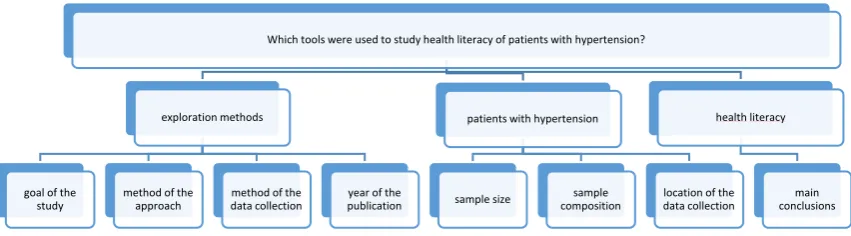
Secondarily, the relevance of the identified studies was assessed. In accordance with Klugarová et al. (2015), the the relevance of the studies was assessed in two phases. In the phase 1, the titles and abstracts were assessed taking into account the relevance of the texts from the point of view of the studied topic. The following exclusion criteria were used: (1) It was not a primary study, (2) it did not concern research on hypertension, unrelated to health literacy research or obtaining of information and acquiring of knowledge, not available in full-text, or clear research methodology description not available, (3) it concerned neither health literacy nor getting information or acquiring knowledge (4) it was not available in full-text, (5) the study methodology was not described clearly. In phase 2, the full-texts were assessed for the purity of the methodology used. The papers selected for analysis were read carefully, and the information contained was recorded in a prepared record sheet. The analysis was performed in accordance with Krippendorff (2004). For the analysis, the key categories were divided according to the following diagram:
Fig. 1. Operationalization of key terms
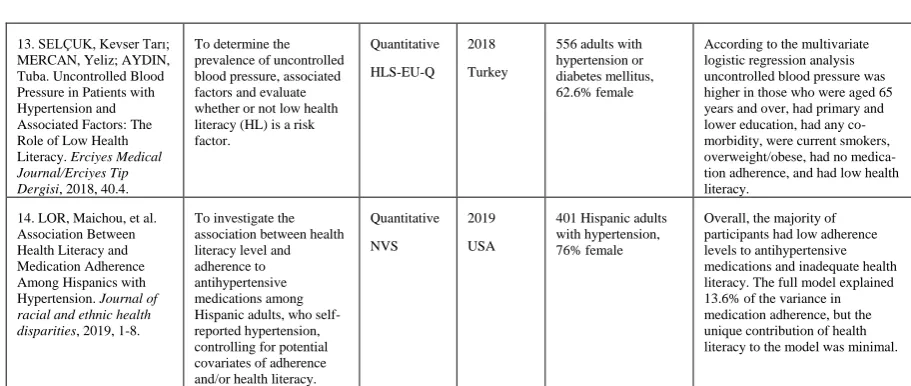
The analysis results were recorded in the pre-developed record sheet and processed in a clear table (see Table 1).
3. RESULTS
301 studies were found using the chosen search strategy. After using exclusion criteria, 14 studies were analyzed. The oldest and the latest analyzed papers were published in 2008 and 2019, respectively. The most studies (n = 6) were performed in American population. Two studies came from China, further two studies came from Iran; Columbia, Switzerland, Portugal and Turkey were represented by one study each. Except for one case, all studies are of a quantitative character. Adapted or abbreviated versions of Health Literacy Survey (HLS) questionnaire represent the most frequent assessment tools: European Health Literacy Survey Questionnaire (HLS-EU-Q), European Health Literacy Survey translated and validated into Portuguese (HLS-EU-PT), Brief Health Literacy Screening (BHLS), High Blood Pressure-Health Literacy Scale HBP-HLS. Totally, these tests were used in 5 studies. In three cases, health literacy of patients with hypertensis was assessed using the abbreviated version of the Test of Functional Health Literacy in Adults (S-TOFHLA). These assessment tools follow: Newest Vital Sign (NVS) 2x, Health Literacy for Iranian Adults (HELIA) 2x, Rapide Estimate of Adult Literacy in Medicine (REALM) 1x, Hypertension Knowledge Level Scale (HK-LS) 1x. The qualitative study used in-depth interviews and focus group discussions.
Which tools were used to study health literacy of patients with hypertension?
exploration methods
goal of the study
method of the approach
method of the data collection
year of the publication
patients with hypertension
sample size compositionsample data collectionlocation of the health literacy
Page 309
Source quote Goal Method/
instrument for measuring HL Year/ place
Velikost a sample composition
Primary output
1. LEVINTHAL, Brian R., et al. Cognition and health literacy in patients with hypertension. Journal of general internal medicine, 2008, 23.8: 1172.
Examined the role of cognitive and sensory abilities as mediators of age and education in determining functional health literacy among patients with hypertension.
Quantitative S-TOFHLA
2008 USA
492 adults with hypertension (aged 21 to 92 years), 73% female, 68% Africa-American
Health literacy was related to age, education, and race (24.4% of variance). Cognitive ability accounted for an additional 24% of variance and greatly reduced the influence of age, education, and race (by 75%, 40%, and 48%, respectively).
When controlling for cognitive and sensory variables, the association of age and education with STOFHLA scores was dramatically reduced. 2. PANDIT, Anjali U., et
al. Education, literacy, and health: Mediating effects on hypertension knowledge and control. Patient education and counseling, 2009, 75.3: 381-385.
To determine whether literacy mediates the association between education, hypertension knowledge and control.
Quantitative S-TOFHLA
2009 USA
330 adults with hypertension, 67.9% female,78.5% Africa-American
Both lower educational attainment and more limited literacy were found to be significant independent predictors of poorer hypertension knowledge and control.
Literacy was a significant independent predictor of blood pressure control, but only minimally explained the relationship between education and blood pressure. 3. KIM, Miyong T., et al.
Development and validation of the high blood pressure-focused health literacy scale. Patient education and counseling, 2012, 87.2: 165-170.
To developed and tested a novel health literacy scale for individuals with high blood pressure (HBP)
Quantitative HBP-HLS
2012 USA
Korean Americans aged 60 or older The study employed an experimental study design, the intervention arm (n=192) receiving a comprehensive, health-literacy focused HBP intervention, the control comparison group (n=194) receiving usual care. 69,5% female
Psychometric testing indicated that the scale was reliable (Kuder-Richardson-20 coefficient=0.98), valid (content validity index ≥0.8), and significantly correlated with theoretically selected variables (education, r=0.67, p<0.01; HBP knowledge, r= 0.33, p<0.01).
4. ABOUMATAR, Hanan J., et al. The impact of health literacy on desire for participation in healthcare, medical visit
communication, and patient reported outcomes among patients with hypertension.
Journal of general internal medicine, 2013, 28.11: 1469-1476.
To elucidate how HL influences patients’ interest in participating in healthcare, medical visit communication, and patient reported visit outcomes.
Quantitative REALM
2013 USA
41 primary care physicians (54,2% female, 45,4% white) and 275 of their patients (65,8% female, 36,7% white)
A lower percentage of patients with low versus adequate literacy had controlled blood pressure. Patients with low and adequate literacy were similarly interested in participating in medical decision making. Low literacy patients in the intensive physician intervention groups asked fewer medical questions. Patients with low literacy may be less able to respond to physicians’ use of patient-centered communication approaches than adequate literacy patients.
5. LEGIDO-QUIGLEY, Helena, et al. Patients’ knowledge, attitudes, behaviour and health care experiences on the prevention, detection, management and control of hypertension in Colombia: a qualitative study. PloS one, 2015, 10.4: e0122112.
To explore patients’ knowledge, attitudes,behaviour and health care seeking experiences in relation to detection, treatment and control of hypertension in Colombia Qualitative in-depth interviews and focus group discussions 2015 Colombia
26 individuals with hypertension and 4 family members in two regions
Page 310 6. ZHANG, Qinghua, et al.
Cross-cultural validation of the high blood pressure health literacy scale in a Chinese community. PloS one, 2016, 11.4: e0152182.
To translate and validate the High Blood Pressure-Health Literacy Scale (HBP-HLS) into Chinese (C-HBP-HLS) and evaluate its psychometric properties in Chinese context.
Quantitative HBP-HLS
2016 China
550 adults with hypertension (pilot sample: 242, validation sample: 308) 51% female C-HBP-HLS demonstrated suitable factor structure and robust psychometric properties for measuring health literacy level among hypertensive patients in China.
7. NÁFRÁDI, Lilla, et al. Intentional and unintentional medication non-adherence in hypertension: the role of health literacy, empowerment and medication beliefs. Journal of public health research, 2016, 5.3.
To assess the socio-demographic, clinical and psychological determinants of intentional and unintentional non-adherence. Quantitative NVS 2016 Switzerland
109 adults with hypertension, 24,8% female
Adherence self-efficacy was a mediator of the effect of health literacy on patients’ medication adherence and acceptance of the doctor’s advice was a covariate.
8. WANG, Chenli, et al. The effect of health literacy and self-management efficacy on the health-related quality of life of hypertensive patients in a western rural area of China: a cross-sectional study. International journal for equity in health, 2017, 16.1: 58.
To examine the association between the HRQL of hypertensive patients and health literacy and self-management efficacy as well as how they affect the HRQL, so as to provide a theoretical reference for improving the HRQL of patients with hypertension in less developed areas.
Quantitative BHLS
2017 China
882 adults with hypertension over 35, 56,1% female
The constructed model had a good fit for the data according to the model fit indices. Based on the model, health literacy (r=0.604, p=0.029) and Self-management efficacy (r=0.714, p=0.018) have a significant impact on HRQL. Demographic characteristics were inversely related to HRQL (r=−0.419, p=0.007), but have a significant impact on health literacy (r=0.675, p=0.029) and self-management efficacy (r=0.379, p=0.029). At the same time, self-management efficacy was positively correlated to health literacy (r=0.413, p<0.01). 9. HALLADAY,
Jacqueline R., et al. The association of health literacy and blood pressure reduction in a cohort of patients with hypertension: The heart healthy lenoir trial. Patient education and counseling, 2017, 100.3: 542-549.
Tested if a multilevel quality improvement intervention could differentially improve Systolic Blood Pressure (SBP) more so in patients with low vs. higher health literacy.
Quantitative S-TOFHLA
2017 USA
525 adults with hypertension, 69% female, 58% Africa-American
At 12 and 24 months, the low and higher health literacy groups had statistically significant decreases in mean systolic blood pressure, but the between group difference was not significant.
10. NAIMI, Ahmad Johari, et al. Correlation between health literacy and health-related quality of life in patients with hypertension, in Tehran, Iran, 2015– 2016. Electronic physician, 2017, 9.11: 5712.
To determine the correlation between health literacy and health-related quality of life in patients with hypertension
Quantitative HELIA
2017 Iran
400 adults with hypertension, 45% female,
The mean and standard deviation scores of health literacy and health-related quality of life were, respectively, 68.66 (±13.56) and 52.94 (±15.20). There was positive and significant correlation between health literacy and health-related quality of life (p<0.01, r=0.30).
11. CHAJAEE, Fateme, et al. Relationship between health literacy and knowledge among patients with hypertension in Isfahan province, Iran.
Electronic physician, 2018, 10.3: 6470.
To determine the relationship between health literacy and knowledge among patients with hypertension in Isfahan province, Iran. Quantitative HELIA HK-LS 2018 Iran
700 adults with hypertension, 68% female
The relationship between age and health literacy and knowledge was statistically significant. There was a significant correlation between the blood pressure knowledge and the mean score of health literacy.
12. DE ARAÚJO, Isabel Maria Batista, et al. Health literacy of patients with hypertension and diabetes in a northern region of Portugal. Revista de Enfermagem Referência, 2018, 4.18: 73-82.
Describe HL level of a group of patients with hypertension and diabetes in a northern region of Portugal.
Quantitative HLS-EU-PT
2018 Portugal
401 adults with hypertension or diabetes mellitus, 52.12% female
Page 311 13. SELÇUK, Kevser Tarı;
MERCAN, Yeliz; AYDIN, Tuba. Uncontrolled Blood Pressure in Patients with Hypertension and Associated Factors: The Role of Low Health Literacy. Erciyes Medical Journal/Erciyes Tip Dergisi, 2018, 40.4.
To determine the prevalence of uncontrolled blood pressure, associated factors and evaluate whether or not low health literacy (HL) is a risk factor.
Quantitative HLS-EU-Q
2018 Turkey
556 adults with hypertension or diabetes mellitus, 62.6% female
According to the multivariate logistic regression analysis uncontrolled blood pressure was higher in those who were aged 65 years and over, had primary and lower education, had any co-morbidity, were current smokers, overweight/obese, had no medica-tion adherence, and had low health literacy.
14. LOR, Maichou, et al. Association Between Health Literacy and Medication Adherence Among Hispanics with Hypertension. Journal of racial and ethnic health disparities, 2019, 1-8.
To investigate the association between health literacy level and adherence to antihypertensive medications among Hispanic adults, who self-reported hypertension, controlling for potential covariates of adherence and/or health literacy.
Quantitative NVS
2019 USA
401 Hispanic adults with hypertension, 76% female
Overall, the majority of participants had low adherence levels to antihypertensive medications and inadequate health literacy. The full model explained 13.6% of the variance in medication adherence, but the unique contribution of health literacy to the model was minimal.
Table 1. Results of the analysis
4. DISCUSSION
High health literacy correlates with a healthy lifestyle, development of positive relationships, and the awareness of solidarity, it increases the general level of health, and, as a result, becomes a characteristic feature of a healthy society and a general culture. At an individual level, health literacy promotes the individual`s self-confidence, dignity and autonomy. Individuals become active in making decisions on their health since, according to Holčík (2011), health literacy is directly associated with the development of the personality of every individual. Persons with a low health literacy are disadvantaged as far as their health is concerned since they do not take preventive measures, do not identify early stages of diseases, are not oriented in healthcare services, and do not participate in the treatments of their own diseases (2010).
The identification of the achieved level of health literacy in individual patients is needed to find the suitable way for their education. Based on this systematic review (Elbashir et al. 2019), the S-TOFHLA and the REALM are the most commonly used instruments to evaluate health literacy in cardiovascular diseases (CVD) population. This study documents HLS to be the the most frequently used tool. The use of existing CVD-specific health literacy screening tools is only documented in two studies.
The key limitation of the study was the method of searching for relevant sources for analysis. A specific limit is naturally apparent in the limited selection of key words. The researchers decided to take this step on the basis of experience from previous research, when entering additional key words did not provide very relevant results with regard to the chosen topic. The search area had to be conceived broadly, because limitation to a narrower topic did not provide any results. The fact that some studies were not available to the researchers in full-text and so could not be included in the analysis can also be considered a limitation of this study.
In spite of the mentioned study limits, it can be concluded that, similarly as the systematic review by Elbashir et al. (2019), our study highlights the limitations of current health literacy screening instruments and reveals that there is a lack of instruments that are specifically designed to assess health literacy in patients with CVDs.
5. CONCLUSIONS
Page 312 ACKNOWLEDGMENTS
This work, as part of project „Multidisciplinary approaches to chronic disease“, was supported by RVO excelent/ MSM - RVO/FHS/2019/003
REFERENCES
1. Thomopoulos C, Parati G, Zanchetti A. 2014 Effects of blood pressure lowering on outcome incidence in hypertension. 1. Overview, meta-analyses, and meta- regression analyses of randomized trials. J Hypertens; vol 32, pp. 2285-2295.
2. Chow CK, Teo KK, Rangarajan S, Islam S, Gupta R, Avezum A, Bahonar A, Chifamba J, Dagenais G, Diaz R, Kazmi K, Lanas F, Wei L, Lopez-Jaramillo P, Fanghong L, Ismail NH, Puoane T, Rosengren A, Szuba A, Temizhan A, Wielgosz A, Yusuf R, Yusufali A, McKee M, Liu L, Mony P, Yusuf S, PURE 2013 Study Investigators. Prevalence, awareness, treatment, and control of hypertension in rural and urban communities in high-, middle-, and low-income countries. JAMA; vol. 310, pp. 959–968.
3. Kearney PM, Whelton M, Reynolds K, Muntner P, Whelton PK, He J. 2005 Global burden of hypertension: analysis of worldwide data. Lancet; vol. 365, pp. 217–223.
4. Widimský J. jr., Filipovský J., Ceral J., et al. 2018 Diagnostické a léčebné postupy u arteriální hypertenze – verze 2017. Doporučení České společnosti pro hypertenzi. Hypertenze KV Prevence; vol. 7(Suppl), pp. 2–22.
5. Emdin CA, Rahimi K, Neal B, Callender T, Perkovic V, Patel A. 2015 Blood pressure lowering in type 2 diabetes: a systematic review and meta-analysis. JAMA; vol. 313, pp. 603-615.
6. Ettehad D, Emdin CA, Kiran A, Anderson SG, Callender T, Emberson J, Chalmers, J, Rodgers A, Rahimi K. 2016 Blood pressure lowering for prevention of cardiovascular disease and death: a systematic review and meta-analysis. Lancet; vol. 387, pp. 957-967.
7. NCD 2017 Risk Factor Collaboration. Worldwide trends in blood pressure from 1975 to 2015: a pooled analysis of 1479 population-based measurement studies with 19.1 million participants.
Lancet; vol. 389, pp. 37-55.
8. Rapsomaniki E, Timmis A, George J, Pujades-Rodriguez M, Shah AD, Denaxas S, White IR, Caulfield MJ, Deanfield JE, Smeeth L, Williams B, Hingorani A, Hemingway H. 2014 Blood pressure and incidence of twelve cardiovascular diseases: lifetime risks, healthy life-years lost, and age-specific associations in 1.25 million people. Lancet; vol. 383, pp.1899-1911.
9. Elbashir, Marwa, et al. 2019 Measurement of health literacy in patients with cardiovascular diseases: A systematic review. Research in Social and Administrative Pharmacy.
10. Nutbeam D. 2000 Health literacy as a public health goal: a challenge for contemporary health education and communication strategies into the 21st century. Health Promot Int; vol. 15, no. 3, pp. 259-67.
11. Ivanová, K., Olecká, I., Vencová, B., & Juríčková, L. 2018. Health literacy of mothers in the first year of motherhood–Expert interpretation map. Kontakt, vol. 20, no. 4, pp. e333-e339.
12. Desai S, Soumya A. 1998 Maternal Education and Child Health: Is there a strong causal relationship? Demography; vol. 35, no. 1, pp. 71-81.
13. Dewalt, D. A., Berkman, N. D., Sheridan, S., Lohr, K. N., & Pignone, M. P. 2004. Literacy and health outcomes. Journal of general internal medicine, vol. 19, no. 12, pp. 1228-1239.
Page 313
15. Baker DW 2006 The meaning and measure of health literacy. J Gen Intern Med, vol. 21, pp. 878– 883
16. Nutbeam, D. 2009. Defining and measuring health literacy: what can we learn from literacy studies?.
Int J Public Health, vol54, pp. 303.
17. Kutner, M., Greenburg, E., Jin, Y., & Paulsen, C. 2006. The Health Literacy of America's Adults: Results from the 2003 National Assessment of Adult Literacy. NCES 2006-483. National Center for Education Statistics.
18. Weiss, B. D., Mays, M. Z., Martz, W., Castro, K. M., DeWalt, D. A., Pignone, M. P., ... & Hale, F. A. 2005. Quick assessment of literacy in primary care: the newest vital sign. The Annals of Family Medicine, vol. 3, no. 6, pp. 514-522.
19. Hawkins, M., Gill, S. D., Batterham, R., Elsworth, G. R., & Osborne, R. H. 2017. The health literacy questionnaire (HLQ) at the patient-clinician interface: a qualitative study of what patients and clinicians mean by their HLQ scores. BMC health services research, vol. 17, no. 1, pp. 309. 20. Osborne R. H., et al. 2013. The grounded psychometric development and initial validation of the
Health Literacy Questionnaire (HLQ). BMC public health, vol. 13, no. 1, pp. 1. http://www.biomedcentral.com/1471-2458/13/658
21. Sørensen, K., Van den Broucke, S., Pelikan, J. M., Fullam, J., Doyle, G., Slonska, Z., ... & Brand, H. 2013. Measuring health literacy in populations: illuminating the design and development process of the European Health Literacy Survey Questionnaire (HLS-EU-Q). BMC public health, vol. 13, no. 1, pp. 948.
22. Pleasant A, McKinney J, Rikard RV 2011 Health literacy measurement: a proposed research agenda.
J Health Commun., vol. 16 (Suppl 3), pp. 11-21
23. Sørensen, Van den Broucke S, Fullam J, Doyle G, Pelikan J, Slonska Z, Brand H 2012 Health literacy and public health: a systematic review and integration of definitions and models. BMC Public Health, vol. 12 pp. 80.
24. Greenhalgh, T. 2003 Jak pracovat s vědeckou publikací (How to work with scientific publications). Basic evidence based medicine. Prague: Grada,.
25. Klugarová J, Klugar M, Marečková J, Hájek M. 2015 Methodology of systematic review development I: the effectiveness of hyperbaric oxygen therapy on mortality in adults with craniotrauma. Czech and Slovak Neurology and Neurosurgery. Vol. 78/111, no. 5, pp. 555–561. 26. Krippendorff, K. 2004 Content Analysis. Thousand Oaks, London, New Delhi: Sage.
27. Holčík J. 2011 Když uvažuji o zdraví, jsem snící romantik. Zdravotnictví a medicína, on line rozhovor, 2. 3. 2011 dostupné z http://zdraví.e15.cz/rozhovory/predstavujeme/445786