Page 117
THE ARCTIC AND POLAR RESEARCH AS A VEHICLE TO INSPIRE INTEREST IN SCIENCE AND RESEARCH CAREERS: IDEAS FROM THE EDU-ARCTIC PROGRAM
Agata Goździk
Institute of Geophysics, Polish Academy of Sciences, Księcia Janusza 64, 01-452 Warszawa, Poland
Abstract
Online classes may be an innovative tool, which helps to establish strong links between the research and education communities by connecting schools to scientists. Polar Regions represent one of the most interesting natural environments that can engage pupils in topics related to global changes. EDU-ARCTIC is a Pan-European initiative available for secondary schools, which uses the Arctic and polar research as a vehicle to encourage pupils aged 13 to 20 to pursue further education in STEM.
Results of the entry assessment survey with information from 146 teachers concerning 12310 pupils from 26 countries were presented and discussed. This survey contains information on pupils’ interest in scientific careers, their knowledge about conditions of work of professional scientists and interest and knowledge about Arctic issues. Moreover, some evaluation studies on online lessons and Arctic competition were described and their impact on pupils interest in STEM was discussed.
Key words: STEM, secondary schools, online lessons
1. INTRODUCTION
According to the Report of the European Commission (European Commission, 2015) – Science Education for Responsible Citizenship it is vital:
To promote a culture of scientific thinking and inspire citizens to use evidence-based reasoning for decision making;
To ensure citizens have the confidence, knowledge and skills to participate actively in an increasingly complex scientific and technological world;
To develop the competencies for problem-solving and innovation, as well as analytical and critical thinking that are necessary to empower citizens to lead personally fulfilling, socially responsible and professionally-engaged lives;
To inspire children and students of all ages and talents to aspire to careers in science and other occupations and professions that underpin our knowledge and innovation-intensive societies and economies, in which they can be creative and accomplished.
In this paper one of the initiative for European schools – EDU-ARCTIC project – is described, which contributes to fulfilling the above mentioned objectives by implementation of an educational program for secondary schools.
Page 118 2. GENERAL INFORMATION ABOUT THE PROJECT
EDU-ARCTIC is an EU-funded project focused on using Arctic research as a vehicle to encourage pupils aged 13 to 20 to pursue further education in science, technology, engineering and mathematics (STEM), setting them on a path to careers in one of these sectors, or even to become a scientist. Pupils participating in the project have a unique possibility to get to know what scientific careers are like and to learn more about different research disciplines while learning how to apply the scientific method, and also to learn crucial problem-solving skills.
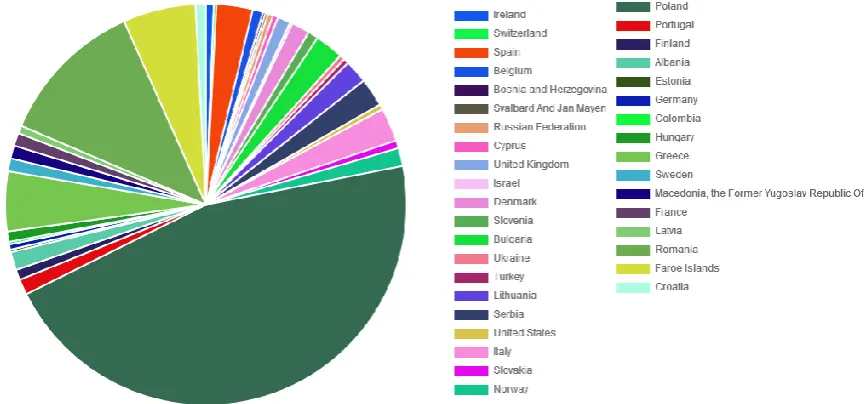
The project is conducted by six organisations: Institute of Geophysics, Polish Academy of Sciences (Coordinator, Poland), American Systems sp. z o.o. (Poland), The Norwegian Institute of Bioeconomy Research – NIBIO (Norway), Jardfeingi (Faroe Islands), Universite de Versailles Saint-Quentin (France), The Arctic Portal (Norðurslóðagáttin ehf) (Iceland). The project is foreseen for 3 years, and started in May 2016, whereas activities for schools started in January 2017. The registration to the program for new schools is still open. Almost 500 teachers from 35 countries have registered to the program already (Fig. 1.).
Fig. 1. Geographical coverage of teachers registered for the EDU-ARCTIC program.
2.1 The EDU-ARCTIC main components
The EDU-ARCTIC project uses a mix of different interactive, innovative tools to bring a fresh approach to teaching STEM subjects:
1. Webinars: Online lessons with polar scientists working at research stations and institutes. The lessons focus on natural science topics, polar research and why they are key to helping solve important challenges in society. In each online lessons up to 23 school groups may participate simultaneously. Webinars are conducted in English and in a few other European languages.
2. “Polarpedia”: An evolving online encyclopedia that contains a glossary of scientific terms and educational resources in nine national European languages (English, Polish, Danish, Norwegian, French, Romanian, Bulgarian, Italian, and Greek so far). It helps teachers and pupils to prepare for their participation in webinars by providing short explanations of scientific terms used by researchers conducting webinars. It contains photos, graphics and animations or videos, if possible. It is divided in 9 categories: Ice & Snow, Climate & Weather, Plants & Animals, Land & Geology, Atmosphere, Seas & Oceans, Space, People & Society, Career Resources.
Page 119
Arctic Competitions are proposed to all secondary schools from Europe, to teams of one pupil and one teacher. Each team develops an innovation or research project in the form of essay, video or a poster. International jury chooses 6 winning teams per edition, who are invited to visit one of the stations participating in the project.
4. Environmental monitoring program: All participating schools in Europe are invited to take part in the program to conduct environmental monitoring around their school. The program has a web-based interface allowing interested schools to report their observations in an open and accessible database. The database can be used as a supplement to science classes, most notably in biology, chemistry, physics and mathematics. The program is dedicated to meteorological and phenological parameters. Within meteorological observations and measurements there are reports on some actual values and reports on phenomena, which occurred since the last observation. Biological observations cover plants, insects, and birds monitoring.
5. Teacher workshops and training sessions aiming at giving teachers the right tools to use EDU-ARCTIC resources and become ambassadors of the project in their home countries. Workshops organized in 3 places of Europe will be also an opportunity to discuss teachers’ suggestions and recommendation for future development of the program.
2.2 Contribution to the policy STEM approaches
There are three main policy approaches related to encouraging STEM studies and careers in Europe (Caprile et al., 2015):
1. curricular and teaching methods;
2. teacher professional development;
3. guiding young people to STEM.
The EDU-ARCTIC program contributes to realization of all of them with the use of its various components. The online lessons and the monitoring system are some innovative ideas for curricular and teaching methods. Teacher professional development is realised within the EDU-ARCTIC project by organization of 3 teachers workshops and training sessions in 3 parts of Europe. Moreover, webinars regarding effective use of the program are offered to teachers. EDU-FORUM, a forum for registered teachers dedicated to discussion on various EDU-ARCTIC tools enables to share experience among international colleagues. The other tool dedicated to teachers’ development is Polarpedia, which helps them to familiarize their pupils with scientific terminology in English and national languages.
Guiding young people to STEM is implemented by the means of the online lessons, in which pupils participate and the Arctic Competitions, in which they are encouraged to propose a research plan or invent innovation addressing Arctic challenges. Moreover, the monitoring system, developed in the project, is an opportunity for pupils to conduct meteorological and environmental observations in the vicinity of their schools and by reporting them to the web-based portal to become a part of the global network of observers. Pupils are also invited to compare various phenomena occurring across Europe by analyzing the maps presenting geographical distribution of data provided by schools in various countries.
3. ENTRY ASSESSMENT
Page 120
at a time convenient for the respondent, it allows to collect more accurate data. The sheet consist of questions about changes in pupils’ behaviour, openness and scientific courage.
The sheet is filled in by teachers registered to the EDU-ARCTIC program. Teachers were encouraged to fill in the entry survey within a month after registration to the program. Participation in the survey was not obligatory, however we received satisfying number of responses. In the period from January 27 till July 1, 2017 we collected responses from 146 teachers from 26 countries (Albania, Belgium, Bosnia and Herzegovina, Bulgaria, Croatia, Cyprus, Denmark, Faroe Islands, Finland, Greece, Hungary, Israel, Italy, Latvia, Lithuania, Macedonia, Norway, Poland, Portugal, Romania, Russian Federation, Serbia, Spain, Sweden, Switzerland, United Kingdom). A very good geographical coverage of European countries has been obtained. Various countries were represented by 1 to 57 teachers, with the highest number of responders from Poland.
Among responders only 36 teachers are men (24% of responders). In the survey teachers of various subjects (geography, physics, biology, mathematics, science and environmental education, chemistry, ICT, English as a foreign language and a few more) took part. Geography, physics and biology teachers represent 65% of all responders. Information on the representation of various school subjects is presented in the Fig. 2.
Fig. 2. Information on the school subjects taught by the responders of the entry assessment survey (total of 146 teachers).
Teachers could have assessed one or more groups of pupils, for which they plan participation in the program. Teachers assessed groups of 2 to 1020 pupils, with the median of 30 pupils per teacher. The total number of pupils assessed within this survey is 12310, with 5720 schoolgirls and 6590 schoolboys. When ‘no opinion’ option was chosen, it was treated as no answer. Therefore, in the description under each figure information on the number of assessed pupils is given separately for schoolgirls and schoolboys and the numbers differ from the total number of pupils from the survey. Pupils assessed in the survey were from 13 to 20 years old, with the average age of 15 years, median of 14,5 and the most often indicated value of 13 years, which represents early stages of lower secondary schools.
Page 121 3.1 Interest and knowledge about scientific career
In this section answers to 5 questions regarding pupils’ interest and knowledge about scientific career are presented and discussed. The results are presented separately for schoolgirls and schoolboys. First, teachers were requested to assess, how many pupils show interest in STEM (science, technology, engineering and mathematics). The results are presented in the Figure 3. The results are very positive: 37% of pupils definitely and 37% rather show interest in STEM, whereas only 7,5% of pupils definitely don’t show interest in STEM. There are quite big differences between schoolboys and schoolgirls: 7% more schoolboys definitely show interest, but the sum of two categories (definitely and rather show interest) is comparable for both sexes.
Subsequently, teachers were assessing, how many pupils show interest in scientific careers. The results are rather optimistic: 27% of pupils definitely and 41% rather show interest in scientific careers (Fig. 4.). Only 10% of pupils definitely don’t show interest in scientific careers. There are some differences between schoolboys and schoolgirls: 4% more schoolboys definitely show interest, but the sum of two categories (definitely and rather show interest) is comparable for both sexes.
Fig. 3. Answers regarding interest of pupils in STEM (total of 5251 schoolgirls and of 5717 schoolboys)
Page 122
Fig. 5. Answers regarding the knowledge about the vocational tasks of a professional scientist (total of 5074 schoolgirls and of 5416 schoolboys)
In next two questions teachers were assessing knowledge of pupils about vocational tasks and conditions of work of professional scientists. More than 53% of schoolgirls and 56% of schoolboys have knowledge about the vocational tasks of a professional scientist (Fig. 5.). However, the group of pupils, who rather or definitely don’t have knowledge about it, is relatively high (45% of all pupils). This demonstrates that initiatives engaging scientists in the educational process may be useful to provide this knowledge to the group that do not have it now.
Subsequently, teachers were assessing, if their pupils know anything about the conditions of work of professional scientists (e.g. possibilities of employment, salary, requirements to obtain a degree). In this field knowledge of pupils is relatively low. Only 18% of pupils have very good knowledge and 25% quite good knowledge about the conditions of scientific work, with slightly higher number of schoolboys in the first option (Fig. 6). The biggest number of pupils have average knowledge: 30%. 23% of schoolgirls and 30% of schoolboys have rather little knowledge on that.
Fig. 6. Answers regarding the knowledge about the conditions of work of professional scientists (total of 5720 schoolgirls and 6590 schoolboys)
Page 123
Fig. 7. Answers regarding the pupils’ ability of use scientific language (total of 5378 schoolgirls and 5837 schoolboys)
3.2 Interest and knowledge about the Arctic
The other part of the survey concerns interest and knowledge of pupils about the Arctic. Teachers were requested to assess their pupils’ interest in issues related to the Arctic. The number of pupils interested in the Arctic is very high. For 74% of pupils teachers declared their interest, with 35% of all definitely interested. The numbers are higher for schoolgirls. Only 6% of girls and 7% of boys are definitely not interested in the Arctic issues (Fig. 8.).
Page 124
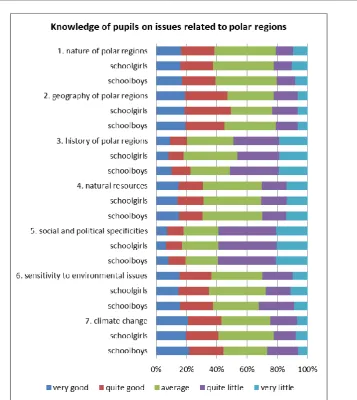
Fig. 9. Answers regarding pupils’ knowledge on issues related to polar regions
According to teachers’ assessment pupils have more knowledge about geography and climate change of polar regions (47% of pupils have very good or quite good knowledge on geography and 43% on climate change) than on social and political specificities and history of polar regions (only 18% of pupils have very good or quite good knowledge on social and political specificities and 20% on history). However, the results of the survey may be affected by teachers’ areas of expertise. It needs to be stressed that geography, physics and biology teachers represent 65% of all responders, with the highest number of geography teachers. For 6 from 7 areas the biggest groups of pupils (30 to 40,5%) have only average knowledge on Arctic issues. For social and political aspects the biggest group of pupils (38%) has only quite little knowledge, and here occurs also a big group with very little knowledge (21% of pupils).
4. EVALUATION STUDIES
Page 125 4.1 Results of online lessons’ evaluation
The data was collected with the use of a CAWI Survey. The online lesson survey contained six content questions and two open questions for suggestions for changes and new topics (Juńczyk & Man, 2016). Content questions were dedicated to 1) the understandability of presented materials, 2) interest of students in the topic, 3) contact of the presenter with students, 4) form of presentation, 5) assessment of the technical part of the lesson, and 6) general effect of lessons on students' interest in STEM.
From January 12 till June 7, 2017 84 online lessons were conducted for students from schools registered for the EDU-ARCTIC educational program. In each lesson from 2 to 19 groups of students were participating, with median of 14 groups per lesson. After each lesson, teachers received invitation to fill in the survey dedicated to particular lesson. In total 856 answers were obtained. The results of the survey are presented in Fig. 10 to 12.
Teachers assessed the material presented during online lessons mainly as easily (78% of answers) and quite easily (21% of answers) understandable for their pupils (Fig. 10.). We collected only 10 answers out of 856 that the material was difficult to understand or completely ununderstandable. In this respect, it is important to mention that it could be also strongly affected by the language of the lesson. For many pupils online lessons conducted in English as foreign language are considered as a challenge.
Fig. 10. Answers regarding understandability of material presented at the lessons (total of 856 answers).
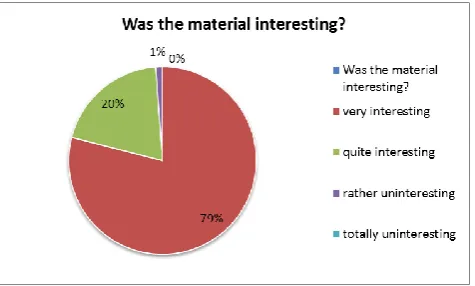
The other question regarded interest of teachers and their pupils in the topics and presented materials. The majority of answers were very positive (Fig. 11.). Majority of teachers found the lessons interesting (very interesting: 79% of answers, quite interesting: 20% of answers and rather uninteresting: 1 % of answers).
Page 126
Moreover, teachers were requested to assess the impact of online lessons conducted by scientists on the growth of pupils’ interest in STEM. Most teachers (97% of answers) found the lessons useful for increasing the pupils’ interest in STEM. Teachers assessed that the online lessons have positive effect on the growth of interest in STEM (very positive: 72% of answers, quite positive: 25% of answers). Only 2% of answers stated that online lessons proposed within the EDU-ARCTIC program have only little effect or no effect whatsoever.
Fig. 12. Opinions of teachers on the impact of online lessons on the pupils’ interest in STEM (total of 856 answers).
4.2 Results of Arctic Competition evaluation
After the first edition of the Arctic Competition all teachers, who participated in the contest were invited to fill in the survey, however it was also not obligatory. Survey was prepared in the form of CAWI. 17 answers were obtain. The survey consisted of 5 content question and one field for suggestions and recommendations (Juńczyk & Man, 2016). Questions concerned 1) understandability of the rules, 2) assessment of the substantive level and given requirements, 3) reaction of pupils, 4) impact of competitions on the growth of interest in STEM, and 5) impact on the level of knowledge about the Arctic.
Teachers were requested to assess the reaction of their pupils to the Arctic competition and its rules. They were assessing in the 6 grade scale from very negative (1) to very positive (6) emotions. All reactions were positive (from 4 to 6 on the scale, with the highest number for the most positive emotions (6): 41% of answers).
Page 127
Fig. 13. Opinions of teachers on the impact of the Arctic Competition on pupils’ interest in STEM and knowledge about the Arctic (total of 17 answers)
5. DISCUSSION AND CONCLUSIONS
Entry assessment took into account 12310 pupils from 26 European countries, which gives quite good statistical and geographical coverage. Teachers were assessing their pupils’ interest in STEM and scientific careers. The results are very positive: 37% of pupils definitely and 37% rather show interest in STEM, whereas only 7,5% of pupils definitely don’t show interest in STEM. 27% of pupils definitely and 41% rather show interest in scientific careers. Generally more schoolboys are definitely showing interest than schoolgirls, however sum of schoolboys definitely showing and rather showing interest is comparable to sum of schoolgirls. Probably schoolgirls show interest in a variety of topics, whereas schoolboys are more oriented to STEM rather than other subjects.
Teachers were requested also to assess the knowledge of pupils about vocational tasks of scientists and conditions of their work. The group of pupils, who rather or definitely don’t have knowledge about the vocational tasks of a professional scientist is relatively high (45% of all pupils). Additionally, only 43% of pupils have very good or quite good knowledge about conditions of scientific work. This demonstrates that initiatives engaging scientists in the educational process may be useful to provide this knowledge to pupils.
More than 60% of pupils are able to use scientific language, which is very helpful for their participation in the online lessons conducted by scientists. However, for the rest of pupils Polarpedia, which includes not only text explanations, but also graphics or videos, could be a useful tool enabling their understanding of topics presented during online lessons with researchers.
The number of pupils interested in the Arctic is very high. For 74% of pupils Teachers declared that 74% of their pupils are showing interest (35% of all definitely big interest). Only 6% of pupils are definitely not interested in the Arctic issues. At the same time knowledge of pupils on issues related to polar regions is not high and the biggest groups of pupils (30 to 40,5%) have only average knowledge on Arctic issues. It confirms that for majority of pupils using the Arctic and polar research as a vehicle to encourage them to science and scientific careers may be potentially effective. Pupils have more knowledge about geography and climate change of polar regions than on social and political specificities and history of polar regions, which is understandable, as first issues are mainly covered by regular school curricula. However, it could be taken as a suggestion to dedicate some of online lessons to the less known topic and, in this respect, to widen the general knowledge of pupils.
Page 128
All responders considered that Arctic competition had very strong or quite strong impact on the level of knowledge about Arctic issues, and 94% of teachers assessed positively the impact of competition on the growth of interest in STEM.
Therefore, we recommend participation in the EDU-ARCTIC educational program for secondary schools, as it proved to be a useful way to inspire youth’s interest in STEM, mainly science. The program is available for all European secondary schools for free and registration is available via the project website: <https://edu-arctic.eu/>. The project activities are foreseen till April 2019.
ACKNOWLEDGEMENTS
EDU-ARCTIC project has received funding from the European Union’s Horizon 2020 research and innovation programme under grant agreement No 710240. The content of the document is the sole responsibility of the author and it does not represent the opinion of the European Commission, and the Commission is not responsible for any use that might be made of information contained.
REFERENCES
Caprile, M., Plamen, R., Sanz, P., Dente G., (on request of the European Parliament’s Committee on Employment and Social Affairs), 2015, Encouraging STEM Studies for the Labour Market.
European Commission, 2015, SCIENCE EDUCATION for Responsible Citizenship. Report To The European Commission Of The Expert Group On Science Education <http://ec.europa.eu/research/swafs/pdf/pub_science_education/KI-NA-26-893-EN-N.pdf>, visited 15.07.2017
Juńczyk, T., Man, K., 2016, Evaluation plan including KPIs (key performance indicators) – public report from the EDU-ARCTIC project (available on request)
Macario, M., Invernizzi, C., Paris, E., Talarico, F., 2013, Case study, resources, ideas and practice to bring inquiry-based polar sciences into Italian classrooms in: A. Raschi et al: Science education and guidance in schools: the way forward. Printed in Italy: pp. 201-207.