Page 402
CONDITIONINGS OF THE EDUCATIONAL FUNCTION OF SENIOR TOURISM ON THE EXAMPLE OF SENIORS FROM WROCLAW, POLAND
Julita Markiewicz-Patkowska1, Krzysztof Widawski2, Piotr Oleśniewicz3
1WSB University in Wrocław, ul. Fabryczna 29–31, 53-609 Wrocław, Poland
2University of Wrocław, pl. Uniwersytecki 1, 50-137 Wrocław, Poland
3University School of Physical Education in Wrocław, al. I.J. Paderewskiego 35, 51-612 Wrocław,
Poland
Abstract
The article presents selected conditionings of the educational function of senior tourism on the basis of a study carried out among a group of Wroclaw seniors. The theoretical introduction defines key tourism functions, with particular emphasis on the educational, cognitive, and attitude-shaping functions. Both the senior group and senior tourism were defined in the context of their participants, motivations, needs, season, etc. The empirical part presents the group of seniors who underwent the tests. The majority of participants were aged 60–79 years. The authors indicated the preferred forms of tourist recreation, and characterized the main motivations, ways of traveling, length of the journey itself, and major goals. Attention was drawn to the economic situation of seniors in connection with its subjective perception; the impact of the latter on the willingness to undertake tourist activity was highlighted.
Key words: senior tourism, tourist functions, travel, tourist motivations
1. INTRODUCTION
The education function of tourism is among the most popular ones, which is often indicated in the subject literature (Kowalczyk 2001; Kurek 2007; Oleśniewicz & Widawski 2013). Tourism is a complex social, cultural, and economic phenomenon, fulfilling many functions. Among the most important ones is the leisure function. Its main component consists in the regeneration of physical and mental strength, lost in the course of professional activity, daily chores, etc. Appropriate behaviours may prevent many civilization diseases. Other functions pointed out in the literature include the economic function, which affects the economic development of the tourist region; and the city-forming function, with tourist development as a significant factor, accompanied by the development of other elements, resulting in area urbanization. However, in the context of this article, two other functions of tourism are important: the educational one, often associated with the cognitive function, and the socializing one. In the first case, tourism is treated as an important cognitive tool. The educational aspects of traveling experience are pointed at. Excursions constitute a perfect excuse for life lessons in the field. New matters, especially bound with positive emotions, stay in memory for many years. The main element of the socializing function is forming the desired attitudes. Learning about the region qualities may be an important part of patriotic education. Getting to know other cultures teaches openness and tolerance towards other ways of organizing the world. Many tourism forms help acquiring such skills as teamwork, dealing with unusual situations, etc. Finally, interacting with nature supports shaping ecological awareness, including the understanding of the need to take care of the natural environment (Czerwiński 2015; Gaworecki 2000; Gołembski 2002; Łobożewicz & Bieńczyk 2001).
The educational function cannot be attributed only to the adolescent age. A human being learns and gains experience throughout the whole life. This applies also to the senior age.
Page 403
Tideswell (2005) or Dąbrowski (2006) indicate the age of 60 years as the threshold. Generally, the senior definition criterion is connected with the socioeconomic factor of retirement.
In the recent decades, senior tourism has undergone a dynamic growth. It attracts the interest of many researchers. Górska (2010) places it in the context of social tourism, emphasizing the special situation of the elderly. As shown by Darcy and Dickson (2009) or Widawski (2010, 2011), senior tourism goes hand in hand with disabilities because of the age of the participants.
Many features are assigned to senior tourism. These include the specific seasonality, which in fact is characteristic of any type of tourism. Senior tourists constitute a group taking advantage of the tourist offer of a region outside the high season, as emphasized by Śniadek (2006), who at the same time points at other specific needs of the group, such as an appropriate means of transport – comfortable, fast, and cheap – or increased safety requirements. Acevedo (2003) or Huang and Tsai (2003) raise the issue of seniors’ needs, especially the need for contacting other people.
The appropriate implementation of the educational function requires a number of conditions to be met. It would be impossible to name them all, but it is worth to focus on the most important ones, indicated by tourists themselves.
2. SELECTED CONDITIONINGS OF THE EDUCATIONAL FUNCTION OF SENIOR TOURISM
To examine the conditionings of the educational function in senior tourism, the authors applied the polling survey method. The studied group included 120 residents of Wroclaw or wider – of Lower Silesia, members of the Wroclaw Senior Centre. Active persons over 50 years of age were tested, and the study was conducted in November 2016.
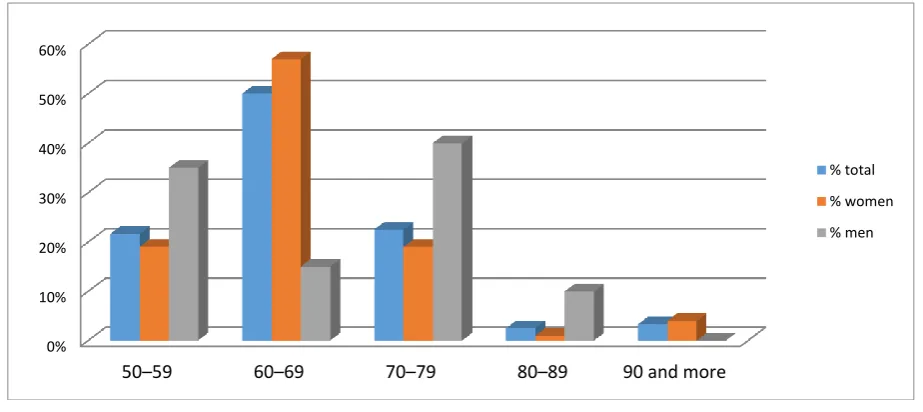
There were significant disparities in the gender share in the tested group. Only 17% of the responders were male, which indicates a much greater activity of females in various types of senior organizations. Taking into account age subgroups (Figure 1), the largest group of seniors were those aged 60–69 years, i.e. people approaching retirement or who had just retired. They constituted half of the studied group.
Figure 1. Age of responders
Source: own elaboration based on research results 0%
10% 20% 30% 40% 50% 60%
50–59 60–69 70–79 80–89 90 and more
% total
% women
Page 404
Almost equally numerous age groups were the one preceding and the one following the largest one. The age range of 70–79 represented 23% of all the test participants, and the age range of 50–59 stood for 22%. The remaining age groups, 80–89 and over 90 years, were definitely less active, which can be justified by the problems in the body functioning, attributed to this age. In both cases, these were only 3% of all responders. Most females, as much as 57 women, belonged to the largest group; only one woman represented the 80-year-olds. In the case of males, the seniors were best represented by 70-year-olds, although in absolute values this meant only eight responders; the oldest age group included no males.
For people undertaking tourist activities, not only for seniors – although it is the most apparent in them – one of the most important features is the availability of information, proximity to associations and clubs gathering people with similar needs. This facilitates many activities, including in the field of tourism. As rightly noted by Kocowski (1982), in larger cities, which offer a wider access to travel agencies, sports clubs, and senior clubs, the chance for seniors to undertake tourist activity is much greater.
Among the responders – not surprisingly, taking into account the Senior Centre location – residents of cities over 500,000 people (59% of all studied seniors) constituted the largest group. The next place of residence of the Senior Centre members was the country, although in absolute values this referred only to 18 people. Looking through the prism of gender, two out of three women lived in a large city (66%), compared with one out of four men. Among men, the most popular place of residence (30%) was a small town, of less than 20,000 inhabitants (Figure 2).
Figure 2. Place of residence
Source: own elaboration based on research results
It is worth to analyse the education of the study participants, which usually goes hand in hand with the awareness of the need for active lifestyle. Intellectual activity typically influences the awareness increase. Secondary education turned out the most popular in the tested group – it was declared by 42% responders. Almost every fourth person (24%) pointed at higher vocational education, and almost every fifth (18%) – a master’s degree. The remaining 16% represented basic vocational or elementary education.
Taking the labour market situation into account, the vast majority of responders (as much as 77%), which is not surprising, were retired people or pensioners. Ranked right after them, although with considerably lower share, were the self-employed and employed in the private sector (8% each). This
0% 10% 20% 30% 40% 50% 60% 70%
% total
% women
Page 405
applies mainly to the responders from the youngest age group defined in the study. The group of retired people or pensioners included 80% of the studied women, but only 60% of the studied men. Men turned out the more active group; 15% of them are still self-employed, and 10% work in the private sector.
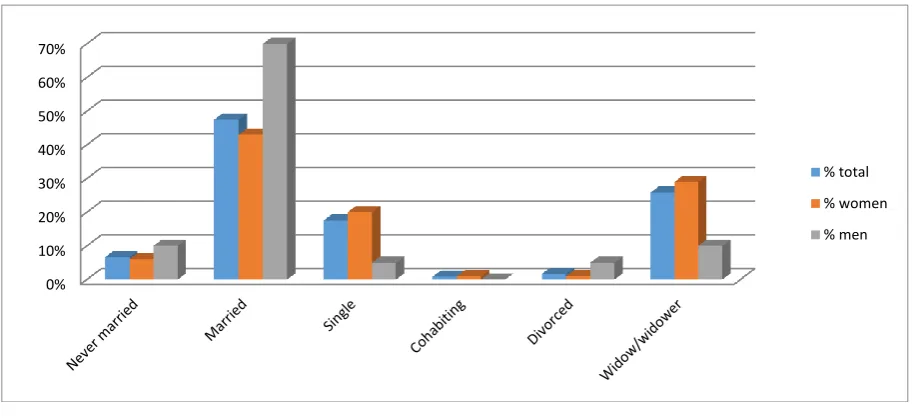
Marital status (Figure 3) can and usually does translate to tourist activity. Older people, usually subjected to some form of disability or age limitations, prefer to travel accompanied. This is, among others, the group that the phenomenon of multi-customer in tourism refers to (Widawski 2011).
Figure 3. Marital status
Source: own elaboration based on research results
Nearly half of the study participants (48%) were married. Much more often, which is worth mentioning, the married one was male (70%) than female (43%). Considering the fact that 1% of study participants remained in informal partnerships, still more than a half of the studied group declared to be single. Every fourth responder was a widow/widower, almost every fifth declared to be single, and 7% had never been married. Taking into account the responders’ age, one can assume that half of them encounters some barriers to tourist traveling resulting from the lack of company. This makes the membership of an association, such as the mentioned Senior Centre, even more important.
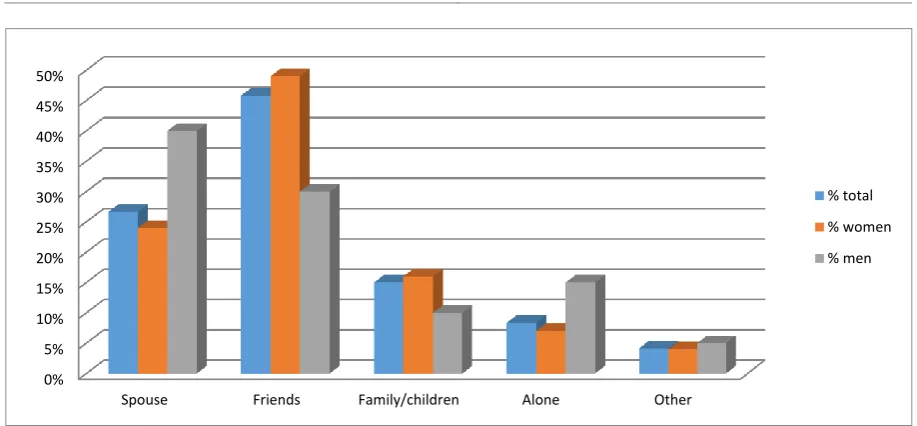
It is worth to take the opportunity to analyse the way a tourist trip is arranged in the tested group, on the basis of the declaration concerning the travel company (Figure 4).
0% 10% 20% 30% 40% 50% 60% 70%
% total
% women
Page 406
Figure 4. Traveling company
Source: own elaboration based on research results
Traveling with friends is the most common option, referring to nearly half of the responders (46%). Women travel with friends definitely more often (49%) than men (only 30%). Ranked next, the travelling company was the spouse. This preference was chosen by 27% of the responders, although it is much more common for married men (40%) than married women (only 24%). Lone trips turned out much less popular. Only 8% of responders decided to choose this type of traveling, and these were more often men (15% of all the studied men).
Tourist activity is greatly dependent on many factors, including the economic status. Monthly income influences the choice of destinations, forms of traveling, its duration, and the tourist offer character. As compared with the whole Europe, where the mobility of the third age sector is considerable, the Polish market remains relatively poor. More than half of the responders (51%) declared income from 1501 to 2500 PLN. This group included 55% the studied women. Ranked next, as many as 23% of responders, declared monthly income of 1500 PLN or less. This group was also dominated by women – as many as 25% of them indicated this a level of earnings. Men turned out more affluent. The largest group included 30% of the studied males. The majority (as many as 45%) declared income from 2501 to 4500 PLN, whereas 5% claim to earn up to 6000 PLN, which is the amount not present among the women (although it must be recognized that 5% of the female responders earned more than 6000 PLN).
The level of salaries is important, but the way one perceives their income is equally significant for the person to undertake tourist activity. Without appropriate (positive) assessment of their financial standing, one cannot think of tourist expenses – usually not treated as indispensable. Definitely, the largest group of responders evaluated their financial situation neutrally, i.e. as being average. This applies to 65% of responders and was more often observed in women (66% of the studied females) than men (60%). Every fourth responder (24%) claimed that their situation was good, and another 5% perceived it as very good. What is worth stressing is that optimism prevailed in this group. If individuals perceiving their situation as bad or very bad are taken into account, as many as 94% of the responders are mentally prepared for grater of smaller expenses not bound with essential commodities or services, i.e. tourist goods. Therefore, potentially, the economic factor was not among tourist activity inhibitors in almost any of the responders.
0% 5% 10% 15% 20% 25% 30% 35% 40% 45% 50%
Spouse Friends Family/children Alone Other
% total
% women
Page 407
3. THE PREFERRED FORMS AND THE CHARACTERISTICS OF THE SENIORS’ LEISURE
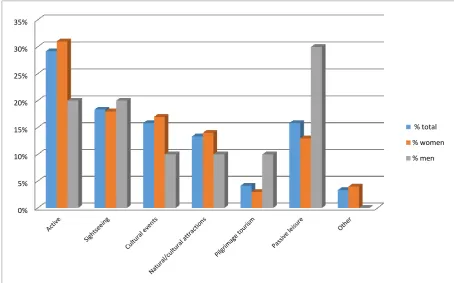
The form of physical activity, which is understandable, is greatly dependent on age. The most common form of activity among the elderly is physical activity which positively affects body and mind. There are many different forms of it. Those characteristic of the tested group are presented below (Figure 5).
Figure 5. The preferred forms of physical activity Source: own elaboration based on research results
Among the seven forms of activity indicated by the responders, the most popular was active recreation, most often represented by walking, Nordic walking, and cycling. These types of activities were indicated by 29% responders. This form of activity was also the most common among the surveyed women (chosen by nearly one third of them, 31%). Less popular, but still important for every fifth tested individual was monument sightseeing (18%), slightly more important for men (20% of them) than for women (18%). The third place was taken by two items: cultural events and passive leisure (16% of indications each). The passive leisure is worth noting, especially in the context of gender. This form of activity was preferred especially by men and, indicated by 30% of them, turned out the most popular among them. One fact deserves attention. If we add up the shares of such declared activities as monument sightseeing, cultural events, natural and cultural attraction sightseeing, and pilgrimage tourism, we would end up with 51% of indications of these forms of activities fulfilling the educational function of tourism, also in the group of seniors. Participation in cultural events, learning cultural of natural values, and even pilgrimage include an educational context, because, irrespective of age, each tourist trip is an open air school.
Another issue to consider is the length of the travels in which the educational activity is undertaken (Figure 6). The travel length usually depends on many factors, such as travel costs, free time limitations or, which remains significant in the case of the tested group, health status. The responders’ age can influence the preferences related to travel duration.
0% 5% 10% 15% 20% 25% 30% 35%
% total
% women
Page 408
Figure 6. Travel duration
Source: own elaboration based on research results
Short trips were most popular among seniors in the tested group. These are called weekend trips in the literature and last up to 4 days. Every third person (33%) preferred such travel duration. This is, at the same time, the period mostly preferred by women (35%). Ranked second are longer trips, referred to as holiday stays, lasting over seven days. Every fourth person (27%) chose longer trips, which usually go hand in hand with complementary cultural events. The third position was occupied by travels lasting up to one week. Every fifth person (22%) stayed outside the place of residence for up to 7 days. This type of travel turned out popular especially among men. Half of them indicated such stay duration as preferred. Every seventh responder declared to be a one-day visitor. This option was usually dictated by economic or health-related restrictions, and had its spatial specificities. It is most often related to the immediate surroundings, and the activity is of rather recreational character.
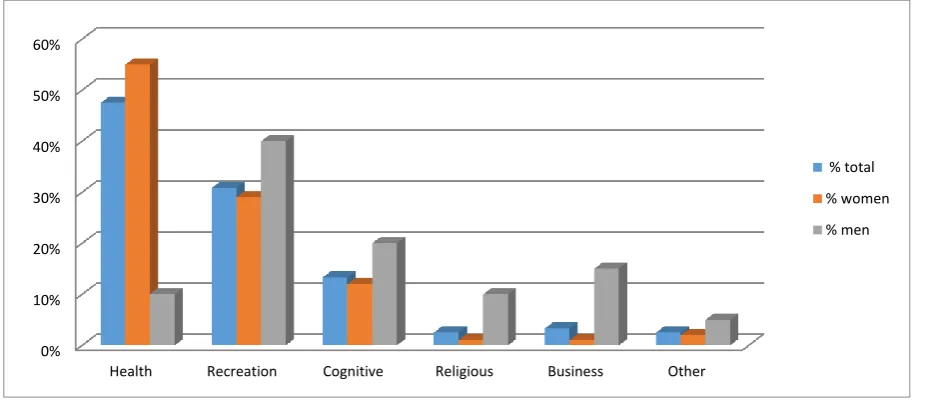
Travel goals in seniors (Figure 7) were similar as in the case of other groups of adult tourism participants, although the share of each goal may vary.
Figure 7. Travel goals
Source: own elaboration based on research results 0%
5% 10% 15% 20% 25% 30% 35% 40% 45% 50%
1 day 2–3 days Up to 7 days Over 7 days Other
% total
% women
% men
0% 10% 20% 30% 40% 50% 60%
Health Recreation Cognitive Religious Business Other
% total
% women
Page 409
The most common goal was, as expected, the health-related one. The awareness of the need to take care of one’s health is high in the described social group, and many activities, including those in the tourist field, are aimed at looking after this good, deficient at this age. This applies to 48% of responders. The distribution of this awareness according to gender can be surprising. More than half of women (55%) treated travels as a means of prolonging or diversifying therapy, while in the case of men, this tourist migration goal was the most important only for 10%. The second most important objective was recreation – the most popular objective among tourists, as reported by United Nations World Tourism Organization (UNWTO 2016). This goal was indicated by every third person, and it was the most popular traveling reason for men (40%). The third rank belonged to the cognitive goal, which is the most important one in the context of the educational function. Every seventh individual declared that goal as their major one, and it turned out twice as much significant for males (20%) as for females (12%).
It is worth considering what type of natural or cultural landscape is preferred by senior tourists.
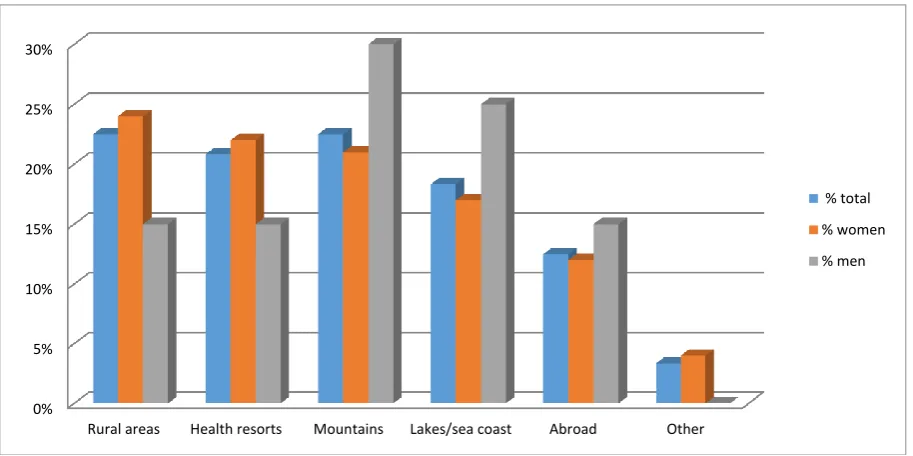
Figure 8. Holiday destinations
Source: own elaboration based on research results
The two most popular holiday destinations (Figure 8) were mountain areas and the countryside. Both turned out attractive for 23% of responders. Mountain landscape – treated as one of the most attractive in terms of views – was preferred especially by men: every third man chose mountains as their holiday destination. The countryside was the most popular among women – every fourth woman spent holidays in the countryside. The second rank was taken by health resorts. In the case of Lower Silesia these are scenically similar to the first two options, but they were distinguished because of their unique resort resources. The next positions were occupied by stays by the water, such as lakes or sea coasts, popular among 18% of responders. It is important to mention that regardless of the landscape type, seniors from Lower Silesia preferred domestic travels. As many as 87% of them stay in Poland, and only every eighth left abroad.
Finally, one should ask the seniors about the tourist offer prepared for them. Without going into details concerning the offer features, most assessments were positive: the offer turned out attractive for 69% of responders. Women were much more satisfied (73% of them) than men, who were equally pleased and dissatisfied with the offer.
0% 5% 10% 15% 20% 25% 30%
Rural areas Health resorts Mountains Lakes/sea coast Abroad Other
% total
% women
Page 410 4. SUMMARY/CONCLUSIONS
Today, a growing proportion of the society are the elderly – mainly the retired and pensioners; the Polish society perceives this life season as a negative one. It is therefore important for seniors who have retired not to withdraw from active life, but to develop new forms of activity.
Senior tourism is the form of activity for people of a certain age, who bear age-related consequences. This group features not only health-related, but also financial limitations. Most of the elderly are no longer professionally active, taking advantage of their retirement benefits only. Therefore, this is their free time that could and should be used to achieve hobby-related goals. To make seniors able to pursue their cognitive passions, certain conditions must be met. Only then, education through tourism could take place. The presented study did not refer to all variables; however, certain trends can be pointed out which are characteristic of the group of seniors at least from Wroclaw, who, with some caution, can be treated as representatives of the senior group of Lower Silesia.
Among the important aspects are the marital status and its derivative – type of company during the travel. The study points at the need for company. The vast minority of the study participants decide to leave home if they are to be alone. It is good if there is a spouse or a friend to share experience. Otherwise, the chances for leaving dramatically decrease. The economic factor is also important, and it should be considered on at least two levels. The first one is the revenues in absolute values, and the other is the subjective assessment of the subjects’ financial capacity. The attitude towards the financial capacity turns out equally important as the condition itself.
It is worth to emphasize the awareness of the need to take care of one’s health. This is the main reason for travelling in the senior tourists group. An appropriate level of knowledge in this field affects the understanding of the need for traveling. Tourism supports human development and education in many areas – from an increased awareness of the need to take care of one’s own wellbeing, through the need of recreation, to the classic form of the educational function, as in the case of implementing the cognitive goal while sightseeing, learning cultural and natural values, and participating in travels of religious character. In conclusion, the success of the educational function of senior tourism depends on many factors, ranging from motivation, through economic conditions, to social issues. Only a comprehensive approach ensures the ultimate success – enriching the tourist with knowledge and experience during the journey.
REFERENCES
Acevedo, CR 2003, ‘Motivos para viajar: um estudio com turistas maduros no contexto brasileiro’, FACEP Pesquisa, vol. 6, no. 3, pp. 78–87.
Alén, E, Domínguez, T & Losada, N 2012, ‘New opportunities for the tourism market: senior tourism and accessible tourism’, in M Kasimoglu (ed.), Visions for global tourism industry. Creating and sustaining competitive strategies, InTech, Rijeka, pp. 139–66.
Czerwiński, J 2015, Podstawy turystyki, CeDeWu, Warszawa.
Darcy, S & Dickson, T 2009, ‘A whole of life approach to tourism: the case for accessible tourism experiences’, Journal of Hospitality and Tourism Management, vol. 16, no. 1, pp. 32–43.
Dąbrowski, A (ed.) 2006, Zarys teorii rekreacji ruchowej, ALMAMER Wyższa Szkoła Ekonomiczna, Akademia Wychowania Fizycznego, Warszawa.
Gaworecki, W 2000, Turystyka, Polskie Wydawnictwo Ekonomiczne, Warszawa.
Gołembski, G 2002, Kompendium wiedzy o turystyce, Wydawnictwo Naukowe PWN, Poznań.
Page 411
Hossain, A, Bailey, G & Lubulwa, M 2003, ‘Characteristics and travel patterns of older Australians: impact of population ageing on tourism’, International Conference on Population Ageing and Health Modelling our Future, Canberra, 8–12 December.
Huang, L & Tsai, HT 2003, ‘The study of senior traveler behavior in Taiwan’, Tourism Management, vol. 24, no. 5, pp. 561–74.
Kocowski, T 1982, Potrzeby człowieka: koncepcja systemowa, Zakład Narodowy im. Ossolińskich, Wrocław.
Kowalczyk, A 2001, Geografia turyzmu, Wydawnictwo Naukowe PWN, Warszawa.
Kurek, W 2007, Turystyka, Wydawnictwo Naukowe PWN, Warszawa.
Lee, SH & Tideswell, C 2005, ‘Understanding attitudes towards leisure travel and the constraints faced by senior Koreans’, Journal of Vacation Marketing, vol. 11, no. 3, pp. 249–63.
Łobożewicz, T & Bieńczyk, G 2001, Podstawy turystyki, Wyższa Szkoła Ekonomiczna w Warszawie, Warszawa.
Oleśniewicz, P & Widawski, K 2013, Turystyka edukacyjna w kontekście turystyki szkolnej: wybrane zagadnienia, Instytut Geografii i Rozwoju Regionalnego Uniwersytetu Wrocławskiego, Wrocław.
Śniadek, J 2006, ‘Age of seniors – a challenge for tourism and leisure industry’, Studies in Physical Culture and Tourism, vol. 13, suppl., pp. 103–5.
UNWTO 2016, Tourism Highlights 2016 Edition.
Widawski, K 2010, ‘Accessibility and the character of the information about tourist values in the Internet on the example of the folklore events’, in J Chromý (ed.), Trendy komunikace v cestovním ruchu, Verbum, Praha, pp. 94–113.