Nonlin. Processes Geophys., 17, 113–122, 2010 www.nonlin-processes-geophys.net/17/113/2010/ © Author(s) 2010. This work is distributed under the Creative Commons Attribution 3.0 License.
Nonlinear Processes
in Geophysics
Another look at climate sensitivity
I. Zaliapin1and M. Ghil2,3
1Department of Mathematics and Statistics, University of Nevada, Reno, USA
2Geosciences Department and Laboratoire de M´et´eorologie Dynamique (CNRS and IPSL), Ecole Normale Sup´erieure, Paris, France
3Department of Atmospheric & Oceanic Sciences and Institute of Geophysics & Planetary Physics, University of California, Los Angeles, USA
Received: 11 August 2009 – Revised: 15 January 2010 – Accepted: 24 February 2010 – Published: 17 March 2010
Abstract. We revisit a recent claim that the Earth’s climate system is characterized by sensitive dependence to param-eters; in particular, that the system exhibits an asymmetric, large-amplitude response to normally distributed feedback forcing. Such a response would imply irreducible uncer-tainty in climate change predictions and thus have notable implications for climate science and climate-related policy making. We show that equilibrium climate sensitivity in all generality does not support such an intrinsic indetermi-nacy; the latter appears only in essentially linear systems. The main flaw in the analysis that led to this claim is in-appropriate linearization of an intrinsically nonlinear model; there is no room for physical interpretations or policy con-clusions based on this mathematical error. Sensitive depen-dence nonetheless does exist in the climate system, as well as in climate models – albeit in a very different sense from the one claimed in the linear work under scrutiny – and we illustrate it using a classical energy balance model (EBM) with nonlinear feedbacks. EBMs exhibit two saddle-node bi-furcations, more recently called “tipping points,” which give rise to three distinct steady-state climates, two of which are stable. Such bistable behavior is, furthermore, supported by results from more realistic, nonequilibrium climate models. In a truly nonlinear setting, indeterminacy in the size of the response is observed only in the vicinity of tipping points. We show, in fact, that small disturbances cannot result in a large-amplitude response, unless the system is at or near such a point. We discuss briefly how the distance to the bi-furcation may be related to the strength of Earth’s ice-albedo feedback.
Correspondence to: I. Zaliapin
1 Introduction and motivation
1.1 Climate sensitivity and its implications
Systems with feedbacks are an efficient mathematical tool for modeling a wide range of natural phenomena; Earth’s cli-mate is one of the most prominent examples. Stability and sensitivity of feedback models is, accordingly, a traditional topic of theoretical climate studies (Cess, 1976; Ghil, 1976; Crafoord and K¨all´en, 1978; Schlesinger, 1985, 1986; Cess et al., 1989). Roe and Baker (2007) (RB07 hereafter) have re-cently advocated existence of intrinsically large sensitivities in an equilibrium model with multiple feedbacks. Specifi-cally, they argued that a small, normally distributed feedback may lead to large-magnitude, asymmetrically distributed val-ues of the system’s response.
Such a property, if valid, would have serious implications for climate dynamics (Allen and Frame, 2007) and for mod-eling of complex systems in general (Watkins and Freeman, 2008). In this paper, we revisit the dynamical behavior of a general, equilibrium climate model with genuinely nonlin-ear feedbacks, and focus subsequently on a simple energy-balance model (EBM). We notice that the main, technical part of RB07’s argument is well-known in the climate liter-ature, cf. Schlesinger (1985, 1986), and thus it seems useful to review the associated assumptions and possible interpreta-tions of this result.
114 I. Zaliapin and M. Ghil: Climate sensitivity
0 0.2 0.4 0.6 0.8 1
0 2 4 6 8 10 12 14
Feedback factor, f
∆
T
(
o C)
∆T = ∆T0/(1-f)
Symmetric feedback distribution Asymmetric
response distribution
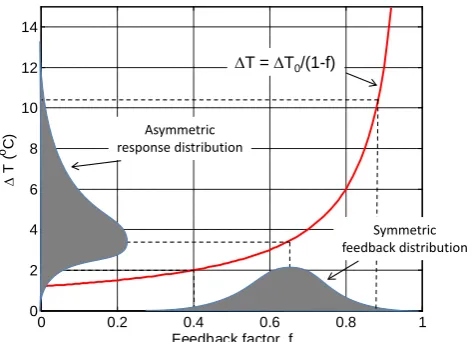
Fig. 1. Temperature response1T as a function of the feedback factorf in a linear climate model; modified after Roe and Baker (2007). In the absence of feedbacks (f=0), the response is given by1T=1T0=1.2oC. The response is amplified by feedbacks; it diverges (1T→ ∞) asf→1. The shaded areas illustrate the hypothetical symmetric distribution of the feedback factorf and the corresponding asymmetric distribution of the system response
1T. Our study shows that this prominently asymmetric response is only seen in a linear model and is absent in a general nonlinear model (see Fig. 2 below).
1.2 Roe and Baker’s (2007) linear analysis
We follow here RB07 and assume the following general setup. Let the net radiationR at the top of the atmosphere be related to the corresponding average temperatureT at the Earth’s surface by R=R(T ). Assume, furthermore, that there exists a feedbackα=α(T ), which is affected by the temperature change and which can, in turn, affect the radia-tive balance. Hence, one can writeR=R (T ,α(T )).
To study how a small change1Rin the radiation is related to the corresponding temperature change1T, one can use the Taylor expansion (Arfken, 1985) to obtain, as1T tends to zero,
1R=∂ R
∂ T1T+ ∂ R ∂ α
∂ α
∂ T1T+O
(1T )2. (1) Here,O(x)is a function such that|O(x)| ≤C xas soon as 0< x < for some positive constantsCand.
Introducing the notations 1
λ0
=∂ R
∂ T, and f= −λ0 ∂ R ∂ α
∂ α ∂ T,
for the “reference sensitivity”λ0 and the “feedback factor”
f, we obtain
1R=1−f
λ0
1T+O(1T )2, (2)
which readily leads to
1T= λ0
1−f1R+O
(1T )2, (3) as long asf6=1.
RB07 drop the higher-order terms in Eq. (3) to obtain
1T= λ0
1−f1R, (4)
which is their Eq. (S4). This equation leads directly to their main conclusion, namely that a normally distributed feed-back factorf results in an asymmetric system response1T
to a fixed forcing1R. The purported sensitivity is due to the divergence of the right-hand side (rhs) of Eq. (4) (their Eq. S4) asf approaches unity. Figure 1, which is analogous to Fig. 1 of RB07, illustrates this effect.
Roughly speaking, RB07 use the following argument: If the derivative ofR(T )with respect toT is close to 0, then the derivative ofT with respect toRis very large, and a small change in the radiationRcorresponds to a large change in the temperatureT. Such an argument, though, is only valid for an essentially linear dependenceR∝T. Our straightforward analysis in Sect. 2 below shows that the sensitivity effect of Fig. 1 is absent in climate models in which genuinely nonlin-ear feedbacksR=R(T ,α(T ))are present.
It is worth noticing that, since one seeks the tempera-ture change1T that results from a change1Rin the forc-ing, it might be preferable to consider the inverse function
T=T (R)or, more precisely,T=T (R,α(R))and the corre-sponding Taylor expansion
1T=∂ T
∂ R1R+ ∂ T ∂ α
∂ α
∂ R1R+O
(1R)2
.
The main conclusions of our analysis will not be affected by the particular choice of direct or inverse expansion, provided the nonlinearities are correctly taken into account.
1.3 Roe and Baker’s “nonlinear” analysis
In this section we address the analysis carried out by RB07 in the supplemental on-line materials, pp. 4–5, Sect. “Non-linear feedbacks.” The main conclusion of that analysis was that, given realistic parameter values for the climate system, the effects of possible nonlinearities in the behavior of the functionR=R(T )are negligible and do not affect the sys-tem’s sensitivity. We point out here two serious flaws in their mathematical reasoning that, each separately and the two to-gether, invalidate such a conclusion.
First, and most importantly, despite their section’s title, the analysis carried out by RB07 is still linear. Indeed, the Tay-lor expansion in their Eq. (S7) is given by
1R≈R01T+1
2R
00
I. Zaliapin and M. Ghil: Climate sensitivity 115 where(·)0stands for differentiation with respect toT. But
RB07 immediately invert this equation for1T subject to the assumption
1T2=1T 1T0,
where 1T0 is a constant. Hence, instead of solving the quadratic Eq. (5), Roe and Baker solve the following linear approximation:
1R=
R0+1
2R
00
1T0
1T ,
and thus obtain the key formula (their Eq. S8)
1T≈ −λ01R
1−f−1
2λ0R
001T
0
; (6)
the last step uses the, correct, fact that R0=(1−f )/λ0. This equation artificially introduces a divergence point for the temperature atf=1−(λ0/2)R001T0, which clearly can-not exist in a quadratic equation. Equation (6) is thus a very crude approximation that significantly deviates from the true solution to the full quadratic Eq. (5) – which we discuss be-low in Sect. 2 – and thus cannot be used to justify general statements about climate models.
The second flaw in the Roe and Baker (2007) reasoning is that, using the model and parameter values they suggest, one readily finds that:
– R0= −2, i.e., global temperature and radiation are
neg-atively correlated, which is hardly the case for the
cur-rent climate (e.g., Held and Soden, 2000). We notice that the negative sign of the correlation follows directly from their Eq. (S10) and is not affected by particular values of the model parameters. Furthermore,
– R00= −0.03, which means that the model they consider is, indeed, essentially linear, and thus not very realistic. Although, in this part of their analysis, Roe and Baker as-sumed thatf=0.4, it is easy to check that, for allf <0.95, their model satisfies |R00/R0|<0.1 and is therewith very close to being linear. To conclude, the effects on nonlinear-ities are indeed negligible in the particular model studied in this part of the RB07 paper, since the model is very close to being linear; one cannot extrapolate, therefore, their conclu-sions to climate models with significant nonlinearities.
We next proceed with a mathematically correct sensitivity analysis of a general climate model in the presence of truly nonlinear feedbacks.
2 A self-consistent sensitivity analysis
It is easily seen from the discussion in Sect. 1.2, especially from Eq. (2), that the relationship (4) is a crude approxima-tion: it is valid only subject to the assumptions that (a) the
higher-order terms in the expansion of1T are vanishingly small:
O(1T )21−f
λ0
1T;
and (b) the quantity in the rhs of this inequality is itself nonzero.
If one assumes, for instance, thatO (1T )2∼C (1T )2, where the precise meaning of g(x)∼f (x) is given by limx→0g(x)/f (x)=1, then the assumptions (a, b) above hold for1T that satisfy both of the following conditions 0< 1T(1−f )/(λ0C) and 0< 1T < , (7) whereC and are defined after Eq. (1). The first of these conditions implies that the range of temperatures within which the approximation (4) works vanishes as the feedback factorfapproaches unity. Hence, all the results based on this approximation – including precisely the main conclusions of RB07 – no longer apply outside a vanishingly small neigh-borhood off=1.0.
The asymptotic behavior we assumed above for
O (1T )2 is not exotic. Consider for instance the functionR=T2 in the neighborhood ofR=0. Its Taylor expansion
1R=2T 1T+O(1T )2
can be used to obtain, ignoring the second-order term,
1T≈1R/(2T ). (8)
The last equation would seem to imply that the growth of
1T is inversely proportional toT itself, so the change inT
should increase infinitely fast asT goes to 0, a rather annoy-ing contradiction.
The way out of this conundrum is to realize that the change
1T given by Eq. (8) is only valid in a small vicinity ofT =0 and cannot be extrapolated to larger values. Of course, we all know that the functionR=T2is nicely bounded and smooth in the vicinity of 0, but it is essential to take into account the second term in its Taylor expansion in this vicinity to obtain correct results. We show in Sect. 3 below that this simple example depicts the essential dependence of the Earth surface temperature on the global solar radiative input, for conditions close to those of the current Earth system.
In summary, the linear approximation of the function
R(T )derived by RB07 from its Taylor expansion is not valid whenf approaches unity. In this case – which is precisely the situation emphasized by these authors – the higher-order terms “hidden” insideO (1T )2, which they neglected, are indispensable for a correct, self-consistent climate sensitivity analysis.
A correct analysis of the case whenf approaches unity needs to start with a Taylor expansion that keeps the second-order term
1R=1−f
λ0
116 I. Zaliapin and M. Ghil: Climate sensitivity 10 I. Zaliapin and M. Ghil: Climate Sensitivity
Fig. 1. Temperature response Δ𝑇 as a function of the feedback factor𝑓 in a linear climate model; modified after Roe and Baker
(2007). In the absence of feedbacks (𝑓 = 0), the response is given byΔ𝑇 = Δ𝑇0= 1.2𝑜C. The response is amplified by feedbacks; it diverges (Δ𝑇 → ∞) as𝑓 →1. The shaded areas illustrate the hypothetical symmetric distribution of the feedback factor𝑓and the corresponding asymmetric distribution of the system responseΔ𝑇. Our study shows that this prominently asymmetric response is only seen in a linear model and is absent in a general nonlinear model (see Fig. 2 below).
0 0.2 0.4 0.6 0.8 1
0 2 4 6 8 10 12 14
Feedback factor, f
Δ
T (
oC)
a=0 a=0.1 a=1 a=10
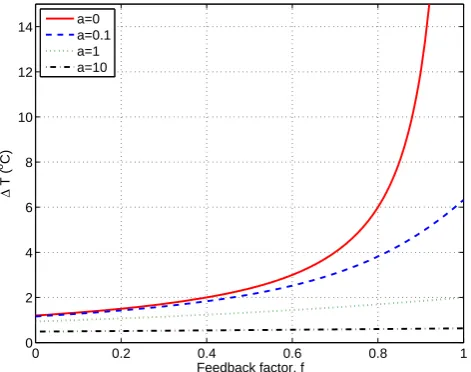
Fig. 2. Temperature responseΔ𝑇 as a function of feedback factor 𝑓in a nonlinear, quadratic climate model, governed by Eq. (9). The curves correspond (from top to bottom) to increasing values of the magnitude𝑎=𝑅′′/2of the quadratic term; the values of𝑎for each curve are given in the figure’s legend, in the upper-left corner. The uppermost curve (red) corresponds to𝑎= 0and is the same as the one shown in Fig. 1 above. Extreme sensitivity, expressed in the
divergence ofΔ𝑇, is only seen in the linear model; it rapidly van-ishes in the nonlinear model, as the nonlinearity factor𝑎increases.
opment: Past, Present and Future, Academic Press, San Diego,
285-325, 2000.
Ghil, M., Chekroun, M. D., and Simonnet, E.: Cli-mate dynamics and fluid mechanics: Natural variabil-ity and related uncertainties, Physica D, 237, 2111–2126, doi:10.1016/j.physd.2008.03.036, 2008.
Gladwell, M.: The Tipping Point: How Little Things Can Make a Big Difference, Little Brown, 2000.
Hannart, A., Dufresne, J.-L., and Naveau, P.: Why climate sen-sitivity may not be so unpredictable, Geophys. Res. Lett., 36, L16707, doi:10.1029/2009GL039640, 2009.
Held, I.M.: The gap between simulation and understanding in cli-mate modeling, Bull. Amer. Meteorol. Soc., 86, 1609–1614, 2005.
Held, I. M., and Suarez, M. J.: Simple albedo-feedback models of ice-caps. Tellus, 26, 613–629, 1974.
Held, I. M. and Soden, B. J.: Water vapor and global warming,
Annu. Rev. Energy Environ., 25, 441–475, 2000.
Hillerbrand, R. and Ghil, M.: Anthropogenic climate change: Sci-entific uncertainties and moral dilemmas, Physica D, 237(14-17), 2132–2138, 2008.
Hoffman, P.F., Kaufman, A.J., Halverson, G.P. and Schrag, D.P.: A
Neoproterozoic snowball earth, Science, 281, 1342–1346, 1998. Hyde, W.T., Crowley, T.J., Baum, S.K. and Peltier, W.R.: Neoproterozoic “snowball Earth” simulations with a coupled climate/ice-sheet model, Nature, 405, 425-429, 2000.
Lenton, T. M, Held, H., Kriegler, E., Hall, J. W., Lucht, W.,
Rahm-storf, S. and Schellnhuber, H. J.: Tipping elements in the Earth’s climate system, Proc. Natl. Acad. Sci. USA, 105, 1786–1793, 2008.
Lorenz, E. N.: Deterministic nonperiodic flow, J. Atmos. Sci., 20, 130–141, 1963.
MacCracken, M. C.: Geoengineering: Worthy of Cautious Evalua-tion? Climatic Change, 77, 235–243, 2006.
McWilliams, J. C.: Irreducible imprecision in atmospheric and oceanic simulations, Proc. Natl. Acad. Sci. USA, 104, 8709– 8713, 2007.
North, G. R.: Theory of energy-balance climate models, J. Atmos. Sci., 32, 2033–2043, 1975.
North, G. R., Cahalan, R. F., and Coakley, J. A.: Energy-balance climate models, Rev. Geophys., 19, 91–121, 1981.
Pierrehumbert, R. T.: High levels of atmospheric carbon dioxide
necessary for the termination of global glaciation, Nature, 429, 646–649, 2004.
Poulsen, C.J. and Jacob, R.L: Factors that inhibit snow-ball Earth simulation, Paleoceanography, 19, PA4021, doi:10.1029/2004PA001056, 2004.
Quon, C., and Ghil, M.: Multiple equilibria in thermosolutal con-vection due to salt-flux boundary conditions, J. Fluid Mech., 245, 449–483, 1992.
Fig. 2. Temperature response1T as a function of feedback factor
fin a nonlinear, quadratic climate model, governed by Eq. (9). The curves correspond (from top to bottom) to increasing values of the magnitudea=R00/2 of the quadratic term; the values ofafor each curve are given in the figure’s legend, in the upper-left corner. The uppermost curve (red) corresponds toa=0 and is the same as the one shown in Fig. 1 above. Extreme sensitivity, expressed in the di-vergence of1T, is only seen in the linear model; it rapidly vanishes in the nonlinear model, as the nonlinearity factoraincreases.
wherea=R00/2. If O (1T )3 is much smaller than the other two terms on the rhs, then the temperature change can be approximated by a solution of the quadratic equation
1−f λ0
1T+a (1T )2=1R. (9) The real-valued solutions to the latter equation, if they exist, are given by
1T1,2= 1 2
f−1
a λ0
± s
1−
f a λ0
2 +41R
a
.
In particular, whenf is close to 1.0, then
1T1,2≈ ± r
1R
a . (10)
One can see from Eq. (10) that the proximity of the feed-back factorf to unity no longer plays an important role in the qualitative behavior of the equilibrium temperature. This point is further illustrated in Fig. 2 that shows the climate sys-tem’s response1T as a function of the feedback factorf for different values of the nonlinearity parametera. The most important observation is that the climate response does not diverge atf =1; moreover, the asymmetry of the response due to the changes in feedback factorf rapidly vanishes as soon as the dependence of1Ron1T becomes nonlinear.
In general, one can consider an arbitrary number of terms in the Taylor expansion ofR(T ). The very fact that one re-lies on the validity of the Taylor expansion impre-lies thatR(T )
is bounded and sufficiently smooth; in other words, a diver-gence of the equilibrium temperature due to a small change in the forcing contradicts the very assumptions on which RB07 based their sensitivity analysis.
3 Sensitivity for energy balance models (EBMs)
We consider here a classical climate model with nonlinear feedbacks to illustrate that, in such a model: (i) the type of sensitivity claimed by RB07 does not exist; and (ii) sensitive dependence may exist, in a very different sense, namely in the neighborhood of bifurcation points, as explained below. 3.1 Model formulation
We consider here a highly idealized type of model that con-nects the Earth’s temperature field to the solar radiative flux. The key idea on which these models are built is due to Budyko (1969) and Sellers (1969). They have been sub-sequently generalized and used for many studies of climate stability and sensitivity; see Held and Suarez (1974); North (1975) and Ghil (1976), among others.
The interest and usefulness of these “toy” models resides in two complementary features: (i) their simplicity, which allows a complete and thorough understanding of the key mechanisms involved; and (ii) the fact that their conclusions have been extensively confirmed by studies using much more detailed and presumably realistic models, including general circulation models (GCMs); see, for instance, the reviews of North et al. (1981) and Ghil and Childress (1987).
The main assumption of EBMs is that the rate of change of the global average temperatureT is determined only by the net balance between the absorbed radiationRi and emitted radiationRo:
cdT
dt =Ri(T )−Ro(T ). (11)
For simplicity, we follow here the zero-dimensional (0-D) EBM version of Crafoord and K¨all´en (1978) and Ghil and Childress (1987), in which only global, coordinate-independent quantities enter; thus
Ri=µQ0(1−α(T )), Ro=σ g(T )T4. (12) In the present formulation, the planetary ice-albedo
I. Zaliapin and M. Ghil: Climate sensitivity 117 I. Zaliapin and M. Ghil: Climate Sensitivity 11
Ramanathan, V., Crutzen, P. J., Kiehl, J. T. and Rosenfeld, D.: Aerosols, climate, and the hydrological cycle, Science, 294(5549), 2119 – 2124, 2001.
Roe, G. H. and Baker, M. B.: Why is climate sensitivity so unpre-dictable? Science, 318, Issue: 5850, 629–632, 2007.
Ruelle, D., and Takens, F.: On the nature of turbulence, Commun. Math. Phys., 20, 167–192, 1971.
Schlesinger, M. E.: Feedback analysis of results from energy bal-ance and radiative-convective models. In MacCraken, M. C. and Luther, F. J. (eds.) Projecting the Climatic Effects on Increas-ing Carbon Dioxide, DOE/ER-0237 US Department of Energy, Washington DC, 280–319, 1985.
Schlesinger, M. E.: Equilibrium and transient climatic warming in-duced by increased atmosphericCO2, Climate Dyn., 1, 35–51, 1986.
Schneider, S.H. and Dickinson, R.E.: Climate modeling. Rev. Geo-phys. Space Phys., 25, 447, 1974.
Sellers, W. D.: A climate model based on the energy balance of the earth-atmosphere systems, J. Appl. Meteorol., 8, 392–400, 1969. Simonnet, E., Dijkstra, H. A., and Ghil, M.: Bifurcation analysis of ocean, atmosphere and climate models, in Computational Meth-ods for the Ocean and the Atmosphere, R. Temam and J. J. Trib-bia (eds.), 2009.
Smale, S.: Differentiable dynamical systems, Bull. Amer. Math. Soc., 73, 199–206, 1967.
Study of Man’s Impact on Climate (SMIC): Inadvertent Climate Modification. MIT Press, Cambridge (Mass.), 1971.
Stommel, H.: Thermohaline convection with two stable regimes of flow. Tellus, 13, 224–230, 1961.
Temam R., 1997: Infinite-Dimensional Dynamical Systems in Me-chanics and Physics, Springer-Verlag, New York, 2nd Ed., 648 pp, 1997.
Thual, O. and McWilliams, J. C.: The catastrophe structure of thermohaline convection in a two-dimensional fluid model and a comparison with low-order box models, Geophys. Astrophys. Fluid Dyn., 64, 67–95, 1992.
Watkins, N. W., and Freeman, M. P.: Geoscience - Natural com-plexity, Science, 320, 323–324, 2008.
Wetherald, R. T. and Manabe, S.: The effect of changing the solar constant on the climate of a general circulation model, J. Atmos. Sci., 32, 2044–2059, 1975.
250 260 270 280 290 300
0.1 0.2 0.3 0.4 0.5 0.6 0.7 0.8 0.9
Temperature, T
Ice−albedo feedback,
α
(a)
κ=0.05
κ=0.1
κ=0.2
κ=1
255 260 265 270 275 280 285 290
50 100 150 200 250
Temperature, T
Absorbed solar radiation, R
i
(b)
κ=0.2
κ=0.1
κ=0.05
κ=1
Fig. 3. Dependence of the absorbed incoming radiation𝑅ion the steepness parameter𝜅: (a) ice-albedo feedback𝛼=𝛼(𝑇;𝜅), and (b) absorbed radiation𝑅i=𝑅i(𝑇;𝜅), for different values of𝜅; see Eqs. (12) and (13).
Fig. 3. Dependence of the absorbed incoming radiationRion the steepness parameterκ: (a) ice-albedo feedbackα=α(T;κ), and
(b) absorbed radiationRi=Ri(T;κ), for different values ofκ; see Eqs. (12) and (13).
We model the ice-albedo feedback by
α(T;κ)=c1+c2
1−tanh(κ (T−Tc))
2 . (13)
This parametrization represents a smooth interpolation be-tween the piecewise-linear formula of Sellers-type models, like those of Ghil (1976) or Crafoord and K¨all´en (1978), and the piecewise-constant formula of Budyko-type models, like those of Held and Suarez (1974) or North (1975).
Figure 3a shows four profiles of our ice-albedo feedback
α(T )=α(T ) as a function of T, depending on the value of the steepness parameterκ. The profile forκ1 would correspond roughly to a Budyko-type model, in which the albedoα takes only two constant values, high and low, de-pending on whether T < Tc or T > Tc. The other profiles
shown in the figure for smaller values ofκ, correspond to Sellers-type models, in which there exists a transition ramp between the high and low albedo values. Figure 3b shows the corresponding shapes of the radiative inputRi=Ri(T ).
The greenhouse effect is parametrized, as in Crafoord and K¨all´en (1978) and Ghil and Childress (1987), by letting
g(T )=1−mtanh(T /T0)6
. (14)
Substituting this greenhouse effect parametrization and the one for the albedo into Eq. (11) leads to the following EBM:
cT˙=µ Q0(1−α(T ))
−σ T4h1−mtanh(T /T0)6 i
, (15)
whereT˙=dT /dt denotes the derivative of global tempera-tureT with respect to timet.
It is important to note that current concern, both scien-tific and public, is mostly with the greenhouse effect, rather than with actual changes in insolation. But in a simple EBM model – whether globally averaged, like in Crafo-ord and K¨all´en (1978) and here, or coCrafo-ordinate-dependent, as in Budyko (1969); Sellers (1969); Held and Suarez (1974); North (1975) or Ghil (1976) – increasingµalways results in a net increase in the radiation balance. It is thus convenient, and quite sufficient for the purpose at hand, to varyµin the incoming radiationRi, rather than some other parameter in the outgoing radiationRo. We shall return to this point in Sect. 4.
3.2 Model parameters
The value S of the solar constant, which is the value of the solar flux normally incident at the top of the atmosphere along a straight line connecting the Earth and the Sun, is as-sumed here to beS=1370 W m−1. The reference value of the global mean solar radiative input isQ0=S/4=342.5, with the factor 1/4 due to Earth’s sphericity.
The parameterization of the ice-albedo feedback in Eq. (13) assumesTc=273 K andc1=0.15,c2=0.7, which ensures thatα(T )is bounded between 0.15 and 0.85, as in Ghil (1976); see Fig. 3a. The greenhouse effect parametriza-tion in Eq. (14) uses m=0.4, which corresponds to 40% cloud cover, andT0−6=1.9×10⁻¹⁵K−6(Sellers, 1969; Ghil, 1976). The Stefan-Boltzmann constant is σ ≈5.6697×
10−8W m−2K−4.
3.3 Sensitivity and bifurcation analysis
3.3.1 Two types of sensitivity analysis
118 I. Zaliapin and M. Ghil: Climate sensitivity 12 I. Zaliapin and M. Ghil: Climate Sensitivity
1500 200 250 300 350 400
100 200 300 400 500 600
Temperature, T
Radiation, R
μ=2.0
μ=1.0
μ=0.5
Fig. 4. Outgoing radiation𝑅o(red, dashed line) and absorbed in-coming solar radiation𝑅i (blue, solid lines) for our 0-D energy-balance model (EBM), governed by Eq. (15). The absorbed
radia-tion is shown for𝜇 = 0.5,1and 2.0 (from bottom to top), while 𝜅 = 0.05. Notice the existence of one or three intersection points between the𝑅ocurve and one of the𝑅icurves, depending on the value of𝜇; these points correspond to the equilibrium solutions of (15), i.e. to steady-state climates.
0 0.5 1 1.5 2 2.5
100 150 200 250 300 350 400
Fractional insolation change, μ
Temperature, T
current Earth state
Fig. 5. Equilibrium solutions of the EBM (15) depending on the
fractional change𝜇in insolation. Notice the existence of two sta-ble (blue, solid lines) and one unstasta-ble (red, dashed line) solution branches. The arrows show the direction in which the global tem-perature will change after being displaced from a nearby equilib-rium state by external forces. The current Earth state corresponds
to the upper stable solution at𝜇= 1; in this figure𝜅= 0.05.
0 0.5 1 1.5 2 2.5
100 150 200 250 300 350 400
μ
Temperature, T
κ=0.01
κ=0.05 κ=0.1
κ=1
Fig. 6. Equilibrium solutions of the EBM (15) for ice-albedo
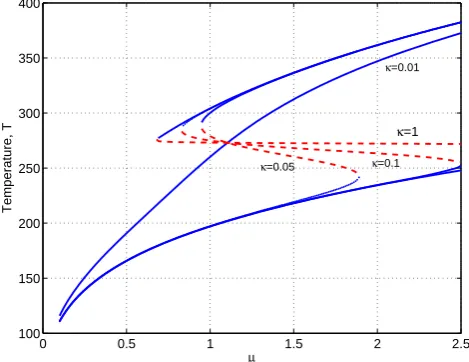
feed-back functions𝛼=𝛼(𝑇;𝜅)given by Eq. (13) and corresponding to the steepness parameter values𝜅= 0.01,0.05,0.1and 1. Notice the deformation of the stable (blue, solid lines) and unstable (red, dashed lines) solution branches: the “cold” tipping point moves to the left, away from𝜇= 1.0, as𝜅increases; compare Fig. 3a.
Fig. 4. Outgoing radiationRo(red, dashed line) and absorbed in-coming solar radiationRi (blue, solid lines) for our 0-D energy-balance model (EBM), governed by Eq. (15). The absorbed radi-ation is shown forµ=0.5,1 and 2.0 (from bottom to top), while
κ=0.05. Notice the existence of one or three intersection points between theRocurve and one of theRicurves, depending on the value ofµ; these points correspond to the equilibrium solutions of Eq. (15), i.e. to steady-state climates.
which may be different from the original one. This analysis refers to the “fast” dynamics of the system, and assumes that
Ri(T )−Ro(T )6=0 forT6=T0; it is often referred to as linear
stability analysis, since it considers mainly small
displace-ments from equilibrium att=0, T (0)=T0+θ (0), where
θ (0)is of order, with 0< 1, as defined in Sect. 2. The second type of analysis refers to the system’s “slow” dynamics. We are interested in how the system evolves along a branch of equilibrium solutions as the external force changes sufficiently slowly for the system to track an equi-librium state; hence, this second type of analysis always as-sumes that the solution is in equilibrium with the forcing:
Ri(T )−Ro(T )=0 for allT of interest. Typically, we want to know how sensitive model solutions are to such a slow change in a given parameter, and so this type of analysis is called sensitivity analysis. In the problem at hand, we will study – again following Crafoord and K¨all´en (1978) and Ghil and Childress (1987) – how changes inµ, and hence in the global insolation, affect the model’s equilibria.
A remarkable property of the EBM governed by Eq. (11) is the existence of several stationary solutions that describe equilibrium climates of the Earth (Ghil and Childress, 1987). The existence and linear stability of these solutions result from a straightforward bifurcation analysis of the 0-D EBM (11), as well as of its one-dimensional, latutude-dependent counterparts (Ghil, 1976, 1994): there are two linearly sta-ble solutions – one that corresponds to the present climate and one that corresponds to a much colder, “snowball Earth” (Hoffman et al., 1998) – separated by an unstable one, which lies about 10 K below the present climate.
12 I. Zaliapin and M. Ghil: Climate Sensitivity
1500 200 250 300 350 400
100 200 300 400 500 600
Temperature, T
Radiation, R
μ=2.0
μ=1.0
μ=0.5
Fig. 4. Outgoing radiation𝑅o(red, dashed line) and absorbed in-coming solar radiation𝑅i (blue, solid lines) for our 0-D energy-balance model (EBM), governed by Eq. (15). The absorbed radia-tion is shown for𝜇 = 0.5,1and 2.0 (from bottom to top), while 𝜅= 0.05. Notice the existence of one or three intersection points between the𝑅ocurve and one of the𝑅icurves, depending on the value of𝜇; these points correspond to the equilibrium solutions of (15), i.e. to steady-state climates.
0 0.5 1 1.5 2 2.5
100 150 200 250 300 350 400
Fractional insolation change, μ
Temperature, T
current Earth state
Fig. 5. Equilibrium solutions of the EBM (15) depending on the
fractional change𝜇in insolation. Notice the existence of two sta-ble (blue, solid lines) and one unstasta-ble (red, dashed line) solution branches. The arrows show the direction in which the global tem-perature will change after being displaced from a nearby equilib-rium state by external forces. The current Earth state corresponds to the upper stable solution at𝜇= 1; in this figure𝜅= 0.05.
0 0.5 1 1.5 2 2.5
100 150 200 250 300 350 400
μ
Temperature, T
κ=0.01
κ=0.05 κ=0.1
κ=1
Fig. 6. Equilibrium solutions of the EBM (15) for ice-albedo
feed-back functions𝛼=𝛼(𝑇;𝜅)given by Eq. (13) and corresponding to the steepness parameter values𝜅= 0.01,0.05,0.1and 1. Notice the deformation of the stable (blue, solid lines) and unstable (red, dashed lines) solution branches: the “cold” tipping point moves to the left, away from𝜇= 1.0, as𝜅increases; compare Fig. 3a.
Fig. 5. Equilibrium solutions of the EBM (15) depending on the
fractional changeµin insolation. Notice the existence of two sta-ble (blue, solid lines) and one unstasta-ble (red, dashed line) solution branches. The arrows show the direction in which the global tem-perature will change after being displaced from a nearby equilib-rium state by external forces. The current Earth state corresponds to the upper stable solution atµ=1; in this figureκ=0.05.
The existence of the three equilibria – two stable and one unstable – has been confirmed by such results being obtained by several distinct EBMs, of either Budyko- or Sellers-type (North et al., 1981; Ghil, 1994). Nonlinear stability, to large perturbations in the initial state, has been investigated by in-troducing a variational principle for the latitude-dependent EBMs of Sellers (Ghil, 1976) and of Budyko (North et al., 1981) type, and it confirms the linear stability results. 3.3.2 Sensitivity analysis for a 0-D EBM
We analyze here the stability of the “slow,” quasi-adiabatic (in the statistical-physics sense) dynamics of model (15). The energy-balance condition for steady-state solutionsRi=
Rotakes the form
µQ0(1−α(T ))=σ T4 h
1−mtanh(T /T0)6 i
. (16) We assume here, following the previously cited EBM work, that the main bifurcation parameter is µ; this happens to agree with the emphasis of Roe and Baker (2007) on cli-mate sensitivity as the dependence of mean temperatureT
on global solar radiative input, denoted here byQ=µQ0. Figure 4 shows the absorbed and emitted radiative fluxes,
I. Zaliapin and M. Ghil: Climate sensitivity 119 steady-state climate values are shown as a function of the
in-solation parameterµin the bifurcation diagram of Fig. 5. The “fast” stability analysis (not presented here) shows that small deviations θ (0) from an equilibrium solution, while all parameter values are kept fixed, may result in two types of dynamics, depending on the initial equilibriumT0: fast increase or fast decrease of the initial deviation (Ghil and Childress, 1987). The fast increase characterizes unstable equilibria: a small deviationθ (0)from such an equilibrium
T0 forces the solution to go further and further away from the equilibrium. In practice, such equilibria will not be ob-served, since there are always small, random perturbations of the climate present in the system: just think of weather as representing such perturbations.
The fast decrease of the initial deviation θ (0) character-izes stable solutions; only such equilibria can be observed in practice. The two stable solution branches of Eq. (15) are shown by solid lines in Fig. 5, while the unstable branch is shown by the dashed line. The arrows show the direction in which the temperature will change when drawn away from an equilibrium by external forces. This change, whether away from or towards the nearest equilibrium, is fast compared to the one that occurs along either solution branch (Ghil, 1976, 1994).
3.3.3 Bifurcation analysis
Given the choice of model parameters, the present climate state corresponds to the upper stable solution of Eq. (15), atµ=1 (see Fig. 5). It lies quite close to the bifurcation point(µ,T )≈(0.9,280 K), where the stable and unstable so-lutions merge.
The so-called normal form of this bifurcation is given by the equation
˙
X= ¯µ−X2, (17)
whereXis a suitably normalized form ofT, andµ¯ is a nor-malized form ofµ. Equation (17) describes the dependence betweenT andµ in a small neighborhood of the bifurca-tion point. In particular, the stable equilibrium branch is de-scribed by
X= +pµ¯;
this result has exactly the same form as the positive solu-tion of Eq. (10), given by our self-consistent analysis of cli-mate sensitivity in the presence of genuine nonlinearities, cf. Sect. 2. Hence, the derivative dX/dµ¯, and thus dT /dµ, goes to infinity as the model approaches the bifurcation point; this is exactly the situation discussed earlier in Sect. 2.
It is important to realize that the parabolic form of tem-perature dependence on insolation change is not an accident due to the particularly simple form of EBMs. Wetherald and Manabe (1975) clearly showed, in a slightly simplified GCM, that not only the mass-weighted temperature of their total at-mosphere, but also the area-weighted temperatures of each
of their five model levels, exhibits such a parabolic depen-dence on fractional radiative input; see Fig. 5 in their paper. Moreover, these authors emphasize that “As stated in the In-troduction, it is not, however, reasonable to conclude that the present results are more reliable than the results from the one-dimensional studies mentioned above simply because our model treats the effect of transport explicitly rather than by parameterization. [...] Nevertheless, it seems to be sig-nificant that both the one-dimensional and three-dimensional models yield qualitatively similar results in many respects.”
In fact, rigorous mathematical results demonstrate that the saddle-node bifurcation whose normal form is given by Eq. (17) occurs in several systems of nonlinear partial differ-ential equations, such as the Navier-Stokes equations (Con-stantin et al., 1989; Temam, 1997), and not only in ordinary differential equations, like Eqs. (11) and (15) above. We emphasize, though, that this does not cause the temperature to increase rapidly due to small changes in insolation: the presence of the bifurcation point will result in small, positive changes of global temperature for slow, positive changes in
µ, while it may throw the climate system into the deep-freeze state for slow, negative changes inµ.
4 Discussion
4.1 How sensitive is climate?
Making projections of climate change for the next decades and centuries, evaluating the human influence on future Earth temperatures, and making normative decisions about current and future anthropogenic impacts on climate are enormous tasks that require solid scientific expertise, as well as respon-sible moral reasoning. Well-founded approaches to handle the moral aspects of the problem are still being debated (e.g., Hillerbrand and Ghil, 2008). It is that much more important to master existing tools for acquiring accurate and reliable scientific evidence from the available data and models. Sev-eral of these tools come from the realm of nonlinear and com-plex dynamical systems (Lorenz, 1963; Smale, 1967; Ruelle and Takens, 1971; Ghil and Childress, 1987; Ghil, 1994; Ghil et al., 2008).
A straightforward analysis, carried out in Sect. 2 of this pa-per, shows that a proper treatment of the higher-order terms in a climate model with nonlinear feedbacks does not reveal the exaggerated sensitivity to forcing that was used in RB07 to advocate intrinsic unpredictability of climate projections. We emphasize that the error in Roe and Baker’s analysis is not related to their choice of model formulation or of the model parameters nor to their interpretation of model results. The problem is purely a matter of elementary calculus, and is due to inappropriate, and unnecessary, linearization of a nonlinear model.
120 I. Zaliapin and M. Ghil: Climate sensitivity of RB07 “results from a mathematical artifact.” We notice
simply that Hannart and colleagues did not even question the linear approximation framework of RB07 and still concluded that the claims of irreducibility of the spread in the envelope of climate sensitivity are not supported by the RB07 analysis. To summarize, while the general human concern about cli-mate sensitivity expressed by RB07 should be reasonably shared by many, their scientific conclusions do not follow from their model and its results, when correctly analyzed, as done here in Sect. 2. Nor are these conclusions supported by other models of greater detail and realism, when properly investigated. Accordingly, conclusions about the likelihood of extreme warming resulting from small changes in anthro-pogenic forcing can hardly be used to support political pro-posals (e.g., Allen and Frame, 2007) that claim to provide future directions for the climate-related sciences.
Still, this paper’s analysis does not preclude in any sense the Earth’s temperature from rising significantly in coming years. The methods illustrated here can only be used to study climate sensitivity in the vicinity of a given state; they can-not be applied to investigate climate evolution over tens of years, for example in response to large increases in green-house gases or to other major changes in the forcing, whether natural or anthropogenic. This latter problem requires global interdisciplinary efforts and, in particular, the analysis of the entire hierarchy of climate models (Schneider and Dickin-son, 1974), from conceptual to intermediate to fully coupled GCMs (Ghil and Robertson, 2000). It also requires a much more careful study of random effects than has been done heretofore (Ghil et al., 2008).
It seems to us that Roe and Baker’s title question “Why Is Climate Sensitivity So Unpredictable?” still remains open. 4.2 Where are the “tipping points”?
The S-shaped diagram of Fig. 5 – see also Fig. 10.6 in Ghil and Childress (1987) and Fig. 4 in Ghil (1994) – was used here to show the smoothness and boundedness of tempera-ture changes as a function of insolation changes, away from a saddle-node bifurcation, like that of Eq. (10) in Sect. 2 or of Eq. (17) in Sect. 3.3.3.
This S-shaped curve nevertheless reveals the existence of sensitive dependence of Earth’s temperature on insolation changes, or on other changes in Earth’s net radiation budget, such as may be caused by increasing levels of greenhouse gases, on the one hand, or of aerosols, on the other. This sen-sitive dependence is quite different from the one advocated by RB07. Namely, if the parameterµwere to slightly de-crease – rather than inde-crease, as it seems to have done since the mid-1970s, in the sense described in the last paragraph of Sect. 3.1 – then the climate system would be pushed past the bifurcation point atµ≈0.9. The only way for the global temperature to go would be down, all the way to a deep-freeze Earth, with much lower temperatures than those of re-cent, Quaternary ice ages.
It has become common in recent discourse about po-tentially irreversible climate change to talk about “tipping points”; e.g., Lenton et al. (2008). The term was originally introduced into the social sciences by Gladwell (2000) to de-note a point at which a previously rare phenomenon becomes dramatically more common. In the physical sciences, it has been identified with a shift from one stable equilibrium to an-other one, i.e., to a saddle-node bifurcation, as seen in Fig. 5 here and explained in Sect. 3.3.3 above.
In the EBM context of Fig. 5, it would require an enor-mous, almost twofold increase in the insolation in order for a deep-freeze-type equilibrium to reach the bifurcation point at
µ≈1.85 and jump from there toT ≈350 K, a temperature that sounds equally unpleasant. Within the broader context of the recent debates on how to exit a snowball-Earth state, very large, and possibly implausible increases in CO2levels would be required (Pierrehumbert, 2004).
Indeed, the likelihood to actually reach the tipping point to the left of the current climate in Fig. 5 seems to be quite small. Mechanisms for entering a snowball-Earth climate have been recently studied with a number of fairly realistic climate models (Hyde et al., 2000; Donnadieu et al., 2004; Poulsen and Jacob, 2004). Both modeling and independent geological evidence suggest that Earth’s climate can sustain significant fluctuations of the solar radiative input, and hence of global temperature, without entering the snowball Earth, and evidence for Earth ever having been in such a state is still controversial.
Nevertheless, the existence of the upper-left tipping point shown in Fig. 5 is confirmed by numerous model studies, including GCMs, and we have already cited some evidence also for the lower-right tipping point in the figure. Several hypothetical tipping points on the “warm” side have been identified by Lenton et al. (2008) and references therein, among many others. But only few of these have been stud-ied with the same degree of mathematical and physical detail as the ones of Fig. 5 here. One worthwhile example is that of the oceans’ buoyancy-driven, or thermohaline, circulation (Stommel, 1961; Bryan, 1986; Quon and Ghil, 1992; Thual and McWilliams, 1992; Dijkstra and Ghil, 2005).
I. Zaliapin and M. Ghil: Climate sensitivity 121 12 I. Zaliapin and M. Ghil: Climate Sensitivity
1500 200 250 300 350 400
100 200 300 400 500 600
Temperature, T
Radiation, R
μ=2.0
μ=1.0
μ=0.5
Fig. 4. Outgoing radiation𝑅o(red, dashed line) and absorbed in-coming solar radiation𝑅i (blue, solid lines) for our 0-D energy-balance model (EBM), governed by Eq. (15). The absorbed radia-tion is shown for𝜇 = 0.5,1and 2.0 (from bottom to top), while 𝜅= 0.05. Notice the existence of one or three intersection points between the𝑅ocurve and one of the𝑅icurves, depending on the
value of𝜇; these points correspond to the equilibrium solutions of (15), i.e. to steady-state climates.
0 0.5 1 1.5 2 2.5
100 150 200 250 300 350 400
Fractional insolation change, μ
Temperature, T
current Earth state
Fig. 5. Equilibrium solutions of the EBM (15) depending on the
fractional change𝜇in insolation. Notice the existence of two sta-ble (blue, solid lines) and one unstasta-ble (red, dashed line) solution branches. The arrows show the direction in which the global tem-perature will change after being displaced from a nearby equilib-rium state by external forces. The current Earth state corresponds to the upper stable solution at𝜇= 1; in this figure𝜅= 0.05.
0 0.5 1 1.5 2 2.5
100 150 200 250 300 350 400
μ
Temperature, T
κ=0.01
κ=0.05 κ=0.1
κ=1
Fig. 6. Equilibrium solutions of the EBM (15) for ice-albedo
feed-back functions𝛼=𝛼(𝑇;𝜅)given by Eq. (13) and corresponding to the steepness parameter values𝜅= 0.01,0.05,0.1and 1. Notice the deformation of the stable (blue, solid lines) and unstable (red, dashed lines) solution branches: the “cold” tipping point moves to the left, away from𝜇= 1.0, as𝜅increases; compare Fig. 3a.
Fig. 6. Equilibrium solutions of the EBM (15) for ice-albedo
feed-back functionsα=α(T;κ)given by Eq. (13) and corresponding to the steepness parameter valuesκ=0.01,0.05,0.1 and 1. Notice the deformation of the stable (blue, solid lines) and unstable (red, dashed lines) solution branches: the “cold” tipping point moves to the left, away fromµ=1.0, asκincreases; compare Fig. 3a.
4.3 How close are we to a cold tipping point?
Let us assume for the moment that the dangers of further warming will lead humanity to actually stop, and possibly reverse, the current trend of an increasingly positive net ra-diation balance. Given, on the other hand, the dangers of a snowball Earth, one might want to estimate then the close-ness of the climate system to the top-left bifurcation point in Fig. 5 here.
The GCM simulations of Wetherald and Manabe (1975) (see again their Fig. 5) suggest that this point might lie no farther than 5% below the current value of the solar constant. At the same time, the Sun has been much fainter 4 Gyr ago (by approximatyely 25–30%) than today, without the Earth ending up in a deep freeze, except possibly much later. So how close are we to this tipping point?
Figure 6 here shows stable and unstable equilibrium so-lutions for different profiles of the ice-albedo feedback,α=
α(T;κ); this profile is determined by the value of the steep-ness parameterκ (cf. Fig. 3a). The figure suggests that the steeper the ramp of the ice-albedo feedback function, i.e. the largerκ, the further away the bifurcation might lie. In fact, for a very smooth dependence of the albedo on temper-ature, i.e. for a very smallκ, there is no bifurcation at all (not shown): very small values ofκproduce only a single-valued, smoothly increasing, stable equilibrium solution to Eq. (15) for any value ofµ.
It seems worthwhile to carry out systematic bifurcation studies with atmospheric, oceanic and coupled GCMs to ex-amine this question more carefully, for warm tipping points, as well as for cold ones. Such studies are made possible by
current computing capabilities, along with well-developed methods of numerical bifurcation theory (Dijkstra and Ghil, 2005; Simonnet et al., 2009). This approach holds some promise in evaluating the distance of the current climate state from either a catastrophic warming or a catastrophic cooling.
Acknowledgements. We thank two anonymous referees for their
constructive comments that helped improve the paper. This study was supported by US Department of Energy grants DE-FG02-07ER64439 and DE-FG02-07ER64440 from its Climate Modeling Programs.
Edited by: H. A. Dijkstra
Reviewed by: P. Ditlevsen and another anonymous referee
References
Allen, M. R. and Frame, D. J.: Call off the quest, Science, 318(5850), 582–583, 2007.
Andronov, A. A. and Pontryagin, L. S.: Syst`emes grossiers, Dokl. Akad. Nauk. SSSR, 14(5), 247–250, 1937.
Arfken, G.: Taylor’s Expansion, Mathematical Methods for Physi-cists, 3rd ed., Orlando, FL, Academic Press, pp. 303–313, 1985. Bryan, F.: High-latitude salinity effects and interhemispheric
ther-mohaline circulations, Nature, 323, 301–304, 1986.
Budyko, M. I.: The effect of solar radiation variations on the climate of the Earth, Tellus, 21, 611–619, 1969.
Cess, R. D.: Climate change: An appraisal of atmospheric feedback mechanisms employing zonal climatology. J. Atmos. Sci., 33, 1831–1843, 1976.
Cess, R. D., Potter, G. L., Blanchet, J. P., Boer, G. J., Ghan, S. J., Kiehl, J. T., Le Treut, H., Li, Z.-X., Liang, X.-Z., Mitchell, J. F. B., Morcrette, J.-J., Randall, D. A., Riches, M. R., Roeckner, E., Schlese, U., Slingo, A., Taylor, K. E., Washington, W. M., Wetherald, R. T., and Yagai, I.: Interpretation of cloud-climate feedbacks as produced by 14 atmospheric general circulation models, Science, 245, 513–551, 1989.
Constantin, P., Foias, C., Nicolaenko, B., and Temam, R.: Integral Manifolds and Inertial Manifolds for Dissipative Partial Differ-ential Equations, Springer-Verlag, New York, 122 pp., 1989. Crafoord, C. and K¨all´en, E.: Note on condition for existence of
more than one steady-state solution in Budyko-Sellers type mod-els, J. Atmos. Sci., 35, 1123–1125, 1978.
Crutzen, P. J.: Albedo enhancement by stratospheric sulfate injec-tions: A contribution to resolve a policy dilemma?, Climatic Change, 77, 211–219, doi:10.1007/s10584-006-9101-y, 2006. Dijkstra, H. A. and Ghil, M.: Low-frequency variability of the
large-scale ocean circulation: A dynamical systems approach, Rev. Geophys., 43, RG3002, doi:10.1029/2002RG000122, 2005. Donnadieu, Y., Godd´eris, Y., Ramstein, G., N´ed´elec, A., and Meert, J.: A Snowball Earth climate triggered by continental break-up through changes in runoff, Nature, 428, 303–306, 2004. Gates, W. L. and Mintz, Y. (Eds.): Understanding Climatic Change:
A Program for Action, National Academies Press, Washington, D.C., 239 pp, 1975.
Ghil, M.: Climate stability for a Sellers-type model, J. Atmos. Sci., 33, 3–20, 1976.
122 I. Zaliapin and M. Ghil: Climate sensitivity Ghil, M. and Childress, S.: Topics in Geophysical Fluid Dynamics:
Atmospheric Dynamics, Dynamo Theory, and Climate Dynam-ics, Springer-Verlag, 485 pp., 1987.
Ghil, M. and Robertson, A. W.: Solving problems with GCMs: General circulation models and their role in the climate model-ing hierarchy, in: General Circulation Model Development: Past, Present and Future, edited by: Randall, D., Academic Press, San Diego, 285-325, 2000.
Ghil, M., Chekroun, M. D., and Simonnet, E.: Cli-mate dynamics and fluid mechanics: Natural variabil-ity and related uncertainties, Physica D, 237, 2111–2126, doi:10.1016/j.physd.2008.03.036, 2008.
Gladwell, M.: The Tipping Point: How Little Things Can Make a Big Difference, Little Brown, 2000.
Hannart, A., Dufresne, J.-L., and Naveau, P.: Why climate sen-sitivity may not be so unpredictable, Geophys. Res. Lett., 36, L16707, doi:10.1029/2009GL039640, 2009.
Held, I. M.: The gap between simulation and understanding in cli-mate modeling, B. Am. Meteorol. Soc., 86, 1609–1614, 2005. Held, I. M. and Suarez, M. J.: Simple albedo-feedback models of
ice-caps. Tellus, 26, 613–629, 1974.
Held, I. M. and Soden, B. J.: Water vapor and global warming, Annu. Rev. Energy Environ., 25, 441–475, 2000.
Hillerbrand, R. and Ghil, M.: Anthropogenic climate change: Sci-entific uncertainties and moral dilemmas, Physica D, 237(14– 17), 2132–2138, 2008.
Hoffman, P. F., Kaufman, A. J., Halverson, G. P., and Schrag, D. P.: A Neoproterozoic snowball earth, Science, 281, 1342–1346, 1998.
Hyde, W. T., Crowley, T. J., Baum, S. K., and Peltier, W. R.: Neoproterozoic “snowball Earth” simulations with a coupled climate/ice-sheet model, Nature, 405, 425–429, 2000.
Lenton, T. M, Held, H., Kriegler, E., Hall, J. W., Lucht, W., Rahm-storf, S., and Schellnhuber, H. J.: Tipping elements in the Earth’s climate system, Proc. Natl. Acad. Sci. USA, 105, 1786–1793, 2008.
Lorenz, E. N.: Deterministic nonperiodic flow, J. Atmos. Sci., 20, 130–141, 1963.
MacCracken, M. C.: Geoengineering: Worthy of Cautious Evalua-tion?, Clim. Change, 77, 235–243, 2006.
McWilliams, J. C.: Irreducible imprecision in atmospheric and oceanic simulations, Proc. Natl. Acad. Sci. USA, 104, 8709– 8713, 2007.
North, G. R.: Theory of energy-balance climate models, J. Atmos. Sci., 32, 2033–2043, 1975.
North, G. R., Cahalan, R. F., and Coakley, J. A.: Energy-balance climate models, Rev. Geophys., 19, 91–121, 1981.
Pierrehumbert, R. T.: High levels of atmospheric carbon dioxide necessary for the termination of global glaciation, Nature, 429, 646–649, 2004.
Poulsen, C. J. and Jacob, R. L: Factors that inhibit snow-ball Earth simulation, Paleoceanography, 19, PA4021, doi:10.1029/2004PA001056, 2004.
Quon, C. and Ghil, M.: Multiple equilibria in thermosolutal con-vection due to salt-flux boundary conditions, J. Fluid Mech., 245, 449–483, 1992.
Ramanathan, V., Crutzen, P. J., Kiehl, J. T., and Rosenfeld, D.: Aerosols, climate, and the hydrological cycle, Science, 294(5549), 2119–2124, 2001.
Roe, G. H. and Baker, M. B.: Why is climate sensitivity so unpre-dictable?, Science, 318(5850), 629–632, 2007.
Ruelle, D. and Takens, F.: On the nature of turbulence, Commun. Math. Phys., 20, 167–192, 1971.
Schlesinger, M. E.: Feedback analysis of results from energy bal-ance and radiative-convective models, in: Projecting the Climatic Effects on Increasing Carbon Dioxide, edited by: MacCraken, M. C. and Luther, F. J., DOE/ER-0237 US Department of En-ergy, Washington D.C., 280–319, 1985.
Schlesinger, M. E.: Equilibrium and transient climatic warming in-duced by increased atmospheric CO2, Clim. Dynam., 1, 35–51, 1986.
Schneider, S. H. and Dickinson, R. E.: Climate modeling, Rev. Geo-phys. Space Phys., 25, 447–493, 1974.
Sellers, W. D.: A climate model based on the energy balance of the earth-atmosphere systems, J. Appl. Meteorol., 8, 392–400, 1969. Simonnet, E., Dijkstra, H. A., and Ghil, M.: Bifurcation analysis of ocean, atmosphere and climate models, in: Computational Meth-ods for the Ocean and the Atmosphere, edited by: Temam, R. and Tribbia, J. J., 2009.
Smale, S.: Differentiable dynamical systems, B. Am. Math. Soc., 73, 199–206, 1967.
Study of Man’s Impact on Climate (SMIC): Inadvertent Climate Modification, MIT Press, Cambridge (Mass.), 1971.
Stommel, H.: Thermohaline convection with two stable regimes of flow, Tellus, 13, 224–230, 1961.
Temam, R.: Infinite-Dimensional Dynamical Systems in Mechanics and Physics, Springer-Verlag, New York, 2nd Ed., 648 pp, 1997. Thual, O. and McWilliams, J. C.: The catastrophe structure of thermohaline convection in a two-dimensional fluid model and a comparison with low-order box models, Geophys. Astrophys. Fluid Dynam., 64, 67–95, 1992.
Watkins, N. W. and Freeman, M. P.: Geoscience – Natural com-plexity, Science, 320, 323–324, 2008.