www.earth-syst-dynam.net/6/411/2015/ doi:10.5194/esd-6-411-2015
© Author(s) 2015. CC Attribution 3.0 License.
Climate and carbon cycle dynamics in a CESM
simulation from 850 to 2100 CE
F. Lehner1,2,*, F. Joos1,2, C. C. Raible1,2, J. Mignot1,2,3, A. Born1,2, K. M. Keller1,2, and T. F. Stocker1,2 1Climate and Environmental Physics, University of Bern, Bern, Switzerland
2Oeschger Centre for Climate Change Research, University of Bern, Bern, Switzerland
3LOCEAN Laboratory, Sorbonne Universités, Paris, France
*now at: National Center for Atmospheric Research, Boulder, USA
Correspondence to: F. Lehner ([email protected])
Received: 28 January 2015 – Published in Earth Syst. Dynam. Discuss.: 26 February 2015 Revised: 18 May 2015 – Accepted: 29 May 2015 – Published: 10 July 2015
Abstract. Under the protocols of phase 3 of the Paleoclimate Modelling Intercomparison Project, a number
of simulations were produced that provide a range of potential climate evolutions from the last millennium to the end of the current century. Here, we present the first simulation with the Community Earth System Model (CESM), which includes an interactive carbon cycle, that covers the last millennium. The simulation is contin-ued to the end of the twenty-first century. Besides state-of-the-art forcing reconstructions, we apply a modified reconstruction of total solar irradiance to shed light on the issue of forcing uncertainty in the context of the last millennium. Nevertheless, we find that structural uncertainties between different models can still dominate over forcing uncertainty for quantities such as hemispheric temperatures or the land and ocean carbon cycle response. Compared to other model simulations, we find forced decadal-scale variability to occur mainly after volcanic eruptions, while during other periods internal variability masks potentially forced signals and calls for larger ensembles in paleoclimate modeling studies. At the same time, we were not able to attribute millennial temper-ature trends to orbital forcing, as has been suggested recently. The climate–carbon-cycle sensitivity in CESM during the last millennium is estimated to be between 1.0 and 2.1 ppm◦C−1. However, the dependence of this sensitivity on the exact time period and scale illustrates the prevailing challenge of deriving robust constraints on this quantity from paleoclimate proxies. In particular, the response of the land carbon cycle to volcanic forc-ing shows fundamental differences between different models. In CESM the tropical land dictates the response to volcanoes, with a distinct behavior for large and moderate eruptions. Under anthropogenic emissions, global land and ocean carbon uptake rates emerge from the envelope of interannual natural variability by about year 1947 and 1877, respectively, as simulated for the last millennium.
1 Introduction
The last about 1000 years constitute the best opportunity pre-vious to the instrumental period to study the transient inter-action of external forcing and internal variability in climate,
atmospheric CO2, and the carbon cycle on interannual to
multi-decadal timescales. In fact, the instrumental record is often too short to draw strong conclusions on multi-decadal variability. The relatively stable climate together with the abundance of high-resolution climate proxy and ice core data makes the last millennium an interesting target and test bed
Compared to glacial–interglacial climate change, the last millennium experienced little climate variability, yet there is evidence for distinct climate states during that period (e.g., Lehner et al., 2012b; Keller et al., 2015). Within the last
mil-lennium, the Medieval Climate Anomaly (MCA,∼AD 950–
1250) and the Little Ice Age (LIA, ∼AD 1400–1700) are
two key periods of documented regional or global temper-ature excursions suggested to be driven by a combination of variations in solar irradiance and volcanic activity (see, e.g., Crowley, 2000; Mann et al., 2009; PAGES 2k network, 2013). Despite great efforts in reconstructing (e.g., PAGES 2k network, 2013) and simulating (e.g., Fernandez-Donado et al., 2013; Masson-Delmotte et al., 2013) the transition from the MCA to the LIA, substantial uncertainties remain with respect to the mechanisms at play. Recent studies point towards solar insolation playing a minor role with regard to climate over the last millennium (Ammann et al., 2007; Schurer et al., 2014), while regional feedback processes in response to volcanic eruptions and solar variability need to be considered to explain decadal-scale climate variability (e.g., Lehner et al., 2013; Moffa-Sanchez et al., 2014). At high northern latitudes, the importance of millennial-scale orbital forcing is another debated issue (e.g., Kaufman et al., 2009). Further, the last millennium offers the possibility to study the natural variability in the carbon cycle and its response to external forcing. Models with a carbon cycle module are extensively tested against present-day observations and widely used for emission-driven future projections (see, e.g., Hoffman et al., 2014). However, there are only few last-millennium simulations including a carbon cycle (see, e.g., Gerber et al., 2003; Jungclaus et al., 2010; Brovkin et al., 2010; Friedrich et al., 2012). The sensitivity of the carbon cy-cle to climate has been shown to be mostly positive, i.e., with warming, additional CO2is released to the atmosphere (Ciais
et al., 2013). However, the magnitude of this feedback re-mains poorly constrained by observations (Frank et al., 2010) and models (e.g. Friedlingstein et al., 2006). In particular, determining the role of land in past and future carbon cycle variability and trends is still challenging. In both idealized (Doney et al., 2006; Joos et al., 2013) and scenario-guided multi-model studies (Friedlingstein et al., 2014), land consti-tutes the largest relative uncertainty in terms of intermediate-to long-term carbon uptake.
As for physical climate quantities, explosive volcanic eruptions constitute an important forcing for the carbon cy-cle. The sensitivity of the carbon cycle to such eruptions has been investigated by Jones and Cox (2001), Frölicher et al. (2011), Brovkin et al. (2010), and Tjiputra and Otterå (2011) using different Earth system models. For this short-lived forcing, the land response appears to be the driver of most post-eruption carbon cycle changes, with a range of magnitudes and time horizons associated with the different models. Further, Frölicher et al. (2013) pointed out that the magnitude of the carbon cycle response to volcanoes depends critically on the climate state during the eruption.
The third Paleoclimate Modelling Intercomparison Project (PMIP3; Schmidt et al., 2011) and fifth Coupled Model In-tercomparison Project (CMIP5; Taylor et al., 2012) repre-sent joint efforts, in which different modeling groups perform identical experiments, allowing for a systematic comparison of the models (e.g., Schmidt et al., 2014). Here we contribute to the existing set of simulations an integration from 850– 2100 CE with the Community Earth System Model, includ-ing a carbon cycle module. The aims of this study are (i) to detect coherent large-scale features of forced variability in temperature and carbon cycle quantities, in particular in re-sponse to volcanic eruptions, (ii) to investigate the relative role of forcing uncertainty and model structural uncertainty, and (iii) to provide an estimate of preindustrial variability and the time of emergence from it under anthropogenic climate change. The setup chosen here is unique in a number of ways and tailored to address the abovementioned aims: first, the carbon cycle is fully interactive with the other model compo-nents with the exception of the radiation code, which is fed by reconstructed CO2. This allows us to study the isolated
ef-fect of climate on the carbon cycle, while guaranteeing an ex-ternal forcing consistent with existing reconstructions. Sec-ond, the orbital parameters are held constant to study their importance relative to simulations with transient orbital pa-rameters. Third, the solar forcing incorporated into the sim-ulation has a larger amplitude than the majority of PMIP3 simulations and hence enables us to investigate whether the results are sensitive to this amplitude.
This paper is structured as follows: a description of the model and experimental setup is presented in Sect. 2. In Sects. 3 and 4 we address the general simulated climate and carbon cycle evolution and investigate forced and unforced variability in the simulated climate by comparing models to reconstructions and models to models. Section 5 focuses on the response of the climate and carbon cycle to volcanic forc-ing. Section 6 deals with estimating the climate–carbon-cycle sensitivity in the Community Earth System Model (CESM). A discussion and conclusions follow in Sect. 7.
2 Data and methods
2.1 Model description
The atmospheric component of CESM 1.0.1 is the Com-munity Atmosphere Model version 4 (CAM4; Neale et al., 2010), which has a finite volume core with a uniform hor-izontal resolution of 1.25◦×0.9◦ at 26 vertical levels. The land component is the Community Land Model version 4 (CLM4; Lawrence et al., 2011), which operates on the same horizontal grid as CAM4 and includes a prognostic carbon– nitrogen cycle that calculates vegetation, litter, soil carbon, vegetation phenology, and nitrogen states. Further, it includes a prognostic fire module, which is governed by near-surface soil moisture conditions and fuel availability.
The ocean component is the Parallel Ocean Program ver-sion 2 (POP2; Smith et al., 2010; Danabasoglu et al., 2012) with an nominal 1◦horizontal resolution and 60 depth lev-els. The horizontal resolution varies and is higher around Greenland, to where the North Pole is displaced, as well as around the equator. Embedded in POP2 is the Bio-geochemical Elemental Cycle model (BEC; Moore et al., 2004) that builds on a nutrient–phytoplankton–zooplankton– detritus food web model and distinguishes three phytoplank-ton functional types (Long et al., 2013). Carbon export and remineralization are parameterized according to Arm-strong et al. (2002). Alkalinity, pH, partial pressure of CO2,
concentrations of bicarbonate, and carbonate ions are di-agnosed from prognostic dissolved inorganic carbon, alka-linity, and temperature- and salinity-dependent equilibrium coefficients. Biogenic calcification is implemented as being proportional to a fraction of small-phytoplankton produc-tion, which is temperature-dependent. An exponential curve is prescribed to simulate the dissolution of sinking CaCO3
(Moore et al., 2004). There is no dependence of calcification– dissolution rates on saturation state. Organic material reach-ing the ocean floor is remineralized instantaneously, i.e., no sediment module is included. River discharge from CLM4 does not carry dissolved tracers but nitrogen deposition to the ocean surface has been prescribed. The sea ice compo-nent is the Community Ice Code version 4 (CICE4) from the Los Alamos National Laboratories (Hunke and Lipscomb, 2010), including elastic viscous plastic dynamics, energy-conserving thermodynamics, and a subgrid-scale ice thick-ness distribution. It operates on the same horizontal resolu-tion as POP2.
2.2 Experimental setup
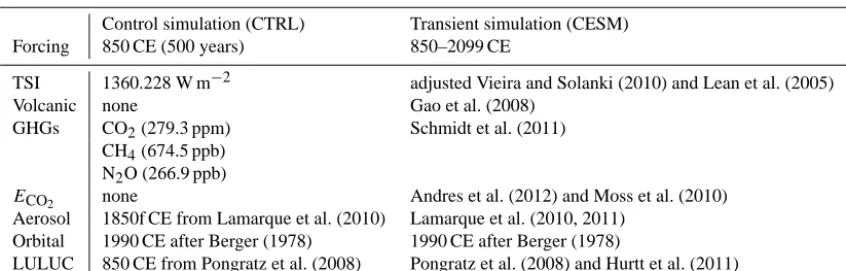
Table 1 provides an overview of the simulations conducted for this study. First, a 500-year control simulation with per-petual 850 CE forcing (hereafter CTRL) was branched off from an 1850 CE control simulation with CCSM4 (Gent et al., 2011). However, restart files for the land component were taken from an 850 CE control simulation, kindly pro-vided by the NCAR, in which the land use maps by Pon-gratz et al. (2008) were applied. This procedure has the ad-vantage that the slowly reacting soil and ecosystem carbon stocks are closer to 850 CE conditions than in the 1850 CE
0 100 200 300
Volcanic aerosol loading mass
0 2 4 6
−0.20 0.2 0.4
1000 1200 1400 1600 1800 2000 0
0.2 0.4
Time [Years CE] 1358
1360 1362 1364 1366
1368 TSI PMIP3 TSI this study
TSI [W/m
2]
[Tg
]
[W/
m
2]
Lan
d Fracti
on
(a) TSI CCSM4
Pasture Crop (c)
(b)
(d)
[W/
m
2]
CO2 CH4 N2O
RF wrt 850 CE
Figure 1.Forcings used in the last millennium simulation with CESM. (a) TSI in comparison with the different TSI reconstructions proposed by PMIP3. (b) Volcanic forcing as total volcanic aerosol mass. (c) Radiative forcing (RF, calculated according to IPCC, 2001) from the greenhouse gases CO2, CH4, and N2O. (d) Major
changes in land cover (as fraction of global land area). See text for details.
control simulation. A transient simulation covering the pe-riod 850–2099 CE was then branched off from year 258 of CTRL. Despite the shortness of CTRL leading up to the start of the transient simulation, most quantities of the surface cli-mate, such as air temperature, sea ice, or upper-ocean tem-perature, can be considered reasonably equilibrated at the start of the transient simulation, as the forcing levels due to total solar irradiance (TSI) and most greenhouse gases are similar between 1850 and 850 CE (Landrum et al., 2013). However, weak trends in CTRL are still detectable in slowly reacting quantities, such as deep-ocean temperature (below 2000 m; ∼ −0.04◦C 100 yr−1), Atlantic meridional over-turning circulation (∼ −0.22 Sv 100 yr−1), Antarctic
Cir-cumpolar Current (∼0.70 Sv 100 yr−1), dissolved inorganic
carbon in the ocean (∼ −0.01 % 100 yr−1), or soil carbon
storage (∼0.2 % C 100 yr−1). The Antarctic Bottom Water formation rate shows no drift.
Table 1.List of simulations conducted for this study. See text for details regarding the forcing. TSI: total solar irradiance; GHGs: greenhouse gases;ECO2: anthropogenic CO2emissions from fossil fuel burning and cement production; LULUC; land use and land use change.
Control simulation (CTRL) Transient simulation (CESM)
Forcing 850 CE (500 years) 850–2099 CE
TSI 1360.228 W m−2 adjusted Vieira and Solanki (2010) and Lean et al. (2005)
Volcanic none Gao et al. (2008)
GHGs CO2(279.3 ppm) Schmidt et al. (2011)
CH4(674.5 ppb) N2O (266.9 ppb)
ECO2 none Andres et al. (2012) and Moss et al. (2010)
Aerosol 1850f CE from Lamarque et al. (2010) Lamarque et al. (2010, 2011) Orbital 1990 CE after Berger (1978) 1990 CE after Berger (1978)
LULUC 850 CE from Pongratz et al. (2008) Pongratz et al. (2008) and Hurtt et al. (2011)
the TSI reconstruction by Vieira and Solanki (2010, TSIVS10)
is used, to which a synthetic 11-year solar cycle is added (Schmidt et al., 2011). In light of the recently enlarged enve-lope of reconstructed TSI amplitude (Schmidt et al., 2012), we scale TSI by a factor of 2.2635 to have an amplitude of 0.2 % between present day (1961–1990 CE) and the late Maunder Minimum (1675–1704 CE), which is about twice as large as the 0.1 % used in most PMIP3 simulations:
TSI=2.2635·(TSIVS10−TSIVS10)+TSIVS10. (1)
Figure 1a shows that the TSI used here lies in between the large-amplitude reconstruction by Shapiro et al. (2011) and the bulk of small-amplitude reconstructions of the original PMIP3 protocol (Schmidt et al., 2011). Note that a recent de-tection and attribution study indicates that small-amplitude TSI reconstructions agree better with temperature recon-structions over the last millennium than large-amplitude re-constructions (Schurer et al., 2014), in agreement with Am-mann et al. (2007). For the twenty-first century, the last three solar cycles of the data set are repeated continuously. The insolation due to Earth’s orbital configuration is calculated according to Berger (1978) with the orbital parameters held constant at 1990 CE values.
The volcanic forcing follows Gao et al. (2008) from 850 to 2001 CE. It provides estimates of the stratospheric sulfate aerosol loadings from volcanic eruptions as a function of lat-itude, altlat-itude, and month and is implemented in CESM as a fixed single-size distribution in the three layers in the lower stratosphere (Neale et al., 2010). Post-2001 CE volcanic forc-ing remains zero.
Land use and land use changes (LULUC) are based on Pongratz et al. (2008) from 850 to 1500 CE, when this data set is splined into Hurtt et al. (2011), a synthesis data set that extends into the future. The two data sets do not join smoothly but exhibit a small stepwise change in the distri-bution of crop land and pasture at the year 1500 CE. Up un-til about 1850 CE global anthropogenic LULUC are small; however, they can be significant regionally (Hurtt et al., 2011). Approaching the industrial era, LULUC accelerate,
dominated by the expansion of crop land and pasture. Here, only net changes in land use area are considered. The impact of shifting cultivation and wood harvest on carbon emissions from land use is neglected; these processes are estimated to have contributed around 30 % to the total carbon emissions from land use (Shevliakova et al., 2009; Houghton, 2010; Stocker et al., 2014).
The temporal evolution of long-lived greenhouse gases (GHGs; CO2, CH4, and N2O) is prescribed based on
esti-mates from high-resolution Antarctic ice cores that are joined with measurements in the mid-twentieth century (Schmidt et al., 2011, and references therein). While the carbon cycle
module of CESM interactively calculates the CO2
concen-tration originating in land use changes, fossil-fuel emissions (post-1750 CE, following Andres et al., 2012), and carbon-cycle–climate feedbacks, it is radiatively inactive. Instead, the ice core and measured data are prescribed in the radia-tive code, keeping the physical model as close to reality as possible. As a result, the impact of the interactive coupling of the carbon cycle module is minor for simulated climate and limited to changes in surface conditions due to changing vegetation. For the extension of the simulation post-2005 CE the Representative Concentration Pathway 8.5 (RCP 8.5) is used, representing the unmitigated “business-as-usual” emis-sion scenario, corresponding to a forcing of approximately 8.5 W m−2in the year 2100 (Moss et al., 2010).
Aerosols such as sulfate, black and organic carbon, dust, and sea salt are implemented as non-time-varying up to 1850 CE, perpetually inducing the spatial distributions of the 1850 CE control simulation during this time (Landrum et al., 2013). Post-1850 CE, the time-varying aerosol data sets pro-vided by Lamarque et al. (2010, 2011) are used, although CESM only includes a representation of direct aerosol ef-fects. Similarly, nitrogen (NHxand NOy) input is held
2.3 Other model simulations
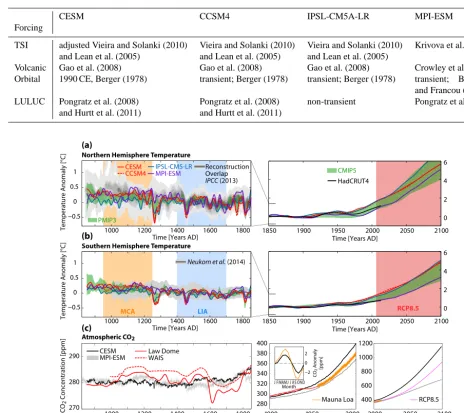
In addition to comparing CESM results to output from cur-rent Model Intercomparison Projects, we also compare them to results from a similar simulation with CCSM4 (Lan-drum et al., 2013) and IPSL-CM5A-LR (Institut Pierre Si-mon Laplace–climate model 5A–low resolution) (Sicre et al., 2013), two simulations without interactive carbon cycle. The solar and volcanic forcing reconstructions applied to CCSM4 and IPSL-CM5A-LR are identical to ours with the exception of the scaling of TSI that we applied to CESM. The goal here is to investigate the question of whether different solar forc-ing amplitudes applied to the same physical model (CESM vs. CCSM4) have a larger effect than applying the same so-lar forcing to two different physical models (IPSL-CM5A-LR vs. CCSM4).
Further, we compare CESM to MPI-ESM (Max-Planck-Institut Earth System Model) (ECHAM5/MPIOM; Jungclaus et al., 2010; Friedrich et al., 2012), a model that includes an interactive carbon cycle, to assess the robustness of the sim-ulated climate and carbon cycle variations in response to ex-ternal forcing. MPI-ESM uses Krivova et al. (2007) as TSI forcing and Crowley et al. (2008) as volcanic forcing. These differ from the CESM forcing in amplitude much more than in timing and therefore allow for a comparison of the forced response. All simulations, except for ours, apply transient orbital forcing and are summarized in Table 2. If not us-ing the full ensemble of MPI-ESM, we focus on the mem-ber “mil0021”. Another difference in terms of experimental setup between CESM and MPI-ESM is that MPI-ESM was run with a fully interactive carbon cycle, i.e., the prognostic CO2 interacts with the radiation and through that again
in-fluences climate, while in our setup this is a one-directional interaction only. Further, MPI-ESM is more coarsely re-solved than CESM in both ocean and atmosphere and ap-plies the A1B scenario for the twenty-first century (IPCC, 2000), which corresponds roughly to the current intermedi-ate scenario as compared to the high-scenario RCP8.5 used in CESM.
3 General climate and carbon cycle evolution
3.1 Temperature
The simulated annual mean Northern Hemisphere (NH) sur-face air temperature (SAT) follows the general evolution of proxy reconstructions: a warm Medieval Climate Anomaly
(MCA, ∼950–1250 CE), a transition into the colder Little
Ice Age (LIA, ∼1400–1700 CE), followed by the
anthro-pogenically driven warming of the nineteenth and twentieth centuries (Fig. 2). The NH MCA-to-LIA cooling amounts to 0.26±0.18◦C (taking the time periods defined above, which are as in Mann et al., 2009), placing it in the lower half of re-constructed amplitudes that range from about 0.1 to 0.7◦C (IPCC, 2013). The subsequent warming between 1851–
1880 CE and 1981–2010 CE amounts to 1.23±0.15◦C,
while observations report only 0.71±0.13◦C (Cowtan and
Way, 2014). This overestimation by CESM takes place al-most entirely after 1960 and arises largely from missing neg-ative forcing from the indirect aerosol effect, which is not implemented in CAM4 (Meehl et al., 2012). The late twen-tieth century being the warmest period in the NH in the past millennium is consistent with reconstructions (e.g., PAGES 2k network, 2013).
In CESM, the inception of the NH LIA occurs in con-cert with decreasing TSI and a sequence of strong volcanic eruptions during the thirteenth century. Reconstructions dif-fer substantially in this matter and start to cool as early as 1100 CE or as late as 1400 CE. Further, new regional multi-proxy reconstructions of temperature provide no support for a hemispherical or globally synchronous MCA or LIA but show a clear tendency towards colder temperatures and ex-ceptionally cold decades over most continents in the second half of the millennium (PAGES 2k network, 2013; Neukom et al., 2014).
The last millennium simulation with CCSM4 shows a largely coherent behavior with CESM in terms of amplitude and decadal variability in NH SAT (850–1850 CE correla-tion of 5-year filtered annual means r=0.88,p <0.001). The difference in NH SAT due to the different TSI ampli-tudes in CESM and CCSM4 scales roughly with the regres-sion slope of NH SAT vs. TSI of both CESM and CCSM4 (∼0.13◦C per W m−2), although internal variability can eas-ily mask this effect at times. For example, the Maunder Min-imum (1675–1704 CE), the 30-year period with the lowest TSI values and – when using TSI scaling – with the largest
difference between CESM and CCSM4 (1.5 W m−2), is only
0.14◦C cooler than in CCSM4 and not 0.20◦C as expected
from the regression.
Table 2.Selected forcing details of simulations used in comparisons with CESM. TSI: total solar irradiance; LULUC: land use and land use change.
CESM CCSM4 IPSL-CM5A-LR MPI-ESM
Forcing
TSI adjusted Vieira and Solanki (2010) Vieira and Solanki (2010) Vieira and Solanki (2010) Krivova et al. (2007) and Lean et al. (2005) and Lean et al. (2005) and Lean et al. (2005)
Volcanic Gao et al. (2008) Gao et al. (2008) Gao et al. (2008) Crowley et al. (2008)
Orbital 1990 CE, Berger (1978) transient; Berger (1978) transient; Berger (1978) transient; Bretagnon and Francou (1988)
LULUC Pongratz et al. (2008) Pongratz et al. (2008) non-transient Pongratz et al. (2008)
and Hurtt et al. (2011) and Hurtt et al. (2011)
Time [Years AD]
1000 1200 1400 1600 1800 −0.5
0 0.5
1
−0.5 0 0.5
1
Temperature Anomaly [°C]
Temperature Anomaly [°C]
Time [Years AD]
1000 1200 1400 1600 1800
Time [Years AD]
Time [Years AD]
MPI-ESM
CESM Law Dome WAIS
1850 1900 1950 2000 2050 2100 0 2 4 6 1850 1900 1950 2000 2050 2100 0 2 4 6
CESM
CCSM4 ReconstructionOverlap
IPCC (2013)
Neukom et al. (2014)
PMIP3
CMIP5
HadCRUT4
MCA LIA RCP8.5
Northern Hemisphere Temperature
Southern Hemisphere Temperature
IPSL-CM5-LR
MPI-ESM
270 280 290
CO
2
Concentratio
n [ppm]
Time [Years AD]
1000 1200 1400 1600 1800
Time [Years AD] Atmospheric CO2
(a)
(b)
(c)
1900 1950 2000 280
300 320 340 360 380 400
J FMAMJ J AS OND −2 0 2
CO
2
Anoma
ly
[ppm
]
Month
2000 2050 2100 400
600 800 1000 1200
Mauna Loa RCP8.5
Figure 2.(a) Northern Hemisphere and (b) Southern Hemisphere temperature anomalies in model simulations and reconstructions. The anomalies are with reference to 1500–1899 CE (left panels) and 1850–1899 CE (right panels). Gray shading in (a) indicates the reconstruc-tion overlap (IPCC, 2013); in (b), it indicates the reconstrucreconstruc-tion by Neukom et al. (2014). The 5–95 % range of the simulareconstruc-tions from the third Paleoclimate Modelling Intercomparison Project (PMIP3) and the fifth Coupled Model Intercomparison Project (CMIP5; applying the RCP8.5) are given in green and red shading, respectively. Note that MPI-ESM applies the A1B scenario (IPCC, 2000), which has a weaker forcing than RCP8.5. Hemispheric means from observations are shown as thick black line (Cowtan and Way, 2014). All time series have been smoothed by a local regression filter which suppresses variability higher than 30 years. The Medieval Climate Anomaly (MCA) and the Little Ice Age (LIA) are indicated as defined in Mann et al. (2009). (c) Evolution of atmospheric CO2in CESM (black), MPI-ESM (grey; ensemble range), from ice cores (red), from measurements (orange), and from RCP8.5 used to force the radiative code in CESM (magenta). The small inset in the middle panel shows the observed annual cycle at Mauna Loa, Hawaii, and a 2◦×2◦average over Hawaii from CESM, both derived from the period 1958–2012.
methods. As many proxy reconstructions of temperature rely heavily on tree ring data, it is worth noting that the den-drochronology community is currently debating whether the trees’ response to volcanic eruptions resembles the true
mag-nitude of the eruption (Mann et al., 2012; Anchukaitis et al., 2012; Tingley et al., 2014).
simula-418 420 422 424
Solar Insolation [W m
−2]
900 1000 1100 1200 1300 1400 1500 1600 1700 1800 −4
−2 0 2 4
Temperature Difference [°C]
Time [Years CE]
418 419 420 421 422 423−0.5 −0.4 −0.3 −0.2 −0.1 0 0.1 0.2 0.3 0.4 0.5
Temperature Anomaly wrt 850-1850 CE [°C]
Solar Insolation [W m−2] ΔT(t) = 0.000071 yr–1 . t + 0.15 °C
Arctic (>60 °N land) June-August Temperature CCSM4–CESM Arctic (>60 °N land) June-August Solar Insolation
CCSM4
CESM
CCSM4 CESM
100 yr
200 yr
100 yr 200 yr
Arctic (>60 °N land) June-August Means (a)
(b)
(c)
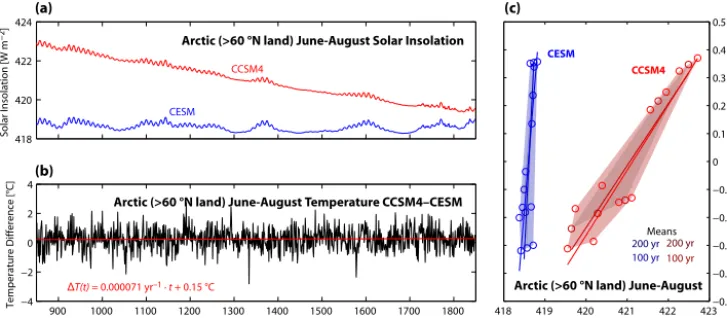
Figure 3.(a) Mean June–August (JJA) Arctic (>60◦N land) solar insolation in CCSM4 with time-varying orbital parameters and CESM with fixed orbital parameters. (b) Arctic JJA temperature difference between CCSM4 and CESM. The least-squares linear trend of this temperature difference is given in red. (c) Arctic JJA temperature anomalies (from their 850 to 1850 AD mean) versus solar insolation as 100- and 200-year averages (10 and 5 circles, respectively) from CCSM4 and CESM (red and blue, respectively). The least-squares linear trend for each cloud of 100- and 200-year averages is given in the respective color. The shading envelops the range of temperature versus solar insolation for each cloud of means.
tion by IPSL-CM5A-LR applied the same TSI and volcanic forcing as CCSM4, yet it comes to lie at the lower end of the PMIP3 model range during the MCA. In other words, the way in which models respond to variations in TSI and other forcings can still make a larger difference in the sim-ulated amplitude than the scaling of TSI by a factor of 2, which in turn complicates a proper detection and attribution of solar forcing during the last millennium (Servonnat et al., 2010; Schurer et al., 2014). Further disagreement among the models exists on the response to volcanic eruptions, where CESM and CCSM4 are among the more sensitive models (an oversensitivity of CCSM4 to volcanoes based on twentieth-century simulations was reported by Meehl et al., 2012). Turning to the century-scale change over the industrial era, CESM and CCSM4 are at the upper end of the CMIP5 range and show an overestimation of the observed warming.
The simulated mean SAT of the Southern Hemisphere (SH) generally shows a similar evolution as in the NH, with the signature of the MCA and LIA superimposed on a weak millennial cooling trend. Models and reconstructions dis-agree to a larger extent in the SH than in the NH, in par-ticular regarding cold excursions due to large volcanic erup-tions, which are largely absent in the reconstructions. Similar results have been reported in a recent study on interhemi-spheric temperature variations that finds much less phasing of the two hemispheres in reconstructions than in models, potentially related to underestimated internal variability on the SH in models (Neukom et al., 2014). A lingering ques-tion of climate modeling in general is whether models are too global in their response to external forcing. That is, they might show too little regional variability that is independent of the global mean response during a forced period. However, the uncertainties in the early period of the reconstructions
make it impossible to robustly answer this question. Simi-lar to the NH, the industrial warming in the SH from 1851– 1880 to 1981–2010 CE (0.53±0.07◦C) is overestimated by
CESM (0.71±0.13◦C).
The differential warming between the hemispheres in CESM is among the smallest among CMIP5 models (not shown). This is mainly due to the underestimated deep-water formation in the Southern Ocean, leading to a compara-bly strong warming of the SH and likely an underestima-tion of the oceanic uptake of anthropogenic carbon (Long et al., 2013). With a transient climate response of 1.73◦C and an equilibrium climate sensitivity of 3.20◦C (Meehl et al., 2012), CESM lies in the middle of recent estimates of 1.0 to 2.5◦C and 1.5 to 4.5◦C (IPCC, 2013).
3.2 Orbital forcing
non-overlapping 100- and 200-year mean SAT anomalies plotted against the corresponding mean solar insolation. The results from CCSM4 suggest a clear relationship between of the two quantities; however, the results of CESM show that nearly identical SAT anomalies are possible without orbital forcing. In other words, while we detect a long-term cooling trend in Arctic summer SAT in both CESM and CCSM4, we fail to attribute this trend to orbital forcing alone, as suggested by Kaufman et al. (2009). This is confirmed in new simulations with decomposed forcing, again comparing simulations with fixed and time-varying orbital parameters (B. Otto-Bliesner, personal communication, 2014).
3.3 Carbon cycle
The prognostic carbon cycle module in CESM allows us to study the response of the carbon cycle to transient external forcing. The land biosphere is a carbon sink during most of the first half of the last millennium, but becomes a source as anthropogenic land cover changes start to have a large-scale impact on the carbon cycle (Table 3). The ocean is a carbon source at the beginning and becomes a sink in the second half of the last millennium. The residual of these fluxes represents changes in the atmospheric reservoir of carbon, illustrated in Fig. 2c by the prognostic CO2concentration. The
ampli-tude of the simulated concentration does not resemble the one reconstructed from ice cores (i.e., imposed on the radia-tive code of CESM); in particular, the prominent CO2drop in
the seventeenth century is not captured by CESM. This raises the question of whether the sensitivity of the carbon cycle to external forcing is too weak in CESM, whether the imposed land use changes are too modest (Kaplan et al., 2011; Pon-gratz et al., 2011), whether major changes in ocean circula-tion are not captured by models (Neukom et al., 2014), and whether the ice core records are affected by uncertainties due to in situ production of CO2 (Tschumi and Stauffer, 2000).
Ensemble simulations with MPI-ESM also do not reproduce the reconstructed amplitudes or the drop (Jungclaus et al., 2010). Further, Earth system models of intermediate com-plexity or vegetation models driven by GCM (general circu-lation model) output do not reproduce the uptake of carbon by either ocean or land needed to explain the reconstructed amplitudes (Stocker et al., 2011; Gerber et al., 2003).
The rise in atmospheric CO2due to fossil-fuel combustion
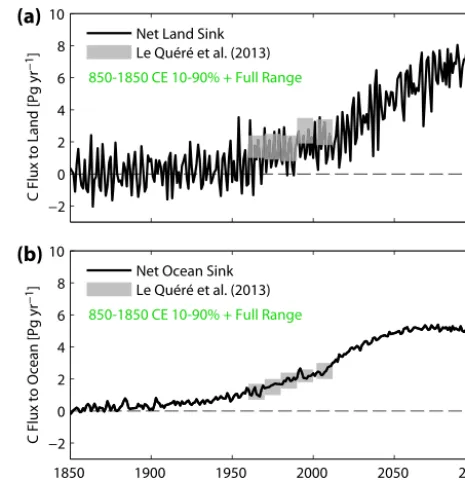
is in good agreement with ice cores until about the 1940s. After that, a growing offset exists, leading to an overestima-tion of about 20 ppm by 2005 in CESM, qualitatively simi-lar to the CMIP5 multi-model mean (Hoffman et al., 2014). From the observational estimates one can diagnose that the discrepancy arises primarily from overestimated carbon re-lease from land (Fig. 4a; see also Hoffman et al., 2014; Lindsay et al., 2014). From 1750 to 2011 CE the cumula-tive total land release (including LULUC) is 83 Pg C
(com-pared to 30±45 Pg C from observational estimates; Ciais
et al., 2013), while the cumulative net land uptake is 95 Pg C
−2 0 2 4 6 8 10
C Flux to Land [Pg yr
−1
]
Net Land Sink
Le Quéré et al. (2013)
1850 1900 1950 2000 2050 2100
−2 0 2 4 6 8 10
C Flux to Ocean [Pg yr
−1
]
Time [Years CE] Net Ocean Sink
Le Quéré et al. (2013) 850-1850 CE 10-90% + Full Range (a)
(b)
850-1850 CE 10-90% + Full Range
Figure 4.Annual mean net carbon flux from the atmosphere to (a) land and (b) ocean. Green bars given the full and 10–90 % range from the preindustrial part of the simulation. Observational esti-mates are from Le Quéré et al. (2013).
(160±90 Pg C; Ciais et al., 2013). The ocean cumulative up-take of 151 Pg C compares more favorably to current esti-mates of 155±30 Pg C (Ciais et al., 2013). Note, however, that given the overestimation of atmospheric CO2, one would
expect a higher ocean uptake. This bias originates largely in an underestimation of the uptake in the Southern Ocean (Long et al., 2013). Along with this goes an underestimated seasonal cycle in CESM, originating from too weak a grow-ing season net flux in CLM4 (Keppel-Aleks et al., 2013). MPI-ESM, on the other hand, underestimates atmospheric
CO2 due to weak emissions from LULUC (Pongratz et al.,
2008).
The twenty-first century sees substantial emissions from fossil-fuel burning under RCP8.5 (Fig. 2c). In addition, LU-LUC is associated with a positive flux into the atmosphere, particularly until around 2050 CE (Table 3). After account-ing for LULUC (which constitutes a carbon loss for land) the net land sink increases to about 7 Pg C yr−1at the end of the twenty-first century (Fig. 4a). The rate of ocean uptake, on the other hand, peaks around 2070 at about 5 Pg C yr−1,
despite the fact that atmospheric CO2 continues to rise
(Fig. 2c). This decoupling of the trends in atmospheric CO2
growth and ocean uptake flux is linked to nonlinearities in the carbon chemistry (Schwinger et al., 2014). The change in dissolved inorganic carbon per unit change in the par-tial pressure of CO2 decreases with increasing CO2, and
Table 3.Cumulative carbon emissions in Pg C by different components over different time periods in CESM. Positive (negative) values indicate emission to (uptake from) the atmosphere.
850–1500 CE 1501–1750 CE 1751–2011 CE 2012–2100 CE
Ocean 26.0 −4.0 −151.3 −413.0
Land −15.0 10.3 82.5 139.4
Land (without LULUC) −24.4 −9.3 −94.7 −436.3
Fossil Fuels 0.0 0.0 358.0 1851.5
the deep ocean likely play a role. While the surface ocean and the thermocline exchanges carbon on annual-to-multi-decadal timescales with the atmosphere, it takes a century to ventilate the deep ocean, as evidenced by chlorofluoro-carbon and radiochlorofluoro-carbon data (Key et al., 2004; Wunsch and Heimbach, 2007, 2008). CESM has a documented low bias in Southern Ocean ventilation due to too shallow mixed layer depths, contributing to the underestimated carbon uptake of the ocean (Long et al., 2013).
The prognostic atmospheric CO2 increases to 1156 ppm
by 2100 CE. This would imply a forcing of 7.6 W m−2from
CO2relative to 850 CE, significantly more than the
approx-imately 6.5 W m−2 that are imposed by the radiative code
(calculated according to IPCC, 2001, see also Fig. 1c). This propagation of the twentieth-century bias is consistent with the CMIP5 multi-model mean (Friedlingstein et al., 2014) and has motivated attempts to reduce such biases by using observational constraints for ocean ventilation (Matsumoto et al., 2004), the tropical land carbon storage sensitivity to temperature variations (Cox et al., 2013; Wenzel et al., 2014; Wang et al., 2014), and the oceanic and terrestrial carbon fluxes (Steinacher et al., 2013). CESM with CLM4, however, shows very little sensitivity to tropical land carbon, in part due to the inclusion of an interactive nitrogen cycle, which – through enhanced photosynthetic uptake due to nitrogen fertilization – tends to counteract accelerated soil decompo-sition from warming (Lawrence et al., 2012; Wenzel et al., 2014). Together with the underestimated oceanic uptake, this leads to the roughly 20 % larger airborne fraction in CESM as compared to what is actually prescribed as atmospheric concentration in the radiative code according to the RCP8.5. Figure 4 places the current and projected changes within the context of preindustrial variability. Estimated interannual variability prior to 1750 CE is ±0.94 Pg C yr−1 (1 standard deviation) for the net atmosphere–land and±0.42 Pg C yr−1
for the net atmosphere–ocean flux. The much larger inter-annual variability in land than ocean flux is consistent with independent estimates and results from other models (e.g., Ciais et al., 2013). Large volcanic eruptions, as they have occurred in the last millennium, cause anomalously high up-take rates that, for a short period of time, are on par with current uptake rates (Fig. 4a and b, full range). We esti-mate when the anthropogenically forced, global mean land and ocean uptake fluxes exceeds the envelope of
preindus-trial natural variability (Hawkins and Sutton, 2012; Keller et al., 2014). As a threshold criteria, it is required that the decadally smoothed uptake fluxes are larger than the upper bound of 2 standard deviations of the annual fluxes prior to 1750 CE. In that case, the simulated global mean land and ocean uptake fluxes have emerged from natural interannual variability by 1947 CE and by 1877 CE, respectively. The
prognostic atmospheric CO2concentration emerges already
in 1755 CE, while the simulated global mean temperature does not emerge until 1966 CE.
4 Model–model coherence
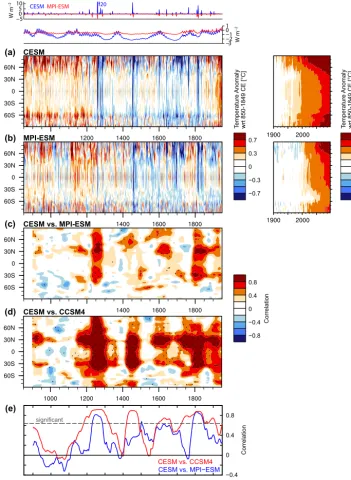
A classical approach to assess the robustness of model results is to rely on the multi-model mean response to a given forc-ing (IPCC, 2013). However, as there are only very few last millennium simulations with comprehensive Earth system models to date, this approach is not feasible for investigating the decadal-scale climate–carbon-cycle responses to external forcing in the period before 1850 CE. Instead, we estimate periods of forced variability with a 100-year running-window correlation of CESM and MPI-ESM, indicating phasing of the two models. The time series are anomalies from their 850–1849 mean and are smoothed with a 5-year local regres-sion filter before calculating the correlation. Thereby, we fo-cus on the preindustrial period, as the twentieth and twenty-first centuries are dominated by anthropogenic trends, which are nontrivial to remove for a proper correlation analysis. In addition, regression analysis is used.
4.1 Temperature
0.8
0.4
0
−0.4
−0.8
Correlation
Correla
tion
0.7
0.3
0
−0.3
−0.7
Te
m
perature
Ano
mal
y
wrt 850-18
49 CE
[°C]
5 3 1 0.5 0 −0.5 −1 −3 −5
Te
m
perature
Ano
mal
y
wrt 850-18
49 CE
[°C]
(a)
(b)
(c)
(e)
Time [Years CE] CESM
MPI-ESM
CESM vs. MPI-ESM
CESM vs. CCSM4 (d)
significant 0.8
0.4
0
−0.4 CESM vs. MPI−ESM CESM vs. CCSM4
−50 5 10
−3 −2 −1 0 1
W m
−2
W m
−2 CESM MPI-ESM 20
Figure 5.Five-year filtered zonal mean anomalies of surface air temperature (SAT), relative to the 850–1849 CE mean from (a) CESM and (b) MPI-ESM. (c) 100-year running-window correlation of zonal mean SAT from CESM and MPI-ESM. A 0.75 Tukey window has been applied to the data before correlation to weaken sharp transitions. Stippling indicates significance (5 % level), taking into account autocorrelation estimated from the entire time period. Panel (d): as (c) but for the correlation of CESM with CCSM4. Panel (e): as (d) but for global mean SAT. Small inset on top shows volcanic and solar forcing of CESM and MPI-ESM. Volcanic forcing of CESM scaled to have the same radiative forcing as MPI-ESM for Pinatubo in 1991 CE. Solar forcing relative to 1850 CE.
global and are able to considerably cool the SH extra-tropics
around 60◦S, while in MPI-ESM the SH extra-tropics are
only weakly affected. These differences are likely related to the Southern Ocean heat uptake rates in the two models (aris-ing from under- and overestimation of Southern Ocean mixed layer depths in CESM and MPI-ESM, respectively;
els (not shown), a behavior common to most PMIP3 mod-els. Note, however, that a recent reconstruction of the SAM finds the models to lack amplitude in their simulated variabil-ity, challenging the models’ capabilities to represent SAM (Abram et al., 2014).
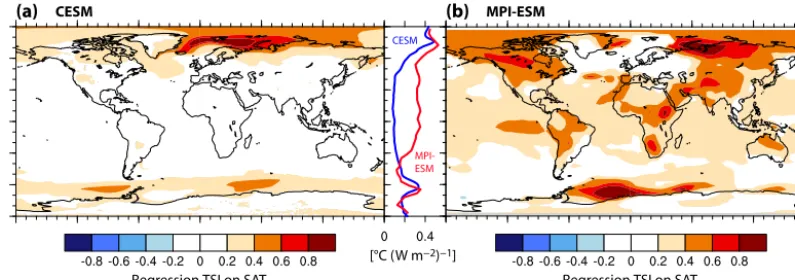
The phasing on interannual to decadal scales between the two models is largely restricted to periods of volcanic activ-ity and, within those, mainly to land-dominated latitudes (ex-cept Antarctica, which shows no forced variability on these timescales; Fig. 5c). Despite the largest absolute tempera-ture anomalies occurring in the Arctic, the correlations are highest in the subtropics, due to the smaller interannual vari-ability there. Periods of centennial trends, such as the MCA or the Arctic cooling during the Maunder Minimum around 1700 CE, do not show up in the correlation analysis that fo-cuses on 100-year windows, suggesting that multi-decadal low-frequency forcing, such as centennial TSI trends, or in-ternal feedback mechanisms are responsible for the missing correlation. A regression analysis between the 5-year filtered annual TSI and SAT at each grid point (different filter lengths of up to 50 years have been tested as well without the re-sults changing) reveals a clear link between the two quanti-ties at high latitudes. In CESM this link seems to be driven primarily by a displacement of the sea ice edge (Arctic) and Southern Ocean heat uptake (Fig. 6a). As the sea ice response has not been detected in an earlier model version (Ammann et al., 2007, their Fig. 4), it warrants the question of whether the regression of SAT on TSI might be biased by imprints of volcanoes (Lehner et al., 2013), even when the time se-ries are filtered, especially in a model like CESM that has a very strong volcanic imprint. Forthcoming simulations with solar-only forcing will be able to answer that question. MPI-ESM, on the other hand, shows a similar polar amplification signal from solar forcing but is not as clearly linked to sea ice (Fig. 6b). MPI-ESM also displays a stronger land–ocean contrast than CESM (see also Geoffroy et al., 2015).
In addition to the comparison with MPI-ESM, Fig. 5d shows results from the correlation analysis between CESM and CCSM4, two simulations that in terms of physics differ only in their applied TSI amplitude and orbital parameters. Not unexpectedly, there are generally more robust signals of forced variability as compared to CESM vs. MPI-ESM (Fig. 5c), very likely due to the identical physical model components in CESM and CCSM4. Similarly, global mean SAT shows generally stronger phasing between CESM and CCSM4 (Fig. 5e). However, the latitudinal and temporal pat-tern of the CESM vs. CCSM4 analysis agrees well with the one arising from CESM vs. MPI-ESM (Fig. 5c; with excep-tion of the much stronger phasing in CESM and CCSM4 dur-ing the volcanic eruptions in the 1450s) and suggests that the physical mechanism behind periods of phasing is robust across the two models.
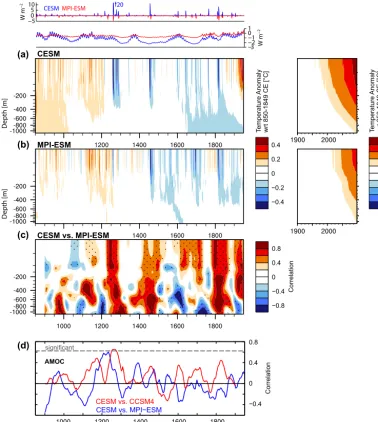
Applied to ocean temperature, the above approach enables us to investigate the penetration depth of a forced signal seen at the surface (Fig. 7). Indeed, most of the surface signals
also show up as significant correlations down to depths of about 150–200 m, and their timing again suggests volcanic forcing as the origin. Reduced heat loss from the tropical equatorial Pacific together with reduced heat uptake at high latitudes are responsible for ocean cooling after volcanoes (not shown). The Atlantic Meridional Overturning Circula-tions (AMOC) in the CESM and MPI-ESM shows no sig-nificant correlation; however, the highest correlation occurs during the thirteenth century and coincides with a phasing of the upper-ocean temperatures due to strong volcanic forc-ing (Fig. 7d). The correlation between CESM and CCSM4 at that time is even higher and points to a significant imprint of the volcanic forcing on ocean circulation (Otterå et al., 2010; Swingedouw et al., 2013, 2015). However, during the remainder of the millennium, no phasing of the AMOC is found.
4.2 Carbon cycle
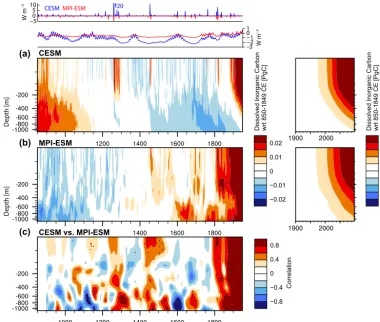
We apply the same correlation analysis to zonally integrated land and ocean carbon fluxes from the two models to de-tect forced variability in the carbon cycle. Compared to SAT hardly any phasing can be found between the models in atmosphere-to-land carbon fluxes (not shown), which is due to its large interannual variability and to distinctly different responses to external forcing in the two models, as will be il-lustrated in Sect. 5. Similarly, there is little model phasing in net atmosphere-to-ocean carbon fluxes (not shown). Results become somewhat clearer when considering globally inte-grated upper-ocean dissolved inorganic carbon (DIC; Fig. 8). There appear to exist spurious trends in CESM, likely re-lated to model drift. We repeated the analysis, but with the CESM output detrended in each grid cell by subtracting the CTRL over the corresponding period 850–1372 CE. Due to the shortness of CTRL, we cannot apply this method to the whole simulation. However, these tests showed that the cor-relation between the two simulations is largely insensitive to the drift in CESM. In Fig. 8c there are periods of coherent carbon drawdown coinciding with volcanic eruptions around 1450 and 1815 CE in response to temperature-driven solu-bility changes. Interestingly, MPI-ESM shows a distinct be-havior for the strong eruption of 1258 CE, with a prolonged ocean carbon loss after a weak initial uptake. CESM shows a stronger and more sustained carbon uptake, leading to no correlation between the two models for this eruption. The reasons for this discrepancy are discussed in Sect. 5.
to-[°C (W m−2)−1]
Regression TSI on SAT Regression TSI on SAT
CESM MPI-ESM
CESM
MPI-ESM
(a) (b)
Figure 6.Regression of total solar irradiance (TSI) on surface air temperature (SAT) for the period 850–1850 CE in (a) CESM and (b) MPI-ESM. Time series at each grid point have been 5-year-filtered. Only significant regression coefficients at the 5 % level are shown. The small panel shows zonal means.
tal ocean carbon uptake than in MPI-ESM (not shown). In MPI-ESM, the Southern Ocean shows stronger variability and larger carbon uptake in the twenty-first century, illus-trating the different behavior of the two models in terms of ocean carbon cycle variability and trend magnitude, closely related to the different mixed layer depths in the Southern Ocean region.
5 Volcanic forcing
To further isolate the response of the climate system and car-bon cycle to volcanic eruptions, a superposed epoch analysis is applied to both simulations. Thereby, composite time se-ries for the strongest three (top3) and subsequent strongest seven eruptions (top10), according to optical depth anomaly, over the period 850–1850 CE are calculated for the CESM and MPI-ESM (Fig. 9). The time series are calculated as de-seasonalized monthly anomalies from the 5 years preceding an eruption.
The physical parameters’ global mean surface air temper-ature and global mean precipitation decrease in both models after volcanic eruptions, although the response of CESM is stronger by roughly a factor of 2–2.5 (Fig. 9a, b, f, g). Con-sequently, CESM temperature and precipitation take longer (∼15 years) to relax back to pre-eruption values than MPI-ESM (∼9 years).
The atmospheric carbon inventory, on the other hand, shows a remarkably different response in the two models. In CESM the atmosphere initially looses about 2–3 Pg C, ir-respectively of the eruption strength, with the minimum oc-curring after about 1–2 years. In the top10 case, values re-turn to normal after about 16 years, while in the top3 case, they tend to return already after about 6 years and overshoot. This overshoot is not straightforward to understand and did not seem to occur in earlier versions of the model (Frölicher et al., 2011; Rothenberg et al., 2012). In MPI-ESM the re-sponse is a priori more straightforward and slower: in the
top10 case the atmosphere looses about 2.5 Pg C, reaches a minimum after 2–4 years, and returns to pre-eruption val-ues after 10–16 years. The top3 case reaches its minimum (−6 Pg C) a bit faster, but then takes about 20 years to return to pre-eruption values (Brovkin et al., 2010).
Partitioning these atmospheric carbon changes into land and ocean changes indicates that land is primarily respon-sible for the differing response behavior of the two models, confirming the findings in the previous section. While in both models, land drives the atmospheric change by taking up car-bon initially, it is released back to the atmosphere within about 3 years in CESM but retained in land areas for at least 15 years in MPI-ESM (and up to 50 years for the 1258 CE eruption; Brovkin et al., 2010). In the top3 case of CESM the land starts to even loose carbon after about 5 years, causing the overshoot seen in the atmospheric carbon.
AMOC
0.4
0.2
0
−0.2
−0.4
Te
m
perature
Ano
mal
y
wrt 850-18
49 CE
[°C]
3
1
0
−1
−3
Te
m
perature
Ano
mal
y
wrt 850-18
49 CE
[°C]
(a)
(b)
(c) CESM
MPI-ESM
CESM vs. MPI-ESM
0.8
0.4
0
−0.4
−0.8
Correla
t
i
on
De
p
th
[m]
De
p
th
[m]
(d)
Correla
t
i
on
significant 0.8
0.4
0
−0.4 CESM vs. MPI−ESM
CESMvs. CCSM4
Time [Years CE] −50
5 10
−3 −2 −1 0 1
W m
−2
W m
−2 CESM MPI-ESM 20
Figure 7.Five-year-filtered zonal mean anomalies of horizontally averaged ocean temperature, relative to 850–1849 CE from (a) CESM and (b) MPI-ESM. Panel (c): 100-year running-window correlation of zonal mean SAT from CESM and MPI-ESM. A 0.75 Tukey window has been applied to the data before correlation to weaken sharp transitions. Stippling indicates significance at the 5 % level, taking into account autocorrelation estimated from the entire time period. Panel (d): 100-year running-window correlation of the Atlantic meridional overturning circulation (AMOC) in CESM and MPI-ESM.
While vegetation decrease and dead biomass buildup balance each other, the soil takes up about 2 Pg C (Fig. 10c), stores it for at least 16 years, and is therefore responsible for the ini-tial net land uptake seen in Fig. 9e (see also the left section of Fig. 11c). After about 2 years, tropical precipitation in-creases again and puts a halt to the decrease in vegetation (Figs. 10a and 11b right). The vegetation does not recover fully for about another 20 years. The dead biomass, on the other hand, gets decomposed entirely within about 15 years and therefore turns land into a carbon source, causing the overshoot in CO2. In the top10 case, the precipitation and
ra-diation response is about half of the top3 case and so is the
0.02
0.01
0
−0.01
−0.02
Dis
solved
Inorgan
ic
Carbon
wrt 850-18
49 CE
[PgC]
0.4
0.2
0
−0.2
−0.4
Dis
solved
Inorgan
ic
Carbon
wrt 850-18
49 CE
[PgC]
(a)
(b)
(c) CESM
MPI-ESM
CESM vs. MPI-ESM
0.8
0.4
0
−0.4
−0.8
Correla
tion
De
p
th
[m]
De
p
th
[m]
Time [Years CE] −50
5 10
−3 −2 −1 0 1
W m
−2
W m
−2 CESM MPI-ESM 20
Figure 8.Five-year filtered zonal mean anomalies of horizontally integrated dissolved inorganic carbon (DIC), relative to 850–1849 CE, from (a) CESM and (b) MPI-ESM. Panel (c): 100-year running-window correlation of zonal mean SAT from CESM and MPI-ESM. A 0.75 Tukey window has been applied to the data before correlation to weaken sharp transitions. Stippling indicates significance at the 5 % level, taking into account autocorrelation estimated from the entire time period.
(Frölicher et al., 2011): tropical Africa sees a reduction in land carbon in CESM, related to a persistent increase in cloud cover and precipitation after volcanoes, while CSM1.4 car-bon saw a decrease in precipitation and an increase in land carbon.
The ocean, on the other hand, shows a qualitatively similar response in CESM and MPI-ESM with an uptake of carbon and a gradual relaxation back to pre-eruption values over 20 or more years. In CESM the radiative cooling leads to in-creased uptake in the Western Pacific, while in the Eastern Pacific, cooling is less as this region is more controlled by upwelling rather than direct radiative forcing, as suggested by Maher et al. (2014) (Fig. 11d). Two or more years after the volcano, a La Niña-like pattern settles in both surface temperature as well as carbon uptake. Some model differ-ences exist; e.g., in the top3 case of MPI-ESM, the ocean starts to release carbon, compensating for the persistent pos-itive anomaly in the land inventory (imposed on the ocean
via atmospheric CO2 concentration; Brovkin et al., 2010),
a feature not present in CESM, in which the land does not store the anomalous carbon for as long. In CESM the tropical
oceans appear to be more sensitive to volcanic forcing than to TSI variations. The equatorial Pacific shows the strongest response in DIC to volcanoes (Fig. 11d), while the response to TSI variations of comparable radiative forcing is up to 1 order of magnitude weaker and confined to higher latitudes (not shown). Overall, it seems, therefore, that the response of the land vegetation governs the overall different responses in the two models.
In an attempt to validate the two models, one is restrained to the well-observed eruption of Pinatubo in 1991 CE, as
the CO2 records from ice cores do not adequately resolve
short-term variations induced by volcanoes over the last mil-lennium. Figure 12 shows the global temperature and atmo-spheric carbon response to Pinatubo as extracted from ob-servations, CESM, and the three-member ensemble of MPI-ESM. Note that the effects of El Niño–Southern Oscillation and anthropogenic emissions have been removed from the CO2 observations to obtain a tentative estimate of the
ac-tual CO2response to the Pinatubo eruption (Frölicher et al.,
cap-∆ Surface temperature [°C] ∆Precipitation [mm/day] ∆Atmospheric C [Pg C; ppm CO2] ∆Ocean C [Pg C] ∆Land C [Pg C]
MPI
-ESM
CES
M
(a) (b) (c) (d) (e)
(f) (g) (h) (i) (j)
0 2 4 6 8 10121416
−3
−2.5
−2 −1.5 −1 −0.5 0 0.5 1
0 24 6 8 10 1214 16
−0.25
−0.2 −0.15 −0.1 −0.05 0 0.05
Time [Yearssince eruption]
02 4 6 8 10 1214 16
−6 −4 −2 0 2 4 6 −3 −2 −1 0 1 2 3
02 4 6 8 10 1214 16
−6 −4 −2 0 2 4 6
02 4 6 8 10 1214 16
−6 −4 −2 0 2 4 6
0 24 6 8 10 1214 16
−3
−2.5
−2 −1.5 −1 −0.5 0 0.5 1
0 24 6 8 10 1214 16 −0.25
−0.2 −0.15 −0.1 −0.05 0 0.05
Time [Yearssince eruption]
02 4 6 8 10 1214 16
−6 −4 −2 0 2 4 6 −3 −2 −1 0 1 2 3
02 4 6 8 10 1214 16
−6 −4 −2 0 2 4 6
02 4 6 8 10 1214 16
−6 −4 −2 0 2 4 6
Top 10
Top 3
Top 10
Top 3
Figure 9.Superposed epoch analysis of the strongest three (top3) and subsequent strongest seven eruptions (top10) of the period 850– 1850 CE in (a–e) CESM and (f–j) MPI-ESM for (a, f) global mean surface air temperature, (b, g) global mean precipitation, (c, h) atmo-spheric carbon given in Pg C on the leftyaxis and in ppm CO2on the rightyaxis, (d, i) ocean carbon, and (e, j) land carbon. Time series
are deseasonalized and calculated as anomalies to the mean of the preceding 5 years. The shading shows the 10–90 % range.
∆ Vegetation [Pg C]
0 2 4 6 8 10 12 14 16
−10 −5 0 5
∆ Dead Biomass [Pg C]
0 2 4 6 8 10 12 14 16
−10 −5 0 5
∆ Soil Carbon [Pg C]
0 2 4 6 8 10 12 14 16
−10 −5 0 5
∆ Incident Solar Radiation [W m−2]
0 2 4 6 8 10 12 14 16
−60 −40 −20 0 20 40 60
∆ NPP [Pg C yr−1]
0 2 4 6 8 10 12 14 16
−50 0 50
0 2 4 6 8 10 12 14 16
−20 −10 0 10 20 Time [Years since eruption]
Time [Years since eruption]
∆Fire Loss [Pg C]
Top 10
Top 3
(a) (b) (c)
(d) (e) (f)
0-1 years after eruption 2-4 years after eruption
Surface Air Temperature [°C]
Precipitation [mm day−1]
Land Carbon [Pg C m−2]
DIC in top 200 m [Pg C m−2]
(a)
(b)
(c)
(d)
Shading = significant
Stippling = significant
Stippling = significant
Shading = significant
Figure 11.Composites of top10 post-volcanic eruption years as anomalies from the preceding 5 years, averaged over (left) the first 2 years starting with the year of the eruption and (right) the following 3 years. (a) Surface air temperature, (b) precipitation, (c) total land carbon, (d) dissolved inorganic carbon (DIC) integrated over the top 200 m. Shading or stippling indicates significance at the 5 % level. Note that for land carbon in an individual grid cell hardly any significant changes are detected due to the large interannual variability.
tured well by both models. The MPI-ESM ensemble, how-ever, shows a large and consistent variation around 1995 CE, seemingly related to a phasing of El Niño–Southern Oscil-lation (ENSO) variability in response to the eruption (see also Zanchettin et al., 2012). Further, the magnitude of atmo-spheric carbon response matches better in CESM, although the overshoot of the observation-based estimate is not cap-tured. CESM’s response also falls within the range of the
earlier model version (Frölicher et al., 2013). It remains un-clear whether this mismatch reflects a model deficiency or is due to uncertainties arising from removing the ENSO signal
from the CO2 observations. However, the mechanisms
de-scribed above that lead to an atmospheric CO2overshoot for
1990 1992 1994 1996 1998 2000 2002 −1
−0.5 0 0.5 1
Time [Years CE]
1990 1992 1994 1996 1998 2000 2002 −6
−4 −2 0 2 4
Time [Years CE]
−3 −2.5 −2 −1.5 −1 −0.5 0 0.5 1 1.5
∆ Surface temperature [°C] [Pg C] ∆ Atmosphericcarbon [ppm]
a) b)
MPI CESM1 Observations
Figure 12. Global mean changes in response to Pinatubo. (a) Global mean surface air temperature and (b) atmospheric car-bon, as (left y axis) Pg C and (right y axis) ppm CO2equivalent,
both deseasonalized and linearly detrended over 30 years centered on June 1991; temperature observations were corrected for El Niño– Southern Oscillation and other dynamical components (Thomp-son et al., 2009); CO2observations were corrected for El Niño–
Southern Oscillation and anthropogenic emissions (Frölicher et al., 2013).
eruptions is not well constrained due to the small number of observed eruptions (Trenberth and Dai, 2007). Biases in the representation of these processes can influence a model’s carbon cycle response.
6 Climate–carbon-cycle sensitivity
Due to the absence of large anthropogenic disturbances of the carbon cycle, the last millennium represents a test bed to estimate the climate–carbon-cycle sensitivity, expressed as ppm◦C−1, and can thus potentially help to constrain this
quantity (e.g., Woodwell et al., 1998; Joos and Prentice, 2004; Scheffer et al., 2006; Cox and Jones, 2008; Frank et al., 2010). Note, however, that there exist important dif-ferences between studies in how this sensitivity is calculated and what it implies. Studies using observations and fully cou-pled simulations (Frank et al., 2010; Jungclaus et al., 2010) estimate the sensitivity from the ratio of changes in CO2to
changes in temperature. This quantity incorporates feedbacks into the response as the initial sensitivity of the carbon cycle to climate change modifies itself via the climate change that arises from the changed carbon cycle. This is distinct from the climate–carbon-cycle feedback sensitivityγ, which uses
idealized simulations with atmospheric CO2 held constant,
while the climate varies naturally to isolate the feedback pa-rameter (Friedlingstein et al., 2006). The sensitivity that can be derived from our CESM transient simulation is subtly dif-ferent again in that the carbon cycle will respond to changes in climate and this response will feed back on the carbon stocks through increased or decreased atmospheric CO2
con-centrations, yet these changes in CO2are not allowed to feed
back on the climate. Such a sensitivity is expected to be lower
thanγ, which we can derive from CTRL.
−2 −1 0 1 2 3 4 5
No
rmali
ze
d
F
requenc
y
Climate-carbon cycle sensitivity [ppm °C−1] 850-1050 CE 1000-1200 CE 1150-1350 CE
1300-1500 CE
CTRL 850-1500 CE
Figure 13.Temporal dependence of the climate–carbon-cycle sen-sitivity in CESM. Normalized probability density functions (PDFs) of climate–carbon-cycle sensitivity for 200-year windows overlap-ping by 50 years (color-filled) for the full period 850–1500 CE (black solid) and for the CTRL (black dashed). The spread of each PDF arises from the range of low-pass filters applied (20 to 120 years).
Here, we estimate the climate–carbon-cycle sensitivity for CESM as follows. We focus on the period before significant LULUC (850–1500 CE) and apply different low-pass filters of 20 to 120 years, taking 5-year increments, to the time se-ries of NH SAT and global CO2. The filtering aims at
mini-mizing the influence of short-lived forcings such as volcanic eruptions that have a relatively direct impact on temperature and CO2(as seen above) and thus may hinder the detection of
a low-frequency influence of temperature on CO2. For each
filter length, we determine the highest lag correlation of the two time series, considering lags of up to 100 years. Due to the design of our simulation, we expect NH SAT to lead CO2,
which is confirmed by all lag correlations indicating positive lags for NH SAT (peak of lag correlation at 80.5±3.4 years). We regress the lagged time series and find a median estimate of 1.3 ppm◦C−1with a range from 1.0 to 1.8 ppm◦C−1, de-pending on the filter length. About−1 ppm◦C−1is explained by the land carbon cycle, while the ocean shows smaller sen-sitivities of about−0.4 ppm◦C−1. Note that we use NH SAT in order to be comparable with existing studies (Frank et al., 2010; Jungclaus et al., 2010). Using global SAT instead of NH SAT can influence the sensitivity estimate, especially for the forced simulation: including the vast ocean area of the SH tends to dampen temperature variability induced by volca-noes and TSI variations. With temperature variability damp-ened, the sensitivity increases to 1.7 ppm◦C−1(1.4–2.1).
the climate–carbon-cycle sensitivity is also found in CESM when looking at individual 200-year windows (Fig. 13). The period 1300–1500 CE even shows negative sensitivity, which seems to be related to the different timescales with which
SAT and CO2 relax back to the pre-eruption conditions
af-ter perturbations from large volcanic eruptions (Fig. 9a and c): atmospheric CO2decreases after having overshot, while
SAT increases after the initial cooling, leading to a negative correlation of the two quantities.
This illustrates the time-variant character of the climate– carbon-cycle sensitivity, which substantially complicates any attempt to constrain it by last millennium data and warrants caution when making inferences from past to future sensitiv-ities. Besides, Frank et al. (2010) and Frölicher et al. (2011) found the sensitivity to vary greatly in a coupled model with the timescale and magnitude of volcanic forcing considered. This issue is further highlighted by the larger sensitivity de-rived for idealized +1 % CO2year−1simulations with CESM
(11.9 ppm◦C−1), for which a dependence on the background state, the scenario, and even the method is reported (Plattner et al., 2008; Arora et al., 2013). Further, it is worth stress-ing that such sensitivity estimates cannot be extrapolated eas-ily across timescales, as different processes might be at play (Ciais et al., 2013).
Applying the identical analysis to CTRL reveals other timescales of climate–carbon-cycle feedback, suggesting maximum lags of less than 10 years and a sensitivity of
2.3 (1.4–2.9) ppm◦C−1. Using global SAT instead of NH
SAT has no discernible effect (2.3 ppm◦C−1), as the CTRL does not see volcanoes or TSI variations. A later peak
in the lag correlation of NH SAT and CO2 is found at
73.3±1.1 years in CTRL, i.e., close to where the forced sim-ulation shows its highest lag correlation, but these lag
cor-relations are much weaker (r∼0.4 compared tor∼0.7 in
the forced simulation). This is generally consistent with the finding by Jungclaus et al. (2010) that a forced simulation exhibits increased power on lower frequencies compared to a control simulation.
7 Discussion and conclusions
This study presents a simulation from 850 to 2100 CE with the fully coupled CESM, including the carbon cycle, and provides an overview of the imprint of external forcing on different climate and carbon cycle diagnostics in the tion. For comparison we draw on a number of PMIP3 simula-tions, particularly simulations with CCSM4 and MPI-ESM. The evolution of NH SAT during the preindustrial era in CESM is in reasonable agreement with both reconstructions and other models, albeit the uncertainties in reconstructions and forcing still being considerable. Compared to more reli-able data in the twentieth century, the anthropogenic warm-ing in CESM is overestimated due to a lack of negative forc-ing from indirect aerosol effects. In the SH, CESM and most
other models do not capture the evolution of the mean SAT as well. The discrepancies could be explained by (i) significant model biases in SH and also interhemispheric SAT variabil-ity (Neukom et al., 2014), (ii) spectral biases in proxies used in the reconstructions (Franke et al., 2013), (iii) uncertain-ties in the external forcing (Masson-Delmotte et al., 2013), or (iv) natural internal variability (Bothe et al., 2013). Unfortu-nately, these potential explanations are neither exclusive nor independent. Arguments for model bias come from the fact that reconstructed interhemispheric SAT variability lies out-side the models’ range over 40 % of the time (Neukom et al., 2014); but these arguments are weakened by the uncertainty in external forcing. We show here that implementing the same TSI forcing in two different models results in a larger difference in simulated SAT than implementing two different TSI forcings in the same model. Hence, model structural un-certainty remains an issue in determining the role of external forcing over the last millennium.
Albeit beyond the scope of this study, detecting structural and spatial dependencies such as those illustrated here offers an opportunity to reconcile the discrepancies (e.g., regard-ing SH volcanic signals) between reconstructions and simu-lations, which might originate from sampling bias, model de-ficiencies, a combination of these, or the fact that reality may be the one realization that, by chance, is not encompassed by a multi-model ensemble (Deser et al., 2012; Lehner et al., 2012a; Bothe et al., 2013; Neukom et al., 2014).
Further, we compare simulations with and without orbital forcing and were not able to attribute northern high-latitude SAT trends over the last millennium to orbital forcing. This hampers, if not challenges, the validation of recent findings based on proxy archives that claim a distinct low-frequency orbital component in millennial trends (Kaufman et al., 2009; Esper et al., 2012). Instead, the decreasing trend in annual TSI – as opposed to seasonal and regional insolation – to-gether with local feedbacks is able to account for a similar magnitude of trend.
When forced with emissions from LULUC, TSI varia-tions, and volcanic eruptions over the last millennium, both
CESM and MPI-ESM do not reproduce atmospheric CO2
variability, as suggested by ice cores. Notably, the large drop of CO2 in the seventeenth century is not reproduced,
simi-lar to the case in earlier studies (Gerber et al., 2003; Stocker et al., 2011; Jungclaus et al., 2010). Neukom et al. (2014) hypothesized that the unique, globally synchronous cooling during the LIA (which might be related to ocean dynamics) can serve as an explanation for this drop. While both CESM and MPI-ESM show a global cooling during the LIA, they develop no apparent phasing of ocean dynamics or carbon
uptake and do not show any marked CO2reduction around