THE PERCEPTION OF
SECOND-ORDER MOTION.
by Christopher Philip Benton
Submitted for the degree o f Doctor o f Philosophy
ProQ uest Number: U 6 4 2922
All rights reserved
INFORMATION TO ALL U SE R S
The quality of this reproduction is d ep en d en t upon the quality of the copy subm itted.
In the unlikely even t that the author did not sen d a com plete manuscript
and there are m issing p a g e s, th e se will be noted. Also, if material had to be rem oved, a note will indicate the deletion.
uest.
ProQ uest U 642922
Published by ProQ uest LLC(2016). Copyright of the Dissertation is held by the Author.
All rights reserved.
This work is protected against unauthorized copying under Title 17, United S ta tes C ode. Microform Edition © ProQ uest LLC.
ProQ uest LLC
789 East E isenhow er Parkway P.O. Box 1346
Declaration.
The work submitted here is the result o f the candidates own investigations.
Acknowledgements.
Abstract.
In this thesis the notion of an independent non-linear channel for the perception of second- order motion is investigated. An examination of speed discrimination thresholds for first- and second-order bars and edges showed no differences in the patterns of response over changes in the temporal and spatial parameters of the stimuli. The higher thresholds for second-order stimuli may be accounted for by appealing to the properties of their noise carriers.
In a study of the direction of motion in reversed-phi stimuh, it was shown that luminance and contrast defined stimuli could elicit both forwards and reversed motion. The forwards motion in the contrast defined stimulus cannot be explained by the operation of a first- or second-order channel. Perception of motion direction in the contrast defined stimulus was dependent upon the characteristics of the noise carrier. Similar dependencies were observed when noise was added to the first-order stimulus. When the effect of carrier is taken into account, both types of stimulus show similar patterns of response over spatial and temporal frequency.
Modulation depth tuning curves for the detection of motion direction in stimuli where motion was defined by contrast and luminance microstructure were also investigated. Luminance microstructure can affect perceived contrast in contrast defined motion and also in static noise patterns. This implies that some early non-linearity exists in the human visual system. The filtering and rectification approach to recovery of the second-order motion should be highly effective at recovering the modulant. However, an estimate of the size of the non-linearity shows that only a relatively small distortion was necessary to account for the modulation depth tuning curves.
Table of Contents.
Chapter One: Introduction.
8
1.1. Overview of Anatomy and Physiology. 10 1.2. Models of Motion processing. 13 1.2.1. Correlation/Reichardt models. 13 1.2.2. The Energy Model. 16 1.2.3. Gradient models. 21 1.2.4. Equivalence of motion models. 23 1.2.5. Motion as oriented Fourier energy. 24 1.3. The detection of second-order motion. 25 1.3.1. Second-order motion. 26 1.3.2. Non-Fourier motion. 28 1.3.3. The distortion product hypothesis. 30 1.3.4. The two-channel model. 33 1.3.5. Evidence for the two channel model. 38 1.3.6. Feature tracking. 44
1.4. Summary. 51
Chapter Two: General Methods.
52
2.1. Equipment. 53
2.2. Stimulus Generation. 53 2.3. Gamma correction. 54 2.4. Psychophysical techniques. 58
Chapter Three: First-order motion from contrast modulated
60
noise?
Chapter Four: Speed discrimination thresholds for first- and
71
second-order bars and edges.
4.1. Introduction. 72
4.2. Method. 75
4.2.1. Equipment. 78
4.2.2. Stimuli. 79
4.2.3. Spatio-temporal clipping. 79 4.2.4. Procedure. 81
4.3. Results. 83
4.3.1. Speed discrimination thresholds as a function of velocity. 83 4.3.1.1. Experiment 4.1 : Speed discrimination in first- and second- 84
order bars as a function o f velocity.
4.3.1.2. Experiment 4.2: Speed discrimination in first- and second- 87
order edges as a function o f velocity.
4.3.1.3. Discussion. 87 4.3.2. Speed discrimination thresholds as a function of width. 88 4.3.2.1. Experiment 4.3: Speed discrimination in first- and second- 88
order bars as a function o f bar width.
4.3.2.2. Experiment 4.4: Speed discrimination in first- and second- 91
order edges as a function o f edge width.
4.3.2.3. Discussion. 91 4.3.3. Speed discrimination thresholds as a function of contrast. 92 4.3.3.1. Experiment 4.5: Speed discrimination in first- and second- 92
order bars as a function o f contrast.
4.3.3.2. Experiment 4.6: Speed discrimination in first- and second- 96 order edges as a function o f contrast.
Chapter Five: Perception of motion direction in luminance and
102
contrast defined reversed-phi motion sequences.
5.1. Introduction. 103
5.2. Method. 105
5.2.1. Equipment. 105
5.2.2. Stimuli. 107
5.2.3. Procedure. 109
5.3. Results. 112
5.3.1. Experiment 5.1: Preliminary investigations. 112 5.3.2. Experiment 5.2: Carrier type. 120 5.3.3. Experiment 5.3: Modulant temporal frequency. 122 5.3.4. Experiment 5.4: Modulant spatial frequency. 125 5.3.5. Experiment 5.5: Additive noise and temporal frequency. 128 5.3.6. Experiment 5.6: Additive noise and spatial frequency. 131 5.3.7. Experiment 5.7: Eccentricity. 131 5.3.8. Experiment 5.8: Modulation depth. 135 5.4. General Discussion. 135
5.5. Conclusion. 141
Chapter Six: Contrast in Motion: evidence for an early non-
142
linearity.
6.3. Results and Discussion. 157 6.3.1.1. Experiment 6.1: Modulation depth tuning curves - 157
dynamic patterns.
6.3.1.2. Experiment 6.2: Modulation depth tuning curves - static 160
patterns.
6.3.1.3. Discussion of results from Experiments 6.1 & 6.2. 160 6.3.2.1. Experiment 6.3: Asymmetric tertiary noise - dynamic 172
patterns.
6.3.2.2. Experiment 6.4: Asymmetric tertiary noise - static 172
patterns.
6.3.2.3. Discussion of results from Experiments 6.3 & 6.4. 175 6.3.3.1. Experiment 6.5: Asymmetric binary noise - static patterns. 176 6.3.3.2. Discussion of results from Experiment 6.5. 180 6.3.4.1. Experiment 6.6: Contrast comparison - asymmetric binary 180
noise.
6.3.4.2. Experiment 6.7: Contrast Matching - asymmetric binary 183
noise.
6.3.4.3. Discussion of results from Experiments 6.6 & 6.7. 185 6.3.4.3. Experiment 6.8: Estimating the necessary non-linearity. 186 6.3.5.2. Discussion of results from Experiment 6.8. 190 6.4. General Discussion. 193
6.5. Conclusion. 198
Chapter Seven: Discussion.
199
7.1. The carrier is crucial. 200 7.2. A second-order channel? 203 7.3. Alternative Models for the extraction of second-order motion. 206 7.4. Conclusions. 214
Chapter One
1. Introduction.
We depend on motion information for a wide variety of tasks, from simply helping us to keep our balance (Lee & Lishman, 1975) through to the high level extraction of three dimensional structure of an object or scene from its component velocities (Braunstein, 1994). The recognition of motion is an important part of the behaviour of a huge number of creatures from scout bees communicating the position of a food source via their "waggling dance" (Frisch, 1967) to humans understanding of sign language, lip reading and gestures. When all that is visible of a walking person is a number of reflective bands attached to their joints and extremities, we can instantly recognise that moving pattern as a walking person, even though the static pattern may be meaningless (Johannson, 1973). Motion itself signals some element of change, the very fact of its existence can potentially tell us something new about our visual world. The images falling across our retinae are inherently spatio-temporally structured. To extract information from this shifting optic array our visual system must be sensitive not only to spatial patterns but also to temporal change.
1.1. Overview of Anatomy and Physiology.
The purpose of this section is twofold. Firstly, to provide a simple overview within which to place some of the discussion that occurs later in this chapter. Secondly, to provide an overview of evidence suggesting the existence of a functionally separate and anatomically distinct region of the brain dedicated to motion processing. Good reviews of the subject are provided by Celesia & DeMarco (1994) and Zeki (1993).
There are two types of photoreceptor present in the retina: rods and cones. Rods operate in low lighting conditions (ie. night vision) whilst cones operate at scotopic levels of luminance (ie. normal vision). Cones can be split into a further 3 types depending upon which type of photopigment they contain. Because of the different photopigments these three types of cone are preferentially activated by different wavelengths of light. They can be described as short-wave sensitive, middle-wave sensitive and long-wave sensitive and show peak responses to wavelengths of 430nm, 530nm and 555nm respectively. By comparing the outputs of cones tuned to different wavelength, the visual system can estimate the wavelength of the light falling on the cones.
The majority of ganglion cells project to the lateral geniculate nucleus (LGN). The area of the LGN to which they project has provided another way of classifying the retinal output into two pathways - the M and P pathways. M-cells in the retina project to the magnocellular layers of the LGN, P-cells project to the parvocellular layers. The latter are colour sensitive and demonstrate either red-green or blue-yellow spectral opponency. M- cells respond to luminance regardless of wavelength. The generally held view is that little or no processing of the visual information occurs in the LGN and that this area simply transmits signals to the primary visual cortex, also termed area VI.
The M/P distinction is one of the cornerstones of current thinking about the way the primate visual system is organized. To a certain degree these pathways appear to continue to remain independent from their source in the retina up through the LGN, onwards through the striate cortex, and then into different locations in the extra-striate cortex. The M-pathway then projects into areas of the parietal lobe whilst the P-pathway projects into areas of the temporal lobe. Cells in the magnocellular layers of the LGN project to layer 4B of the primary visual cortex. Cells in this region have projections up to the middle temporal area (also termed V5) both directly and indirectly via an area of secondary visual cortex, V2. Whilst areas VI and V2 appear functionally heterogenous, a great deal of evidence suggests that cells in extra-striate area V5 respond to motion and the vast majority appear to be directionally selective (Zeki, 1974; van Essen, Maunsell & Bixby, 1981; Albright, 1984; Newsome, Wurtz, Diirsteler & Mikami, 1985; Newsome & Paré, 1988).
The findings in non-human primates (mainly macaque) are generally held to apply to human visual processing. Evidence of functional specialisation for motion processing in humans is provided by Zihl, von Cramon & Mai (1983) who studied a patient with lesions to the extra- striate cortex. The patient demonstrated profound akinotopsia, an inability to perceive motion, but other aspects of her visual perception were apparently normal. A homologue of macaque V5 has been identified in the human brain by the use of positron emission tomography (PET) (Zeki, Watson, Lueck, Friston, Kennard & Frackowiak, 1991; Watson, Myers, Frackowiak, Hajnal, Woods, Mazziotta, Shipp & Zeki, 1993). Watson et al
coregistered their PET images with images of the brains of their subjects obtained using magnetic resonance imaging (MRI). The greater resolution of MRI allowed Watson et al
existence of human V5 has also been confirmed by MRI (Tootell, Reppas, Kwong, Malach, Born, Brady, Rosen & Belliveau, 1995) and magneto-encephalography (SQUID) (Anderson, Holliday, Singh & Harding, 1996).
In an novel paradigm, Beckers & Zeki (1995) looked at the effects of inactivating human V5 using transcranial magnetic stimulation (TMS) on awake behaving volunteers (see also Hotson, Braun, Herzberg & Boman, 1994). They found that stimulation of V5 abolished the perception of motion. It is interesting to note that TMS applied to V 1 did not totally abolish the perception of motion, Beckers & Zeki claim that this may be due to a fast neural pathway that projects from the retina to V5 without passing through VI. It should also be noted that TMS is a relatively new and untried technique. It is difficult to say to what degree and over what precise region of the brain the disruption occurs. However their induced akinotopsia caused by TMS to the extra-striate cortex fits well with the Zihl et al's (1983) study of the akinotoptic patient.
In summary, there appear to be two parallel pathways, the P pathway and the M pathway. That latter projects to area MT/V5. A great deal of evidence strongly suggests that this area plays a crucial part in motion perception. However, there are a great deal of interconnections between and within areas of the visual pathway that can potentially exchange information between the M and P pathways. Whilst the notion of two parallel pathways does appear to capture something fundamental about the visual system, there are a number of pieces of evidence that do not totally concur with this view (for a review see Merigan & Maunsell, 1993). For example, patient L.M., originally studied by Zihl et al
of some dispute (Gegenfurtner, Kiper, Beusmans, Carandini, Zaidi & Movshon, 1994; Dobkins & Albright, 1995).
1.2. Models of Motion processing.
Low level models of motion processing may defined as those models which seek to extract motion directly from spatiotemporal filtering operations applied to the luminance surface, rather than by extracting motion from some higher order representation, as in, for example, a feature tracking mechanism (see section 1.3.6 below). Whilst a huge number of motion models are included in the computational literature, those that have been specifically identified as potential models of biological motion processing can be divided into three broad approaches: correlation models, energy models and gradient models.
1.2.1. Correlation/Reichardt models.
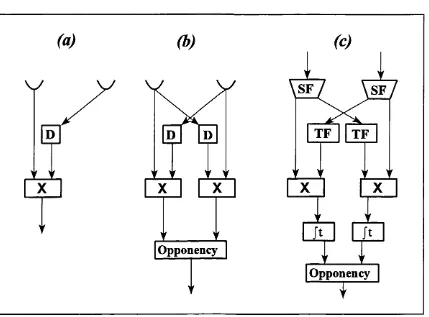
The correlation model represents the earliest and simplest class of motion detection model applied to animal vision. The prototypical correlation model consists of two spatially separated receptors. The output from both of these is multiplicatively combined, but with a temporal delay on the output of one of the receptors preceding the multiplicative stage (Figure 1.1a). This arrangement will also respond to static patterns, for example if both of the receptors are continually excited. This problem can be avoided by the use of an opponent detection arrangement such as that described by Reichardt (1961) to account for optomotor responses in insects. A simplified version of this model is outlined in Figure 1.1b. As the majority of early work on correlation models was carried out by Reichardt and his co-workers, models of this type are often referred to as Reichardt models.
(a)
(b)
(c)
SF SF
T F T F
Opponency
Opponency
Figure 1.1: Correlation/Reichardt models, (a) basic subunit, D indicates temporal delay, X
^ ^ g u re 1 . 2 ' f a ) rj
functions.
Sanctions^^Parated by
15
the relationship between the spatial and temporal frequencies in the input stimulus and the spatial separation and temporal delay/filtering within the model. One way that temporal aliasing may be avoided is to prevent the phase delay for any temporal frequency from being greater that half a temporal cycle. In their original extension of the Reichardt model, van Santen & Sperling propose a low pass temporal filter with a weighting function of the form they show that a filter with this profile will guarantee that the phase delay is always between zero and k/2.
In order to avoid spatial aliasing van Santen & Sperling (1984) add a spatial filtering stage to the input of the model (Figure 1.1c). At this stage, their model is no different from that described by Reichardt (1961), however they show that by choosing the separation between the spatial filters such that they are separated by a phase difference of tt:/2, the problem of
spatial aliasing can be avoided. This may be accomplished by a simple spatial separation (see Figure 1.2a) or by the use of odd and even Gabor filters (Figure 1.2b), a suggestion originally put forward by Watson & Ahumada (1983). In a later change to their model, which they term the "Elaborated Reichardt Detector" (ERD) van Santen & Sperling (1985) use Watson & Ahumada's (1983) suggestion of a temporal filter that approximates to a hyperbolic filter over a wide range of temporal frequencies. Watson & Ahumada (1983) show that a hyperbolic filter has a constant phase lag of 7t/2. The central importance of van Santen & Sperling's approach is not the changes they made to the Reichardt model. Indeed they simply brought together a number of ideas and suggestions that were already extant in the literature. However, they do provide a rigid mathematical characterisation of the performance of the model, and their model provides a generalisation of a model developed for explaining insect vision into a model of human low level motion perception.
1.2.2. The Energy Model.
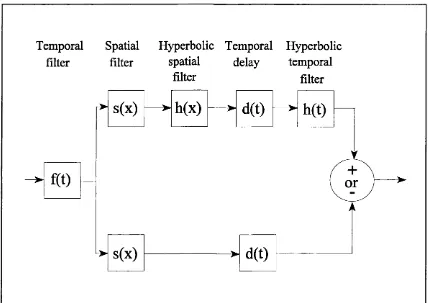
described above except that the multiplicative stage is replaced by simple summation. A diagram of their model is shown in Figure 1.3. The hyperbolic filters simply act to convert odd functions into even and even functions into odd (see Watson & Ahumada, 1985). The model can best be understood in terms of its response to a translating sinusoidal grating. Whereas in one direction the outputs of the two channels will be in phase such that the output of the summed response is twice that of the response in one channel, when the grating translates in the opposite direction then the signals in the two channels will be ti
radians out of phase so that there is no overall summed response.
The Watson & Ahumada motion detector can be regarded as a detector of Fourier motion energy that is localised in frequency space. By analysing motion signals in the Fourier domain and providing a model of how biological motion detectors might act as detectors of Fourier energy, Watson & Ahumada provided the basis for the energy model approach to motion perception. Watson & Ahumada note that their model has a number of desirable characteristics. The model is selective for motion direction but does not encode velocity. Human velocity discrimination at threshold is quite poor (Watson & Robson, 1981). This may be accounted for if it is presumed that velocity is extracted by examining outputs across a number of motion energy detectors. Furthermore, the model is selective also for spatial frequency and orientation, with the preferred direction of motion orthogonal to the spatial orientation of the sensor. These properties accord with the findings of studies that have examined the response of cells in the primary visual cortex of primates (De Valois, Albrecht & Thorell, 1982; DeValois, Yund & Hepler, 1982).
Temporal Spatial filter filter
Hyperbolic Temporal Hyperbolic spatial delay temporal
filter filter
or
s(x)
h(x)
d(t)
h(t)
s(x)
d(t)
and then add them, we obtain a phase invariant measure of Fourier motion energy. This procedure takes advantage of the fact that sin^0 + cos^G = 1 (the phase difference between sin8 and cosG is ti/2 s o this equation can be rewritten sin^G + sin^(G h-ti/2) = 1).
Conputationaly, spatio-temporally oriented Gabors may be implemented by the addition and subtraction of filters composed of space-time separable spatial and temporal Gabor functions. In this arrangements all spatial and temporal responses for the linear filters are tx/2 out of phase with one another. The use of these filters therefore prevents both temporal and spatial aliasing from occurring.
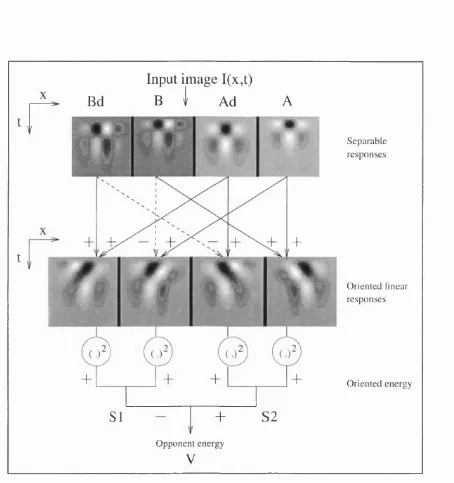
Adelson & Bergen note that spatio-temporally oriented Gabors are probably not biologically plausible filters. They show how a set of four filters created from biologically plausible filter profiles can be combined to form an approximation to spatio-temporally oriented Gabors. In the spatial domain they utilise the first and second derivatives of a Gaussian, and in the temporal domain they use two impulse functions. Whilst the model does show a larger response for motion in one particular direction, it will also show a response for motion in the opposite direction and will also respond to a static pattern. In a similar fashion to the Reichardt model, Adelson & Bergen incorporate motion opponency into their model. The stages of the Adelson & Bergen model and space-time plots of their biologically plausible filters are shown in Figure 1.4. The notion of motion opponency sits well with the literature regarding the motion aftereffect (Wohlgemuth, 1911). It can be argued that, for example, a rightward signalling motion detector has been desensitised by the continual presentation of rightwards motion. When presented with a static pattern the leftward signalling detector will signal the larger response, leftward motion will be perceived.
Bd
Input im age I(x,t)
B
i
Ad
A
4
:+
+
+
SI
+
+
O pponent energy
V
S 2
Separable resp on ses
O riented linear resp on ses
O riented energy
the comparison of outputs involves taking ratios, the measure of velocity may become increasingly unreliable as the denominator decreases. Adelson & Bergen suggest that measures of confidence may be attached to the velocity measures and that the outputs from a number of channels may be combined to recover a stable estimate of velocity. Additional schemes for the extraction of velocity from arrays of motion energy detectors have subsequently been advanced (ie. Heeger, 1987; Grzywacz & Yuille, 1990). It should be noted that in all cases the final estimate of velocity must be extracted from the combined outputs of a number of channels tuned to different spatial and temporal frequencies.
1.2.3. Gradient models.
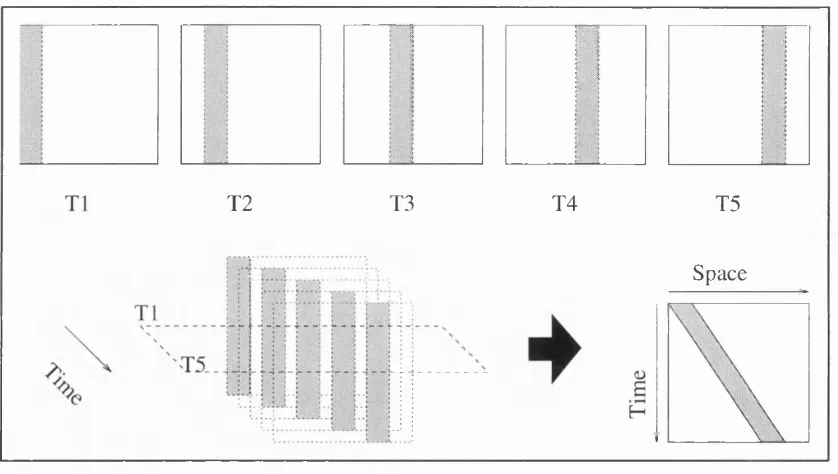
Gradient models have one strong advantage over the other models described above; they provide a well defined account of how velocity may be recovered. Gradient methods are based on the following two observations. Firstly, when viewed in a space-time cube, the trajectory of a rigidly translating object forms oriented lines through that space. If we assume that there are no abrupt changes of lighting as the object moves through space and time, then we can assume that the luminance along these oriented lines is locally conserved. Secondly, the slope of the lines in the space-time cube is a measure of velocity. This is shown in Figure 1.5 Therefore if one can recover the gradient over which luminance is conserved, one can extract a local measure of velocity. The gradient can be recovered by taking the ratio of temporal change over the rate of spatial change. If we consider the process in only one spatial dimension and use for our example a space-time separable filter
g(x)h(t). From this filter we can derive another filter by taking the partial derivative with
respect to the spatial dimension x to obtain g'(x)h(t). We can derive another filter by taking the partial derivative with respect to the temporal dimension t, obtaining function g(x)h'(t).
The result of filtering the derivative of an image with a function is equivalent to filtering the image with the derivative of the function. If we take an input image I(x,t) and filter it with the function g'(x)h(t) we obtain the image IjJxJ). In this terminology is the result of filtering the image I(x,t) with the filter created by differentiating the function g(x)h(t) n
times with respect to x and p times with respect to t. If we take the input image I(x,t) and filter it with the function g(x)h'(t) we obtain the image Io,](x,t). By dividing Ioj(x,t) by
Ij Jx,t) we obtain local measures of image velocity (Fennema & Thompson, 1979; Johnston,
T2 T3 T4 T5 Space
above, velocity is described by the following equation (Fennema & Thompson, 1979; Horn & Schunk, 1980):
■^1
Because gradient models involve the use of a quotient, they can produce an infinite response when the denominator is zero. This problem can be avoided by multiplying both the top and bottom of the equation by the denominator. This merely sets the output to zero when the denominator is zero. However, this is still an unsatisfactory state of affairs. The model may produce a zero response in an area where motion exists (ie. when the spatial derivative is zero). Another method by which the velocity calculation to be made more reliable is to combine a number of velocity measures by, for example, using a least means square procedure. This may be done by integrating over space (Lucas & Kanade, 1981) or by taking a number of other measures of velocity at each point. This latter approach has been implemented by Johnston et al (1992) who use increasing levels of spatial and temporal derivatives to stabilise the velocity measure.
1.2.4. Equivalence of motion models.
Van Santen & Sperling (1984, 1985) and Adelson & Bergen (1985,1986) examined the relationships between the various motion models. They prove that, for certain configurations, the energy model, the elaborated Reichardt model and the model developed by Watson & Ahumada (1983,1985) are identical in terms of performance. They all behave as local detectors of Fourier motion energy. Adelson & Bergen (1986) showed that this could also be extended to a sinple gradient model. Bruce, Green & Georgeson (1996) show that the energy model and the approach taken by Johnston et al (1992) may, in some cases, be mathematically equivalent. However it should be noted that this last derivation only applies to a limited subset of the Johnston et al model and it is not clear whether it can readily be generalised to the entire model.
The gradient model extracts velocity precisely because it does have these relationships. At a very fundamental level it is these relationships that define the model as a gradient model. In derivations where the energy model is shown to be equivalent to gradient models, the similarity is achieved by utilising a set of filters that are ideal for the gradient model approach. These filters may not be ideal for an implementation of the energy model. In order to prove the equivalence between these two models the energy model essentially becomes a gradient model in that it succeeds in extracting velocity as a consequence of the mathematical relationships between the filter shapes. If energy models were truly identical to gradient models then there would be no need to address the issue of how to extract velocity from them (ie. Heeger, 1987; Grzywacz & Yuille, 1990).
1.2.5. Motion as oriented Fourier energy.
The idea that all low level motion models can be seen as detectors of Fourier motion energy has led to the tacit acceptance that models based upon linear filtering (ie. those described above) operate by detecting the orientation of lines or planes through the frequency domain origin that contain Fourier motion energy. This reason for this belief can be illustrated in the following manner. Velocity is given by the ratio of spatial frequency over temporal frequency. Therefore, in the frequency domain and considering only one spatial dimension, points that signify a particular velocity must lie on a line that passes through the origin.
To be more specific, velocity is given by the equation,
sf
If we choose a particular velocity V; and reformat the equation in the traditional y = mx + c terms (where m is the slope and c is the intercept) then
t f
expand this up to two spatial dimensions, then points of equi-velocity all lie on a plane that passes through the frequency domain origin.
Although this is an extremely simple point and the description given above is rather laboured, this is because this concept is central to the way in which energy mechanisms (and by extension all other low level motion detection mechanisms) are seen to operate. If the contribution of stimulus contrast can be discounted, then at a fundamental level, energy models encode velocity simply as a function of their tuning characteristics. Of course this is not quite true because the response profile of an energy model in frequency space is not localised to a point but extends both spatially and temporally in frequency space. However, if we take a bank of motion energy detectors which overlap and fill an area of frequency space, then the velocity of a translating sine wave grating is given simply by the detector that gives the largest response (Fahle & Poggio, 1981).
The Adelson & Bergen (1985) model has proved so influential mainly because its operation can be explained in the simple heuristic terms outlined above. However, it should be noted that in reality the problem of extracting velocity from measures of motion energy is not facile. When the stimulus consists of a translating pattern with two or more components, then the response of any single energy detector may be based on the contribution of two or more components. Whilst this may be accounted for by a models that extract velocity on the basis of, for example, a regression in frequency space (Heeger, 1987), there are a number of motion patterns, the perceived velocity of which cannot be accounted for in these terms. Such patterns include the classes of motion stimuh defined as second-order or non-Fourier.
1.3. The detection of second-order motion.
1.3.1. Second-order motion.
The first-order/second-order dichotomy was first suggested by Cavanagh & Mather (1989). They defined first-order characteristics as those characteristics that are encoded at the lowest level in vision, at the level of retinal ganglion cells; ie. luminance and colour. As the M pathway has been identified as the motion pathway, and as this pathway is generally seen not to encode colour information, there has been a considerable reluctance to accept the proposal that colour-defined motion and luminance defined motion are processed by the same mechanism. Research into the perception of motion elicited by isoluminant stimuli suggests that luminance motion and chromatic motion are either processed differently or by different mechanisms (for a short review see Gegenfurtner & Hawken, 1996a). Therefore, more generally, the term first-order motion has come to mean rigid luminance defined motion. As detailed above, this can be characterised by orientations of Fourier motion energy through the frequency domain origin (Fleet & Langley, 1994).
A # ; # ' # ;
m
f I I "i 11 1 1Y
Figure 1.6: Space-time plots of contrast modulated sine wave grating (left) and a beat pattern created by the addition of two sine waves (right). Images shown are space time plots with increasing time as one moves down the vertical axis and increasing displacement as one moves along the horizontal axis.
t f
A
t fA
s f
1.3.2. Non-Fourier motion.
Chubb & Sperling (1988) describe a number of stimuli, the motion of which cannot be extracted using an approach to motion perception that is based on Fourier decomposition. They introduce the terms drift-balanced and micro-balanced. These are defined as follows:
"A random stimulus S is drift balanced if its expected power in the frequency domain is symmetric with respect to temporal frequency",
and
"S is microbalanced if the result WS of windowing S by any space-time-separable function
W is drift balanced". (Chubb & Sperling, 1988, pl986).
The class of microbalanced stimuli includes contrast and frequency modulations of binary noise. Space-time plots and luminance profiles of these stimuli are shown in Figure 1.8. Chubb & Sperling provide a formal mathematical proof showing that these stimuli are indeed microbalanced. By their definition such a stimulus cannot consistently elicit Fourier motion. It is for this reason that the motion elicited by these stimuli has been termed
non-Fourier. It should be noted that the Chubb & Sperling definition does not imply that no
Fourier motion can ever be detected in these stimuli. It is the fact that no consistent Fourier motion can be detected in these stimuli. As it says in the definition, at any spatio-temporal location, the expected power in the frequency domain is symmetric with respect to temporal frequency. Therefore the actual power may not be symmetric but the probability of that power signalling motion in the leftwards direction is equal to the probability of it signalling motion in the rightwards direction.
y
1
/
I
through the distortion product hypothesis. The addition of a non-Fourier channel has generated a two channel model of human motion processing.
1.3.3. The distortion product hypothesis.
Burton (1973) found that a beat pattern created by the addition of two high contrast interference fringes was readily distinguishable. Each of the interference fringes was of a high enough spatial frequency to be unresolvable. Burton suggested that a logarithmic non- linearity inherent in the visual transduction process may introduce distortion products into the signal at the spatial frequency of the beat. This idea may be extended to the perception of second-order motion. Any one of a number of non-linearities can introduce distortion products at the frequency of the second-order components into the signal. In this approach, both the first- and second-order motion information is carried in one single channel. The same motion detectors that extract first-order motion wül also serve to extract second-order motion.
Henning, Hertz & Broadbent (1975) examined masking effects between sine wave gratings and complex gratings. The latter were constructed from the addition of three sine wave gratings of the same orientation but differing spatial frequencies such that they were mathematically equivalent to the contrast modulation of a high frequency carrier with a low frequency envelope. Henning et al found that masking using sine wave gratings of the same spatial frequency as the envelope significantly reduced the detectability of the complex grating. There was also a strong effect on the detectability of envelope frequency sine wave gratings when these were masked with complex gratings. When the phase relationship of the three components comprising the complex grating were changed so that the variation of contrast across the pattern was significantly reduced, there was no strong masking effect. These results are consistent with the idea of a distortion product.
that mask. Henning et al (1975) do make the point that this latter finding could be accounted for supposing that a non-linearity was applied to high frequency, but not low frequency, signals. Such a process would produce distortion products at the frequency of the modulant with a high frequency carrier but would not produce any distortion products with a low frequency sine wave mask. This might reasonably account for their results and those of Burton (1973).
Nachmias & Rogowitz (1983) used a similar stimulus and replicated the findings of Henning
et at (1975). They also showed that, with a contrast modulated sine wave mask, the strength
of the masking effect was strongly phase dependent. They tentatively hypothesise that only a distortion product at the spatial frequency of the envelope caused by some non-linearity in the visual system can account for the interactions between contrast modulated and sine wave gratings. However, they do quahfy this by noting that some of the results found in their study do not agree with this hypothesis. Particularly, they find discrepancies in the relationship between the estimated size of the distortion product and the contrast and the consistency of the conplex pattern. It would seem from the results of Henning et al (1975) and Nachmias & Rogowitz (1983), that there is some interaction between modulations of contrast and sine wave gratings but that the actual way that these may interact is not clear.
In a direct test of the distortion product hypothesis, Badcock & Derrington (1989) showed that the perceived motion of a drifting beat could not be nulled by the addition of a signal designed to cancel the distortion product. Evidence against the distortion product hypothesis is also provided by the following studies. Hammett & Smith (1994) examined temporal beats and found no masking effects. A luminance non-linearity should produce distortion products as the signal changes over time and should therefore affect the detectability of a grating that is temporally rnodulated at the beat frequency. Ledgeway & Smith (1994a) interleaved flrst- and second-order motion gratings and showed that, when there was a quarter cycle displacement between each frame, there was no consistent percept of motion direction. If an expansive non-linearity is applied to a contrast modulated pattern then a distortion with the same frequency and phase as the modulant is introduced into the signal. If this were the case then the stimulus employed by Ledgeway & Smith should appear to move forwards. If a compressive non-linearity is applied then the distortion product will be n radians out of phase with the modulant. The stimulus should appear to move in the direction opposite to the displacement. Therefore the Ledgeway & Smith (1994a) finding appears to weigh against the distortion product hypothesis. A similar study by Mather & West (1993) concurs with the findings of Ledgeway & Smith (1994a).
to the pattern. Additionally, the finding of Ledgeway & Smith (1994a) which showed no consistent motion elicited by an interleaved first- and second-order gratings stimulus was replicated but only at a low temporal frequency. At a high temporal frequency, coherent motion was elicited by this stimulus in the direction opposite to the displacement; a result that would be predicted by the operation of a compressive non-linearity.
Although there is evidence for a role for distortion products at high envelope temporal frequencies, there is no strong evidence to suppose that they can account for second-order motion at low temporal frequencies. If this is the case then some non-Fourier mechanism must exist. However the idea that second-order motion is extracted via some non-linearity that precedes a motion detection stage has not been abandoned. Chubb & Sperling (1988) suggest that a specific non-linear mechanism or channel exists for the extraction of second- order motion and that this channel exists in parallel to the traditional idea of the Fourier motion energy channel (Chubb & Sperling, 1989a).
1.3.4. The two-channel model.
f
H
ft
Space
t f
4
Figure 1.9: (top) Space-time plot showing rectified contrast modulated sine wave grating, and (bottom) Fourier spectrum of the rectified image. The areas of the dots are approximately proportional to the amplitude of the components.
viewing distances this stimulus appears to moving forwards. As viewing distance is increased, the stimulus appears to be going in the reverse direction. Chubb & Sperling take this indicate the existence of two separate processing streams, a first-order channel and a second-order channel. Such a model has also been proposed by Wilson, Ferrera & Yo (1992). A schematic diagram of the two channel model is shown in Figure 1.10.
The Chubb & Sperling (1989a) contrast reversing stimulus is particularly interesting. In terms of the application of a pointwise non-linearity, some fullwave rectification process (or similar) applied around mean luminance would be necessary to make motion in the direction of displacement visible to standard motion energy analysis. The motion in this stimulus cannot be explained through the operations of some monotonically increasing function applied directly to the luminance input. In other words, the distortion product hypothesis cannot account for the perception of forward motion that is readily elicited by this stimulus.
Chubb & Sperling (1989b, 1991) have examined the form that the initial linear filtering process may take. They showed that, to account for the perception of motion in both a contrast modulating square-wave and a contrast reversing square wave, the initial temporal filtering stage must include filters with both lowpass and bandpass characteristics. They postulated a "best of both worlds" temporal filter which is constructed by the addition of these two types of filters. The spatial filtering characteristics were examined using texture quilts. Chubb & Sperling (1991) showed that subjects could readily perceive spatial frequency and texture orientation modulations and that there seemed to be no consistent difference in performance between these two type of stimuli. They put forward the proposal that a stage of oriented bandpass (specifically Gabor) filtering prior to some point-wise non- linearity might reasonably account for these data. This view is also supported by Langley, Fleet & Hibbard (1996), Wilson et al (1992) and Sutter, Sperling & Chubb (1995).
At present there is no firm consensus on the form of the subsequent non-linearity. Sperling (1989) and Lu & Sperling (1995a) appear to favour fullwave rectification, a process that could be accomplished by the simple addition of on and off pathways whilst Wilson et al
Fourier
pathway
non-Fourier
pathway
Linear
filtering
Linear
filtering
Motion
energy
Linear
filtering
Motion
energy
non-linearity
Integration
pointwise non-linearity. Solomon & Sperling (1994) employed second-order stimuli that they argue could only be perceived using halfwave and not fullwave rectification (and vice versa). They conclude that there are separate fullwave and halfwave channels but that only approximately one third of the population can perceive stimuli designed for the latter. It is probably unrealistic to expect a biological system to be perfectly linear and, as we have seen, it has also been suggested that there is a distortion product within the first-order channel as well as an explicit non-Fourier mechanism (Holliday & Anderson, 1994; Scott-Samuel & Georgeson, 1995).
Wilson et al (1992) have proposed a specific mechanism for the integration of first- and second-order signals using a lateral inhibition competitive neural network to account for the perception of motion direction in plaids. Contained within this model is the idea that motion detection in first- and second-order signals relies on different sets of detectors and that the information from these is subsequently combined. There is some psychophysical evidence that challenges this assumption. Ledgeway & Smith (1994b) found cross-adaptation between first-order adapting stimuli and second-order test stimuli (and vice versa). In fact, they found no evidence of any difference between cross-adaptation and same-adaptation conditions. This finding might imply that both types of motion are detected by a common low level motion detection mechanism Turano (1991) found that cross adaptation between sine wave gratings and contrast modulated sine wave gratings (and vice versa) occurred, she concludes that this supports the idea of a common low level mechanism. This conclusion is also supported by the following two observations: Firstly, velocity discrimination thresholds in sine wave gratings and contrast modulated sine waves appear to be very similar both in magnitude and in the way that they vary with velocity (Turano & Pantle, 1989). Secondly, perceived velocity in both contrast and luminance defined stimuli varies similarly with modulation depth (Ledgeway & Smith, 1995).
spatial frequencies than the first-order system (Sutter, Sperling & Chubb, 1995; Wilson, 1994).
The construct of a second-order channel is largely based on the implicit acceptance of the principle that motion can only be detected from Fourier components that lie on a plane or line through the frequency domain origin. If second-order motion cannot be fully explained by the distortion product hypothesis then, it is argued, the only way that motion can be extracted is by constructing a non-linear channel designed specifically to ensure a signal with this property. However, Johnston & Clifford (1995a) showed that it was possible to account for the perception of second-order motion in contrast modulated gratings using a model without an explicit non-linear stage preceding motion detection. They have also demonstrated that the reversal of direction found by Chubb & Sperling (1989a) can be accounted for without appealing to a separate non-linear channel (Johnston & Clifford, 1995b). The simple fact that the Johnston et al (1992) model can extract second-order motion has interesting ramifications. Firstly, it implies that a non-linearity that precedes motion calculation is not necessary in order to model the perception of second-order motion. Secondly, it inplies that the behaviour of the model utilised by Johnston & Clifford cannot be accounted for simply in terms of the Fourier decomposition approach.
1.3.5. Evidence for the two channel model.
Derrington, Badcock & Henning (1993) examined the detection of motion direction in a luminance grating and a beat pattern. They showed that the motion of the beat could only be discriminated at stimulus durations of more than 200 msec. The direction of motion in the luminance grating was discriminable at far lower stimulus durations. Derrington et al
take this as evidence for the existence of a second-order mechanism which operates more slowly than the first-order mechanism In agreement with this finding. Cropper & Derrington (1993) measured the lowest velocity required to detect motion in luminance gratings and beats presented at multiples of their respective detection thresholds. Direction of motion was not discriminable in beat patters below stimulus durations of 120 msec whereas the motion in luminance gratings was discriminable at stimulus durations as low as 15 msec (see also Cropper & Derrington, 1996). Evidence for a difference in processing speed between first- and second-order stimuli is also supplied by Yo & Wilson (1992) who found that the perceived direction of motion in plaids could vary as a function of stimulus duration. Wilson
et al (1992) found that this effect could be modelled by incorporating a short delay into the
second-order channel of their two channel model.
Not only does it appear that the motion of beats is perceived more slowly than the motion of luminance gratings, there is also evidence that the function describing contrast thresholds for detecting motion direction in beats is tuned to lower temporal frequencies than the function describing thresholds for the detection of motion direction in luminance gratings (Derrington & Henning, 1994). However, more recently. Lu & Sperling (1995b) showed that the temporal contrast sensitivity functions for direction discrimination were similar for a luminance modulation and a contrast modulation of static binary noise. Similar evidence has also been produced by Smith & Ledgeway (1997b) who additionally showed that, whilst the contrast sensitivity function for direction discrimination with modulations of dynamic noise appeared lowpass, those for luminance modulations and modulations of static noise appeared bandpass. These data imply that the form of the tuning function for second-order stimuli is dependent upon the particular stimulus that is being investigated.
microbalanced stimuli rather than, for example, contrast modulated gratings or beats. Direction of motion in contrast modulated gratings can potentially be detected by an energy model (Chubb & Sperling, 1988). Ledgeway and Smith added noise to their first-order stimuli so that any differences between the two types of stimuli could not be put down to the presence (or absence) of the carrier. They also took the precaution of equating the visibility of the two types of stimulus by presenting them at the same multiple of their respective direction identification thresholds. In all of their studies comparing first- and second-order motion no reliable differences were found to discriminate measures of performance in response to the stimuli.
For example. Ledgeway & Smith (1994b) and Ledgeway (1994b) examined the motion aftereffect for first- and second-order motion. They found both first- and second-order motion produced similar aftereffects and that cross-adaptation between the two classes of stimuli also occurred. Müller & Greenlee (1994) showed that the perceived speed of a luminance grating could be reduced by adaption to a grating of the same spatial frequency and of the same or a higher temporal frequency. Similarly, Ledgeway & Smith (1996) examined the effects of adaptation and cross-adaptation to first- and second-order motion on the subsequent perceived speed of first- and second-order motion sequences. They showed that prior adaption to both types of grating could affect the perceived speed of both first- and second-order stimuli. All four adaption/cross-adaptation conditions showed similar patterns of response to one another. When the speed of the adaptation stimulus was higher than that of the subsequently presented test stimulus, a reduction in perceived speed was observed. However when the adaptation stimulus moved more slowly than the test stimulus then increases in perceived velocity were observed. Ledgeway and Smith proposed that the data supports two hypotheses. Firstly, that both types of motion are detected by the same mechanism and secondly, that they are detected by different mechanisms operating on the same principle. In the papers described in this paragraph. Ledgeway and Smith come down on the side of the latter hypothesis.
same. They also looked at the effect of varying modulation depth on the perceived velocity of first and second-order stimuli. In agreement with studies examining the effect of reducing contrast on first-order stimuli, Ledgeway & Smith found that the perceived speed was linearly related to the log of the modulation depth. Interestingly, the slope of this line (determined by linear regression) was no different for the two stimulus types. Gegenfurtner & Hawken (1996b) also examined the slope of the line relating log contrast to the log of perceived velocity and found that the slope of the line was substantially greater for second- order stimuli (square wave modulations of binary noise) than for first-order stimuli. Gegenfurtner & Hawken used sine wave gratings as their first-order stimuli and amplitude modulated binary noise as their second-order stimuli. It is possible that the difference between the two studies can be directly attributed to the additive noise used by Ledgeway & Smith in their first-order stimuli.
Edwards & Badcock (1995) studied the perception of motion in stimuli that consisted of mixtures of Fourier and non-Fourier dots. They measured motion thresholds in dot stimuli by varying the number of signal dots within a fixed number of dots (the remainder would move randomly). With the addition of random motion Fourier dots, motion thresholds for non-Fourier dots decreased substantially but the addition of random motion non-Fourier dots had little effect on the motion threshold for the Fourier dots. In a second experiment, Edwards & Badcock looked at global motion thresholds in stimuli consisting of the two dot types where a proportion of the dots of each dot type moved in the opposite direction to a proportion of those of the other type. The data from this experiment supported that of the first in that, to reach motion threshold, the coherence of the second-order dots needed to be substantially increased. This was not the case with the first-order dots. Edwards & Badcock take these data to indicate the existence of two channels; a first-order channel that is sensitive to the motion of the Fourier dots and a second-order channel that is sensitive to the motion of both the Fourier and the non-Fourier dots. This study is of particular interest because it does appear to show a genuine difference between the processing of first- and second-order signals.
the Fourier dots with non-Fourier dots in the display led to the abolition of transparency. When the consistency of the non-Fourier dots was unaltered, but the background luminance was changed so that a first-order signal was introduced, then the perception of transparency was reinstated. Initially this would appear to be a clear indication of a difference between first- and second-order processing with the evidence supporting the theory that the second- order system had no capacity to support transparency. However, when dynamic noise was added to the background in the Fourier dot stimulus, then the percept of transparency was abolished. This latter finding would seem to imply that noise has some critical part to play in the perception of transparency and McOwan & Johnston conclude that lack of transparency in the stimulus containing the non-Fourier dots is based on the presence of noise in the local velocity field.
In one study. Ledgeway & Smith (1994a) examined the perception of motion in a stimulus created by interleaving first- and second-order patterns. When the patterns step forwards a quarter cycle every frame and alternate between first- and second-order then no motion is seen in this stimulus. Ledgeway & Smith argue that if both first- and second-order motion were detected by a single system then the information from both types of pattern would be integrated to form an unambiguous motion percept. They take this as evidence for strong proof for the two channel hypothesis. A similar study by Mather & West (1993) produced similar findings and conclusions. However, Johnston & McOwan (1996) recently demonstrated that this finding could be accounted for by a single channel model. Furthermore, Scott-Samuel (1997) showed that motion could be elicited by the Ledgeway & Smith stimulus with increases in temporal frequency. An additional piece of strong evidence for the two channel model is the finding that second-order motion does not elicit optokinetic nystagmus (OKN) (Harris & Smith, 1992). This finding is weakened by the fact that Harris & Smith used a standard drifting sine wave grating as their first-order stimulus. They cannot guarantee that the presence of the carrier in the second-order stimulus might be responsible for the low level of OKN.
types of second-order motion when compared to performance on a first-order motion stimulus. However, in a more recent study, Greenlee & Smith (1997) examined orientation, direction and speed discrimination thresholds in first- and second-order motion patterns. They studied these in 21 patients with unilateral damage to various regions of cortex. By comparing the responses of the patients over their hemifields and by taking into account the different regions of damage, Greenlee & Smith hoped to be able to localise an area of the brain that might be implicated in second-order motion. Whilst they do find slight quantitative differences between the two stimuli, they find no real evidence for anatomical specialisation between first- and second-order motion processing. Furthermore, in a study which recorded visual evoked potentials (VEPs) in response to Fourier and non-Fourier motion, Victor & Conte (1992) found no evidence for any differences in response either in temporal onset or scalp topography of the components of the YEP that were examined. Using MRI, Greenlee, Smith, Singh, Kraemer & Hennig (1997) attempted to locate the cortical areas involved in the perception of first- and second-order motion. They found no difference in the activated areas between first-order motion and three types of second-order motion; contrast modulated static noise, contrast modulated dynamic noise and flicker frequency modulated noise. Greenlee et al reported that second-order motion readily activated an area identified as human V5/V5a.
and the spatial frequency tuning for envelope motion rules out the possibility of explaining the result by any early pointwise non-linearity. To account for their data, Zhou & Baker propose that their envelope responsive cells receive input from both linear and non-linear pathways. Of course, all we really know about these cells is that they respond to both first- and second-order motion. The mechanism that Zhou and Baker propose is pure hypothesis. It is interesting to note that nobody has found cells that respond to second-order motion whilst giving little or no response to first-order motion. Such cells would be predicted by the two-channel model.
In general, there appears to be no conclusive evidence for a difference in processing between first- and second-order stimuli. Where differences have been found, subsequent investigation has not supported the distinction. For example Pantle (1992) found the motion of some peripherally presented second-order stimuli was not readily distinguished. However, Solomon & Sperling (1994) did observe sensitivity to second-order motion in the periphery. The difference between the two studies appears to be due to the fact that Solomon & Sperling (1994) utilised much larger patches of stimulus than Pantle (1992). Similarly a conclusion that second-order motion could not support a significant motion aftereffect (Derrington & Badcock, 1985) was subsequently shown to be false (Ledgeway & Smith, 1994b). From the studies presented above there is also the implication that differences in the perception of motion elicited by first- and second-order motion stimuli may be based on the presence of the carrier (or some other difference) rather upon the "orderness" of the stimuli.
1.3.6. Feature tracking.
recognition of biological motion (Goddard, 1989), gesture recognition (Davis & Shah, 1994), and gaze tracking (Gee & Cipolla, 1994). Low level feature tracking mechanisms combine the outputs of linear filters tuned to different frequencies or orientations (Watt & Morgan, 1985; Georgeson, 1992; Bowns, 1996). These early operations are generally seen as part of a process that detects edges and are generally followed by some procedure to extract zero crossings following the approach described by Marr & Hildreth (1980).
In many ways, the extraction of features through some low level processing procedure is similar to operation of second-order motion mechanisms. These might usefully be regarded as a feature tracking mechanisms that is specialised to extract second-order motion. Watt & Morgan (1985) present a model for the extraction of low level features that contains characteristics of both traditional feature tracking mechanisms and second-order motion mechanisms. In the first stage, the on-centre outputs fi*om a range of spatial frequency filters are combined into one output stream and the off-centre outputs from the same filters are combined to form another output stream. These output streams are then subject to a processing stage in which the amplitude and width of "centroids" are identified. These are essentially zero bounded regions of activity in each of the output streams. These centroids are then labelled according to a series of rules which define whether they describe bars, edges or areas of zero activity. The resultant “spatial primitives” may subsequently be subjected to some motion analysis procedure.
Earlier studies focused on providing evidence for the existence of some short range motion processing system in addition to some long range process (Braddick, 1974, 1980). More recently the existence of some short range low-level system has become widely accepted and the focus of the research has changed to provide evidence for the existence of a long range feature tracking mechanism. For example, Georgeson & Harris (1990) presented subjects with a missing-fundamental square-wave grating that translated by a quarter of a cycle of the spatial frequency of the fundamental. Traditionally, this stimulus has been used to demonstrate the existence of some low level motion energy process (Adelson & Bergen, 1985). The Fourier spectrum of the stimulus is shown in Figure 1.11a. The spatial and temporal frequency of the missing fundamental are marked by the crosses on the spectrum. The area of the dots representing the components is proportional to the amplitudes of the components. It can readily be seen that the largest component in the spectrum signals motion in the direction opposite to that of the displacement. A standard motion energy approach would predict that motion in the reversed direction should be perceived. However, Georgeson & Harris added a mean luminance interstimulus interval (ISI) between the quarter phase translations and found that, with increases in the temporal extent of the ISI, subjects increasingly reported that the stimulus elicited a perception of motion in the direction of the displacement. Georgeson & Harris take this pattern of results to indicate the operation of two motion systems, a short-range process and a long-range feature based motion process. Their conclusion is supported by the results from a study by Hammett et al (1993) who employed a beat stimulus created from the addition of two components with spatial frequencies of 3 and 4 times that of a notional fundamental frequency. They stepped the stimulus forward by a quarter of a cycle of the fundamental frequency, the Fourier spectrum of the stimulus is shown in Figure 1.11b. With no ISI, subjects reported that the stimulus appeared to exhibit motion transparency with both forwards and reversed motion present. As the ISI was increased, the percept of transparency decreased and subjects increasingly perceived motion in the direction of displacement. Hammett et al take this to indicate the existence of some long range feature processing mechanism.
I
I
H(a)
•
•
e
•
•
•
e
#
•
•
•
#
•
•
•
Spatial Frequency
c
1
2
0
1
Spatial Frequency
tracking process. As the ISI is increased, the contribution of the short-range process was thought to have decreased, leaving the long-range process increasingly dominant. However, the operation of some second-order mechanism (rather than a feature tracking mechanism) might also explain this pattern of results if it were supposed that the second-order mechanism were comparatively unaffected by increasing ISI. An additional possibility is that the patterns of results might be modelled by the operation of a single motion extraction mechanism. Johnston & Clifford (1995b), utilising an extended gradient model similar to that described by Johnston et al (1992), showed that the effect reported by Georgeson & Harris (1990) could be accounted for by the operation of a single low level motion mechanism.
Smith (1994b) suggests that a feature tracking mechanism exists side by side with the lower level first- and second-order channels. He presented subjects with a contrast defined version of the 3 /plus 4 / stimulus employed by Hammett et al (1993). The stimulus was constructed by modulating the contrast of static binary noise rather than, as in the case of Hammett et al, modulating luminance. This stimulus is opaque to standard motion energy analysis (Chubb & Sperling, 1988) so any motion elicited by the stimulus must indicate the operation of some non-Fourier mechanism or mechanisms. Smith found that, with no ISI, reversed motion was perceived. This finding is fully consonant with the notion of a second-order channel in which the signal is demodulated and then subject to motion energy analysis. However subjects perceived motion in the forward direction when a short ISI was incorporated into the stimulus. Clearly this must reflect the operation of some process other than simple demodulation and subsequent standard motion energy analysis. Smith takes his findings to be evidence for a tripartite model of human motion perception in which some feature tracking mechanism exists in parallel to the first- and second-order mechanisms.
in the direction of translation. Lu & Sperling believe that the addition of the pedestal is therefore a potent technique by which to isolate motion systems that do not rely on feature tracking. Lu & Sperling show that motion is readily perceived in both luminance and contrast modulated pedestal stimuli. This is taken to demonstrate the existence of separate first- and second-order motion systems which are both ultimately based upon some motion- energy type motion detection process. Demodulation is incorporated into the second-order channel so that the motion is visible to standard motion energy analysis.
Lu & Sperling (1995b, 1995c) demonstrate the existence of a feature tracking channel by showing that the perception of motion elicited by some types of stimuli are severely disrupted by the addition of a pedestal. Most notably these include interocular displays. In these the motion information available to any single eye will not preferentially signal motion in any single direction. However, when information firom both eyes is combined then motion should be visible. Lu & Sperling propose that the first- and second-order systems are primarily monocular and that interocular motion displays isolate the feature tracking mechanism The conclusion that low level motion systems are primary monocular rests upon their finding that interocular motion is disrupted by the addition of a pedestal.
Sperling that the response if the feature tracking mechanism is low pass with respect to temporal frequency and has a cut-off frequency of approximately 3 Hz.