4230
Determining Variables Of Financial Performance
Between Conventional Rural Bank and Sharia
Rural Bank and Different Variables in Financial
Performance Between Both
Ahmad Roziq, Agung Budi Sulistiyo, Septarina Prita Dania Sofianti, Moch. Shulthoni, Nur Hisamuddin, Wasito, Siti Maria Wardayati, Ririn Irmadariyani, Hendrawan Santosa Putra, Ahmad Ahsin Kusuma Mawardi, Eza Gusti Anugerah
Abstract: This study aims; (a) to analyze the effect of liquidity, rentability, capital and asset quality on the financial performanace of conventional and sharia BPR in East Java; and (b) to analyze the effects of liquidty, rentability, capital and asset quality to distingusih financial performanace of conventional and sharia BPR in East Java. Type of research includes explanatory research and comparative study through hypothesis test. Populations of the research are conventional and sharia BPR located in East Java. Cluster sampling is used to determine the representative sample. Total numbers of samples are 15 conventional BPR and 15 sharia BPR with same regency or city in East Java. This study uses secondary data in the form of financial ratios for 5 years, ferom 2014 t0 2018. The data analysis techniques used in this study are multiple regression and logistic regression. The research found that (a) liquidity has ssignificant effect on financial performance of conventional BPR; (b) liquidity and asset quality have a significant effect on financial performance of sharia BPR; and (c) asset quality has a significant effect to distingusih financial performance between conventional BPR with sharia BPR.
Index Terms: Likuidity, Rentability, Capital, Asset Quality, Financial Performance, BPR Konvensional, BPR Syariah —————————— ——————————
1.
INTRODUCTION
Banks in Indonesia are divided into 2 types, namely conventional banks consisting of commercial banks and rural credit banks, and Sharia banks consisting of Sharia commercial banks (BUS), Sharia business units (UUS) and Sharia people's financing banks (Sharia Rural Banks). Conventional banks are banks based on the principle of interest. whereas Sharia Banks are banks based on Sharia law, many principles are offered to generate profits, such as profit sharing, buying and selling, leasing, services and others in sharia bank operations. From an institutional perspective, it is recorded that as of February 2017 Indonesia has 13 Sharia Commercial Banks and 21 Sharia Business Units. Meanwhile, Sharia Credit Banks as of February 2017 amounted to 166 BPRS (OJK, 2017). Significant developments also occurred in East Java as a province that has the most BPRs and BPRS in Indonesia. Recorded as of February 2017, East Java has 31 BPRS, both government and private owned more than any other province in Indonesia. Whereas for BPRs, East Java has 321 BPRs, the most in Indonesia (BI: 2017). Muhari and Hossen (2014) stated that the existence of BPR and BPRS has the aim to provide banking services and products for the people of the economically weak group and small and micro businesses (SMEs) both in urban and rural areas. In general, BPRs and BPRS have objectives and characteristics that are
relatively the same as Microfinance Institutions (MFIs), namely commercial and community development (Buchori, 2003). Commercial means that the MFI in running its business must benefit so that operational activities are sustainable and the ability to serve customers increases (outreach). This is closely related to the second objective, namely community development. The people that are the priority of channeling funds are those with a weak economy or who cannot reach commercial banking. Thus, with the existence of BPR and BPRS, the mission of financial institutions is to empower the community, create jobs, develop the business of customers and ultimately reduce poverty will be achieved.
During 2018, the financial performance of banks in East Java in general experienced positive growth, especially Islamic banking. The growth of the People's Financing Bank (BPR) and Islamic People's Financing Bank (BPRS) in East Java is in line with the increase of East Java's economy above the national average. the growth of sharia banking is much higher than the growth of other public banks in East Java, so this indicates that the level of public confidence in sharia banks jumped significantly in 2018. However, sharia banking in East Java must make more efforts to improve the principle of prudence in channeling financing , considering the risk of Islamic banking credit in East Java tends to rise, which is characterized by an increase in the NPF ratio from 2.74% in the third quarter of 2017, to 5.23% in the third quarter of 2018 (KabarBisnis, 2018). In general, the financial performance of Conventional Rural Banks and Sharia Rural Banks in East Java as seen from the ratio of Return On Assets for the past five years shows that the ratio is classified as safe for banks because it is above 1.215% as determined by Bank Indonesia in categorizing the soundness of BPR. There are many factors that can affect changes in bank's Return On Assets, such as bank internal factors, macroeconomic conditions as well as factors from customers both creditors and debtors. According to Mahardian (2008), the biggest factor influencing bank return on assets is the level of operational efficiency seen from the bank's BOPO ratio. The high BOPO ratio shows that the ————————————————
Ahmad Roziq, University of Jember, Indonesia.
Agung Budi Sulistiyo, University of Jember, Indonesia.
Septarina Prita Dania Sofianti, University of Jember, Indonesia.
Moch. Sulthoni, University of Jember, Indonesia.
Nur Hisamuddin, University of Jember, Indonesia.
Wasito, University of Jember, Indonesia.
Siti Maria Wardayati, University of Jember, Indonesia.
Ririn Irmadariyani, University of Jember, Indonesia.
Hendrawan Santosa Putra, University of Jember, Indonesia.
Ahmad Ahsin Kusuma Mawardi, University of Jember, Indonesia.
4231 bank's operational margins have not yet been optimized for
operational costs, which shows the inefficiency of the bank's business activities. Inefficient operation of banks is usually caused by several factors, such as the inability of management to manage the bank due to low human resources owned, low product marketing, operational costs that are too high due to the interest system and bank locations that are not strategic. However, if the bank's BOPO ratio is low, it shows that the bank is able to optimize its operating income margins on its operational costs, so that in such circumstances the bank is efficient in using its resources, both capital and human resources. According to Faisol (2007), in general there are three ratios used to measure the performance of a bank, namely (1) Liquidity Ratio is a ratio used to measure the ability of banks to pay short-term debt (Cash Ratio, Reserve Requirements, Loan to Deposit Ratio, Loan to Asset Ratio). (2) Rentability Ratio is the ratio used to analyze or measure the level of business efficiency and profitability achieved by the Bank concerned (Return On Assets, Return On Equity, Operating Expenses to Operating Income, Net Profit Margin Ratio). (3) Solvency Ratio is a ratio used to measure the ability of banks to meet their long-term obligations or the ability of banks to meet all their obligations in the event of liquidation at the bank (Capital Adequacy Ratio, Debt to Equity Ratio). As Cahyadi (2010) did in examining the financial performance of BPR and BPRS in Surabaya, which also uses financial ratios and proves that: there are significant differences between BPR and BPRS in terms of LDR / FDR, Cash Ratio, NPL / NPF, APB , BOPO and there is no significant difference between BPR and BPRS in terms of ROA, ROE, CAR, Capital Ratio, ATTM. In addition, a measurement of financial performance using financial ratios was also conducted by Personal (2013) with a study entitled Comparative Analysis of Financial Ratios of BPRs and Sharia Rural Banks in East Java, Nugroho (2011) with the title Comparative Analysis of Sharia Banking Performance with Conventional and Angular Banking (2012) in his research entitled Comparative Analysis of Financial Performance of Islamic Banking and Conventional Banking (2002-2011 period). Based on the background above, the objectives to be obtained in this study are (a) testing and analyzing the effect of liquidity, profitability, capital, and asset quality affecting the financial performance of conventional rural banks in East Java Province; (b) test and analyze the effect of liquidity, profitability, capital, and asset quality affecting the financial performance of sharia rural banks in East Java Province; and (c) test and analyze the effect of liquidity, profitability, capital and asset quality on differences in financial performance between conventional and Sharia rural banks
2 LITERATURE REVIEW
2.1 Conventional Rural Bank
Conventional system Rural Banks can be defined on the understanding of commercial banks in article 1 paragraph 3 of Law No.10 of 1998 by eliminating and / or based on sharia principles, namely banks that carry out conventional business activities which in their activities provide services in payment traffic. Furthermore, based on Financial Services Authority Regulation No. 20 / POJK.03 / 2014 concerning Rural Credit Bank Article 1 states that Rural Credit Bank hereinafter referred to as RB is a bank that conducts conventional business activities in which its activities do not provide
services in payment traffic as referred to in the Law concerning banking. The forms of legal entity for an RB are: Limited Liability Company; Cooperative; or Regional Company. Business activities carried out by Rural Banks in accordance with the 2014 Indonesian Banking Booklet include: Collecting funds from the public in the form of deposits in the form of time deposits, savings, and / or other forms equivalent to that; Give credit; and Placing funds in the form of SBIs, time deposits, certificates of deposit and / or savings with other banks
2.2 Sharia Rural Bank
In Act No. 21 of 2008 it is stated that, the Islamic People's Financing Bank, hereinafter referred to as the BPRS, is a sharia bank that in its activities does not provide services in payment traffic as referred to in the Law on Sharia banking. While Muhammad (2005) explains that Islamic banks are banks that carry out business activities or operate based on sharia principles and do not rely on interest in providing financing and other services in payment traffic. Sharia principles that must be implemented by Islamic banks are also explained in the 2014 Indonesian Banking Booklet, which is meant by the fulfillment of sharia principles, which are implemented by fulfilling the basic provisions of Islamic law, including the principles of justice and balance (adl wa tawazun), benefit (maslahah), universalism (natural) and does not contain gharar, maysir, usury, wrongdoers and haram objects. Fulfillment of sharia principles is carried out as follows: Collecting funds by using, among other things, wadiah and mudharabah agreements; Distribution of funds / financing by using, among others, mudharabah, musyarakah, murabahah, salam, istishna, ijarah, ijarah muntahiya bittamlik and qardh contracts; and Services, namely by using, among other things, contract kafalah, hawalah and sharf. In addition, according to Law No. 21/2008, business activities are based on sharia principles, namely business activities that do not contain the following elements: First, usury, namely the addition of unauthorized income (batil), among others in exchanges of goods of the same type which are not of the same quality, quantity, and time of delivery (fadl), or in a lending and borrowing transaction that requires the recipient customer to return the funds received exceeding the loan principal due to time (riceah); Second, Maisir, which is a transaction that is subject to an uncertain and chancy situation; Third, Gharar, a transaction whose object is unclear, not owned, is not known to exist, or cannot be submitted at the time the transaction is carried out unless otherwise stipulated in sharia; Fourth, Haram, namely transactions whose objects are prohibited in sharia; Fifth, Zalim, which is a transaction that creates injustice for other parties
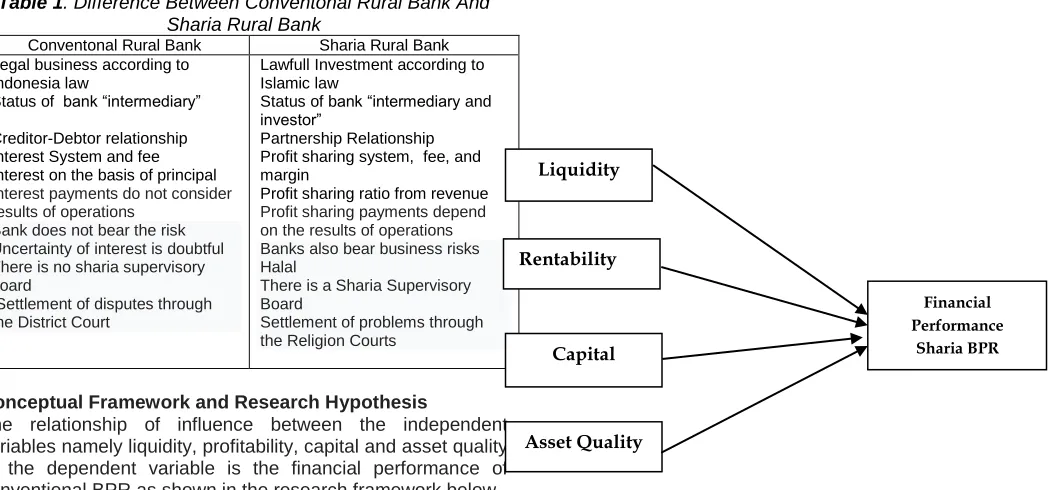
Difference Between Conventonal Rural Bank And Sharia Rural Bank
4232 Table 1. Difference Between Conventonal Rural Bank And
Sharia Rural Bank
Conventonal Rural Bank Sharia Rural Bank Legal business according to
Indonesia law
Status of bank “intermediary”
Creditor-Debtor relationship Interest System and fee Interest on the basis of principal Interest payments do not consider results of operations
Bank does not bear the risk Uncertainty of interest is doubtful There is no sharia supervisory board
Settlement of disputes through the District Court
Lawfull Investment according to Islamic law
Status of bank “intermediary and investor”
Partnership Relationship Profit sharing system, fee, and margin
Profit sharing ratio from revenue Profit sharing payments depend on the results of operations Banks also bear business risks Halal
There is a Sharia Supervisory Board
Settlement of problems through the Religion Courts
Conceptual Framework and Research Hypothesis
The relationship of influence between the independent variables namely liquidity, profitability, capital and asset quality to the dependent variable is the financial performance of conventional BPR as shown in the research framework below.
Figure 1. Research Conceptual Framework 1
Based on the explanation of the relationship between variables and the conceptual framework of the study, the hypothesis in study 1 as follows;
1. Liquidity has a significant effect on the financial performance of conventional
BPR
2. Rentability has a significant effect on the financial performance of conventional
BPR
3. Capital has a significant effect on the financial performance of conventional BPR
4. Asset quality significantly influences the financial performance of conventional
BPR
Based on the explanation of the relationship between the variables above, it can be described the relationship of influence between the independent variables, namely liquidity, profitability, capital and asset quality to the dependent variable, namely the financial performance of Sharia Rural Banks as shown in the research framework 2 below.
Figure 2. Research Conceptual Framework 2
Based on the explanation of the relationship between variables and the conceptual framework of the study, the hypothesis in study 2 as follows;
1. Liquidity has a significant effect on the financial performance of sharia BPR
2. Rentability has a significant effect on the financial performance of sharia BPR
3. Capital has a significant effect on the financial performance of sharia BPR
4. Asset quality significantly influences the financial performance of sharia BPR
Based on the explanation of the relationship between the variables above, it can be described the influence relationship between the independent variables namely liquidity, profitability, capital and asset quality that distinguishes financial performance between conventional BPR and Sharia BPR as shown in the research framework 3 below.
Figure 3. Research Conceptual Framework 3 Liquidity
Rentability
Capital
Asset Quality
Financial Performance Sharia BPR Financial Performance
Conventional BPR VS Liquidity
Rentability
Capital
Asset Quality
Financial Performance
Sharia BPR
Liquidity
Rentabilit y
Capital
Asset Quality
Financial Performance Conventiona
4233 Based on the explanation of the relationship between
variables and the conceptual framework picture of the study, the hypothesis in study 3 as follows;
1. Liquidity significantly influences the financial performance of conventional BPR
and Islamic BPR
2. Rentability has a significant effect in differentiating the financial performance of
conventional BPR and Islamic BPR
3. Capital has a significant effect in differentiating the financial performance of
conventional BPR and Islamic BPR
4. Asset quality significantly influences the financial performance of conventional
BPR and Islamic BPR
3 METHODOLOGY
The research method that will be used in this research is the quantitative method. This type of research in this research is explanatory research which is the type of research that explains the effect of independent variables (Liquidity, Profitability, Capital, Asset Quality) on the dependent variable on the financial performance of conventional BPR and Sharia BPR as well as comparative research which is the type of research aimed at explaining performance differentiating variables finance between conventional Rural Banks and Islamic Rural Banks through hypothesis testing. Hypothesis testing through statistical tests to determine and analyze the variables that affect the financial performance of Conventional Rural Banks and Islamic Rural Banks and analyze what variables that affect the differences in financial performance of conventional Rural Banks and Islamic Rural Banks in Indonesia. The type of data used in this study is secondary in the form of financial ratios and financial data that are relevant to the independent and dependent variables to be studied. This secondary data was obtained from the financial statements of conventional BPR and Sharia BPR which have been audited and published in annual reports starting in 2014 - 2018. Technical analysis of data using PLS and discriminant analysis. The analysis in this study includes descriptive statistical analysis, the classic assumption test and the hypothesis test. PLS is used to analyze the variables that affect the financial performance of Conventional Rural Banks and Islamic Rural Banks. While logistic regression analysis is used to analyze which variables influence the differences in the financial performance of Conventional Rural Banks and Islamic Rural Banks in East Java.
4 RESULTS
AND
DISCUSSION
Analysis of Conventional Rural Banks Financial Performance
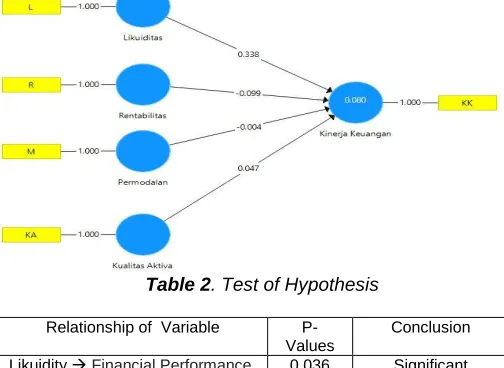
The figure below shows data analysis using PLS on hypothesis testing, to show whether liquidity, profitability, capital and asset quality significantly influence the financial performance of rural conventional bank.
Table 2. Test of Hypothesis
Relationship of Variable P- Values
Conclusion
Likuidity Financial Performance 0,036 Significant Asset Quality Financial
Performance
0,479 Non Significant
Capital Financial Performance 0,969 Non Significant Rentability Financial
Performance
0,595 Non Significant
Rule of tumbs of the support of a research hypothesis are: (1) if the coefficient or direction of the variable relationship (indicated by the original sample value) is in line with what is hypothesized, and (2) if the statistical t value is more than 1.64 (two-tiled) or 1.96 (one-tiled) and probability value (p-value) of less than 0.05 or 5%. In this case, referring to the results presented in the path coefficients menu, there is one supported hypothesis, namely: liquidity financial performance with P Values of 0.036. From these results it can be concluded that liquidity has a positive effect on financial performance, while the quality of assets, capital and profitability has no effect on financial performance. From these results it can be concluded that The R square adjusted value of all independent variables on the dependent variable is Financial Performance of 0.030 (3%). That is, the ability of the independent variable to explain the dependent variable in this research is 3% and the rest is explained by other independent variables that are not in the research model formulated in this study.
Analysis of Financial Performance of Sharia Rural Bank The figure below shows the data analysis using PLS on hypothesis testing, to show whether liquidity, profitability, capital and asset quality significantly influence the financial performance of sharia rural bank.
4234 Table 3. Test of Hypothesis
Variable Relationship P- Values Conclusion Asset Quality Financial Performance 0,295
Non-Significant LikuidityFinancial Performance 0,001 Significant Capital Financial Performance 0,291
Non-Significant Rentability Financial Performance 0,005 Significant
Financial performance with P Values of 0.005. From these results it can be concluded that liquidity has a positive effect on financial performance, as well as profitability also has a positive effect on financial performance while asset quality and capital have no effect on financial performance. The R Square Adjusted value of all independent variables on the dependent variable is Financial Pperformance of 0.361 (36.1%). This means that the ability of the independent variable to explain the dependent variable in this research is 36.1% and the remaining 63.9% is explained by other independent variables that are not in the research model formulated in this study. Financial performance with P-values of 0.001 and profitability. Rule of tumbs of the support of a research hypothesis are: (1) if the coefficient or direction of the variable relationship (indicated by the original sample value) is in line with what is hypothesized, and (2) if the statistical t value is more than 1.64 (two-tiled) or 1.96 (one-tiled) and probability value (p-value) of less than 0.05 or 5%. In this case, referring to the results presented in the Path Coefficients menu, there are two supported hypotheses, namely: liquidity
Analysis of Differences in Financial Performance between Conventional and Sharia Rural Banks
This data analysis uses logistic regression about hypothesis testing, to show whether liquidity, profitability, capital and asset quality significantly influence the difference in financial performance between conventional rural banks and islamic rural banks
Table 4. Test of Hypothesis
B S.E
. Wald df Sig. Exp(B )
95% C.I.for EXP(B)
Lower Upper Step 1a L .00
0 .01 8
.000 1 .99
8
1.000 .965 1.036
R .00
1 .01 0
.014 1 .90
4
1.001 .982 1.021
M .01
9 .02 0
.889 1 .34
6
1.019 .980 1.060
KA
-.07 2
.01 2
35.74 8
1 .00 0
.931 .909 .953
Const ant
2.2 05
1.4 64
2.268 1 .13 2
9.070
a. Variable(s) entered on step 1: L, R, M, KA.
Based on the Odds ratio (Exp (B)) and its significance it is known that only the asset quality variable is significant (0,000) while the other three variables are not significant. This shows that the only variable that has a significant influence and distinguishes between the financial performance of conventional rural banks and sharia rural banks is asset quality.
CONCLUSION
Based on the analysis of the results of the research and discussion previously described, the conclusions in this study are: (a) liquidity has a positive effect on financial performance,
while the quality of assets, capital and profitability has no effect on the financial performance of conventional rural banks; (b) liquidity has a positive effect on financial performance, as well as profitability also has a positive effect on the financial performance of sharia rural banks while the quality of assets and capital does not affect the financial performance of sharia rural banks; and (c) asset quality has a positive effect on differences in financial performance between conventional BPRs and sharia BPRs while liquidity, profitability and capital do not have a positive effect on differences in financial performance between conventional BPRs and sharia BPRs. Based on the analysis of research results, discussions and conclusions that have been stated previously, some suggestions for related parties and have implications for further research, among others; (a) for conventional rural banks management in order to improve the financial performance of conventional rural banks, then conventional rural banks management really needs to manage their liquidity, the better the liquidity of conventional rural banks financial performance is getting better; (b) for sharia BPR management in order to improve the financial performance of sharia BPR, sharia BPR management really needs to manage its liquidity and profitability, so that the BPR Sharia financial performance will improve; and (c) for management of conventional rural banks and sharia rural banks will have the same good financial performance if both of the Rural Banks are able to manage assets to be quality so that the financial performance of conventional rural banks will be the same as the financial performance of sharia rural banks
REFERENCES
[1]Adiputra, F. (2018). Effect of CAR, NPF, FDR and BOPO on profitability (ROA and ROE) at Islamic Commercial Banks (Bachelor's thesis, Jakarta: Faculty of Economics and Business UIN Syarif Hidayatullah Jakarta).
[2]Anggraini 2012. Comparative Analysis of Financial Performance of Islamic Banking with Conventional Banking (2002-2011 Period). Thesis. Makassar: Hasanudin University. http: //etd.eprints. ums.ac.id/id/eprint/28112. [3]Arikunto, S. 2013. Research Procedure A Practical
Approach. Jakarta. Deporte. Bobbi. 2005
[4]Aulia, F. and Prasetiono, P. (2016). Effect of CAR, FDR, NPF, and BOPO on Profitability (Return on Equity) (Empirical Studies on Sharia Commercial Banks in Indonesia for the period 2009-2013). DIPONEGORO JOURNAL OF MANAGEMENT, 5 (1), 1-10.
[5]Bank Indonesia. 2014. Indonesian Banking Booklet. Available: http: // www. bi.go.id/id/publikasi/ Sacrifice And Stability / Bookletbi (accessed on April 1, 2015)
[6]_____________. 2009. Bank Indonesia Regulation Number 11/23 / PBI / 2009 concerning Islamic Sharia Funding Banks.
[7]_____________. 2013. Bank Indonesia Regulation Number 15/3 / PBI / 2013 concerning Transparency of Financial Conditions of Credit Rural Banks.
[8]_____________. 2006. Bank Indonesia Regulation Number: 8/18 / PBI / 2006 Concerning the Minimum Capital Requirements for Rural Credit Banks.
[9]Cahyadi, A. T. 2010. Comparison of Financial Performance Between Rural Credit Banks and Islamic People's Financing Banks in Surabaya. Surabaya: STIE
PERBANAS. http: // ejournal.
4235 [10] Faisol, A. 2007. Analysis of Bank Financial
Performance at PT Bank Muamalat Indonesia Tbk. Four Monthly Periodical Scientific Journal. Vol. 3 No. 2 Pages: 129-170.
[11] Fatimah, S., & Sofiyani, A. (2017). Influence of Earning Assets Quality, Liquidity Ratios and Bank Sizes on the Profitability of Studies at Mandiri Syariah Banks During the 2009-2016 Period (Doctoral dissertation, IAIN Surakarta).
[12] Hadi, A. et al., 2010. Feasibility Study on the Establishment of Rural Credit Banks (BPR) in Tanah Bumbu Regency in terms of financial aspects. Journal of Management and Accounting. Vol. 2 No. 1
[13] Iswandari, Mona and Edy Anan. 2015. Financial Performance of Rural Credit Banks and Islamic People's Financing Banks: Case Study in Yogyakarta Special Region. JRAK Vol. 11 No. 1 Pages 31-45.
[14] Gift, C. (2013). Analysis of the Effect of Capital Ratio, Asset Quality and Liquidty on Financial Performance in the Banking Sector Listed on the Indonesia Stock Exchange (BEI) for the period 2007-2011. Calyptra, 2 (1), 1-17 [15] Kasmir. 2008. Banks and Other Financial Institutions.
Revised Edition, Jakarta: Rajagrafindo Persada.
[16] ______. 2012. Banking Management. Jakarta: PT. Raja Grafindo Persada.
[17] Munir, M. (2019). Analysis of the Effect of CAR, NPF, FDR and Inflation on the Profitability of Islamic Banking in Indonesia. Ihtifaz: Journal of Islamic Economics, Finance, and Banking, 1 (2), 89-98.
[18] Noviana, Y. and Erna Hernawati, E. (2013). The Effect of Liquidity, Capital Adequacy Ratio (CAR) and Institutional Ownership on Financial Performance in Foreign Exchange Banks Listed on the Indonesia Stock Exchange (IDX). Equity, 16 (2), 25-40.
[19] Nugroho, A. S. 2011. Comparative Analysis of Financial Performance of Islamic Banking and Conventional Banking. Thesis. Semarang: UNES.
[20] Financial Fervices Authority. 2014. Financial Services Authority Regulation No. 20 / POJK.03 / 2014 concerning Rural Credit Banks.
[21] Pribadi, I. S. 2013. Comparative Analysis of Financial Ratios of Conventional People's Credit Banks and Islamic People's Credit Banks in East Java. Thesis. Jember: Jember University.
[22] Rafelia, T., & Ardiyanto, M. D. (2013). The Influence of CAR, FDR, NPF, and BOPO on Bank Syariah Mandiri ROE for the December 2008-August 2012. Diponegoro Journal of Accounting, 320-328.
[23] Sandy, G. E. (2015). The Effect of Liquidity and Solvency on Financial Performance of Indonesian Banks Listed on the Indonesia Stock Exchange in 2010-2012. Jember University, Jember.
[24] Sriwahyudi, P. (2019). Analysis of the Influence of the CAR Ratio, PPAP, NPM, BOPO, LDR and IER the Financial Performance of the Banking Company Listed on the Stock Exchange.
[25] Suryani, S. (2011). Analysis of the Effect of Financing to Deposit Ratio (FDR) on Sharia Banking Profitability in Indonesia. Walisongo: Journal of Religious Social Research, 19 (1), 47-74.
[26] Wati, E. (2011). Analysis of the Effect of BOPO, NIM, GWM, LDR, PPAP and NPL on ROE in Go Public and Non
Go Public Banks in Indonesia for the 2007-2009 Period (Doctoral dissertation, Diponegoro University).
[27] Wibisono, M. Y., & Wahyuni, S. (2017). Effect of CAR, NPF, BOPO, FDR, on ROA Mediated by NOM. Journal of Business and Management, 17 (1), 41-62.
[28] Widyawati, G. N., & Djazari, M. (2017). Effects of Capital Adequacy Ratio (CAR), Non Performing Financing (NPF), Operational Efficiency Ratio (OER), Allowance for Earning Asset Losses (PPAP) and Net Operating Margin (NOM) on Profitability in Sharia Commercial Banks 2010-2015. Profita Journal: Accounting Studies, 5 (2).
[29] Umam, K. 2012. Banking Economics Jurisdiction Legislation: Synchronization of the Role of the National Sharia Board and Sharia Banking Committee. Bulletin of Justice Forum no.2 vol. 24. June 2012. p. 358