967
Assessment Of A Prototype For Application Of
Discharge Planning Using Android
Abdul Aziz Alimul Hidayat, Musrifatul Uliyah
Abstract:-Discharge planning (DP) is a form of nursing service that relies on information and education, and information technology can accelerate its delivery. The issue revolves around the delivery of the service in some hospitals that are ineffective and may fail in the long-term. Information technology can be used in discharge planning. This research assessed a prototype application installed in cellular devices to plan discharge of patients from hospitals. The study involved an exploratory and descriptive research, carried out at Muhammadiyah hospitals in Surabaya, Sidarjo and Gresik. The development of the prototype was carried out in three stages, namely defining the system, developing the data entry during work system design, and maintenance. The results showed that the application using Android bore positive results, although some of the nurses at the hospitals reported some difficulties, while others didn’t experience any problems. This application assist both nurses and patients in discharge planning, but it still can still be improved in terms of layout design, color, etc.
Keywords:- Discharge Planning, Mobile Cellular, Nursing Care, Nursing Informatics, Nursing Documentation ————————————————————
1. INTRODUCTION
Discharge planning (DP) is a form of on-going nursing services. The service includes planning for returning patients to monitoring patient care at home. Discharge planning not only involves nurses or other health teams but also involves the patients’ families. Its success depends on several factors, including involvement and participation, communication, time, agreement and consensus as well as personnel, type of hospital (education or general), patient complexity, nurses' attitudes and competencies [1]. Discharge planning upon admission to hospitals can improve the patients’ health conditions during their stay in the hospitals and help patients achieve optimum quality of life before discharge. Good discharge planning can improve the quality of patient health. Ignorance or the inability of patients and families to plan for home care after discharge can cause future health problems. This usually entails increased risk of complications and results in re-hospitalization [2, 3] Ideally discharge planning must start from the time the patient is admitted to the procedure on the day of discharge. The nurse examines all changes in the patient's condition. Moreover there must be evidence of client and family involvement in the discharge planning process. Patients should have the information needed and resources needed to return to the hospital. The nurse also prepares a resume or return planning format in detail and is given to the patient, family or community nurse. The result of research Purnamasari and Ropyanto (2012) found in Tugurejo Hospital, 39.8% of respondents in discharge planning with the category good [4]. Safrina and Nelly's (2016) showed that 67.2% surveyed in Hospital of Banda Aceh [5] stated the importance of discharge planning.
The problems revolve around poor discharge planning in
several hospitals, such as Muhammadiyah hospitals, which were not carried out comprehensively and did not include biopsychososiospiritual assessments needed for discharge planning during treatment. For patients sent from the Emergency Department, the nurses only carried out treatments according to the doctor's advice and when complaints were received from family members. After discharge, most patients found it difficult to get information about home care leading to failure in treatments, and results in the illnesses to recur. Therefore, it is important to provide solutions for the effective use of discharge planning by utilizing information technology that can be easily accessed by patients and monitored by nurses online. This study examined a prototype of discharge planning application for post-treatment in hospitals.
2. METHODOLOGY
This study took an exploratory and descriptive approach, carried out at Muhammadiyah hospitals in the cities of Surabaya, Sidoarjo and Gresik between March and August 2019. The prototype development was carried out in three stages, the first stage involved defining the system in terms of the systems to process information, the functionalities, program performance, boundaries and interfaces. The second stage looked into the data entry system design work, detailed procedures for implementation and translation to the programming language, and lastly the third stage involved maintenance, error correction and adaptation to user requirements (nurses and patients). In developing the software’s prototype, the data was obtained from nurses and patients’ records treated in the hospitals. The technological tools used to develop the software were Program languages, JavaScript; Bootstrap framework; Production server, Web Server and Database Management System. Once the software is implemented, the nurses were trained to use the device and asked to assess the prototype. The nurses selected had more than 2 years’ work experience, and had never taken a course or training in information technology. To assess the suitability of the cellular protocols with the reality of the hospitals, respondents were interviewed to gauge their opinions about the use of the system, the prototype’s importance and suggested improvements. Data were analyzed qualitatively and via content analysis. In term of the research ethics, this study was approved by the Ethical Review Board (EB)
______________________________________
Dr. Abdul Aziz Alimul Hidayat*, Departement of Nursing, Faculty of Health Sciences, University of Muhammadiyah Surabaya, Jl. Sutorejo No. 59 Surabaya, 60113 Indonesia.
Mrs. Musrifatul Uliyah, Departement of Nursing, Faculty of Health Sciences, University of Muhammadiyah Surabaya, Jl. Sutorejo No. 59 Surabaya, 60113 Indonesia.
Committee of the UM (Surabaya, Indonesia; ERB No. 417/2019. The study obtained participants’ consent using participation consent forms with statements that allowed participants to withdraw from the study at any time, the collected data would only be used for research purposes, and their anonymity protected. The participants were also briefed prior to giving consent voluntarily.
3. RESULTS
The results showed that there were two phases of the research, namely the development of the prototype followed by the assessment of the prototype for mobile devices. The prototype was developed using the patients’ database and nurses selected from units that have been validated. These served as the empirical data used for analysis, to identify the patients treated and those who can be discharged from the hospital. The trial data used in the discharge planning application came from patients’ data treated at the hospitals. Figure 1 shows the components of the discharge planning application system.
Figure 1. Components of the discharge planning system
with functions according to the type of system users
The system has two types of users, namely user-administrator i.e. the nurses and the patients. The administrator function controlled by the nurses manages account settings, patient data input, and discharge planning input and patient monitoring. The account settings function selects a username and password for the patient; input their identity data such as gender, age, patient address, medical diagnosis, nursing diagnosis, control date (repeat visit), time of return visit, hospital discharge date. Other data are also needed for discharge planning such as health education, food, diet, preparing medicine, taking medication, bathing, dressing, transportation, mobilization, wound care, insulin injection, nasogastric tube (NGT) treatment, catheter care, toileting, and other information/status of patients such as recovering, forced to go home, move to another hospital, and otherThe patient monitoring function facilitates inputs like monitoring the medication plan, monitoring treatment, monitoring care plans, monitoring health education plans, monitoring visit / re-control plans, and monitoring diet plans. Inputs for
monitoring the medication plan include the name of the drug, the time to administer the drug, the intended use of the drug, the dosage, the side effects and the record of treatment. Inputs for monitoring the treatment plan, care plan include the type of treatment, care, date of administration, dose, and nurse records. Inputs for monitoring health education plan includes topics on health education, time of delivery and health education videos, and nurse’s notes. Inputs for monitoring visits, control plan to hospitals include the date of re-visit, control, place, room, and parts of hospital, hospital name and nurse's note. Input for diet plans include monitoring dates, types of diet to be avoided, types of diet to consume, and treatment records. Figure 2 shows the nurses menu display of the application.
Figure 2. The nurse menu display of the discharge
planning application
969
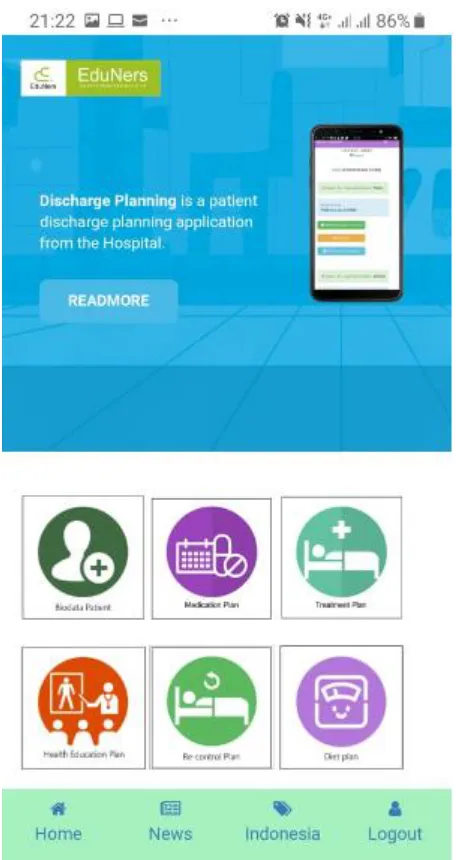
treatment, dosage, and nurse’s notes. The health education plan menu include the topics in health education, date and time of health education provision, health education videos and nurse’s notes. The re-control plan menu includes the date and time of the plan, place / room / section / unit, hospital’s name, and nurse’s notes. The diet plan menu include the diets to be avoided, diets to be consumed, the number / dosage of administration, video / picture examples of diets to be avoided and consumed and nurse's notes. Figure 3 shows the the patient menu display.
Figure 3. The patient menu display of the discharge
planning application
Nurses use the system to perform various functions, to provide a username and account for patients, to input their personal data, to input their discharge planning data. The patient's application enables patients to log-in with their own usernames and passwords provided by nurses, to assess medication plans, monitoring treatment plans, monitoring health education plans, re-control plans, and diet plans. To assess the applications in the system installed on mobile devices, interviews were conducted with five nurses. They were asked to assess the prototype based on three
categories namely, difficulty in using the system, the importance of the system, suggested modification for practical application. For category 1, the difficulty in using the system [...] I find it difficult because I am not an expert in information systems, but ... I can overcome it by accessing and reading the instructions [p1]; [...] This is the first time I have used a system/application for discharge planning that is unknown to me, so I initially had a bit of trouble (p2); [...] Not too difficult, I find it easy because there is prior information [...] I certainly can make use of the system and it helps me provide better services (p3); [...] I didn’t experience any difficulty using the system and it is almost similar to other applications used in areas outside nursing (p4) [...] It is very easy for me to use (p5). The results showed that there were some nurses who experienced difficulties due to lack of experience in the use of information technology, the fact that they have never used it in nursing, but other nurses found it easy to use because it worked like most other applications. Category 2: recognizing the importance of the prototype system, [...] This smartphone and tablet gives freedom in providing patient planning wherever they are, this system needs to be developed continuously (p1); [...] With this smartphone I can go anywhere and monitor patients who have been discharged, and all nurses will be happy to use it (p2); [...] I have time to manage patients’ return planning and I can work better (p3); [...] I think nurses will be more organized in their work especially in discharge planning and will follow these steps (p4); [....] The fact that this system provides flexibility for nurses to manage patients going home, without taking up additional resources (p5). The respondents' statement showed that the nurses saw the importance of using the prototype system for discharge planning via smartphones. They found it easy to use, making them more effective, flexible in term of time and relieve their workload especially in documenting return planning. Category 3: suggestions for system modification for daily use as per the following respondent's statements: [...] To improve color visualization by adding more colors so it is more comfortable to see (p1); [....] Variations/alternatives in the menu especially for the health education function through videos and posters (p2); [...] Provide timely notifications to nurses making easy to remember tasks, and also notifications in the patient's menu (p3); [...] Provide information related to aspects of drug use, aspects of treatment, topics in health education, and diets (p4 ); [...] Provide patients’ personal and illness history to document relationships with drug planning, medication, foods to be avoided, via the report menu for ease of documentation (p5).
5. DISCUSSION
play because it can help speed up nursing services [7, 8]. However, this study found that some users still lack the ability to use the computerized online discharge planning system properly. Nurses were reluctant to use the system, even though they use smartphones daily, because they found it difficult to adapt to the system installed in their cellular devices [9]. The use of discharge planning systems via smartphones still has its own detractors, however with confidence its use in nursing will improve. This will help patients everywhere, as users gradually overcome the difficulties of using smartphones in discharge planning. Previous research like Kirwan (2012) demonstrated the use of applications in smartphones to improve nursing or health services in monitoring physical activity [10]. Celler (2003) showed that the use of information technology can improve chronic disease management [11]. Discharge planning needs to be manage by nurses both conventionally and by utilizing information technology through the use of online applications[12]. Researches have shown that discharge planning has an impact on patients, including the impact of patients’ readiness to leave the hospitals, length of stay and bed occupancy rate [13-17]. The study found that mobile devices are relatively easy to use compared to other devices. Mobile devices benefit users in terms of flexibility and effectiveness. The surveyed nurses made some suggestions to improve visualization in term of use of colors. They also suggested that additional/alternative information are provided pertaining to health education information in the form of videos or leaflets / brochures. The study concludes that the use of online-based discharge planning applications can contribute to nursing, and provide opportunities for nurses to develop professional competencies in addition to competencies in digital literacy. This will further help them to deal with new technologies, and other developments in the nursing profession.
6. CONCLUSIONS
This research entails the development of a system to enable nurses to provide improved, focused and continuous discharge planning services through the use of smartphones or other mobile devices. The research revealed that nurses had difficulties using cellular devices; however, the nurses felt that the system installed in the smartphones can still benefit them in terms of flexibility and to speed up discharge planning. The system also helps patients to take actions related to their care or activities after returning home.
Acknowledgments
We gratefully acknowledge the support of the Ministry of Technology Research and Higher Education of the Republic of Indonesia for funding this research.
REFERENCES
[1] S. Chalmers and E. Coleman, "Transitional care in later life: Improve the move," Generations, vol. 30, no. 3, pp. 86-89, 2006.
[2] P. A. Potter and A. G. Perry, Fundamentals of nursing. Mosby, 2005.
[3] N. Jannah, T. Sukartini, and A. A. A. Hidayat, "Discharge planning model with approach of method in improving patients’ readiness for discharge in hospitals," Indian Journal of Public
Health Research and Development, Article vol. 10, no. 1, pp. 288-292, 2019.
[4] L. D. Purnamasari and C. B. Ropyanto, "Evaluasi Pelaksanaan Perencanaan Pulang," Jurnal Keperawatan Diponegoro, vol. 1, no. 1, pp. 213-218, 2012.
[5] N. Safrina and A. Putra, "Persepsi Perawat Pelaksana Terhadap Pentingnya Discharge Planning Di Rsudza Banda Aceh Nurse’S Perception of the Importance of Discharge Planning in Rsudza Banda Aceh," Jurnal Iilmiah Mahasiswa Fakultas Keperawatan, vol. 1, no. 1, pp. 1-9, 2016.
[6] G. Rouleau, M.-P. Gagnon, J. Côté, J. Payne-Gagnon, E. Hudson, and C.-A. Dubois, "Impact of Information and Communication Technologies on Nursing Care: Results of an Overview of Systematic Reviews," (in eng), Journal of medical Internet research, vol. 19, no. 4, pp. e122-e122, 2017.
[7] M. Gholizadeh, A. Janati, B. Delgoshaei, H. A. Gorji, and S. Tourani, "Implementation Requirements for Patient Discharge Planning in Health System: A qualitative study in Iran," (in eng), Ethiopian journal of health sciences, vol. 28, no. 2, pp. 157-168, 2018.
[8] M. Gholizadeh, B. Delgoshaei, H. A. Gorji, S. Torani, and A. Janati, "Challenges in Patient Discharge Planning in the Health System of Iran: A Qualitative Study," (in eng), Global journal of health science, vol. 8, no. 6, pp. 47426-47426, 2015. [9] C. Urquhart, R. Currell, M. J. Grant, and N. R.
Hardiker, "WITHDRAWN: Nursing record systems: effects on nursing practice and healthcare outcomes," (in eng), The Cochrane database of systematic reviews, vol. 5, no. 5, pp. CD002099-CD002099, 2018.
[10]M. Kirwan, M. J. Duncan, C. Vandelanotte, and W. K. Mummery, "Using smartphone technology to monitor physical activity in the 10,000 Steps program: a matched case–control trial," Journal of medical Internet research, vol. 14, no. 2, p. e55, 2012.
[11]B. G. Celler, N. H. Lovell, and J. Basilakis, "Using information technology to improve the management of chronic disease," Medical Journal of Australia, vol. 179, no. 5, pp. 242-246, 2003. [12]A. A. A. Hidayat, M. Uliyah, Sukadiono, and
Taufiqurrahman, "Information system model of discharge planning based on android in hospital," International Journal of Civil Engineering and Technology, Article vol. 9, no. 10, pp. 941-948, 2018.
[13]A. Wahyuni, E. Nurrachmah, and D. Gayatri, "Kesiapan pulang pasien penyakit jantung koroner melalui penerapan discharge planning," Jurnal keperawatan indonesia, vol. 15, no. 3, pp. 151-158, 2012.
971
[15]K. H. Bowles, A. Hanlon, D. Holland, S. L. Potashnik, and M. Topaz, "Impact of discharge planning decision support on time to readmission among older adult medical patients," Professional case management, vol. 19, no. 1, p. 29, 2014. [16]M. U. Majeed et al., "Delay in discharge and its
impact on unnecessary hospital bed occupancy," BMC health services research, vol. 12, no. 1, p. 410, 2012.