Effects of Non-linear Composite Barriers on Tree
Growth in Solid Insulation
Abdur Rashid
*, Faisal khan
*,Syed Riaz ul Hassnain
*Comsats Institute of Information and Technology, Abbottabad, Pakistan University of Engineering and Technology, Abbottabad, Pakistan
Abstract-- The consequences of zinc oxide (ZnO), Aluminum oxide (
3 2O
Al ) and Titanium oxide (TiO2) on tree growth have been comprehensively investigated in this paper. Zinc oxide (ZnO), II-VI compound semiconductor, is used in varistors in power insulation life. Due to its excellent electrical properties such as nonlinearity of current-voltage (I-V) characteristics, high fast-transient response and high discharging capability, it is extensively used in polymeric insulation materials. Titanium oxide (TiO2) polycrystalline is used in electronic devices as varistor (voltage dependent resistor). Titanium oxide is also used for surge arrester applications due to its nonohmic behavior. In present work, zinc oxide (ZnO) and titanium oxide (TiO2) are used in clear polyester resin as barriers. High voltage 28kV rms is applied. Polariscope is used to investigate the behavior of growth of tree on regular intervals. The results of zinc oxide (ZnO) barrier specimens are compared with titanium oxide (TiO2) barrier specimens. When zinc oxide (ZnO) barrier and Titanium oxide barrier specimens were tested, the life time of zinc Oxide barrier was more than the titanium oxide barrier. It is experimentally proved that by using semi conducting filler material with nonlinear conductivity characteristics can raise resistance against electrical tree propagation.
Index Term-- Zinc oxide, Titanium oxide, Insulation, Barrier, Electrical tree
I. INTRODUCTION
The resistance of silver sulphide varied with te mperature was discovered by Michael Faraday in 1833. This was the base knowledge of linear resistors but later on practical non-linear resistors were produced by many electronics industries. The value of linear resistance does not change by changing temperature, light, potential, etc but in non -linear resistor, the value of resistance changes to a la rge value by changing these parameters. The in itia l ra w materia ls, the physical size of the component and the manufacturing methods determines the electrical properties of non –linear resistance [1]. Vo ltage sensitive is the ma jor type of non -linear resistors; their resistance decreases as the applied voltage increases. Zinc oxide is non-linear resistor, most s uitable for surge suppression. Zinc oxide (Zn O) is used in varistors to increase insulation life where its conductivity is imp roved by the reaction of Bi2O3, Co O, MnO, Cr2O3 and Sb2O3. Titanium oxide is also used as varistor (voltage dependent resistor) fo r surge arrester applications due to nonohmic behavior reported by Yan and Rhodes [2]. In recent years, research has been
undertaken into properties of polymeric insulation materia ls containing zinc oxide and titanium oxide fillers.
When the filler volu me fraction goes beyond the percolation threshold, then inclusion of (Zn O) in epo xy resin is capable of producing non-linear conductivity reported by Donnelly and Varlow [3]. Electrical transport measure ments have been carried out on indiv idual Zn O nanowires and nanorods. Single ZnO nanowire was config.d as field effect transistor (FET) subsequent numerous procedures [4] [5]. The mechanical, electrica l and other properties of ZnO we re e xp la ined by Zhiyong Fan and Jia G. Lu[6].
Zinc oxide has high melting point and when used with polyester resin, it has high work of adhesion. The V-I Characteristics of ZnO is very significant on the protection scheme of metal-oxide surge arresters, which keeps power equipment safe against surges reported by Jun Hu, Jinliang He and Qingheng Chen[7].
Titaniu m o xide is also used as varistor devices, contributing a huge collection of opportunities supported on control of grain ma rgin characteristics and of barrier layers. Despite of nonohmic properties, Titaniu m o xide can be used for ce ra mics insulator and barrier layer capacitors [8]. Titaniu m o xide has high work o f adhesion, surface energy and melting point. When ZnO and TiO2 are added to polyme ric insulation materia ls, they show non-linear behavior. In this work, Zn O and TiO2 are used as barriers in Po lyester resin and electrica l trees, time to breakdown are investigated.
The growth of trees was inhibited by the Aluminu m o xide particles used as a barrier, reported by Auckland, Rashid and Varlow [9].Zinc o xide and titaniu m o xide have high physical properties (me lting point, work of adhesion) making it analogous to alu minu m o xide as much as its mechanica l resistance to tree growth is concerned.
II. MATERIALS AND METHODS
Zinc Oxi de: Zinc Oxide used was 99% pure with 1% impurity of unknown materia ls, mixed with polyester resin. Point-Plane electrodes specimens having separation distance 3mm we re made. Ba rriers of Zn O materia l were formed between point/plane specimens.
Titanium Oxi de: Titaniu m o xide was used as barrier.
Titaniu m o xide has high surface energy so it adheres we ll to the polyester resin and its work of adhesion is also high.
Aluminium Oxide: Aluminum oxide (black powder form)
was used as barrier. Due to its high surface energy, aluminum oxide adheres well to polyester. Work
of adhesion and fracture toughness of aluminum oxide are also high.
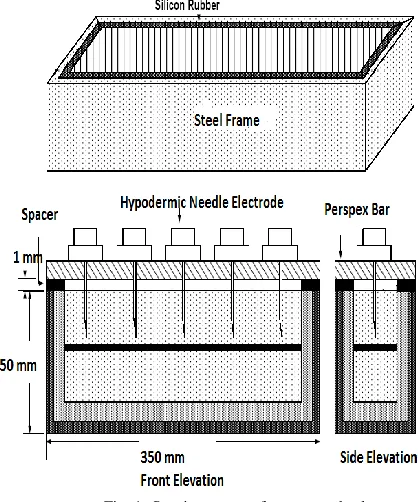
Specime n Design: Point plane specimens of polyester resin were prepared which had 1% hardener by volume. Hypodermic needles with 5 μm radii tip were pointed enough to sustain tree growth and easily availab le, used as point electrode. The needles were fixed to the Perspe x bar which was covered by adhesive rubber.
Steel fra me was used for silicon mould to cast specimens in strips of silicon mould as shown in Fig. 1.For optica l observation, melinex was used to crease the wall of mould.
Fig. 1. Specimen manufacture method
The specimens we re p repared in two phases. In phase one, a layer of polyester resin appro ximately 4mm deep was caused to flow into the bottom of the mould and permitted to lay down. ZnO and TiO2 partic les of required size were mixed with po lyester resin to ma ke layer and transferred on the top of hardened surface of polyester resin. The particles to
polyester resin ratio were 5:100 by volu me. The part icles sank and settled at the solid resin surface form thin layer. When the resin hardened, the particles co mbined to form a barrie r laying approximately 0.7mm be low the tip o f needle. The hypodermic needles we re then suspended in the mixture . The upper resin layer was permitted to hard fo r 24 hours at roo m temperature. The specimen bar was then separated fro m the mould and allowed to cure for three hours at 80 degree centigrade in an oven. The specimen bar was allowed to cool at room te mpe rature. The specimen bar was then cut to ma ke 5 specimens and was drilled opposite the needle tip, to a depth which gives separation of 3mm between the two electrodes. The drilled surface was covered with a lu min iu m foil to form other electrode. A co mpleted specimen is shown in fig. 2(a). High voltage 28kV A.C, 50Hz was then applied in the form of burst through counter and number of cycles were counted by counter applied to each specimen.
Fig. 2(a). Point plan Specimen containing barrier
High Voltage Test Equi pment: The high voltage test
apparatus used is shown in Fig. 2(b). 220/100kV, 50 Hz single phase step up transforme r supplied by variab le ratio transformer variac via a triac TR made active by a control unit. Applied voltage was managed by auto transformer wh ilst the control unit synchronized the nu mber of cycles (1 to 9999) applied.
Comparator Input Counter
IC
TW Thumbwheel switch Isolator
Display
220 VAC
Squarer Low Voltage Transformer
S
Output
V
HT
Fig. 2(b). Block diagram High voltage apparatus
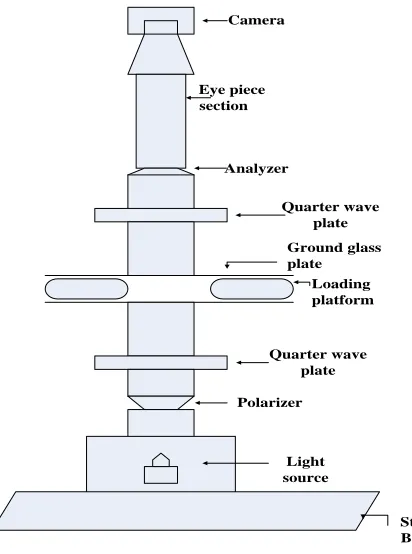
strain samples within polyester resin. Crossed circular type polariscope was used in this work and is shown in Fig. 3. Brightly coloured fringe samples are vie wed due to white light source used within a c ircu lar pola riscope. These colo ured fringes are shapes of equal relative retardation.
Camera
Eye piece section
Analyzer
Quarter wave plate
Ground glass plate
Loading platform
Quarter wave plate
Polarizer
Light source
Steel Base
Fig. 3. The Circular Polariscope
V-I Charac teristics Measureme nts: The voltage against
current characteristics of zinc o xide, alu minu m o xide and titanium o xide barrie rs were measured. Bronze electrode of rectangular shape, having dimensions of length 36*25mm and thickness of 7mm were used to cast these layers. The lower electrode had a rest on the base of silicon mould.
The other electrode was fastened to a rod having string which rotated into a tapped gap in a beam resting on a casing above the mould top. The required electrode space was attained by rotating the upper electrode downward t ill it contacted the lower electrode. The rod having string was then turned in the reverse direction till the space of 1.5mm was achieved; in each case. Particle filled resin was then put into the mould. The resin was separated fro m the mould and allo wed to cure for three hours at 80 degree centigrade in an oven. The resin was then permitted to cool at room temperature.
The V-I characteristics of zinc o xide, a lu minu m o xide and Titaniu m o xide were attained using a dc voltage source of 15kV, 2mA. Resistor connected in series with dc voltage source was used to limit the current. The resultant current was shown by digital a mmeter when the voltage rose. The voltage was increased mo re in steps and resultant current readings
were recorded at every step till the ma ximu m va lue of the voltage source was attained. Fig. 4 shows the V-I characteristics of zinc o xide. The same process was imple mented for measuring V-I characteristics of Titaniu m oxide and aluminum oxide.
Fig. 4. Specimen design for V-I measurement
III. EXPERIMENT AL MET HOD
Polyester resin with out barrier was tested for a group of 10 identical specimens. Then particles of different materia ls used as a barrier in polyester resin we re tested for a group of 10 identical specimens. Brass electrodes were used to cla mp each specimen between them shown in Fig. 5. Pentane was pored into the cell to suppress extraneous discharges. 28 kV rms test voltage was applied because it caused breakdown at hypodermic needle tip. Using polariscope, the gap between electrodes was exa mined for tree growth. Polariscope was also used to take photographs of tree growth through camera built up on the eye piece.
IV. RESULTS AND DISCUSSIONS
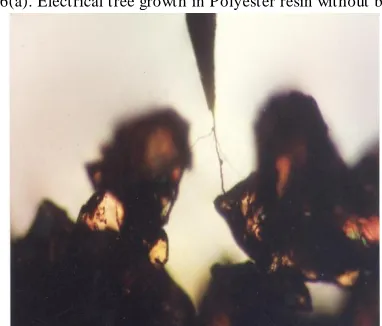
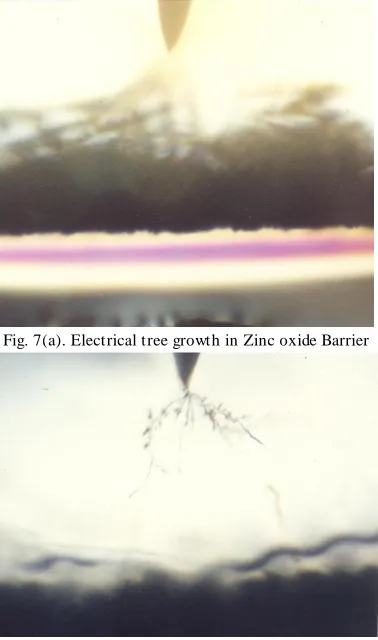
When 7,040 cycles we re applied to polyester resin without barrie r, it broke down .Fig. 6(a ) shows tree growth in polyester resin without barrier. Polyester resin specimens with alu minu m o xide barrier we re tested. Fig. 6(b ) shows tree growth in polyester resin with alu minum o xide barrier. When a tree hit the barrier, the paths of tree increased in size due to discharge activity. Polyester resin specimens with zinc oxide barrie r were tested. When 270,000 cycles were applied, none of the specimens broke down. It is due to the reason that when the tree struck the barrier, it diffused and further movement stopped. Hence did not reach the ground electrode. Fig. 7(a ) shows tree growth in the presence zinc oxide barrier. Specimens were again made by the same procedure but the separation distance between point-plane electrodes were approximately 2mm.The applied test voltage was 28 kV 50Hz.When 174,000 cycles were applied, the tree penetrate the zinc oxide barrier and caused breakdown.
Ten specimens of polyester resin having titaniu m o xide barrie r was tested to found their lifetime in the occurrence of tree growth. Each specimen g ives a separation of 3mm between the point-plane electrodes. Fig. 7(b) shows tree growth in the presence titanium o xide barrier. Polyester resin without barrie r, polyester resin with a lu minu m o xide barrie r, zinc oxide barrier and titanium o xide barrier were tested. Table I shows the results of diffe rent specimens. Fro m table I, it is understandable that the life time of zinc o xide barrier is much greater as compared with other specimens having different barrier materials.
TABLE I
Specimen Average Life
time
Mean Cycles to Breakdown
Polyester resin 140.8 sec 7040
Polyester with aluminum oxide barrier
3425.8 sec 171290
Polyester with zinc oxide barrier
3852 sec 192600
Polyester with titanium oxide barrier
260.8 13040
Diffe rent tree growth behavior was observed, although initiat ion time of tree and growth towards barrier was approximately sa me. In the filled resin no such action could be e xa mined within the material. Electrical tree could be seen when the tree penetrated the clear resin close to the plane electrode. Zinc o xide (ZnO) filled resin lifetime is about is fifteen times greater than titaniu m o xide (TiO2) when both are compared.
In the case of zinc oxide (ZnO) barrier, when a tree struck the barrie r its growth was inhibited by barrier. It was noted that the size of tree paths increased due to discharges when further growth of tree was stopped by titaniu m o xide and other barrie rs. Spreading of Electrical tree a long the barrier resin was also observed when tree regenerated in the direction of barrier.
The lifetime of zinc o xide (Zn O) specimen was higher than Titaniu m o xide (TiO2) barrier, but finally broke down. Zinc oxide (ZnO) had no direct connection with the electrode where high voltage was applied but only connection was through the tree paths. Increase in local temperature and therma l degradation around the pin t ip was may be the ma in reasons of specimen breakdown.
Fig. 4 e xp lains V-I characteristics of zinc o xide (ZnO). Up to 6 kV no current was flowing, later on a sma ll a mount of micro a mperes we re noted. When the voltage was increased to 7 kV the current raised speedily to millia mps. Many authors have been recommended theories to enlighten conduction in zinc o xide (Zn O) mostly for the materia l utilized in Varistors, which includes about 96% Zn O and 4% other o xides such as
bismuth oxide, manganese oxide, ca lciu m o xide, antimony peroxide and chromium oxide.
Fig. 6(a). Electrical tree growth in Polyester resin without barrier
Fig. 7(a). Electrical tree growth in Zinc oxide Barrier
Fig. 7(b). Electrical tree growth in T itanium oxide barrier For Zinc oxide (ZnO) Varistor conduction the main theories are
Simple tunneling.
Space- charge – limited current
Thermal activation over double Schottky barrier Avalanche breakdown
Brea kdown in se miconductor junction frequently continue by means of avalanche mult iplication. The current -voltage relation re lated with the brea kdown process are enormously sharp and be in contact in many situations to the alpha carrier mu ltip licat ion factor of 1000. Avalanche -mode is described by positive temperature coefficient (PTC) thermistors of breakdown voltage. Zinc o xide (Zn O) Voltage dependent resistor reveals a negative temperature coefficient (NTC). In an insulator, when an ohmic contacts is provided result space-charge limited process. This theory is valid for e xplanation of additives on the non -ohmic behavior. Currently, it has been described that conduction mechanis m in the voltage region between the threshold voltage between non -linear and the -linear pa rts of the V-I re lation follows the thermally activated Frenkel-Poole law of the Schottky barrier. Expe rimental results, such as the effect of different barrie r materia ls and the irregular degradation of voltage-current relation were not explained by these theories.
In our research work 99% pure zinc o xide (Zn O) with 1%
contamination of unidentified co mposition and titanium o xide (TiO2) mixed with polyester resin. It is understood that the semiconductor-insulator –semiconductor composition work as inter grainy sheet sandwiched between the Schottky barrier created at the surface of n-type semiconductor zinc o xide (ZnO) grains and titanium o xide (TiO2) gra ins. When the voltage is in itia lly increased, no current flows in the circuit and the material act as an insulator.
The energy is not sufficient to cross the barrier of the polyester resin, supplied by source. When the voltage is further raised to a level, conduction electrodes in ZnO attain enough energy and insulation barrier is not capable to inhibit electrica l tree gro wth. After that the current rise rapid ly and shoot from micro to milli a mpere level. Both zinc o xide (ZnO) and titaniu m o xide (TiO2) have characteristics of typ ical solid breakdown.
At the start, no current flo wing is observed but when voltage is increased further causing breakdown of whole specimens.
V. CONCLUSIONS
The present research work is main ly focused to exa mine e ffect of non-linear co mposite barrie rs on electrical tree ing. Zinc oxide (ZnO) and Titaniu m o xide ((TiO2) used in point plan electrode as a barriers .The following results have been achieved.
The life t ime of the zinc o xide filled resin is fifteen times greater than titanium o xide which is very high. Identical cycles to brea kdown were observed after the penetration in both cases.
In the case of Zn O barrier and TiO2 barrie r specimens, when tree struck the barrier, the growth of tree inhibited, due to zinc o xide and titaniu m o xide conduction particles in the surrounding area in accordance with the V–I characteristics.
ZnO is very useful to inhibit the growth of electrical trees. Although, TiO2 has high surface energy, work of adhesion, melting point but low fracture toughness. Some other materials should be added to increase its fracture toughness. It may yields better results to inhibit the electrical tree if titanium oxide is doped with small quantity of aluminum because the non-linear coefficient will increas e.
FUTURE WORK
titanium o xide is doped with sma ll quantity of alu minu m because the non-linear coefficient will increase fro m β=3-4 to β=7.
Tin d io xide having che mical formu la
SnO
2 is an inorganic materia l .It a lso shows non-ohmic behavior. It can be used as a barrie r in polyester resin. Tin dio xide propert ies show that when it is densified in the presence of cobalt o xide (CoO), the non-ohmic behavior inSnO
2.CoO-based systems can be as good as that achieved in ZnO.REFERENCES
[1] K. W. Stanley, “Non-linear resistors” Vol. 43. No. 10, October 1973. [2] Yan MF, Rhodes WW. “Preparation and properties of TiO2 varistors”
Applied Physics Letters. 1982.
[3] Donnely, K.P. and B.R Varlow, 2003. Non linear dc and ac conductivity in electrical insulation composites IEEE Transtraction on Dielectric and electrical insulation, 10(4): 610-614
[4] P. Chang, Z. Fan, W. T seng, D. Wang, W. Chiou, J. Hong, J. G. Lu, Chem. Mater. 16, 5133 (2004).
[5] H. Chik, J. Liang, S. G. Cloutier, N. Kouklin, J. M. Xu, Appl. Phys. Lett. 84, 3376(2004).
[6] Zhiyong Fan and Jia G. Lu“ Zinc Oxide
Nanostructures: Synthesis and Properties” 22 April, 2005 [7] Jun Hu, Jinliang He, Qingheng Chen“High Voltage Gradient ZnO
Nonlinear Resistor Doped with Rare-Earth Oxide” IEEE, pp. 963-966, 2006.
[8] Paulo Roberto Bueno,Jose Arana Varela, “ Electronic ceramics based on polycrystalline SnO2, TiO2 and (SnxT i1-x)O2 solid solution”Mat.
Res. vol.9 no.3 July/Sept. 2006.
[9] Auckland, D.W., A. Rashid and B.R. Varlow, 1995.