FORMULATION AND EVALUATION OF ELETRIPTAN HYDRO-
BROMIDE MICROSPHERES BY USING NATURAL POLYMERS
R.Manivannan*, Mahaboob Ali Baig, 1M.Purushothaman and N.Senthil kumar
Department of Pharmaceutics, JKKMMRF’s- Annai JKK Sampooraniammal College of Pharmacy, Ethirmedu, B.Komarapalayam, Namakkal (DT), Tamilnadu, India. 1
Department of Pharmaceutics, Aadhi Bhagawan College of Pharmacy, Cheyyar (TK), Thiruvanamalai (DT), Tamilnadu, India.
Date Received: 16-Mar-2014
Date of Accepted: 13-Apr-2014
Date Published: 15-Apr-2014
Abstract:
Purpose: The aim of present work to develop competent and efficient sustained release microspheres of Eletriptan hydrobromide, prepared by Ionotropic gelation technique in order to reduce the frequency of administration and achieve patient compliance.
Method: Microspheres of Eletriptan hydrobromide were prepared by Ionic gelation method using natural polymers like sodium alginate, chitosan, karaya gum and guar gum. The morphology, particle size distribution and production yield were investigated. Release of Eletriptan hydrobromide was evaluated by In-vitro dissolution method using USP type I apparatus.
Result: Results showed that microspheres were spherical, discrete in shape. The percentage yield of the prepared microspheres was found to be 80.46% to 87.12%. Particle size distribution of the prepared microspheres was in the range of 487.0 – 802.5µm. In-vitro release studies revealed a controlled release of microspheres suitable for preoral administration. Formulation FEC1 showed 90.82% ± 0.26 of drug release for 12 hours in predetermined rate.
Conclusion: Based on the results the formulation FEC1 was found to be best when compared to other formulations.
Keywords: Eletriptan
, Chitosan, SEM analysis and in-vitro studies.Introduction
Drugs that are easily absorbed from the gastrointestinal tract (GIT) and having a short half-life are eliminated quickly from the blood circulation, so they require frequent dosing. To avoid this drawback, the oral sustained-controlled release formulations have been developed in an attempt to release the drug slowly into the GIT and maintain an effective drug concentration in the serum for longer period of time. Novel drug delivery systems that can precisely control the release rates or target drugs to a specific body site have had an enormous impact on the healthcare systems. However problem frequently encountered with controlled release dosage forms is the inability to increase residence time of the dosage at the site of absorption. Such oral drug delivery devices have a restriction due to the gastric retention time (GRT), a physiological limitation.
Microsphere drug administration offers a number of advantages in therapeutics, where the controlled releases of drug delivery as well as the predictable and reproducible drug release kinetics are important feature of them.
The present work is to develop competent and efficient sustained release microspheres of Eletriptan hydrobromide, prepared by ionotropic gelation technique inorder to reduce the frequency of administration and achieve patient compliance. The prepared microspheres were evaluated by particle size determination, drug entrapment efficiency, in-vitro drug release studies.
Materials and Methods: Materials:
Eletriptan hydrobromide drug is the gift sample from Hetero drugs ltd, Hyderabad. Sodium alginate and Calcium chloride from Thomas baker chemicals, Mumbai. Guargum, Chitosan from Yarrow chem. Products, Mumbai. Karayagum from cochin fisheries, Cochin. Liquid paraffin from fine chem chemicals, Chennai. N-hexane from hi pure fine chemicals Chennai.
Methods:
Determination of λλλλmax (UV-Spectroscopy):
Standard solution of Eletriptan was prepared by taking 10mg of Eletriptan and add small amount of ethanol and make up the volume with phosphate buffer pH 6.8 upto 10ml. The final concentration of standard solution of drug is 1µg/ml. A solution of 1µg/ml of Eletriptan was scanned by using UV spectrometer in the range of 200-400nm to get the λmax of Eletriptan.
Preparation of microspheres of Eletriptan hydrobromide:
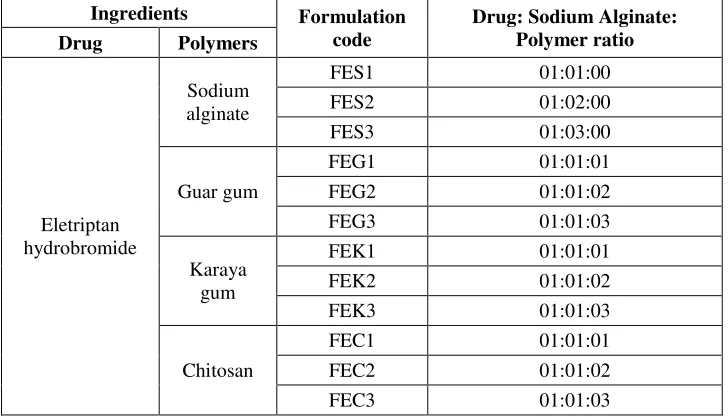
Alginate microspheres containing Eletriptan hydrobromide were prepared by emulsification ionic gelation technique. Sodium alginate and copolymers were dispersed in deionised water (30 ml) separately with continuous stirring to form homogenous polymer dispersion and both the dispersions were added in different ratio as mentioned in formulation chart. Eletriptan hydrobromide was added to polymer dispersion and mixed thoroughly to form a viscous suspension. The dispersions were sonicated for 30 minutes to remove any air bubbles that may have been formed during stirring. The stream of smooth viscous suspension was added to light liquid paraffin in the form of a thin stream. Stirring of the above mixture was done in a beaker placed on mechanical stirrer. Then 100 ml of calcium Chloride solution (5% w/v) was added slowly while stirring for ionic gelation reaction. The stirring was continued for 15 minutes. The mixture was allowed to settle and product was separated. Obtained microspheres were washed several times with n-hexane to remove the adhering paraffin and dried in room temperature (Table 1).
Evaluation and characterization of prepared
microspheres
Production yield (%):
The production yield of microspheres of various bathes were calculated using the weight of the final product after drying with respect to the initial weight of the drug and polymer used for the preparation of microspheres and percentage production yield was calculated as per the following formula:
Percentageyield %
= Practicalmass Microspheres
Theoriticalmass Drug + Polymer × 100
Particle size analysis:
Particle size of prepared microspheres was determined by optical microscopy. The optical microscope is fitted with an ocular micrometer and stage micrometer. The eyepiece micrometer
was calibrated. The particle diameters of more than 200 microspheres were measured randomly.
Shape and surface morphology:
The shape and surface characteristics of the prepared microspheres were evaluated by means of scanning electron microscopy. The scanning electron microscopy samples were prepared by lightly sprinkling the microspheres powder on a double adhesive tape, which is stucked to an aluminium stub. The stubs were then coated with gold using a sputter coater under high vacuum and high voltage to achieve.
In-vitro drug release studies:
The in-vitro drug release of Eletriptan hydrobromide from formulated tablets was carried out in acid buffer pH 1.2 for 2 hours and then continued in phosphate buffer pH 6.8 for 10 hours. The studies were performed in USP dissolution apparatus I, (Dissolution Test Apparatus, Model DS 8000, Lab India Pvt Ltd) at 37 ± 0.5° C and 100 rpm speed. Samples were taken at hourly interval and analyzed for Eletriptan content at 255.0 nm by using UV–visible spectrophotometer.
Results and discussion:
Determination of λλλλmax of Eletriptan:
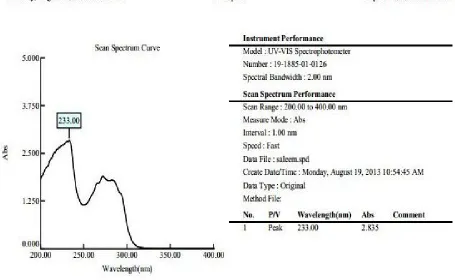
A solution of 1µg/ml of Eletriptan was scanned in the range of 200 to 400 nm. The drug exhibited the λmax at 233nm in phosphate buffer pH 6.8 and has good reproducibility shown in graph 1.
Production yield:
Particle Size Analysis:
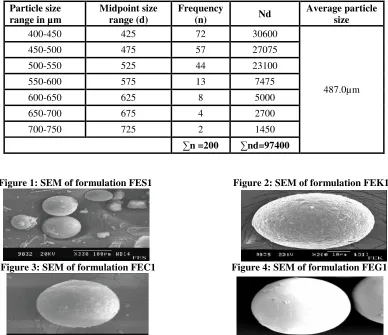
The mean size increased with increasing polymer concentration which is due to a significant increase in the viscosity, thus leading to an increased droplet size and finally a higher microspheres size. Microspheres of Eletripan hydrobromide using Sodium alginate alone had a size range of 613.25 µm to 665.0 µm, microspheres using Guar gum as copolymer exhibited a size range between 762.25µm to 802.5µm and microspheres using Karaya gum as copolymer 568.75µm and 600.75µm. Microspheres with Chitosan as copolymer exhibited a size range between 487.0µm to 527.0µm.The particle size data of an optimized formulation was presented in table 3.
Determination of Shape and Surface Morphology by SEM analysis:
Morphology of the microspheres was investigated by Scanning electron microscopy. The results of SEM revealed that the microspheres of Eletriptan using sodium alginate, Guar gum, Karaya gum and Chitosan were spherical and their surface was smooth and devoid of cracks giving them a good appearance. The figures were showed from 1 to 4.
In-vitro drug release studies:
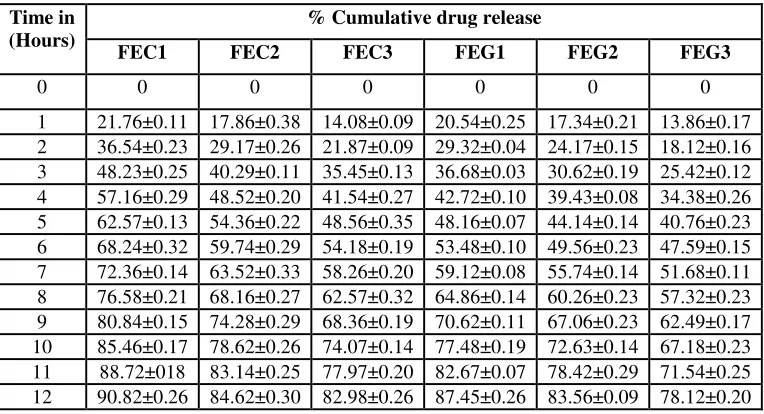
Dissolution studies of all the formulations were carried out using dissolution apparatus USP type-I using 0.1 N HCl at PH 1.2 and phosphate buffer at PH 6.8 as dissolution medium. The results of the in-vitro dissolution studies data of all the formulations were shown in tables 4 and 5. The plots of Cumulative percentage drug release Vs Time were plotted. Graph 2
and 3 shows the comparison of cumulative percentage drug release for all the formulations. The formulation FEC1 contain chitosan in the ratio of 1:1 was showed better drug release (90.82%).
SUMMARY AND CONCLUSION
In this work an attempt was made to design a sustained release drug delivery system in the form of microspheres for Eletriptan hydrobromide using Sodium alginate and in combination with natural polymers such as Chitosan, guar gum and karaya gum as copolymers. The technique used for the preparation was ionic gelation method. Increase in the polymer concentration led to slight decrease in Percentage yield and increase in Particle size. Micromeritic studies revealed that the mean particle size of the prepared microspheres was in the size range of 487.0-802.5µm and are suitable for microspheres for oral administration.
SEM analysis of the microspheres revealed that all the prepared microspheres were discrete, spherical in shape and had satisfactory surface morphology. The in-vitro release study of all formulations showed a retarded release with increase in percentage of polymers. From the study it was concluded that formulation FEC1 were found to be best carriers for oral drug delivery of Eletriptan hydrobromide microspheres.
Acknowledgement:
Authors are sincerely thankful to the management of JKKMMRF’s College of Pharmacy, Komarapalayam, Nammakal dist, Tamilnadu for providing the needful facilities and moral support to carry out this research work.
Table 1: Composition of various formulations of Eletriptan hydrobromide microspheres
Ingredients Formulation
code
Drug: Sodium Alginate: Polymer ratio
Drug Polymers
Eletriptan hydrobromide
Sodium alginate
FES1 01:01:00
FES2 01:02:00
FES3 01:03:00
Guar gum
FEG1 01:01:01
FEG2 01:01:02
FEG3 01:01:03
Karaya gum
FEK1 01:01:01
FEK2 01:01:02
FEK3 01:01:03
Chitosan
FEC1 01:01:01
FEC2 01:01:02
Graph 1: λmax of EletriptanHydrobromide
Table 2 : Percentage yield of Eletriptan microspheres using Sodium alginate with Karayagum, Chitosan, Guargum as copolymer.
Formulation Code Yi Percentage Yield eld
FES1 87.12
FES2 85.56
FES3 82.2
FEK1 86.02
FEK2 84.23
FEK3 80.62
FEC1 86.46
FEC2 83.54
FEC3 81.75
FEG1 84.56
FEG2 82.32
Table 3 : Particle size data of optimized formulation FEC1
Particle size range in µm
Midpoint size range (d)
Frequency
(n) Nd
Average particle size
400-450 425 72 30600
487.0µm
450-500 475 57 27075
500-550 525 44 23100
550-600 575 13 7475
600-650 625 8 5000
650-700 675 4 2700
700-750 725 2 1450
∑n =200 ∑nd=97400
Figure 1: SEM of formulation FES1
Figure 2: SEM of formulation FEK1
Figure 3: SEM of formulation FEC1
Figure 4: SEM of formulation FEG1
Table 4: Invitro drug release data of Eletriptan microspheres using Sodium alginate polymer.
Time(hour) %Cumulative drug release
FES1 FES2 FES3 FEK1 FEK2 FEK3
0 0 0 0 0 0 0
1 24.32 16.42 13.96 23.89 21.14 18.02 2 38.57 27.78 22.74 32.64 26.38 23.18 3 44.72 39.89 30.84 39.16 30.74 28.1
4 54.23 47.53 43.69 44.26 37.52 33.1 5 67.56 54.35 57.67 50.48 42.83 38.12 6 72.32 66.82 69.85 57.23 48.64 42.38 7 84.48 79.47 77.47 62.42 56.32 47.56 8 90.16 87.52 85.74 69.08 61.36 53.74
9 --- --- --- 74.16 65.28 58.18
10 --- --- --- 78.42 70.33 64.32
11 --- --- --- 83.25 74.48 69.83
12 --- --- --- 85.68 80.74 76.68
Table 5: In-vitro drug release data of Eletriptan microsphere using Chitosan and guar gum
Time in (Hours)
% Cumulative drug release
FEC1 FEC2 FEC3 FEG1 FEG2 FEG3
0 0 0 0 0 0 0
1 21.76±0.11 17.86±0.38 14.08±0.09 20.54±0.25 17.34±0.21 13.86±0.17 2 36.54±0.23 29.17±0.26 21.87±0.09 29.32±0.04 24.17±0.15 18.12±0.16 3 48.23±0.25 40.29±0.11 35.45±0.13 36.68±0.03 30.62±0.19 25.42±0.12 4 57.16±0.29 48.52±0.20 41.54±0.27 42.72±0.10 39.43±0.08 34.38±0.26 5 62.57±0.13 54.36±0.22 48.56±0.35 48.16±0.07 44.14±0.14 40.76±0.23 6 68.24±0.32 59.74±0.29 54.18±0.19 53.48±0.10 49.56±0.23 47.59±0.15 7 72.36±0.14 63.52±0.33 58.26±0.20 59.12±0.08 55.74±0.14 51.68±0.11 8 76.58±0.21 68.16±0.27 62.57±0.32 64.86±0.14 60.26±0.23 57.32±0.23 9 80.84±0.15 74.28±0.29 68.36±0.19 70.62±0.11 67.06±0.23 62.49±0.17 10 85.46±0.17 78.62±0.26 74.07±0.14 77.48±0.19 72.63±0.14 67.18±0.23 11 88.72±018 83.14±0.25 77.97±0.20 82.67±0.07 78.42±0.29 71.54±0.25 12 90.82±0.26 84.62±0.30 82.98±0.26 87.45±0.26 83.56±0.09 78.12±0.20
Graph 2: Comparison of in-vitro drug release profile of Eletriptan microspheres using Chitosan as polymer and Karaya gum as copolymer
Graph 3: Comparison of in-vitro drug release profile of Eletriptan microspheres using chitosan and guar gum as copolymer.
0 20 40 60 80 100
0 2 4 6 8 10 12 14
P
er
ce
n
tage
D
ru
g r
el
eas
e
Time in Hours
FES1
FES2
FES3
FEK1
FEK2
FEK3
0 20 40 60 80 100
0 2 4 6 8 10 12 14
FEC1
FEC2
FEC3
FEG1
FEG2
REFERENCES
1. Akashmoy Chakraborty et al. Ionotropic Gelation
Method of Sodium Alginte Microspheres. International journal of Comprehensive Pharmacy. 2011; 7 (07): 0976-8157.
2. Chinna Gangadhar et al. Indomethacin microspheres using natural and synthetic polymer as controlled release. International Jornal of Drug Discovery. 2010; 2(1): 08-16.
3. Shravan Kumar K et al. comparision of calcium silicate and cholestyramine based Eletriptan hydrobromide floating microspheres. Journal of drug delivery and therapeutics. 2013: 3(3): 104-112. 4. Chittam SS et al. Mucoadhesive microspheres of
Norfloxacin. International Journal of Pharmaceutical Research. 2012; 2(6).
5. Durgacharan A Bhagwat et al. Controlled release microspheres of Isosorbode dinitrate. International Journal of Pharma Tech Research. 2009; 1(2): 125-128.
6. Prashanth VV et al. Microsphere over view. International Journal of Research in Pharmaceutical and Bio-medical Sciences. 2011; 2(2): 2229-3701. 7. Rajmanikam Deveswaran et al. Formulation and
Evaluation of Albumin Microspheres Containing Aceclofenac. International Journal of Pharmaceutical Sciences Review and Research. 2010; 4(1): 0976-044X.
8. Roy Sl. Preparation on Microspheres of Mefenemic acid. International Journal of Pharmaceutical Sciences and Drug Research. 2009; 1(1): 36-42. 9. Senthil S Periyasamy et al. Microspheres containing
Imatinib Mesylate using sodium alginate by chemical cross linking method. Journal of Drug Delivery & Therapeutics. 2012; 2(6): 37-40.