Corporate Debt Restructuring: An Evaluation
- Dr.V.Mary Jessica *
Abstract
Businesses obtain funds for capital acquisitions as well as for daily operations. However, some times the borrowers may find themselves unable to meet their financial commitments, and may become ‘financially distressed’. In such circumstances, the companies face tough times, and may even face liquidation. In order to pre-empt liquidation of the company, the borrowers seek to renegotiate with their lenders regarding modification of the terms of the loan. This action of the corporate leads to what is popularly called ‘debt recast’ or ‘debt workout’ or ‘corporate debt restructuring.’.
Statistics suggest about 85 per cent of the loan restructuring cases referred to corporate debt restructuring (CDR) cells are able to meet their obligations. And, almost 45 per cent of these cases (or four of every 10) are successfully revived. Nevertheless, more number of companies goin for CDR does not augur well for the banks and the economy. It is said that 10-15% of the restructured loans turn bad for most banks. This paper aims to look into Corporate Debt Restructuring(CDR) , the concept, the rationale and need for CDR, the status of CDR in India, and suggests measures that can be taken up to obviate the need for CDR in the first place.
Keywords: Financial Distress, Debt- workout ,Contagion, Non-performing Assets, Corporate Debt Restructuring
1. Introduction
Businesses obtain funds for capital acquisitions as well as for daily operations. Apart from the owners’ equity, a bulk of these funds come from banks and term lending financial instititutions. These banks and institutions, in the normal course of activities are expected to do due diligencE regarding the profitability, commercial feasibility, cash flow ability, and debt servicing capabilities and so on of the borrower enterprises. Thereafter, the loans are sanctioned and repayment schedules drawn. However, some times such estimates may turn awry, due to various reasons both avoidable and unavoidable, and the borrowers may find themselves unable to meet their financial commitments, and may become ‘financially distressed’. In such circumstances, the companies face tough times, and may even face liquidation.
In order to pre-empt liquidation of the company, which has far reaching adverse impact both financial and social, the borrowers seek to renegotiate with their lenders regarding modification of the terms of the loan. In fact, the lenders too might seek a reschedulement to minimise the losses and reduce non-performing assets. This action of the corporate leads to what is popularly called ‘debt recast’ or ‘debt workout’ or ‘corporate debt restructuring.
Contextual Significance of the Topic
Indian banks sought to restructure $12 billion in corporate loans in the fiscal year that ended in March 2012. Industry data showed, as slowing economic growth proved a drag on borrowers’ ability to repay their debts.
Debt restructuring through the Corporate Debt Restructuring Cell (CDR) in fiscal year 2012 was the highest ever since the forum was launched in 2001, the number of cases referred to the CDR has witnessed an eight-fold increase since 2008.
Banks bring cases to the CDR Cell, an informal Reserve Bank of India-approved forum of bankers, to negotiate relaxed repayment terms with struggling borrowers. Cases brought to the CDR during the year included big-ticket loans to telecom tower services provider GTL Ltd , shipbuilder Bharati Shipyard , Hindustan Construction Company and several sugar and steel mills.
Statistics suggest about 85 per cent of the loan restructuring cases referred to corporate debt restructuring (CDR) cells are able to meet their obligations. And, almost 45 per cent of these cases (or four of every 10) are successfully revived.
Statistics are just an indication but provide enough hope for some companies recently referred to/or have announced their plans to undergo CDR. Already under severe pressure from mounting debt, these are potential turnaround cases — many trade in the market at life-time lows. Examples like that of Wockhardt — its shares were trading at ` 75 when it was referred to CDR in April 2009, while they are presently at ` 560, up more than seven times, led by the successful debt restructuring – only provide confidence. However, experts warn that not all can turn around (Jitendra Kumar Gupta 2012).
Moreover, the first two months of the current fiscal 2012-13 itself saw 22 cases being referred involving around ` 9000 crore. This is a grim situation and banks are worried. Non-performing
2. The Study
This paper aims to look into Corporate Debt Restructuring(CDR) , the concept, the rationale and need for CDR, the status of CDR in India, and suggests measures that can be taken up to obviate the need for CDR in the first place.
The paper is presented in three sections. Section I presents the concept of CDR, the significance and the rationale for CDR, the generally available options for coprorate debt restructuring. Section II deals with evolution of Corporate Debt Restructuring in India. Section III presents the status of Coprorate debt restructuring in India and briefly discusses the impact of CDR with reference to three major industries in CDR. Section IV suggests measures than can be taken to obviate the need for corporate debt restructuring in the first place and ends with conclusion.
Section I
Definition - Corporate Debt Restructuring
The reorganization of a company’s outstanding obligations, often achieved by reducing the burden of the debts on the company by decreasing the rates paid and increasing the time the company has to pay the obligation back. This allows a company to increase its ability to meet the obligations. Also, some of the debt may be forgiven by creditors in exchange for an equity position in the company.
Rationale for CDR
The Interlinkage Perspective: Corporate debt problems have many implications and dimensions. First of all, debt problems create real risks of disruption of activity/output as stressed corporatesfind it difficult to meet their working capital requirements to ensure uninterrupted production. This in turn leads to weaker debt-servicing capacity and further deteriorates the companies’ balance sheet. Secondly, the general slowdown of activity by these companies contributes to unemployment and related social pressures. Thirdly, corporate debt problems and the resulting increase in nonperforming loans (NPLs) endanger the banking system and reduce the ability of banks to extend further credit, thus slowing down the entire economy. Debt over-hang thus becomes self-perpetuating as companies are unable to deleverage and the problem gets prolonged by the high level of debt. The resolution of corporate debt problems thus becomes very important for sustaining the health of the economy and also to recover from a slowdown or a recession.
Given the importance of interlinkages between corporate debt problems on the one hand and the financial system and overall economy on the other hand, several governments have embarked on measures to help facilitate the process of corporate debt resolution.
The Magnitude Perspective
In cases where the number of troubled corporations is small, their potential macroeconomic importance is limited and the financial system is sound, the rationale for corporate debt workouts is weak. In contrast, when corporate debt problems are widespread, with potentially sizable macroeconomic consequences, and market failures inhibit debt workouts on the required scale, a comprehensive approach could be warranted.
Due to interlinkages between the balance sheets of corporations and the financial sector, without an effective corporate debt restructuring, bank lending is likely to remain constrained. This in return will slow down corporate recovery and growth prospects. Corporate debt restructuring is, therefore, an important step toward recovery from a financial crisis or prempt one.
The Government’s Perspective
Governments’ also might be interested in CDR of large and strategic companies. Such companies—both state- and privately-owned— may be seen as too big to fail, that is, important either as strategic assets or for employment and social safety net considerations.
Rationale or Advantages: Debt restructuring and related measures help avoid large-scale corporate insolvencies. These measures provide confidence to the markets, stabilize expectations, but also create moral hazard. They come at a (direct and indirect) cost to the taxpayer.
As NPAs appear to be on the rise and more widespread corporate debt problems could emerge requiring active government intervention. It is safe to conclude that to avoid corporate debt crises from becoming a major problem, conditions for orderly and orderly debt workout should be created and maintained where debt problems are pervasive and impose negative externalities on the economy.
Objectives and Modalities of Restructuring
The aim of financial restructuring is to improve the financial position of the company, thus optimizing its capital structure. This action should either improve the cash flow of the company or decrease the cost of capital. Financial restructuring covers the restructuring of equity or debt contracts The objective of corporate debt restructuring is a timely and orderly restructuring of corporate liabilities with a view to restoring the corporations’ operation and financial viability.1
Section II
EVOLUTION OF CDR IN INDIA
India’s insolvency regime prior to 2001 can be said to have been marred by the absence of a viable mechanism for restructuring. Rather than encouraging an in-depth debt restructuring strategy after scrupulous cash-flow analyses and consolidated negotiations, the Indian strategy was more or less one of rehabilitation by way of some kind of relief or concession at a superficial level. There were two connected issues which were the main causes of concern: firstly the rapid rise in Non-performing Assets (NPAs) in India, and secondly the weak insolvency laws of the country.
Individual settlements were the norm. However such settlements took much more time due to lack of an organised structure, thus resulting in further erosion of the asset base and even less returns to creditors. Further, the fact that most of the major creditors were in fact state-owned banks and financial institutions took its toll since court intervention on account of public interest litigation was an interference. Moreover the compromises and other arrangements as decided by such creditors also required the approval of, among others, the Central Vigilance Commission and the Comptroller and Auditor General.
India’s insolvency regime, in any case was not helping matters. Company winding-ups were a long drawn process, taking on an average 10 years, with instances of some cases taking up to 50 years. The restructuring regime had been initiated by the passing of the Sick Industrial Companies Act (SICA) in 1985. The task of reviving sick companies was handed to a quasi-judicial body called the Board for Industrial Financial Reconstruction (BIFR). Under the Act, it is up to the Board of Directors of a sick company to refer the matter to the BIFR.
Though the enactment of the SICA received praise since it had initiated a rescue culture in the Indian insolvency regime, the issues at the time of implementation were creating more harm than help for the following reasons:
1. Under the SICA, a reference could be made to the BIFR only if the company under consideration was ‘sick’. The definition for ‘sick company’ provided that the company’s accumulated losses must equal or exceed its net worth and BIFR intervention would only be at a stage when the losses accumulated have made any meaningful reconstruction an impossibility.
2. Further, during the period that the inquiry is being made and the scheme being prepared and implemented, the debtor company could dispose-off its assets conferring an unmerited advantage on the inefficient management of the sick industrial company.
4. Further the BIFR proceedings increasingly came to be abused by the companies’ promoters. Quite a few defaulting debtors found a safe haven under the BIFR proceedings.
The result is that the BIFR procedure under SICA has been a complete failure.
Following the sudden opening up of the economy through the liberalisation measures of 1991, mushrooming industries in India were commonplace. Unlike in UK, this was not complemented by a rush by banks to provide funding for the same. Banks were still restricted by a strict monetary policy, which meant that the interest rates remained high. However, the companies continued to accumulate a high ratio of gearing. India’s industrial boom was evidenced at a time when global demand diminished. This meant that the assets gradually saw value erosion. The NPAs of the Public Sector Banks as of March 2001 had risen to Rs 548 billion, while those of other financial institutions had reached Rs 240 billion, causing a major concern for the banking sector which had not been used to coping with this degree of financial stress. This necessitated a mechanism which would be able to circumvent all the aforesaid limitations and provide, timely and viable solution to corporate debt problems. Hence the present CDR Mechanism.
According to the RBI, the objective of the Corporate Debt Restructuring (CDR) framework is to ensure timely and transparent mechanism for restructuring the corporate debts of viable entities facing problems, outside the purview of BIFR, DRT and other legal proceedings, for the benefit of all concerned. In particular, the framework will aim at preserving viable corporates that are affected by certain internal and external factors and minimize the losses to the creditors and other stakeholders through an orderly and coordinated restructuring programme.
The Corporate Debt Restructuring (CDR) Mechanism is a voluntary non-statutory system based on Debtor-Creditor Agreement (DCA) and Inter-Creditor Agreement (ICA) and the principle of approvals by super-majority of 75% creditors (by value) which makes it binding on the remaining 25% to fall in line with the majority decision.
Eligibility Criteria
The CDR mechanism will cover only multiple banking accounts / syndication / consortium accounts of corporate borrowers engaged in any type of activity with outstanding fund-based and non-fund based exposure of Rs.10 crore and above by banks and institutions.
of creditors. There would be no requirement of the account / company being sick, NPA or being in default for a specified period before reference to the CDR system. However, potentially viable cases of NPAs will get priority. This approach would provide the necessary flexibility and facilitate timely intervention for debt restructuring.
While corporates indulging in frauds and malfeasance even in a single bank will continue to remain ineligible for restructuring under CDR mechanism as hitherto, the Core group may review the reasons for classification of the borrower as wilful defaulter especially in old cases where the manner of classification of a borrower as a wilful defaulter was not transparent and satisfy itself that the borrower is in a position to rectify the wilful default provided he is granted an opportunity under the CDR mechanism. Such exceptional cases may be admitted for restructuring with the approval of the Core Group only. The Core Group may ensure that cases involving frauds or diversion of funds with malafide intent are not covered.
The accounts where recovery suits have been filed by the creditors against the company, may be eligible for consideration under the CDR system provided, the initiative to resolve the case under the CDR system is taken by at least 75% of the creditors (by value) and 60% of creditors (by number).
BIFR cases are not eligible for restructuring under the CDR system. However, large value BIFR cases may be eligible for restructuring under the CDR system if specifically recommended by the CDR Core Group. The Core Group shall recommend exceptional BIFR cases on a case-to case basis for consideration under the CDR system. It should be ensured that the lending institutions complete all the formalities in seeking the approval from BIFR before implementing the package.2
Section III
Status Of CDR In India
Since its inception in 2001 each year has seen more number of cases being referred for debt restructuring. Prima-facie, it appears that this institution/ mechanism of corporate debt restructuring is effective in curtailing industrial sickness and also enabling banks avoid accumulating NPAs. In fact, if one goes to the website of the CDR Cell, statistics are presented with the heading ‘CDR performance’. While this indeed is the performance of the CDR cell, mounting number being referred to the cell also indicate mounting corporate problems or poor appraisal or bad projects or overleveraging, any of them or all of them leading to reschedulement of dues to banks which necessarily affects the health of banking sector. As already stated any health hazard to the banking industry has a whirlpool effect on the entire economy and needs serious attention.
Table I : Cases referred to CDR Cell since Inception Year ended March 31 Total References Received Cases Rejected/Closed Cases under finalization of restructuring of packages Total cases approved (including cases withdrawn/ exited) No. of cases Aggregate Debt ( `. in Crores)
No. of cases
Aggregate Debt ( `. in
Crores)
No. of cases
Aggregate Debt (` in
Crores)
No. of cases
Aggregate Debt (` in
Crores) 2009 225 95815 29 5018 12 4261 184 86536
2010 256 (31) 115990
20175* 32 7050 9 4641
215 (31)
104299 17763*
2011 305
(49)
138604
22614* 42 9667 21 18023
242 (27)
110914 6615*
2012 392
(87)
206493
67889* 59 20817 41 35161
292 (50)
150515 39601*
Source: Compiled from www.cdrindia.org.
Note: ( ) = Number of Cases in the fiscal Year & * = Amount involved in the fiscal year Table I above shows that a total of 392 no of cases have been referred to CDR cell since its inception until March 2012. The number of cases referred in each of the years from 2010 to 2012 are 21, 49 and 87 respectively. This itself shows that the number of cases has increased nearly 100 per cent every year. Considering the amounts involved in the restructuring, ` 20175 crore was involved in the fiscal 2009-10, ` 22674 crore in 2010-11 and a whopping ` 67889 crore(nearly three times the previous year) in 2011-12. Clearly, this presents a serious cause of concern. On the top of this, in the first two months of this fiscal as many as 22 cases involving around ` 9000 crores have already been to CDR Cell. CDR should, in normal course be necessitated occasionally and should not be routine. More number of cases being referred means widespread corporate distress and sends warning signs to both financial sector and the economy as a whole. While more number of cases being handled by CDR may reflect efficiency or effectiveness of the cell, they do not speak the same story for the banks and the economy. It is said that 10-15% of the restructured loans turn bad for most banks. It is also felt by most banks that borrowers have been misusing the facility and passing on their burden to the lenders. The rising number of loan recasts across the sector has resulted in a spike in bad assets in the banking sector, especially among state-run banks. The country’s largest lender SBI, has gross NPAs of around 4.44% of total advances in march, while for Central bank of India, the figure stood at 4.83%. Typically banks have to set aside more money in the form of restructured advances which affects profitability (Dinesh Unnikrishnan, 2011)
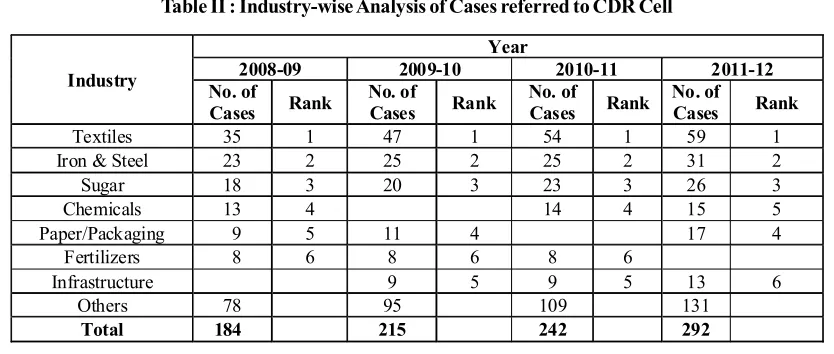
Table II : Industry-wise Analysis of Cases referred to CDR Cell
Industry
Year
2008-09 2009-10 2010-11 2011-12 No. of
Cases Rank
No. of
Cases Rank
No. of
Cases Rank
No. of
Cases Rank
Textiles 35 1 47 1 54 1 59 1
Iron & Steel 23 2 25 2 25 2 31 2
Sugar 18 3 20 3 23 3 26 3
Chemicals 13 4 14 4 15 5
Paper/Packaging 9 5 11 4 17 4
Fertilizers 8 6 8 6 8 6
Infrastructure 9 5 9 5 13 6
Others 78 95 109 131
Total 184 215 242 292
Source: Compiled from www.cdrindia.org
Table II shows the share of the top six industry groups (in terms of numbers) which have been approved for CDR. It may be seen from the table that only six or seven industry groups have accounted for more than 40 per cent of arestructuring in any single year. As at the end of March 31, 2009, while textiles accounted for 19.02%, iron and steel accounted for 12.5%, and sugar for 10%. The top six industries accounted for nearly 58% of the cases approved for CDR. The 2009-10 was no different. Again textiles, Iron and Steel and Sugar industries accounted for 42% and the top six industries for 54.42%. The fiscal 2010-11, and 2011-12 present nearly the same picture where the top 6 industries accounted for nearly 45% of the cases. What is noteworthy is that textile industry has always stood at the top of the table, with Iron and Steel and Sugar following.
Table III : Aggregate Debt Restructure by CDR Cell to the Top Six Industries (Rs.in crores)
2008-09 2009-10 2010-11 2011-12
Industry Aggre
gate
`
Percentage
Share Industry
Aggre gate
`
Percentage
Share Industry
Aggregate
`
Percentage
Share Industry
Aggre gate
`
Percentage Share
Iron & Steel 30169 34.86 Iron & Steel 36673 35.16 Iron & Steel 36673 33.06 Iron & Steel 39252 26.08 Fertilizers 8453 9.77 Fertilizers 8454 8.11 Fertilizers 8454 7.62 Fertilizers 8455 5.62
Textiles 6097 7.05 Textiles 8902 8.54 Textiles 10227 9.22 Textiles 11661 7.75 Petrochemicals 5493 6.35 Petrochemicals 5493 5.27 Petrochemicals 5493 4.95 Sugar 6733 4.47 Refineries 4874 5.63 Sugar 5328 5.11 Cements 5928 5.34 Telecom 9199 6.11 Cements 4663 5.39 Telecom 5250 5.03 Sugar 6131 5.53 Infrastructure 16774 11.14
Others 44550 30.95 Others 34199 32.78 Others 38008 34.28 Others 58441 38.83 Source: Compiled from www.cdrindia.org
Table III shows the aggregate amount of debt restructured during 2009-12 for 6 industries which accounted for highest amount of restructuring. It may been that Iron and Steel Industry accounted for the highest share in all the years under consideration. The industry profile reveals that the industry had a smart performance in the until the eve of the eleventh plan. However post the 2008 global turmoil, the industry performed lower than expected. The Report Of The Working Group on Steel Industry for The Twelfth Five Year Plan felt that ‘the sector already has certain inherent advantage like easy access to key raw materials, low cost of labour, requisite technical manpower, a high potential for technology absorption and most important a growing domestic market…. The Indian steel industry is experiencing a slowdown, Nevertheless, there exists enormous potential in the economy for higher growth of domestic steel demand in medium and long term….. India has enormous potential and necessary resources, capabilities to become a global supplier of quality steel. Also there exists ample market opportunities in the neighbouring regions of Asia, Africa and the Middle East. The policy framework while according top priority to meet domestic demand should also take into account the large export possibilities (Ministry of Steel, 2010).
However due to controversies regarding illegal mining and consequent ban on combined with general slow down across board, iron and steel industry has seen the bad side which is very well reflected in the number of cases andamount of debt restructured. Imports of raw material in places richly endowed with the mineral such as Odisha is an irony. This is again a case where more than business principles, corruption, politics have had an overriding impact.
Section IV
Can Corporate Debt Restructuring be Avoided?
The various reasons, either singly or jointly, behind corporate debt restructuring could be from the economy side, or industry side, or borrower’s side, or the banking system side, or loan structuring side, or fromthe security side – collateral vs cash flow.
Reasons from the economy side could be the political–mindset regarding paradigm, proactive action, fiscally responsibility and so on. They could also be the status of Economic growth, distribution, efficient allocation of resources etc.
Reasons from the industry side could beGlobal competition, cyclical downswing or simply being a sunset industry. Reasons from the borrower’s side could be Misconceived project, Poor governance, or product failure, inefficient management, diversion of funds, or simply adormant capital market.
Reasons from the banking system side could be:
• Parameters set for their functioning were deficient: incorrect goal perception and identification – lazy banking
• Directed banking and lack of freedom to choose products and pricing
• Being unexposed to international marketing methods and products, people lacked training and knowledge resources
• Lack of systems and procedures – audit and inspections
• Inability to handle enormous growth in liabilities and assets
• Lack of a mechanism of credit information dissemination
• Collateral based lending leading to idle assets
• Fixing of price and quantum of loans
Reasons from the loan structuring side could be High debt equity ratio,discrepancy between the rate of interest charged and the realistic rate of return, inconsistency between revenue generation and the loan repayment schedule, lack of binding penal clauses and performance guarantees and so on.
If the causes detailed above had been appropriately taken care of by all the players, probably we can avoid such huge numbers queueing up for CDR. There have been instances of banks extending credit to doubtful debtors (who wilfully default on debt) and getting kickbacks for the same. Ineffective legal mechanisms and inadequate internal control mechanisms have made this problem grow – quick action has to be taken on both counts so that both the defaulters and the authorising officer are made accountable judiciously without paralysing their decision making abilities as is currently the state in the country. Without this, all the mechanisms may prove to be ineffective. On a broader note, there is the need for contingency planning for too-big-to-fail companies— both state-and privately owned—that have potential systemic impact. Prudent management of state-owned companies in tranquil times could help avoid counter-cyclical interventions at a time of crisis when the opportunity cost of fiscal resources is particularly high. Lessons once learnt should be included in the tool box for good liability management across board so that history does not repeat itself.
Conclusion
The main conclusion that can be drawn here is that while corporate debt restructuring is an essential mechanism to avoid systemic contagion, analysis needs to be done for the causes leading to large-scale corporate distress. While remedial measures should be initiated immediately to prevent the situation from deteriorating further, better would be to put preventive measures in place. Corporate financial distress is not the result of for financial reasons alone. There are a host of other factors, which result in financial distress. A more hoslistic approach encompassing scientific appraisal (including simulation analysis, sustainable growth modelling), monitoring of projects, proactive banking(avoiding lazy banking), avoiding herd mentality, good governance and creating an enabling environment with necessary checks and balances needs to be explored.
References
1. http://www.sify.com/finance/corp-debt-restructuring-hits-record-high-news-debt-mflrkCacbij.html
2. Andrea Jurickova Heglasova, University of Economics in Prague, Creating Value Through Corporate Debt Contracts Restructuring, Global Journal Of Business Research , Volume 5, (2), 2011
3. Annex Revised Guidelines on Corporate Debt Restructuring, bi.org.in/upload/ notification/pdfs/67158