An Approach for Description of Computer
Network Defense Scheme and Its Simulation
Verification
Zhao Wei, Chunhe Xia, Yang Luo, Xiaochen Liu and Weikang Wu
Beijing Key Laboratory of Network Technology, School of Computer Science and Engineering, Beihang University, Beijing, China
Email: [email protected], [email protected], [email protected], [email protected], [email protected]
Abstract—In order to solve the problem of which the existing defense policy description languages can only describe some aspects of defense, such as protection or detection, but cannot express relationship among actions and to cope with large-scale network attack, we proposed an approach for description of computer network defense scheme and its simulation verification. A computer network defense-oriented scheme description language (CNDSDL) was designed to describe actions of protection (i.e., access control, encryption communication, backup), detection (i.e., intrusion detection, vulnerability detection), analysis (i.e., log auditing), response (i.e., system rebooting, shutdown), recovery (i.e., rebuild, patch making), and relationship among actions (i.e., sequence-and, sequence-or, concurrent-and, concurrent-or, and xor). The Extend Backus-Naur Form (EBNF) of CNDSDL was provided. At last, we provided an implementation mechanism of CNDSDL. A task deadlock detection algorithm was given for the defense scheme. The simulation was completed in simulation platform of GTNetS. Three simulation experiments verified the description capability and effectiveness of CNDSDL. The results of the experiments show that the defense scheme described by CNDSDL can be transformed to detailed technique rules and realize the defense effect of expression.
Index Terms—defense, deadlock detection, EBNF, scheme description language, simulation verification
I. INTRODUCTION
Researchers have proposed defense technology and mechanisms to protect network security. For example, detection [1] or response [2] mechanism of defense scheme for DDoS attack, a linkage defense framework [3-4] that makes IDS and Honeypot work together, a mechanism [5] that detects the conversion channels through the interaction of IDS and firewalls.
As the scale of network grows, it is a huge challenge for administrator to manage different defense mechanisms and devices in a large-scale network environment. In order to solve these problems, researchers have proposed policy-driven management methods [6] to simplify the management for the complicated and distributed network system, such as cloud framework [7]. Administrator may specify the
targets and constraints only in the form of policy. Thus, a variety of policy description languages are proposed [8-9]. However, most of these policy languages [10-12] focus on one aspect of the network defense, such as access control. And these policy languages can’t describe the interaction actions of linkage mechanism for defense devices.
Based on the characteristics of computer network defenses (CND), we intend to provide a language description for linkage defense of different defense mechanism to cope with large-scale network attack and make it convenient for the security management of administrator.
Computer network defenses are actions through the use of computer networks to protect, monitor, analyze, detect, and respond to unauthorized activities within Department of Defense information systems and computer networks [13].
Based on these problems, we proposed an approach for description of computer network defense scheme and its simulation verification. We designed a formalized description language of defense scheme and its implementation mechanism and completed simulation verification in simulation platform of GTNetS. This language can describe actions of protection, detection, analysis, response, recovery, and relations among actions. These relations include sequence-and, sequence-or, concurrent-and, concurrent-or, and xor.
The remaining parts of this paper are organized as follows: The relevant literature is discussed in Section II, the description of computer network defense scheme is presented in section III, an implementation mechanism of CNDSDL is provided in Section IV, and the experiment verification and analysis are shown in section V, followed by a conclusion of our work in section VI.
II. RELATED WORK
Many studies on defense scheme focus on defense mechanism. For example, Reference [1] proposes a new defense scheme to develop a flow monitoring scheme to defend against DDoS attacks in mobile ad hoc networks. In this paper, they provide a new defense mechanism that consists of a flow monitoring table at each node. It contains flow id, source id, packet sending rate and destination id. Reference [2] proposes an effective DDoS Manuscript received June 1, 2013.
attack defense scheme using web service performance measurement and development of a DDoS attack response system. Reference [14] presents a two-tier coordination defense scheme for detecting and mitigating DDoS attacks. The first tier traffic filter (1st-TF) filters suspicious traffic for possible flooding. The second tier traffic filter (2nd-TF) performs online monitoring of queue length status with RED/Droptail mechanism for any incoming traffic. Reference [15] proposes a robust scheme to defend these routing attacks in MANETs and improve the performance of the networks.
How do we provide a language description for linkage defense of different defense mechanisms to cope with large-scale network attack? This is a problem to be solved. At present, there are a variety of policy description languages to express defense actions.
Reference [16] provides a policy description language-Ponder. This is an oriented-object and illustrative language. It can define access control policy based on role and management policy, such as condition-response rule of event triggering. Then, Ponder2 [17] is applied to miniature embedded system and large-scale complex network for network management. XACML [18] is a general language which is developed by OASIS for accessing control. TPL [19] is used to define authorization policy of Internet services. But its grammar of XML is very tediously long and unreadable. These policies contain many rules but lack succession and reusing. REI [20] is a semantic policy description language in the ubiquitous computing environment including access control policy and management policy. According to the difficulty in the management of distributed network, reference [21] suggests a high-level security configuration description language-FLIP to describe access control policy of firewall.
Nevertheless, most of these policy languages focus on one aspect of the network defense, such as access control. They lack a unified defense scheme description language that can describe defense actions of protection, detection, analysis, response, recovery, and relations among actions to cope with complicated network attacks.
III. DESCRIPTION OF THE COMPUTER NETWORK DEFENSE SCHEME
In this section, we provide a description of computer network defense scheme including a formalized definition of computer network defense scheme, CNDSDL and its EBNF.
A. The formalism Definitions of Defense Scheme
Definition 1. Defense Scheme. It is a plan that consists of tasks to achieve defense intention. It is a two-tuple including task set and relation set. It is represented as follows:
(
)
{
}
::= , ;
::= |1 ;
.
i
Scheme R
Task i n
R
ζ ζ
ζ ζ ⎧
⎪ ≤ ≤
⎨ ⎪ ⊆ × ⎩
Wherein, ζ denotes the set of tasks, R denotes the set of relations between tasks.
Definition 2. Task. It is a six-tuple which includes subject, operation, execution time, execution results and constrains. It is represented as follows:
{
}
:: ( , , , , int);
;
:: i| 1 .
Task sub Operation Time Effect Constra
sub Subject
Operation ope i n
⎧ =
⎪ ∈
⎨
⎪ = ≤ ≤
⎩
Wherein, Subjectare the subjects in the network that can execute tasks; Operationis the set of operations of a task; Time denotes the starting time when a task runs.
Effect denotes the executing result of tasks including success and failure. Constraint denotes the prerequisites of tasks.
Definition 3. Subject. It refers to all the hardware and software resources participating in network defense such as firewall Sfirewall , IPsec VPN Sipsec_vpn , intrusion
detection system (IDS) Sintrudedetect, vulnerability library
_
vul server
S , log audit system Slogaudit_system, operation system
_
operation system
S , backup server Sbackup server_ .
Definition 4. Operation. It is a three-tuple that consists of action, object of action, and input parameters of actions. It can be represented as follows:
(
)
:: , , ;
; .
i
ope action object InPara
action Action object Object
= ⎧
⎨ ∈ ∈
⎩
Wherein, Object denotes the set of objects including node Onode , service Oservice , application program
_
application program
O and data packet Odata_packet . InPara
denotes the set of input parameters of actions. Action
was defined as follow.
Definition 5. Action. It denotes the set of defense actions including protection action (such as permit action
permit
A and deny action Adeny of firewall, the permission
Encryption action Apermit_crypt of IPsec VPN, backup
action Abackup of backup server), detection action(such as alerting action Aalert of IDS, scan action Avulscan of vulnerability scan server), responding action(such as rebooting Areboot and shutdown Ashutdown action of
operation system), analysis action(such as log audit action Alog_audit of log audit system) and recovery
action(making patch action Amakepatchof operation system,
rebuild action Arebuild of backup server).
Definition 6. Relation of Task. It means temporal and logic relation which include sequence and rseq and_ , sequence or rseq or_ , concurrent and rconcurrent_and ,
concurrent or rconcurrent or_ , xor rxor . To simplify the discussion, we assume that there are only two tasks in one scheme. Task::=
{
task task1, 2}
; Each relation isexplained separately as follows:
_
seq and
r : If seq and task task_
(
1, 2)
, it denotes that the 1task is executed firstly. If the executing effect of task1
tasks are successfully completed can we say the scheme is finished successfully.
_
seq or
r : If seq or task task_
(
1, 2)
, it denotes that the task1is executed firstly. If the executing effect of task1 is true,
the task2 does not need to be executed. If the executing
effect of task1 is false, the task2 must be executed.
Whether the scheme is finished successfully depends on the success of task1or task2.
_
concurrent and
r :If concurrent and task task_
(
1, 2)
, it denotesthat both task1and task2are executed at the same time.
Only if the effects of task1and task2are true can we say that the scheme is successfully finished.
_
concurrent or
r :If concurrent or task task_
(
1, 2)
, it denotes that both task1and task2are executed at the same time.Only if there is a true executed effect between task1and 2
task , we can say that the scheme is successfully finished.
xor
r :If xor task task
(
1, 2)
, it denotes that there exists one executing task between task1 and task2 . Whether the scheme is finished successfully depends on the true effect of task1 or task2.B. EBNF of CNDSDL
Based on the discussions above about the concepts and relations, we propose a CNDSDL in this section. Its grammar is expressed in EBNF as follows:
The defense scheme described by CNDSDL consists of three main parts: global variables declaration and definition; task description; and the tasks’ relation description.
<scheme>::=[<global_variable_statement>]<tasks>[tas k_relations‘:’<task_relations>]
<tasks>=<task>|<tasks><task>
(1) Global variables declaration and definition
Global variable sentence is used to define global variable including statement sentence and variable assignment sentence. Global variable is alive during the entire time of scheme.
<global_variable_definiton>::=globals:<variable_state ment>;|<variable_assignment>;|<global_variable_stateme nt><variable_statement>;|<global_variable_statement><v ariable_statement>;
<variable_statement>::=<variable_type><variable_na me>;
<variable_type>::=ip|time|int|float|string
The global variable type can be extended by adding key words. These variables are string.
(2) Task description • Task
<tasks>::=<task>|<tasks>;<task>
<task>::=task <num> ‘{‘ subject: <subject> actions: ‘(‘ <actions> ‘)’[time: <time >] [constrains: ‘{‘ <constrains>’}’]
• Subject
<subjcet>::=<protection_subject>|<detection_subject>| <analysis_subject>|<response_subject>|<recovery_subjec t>
<protection_subject>=back_up_server<num>|firewall< num>|gateway <num>|cryptor <num>| host <num>| server <num>
<detection_subject>::=IDS<num>|anti_virus_system< num>|vul_base<num>
<analysis_subject>::=audit_system<num> <response_subject>::=server <num>|host <num> <recovery_subject>::=back_up_server <num> | host <num>| server <num>
• Actions
<actions>::=<action>|<actions>,<action>
<action>::=<protect_action>|<detect_action>|<analysis _subject>|<respond_action>|<recover_action>
<protect_action>::=<protect_act><protect_obj>[inPara :’{‘<protection_inParas>’}’]
Protect action consists of protect act, protect object and parameter. Its EBNF is shown as follows:
<protect_act>::=back_up|permit|deny|crypt|authenticat e
<protect_obj>::=<file>|<packet>|ip
<packet>::=<ip_packet>|<tcp_packet>|<udp_packet>| <icmp_packet>
<ip_packet>::=IP <src_ip><dst_ip>
<tcp_packet>::=TCP<src_ip><ports> <dst_ip><ports> <udp_packet>::=UDP<src_ip><ports><dst_ip><ports >
<icmp_packet>::=ICMP<src_ip><ports><dst_ip><por ts>
<src_ip>::=(ip/mask)|any <dst_ip>::=(ip/mask)|any
<ports>=<port>|<port>:<port>|<port_operator><port>| any
<protection_inPara>::=priority:<num>|type:(full|additi on|offset)|crypt:(Y|N)|secure_trans:(Y|N)|interface:<num >
Detect action consists of detect act, detect object and parameter. It contains intrusion detection, virus checking, and vulnerability scanning. Its EBNF is shown as follows:
<detection_action>::=<detect_act><detect_obj>[in_Pa ra:’{‘<detection_inParas>’}’
<detect_act>::=ids_detect| check_virus|vul_scan <detect_obj>::=<IDS_rule>|<virus>|<vul>|<log> <virus>::=<string>
<vul>::=cve-<cve_year>-<cve_number> <log>::=<file>
<detection_inPara>::=(host:<num>)|(ip:<ip>)|(service: <service_name>)
<service_name>::=Web|Telnet|Rlogin|Ftp|SMTP <ids_rule>::=<idsRule_head><idsRule_body> <idsRule_head>::=<idsRule_action><packet> <idsRule_action>::=alert|pass|log
<idsRule_body>::=’(‘<options>’)’ <options>::=<option>|<options>;<option>
Response action consists of response act, response object, and parameter. It contains account locking, system shut down, reboot, patch installing, file deleting, process killing, and file access authority. Its EBNF is shown as follows:
<response_action>::=<response_act><response_obj>[i nPara:’{‘<response_inPara>’}’
<response_act>::=lock|shutdown|reboot|install|patch|de lete|kill|set_file_access
<response_obj>::=<account>|<patch>|<file>|<process >|<service_name>
<response_inPara>::=access_authority:<access_authori ty>|account:<account>
<access_authority>::=R|W|X|RW|RX|WX|RWX Recovery action consists of recovery act, recovery object, and parameter. It contains rebuild and redundant. Its EBNF is shown as follows:
<recovery_subject>::=back_up_server <num>|host <num> |server <num>
<recovery_action>::=recover<recovery_obj>[inPara:’{ ‘<recovery_inPara>’}’]
<recovery_obj>::=<file>|<service_name>
<recovery_inPara>::=host<num>|server<num>|date:<d ate>
• Time
Time denotes the task’s start time. <time>::=<num> (s|ms|us) • Constrains
Constrains denotes some conditions and environment necessary to execute task for task subject. <constrain>::=<conditions>
<conditions>::=<condition>|<conditons>;<condition> <conditon>::=<state_condition>|<expression_conditio n>
<state_condition>::=<state_variable><state_operator> <state_value>
<state_variable>::=cpu_ratio|mem_ratio|bandwith|disk _pace
<state_value>::=<float>|<int> (3) Tasks’ relation description
<task_relations>::=<task_relation>|<task_relations>;<t ask_relations>
<task_relation>::=seq_or‘(’<num>,<num>‘)’|seq_and‘ (’<num>,<num>‘)’|con_or‘(’<num>,<num>‘)’|con_and‘( ’<num>,<num>‘)’|xor‘(’<num>,<num>‘)’
IV.THE IMPLEMENTATION MECHANISM OF CNDSDL The defense scheme described by CNDSDL needs scheme interpretation and deployment so that the simulation can be executed on the simulation platform. The implementation mechanism of CNDSDL includes three modules: scheme interpretation, scheme deployment, and scheme simulation. In the scheme interpretation module, we executed the lexical analysis, syntactic analysis, and identification of meanings for defense scheme that is described by CNDSDL through lexical and syntactic analyzer lex/yacc in order to check grammar errors and generate the corresponding tasks. In the scheme deployment module, we executed task deadlock detection at first. If a deadlock exists, the
scheme is refused to execute. Otherwise, tasks in the scheme will be scheduled and deployed to corresponding simulation node to realize simulation. In the scheme simulation module, we realize simulation of defense tasks of IDS, firewall, vulnerability library, patch making, and system rebooting with network topology information and generated the simulation executing report of defense scheme.
The system architecture of the implementation mechanism of CNDSDL is shown in Fig.1.
Figure 1. System architecture of implementation mechanism of CNDSDL
In the scheme deployment module, we designed some algorithms to detect deadlock in the defense scheme. At first, task graph and task deadlock are defined as follows:
Definition 7. TaskGraph. Suppose the task set in a scheme is ζ and a set of sequential relations is ≺
including the relations of “seq_or” and “seq_and” among
tasks, the TaskGraph is
:: ,
TaskGraph =< Nodes Edges> ,wherein
Nodes=ζ ,Edges=≺, TaskGraph is a diagraph and the directions of the edges indicate the sequential relations.
Definition 8. Task deadlock. Suppose the two tasks include ti and tjin one scheme: the finish of one task is
the premise of the other, or the start of executing one task requires the successful execution of the other. This can be represented by ti ≺tj. If ti ≺tj and tj ≺tiexist in one scheme, there is a task deadlock.
The algorithm of task deadlock detection is described as follows. (1) First a graph of task relation is constructed. The task set ζ is derived from scheme. Then, a task is taken as node to be added to task relation graph
TaskGraph. It means Nodes=ζ . At the same time, we can get Edges= ∅. Any two tasks ti and tj can be
analyzed to check whether there is a sequential relation
i j
t ≺t or tj ≺ti. At last, task relation is taken as edge to
be added to the set of edge Edges for task relation graph TaskGraph. The number of pairs of tasks is n n( -1) / 2. (2) Transitive closure is constructed for ζ which is a binary relation of the set ζ. If the number of element is n for set
ζ , the transitive closure for ≺, we can get
1
( )
n i i t
= =
≺
∪
≺ .'
TaskGraph for the graph TaskGraph. It means the task of ζ is regarded as node of TaskGraph' and relation of
( )
t ≺ as edge of TaskGraph'. Because transitive closure ( )
t ≺ is constructed with transitivity of relation ≺, the sequential relation among tasks is not changed by
'
TaskGraph . If there is a sequential relation among task node for TaskGraph, it will be shown in a directed edge.(3) The edge set Edges' is checked for TaskGraph'. If there exists ti ≺t tj, j ≺ti∈Edges', there is a deadlock between task ti and task tj . So this scheme will be
refused to execute. Otherwise, this scheme will be simulated in corresponding node according to the sequential and logic relations among tasks.
Transitive closure is constructed with Floyd-Warshall algorithm. The time complexity of task deadlock detection algorithm is O n( 3) . wherein, n=|ζ | .The pseudo-code of task deadlock detection algorithm is shown as follows:
ALGORITHM TASK_DEADLOCK_DETECTION
INPUT: : ; Re : .
OUTPUT: : .
PROCEDURE ()
: , ;
' : ', ' ;
Task Set Task lation Set BOOL ISDeadLock
DeadLockDetection TaskGraph Nodes Edges TaskGraph Nodes Edges
ζ < > < > ≺ ; ' ; ; ' ; // ' // ( , , ) ( ', ', ) // Nodes Nodes Edges Edges
adding task set to node set Nodes and Nodes of task graph AddNodeSet TaskGraph Nodes
AddNodeSet TaskGraph Nodes addin ζ ζ ζ ←∅ ←∅ ←∅ ← ∅ //
FOR 0 TO | | DO FOR 0 TO | | DO
IF( , AND AND , )
( , , ,
i j i j i j
i
g task relation to edge set Edges of TaskGraph i
j
n n Nodes n n n n
AddEdge TaskGraph Edges n
ζ ζ
= =
∈ ≠ < >∈
< ≺ 1 ); ENDIF REPEAT REPEAT // ' // ( ) ;
FOR 0 TO | | DO FOR 0 TO | | DO j n i i n
constructing a transitive closure graph TaskGraph forTaskGraph
t i j ζ ζ = > = = = ≺
∪
≺ ' ' ' ' ' ' ' 'IF( , ' , ( ))
( ', ', , );
ENDIF REPEAT REPEAT
//
i j i j i j
i j
n n Nodes AND n n AND n n t AddEdge TaskGraph Edges n n
checking dead lock in TaskGra
∈ ≠ < >∈
< >
≺
1
'//
FOR ' DO
FOR ' ' DO
IF( ' ) THEN
TRUE;
RETURN ; ENDIF
REPEAT REPEAT EN
ph each e in Edges
each e e in Edges e e ISDeadLock ISDeadLock − ≠ = =
D DeadLockDetection
V. THE EXPERIMENTS
In this section, we provide some defense scheme instances to illustrate the usage of CNDSDL. These defense schemes can be executed automatically in the simulation platform through our implementation mechanism of CNDSDL and the simulation effect can be observed.
A. Experiment Environment
The experiment environment is the network security simulation platform based on GTNetS. Network topology environment is shown in Fig.2. The whole network is divided into three main parts: external network, DMZ, and internal network. DMZ includes Web server, DNS server, FTP server and SMTP server (The corresponding IP addresses are 192.168.1.4/24, 192.168.1.5/24, 192.168.1.2/24 and 192.168.1.3/24.). The internal network is partitioned into two segments by switcher, i.e. Net 1 and Net 2. There are three hosts and one backup Server (IP:192.168.2.2/24)in Net 1; one host and one Database Server (IP :192.168.3.2/24) in Net 2.
Figure 2. Network topology
The IP address, operation system, service information of hosts and servers are shown in Table I.
TABLE I.
HOSTS AND SERVERS INFORMATION
Outside Hosts
IP Address Hostname OS Notes 192.168.4.2 Host0 Redhat 5.0 kernel 2.0.32
DMZ Hosts
192.168.1.2 Server1 Windows Server
2003
MS Exchange 2003 Mail server
192.168.1.3 Server2 Windows Server
2003
Windows IIS 5.1 FTP server
192.168.1.4 Server3 Red hat 5.0 Linux Apache 2.8.19 Web server 192.168.1.5 Server4 Windows
2000 server
DNS server
192.168.1.6 Host1 FreeBSD 4.0
IDS
Inside Hosts
192.168.2.2 Server5 Windows Server
2003
System management
software 192.168.2.3 Host2 Ubuntu
8.04
host in domain B
192.168.2.5 Host4 Windows XP Home Edition sp1
host in domain B
192.168.3.2 Server6 Solaris 2.6 Oracle 11i Database server 192.168.3.3 Host5 Ubuntu
8.04
Domin SunPRC(linux) Database server B. Verification and Analysis of the Experiments
(1)Defense scheme including one simulation task of access control of firewall
Scenario: We assume that the attacker can access FTP and SMTP servers at the beginning. Then this attacker is detected. So we must give a defense scheme to deny this attacker.
The defense scheme that is described by CNDSDL is shown as follows:
1 { : 1;
: (
192.168.4.2 / 24 192.168.1.2 / 32 25
:{int : 4 },
192.168.4.2 / 24 192.168.1.3 / 32 21 :{int : 4 }, )
: 1; } task subject Firewall
actions
deny TCP any
inPara erface
deny TCP any
inPara erface time
After executing this scheme, we find there are many denial rules in the firewall. This firewall ACL is shown in Fig.3.
Figure 3. The control platform results of the ACL in firewall1 In the simulation platform, we can find that the attacker cannot access FTP server. The simulation effect is shown in Fig.4.
Figure 4. Denying packet from attacker in firewall1 (2) Defense scheme including simulation task of access control of firewall, patch making, system rebooting, and temporal-logic relations among these tasks.
Scenario: There is a presumption that the network exits some vulnerability shown in Server3 (CVE-2003-0542), Server4 (CVE-2007-0939) and Host2 (CVE-2005-0753). By utilizing these vulnerabilities, the attacker can gain root access and bring about DoS attack. The attacker can access Net1 and Net2 through the DMZ area to form some attacking paths which are found with the tool in reference [22], such as >Sever3->Host2, Host0->Server4->Host2.
To cope with the situation above, we have designed a defense scheme: At first, we must deny the attacker
accessing the Server3 and Server4. Then, we must install some patch on Server3 and Server4, and reboot system subsequently. The defense scheme description using CNDSDL is shown as follows:
: 192.168.4.2;int 1 1; 2 1.5;
1{ : 1;
: ( / 32 192.168.1.4 / 32 :{int : 4 }, / 32 192.168.1.5 / 32
globals ip attIP t float t task subject Firewall
actions deny IP attIP inPara erface deny IP attIP
= = =
:{int : 4 }) : 0.5;},
2{ : 3;
: ( - 2.0.46 - 26) : 1;},
3{ : 3;
: ( )
inPara erface time
task subject Server actions patch httpd time t
task subject Server actions reboot tim : 2;},
4{ : 4;
: ( 924430) : 1;},
5{ : 4;
: ( ) : 2;},
6{ : 2;
e t task subject Server
actions patch KB time t
task subject Server actions reboot time t task subject Host
actio : ( -1.11.2 - 27) : 1;},
7{ : 2;
: ( ) : 2;},
_ : _ (2, 3); _ (4, 5); _ (6, 7). ns patch cvs
time t task subject Host
actions reboot time t
task relations seq and seq and seq and
In this scheme, task1 gives a description which denotes firewall preventing attackers from access Server3 and Server4. Then Server3, Server4, and Host2 are installed patch and reboot subsequently in task2, task3, task4, task5, task6, task7. The expression “seq_and” denotes that patch installing is finished before system rebooting. It is shown in Fig.5.
Figure 5. The control platform results of the patch installing and rebooting
(3) Defense scheme including simulation tasks of access control of firewall, intrusion detection of IDS, vulnerability library, and temporal-logic relations among these tasks.
Scenario: There is a presumption that the attacker can bypass the Firewall2 and access DB server in Net2 and file server in Net1 according to the configuration venerability of firewall. The attacker send a one byte packet to server which runs the service of Oracle 9i 9.0.1. These results in triggering the vulnerability of daemon process TNS Listener. So, it will conduct the dos attack. In addition, attacker can also conduct the buffer overflow attack for the file server.
mentioned above. This defense scheme description using CNDSDL is shown as follows:
1{
: 1; :
( 192.168.4.2 / 32 192.168.2.0 / 24 ( : " "; : "01000110"; ) 192.168.4.2 / 24 192.168.3.0 / 24 21 ( : "
task
subject IDS actions
alert IP
message bufferoverflow content alert TCP any message "; : "00110010"; )) : 0;
}, 2{
: :192.168.101.2;
: ( - 2007 - 5398; - 2002 - 0509; ) : 0.5;
}, 3{
: 2;
:
( IP 192.16 dos content time
task
subject vbase
actions vulcheck cve cve time
task
subject Firewall actions
deny 8.4.2 / 24 192.168.2.0 / 24 :{int : 4}, TCP 192.168.4.2 / 24 192.168.3.0 / 24 :{int : 4} )
:1.2; }
_ : _ (1, 2); _ (2, 3).
inPara erface deny inPara erface
time
task relations seq and seq and
This defense scheme is deployed in the simulation platform. The simulation effect is shown as follows:
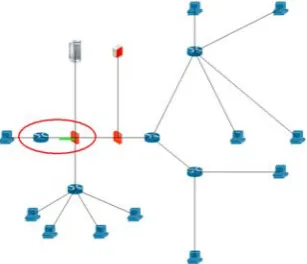
When the dos attack is detected by IDS, IDS inquires the vulnerability library to affirm this vulnerability information. In the Fig.6, the yellow packet in the circle denotes enquiring packet from IDS to vulnerability library.
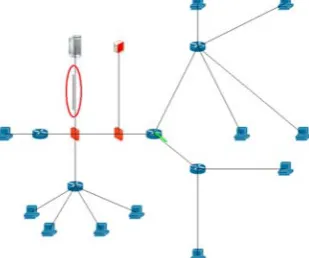
Figure 6. Inquiring message sending from IDS to vulnerability library The vulnerability library queries the database and affirms this attacking. Then the vulnerability library sends affirmed information to IDS. In the Fig.7, the gray packet in the circle denotes affirmed packet from vulnerability library to IDS.
Figure 7. Affirming message sending from vulnerability library to IDS
In the Fig.8, the red packet in the circle denotes that IDS informs the firewall1 to forbid the unlawful access after receiving the vulnerability affirmed information.
Figure 8. Denying packet message sent from IDS to firewall Now, the packet of attacker cannot bypass the firewall1. It is shown in Fig.9. The control platform results of the packet denying from attacker are shown in Fig.10.
Figure 9. The packet is denied from attacker
Figure 10. The control platform results of the packet denying from attacker
VI.CONCLUSION
making, system rebooting, and temporal-logic relations among these tasks; simulation tasks of access control of firewall, intrusion, detection of IDS, vulnerability library, and temporal-logic relations among these tasks. The results of these experiments verified the description capability and effectiveness of CNDSDL. In our future work, we will describe a variety of defense schemes in CNDSDL in order to further verify our language’s description capability.
ACKNOWLEDGMENT
This work is supported by the following funding sources: the National Nature Science Foundation of China under Grant No. 61170295, the Project of National ministry under Grant No.A2120110006, the Co-Funding Project of Beijing Municipal education Commission under Grant No.JD100060630 and the Project of BUAA Basal Research Fund under Grant No.YWF-11-03-Q-001.
REFERENCES
[1] S.A.Arunmozhi and Y.Venkataramani, “A New Defense Scheme against DDoS Attack in Mobile Ad Hoc Networks,” International Conference on Computer Science and Information Technology, Bangalore, India, p p.210-216, 2011.
[2] N.Baik, A.Sungsoo and K.Namhi, “Effective DDoS attack defense scheme using web service performance measurement,” International Conference on Ubiquitous and Future Networks, Phuket, Thailand, pp.428-433, 2012.
[3] B.Khosravifar and J. Bentahar, “An experience improving intrusion detection systems false alarm ratio by using honeypot,” International Conference on Advanced Information Networking and Applications, Okinawa, Japan, pp.997-1004, 2008.
[4] B.Khosravifar, M. Gomrokchi and J. Bentahar, “A multi-agent-based approach to improve intrusion detection systems false alarm ratio by Using Honeypot,”
International Conference on Advanced Information Networking and Applications, Bradford, United Kingdom, pp.97-102, 2009.
[5] S.Hammouda, L.Maalej and Z.Trabelsi, “Towards optimized TCP/IP covert channels detection, IDS and firewall integration,” International Conference on New Technologies, Tangier, Morocco, pp.1-5, 2008.
[6] J.P.Loyall, M.Gillen, A.Paulos et al, “Dynamic policy-driven quality of service in service-oriented information management systems,” SOFTWARE-PRACTICE & EXPERIENCE, Vol.41, No.12, pp.1459-1489, 2010.
[7] X.LUO,M.SONG and J.SONG, “Research on service-oriented policy-driven IAAS management,” The Journal of China Universities of Posts and Telecommunications, Vol.18, pp.64-70, 2011.
[8] M.D.Amicoa, G.Sermeb, M.S.Idreesa, A.S.de.Oliveirab, Y.Roudiera, “HiPoLDS: A Hierarchical Security Policy Language for Distributed Systems,” Information Security Technical Report, Vol.17, No.3, pp.81-92, 2013.
[9] J.Poroora, B.Jayaramanb, “C2L:A Formal Policy Language for Secure Cloud Configurations,” Procedia Computer Science, Vol.10, pp.499-506, 2012.
[10]Q.Ni, E.Bertino, “xfACL: An extensible functional language for access control,” ACM Symposium on Access Control Models and Technologies, Innsbruck, Austria, pp.61-72, 2011.
[11]P.W.L. Fong, “Relationship-based access control: protection model and policy language,” ACM Conference on Data and Application Security and Privacy, San Antonio, USA, pp.191-202, 2011.
[12]P.Fong, I.Siahaan, “Relationship-based access control policies and their policy languages,” ACM Symposium on Access Control Models and Technologies, Innsbruck, Austria, pp.51-60, 2011.
[13]Department of Defense, “JP3-13: Information Operations,” Washington DC: US Government printing, 2006.
[14]C.Chin-Ling, and C.Chih-Yu, “A two-tier coordinated defense scheme against DDoS attacks,” International Conference on Computer Science and Service System, Nanjing, China, pp.148-151, 2011.
[15]H.M.Sun, et al, “A Robust Defense Scheme to Resist Routing Attacks in Mobile Ad Hoc Networks,” World Congress in Applied Computing, Computer Science, and Computer Engineering, Kota Kinabalu, MALAYSIA, pp.58-65, 2011.
[16]N.Damianou, N.Dulay, E.Lupu, et al, “The ponder policy specification language,” Proceedings of the International Workshop on Policies for Distributed Systems and Networks, Bristol, UK, pp.18-38, 2001.
[17]K.Twidle, N.Dulay, E.Lupu, et al. “Ponder2: A policy system for autonomous pervasive environments,” Fifth International Conference on Autonomic and Autonomous Systems, Valencia, Spain, pp.330-335, 2009.
[18]OASIS, “eXtensible access control markup
language(XACML) Version 3.0,” http://docs.oasis-open.org/xacml/3.0/xacml-3.0-core-spec-os-en.pdf , 2013. [19]A.Herzberg,Y.Mass,J.Mihaeli,D.Naor, et al, “Access
control meets public key infrastructure, or: assigning roles to strangers,” IEEE Symposium on Security and Privacy, Berkeley, America, pp.2-14,2000.
[20]L.Kagal, “Rei: A Policy Language for the Me-Centric Project,”
http://ebiquity.umbc.edu/_file_directory_/papers/57.pdf, 2005.
[21]Z.Bin, A.S.Ehab, J.Radha, R.James, P.Corin, “Specifications of a high-level conflict-free firewall policy language for multi-domain networks,” Proceedings of the 12th ACM symposium on Access control models and technologies, Sophia Antipolis, France, pp.185 – 194, 2007.
[22]L.P.Swiler, C.Phillips, D.Ellis, S.Chakerian, “Computer-attack graph generation tool,” Proceeding of DARPA Information Survivability Conference & Exposition II, Vol.2, pp.307-321, 2001.
Zhao Wei, born in 1984, Ph. D. candidate, His main research interests include computer network and information security.
Chunhe Xia, born in 1965, professor, Ph. D. supervisor. His main research interests include computer network and information security, information operations and cloud computing.
Yang Luo, born in 1989, master candidate, His main research interests include network security and virtualization technology.
Xiaochen Liu, born in 1988, Ph. D. candidate. Her main research interests include network security and cloud computing.