Research Article
CODEN: IJPNL6
RP-HPLC METHOD DEVELOPMENT AND VALIDATION OF BALSALAZIDE IN
BULK AND CAPSULE DOSAGE FORM
G. Parimala
*, D. Narasimharao, M. Prasadarao
Department of Pharmaceutical Analysis, M.A.M College of Pharmacy, Kesanupalli,
Narsaraopet-522601, Guntur district, Andhra Pradesh, India
*Corresponding author e-mail: [email protected]
ABSTRACT
A RP-HPLC method was developed for the estimation of Balsalazide in bulk and Capsule dosage form and the method was proposed for the validation for the parameters like accuracy, precision, linearity, range, robustness, ruggedness, % of recovery and limit of detection and limit of quantitation. Still now there were number of analytical methods were developed for the estimation and validation of Balsalazide alone and in combined dosage form like UV-Visible spectroscopy, fluorimetry and RP-HPLC method but compared to those methods the present study was a simple and selective LC method for the quantitative estimation of Balsalazide in capsule dosage form. Chromatographic separation was achieved on a c18 column using Inertsil ODS 3V column, C18 (250x4.6 ID) mobile phase consisting of a mixture of KH2PO4:ACN:MEOH (50:30:20 v/v/v %)PH: 4.5 with detection of 304 nm. The retention time was found to be 2.487 min and linearity was observed in the range 90-210µg /ml for Balsalazide. The method was found to be precise as indicated by the repeatability analysis, showing %RSD less than 2.
Key words: RP-HPLC, UV detection, Balsalazide
INTRODUCTION
Balsalazide (5-[(E)-2-{4-[(2-carboxyethyl) carbamo- yl]phenyl}diazen-1-yl]-2-hydroxybenzoic acid) is an anti-inflammatory drug used in the treatment of inflammatory bowel disease It is usually administered as the disodium salt. Balsalazide releases mesalazine, also known as 5-aminosalicylic acid, or 5-ASA, in the large intestine. Its advantage over that drug in the treatment of ulcerative colitis is believed to be the delivery of the active agent past the small intestine to the large intestine, the active site of ulcerative colitis. The literature survey reveals several analytical methods for quantitative estimation of Balsalazide in body fluids and in pharmaceutical formulations, these methods include Ultaviolet spectrophotometry, High-performance liquid formulations (HPLC), TLC- densitometry and voltammetry quantitation of Balsalazide in human plasma, saliva and gingival crevicular fluid by LC– MS/MS. Methods available for the estimation of Balsalazide are Ultaviolet spectrophotometry,
High-performance liquid formulations (HPLC), and HPTLC method. The literature survey was carried out for the estimation of Balsalazide, there was only two methods were available on this the drug. Individual methods are also available for both the drugs. Therefore attempts were made to develop and validate a new simple, accurate, precise, selective RP-HPLC method for determination of Balsalazide in pharmaceutical dosage form.
MATERIALS AND METHODS
Balsalazide drugs gift Samples obtained from Chandra labs, Hyd.Cozabal (750 mg) Capsule (contains Balsalazide-750 mg label claim)Mfg by : Sun Pharmaceutical Industries Ltd. Obtained from local pharmacy.
Preparation of Phosphate buffer: 2.72gm of potassium di hydrogen phosphate (KH2PO4) was weighed and dissolved in 100ml of water and volume was made up to 1000ml with water. Adjust the pH to
International Journal of Pharmacy
4.5 using ortho phosphoric acid. The buffer was filtered through 0.45µ filters to remove all fine particles and gases.
Mobile Phase: A mixture of 50 volumes of Phosphate buffer (KH2PO4) pH 4.5,30 volumes of Acetonitrile and 20 volumes of Methanol was prepared. The mobile phase was sonicated for 10min to remove gases.
Preparation of standard solution: Weigh accurately 75 mg of BALSALAZIDE in 50 ml of volumetric flask and dissolve in 10ml of mobile phase and make up the volume with mobile phase. From above stock solution 150 µg/ml of BALSALAZIDE is prepared by diluting 1ml to 10ml with mobile phase. This solution is used for recording chromatogram.
Preparation of sample solution: 10 Capsules (each capsule contains 750 mg of BALSALAZIDE) were weighed and taken into a mortar uniformly mixed. Test stock solutions of BALSALAZIDE (150μg/ml) and was prepared by dissolving weight equivalent to 750 mg of BALSALAZIDE and dissolved in sufficient mobile phase. After that filtered the solution using 0.45-micron syringe filter and Sonicated for 5 min and dilute to 100ml with mobile phase. Further dilutions are prepared in 5 replicates of 150 μg/ml of BALSALAZIDE was made by adding 1 ml of stock solution to 10 ml of mobile phase.
Method validation
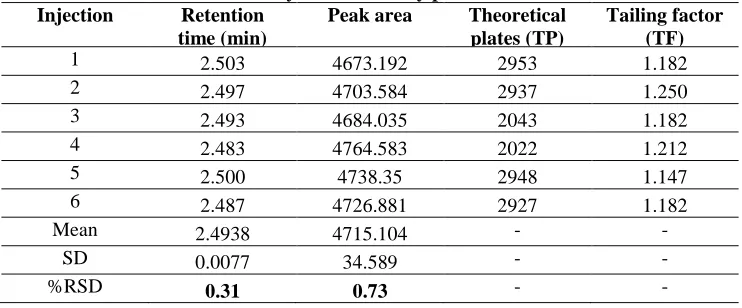
System suitability parameters: The system suitability parameters were determined by preparing standard solutions of Balsalazide and the solutions were injected six times and the parameters like peak tailing, resolution and USP plate count were determined.
Specificity: There is no interference of mobile phase, solvent and placebo with the analyte peak and also the peak purity of analyte peak which indicate that the method is specific for the analysis of analytes in their dosage form.
Linearity: Linearity the method was tested from 90-210 % of the targeted level of the assay concentration for analyte. Standard solutions contained 90-210 μg/mL of Balsalazide Linearity solutions were injected in triplicate. The calibration graphs were obtained by plotting peak area against the concentration of the drugs. The equations of the calibration curves for Balsalazide obtained was y = 34.064x + 316.07 In the Balsalazide determination, the calibration graphs were found to be linear in the aforementioned concentrations with correlation coefficients 0.9992.
Accuracy: Accuracy of the method was determined by Recovery studies. To the formulation (pre analyzed sample), the reference standards of the drugs were added at the level of 80%, 100%, 120%. The recovery studies were carried out three times and the percentage recovery and percentage mean recovery were calculated for drug is shown in table. To check the accuracy of the method, recovery studies were carried out by addition of standard drug solution to pre-analyzed sample solution at three different levels 80%, 100%, 120%.
Precision: Prepared sample preparations of BALSALAZIDE as per test method and injected 6 times in to the column. The repeatability of the method was studied by determining the concentrations of Balsalazide six times. The results of the precision study indicate that the method is reliable (%RSD < 2). Intermediate precision of the method was determined by analyzing the samples six times on different days by different chemists using different analytical columns of the same make and different HPLC systems.
Robustness: To demonstrate the robustness of the method, prepared solution as per test method and injected at different variable conditions like using different conditions like flow rate and wavelength. System suitability parameters were compared with that of method precision.
Ruggedness: The ruggedness of the method was studied by the determining the analyst to analyst variation by performing the Assay by two different analysts.
Limit of Detection (LOD): The limit of detection (LOD) of an analytical method may be defined as the concentration, which gives rise to an instrument signal that is significantly different from the blank. For spectroscopic techniques or other methods that rely upon a calibration curve for quantitative measurements, the IUPAC approach employs the standard deviation of the intercept (Sa), which may be related to LOD and the slope of the calibration curve, b
Limit of Quantification (LOQ): The LOQ is the concentration that can be quantitate reliably with a specified level of accuracy and precision. The LOQ represent the concentration of analyte that would yield a signal-to-noise ratio of 10.
Preparation of samples for Assay:
Sample: 10 Capsules (each capsule contains 750 mg of BALSALAZIDE) were weighed and taken into a mortar uniformly mixed. Test stock solutions of BALSALAZIDE (150μg/ml) and was prepared by dissolving weight equivalent to 750 mg of BALSALAZIDE and dissolved in sufficient mobile phase. After that filtered the solution using 0.45-micron syringe filter and Sonicated for 5 min and dilute to 100ml with mobile phase. Further dilutions are prepared in 5 replicates of 150 μg/ml of BALSALAZIDE was made by adding 1 ml of stock solution to 10 ml of mobile phase.
RESULTS AND DISCUSSION
Chromatographic separation was achieved on a c18 column using Inertsil ODS 3V column, C18 (250x4.6 ID) mobile phase consisting of a mixture of KH2PO4:ACN:MEOH (50:30:20 v/v/v %)PH: 4.5 with detection of 304 nm. The retention time was found to be 2.487 min and linearity was observed in the range 90-210µg /ml for Balsalazide. The method
was found to be precise as indicated by the repeatability analysis, showing %RSD less than 2. Accuracy, limit of detection, limit of quantification, robustness and ruggudness values were with in the limits.
Conclusion
The proposed RP-HPLC method was validated as per ICH guidelines and can be applied for the determination of Balsalazide in bulk and capsule dosage form. The method was found to be system suitability, specificity , accuracy , recovery , robustness, linearity, ruggedness , and limit of detection and limit of quantification. The recovery studies of Balsalazide was found to be 99.33% and get a retention time 2.487 mints . the linearity method was investigated and observed in the range of 90-210 ug/ml for balsalazide and the method was found to be precise as indicated by the repeatability analysis showing %RSD <2
Table.1 system suitability parameters Injection Retention
time (min)
Peak area Theoretical plates (TP)
Tailing factor (TF)
1 2.503 4673.192 2953 1.182
2 2.497 4703.584 2937 1.250
3 2.493 4684.035 2043 1.182
4 2.483 4764.583 2022 1.212
5 2.500 4738.35 2948 1.147
6 2.487 4726.881 2927 1.182
Mean 2.4938 4715.104 - -
SD 0.0077 34.589 - -
%RSD 0.31 0.73 - -
Table 2 linearity of Balsalazide BALSALAZIDE
S.No. Concentration µg/ml
Peak Area
1 90 2708.567
2 120 3806.345
3 150 4798.441
4 180 5866.397
5 210 6788.201
S.D. 47.43 1616.43
Table 3 Recovery results for Balsalazide
Table 4 Method Precision BALSALAZIDE
S.No. Rt Area
1 2.503 4673.192
2 2.497 4703.584
3 2.493 4684.035
4 2.483 4764.583
5 2.500 4738.35
6 2.487 4726.881
avg 2.4938 4715.104
stdev 0.0077 34.589
%RSD 0.31 0.73 TABLE 5 Results for Robustness
PARAMETER BALSALAZIDE RETENTION
TIME (min)
TAILING FACTOR
Flow 0.8ml/min 1.2ml/min
3.323 2.477
1.220 1.179
WAVE LENGTH 302nm 306nm
2.477 2.480
1.212 1.250
Table 6 Results for Ruggedness BALSALAZIDE %Assay
Analyst 01 98.65
Analyst 02 99.61
%RSD 0.68 Recovery
level
Accuracy BALSALAZIDE Average
% Recovery Amount
taken(mcg/ml)
Area Average area
Amount recovered(mcg/ml
)
%Recovery
80% 150 4730.754 4734.724 149.27 99.51
99.33%
150 4692.637
150
4780.780
100% 180
5674.422
5728.644 179.08 99.49
180
5737.089
180 5774.422
120% 210
6893.712
6775.049 207.88 98.99
210 6756.735
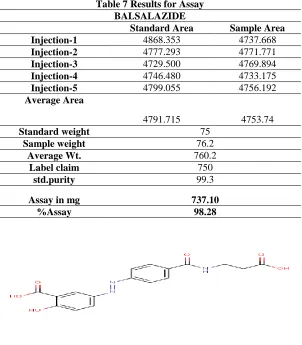
Table 7 Results for Assay BALSALAZIDE
Standard Area Sample Area Injection-1 4868.353 4737.668
Injection-2 4777.293 4771.771
Injection-3 4729.500 4769.894
Injection-4 4746.480 4733.175
Injection-5 4799.055 4756.192
Average Area
4791.715 4753.74
Standard weight 75
Sample weight 76.2
Average Wt. 760.2
Label claim 750
std.purity 99.3
Assay in mg 737.10 %Assay 98.28
Fig 1. Structure of Balsalazine
Fig 2 Balsalazide
REFERENCES
1. Skoog DA, West DM, Holes JF. Fundamentals of Analytical Chemistry. Harcourt College Publishers; 2001; 1-5.
2. Sethi PD. HPLC Quantitative Analysis of Drugs in Pharmaceutical Formulations. CBS publisher and distributors, New Delhi; 2001;3:53-62.
3. Kennedy JH. Analytical Chemistry: Principles. Saunders college publishing-New York,.1990.2:3-20.
4. Higuchi T, Einar B, Hanffeu H. Pharmaceutical Analysis.1997;1:1-10.
5. Conners KA. A Textbook of Pharmaceutical Analysis, Wiley-Interscience Publication, John Wiley & Sons,. 1982;3:173-187.
6. Gennaro AR, Remington: The science and Practice of Pharmacy, Indian edition, Lippincott Williams and Wilkins, 200;20(1): 587-610.
7. Kaplan LA, Pesceb AJ, Kazmierczak SC. Clinical Chemistry Theory, Analysis, Correlation, Mosby,2003;4:109-110.
8. Skoog DA, Holler FJ, Nieman TA. Principles of Instrumental Analysis, Thomson Brook/cole,. 2005;5:674-696.
9. K. Senthil Kumar, GS. Naveen Kumar, G. Manoj Varma, G. Pavan Kumar, T. Rama Krishna and P. Kiran Kumar Rp-Hplc Method For The Estimation Of Balsalazide In Bulk And Pharmaceutical Dosage Form. International Journal Of Research In Pharmacy And Chemistry 2012; 2(3) 797-800.
10. Anandakumar K, Jothieswari D, Subathrai R, Varatharajan K, Sivanseyal GDevelopment and Validation of RP–HPLC Method for the Estimation of Balsalazide in Pure and in Pharmaceutical Dosage forms.Research Journal of Pharmacy and Technology.Year : 2010,3(9).
11. Emanual Michael Patelia, Rakesh Thakur and Jayesh Patel Estimation of Balsalazide by HPTLC-Densitometry Method in Pharmaceutical Formulations. Open Access Scientific Reports., 2013;2(4).
12. MayankMandhanya, NitinDubey, NidhiDubey, Praveen Sharma, Shiv Shankar HardeniaSpectrophotometric and Reversed-Phase High-Performance Liquid Chromatographic Methods for Simultaneous Determination of Paracetamol and Balsalazide Disodium Dihydrate in Combined capsule Dosage Form.Asian Journal of Pharmacy and Medical Science. 201;1(1):13-20.
13. K. V. Surendranath, Ravi KiranKaja, P. Radhakrishnanand, J. Satish, P. V. V. Satyanarayana A Stability-Indicating LC Method for Analysis of Balsalazide Disodium in the Bulk Drug and in Pharmaceutical Dosage Forms. Chromatographia 69(9): 1031-2