OPTIMIZATION IN THE ASPECT OF CRASH TRIGGERS PATTERN UNDER
AXIAL AND OBLIQUE IMPACT LOADING
Mr. S. D. Yadav
M.Tech, Department of Mechanical Engineering, Rajarambapu Institute
of Technology,Rajaramnagar, Urun Islampur, India
Mr. S. M. Kalel
M.Tech, Department of Mechanical Engineering, Rajarambapu Institute of Technology,Rajaramnagar, Urun
Islampur, India
Prof. S. R. Patil
Associate Professor, Department of Mechanical Engineering, Rajarambapu Institute of Technology,Rajaramnagar, Urun
Islampur, India
Abstract: A crash box is a thin-walled structure made of metal, alloy or composite material which is mounted on the front region as well as rear region of the vehicle. Main purpose of crash box is to absorb the energy during the collision event i.e. crash. A crash box should absorb maximum possible energy and should deform sequentially so that the deformation pattern is not random. In this paper the effect of various types of triggers is investigated for mild steel crash boxes. Triggers are the mechanism provided for structural failure or deformation of sections, importance of structural failure is to reduce the shock during the impact and smoothly transfer of energy to the supporting structure. A comparative study of variation of peak forces, energy absorbed was done with the variation of crash triggers for crash box. Force vs. displacement curves were plotted for each case providing detailed discernment into the force variation during deformation.
Keywords: Crashworthiness , thin-walled structure, Energy absorption.
I. INTRODUCTION
Vehicle crash is a dynamic phenomenon featuring a complex interaction between structural and inertial behavior. In crash events, automotive structures are subjected to a loading of high intensities, which includes transient deformations ranging from small deformation and small strain to large plastic permanent deformation with large strain. In a typical collision, it is the outer envelope, which experiences the impact and undergoes deformation locally in the impact region. The occupants experience the impact only later. Crashworthiness is the ability of a structure to protect its occupants during an impact. Therefore, the structure of the vehicle should absorb this impact kinetic energy of collisions to convert it into the plastic deformation energy in a predictable manner and thereby transferring fewer forces on the occupants to ensure their safety. Energy absorption is the ability of a material or a section that absorbs energy or forces during various mechanical loading conditions. Structures that are tailored to perform in this manner are termed crashworthy.
The thin-walled tubular structures are considered as the most efficient energy absorbing structures. Therefore, the study of thin-walled tubular
structures under dynamic loading conditions has become the basis of structural crashworthiness.
II. DESIGN AND MODELING
The cross sectional profile of the designed thin wall structure tube was square. It is modeled using mild steel as a material and having length of 200mm, thickness of 1.5mm and perimeters of 240mm. The purpose of the research is to investigate the crash performance of the different types of trigger pattern, followed by the enhancement of the crashworthiness capacities of the selected best design.
A. Section with triggers
Triggers are the mechanism provided for structural failure or deformation of sections, importance of structural failure is to reduce the shock during the impact and smoothly transfer of energy to the supporting structure. Dimensions of the triggers play important role in deformation initiation process. Width and depth of triggers should be much enough just to start the deformation process; if they are too deep or too wide they will cause the locking of structure during the process. Also number of triggers and pitch (distance between two successive triggers) also play vital role in deformation process.
It is found that trigger position is ranges from C/8 to C/2 from the top end of the box has no any changes on response. The nature of load vs deformation is near about same.
Hence C/8 to C/2 will give an optimum FE parameter for modeling of crash box.
Hence for the design of crash box here trigger position is taken as C/2.
therefore the trigger position for crash box is 30mm from top end of the box. The crash box having length of 200mm hence the 5 triggers positioned from top end of box.
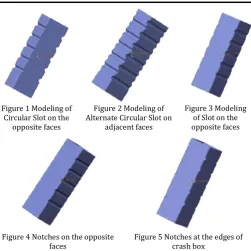
By using creo surface modeling software 5 different type of triggers or beads crash box are modeled and they are as follows,
Figure 4 Notches on the opposite
faces Figure 5 Notches at the edges of crash box
The various trigger patterns which are modeled are as follows,
Table I TYPES OF TRIGGERS Sr. No Type of trigger
1 Circular Slot on the opposite faces 2 Alternate Circular Slot on adjacent
faces
3 Slot on opposite the faces 4 Notches on the opposite faces 5 Notches at the edges of crash box
efficiency and the energy absorption capacity value of force is required.
We know that at the time of impact the kinetic energy and work done are equal
Hence
...a
The crash force efficiency (CFE) can be defined as the mean crashing force (P mean) divided by the peak crushing load (P peak).
Load vs Deformation is used to find out the values of energy absorption capacity in terms of N-mm.
A. Axial Impact Loading
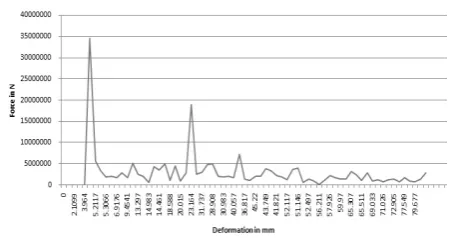
1. Circular Slot on the opposite faces
Figure 8 Axial impact analysis of alternate circular slot on adjacent faces
Figure 9 Load vs deformation graph for Axial impact analysis of alternate circular slot on adjacent faces
3. Slot on the opposite faces
Figure 10 Axial impact analysis of slot on the opposite faces Figure 11 Load vs deformation graph for Axial impact analysis of slot on the opposite faces
4. Notches on the opposite faces
Figure 12 Axial impact analysis of notches on the opposite faces Figure 13 Load vs deformation graph for axial impact analysis of notches on the opposite faces
Figure 14 Axial impact analysis of notches at the edges of crash box
Figure 15 Load vs deformation graph for Axial impact analysis of notches at the edges of crash box
B. Oblique Impact loading
1. Circular Slot on the opposite faces
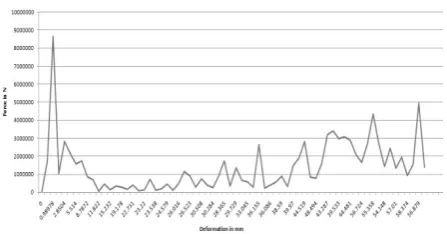
Figure 16 Oblique impact analysis of circular slot on the opposite faces Figure 17 Load vs deformation graph for Oblique impact analysis of circular slot on the opposite faces
2. Alternate Circular Slot on adjacent faces
Figure 18 Oblique impact analysis of alternate circular slot on adjacent
faces Figure 19 Load vs deformation graph for Oblique impact analysis of alternate circular slot on adjacent faces
Figure 20 Oblique impact analysis of slot on the opposite faces
Figure 21 Load vs deformation graph for Oblique impact analysis of slot on the opposite faces
4. Notches on the opposite faces
Figure 22 Oblique impact analysis of notches on the opposite faces Figure 23 Load vs deformation graph for Oblique impact analysis of notches on the opposite faces
5. Notches at the edges of crash box
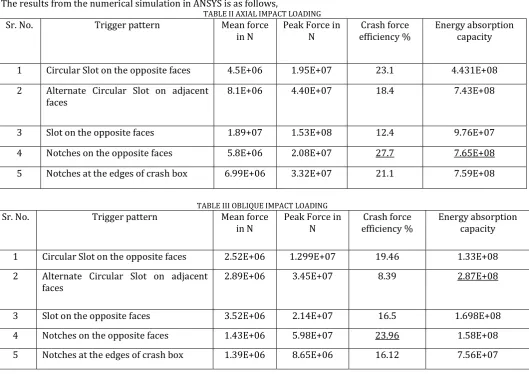
3 Slot on the opposite faces 1.89+07 1.53E+08 12.4 9.76E+07
4 Notches on the opposite faces 5.8E+06 2.08E+07 27.7 7.65E+08
5 Notches at the edges of crash box 6.99E+06 3.32E+07 21.1 7.59E+08
TABLE III OBLIQUE IMPACT LOADING
Sr. No. Trigger pattern Mean force
in N Peak Force in N efficiency % Crash force Energy absorption capacity
1 Circular Slot on the opposite faces 2.52E+06 1.299E+07 19.46 1.33E+08
2 Alternate Circular Slot on adjacent
faces 2.89E+06 3.45E+07 8.39 2.87E+08
3 Slot on the opposite faces 3.52E+06 2.14E+07 16.5 1.698E+08
4 Notches on the opposite faces 1.43E+06 5.98E+07 23.96 1.58E+08 5 Notches at the edges of crash box 1.39E+06 8.65E+06 16.12 7.56E+07
From the table no. II; both crash force efficiency and the energy absorption capacity in axial impact loading is maximum in notches on the opposite faces pattern. From the table no. III; the crash force efficiency is maximum in notches on the opposite faces pattern and energy absorption capacity is maximum in alternate Circular Slot on adjacent faces.
Out of 4 parameters the 3 parameters are maximum in notches on the opposite faces pattern and 1 parameter is near to the maximum value. Hence the notches on the opposite face pattern is optimize in the aspect of trigger pattern.
IV. CONCLUSION
In the present work crash boxes with different crash trigger patterns are analyzed numerically with axial and oblique impact loading. Following conclude remarks can be drown,
Location, dimensions and type of triggers play vital role during a crash event.
Crash boxes are optimized in the aspect of trigger pattern.
Trigger pattern on opposite faces with 5 notches are
Though energy absorption and crash efficiency is found better during axial impact yet crash boxes need to be optimized with various impact direction as most of the crash events are not in axial direction.
V. ACKNOWLEDGEMENT
I would like to express my deep sense of gratitude to my supervisor Prof. S. R. Patil for his inspiring & valuable suggestions. I am deeply indebted to him for giving me chance to study this subject and providing constant guidance throughout this work.
I am thankful for the assistance provided by the department staff, central library, staff & computer faculty. Finally, I would like to thank my colleagues and friends for directly and indirectly helping me for the same.
REFERENCES
[1] Omer Masood Qureshi, Enrico Bertocchi. "Crash performance of notch triggers and variable frequency progressive-triggers on patterned box beams during axial impacts." Thin-Walled Structures Vol. 63 (2012): pp 98–105.
Subjected to Axial Impact Loading." 11th International Symposium on Plasticity and Impact Mechanics, Implast 2016.
[3] F. Ince, H.S. Turken, Z. Mecitoglu, N. Uludag, I. Durgun, E. Altinok, H. Orenel. "A numerical and experimental study on the impact behavior of box structures." Procedia Engineering Vol. 10 (2011): pp 1736–1741.
[4] Niyazi Tanlak, Fazil O. Sonmez. "Optimal shape design of thin-walled tubes under high-velocity axial impact loads."Thin-Walled Structures Vol. 84 (2014): pp 302–312.
[5] A.M.S. Hamouda, R.O. Saied, F.M. Shuaei. "Energy absorption capacities of square tubular structures." Materials and Manufacturing Engineering (September 2007).
[6] Javad Marzbanrad, Mehdi Mehdikhanlo, Ashkan Saeedi Pour. "An energy absorption comparison of square, circular, and elliptic steel and aluminum tubes under impact loading." Turkish J. Eng. Env. Sci. Vol. 33 (2009): pp 159 – 166.
[7] B.P. DiPaolo , P.J.M. Monteiro b, R. Gronsky. "Quasi-static axial crush response of a thin-wall."International Journal of Solids and Structures Vol. 41 (2004): pp 3707–3733.