Dynamic Routing for Data Integrity and Delay
Differentiated Services in WSN
Sharmila Banu. M Raj Barath. S
Post Graduate Scholar Assistant Professor
Department of Electronics and Communication Engineering Department of Electronics and Communication Engineering Christian college of Engineering and Technology,
Oddanchathram, India
Christian college of Engineering and Technology, Oddanchathram, India
Abstract
Applications running on the same Wireless Sensor Network (WSN) platform usually has different Quality of Service (QoS) requirements. Two basic requirements are low delay and high data integrity. However, in many cases, these two requirements cannot be satisfied consequently. In this paper, based on the concept of potential in physics, we propose IDDR, a Destination Sequenced Distance Vector routing algorithm, to resolve this conflict. DSV is table driven protocol, for maintain topology it sends the table to all its all neighboring nodes. By constructing a virtual hybrid potential field, according to the weight assigned to each packet IDDR separates packets of application with different QoS requirements, routes them towards the sink through different paths to improve the data fidelity for integrity-sensitive applications as well as reduce the end-to-end delay for delay sensitive ones. Using the Lyapunov drift technique, we prove that IDDR is stable. IDDR provides data integrity and delay differentiated services that demonstrated by Simulation results.
Keywords: Wireless sensor network, Integrity and Delay Differentiated Routing, Zone Transfer Protocol, Neighbour Discovery Protocol, Destination Sequenced Distance Vector Routing Algorithm
________________________________________________________________________________________________________
I. INTRODUCTION
A wireless sensor network (WSN) is a wireless network that consisting of spatially distributed autonomous devices using sensors to cooperatively monitor physical or environmental conditions, such as temperature, sound, vibration, pressure, motion or pollutants, at different locations. The network is formed by hundreds or thousands of motes that communicate with each other and pass data along from one to another. The previous work aims to simultaneously improve the fidelity for high-integrity applications and reduce the end-to-end delay for delay-sensitive ones, even when the network is conjested. We borrow the concept of potential field from the discipline of physics and design a novel potential based routing algorithm, which is called integrity and delay differentiated routing (IDDR). The network is a homogeneous network so its delay is high. In this work the data loss is high due to its high traffic in the transmission path. During data sharing process if any error is occurring it can’t reroute its path. In this paper data is transferred between two nodes in between it has one node it share the data between the nodes. The middle node is used to reroute the data during transmission. So the network used in that is a heterogeneous one. Routing packets from source to destination is the main function of the network layers . The major area of network layer design used by routes and the data structures is choosen by the algorithm. The transmitted data from the incoming packets are decided by network layer software and it is the part of the routing algorithm. If the datagrams are used by the subnets internally, for every arriving data packet this decision must be made a new since the best route may have changed since last time. The virtual circuits is used by th subnet in that such decision is made ones per session. The Distributed Bellman Ford (DBF) Routing Algorithm gave an idea to the Destination Sequenced Distance Vector (DSDV) Routing Algorithm is based on the idea of the with certain improvements. In Ad Hoc environment using a Distributed Bellman Ford algorithm is the primary concern is its susceptibility towards forming routing loops and counting to infinity problem. DSDV. At all instants the loop free path is guarantees by DSDV. The same rules will be followed by the neighboring nodes for updating the information when information about a node with a newer sequence number is received. The newly received broadcast information are incremented by one hop for the metrics of routes. It is heterogenous network.
II. PREVIOUS WORK
We investigate and exploit various methods used to detect various error free path, and also the methodologies used in that also discussed, and also additional features included to overcome the limits in that effectiveness.
CEDAR: A Core Extraction Distribute Ad hoc Routing algorithm
increase waves and (c) a QoS route computation algorithm that is executed at the core nodes using only locally available state[3]. The effectiveness of the method is poor in terms of delay and efficiency.
Achieving Real-time Guarantees in Mobile Ad Hoc wireless Networks
We investigate whether real-time event constraints can be guaranteed in a mobile ad hoc wireless network. In this work in progress paper we present our analysis of the impact of mobile ad hoc wireless network on achieving real-time guarantees. We introduce our ongoing work on the use of a proactive routing and resource reservation protocol using mobility awareness and prediction to reduce the unpredictability of a dynamic mobile ad hoc wireless network[5]. But it is difficult to achieve high level communication scheme.
TOSSIM: Accurate and Scalable Simulation of Entire Tiny OS Applications
We present TOSSIM, a simulator for Tiny OS wireless sensor networks. TOSSIM can capture network behavior at a high fidelity while scaling to thousands of nodes. Using TOSSIM, we have discovered several bugs in Tiny OS, ranging from network it level MAC interactions to queue overflows in an ad-hoc routing protocol. Through these and other evaluations, we show that detailed, scalable sensor network simulation in possible[1]. It is expensive enough to capture a wide range of network interactions.
Dynamic Routing for Data Integrity and Delay Differentiated Services
We propose IDDR, a multi oath dynamic routing algorithm, to resolve this conflict. By constructing a virtual hybrid potential field, IDDR separates packets of applications with different QoS requirements according to the weight assigned to each packets, and routes them towards the sink through different paths to improve the fidelity for integrity-sensitive applications as well as reduce the end-to-end delay-sensitive Using the Lyapunov drift technique, we prove that IDDR is stable[11]. But it is not a efficient one because it has a homogeneous network, high data loss and it can’t reroute easily.
III. PROPOSED WORK
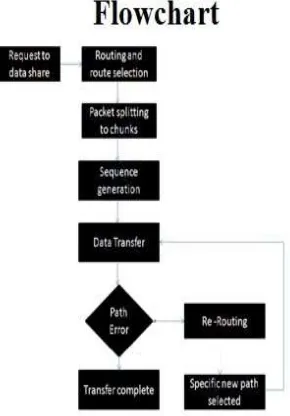
The main objective is to determine whether the data are reached its desired destination from its source location and also performance can be obtained by rerouting mechanism. The stages of data sharing from source to destination between the nodes are shown below in Fig 1.
Fig. 1: Flowchart of Data Sharing.
The Flowchart will explain the data sharing between nodes. At first request message from node A is sent to parent node, it will have sent an acknowledgement. Then it will start a route selection process, packet splitting. It will generate the sequence for data transfer between the nodes. If any path error occurs, it will reroute the path otherwise it will complete the data transfer.
Destination Sequenced Distance Vector Routing Algorithm
problem, the Distributed Bellman Ford (DBF) algorithm is used. At all instants DSDV guarantees loop free paths. Each node maintains a routing table, which contains entire for all nodes in the network, each entry consists of:
The destination's address
The number of hops required reaching the destination (hop count) The sequence number as stamped by the destination.
Beacon message (“I am alive message”) will be broadcasted with a locally maintained sequence number when the node ‘B’ comes up. The neighboring nodes listen to the message and update the information to the node. If there is no previous entry for the node B, only B’s address will be entered in the routing table with hop count and sequence number. If there is any previous entry, sequence number of broadcast information is compared with the sequence number stored in the node for destination B.
If the message has higher sequence number, the node B will propagate a new information about its location and entry will be updated according to new information. The received new information is scheduled for broadcasting to its neighbors to know the changes in topology. The same rules will be followed by the neighboring nodes
Routing Table Updation
Two ways are available to sent the updated routing table. The first is full dump. All routing information’s are in this type of packets and it require multiple network protocol data units (NPDUs). The packets are transmitted infrequently during periods of accessional movements. For relay only that information smaller incremental packets are used which has changed since the full dump. At each broadcasts must fit into a standard-size NPDU, the amount of traffic generated will get decreased. The additional table will be maintained by the mobile nodes where they store the data sent in the incremental routing information packets.
Cluster head Gateway Switch Routing
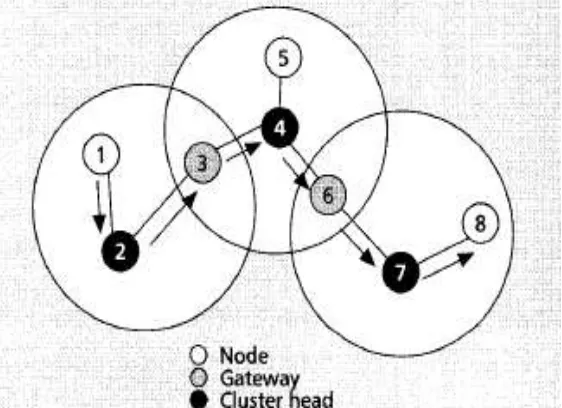
In this type of addressing and network organization, the cluster Head Gateway Switch Routing (CGSR) protocol differs from the previous protocol. Instead of flat network, CGSR is a multi-hop mobile wireless network with several heuristic routing schemes. A group of ad hoc nodes, a framework for code separation (among cluster), channel access, routing, and bandwidth allocation can be achieved and it is controlled by cluster head. Within the cluster node is selected as the cluster head using distributed algorithm, a Cluster Head selection algorithm is used. Routing protocol information will be affected by frequent cluster head changes since nodes are busy in cluster head selection rather than packet relaying is the disadvantages of having the cluster head scheme.
Zone Routing Protocol (ZRP)
The Zone Routing Protocol (ZRP) focus to address the problems by combining the best properties of both approaches. ZRP can be classed as a hybrid reactive proactive Routing Protocol. It can be assumed that the largest part of the traffic is directed to nearby nodes in an Ad Hoc network. At each node, ZRP can be reduces the proactive scope to a zone. The maintenance of routing information is easier at limited zone. Latterly, the amount of routing information that is never used is reduced. Still, nodes further away can be reached with reactive routing information, without querying tha all the network nodes route request can be more efficiently performed.
Despite the use of zones, ZRP has a flat view over the network. Node belonging to different subnets must send their communication to a subnet that is common to both nodes. Parts of network may have congested. Because of the zones overlap, ZRP can be categorized as a flat protocol. lately, the behaviour of ZRP is adaptive. The behaviour depends on the current configuration of the network and the behaviour of the users. Zone Routin Protocol is shown in Fig 2.
Route Maintenance
In ZRP, the knowledge of the local topology can be used for route maintenance. Within one zone Link failure and sub-optimal route can be bypassed. Through an active multi-hop path incoming packets can be directed around the broken link. Similarly, the topology can be used to shorten routes.
IV. RESULT
Startx Window Opening
Initially STARTX Window will appear for data transferring process.
Fig. 3: STARTX Window opening.
Output Window
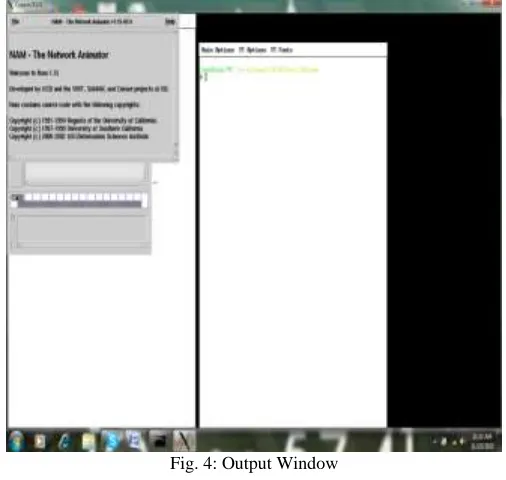
After the STARTX window opened output screen will display. The input is given that is data is transferred from node A to node B through the network path. Then open the respective data transfer file.
Fig. 4: Output Window
Data Transfer
Fig. 5: Data Sharing from Node A to Node B.
Comparison Table
Table – 1 Comparison Table.
EXISTING METHOD PROPOSED METHOD
Throughput 79%
Throughput 84.9%
Homogeneous Network Heterogeneous Network
Data loss is high and limited communication frequency Data loss is low and extended Communication frequency. Performance Graph
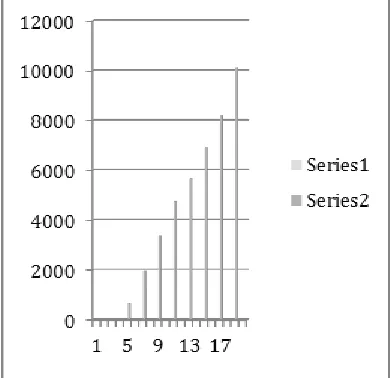
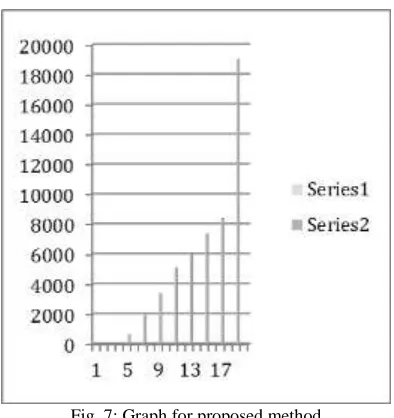
In the performance graph it will display the performance between the existing and proposed method. The Graph will be used to identify the performance and it will improve the KPI process.
Fig. 7: Graph for proposed method
V. CONCLUSION AND FUTURE WORK
The proposed system has been implemented to enable communication for heterogenous network with low data rate and high efficiency. The Future work is to increase the node integrity with changes in the routing protocol aiming to reduce the data loss and increase the data transfer speed.
REFERENCES
[1] P. T. A. Quang and D.-S. Kim, “Enhancing real-time delivery of gradient routing for industrial wireless sensor networks,” IEEE Trans. Ind. Inform., vol. 8, no. 1, pp. 61–68, Feb. 2012.
[2] M. Radi, B. Dezfouli, K. A. Bakar, S. A. Razak, and M. A. Nematbakhsh, “Interference-aware multipath routing protocol for QoS improvement in event-driven wireless sensor networks,” Tsinghua Sci. Technol., vol. 16, no. 5, pp. 475–490, 2011.
[3] J. Ben-Othman and B. Yahya, “Energy efficient and QoS based routing protocol for wireless sensor networks,” J. Parallel Distrib. Comput., vol. 70, no. 8, pp. 849–857, 2010.
[4] D. Djenouri and I. Balasingham, “Traffic-differentiation-based modular qos localized routing for wireless sensor networks,” IEEE Trans. Mobile Comput., vol. 10, no. 6, pp. 797–809, Jun. 2010
[5] P. Levis, N. Lee, M. Welsh, and D. Culler, “TOSSIM: Accurateand scalable simulation of entire TinyOS applications,” in Proc. 1st Int. Conf. Embedded Networked Sensor Syst., 2003, pp. 126–137.
[6] B. Hughes and V. Cahill, “Achieving real-time guarantees in mobile ad hoc wireless networks,” in Proc. IEEE Real-Time Syst. Symp., 2003.
[7] E.Felemban, C-G Lee, and E.Ekici, “MMSPEED: Multipath multi-speed protocol for QoS guarantee of reliability and timeliness in wireless sensor networks,” IEEE Trans. Mobile Comput., vol.5, no. 6, pp.738- 754, Jun. 2003.
[8] C. Lu, B. Blum, T.Abdelzaher, J. Stankovic, and T. He, “RAP: A real- time communication archietecture for large-scale wireless sensor networks, ” inProc.IEEE 8th Real-Time Embedded Tecnol. Appl. Symp., 2002, pp. 55-66.
[9] M.Caccamo, L.Zhang, L. Sha, and G. Buttazzo, “An implicit prioritized access protocol for wireless sensor networks,” in Proc. IEEE Real-Time Syst. Symp., 2002, pp.39-48.
[10] S.Bhatnagar, B.Deb, and B.Nath, “service differentiation in sensor networks,”in proc.Int.Symp.Wireless Pers. Multimedia Commun., 2001.