STUDENTS’ REFLECTION ON GREEN SCHOOL
Nurul Hafiffah Bt. Abdul Razak1, Zanaton H. Iksan2, Sharifah Zarina Syed Zakaria3
1,2
Faculty of Education, Universiti Kebangsaan Malaysia 3
Institute for Environment and Development (LESTARI), UKM
2
ABSTRACT
Education plays an important role in enhancing sustainable development and improving human capacity in addressing the issues of environment. Environment and development need to be incorporated as a key component in learning fields. Environment and Sustainability Course (GGGR6223) is a course offered to postgraduate students who are taking Science Education at the Faculty of Education, Universiti Kebangsaan Malaysia (UKM). This course prepares students with the knowledge, skills and approaches in management and environmental sustainability, especially on renewable and non-renewable resources as well as the problems that exist due to human activities. This study aimed to review the reflections made by the students of Environment and Sustainability Course at the National University of Malaysia on Green School. Data were collected through reflections made by the students upon completion of tasks and lectures related to green school carried out in their school. A total of 26 students’ reflections were analyzed. Thematic analysis resulted in five key dimensions: positive feelings, awareness of green schools, understanding of green school’s concepts, the role of teachers in instilling awareness about green schools and challenges in its implementation. The analysis demonstrated that the students have been exposed and have proper awareness about green schools. Awareness of green schools and environmental education are expected to form the next generations who are able to appreciate life and the environment.
Keywords: Environment, Green Schools, Awareness, Role of teachers, Reflection.
1. INTRODUCTION
The environment is a trust that must be kept together by the whole society. Each individual must play an important role in maintaining, preserving and conserving the environment. Environmental issues are not strange to us but efforts to sustain the environment are still poorly implemented. In reality, the issue of environmental degradation is increasingly critical and has sparked worldwide concerns. This issue affects the well-being of all mankind in present as well as the future. It has been proven that the environment has begun to undergo some changes, such as water and air pollution, natural resource depletion, depletion of the ozone layer, the reduction of mangrove swamps and forests, acid rain and global warming (Mohd Rafi et al., 2003; Martinsons et al., 1996).
Do we realize that in the context of environmental management, Islam has asserted that men cannot do any damage to the environment? It is a claim that must be implemented by all humans. It has been described in the Al-Quran, which means:
“Mischief has appeared on land and disasters in the sea because of what has been done by human hands; That (Allah) may make them taste some part of the bad deeds they have done, so they come back (repent).
(Ar-Rum 30:41)
Islam highlighted that the universe interact in harmony and man has no right to ruin a whim. This perspective emphasizes the position and role of humans in the universe, as the caliphs who are assigned to the prosperity of this nature. In this context, the prosperity of this nature encompasses all aspects of human life, whether in connection with the Creator, human beings or the natural surroundings. This shows that the task of preserving the environment is not an option, but an obligation required by Islam. Therefore, we are obliged to ensure that the forest is being conserved, environmental pollution avoided, open burning is stopped and environmental management implemented as they are the responsibility of every individual Muslim.
2. ENVIRONMENTAL EDUCATION
Malaysia, as a developing country is facing significant challenges in ensuring a sustained development. Therefore, education has been accepted as the most appropriate medium in order to control the environment and sustainable development. It is in regard of education to the environment and education for sustainability introduced since the Tbilisi Conference in 1977 (Fien, 1993; Huckle, 1983). The importance of education in environmental disciplines is undoubted when it has been made as an agent of change in national and international discussions over the past few decades. Moreover, education can create a good society who appreciates the environment.
The Environmental Education in Malaysia was introduced by Ministry of Education in 1998. Therefore, the Curriculum Development Centre published a manual called Manual for Teachers: Environmental Education across the Curriculum as guidance to primary and secondary schools’ teachers (Mohammad Zohir & Nordin, 2007). Environmental Education refers to:
"Learning to understand human interactions with the environment and how the environment can be managed with a prudent and responsible towards the preservation of life on Earth. This process involves education about the environment, through the environment and for the environment. "
(Palmer & Neal, 1994)
The environmental education in schools aims to produce students who are more sensitive to environmental issues. It acquires knowledge, skills, values and commitment to work and act individually or collectively towards solving environmental issues. All of these elements need to be inculcated as early as possible because they will be the deciding factor towards the practice of environmental friendly lifestyle in the future.
Researchers found that educational institutions especially schools are the most effective medium to disseminate environmental education and tackle the environmental issues at an early stage. In this context, the school plays an important role in addressing issues associated with the environment (Mohammad Zohir & Nordin, 2007; Moroye, 2005).
In accordance to the importance of schools as an institution of excellence for environmental education, it is responsible in creating the next generation who are more sensitive and affectionate environment and also in improving and enhancing the quality of life and the environment. As a result, schools’ designs have seen significant changes to reach the standard of environmental friendly school. Based on the previous research, there are impacts of building's design on students learning and long-term impact on cost management.
The design of schools with the implementation of green elements consist of several actions such as preserving natural vegetation, conserving natural resources, preserving the quality of internal ventilation, efficient use of water and energy, natural lighting and extensive recycling facilities (Era Hijau, 2009). The proponents of green building practices believe that the design of such buildings can improve the health and performance of students and does not involve high costs. Moreover, green schools provide additional unnoticed advantages which can reduce the number of unhealthy teachers, operating and repairing costs, known or unknown risks, and improve the quality of learning (Gregory Kats, 2006).
Furthermore, students should be exposed to the green school’ elements in order to be more sensitive to the developments and aspects related to the environment. The school community should be encouraged to implement environmental friendly activities effectively to preserve the environment. Moreover, collaboration between schools and the community also can be improved to ensure the successful of environmental education implementation. Hence, a conducive atmosphere can be created in order to produce schools which practice a sustainable living. Therefore, Sustainable School – An Environment Award Program was established as one of the initiatives in nurturing positive values towards environmental care among the younger generation, especially school children. The program was developed in accordance with the National Environmental Policy in which one of the seven (7) Green Strategies focuses on environmental awareness and education to all levels of society.
Implementation of Sustainable School-An Environment Award Program will provide added value in order to create a conducive and cheerful environment for teaching and learning process, as well as creating a community who loves the environment. The Sustainable School – Environment Award initiative is designed to recognize the achievements of primary and secondary schools in Malaysia in a particular year based on five pillars of environmental related activities, namely the curriculum, the co-curriculum (extra-curricular), the school administration of environmental activities, the greening programs, and the special eco projects. The Award is a holistic and integrated approach in the sense that the program acts like an umbrella for all environment related activities organized by the schools. It can be implemented not only through a teaching process in the classroom but also through active student participation in extra-curricular activities in school. It is necessary to produce future generations who can inculcate values of environmental stewardship in every policy or action taken.
Nevertheless, even after almost 13 years of green schools program was introduced in Malaysia, its effectiveness among students is still not widely known (Mohamad Fazli, 2006). Environmental education embodied in the curriculum content was unable to produce the desired learning effect as specified by the Curriculum Development Centre.
Studies have shown that only 30% are committed to the efforts of preservation and conservation of the environment, although the level of environmental awareness among the public is 90% (Era Hijau, 2009). This issue indicates that there are still many people who are less concerned about the importance of the relationship between development and environmental management (Surtahman & Abd. Ghafar, 1997). The level of individuals’ involvement in the issues of environmental stewardship is affected by their awareness of the environment. Education concerning the environment needs to be augmented, and awareness must be given especially to the teachers, as schools became the primary medium in spreading the environmental education. Therefore, the study was set out to gain a deeper understanding about the impact of the Environment and Sustainability Course to the students’ behavior
towards environment as well as exploring the awareness and perceptions of students about green schools.
3. METHODOLOGY
This study aimed to explore the students’ views and identify their awareness about green school. A total of 26 respondents were involved in this study. The respondents were postgraduate students who are taking Environment and Sustainability Course at Universiti Kebangsaan Malaysia (UKM). Most of the students were made up of primary and secondary schools’ teachers throughout the country. Data were collected by analyzing the reflections that have been made through i-Folio after the students attending lectures and conducted some assignments for 14 weeks. The reflections were analyzed qualitatively using the software NVivo 10 and the themes or ideas in accordance with the purposes of this study were highlighted. These themes defined based on the students’ reflection.
4. FINDINGS AND DISCUSSION
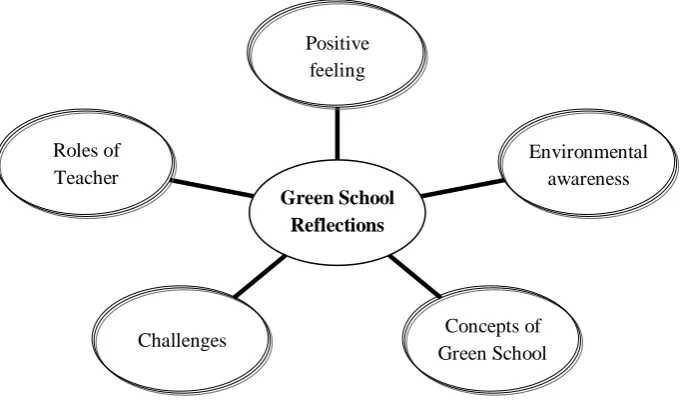
The reflections analyzed consist of observations and views of students about Green School. Thematic analysis was applied to the data. Five key dimensions emerged from the data, relating to green school. They were: positive feelings, environmental awareness, green school concept, challenges, and the role of teachers. The themes within these key dimensions are presented in Figure 1.
Figure 1: Five Key Dimensions
4.1 Positive Feelings
Most students have shown positive feelings towards the knowledge gained throughout the course. The positive feelings highlighted were happy, amazed, lucky, grateful and excited. 20 out of 26 students felt that the activities carried out regarding green school can give them pleasure and chances to explore their respective schools. Gregory Kats (2006) stated that green school provides additional unnoticed advantages and able to improve the quality of learning and students’ achievement. This has been acknowledging by the students themselves which is:
Roles of Teacher
Challenges Concepts of
Green School
Environmental awareness Positive
feeling
Green School Reflections
"As the green audit reviewed in SMA Rembau, I felt very happy as I got an opportunity to see other schools that are excellent in greening activities."
(Student R)
Moreover, according to Barlia (2008), environmental education can be implemented by integrating it through interdisciplinary approaches, interdisciplinary and transdisciplinary. Therefore, educational institutions are very suitable in providing environmental exposure to the students. The analysis also indicates that the opportunities gained during the completion of the assignment made them feel grateful and they realized the importance of the green school.
"I feel grateful in doing this course, I could gain more knowledge about green schools and sustainable partnership with colleagues in other schools."
(Student O)
4.2 Environmental Awareness
The researchers noticed that the knowledge gained has been creating awareness among students on the environment, especially about green school. Most students agreed that green school’s assignment can provide knowledge and new information for them.
"A lot of information and new knowledge acquired. Partnership with friends had opened my eyes regarding sustainable schools.
(Student A)
In addition, the students also expressed their awareness and thought about the activity that had been carried out. They would become an individual who is more sensitive to the environment. According to Barlia (2008), environmental education should be able to educate individuals who are responsive to technological developments, understand the environmental problems, and outstanding in maintaining and sustaining the environment. Nevertheless, there are some students who have no ideas about the green school until they complete the course and the assignments.
“Like other colleagues, I am lack of environmental awareness and did not fully practice in implementing environmental care. I have never heard about green school until my lecturer herself introduced the topic.”
(Student P)
“Earlier, I did not care about environmental aspect and thought that there are
authorities to protect the environment but now the awareness to preserve the environment is the responsibility of all individuals.”
(Student G)
Reid (2002) stated that education for the environment is closely linked to environmental responsibility and empathy in a respectful and positive action. This resulted from the view of some students where the completion of the assignments had led them to the improvement of self-esteem and also the ability to apply the concept of nature and green elements in everyday life.
"Through this activity, I am more sensitive to the environment and look forward to good practice that will affect my fellow teachers, students or family members so, they are caring for the environment too."
(Student D)
4.3 The Concept of Green Schools
The next theme highlighted is the students’ understanding about the concept of green school. According to Noraziah (2010), personality and perception towards the environment can be shaped or formed in school. Therefore, the concept of green school needs to be appreciated and understood in advance to ensure that this knowledge can be disseminated to the school community as well as to make it a reality.
Based on the reflections, students are capable of expressing the concepts and features of green school such as the consumption of electricity and water, better waste management practices, and others. The application of 5R which is one of the waste management practices implemented in order to keep the environment clean, as stated by Student D and Student I.
"Many aspects need to be addressed in order to achieve green school standard. The aspects, like electricity consumption, water consumption, and good waste management methods needs to be nurtured at the individual level before they can be implemented in schools or communities. "
(Student D)
"Some of the characteristics that should be underlined are the 5R Practices, resource management, and reforestation. Environmental education and moral values in school management, curriculum, co-curriculum, ongoing greening are also important to create a way of life that is consistent with the concept of sustainable development. "
(Student I)
Moreover, most of the students thought that the schools with verdant surroundings, availability of green plants and a cozy atmosphere can be classified as a green school.
"Green School is a school where the environment is fresh and clean, typically filled with lush plants."
(Student J)
"... creating a new learning environment that is more conducive, able to provide an atmosphere that comfortable for teaching and learning process and school activities."
(Student F)
The concepts described coincide with the definition of green school that have been expressed by Stephanie Barss et al. (2013), a school which creates a healthy and conducive learning environment, and consist of energy conservation, resource, and cost.
4.4 Role of Teachers
Teachers should play a significant role to enable the knowledge of green school to be well-delivered. According to Nor Aznan Mahmud et. al. (2010), the attempts to provide an understanding of the environment is closely related to the teaching methods and students learning. The students are the prime movers of the activities with the teachers playing a supervisory role. Therefore, teachers are considered as a mentor in disseminating information concerning the environment.
"It is very important that as a teacher, we should guide students towards nurturing a good culture of care for the environment than just focusing on teaching and learning process in the classroom."
(Student F)
"I need to apply knowledge related to the environment during the process of teaching and learning. In addition, I need to apply these practices at school and at home. "
(Student S)
Based on the views of the students, they aware and agreed that a teacher is a man who played a key role in the application of knowledge and values as well as being a role model to the students. This was specified in their reflections.
"Teachers must instill awareness to every level of society about the importance of the environment in balancing the Earth's cycles."
(Student G)
“Teachers are representing the school. So, they should set a good example to be emulated by the students. Thus, the practice of environmental care can be improved”.
(Student A)
However, there were a small number of students who realize that they applied less environmental values outside the classroom as noted by Student O:
"Implementation of the environment with eco-friendly lifestyle was less applied outside the classroom."
(Student O)
Hence, in general, students believe that a teacher is a good example in preserving the environment. Teachers have a close relationship with the students, curriculum content and students’ activities (Asmawati Suhid & Abdul Rahman Md. Aroff, 2006).
4.5 Challenges in Green Schools’ Implementation
The last theme traced is the challenges in implementing green schools. This theme is based on the opinion of those who claim that it is too difficult to apply the sustainability practices and adopted elements of green school in their respective school. Some of the challenges identified are time constraints, limited space, lack of moral values, strict rules and negative mindset of the society. One of the issues had been expressed by Student B:
"I've neglected my school surrounding because the school it was surrounded by tall buildings. During the process of gathering information for my assignment, I was totally aware of this school. On weekdays, I am busy with teaching classes that led to ignore the beauty of this school”
(Student B)
Students acknowledged that the rigors taught to finish the syllabus were a major constraint. This issue is also raised by the Curriculum Development Centre (1996) in which the study proved that teachers in schools only focusing on finishing the content in the syllabus and textbooks due to time constraints. This was the factor that led to the neglecting of greening the school.
In addition, the students also expressed their disappointment because they must follow various rules and regulations which causing the implementation of a green school being not easy. Furthermore, there are some people in the society who consider the small contributions do not affect the environment as stated by Student A and Student D. This issue coincides with the findings from Noraziah (2010) where the process of instilling green elements and environmental education in school is in critical state.
“In this current situation, many rules to be followed in order to carry out a study involving schools.”
(Student A)
"This practice is very difficult to carry out because many people feel that the individual contribution is too small and does not make any impact on the environment. Maybe someone underrate them when they are trying to save water or electricity. "
(Student D)
Overall, based on the themes highlighted, postgraduate students of Environment and Sustainability Course at Universiti Kebangsaan Malaysia (UKM) are aware of the importance of sensitivity to the environment. They understand the concepts of green schools although many of them considered a green school as a new knowledge. The students are able to identify the roles of teacher in schools which enable the implementation of green school concept. This coincided with the efforts to create the next generation who are balanced in terms of knowledge and its responsibility to the environment. However, there are some challenges need to be faced before the elements of green schools can be implemented. Initiatives and co-operations from various parties have to be strengthened and sustained to ensure that the goal of environmental sustainability achieved.
5. CONCLUSION
The quality of life is not only to be taught and learned but more important is, it must be expressed in the form of behavior that truly reflects the quality of a person. As educators, teachers should be a role model in shaping the future generations who are able to appreciate life and the environment. We can live in more sustainable environment if we become more aware of it, learning from nature, living with moderation and being active citizens in a developing environment.
6. ACKNOWLEDGEMENTS
Thank you for UKM Grant under Research Project PTS-2014-025 UKM.
REFERENCES
Amir Hamzah Sharaai & Chin, C. C. (2012). Sikap dan Amalan Murid Sekolah Rendah
dalam Konsep Lestari. Persidangan Kebangsaan Pembangunan dan Pendidikan
Lestari 2012. pp 1-7.
Era Hijau (2009). Kekayaan Manusia Kemiskinan Bumi. Kuala Lumpur: Jabatan Alam
Sekitar Malaysia.
Jabatan Alam Sekitar (2012). Asas Pembentukan Sekolah Lestari-Anugerah Alam Sekitar.
Kuala Lumpur: Dewan Bahasa Dan Pustaka.
Maria Salih & Hazinah Nor Hanipah (2009). Penerapan Pendidikan Alam Sekitar Merentas
Kurikulum Di Kalangan Guru Sekolah Menengah: Satu Tinjauan. Universiti
Pendidikan Sultan Idris.
Mohamad Fazli Sabri & Teoh, Y. Y. (2006). Tahap Keprihatinan Alam Sekitar dan Amalan
Kepenggunaan Hijau Pengguna di Petaling Jaya, Selangor. Pertanika J. Soc. Sci. &
Hum. 14(2):95-109.
Mohammad Zohir Ahmad & Nordin Abdul Razak (2007). Pendidikan Alam Sekitar di
Sekolah: Komitmen Guru. Pendidikan Lestari DP. Jilid 7.
Noraziah Mohd Yusop & Latipah Sidek (2010). Pendidikan Alam Sekitar dalam Pendidikan
Islam: Peranan Guru. Proceeding of The 4th International Conference on Teacher
Education.