fer cross section calculated by the algebraic approximation is close to the exact one. The CPU time required for the algebraic approximation is only about 20 min using a personal computer, whereas the exact analysis requires 15 h to integrate the entire set of multibody equations of motion, in which all the field particles are at rest.
c
2008 The Japan Society of Plasma Science and Nuclear Fusion Research
Keywords: multibody problem, algebraic analysis, anomalous diffusion DOI: 10.1585/pfr.3.S1073
1. Introduction
Since it is difficult to deal with multibody Coulomb and gravitational [1] collisions, the current classical the-ory considers them as a series of temporally-isolated bi-nary Coulomb collisions within the Debye sphere. Let us first briefly review a binary collision between ions. In the center of mass coordinate (r, θ) space in the collision plane, the test particle with a reduced mass ofμmoves along a hyperbola as
r(θ)= bsinθ0
cosθ−cosθ0
cosθ sinθ
(1) with a relative velocity of
g(θ)= g0 sinθ0
cosθ0sinθ
1−cosθ0cosθ
, (2)
from which the velocity change in the binary Coulomb interaction is given by Δg = 2g0cosθ0ex. As shown in Fig. 1, its scattering angle χ ≡ π−2θ0 is given by
b = b0tanθ0, where b is the impact parameter, b0 ≡
e2/4πε0μg20 corresponds toχ = π/2 scattering, and g0 is
the initial relative speed atr=∞andθ=−θ0.
The angular component of the equation motion gives the well-known invariant of
r2dθ
dt =const.=bg0, (3)
and the radial component is given by dgr
dt = g2
0b0
r2
1+b0
r tan
2θ 0
, (4)
wheregr ≡r˙denotes the radial velocity. The first term in the parentheses on the right hand side of Eq. (4) represents the Coulomb forceFc ∝ r−2. For small angle scatterings
such asχ1, this force is much smaller than the second termFa, which scales as∝r−3and results from the
conser-vation of angular momentum Eq. (3), since at the closest
author’s e-mail: [email protected]
Fig. 1 Unperturbed trajectoryr =r(θ) in an orbital plane. The scattering center is at the origin. An impact parameter is
b=b0tanθ0. Interaction region is inside the circle with a radiusr= Δ/2.
pointr=rminatθ=0 in Eq. (1), we have
b0tan2θ0
rmin
2
χ 1. (5)
Thus the main force on the particle is not the Coulomb forceFc, but Fa due to the conservation of angular
mo-mentum.
2. Algebraic Approximation for
Two-dimensional
Multibody
Interac-tions
Since ther-dependence onFa ∝ r−3 is steeper than
that onFc ∝ r−2, the momentum change inμg is almost
solely due to Fa near r = rmin. As a consequence, the
exact hyperbolic trajectory Eq. (1) for the particle can be approximated as a broken line with an impulse force of
μΔg=2μg0cosθ0ex (6)
c
2008 The Japan Society of Plasma
Fig. 2 Algebraic trajectory (broken line) and exact trajectory (curved line) which is a part of a hyperbola. A Field par-ticle (black circle) is on the left.
near the closest point, as shown in Fig. 2.
With this in mind, we have approximated a multibody problem for a series of binary deflections near their closest point, as shown in Fig. 2, in which a test particle starts at the lower-right point, and its final point is at the upper-right point due to the interaction with a field particle at rest.
Theexactcalculation hereafter refers to that obtained by solving the following equation of motion for the test particle with a chargee, massm, and velocityuat a position
r. du dt =
e2
4πε0m
N
i=−N N
j=−N r−ri j
r−ri j
3, (7)
whereri j are the field particles’ positions determined by the 5-th order Runge-Kutta-Fehlberg method, which is also known as the RKF56.
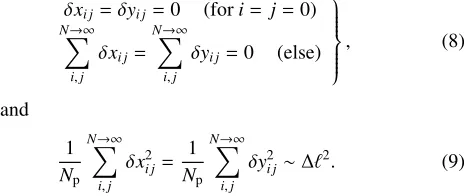
For simplicity, let us assume, that all the filed particles are at rest, i.e.,ui j =0, in thex–yplane. Let us also assume that their spatial distributionri j is almost uniform with a spacing of the average interparticle separationΔ≡n−1/3,
as
ri j =
iΔ+δxi j ex+
jΔ+δyi j ey,
for−N ≤i, j ≤N, as shown in Fig. 3, wherenstands for the number density, and deviationsδri j =
δxi j, δyi j from grid points (iΔ, jΔ) satisfy
δxi j=δyi j =0 (fori=j=0) N→∞
i,j δxi j=
N→∞
i,j
δyi j =0 (else)
⎫⎪⎪ ⎪⎪⎪⎬ ⎪⎪⎪⎪⎪ ⎭,
(8)
and 1
Np
N→∞
i,j
δx2i j= 1 Np
N→∞
i,j
δy2i j ∼Δ2. (9)
The first assumption in Eq. (8) states that the field particle withi = j = 0 is always at the origin in this study, i.e.
r00 = 0. The impact parameterb is for the field particle
at the origin, i.e.,b=b00, as shown in Fig. 3. It should be
noted that the numberNis not the number of field particles,
Np, which is given byNp=(2N+1)2.
Fig. 3 Two-dimensional multibody Coulomb interaction. A gray circle (or red in color) is a test particle at r with an impact parameterb, and almost-uniformly-distributed black circles are field particles.
Fig. 4 An example of theexactvelocity changes vs nondimen-sional plasma size N. The impact parameterb = Δ/5 and the field particle positions are fixed.
In typical fusion plasmas with a temperature ofT =
10 keV and a number density ofn = 1020 m−3, the De-bye length isλD ∼ 500Δ, thusN ∼500 corresponds to
λD. Figure 4 shows N-dependence of the exactvelocity
changesΔvxfor a fixed impact parameterb= Δ/5 and for fixed positions ofNpfield particles [2]. After the equation of motion for a test particle is solved in the presence ofNp
field particles for anN with 0 ≤ N < Nmax ≡ 500, we
increaseNas N = N+1 without changing the positions ofNp field particles, which are already considered in the
previousN-th stage of the analysis. In Fig. 4, the velocity change is seen to converge aroundN=10, which we adopt in the following calculations.
2.1
Coordinate transformation
Fig. 5 Coordinate transformation.
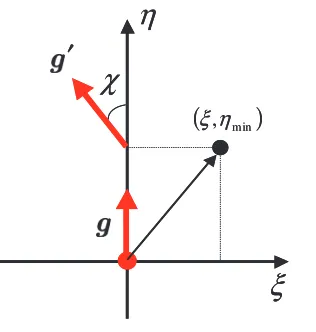
purpose, it is convenient to transform the coordinate sys-tem from (x, y) to (ξ, η), such that the initial position of
the test particle is at the origin (ξ, η) =(0,0), and the rel-ative velocityg ≡u−ui jis (gξ,gη) =(0,g). Then a field particle atri jhas anη-coordinate of
ηi j =
ri j−r ·g/g. (10)
The test particle moves along the η-axis with a con-stant velocityg, and is to interact at0, ηi j with this field particle in a time interval ofΔti j ≡ ηi j/gs. Accordingly, the field particle that provided the test particle with an im-pulse force at the earliest time has the smallest positiveηi j, i.e.,
ηmin ≡minmax0, ηi j, for −N≤i,j≤N. (11) We have ignored the effect of field particles withηi j <0, since the interaction is completed atη =0 in our approx-imation. In other words, such field particles have already interacted with the test particle in the past.
When the test particle moves to (0, ηmin) position, it
changes the relative velocity byΔgi jas Δgi j=−2gsin
χi j
2 eξ, (12)
χi j2 arctan
b0
ξi j
, (13)
where the pair of i and jsatisfies Eq. (11), and we have approximated that the impact parameter is given byb=ξi j in Eq. (6), as shown in Fig. 5. Thus, in the (ξ, η) coordinate system, the field particle positions,ξi jandηi j, correspond to the velocity changeΔgi j and the time of the interaction Δti j, respectively. This procedure is repeated until the test particle leaves the prescribed interaction region, i.e., r <
Δ/2, as depicted in Fig. 1.
3. Calculation
3.1
Comparison between the exact and
alge-braic trajectories
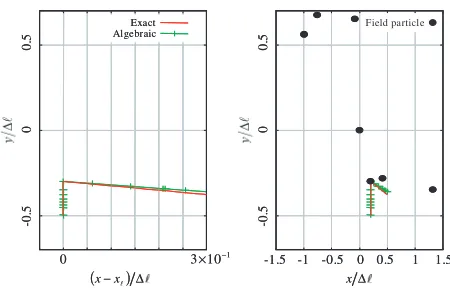
Figure 6 compares the algebraic trajectory and the ex-act hyperbola in the case of the pure binary Coulomb
in-Fig. 6 Comparison of algebraic trajectory and exact trajectory in the case of binary Coulomb collision (N=0) with an impact parameterb = Δ/5. In the figure on the right, the exact- and algebraic trajectories are depicted with the only field particle at the origin, in which the field particle location is also shown with a black circle. On the left is the enlarged view.
Fig. 7 Comparison of algebraic trajectory and exact trajectory in the case of multibody (N=10) Coulomb collisions with an impact parameterb= Δ/5. Note that not all the field particles are shown. This is an example of small angle scatterings.
teraction, i.e.,N =0 in Eq. (7), with an impact parameter
b = Δ/5. The only field particle is at the origin in this
case. The test particle starts at the lower right point, passes through the closest point, and ends at the upper right point in the figure.
Figures 7, 8, and 9 are three examples out of 105
Monte Carlo calculations for an impact parameter b =
Δ/5, and they compare the algebraic and exact trajecto-ries in the case of the multiple Coulomb interactions, i.e.,
N = 10 in Eq. (7). In these cases, there are nearly uni-formly distributed 21×21 field particles at rest, and sym-bols in the figures for the algebraic trajectories indicate the positions at which the test particle is provided with the im-pulse force by one of theNpfield particles. Individual
Fig. 8 Comparison of algebraic trajectory and exact trajectory in the case of multibody (N=10) Coulomb collisions with an impact parameterb = Δ/5. This is an example of large angle scatterings.
Fig. 9 Comparison of algebraic trajectory and exact trajectory in the case of multibody (N=10) Coulomb collisions with an impact parameterb = Δ/5. The discrepancy is as small as 10−13meter in typical fusion plasmas.
approximation seems bad. The algebraic trajectory in Fig. 9 deviates from the exact one, however, the deviation is as small asΔ×10−6∼10−13meter in typical fusion plasmas, which is of the same order of the de Broglie wavelength.
3.2
Momentum transfer cross section
Finally, we conducted the above calculation for differ-ent impact parameters 0<b<Δ/2. Figure 10 shows the
accumulated variance of velocity change(Δg)2, which is in proportion to the momentum transfer cross section,σbin
m ,
as
σbin m =
bmax
0
Δg g
2
πbdb=4πb20lnbmax
b0 .
(14) Depicted in Fig. 10 is theaccumulatedscattering cross sec-tionσacc(b) as a function of the impact parameterbdefined
by
σacc(b)=
b
0
Δg g
2
πbdb. (15)
The error in the accumulated cross sectionσbinacc(b) due to
Fig. 10 Accumulated binary (N=0) Coulomb scattering cross sectionσbin
acc(b)/Δ2vs normalized impact parameter ¯b=
b/Δ.
Fig. 11 Accumulated multiboby (N=10) Coulomb scattering cross sectionσmulti
acc (b)/Δ2vs normalized impact param-eter ¯b=b/Δ.
the algebraic approximation is quite small for the binary (N=0) case, as shown in Fig. 10, where there is only one field particle. It should be noted that in the binary interac-tions, the cross sectionσmulti
acc (b) is converged atb Δ,
which is far less than the Debye lengthλD ∼ 500Δ in
fusion plasmas.
In the case of the multibody (N=10) interaction, where there are 21×21 field particles, the error inσmulti
acc (b)
is quite small, as shown in Fig. 11.
4. Discussion
The two-dimensional multibody scattering cross sec-tionσmulti
acc 2.8×10⁻⁸Δ2with the maximum impact
pa-rameterbmax = Δ/2 is more than 103 times the binary
cross sectionσbin
acc 2.3×10⁻¹¹Δ2. However, this is not