A SYSTEM DYNAMICS MODEL TO ANALYSE THE
ENVIRONMENTAL PROBLEM AT CONSTRUCTION SITE
Fatin Fasehah Haron1 and Nurul Nazihah Hawari2
1,2
School of Quantitative Sciences, Universiti Utara Malaysia
*Corresponding E-mail: [email protected]
Abstract
This study develops a system dynamics model at a construction site to analyse the impact of environmental problem. Construction sites may cause damages to the environment, and interference in the daily lives of residents. A proper environmental management system must be used to reduce pollution, enhance bio-diversity, conserve water, respect people and their local environment, measure performance and set targets for the environment and sustainability. This study investigates the damaging impact normally occur during the construction stage. Environmental problem will cause costly mistake in project implementation, either because of the environmental damages that are likely to arise during project implementation. Thus, findings from this study has helped in significantly reducing the damaging impact towards environment, and improve the environmental management system performance at construction site.
Keywords: System dynamics, environmental problem, construction, environmental management system, damaging impact
Received: January 16, 2018 Accepted: January 25, 2018 Published: December 15, 2018
1.0 Introduction
Construction site is a place where construction activity is carried for a certain period and is prohibited to the public. Activities at the construction sites may cause damages to the environment, and interference in the daily lives of residents. Inconveniences caused by construction activities include the waste materials deposition in public spaces, dust and noise generation, damages to public drainage system, soil and water contamination, destruction of plants, birds and native fauna (Pacifica & Ogola, 2007). Housing and infrastructural development which are very resource-intensive, will so much negatively impact the physical environment. The call for sustainable construction is in the realization of the construction industry’s capacity to make a significant contribution to environmental sustainability because of the enormous demands it exerts on global resources (Deogratias, Sanjay, & McLean, 2011). The industry should also employ efficient environmental management systems to reduce pollution, conserve water, enhance bio-diversity, respect people and their local environment, measure performance and set targets for the environment and sustainability (Scoones, Leach, Smith, Stagl, Stirling, Thompson, & Teixeira, 2007). Particularly, in this study, a system dynamics simulation approach is utilized to study and analyze the environmental problem at a construction site in Johor. All activities will affect the environment if not properly managed.
Most of damaging impact towards environment normally occur during the construction stage. This problem will cause costly mistakes in the project implementation phase. This is either because of the environmental damages are likely to arise during project implementation, or because of modification that may be required subsequently to make the action environmentally acceptable. Using system dynamics simulation software, a simulation model of environmental problem at a construction site at a project rapid area in Johor is developed to analyse the
Thus, the objectives of this study are first t
o develop a system dynamics simulation model of environmental problem to analyse the damaging impact at the construction site, and secondly to propose solutions for better environmental management at the construction site based on scenario analysis using the developed model.2.0 Environmental Health and Pollution
Sustainable development is meeting the needs of the present without compromising the future generations own needs. Existing in literature, there are studies presenting various methods for promoting environmental management and enabling better sustainability in implementing construction projects across their life cycle (Cole, Zhen Chen, Ogunlana, & Ikediashi, 2011). As early 1975, a research has been conducted to determine the contribution of the construction project implemented properly for sustainable development (Mark, 1975). Recently, Sondoss, Hedwig, Suzanne, Amgad, Alexey, & Anthony (2012) has introduced a framework for sustainable environmental modelling. Nowadays, people are great contributors who have caused the contamination. Environmental Health and Pollution Air pollution is an act which causes staining of clean air quality deteriorates. Air pollution has the biggest impact on the environment.
Air pollution which caused by the phenomenon of global warming causes natural disasters that loomed our earth. Air pollution spoils the natural processes in the atmosphere, and under the prevailing prejudice of Public Health (Nouri, Jaasbi, Jafarzadeh, Abbaspour, & Varshozas, 2009). Adverse effects of air pollution are bad to human health and the environment. Air pollution is to become the focus of world-wide and take measures to tackle the level of pollution control complement can free controlled. Air pollution contributes to the increase in mortality and hospital admission. Human health effects can range from nausea and difficulty breathing or skin irritation, cancer. Air pollution can be classified into two parts, namely primary and secondary pollution contamination. Studies have shown that air pollution did contribute to the development and growth of lung cancer. It was also found that air pollution increases the risk of acute respiratory tract diseases especially in children and that it causes an increase in cardiorespiratory morbidity and mortality (Sondoss et al., 2012; Nouri et al.,2009).
3.0 Research Methodology
This study employs system dynamics modelling method in developing a simulation model to analyse environmental problem in a construction site in Johor. This study uses the secondary type of data which was obtained from the Environment Department of the company. From the Environmental Monitoring Report, all data concerning details of activities in the construction site that caused pollutions is gathered. This data can be analyzed through daily and monthly monitoring report. The monitoring report is divided into two mains; Onshore and Offshore. The Onshore monitoring are focus of air quality, noise level, vibration level and groundwater are to be carried out for the entire duration of the construction period. Air, noise, vibration monitoring will be undertaken monthly while groundwater monitoring will be carried out quarterly throughout the construction period. The Offshore monitoring of marine water is to be carried out for the entire duration of the construction period. Marine water monitoring will be undertaken monthly throughout the construction period and the turbidity of marine water shall be undertaken on daily basis.
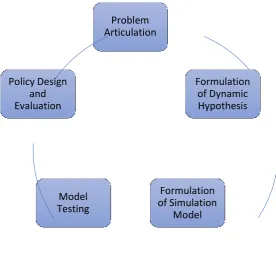
Figure 1: System Dynamics Modelling Process
3.1 Model development
The purpose of this study is to investigate the most of damaging impact normally
occur during the construction stage. Based from the collected data, the key variables of
the environmental problem are identified as follows:
Construction activity
: all activities of the construction during a certain period of time
in a construction’s place where is prohibited to the public
Water pollution
: water that is contaminated with the chemical and foreign substance
which are harmful to human, plants and animals
Noise pollution
: defined as the unwanted sound released into the environment
Air pollution
: occurs when gases, dust particles, fumes or odor are presents in the
atmosphere in a way that make it harmful
Damaging impact
: subject to the pollutions caused by the construction activities
commences during the implementation phase of project on site
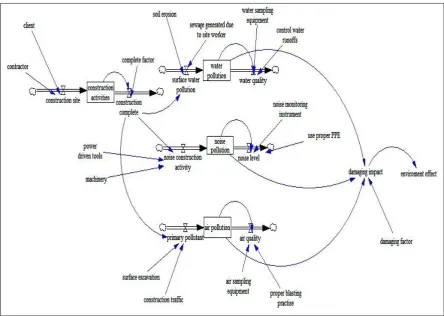
Next, a dynamic hypothesis of the problem under study is developed to analyse
the relationships between factors. In order to see the behaviour of these variable through
time, the dynamic hypothesis is transformed into a stock flow diagram (Figure 2) using
Vensim
software. From Fig. 2, the construction activities that been performed at the
construction site will caused the water, noise, and air pollutions. All these pollutants will
be the damaging impact factor towards the environment.
Problem Articulation
Formulation of Dynamic Hypothesis
Formulation of Simulation
Model Model
Testing Policy Design
Figure 2
: Stock Flow Diagram of environmental problem at construction site
3.2 Model validation
Before proceeding to analysis using the developed model, the structural and
behaviour validity of the developed model is tested (Barlas, 1996; Barlas, 2004; Sterman,
1984). The model structure is tested by performing the dimensional consistency test.
Result from the built-in function in
Vensim
dimensional consistency test shows that there
are no dimensional errors. Next, the behaviour reproduction test was performed to test the
model behaviour. The simulated and the actual values were compared. Findings shows a
comprehensive similarity between the model behaviour and the real system behaviour
was achieved.
4.0 Analysis and Finding
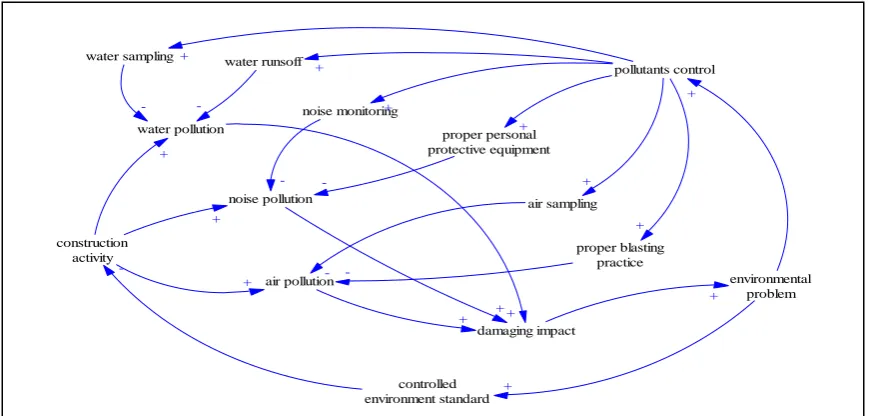
Figure 3:
Revised causal loop diagram of improved environment management system
Scenario 1: Increase pollutants control
The first scenario is to increase pollutants control. Fig. 4 (a) depicts the results of
controlling the root of causes which is water sampling, controlling water runoffs, noise
monitoring, using proper personal protective equipment (PPE), air sampling and proper
blasting practice. Results from controlling pollutants has caused a decrease in the
damaging impact of pollutions, and consequently improve the environmental problem.
Scenario 2: Decrease activities to follow the controlled environment standard
Fig. 4 (b) shows the behaviour of pollutions on site. When then the activities of
construction are decreased to follow the controlled environment standard, we can notice
that the number of pollutions are decreases as well. Thus, by introducing the controlled
environment standard, the number of construction activities per month is decrease and
this results in the decreasing in the damaging impact through time.
(a)
(b)
Figure 4
: The behaviour of damaging impact on site
construction activity air pollution noise pollution water pollution controlled environment standard -+ + + damaging impact environmental problem + + + + pollutants control +
water sampling water runsoff
noise monitoring proper personal protective equipment + air sampling proper blasting practice - -- -- -+ + + + + + damaging impact 610,000 607,500 605,000 602,500 600,000
2 2 2 2 2 2 2 2 2 2 2 2 2 2 1 1 1 1 1 1 1 1 1 1 1
1 1 1
0 2 4 6 8 10 12 14 16 18 20 22 24
Time (M onth)
D
m
nl
damaging impact : Current1 1 1 1 1 1 1 1 1 1 1 damaging impact : Cont rol pollut ant s 2 2 2 2 2 2 2 2 2
damaging impact 700,000 525,000 350,000 175,000 0
2 2 2 2 2 2 2 2 2 2 2 2 2 2
1 1 1 1 1 1 1 1 1 1 1 1 1 1
0 2 4 6 8 10 12 14 16 18 20 22 24
Time (M onth)
D
m
nl
5.0 Conclusion and Recommendation
References
Barlas, Y. (1996) Formal aspects of model validity and validation in system dynamics, System Dynamics Review, 12(3), 183-210.
Barlas, Y. (2004) System dynamics: systemic feedback modeling for policy analysis, in Encyclopedia of Life Support Systems (EOLSS), Developed under the Auspices of the UNESCO, EOLSS Publishers, Oxford, UK, [http://www.eolss.net]
Deogratias, K., Sanjay, J., & Charles, R. McLean. (2011) A System Dynamics Modelling Framework for Sustainable Manufacturing, The George Washington University.
Mark, B. Lapping, Environmental Impact Assessment Methodologies: A Critique, from
http://lawdigitalcommons.bc.edu/ealr/vol4/iss1/8
Nouri, J, Jaasbi, J, Jafarzadeh, N, Abbaspour, M, & Varshozas, K, (2009) Comparative Study of Environmental Impact Assessment Methods along with a New Dynamic System-based Method, Islamic Azad University.
Pacifica, F., Achieng Ogola, (2007) Environmental Impact Assessment General Procedures, Kenya Electricity Generating Company Ltd. (KenGen).
Prince, B.C., Zhen Chen, Stephen, O. & Dubem I. (2011) A System Dynamics Approach to Risks Description in Megaprojects Development, Herriot-Watt University.
Scoones, I., Leach, M., Smith, A., Stagl, S., Stirling, A., Thompson, J., & Teixeira, (2007) Dynamics Systems and the Challenge of Sustainability, STEPS Working Paper 1, Brighton: STEPS Centre. Sondoss, E., Dagmar, H., Hedwig van Delden, Suzanne, P., Amgad, E., Alexey, A.V., & Anthony, J.J.
(2011) Using System Dynamics for Environmental Modelling: Lessons Learnt from Six Case Studies, The Australian National University.
Sterman, J.D. (1984) Appropriate summary statistics for evaluating the historical fit of system dynamics models, DYNAMICA, 10(2), 51-66.