SOFTWARE APPROPRIATION OVER TIME: FROM ADOPTION TO
STABILIZATION AND BEYOND
Antonette Mendoza
Department of Computer Science and Software Engineering The University of Melbourne
Melbourne, Victoria
Email: [email protected]
Jennie Carroll
Department of Property, Construction and Project Management RMIT University
Melbourne, Victoria Email: [email protected]
Linda Stern
Department of Computer Science and Software Engineering The University of Melbourne
Melbourne, Victoria Email: [email protected]
ABSTRACT
Technologies are introduced into an organization with the aim of improving productivity. However, persistent use of an information system is required to enhance productivity and user satisfaction. In this paper, we examine the process of technology appropriation and the influences that encourage and discourage use of an information system over time. In a longitudinal field study in an educational setting, we identify changing expectations and influences that encourage persistent use of a technology above and beyond adoption. Our work indicates that stabilization of a technology may only be temporary. Further appropriation may occur beyond initial stabilization as expectations and influences encourage new uses of a technology. We have found that the driving forces in encouraging productive use of a technology are the ability for users to experience the technology as useful and to have easy access to ongoing training.
INTRODUCTION
and Chervany 1999; Rogers 1995; Taylor and Todd 1995; Venkatesh, Morris, Davis and Davis 2003). The influences on longer-term use have received much less attention. Observations that users adapt their practices over time to accommodate a new technology as well as adapting the technology to suit their needs, suggest that studying longer-term use is an important topic to investigate (Chu and Robey 2008; Majchrzak, Rice, Malhotra and King 2000; Ciborra 1996; DeSanctis and Poole 1994; Trigg and Bodker 1994; Tyre and Orlikowski 1994, 1992; Leonard-Barton 1988). There has been little exploration to date of the journey from initial adoption of a technology through to its stabilization in a particular context, raising questions such as: What are the influences that encourage longer-term use? How long does it take before a technology is stabilized?
This paper investigates the influences that encourage long term use through the lens of appropriation. Appropriation means to “take possession of” (Turner 1988); technology appropriation is: "the way that users evaluate and adopt, adapt and integrate a technology into their everyday practices" (Carroll, Howard, Peck and Murphy 2002). Implicit in these definitions is the idea that appropriation is a process that may take different forms, depending on the individuals involved, the technology, and the particular social or organisational context in which it is introduced (Orlikowski 1992). The definition of technology appropriation applied in this study captures both adoption and adaptation over time. Adoption of a technology refers to a state when users have made a decision to use an innovation when faced with it (adapted from Rogers 1995). Adaptation refers to adjustments and changes following the implementation of a new information technology. In this paper, two aspects of user adaptation are applied. Firstly, users may adapt their practices to suit the technology. Secondly, users may adapt the technology. That is, they customise and adjust the way in which the technology and its features can be used to suit their needs; this may include applying the technology for new or unintended purposes.
In this research the processes of appropriation of technology are studied in an educational setting. The research question addressed by this paper is: What are the influences on the way in which users appropriate a technology over time? A longitudinal approach was taken whereby users were observed at a number of points of time over a 20 week period. The findings were analysed and interpreted using the Model of Technology Appropriation (Carroll et al. 2002). Our study identifies influences that encourage persistent use of a software application in an educational setting from first encounters through to long-term use. 1
We begin the paper with the theories relating to the process of technology adoption and use, followed by the research methodology. The research findings are presented and their implications are discussed. The paper concludes by presenting some avenues for future research to build on the findings of this work.
THEORETICAL BACKGROUND
Many information systems studies have focussed on technology acceptance and use (Brown et al. 2002; Davis 1989; Davis, Bagozzi and Warshaw 1989; Moore and Benbasat 1991; Thompson,
1
Higgins and Howell 1991; Taylor and Todd 1995; Venkatesh and Davis 2000). Researchers have been interested in understanding individual perceptions, to understand what motivates them to accept or use a technology. Different approaches have been taken to examine technology acceptance and use. Some researchers have used a variance approach to identify and test the effects of causal factors on use, focusing on antecedents of adoption and usage of new technologies (Davis 1989; Venkatesh 2003; Agarwal and Prasad 1999; Compeau, Meister and Higgins 2007). According to the variance approach, levels of outcomes are predicted from predictor variables, at a specific point in time. A cause is necessary and sufficient for an outcome which invariably occurs when necessary and sufficient conditions are present (Markus and Robey 1988; Mohr 1982). The Technology Acceptance Model (TAM) has been one of the most prominent variance models. According to this model, adoption and usage of a technology are predicted by intentions to use the technology, which, in turn are influenced by perceptions and attitudes about the technology. Perceived usefulness and perceived ease of use are considered to be the main determinants of user acceptance (Davis 1989) which act as the antecedents of attitude. Perceived usefulness along with user attitudes determines a user’s behavioural intention. Perceived ease of use also has a significant effect on perceived usefulness (Taylor and Todd 1995; Venkatesh and Davis 2000; Szajna 1996; Davis 1989) and behavioural intentions (Igbaria et al. 1997; Adams, Nelson and Todd 1992). However, some other studies have suggested that these effects are not significant (Chau and Hu 2002a; Szajna 1996). Even with a recent revision of the TAM (Venkatesh et al. 2003) that includes social influences and key moderators, the lack of further explanation of the relationships between social influences and the key moderators, has prompted some researchers to question the generalizability of TAM (Straub, Keil, and Brenner 1997; Van der Heijden 2004; Sun and Zhang 2006).
Another prominent theory grounded in empirical work that includes observations is the Diffusion of Innovation Theory (Rogers 1995). It examines the process of adoption and implementation of innovations. According to the Diffusion of Innovation Theory, diffusion is a process by which an innovation is communicated through certain channels over time among members of a social system. The innovation decision process takes place in sequential stages. It starts from a user gaining knowledge about the innovation, to forming an attitude towards it, to deciding to adopt or reject the innovation, to implementing the new idea and finally to confirming the decision. An innovation perceived by individuals as having greater relative advantage, compatibility, trialability, observability and less complexity will be adopted more rapidly than other innovations. The diffusion of innovation theory has made a major contribution to the understanding of the influences on adoption of an innovation.
However, the Diffusion of Innovation Theory has depicted the stages as sequential in nature. The need for process research, involving descriptions and analysis of sequences of activities, may provide a dynamic view of the innovation process and has been advocated by Roger (1991) and others (for example, Gallivan 2001). To date, little is known about the ongoing process from a user’s initial encounters with a new technology through to long term use or rejection.
implicit in such variance approaches is an assumption that two of the key concepts, use and technology, are unchanging over time.
Other researchers have focused on a process approach to understand adaptation as a part of technology use (Orlikowski 1996; Tyre and Olikowski 1994; DeSanctis and Poole 1994; Majchrzak et al. 2000). The studies have shown how users change their skills, beliefs, attitudes, expectations (Tyre and Orlikowski 1994), modify their work practices (Leonard-Barton 1988; DeSanctis and Poole 1994) and sometimes re-invent the technology in un-anticipated ways (Griffith 1999; Leonard-Barton 1988). Little is known however about why users accept and adopt a technology initially but reject it over time. Less attention is paid to changes in adopters’ practices or to adaptations of the innovation itself, that have long been observed by IS researchers (Ciborra 1996; Leonard-Barton 1988; Orlikwoski 1992).
Some studies have focused on adaptation as a process of appropriation. Tyre and Orlikowski 1994 argue that most adaptation takes place following initial implementation, in what they term a window of opportunity. The technology use stabilizes and the window of opportunity may then close. Adaptations may not be gradual and may be highly discontinuous in nature. These adaptations may be initially steep with brief windows of opportunity in which technologies could be altered. In some other studies, the technology adaptation process is viewed as continuous, with cycles of misalignments or discrepant events that gradually reduce over time. Eventually, an alignment of the delivery system, the technology and the performance criteria take place (Leonard-Barton 1988). Other researchers have used Structuration Theory (Giddens 1984) to examine the micro-processes through which humans and technology are mutually constituted (Orlikowski 1992; DeSanctis and Poole 1994). The Structuration theory suggests that use of a new technology is stochastic in nature. Users adopt and then adapt a technology, reshaping their technologies to suit their needs.
Despite all these theories, the lack of an increased understanding of how people engage with various technologies in their everyday practices and the evolving dynamics of changes in technology use and user expectations is a theoretical concern (Orlikowski 2000). More recently, one study has revisited the concepts of structural features and spirit focussing on the technology related concepts of structural features and systems spirit for use in research based on the behavioural and social effects of IT use (Markus and Silver 2008). Lyytinen and Gaskin (2010) explored factors influencing individual appropriation of technology and concepts related to psychological ownership. Yet, there has been little research, into the influences that encourage or discourage appropriation of a wide range of technologies used by different cohort of users, over time.
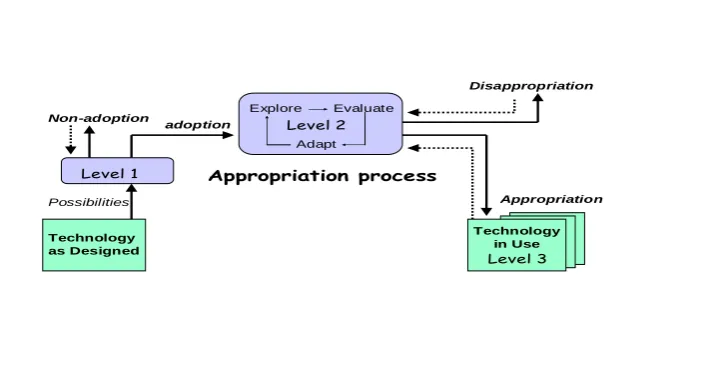
Carroll et al. (2002) conducted field research into the use of mobile technologies and induced a Model of Technology Appropriation (MTA) to build theory about appropriation. According to the MTA, a technology that is introduced in a work place (technology as designed) is changed over time. The technology shapes the users' practice and in turn, is shaped by users' actions. This changed technology (technology in use) is an outcome of the process of appropriation, which involves users’ trialling, evaluating and adapting the technology to suit their personal needs based on their perceptions and various other influences. The model as shown in Figure 1 represents three levels of evaluation of an Information Communication Technology, with influences affecting these levels:
Level 1: Users are introduced to the technology and they are faced with the decision of whether to adopt the technology or not during these initial encounters with the ICT. This decision is based on various influences that have been well-examined in the literature, such as perceptions of the technology, the user, the task and the context of use (Davis 1989; Rogers 1995).
technology to suit their practices or may adapt their practices to suit the technology. At any time during this exploration, users may reject the technology because, for example, it is difficult to use or does not meet their needs.
Technology in Use Level 3 Technology
as Designed
Possibilities Non-adoption
Explore Evaluate
Adapt
Disappropriation
Appropriation
Level 2
Level 1
adoption
Appropriation process
Figure 1: The Model of Technology Appropriation (adapted from Carroll et al. 2002)
Level 3: Use of the technology is persistent. In this level users have integrated the technology into their practices and the technology is considered to be stabilized. Persistent use is “reinforced” by influences and changes in these influences may lead to re-evaluation of the technology or even its rejection.
Thus the MTA represents the process of appropriation from adoption through to long-term use. It suggests that the influences on users’ actions are not static but may change over time and it includes changes both in the technology (from Technology as Designed to Technology in Use) as well as in users’ actions. The MTA was developed by examining young people using mobile technologies.
We were interested in understanding the influences on the actions of users throughout the period from initial encounters through to long-term use of a software application. We selected the MTA as a practice lens in designing the research and interpreting the results in the study because it acknowledges that the status of a technology can change with time and because it describes the process of adoption and actual use of a technology. It was not initially clear how well the MTA would fit such a different domain to mobile technologies.
RESEARCH METHODOLOGY
With permission from the facilitator of the EndNote training courses conducted by the School of Graduate Studies at The University of Melbourne, one of the researchers attended 5 training courses and invited participants for the study. 14 participants (9 female and 5 male) agreed to participate. Twelve out of the 14 participants had no prior experience of using the software. Participants were studied from their initial encounter with EndNote after training (1-2 weeks) through to 20 weeks of use. Data were collected at the initial encounter with the technology and 3 subsequent times over the following 20 weeks, as shown in Table 1.
The research design used similar methods to that of the original MTA research, which included interviews, focus groups, scrap books and participant observations (Carroll et al. 2002). This approach allowed us to capture and triangulate (Lee 1991; Yin 2002) participants' perceptions and expectations during their initial encounter with the technology after attending a training program. It also enabled us to track their likes, dislikes and actual experiences with the technology during continued use of the technology. However, it should be noted that not all of the 14 participants were interviewed and observed at every time point but attempts were made to follow up all participants. Some of the participants were either overseas or busy at critical dates but all claimed that they were using EndNote. Only subsets of the 14 participants were interviewed and observed at critical dates (explaining the drop in the number of participants sampled in Table 1).
Time-line No. of participants
sampled Techniques
1 – 2 weeks 14 Interview
3 – 4 weeks 6 Focus group + scrap book
7 – 8 weeks 8 Participant observation +
scrap book
16 – 20 weeks 7 Follow-up interview
Table1: Data collection timelines, number of participants and techniques
All 14 participants were interviewed between 1 and 2 weeks after initial training. Some demographic information about them, their research, their prior knowledge about EndNote and the department or faculty they belong to, was noted. Post hoc recollection of how they came to know of EndNote and why they attended the training program were also collected. Issues such as their attitude and expectations during their initial encounter with the technology were explored - a time when they were faced with the decision to adopt EndNote. Scrap books were given to all participants during the first interview with the aim of capturing and tracking participants’ expectations, likes and dislikes of EndNote when the researcher was unable to be present. The scrap book was used to validate post hoc recollections made by participants (Carroll et al. 2002).
A focus group of 6 participants was conducted at weeks 3 and 4, in which users shared their experiences and expectations with each other (Vaughn, Schumm and Sinagub 1996). The use of focus groups in the collection of data encouraged interaction and greater openness among users as they shared their experiences, expectation, likes and dislikes about the technology, with each other.
Follow up interviews were conducted with 7 participants between 16 and 20 weeks after the initial training course. The interview questions were related to how they used the technology in their research practice and their likes and dislikes about the technology and its features. They were also asked why they continued using the technology and what influences them to continue using the technology.
Data were collected using audio tapes and field notes. They were transcribed and descriptive codes were used to identify general and specific themes. A time ordered matrix was also used to display and analyse the themes (Miles and Hubermann 1994) from the data collected during different times in the research.
RESULTS
In this section we describe how participants used EndNote to support their research practices. We also describe the influences that encouraged and discouraged their use at different times. The data are organized according to the time after the initial training course, reflecting the duration of use.
Decision to adopt EndNote
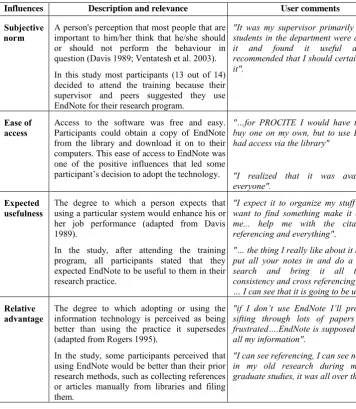
All participants stated that they attended the EndNote training program because they perceived it might be useful to them in their research. After the initial encounter with EndNote at the training program, they were faced with the decision whether or not to adopt this technology. Influences observed to encourage the decision to adopt included the subjective norm, ease of access, expected usefulness and relative advantage, as shown in Table 2.
Technology use during weeks 1 and 2
During weeks 1 and 2, participants were trialling EndNote, not in the training environment but in their everyday study environment. They used the instruction sheet provided to them during training and their personal notes to assist them during this period.
Positive influences
Positive influences noted by participants using EndNote in weeks 1 and 2 were integration, usefulness, adaptability and the ability to contact trainers. Integration of EndNote with other software such as Microsoft Word in participants’ research practice and the ability to link a Word document with EndNote gave the participants the perception that EndNote was compatible with their needs and existing expertise.
Comments such as "I like that it actually ties in with Microsoft Word so when you are doing citing, it inserts there, it's well integrated" and "I find it very helpful, it is Windows based and everything is just on the top, it’s there and I can click it" highlight this fact. This is similar to compatibility, defined by Rogers (1995) as the degree to which an innovation is perceived as being consistent with the existing values, needs and past experiences. Participants perceived that EndNote integrated with their research practices and the existing technology used by them.
Influences Description and relevance User comments
Subjective
no norm A person's perception that most people that are important to him/her think that he/she should or should not perform the behaviour in question (Davis 1989; Ventatesh et al. 2003).
In this study most participants (13 out of 14) decided to attend the training because their supervisor and peers suggested they use EndNote for their research program.
"It was my supervisor primarily but other students in the department were also using it and found it useful and they recommended that I should certainly go for it".
Ease of access
Access to the software was free and easy. Participants could obtain a copy of EndNote from the library and download it on to their computers. This ease of access to EndNote was one of the positive influences that led some participant’s decision to adopt the technology.
"…for PROCITE I would have to go and buy one on my own, but to use EndNote I had access via the library"
"I realized that it was available to everyone".
Expected usefulness
The degree to which a person expects that using a particular system would enhance his or her job performance (adapted from Davis 1989).
In the study, after attending the training program, all participants stated that they expected EndNote to be useful to them in their research practice.
"I expect it to organize my stuff…and if I want to find something make it easier for me... help me with the citation and referencing and everything".
"… the thing I really like about it is you can put all your notes in and do a key word search and bring it all together… consistency and cross referencing I suppose … I can see that it is going to be useful”.
Relative advantage
The degree to which adopting or using the information technology is perceived as being better than using the practice it supersedes (adapted from Rogers 1995).
In the study, some participants perceived that using EndNote would be better than their prior research methods, such as collecting references or articles manually from libraries and filing them.
"if I don’t use EndNote I’ll probably be sifting through lots of papers and get frustrated….EndNote is supposed to collect all my information".
"I can see referencing, I can see now, when, in my old research during my under-graduate studies, it was all over the place".
Table 2: Influences that encourage decision to adopt EndNote
Participants commented that the technology was useful in terms of the features provided by it. This is reflected in comments such as: "Being able to search and find through keywords, that's very useful for me I think" and "the Cite While You Write feature which I found very useful".
Adaptability, that is, the extent to which users can personalize or customize the technology to fit their work practices, was a positive influence observed by participants. Participants were in the process of trialling, exploring and learning to change their existing research practices to suit EndNote: "…I have been entering whatever I have done, all my literature papers into EndNote".
is what I have been doing…identifying the grey areas, identifying areas that I’m not too familiar with, and seeking assistance".
Negative influences
Several negative influences were noted during weeks 1 and 2 of EndNote use. The difficulty in adapting and learning to use the technology were prominent negative influences.
The inability to adapt individual practices due to shortcomings of the technology was observed as a negative influence. During the process of adapting practices, some participants ran into problems. For example, one participant commented, "… I was filling a research application and when I tried to add the research protocol and the reference list, the reference list went to the back of the application form, not within the same cell. I think I manually did it in the end". The participant ended up working around the problems instead of finding a solution.
Lack of ease of learning to use EndNote was also observed as a negative influence among participants as they were in the process of learning to use it. This is reflected in comments such as: "I’m still learning it (EndNote), I have needed the manual to guide me through". Some participants found the technology to be unintuitive and not easy to learn to use: "At the moment you feel like you have to look up and follow it step by step because it does not speak to you from the screen, it does not suggest where to go next". The HELP feature on the software did not help them because they were not familiar with the terminology used: "…when I looked at the HELP to find a field, I don’t know what they called it. I would call it field but I think they call it something else... it’s the jargon that makes it difficult". Participants expressed frustration when the instruction sheet given to them did not help them trouble shoot when they faced obstacles: "… they provide you with the manual, but sometimes manuals do not help you trouble shoot, there are certain areas where the manuals do not address". Technology use during weeks 3 and 4
Most participants’ expectations of EndNote changed as they used the technology over 3 to 4 weeks. This is reflected in comments such as, "It’s been hard in the sense, you expect a lot and now I’m learning that I can’t get all that I want from it. It feels like as though I don’t have any expectations from it now". Frustrations were building up among participants and expectations were lowered. This is reflected in comments such as: "Just the little annoying things, they really add up…I’m not saying they should revolutionize it or something, I was not expecting that, but yeah, it’s not performing” or "One of my expectations of EndNote was that I could just search around the database and find everything and download it into my computer, but could not…I was put off by it…I didn’t do anything about it…”. They worked around some of the problems, “…what I have used so far is just to manually find what ever I’m reading and type it in".
Positive influences
Positive influences that continued to be noted by participants in weeks 3 and 4 of using EndNote were usefulness and the ability to contact trainers.
the technology: "For me it’s the best bibliographic software there is at the moment…so that is motivation enough to continue to use EndNote... it is useful, Am I having problems with it? Yes”. The availability of trainers and other on-line tutorials continued to help participants fix some of their problems. For example one participant had problems downloading information using EndNote, "I got only the first reference from the ones I marked. That was a problem”, and contacted the trainer for help, “The [Trainer] said 'down load the additional filter from the university web site" . Another participant used on-line tutorial to learn to use features, "I found myself running back again to those on-line tutorials".
Negative influences
The difficulty in adapting, integrating and learning to use the technology were prominent negative influences during weeks 3 and 4.
Lack of adaptability continued to be observed as a negative influence. The inability to adapt and customize some of the features led to frustration among participants: "there are many fields that I don’t use, I should be able to set it up so that I can put in the fields I would like to use" or "You should be able to customize something quite easily…there seems to be a lot of fields that you don’t need it". Having too many features did not help participants adapt the technology. For example, one participant said, "There are too many fields some of which I don’t know…some of the fields… you don’t need them…also missing features that should be there".
Lack of easy integration of EndNote with other databases was another negative influence that was evident from participant’s comments. While participants liked the ability of EndNote to tie up with Microsoft Word, they complained about the lack of information given to them on updates of filters that allow references to be accessed from other databases. One participant said, "Obviously it has problems. If they have additional downloads, then they could just email the user, something to say, or automatically update".
Lack of ease of learning continued as a negative influence with time. Participants found it difficult to remember the number of steps they had to go through in order to get a particular task done. The inability of the technology to guide the user through the steps frustrated participants, "If you find out eventually what to do and you repeat it enough of times, then you can learn to do anything really. It takes so long, I find myself consciously trying to remember the steps". If a technology is not easy to learn then it can influence users to start comparing other technologies "nothing seems intuitive…and I have found myself trying the help all the time… I can’t recall any other software that I have ever pressed HELP as many times as this one and even then it didn’t quite help me".
Technology use during weeks 7 and 8
short title... It may be necessary later but at this point I don’t use". Thus, stabilization of the technology was attained as a result of mutual adaptation - participants adapted the technology and adapted to the technology to suit their needs.
Positive influences
Usefulness continued to influence longer term use. Usefulness was expressed in terms of the technology as a whole, "It provides a platform to organize my references…" and the useful features provided by it, "That’s what I wanted to do, cite while you write, have a database with references and to be able to put them into your Word document and standardize them. I really like that you can change it if you are writing an article and want a particular style you can change it and you don’t have to manually go and change it".
Negative influences
However, even after months of use, some negative influences on participants’ use, such as lack of integration with other databases and lack of ease of learning to use features provided by the technology, continued to persist over time.
Lack of integration with other databases was an issue that continued to frustrate some participants. Participants were unable to either transfer information from one software to EndNote or connect to databases related to the specific area of research. One participant said: "I can’t search from outside because I can’t connect to those libraries. So I have to manually search outside using my music journals, they have their own databases. I will slowly switch between the EndNote and the databases and enter it myself. It’s tiring though".
Lack of ease of learning continued to be a problem among participants during further exploration and adaptation of EndNote. Participants commented that they found it difficult to remember the various steps they had to click before getting to what they wanted. For example one participant said, "…that’s not the way to go, because it’s not in the screen, I have to memorize how to do all that, and if I go away for a few days and didn’t remember the right button to push, I’m back again to the manual, because it’s not like as its easily remembered". The lack of ease of learning to use the technology due to usability issues may be a hurdle even if easy access to the manual or the trainer be made available when problems need to be resolved. This is reflected in one such comment, "Some of the features could be more detailed, like if you get stuck it should be able to tell you then and there, how to go about it… I think that was frustrating for me because you don’t want to be calling the instructor all the time…I was reading the manual itself several times, its quite detailed but if you don’t know what the problem is, then it does not make sense".
Not all features provided by the technology, were used by participants, due to the lack of knowledge or further exploration of the features supported by the technology. For example, one participant said, "When I key in, there are too many entries in the bottom… alternate title, translator etc… they are not relevant to me. I would like to get rid of them in my course. Whether I can customize that I don’t know, it’s not obvious to me". Although participants faced problems while using the technology, stabilization of the technology was attained as participants worked around problems they encountered during the process of appropriation. The negative influences did not stop any of the participants from using the technology.
Technology use after 16 to 20 weeks
Positive influences
Influences such as usefulness and easy access to ongoing training continued to encourage use of the technology.
Usefulness was expressed in terms of saving time while using EndNote in their research practice, “There was a time when I thought it was creating more work, now it’s actually going to work from me. It’s saving time". In addition, usefulness was also expressed in terms of the ability to re-use and share information with others. Some participants realized that the technology could be a common platform where large amounts of information can be collected, organized and later shared among peers working in the same area of research. For example one of the participants said, "…other people working in other parts or areas can also be able to look at this…that’s the reason I thought better pursue it if it’s in a commercial format then other people can then use it for other purpose… that’s why I ultimately persevered using it".
Easy access to ongoing training helped participants resolve existing problems that arose while adapting the technology to suit their new needs, "Things like these - the importing and exporting…with the training it made it easy. This filter thing is not something that I would have known if I had not gone for the training”. The training session also helped users further explore and use the technology. This is reflected in comments such as: "… I went for this course and asked her [trainer] a few things and then I clicked this one thing and it changed from lower case to upper case" or "…I enrolled into the course and found out that I could just have adjusted or modified one of the other styles". The on-going training also emphasized the capabilities of the technology to participants: "… I think I know now what the program limitations and my limitations are. Before, it was big frustration…but now I know what it can and can’t do and I know I can’t push it after more than it can give”.
Negative influences
Negative influences on participants’ use, such as lack of adaptability and lack of ease of learning to use features provided by the technology, continued to frustrate users of EndNote, even after 16 to 20 weeks.
Lack of adaptability of the technology continued to be a negative influence for some participants as new needs arose. As they encountered new tasks or activities in their research practice, over time, they expressed frustration in adapting EndNote to suit those immediate needs. For example one of the participants commented that adapting the STYLE feature to suit her research practice, was not easy, "I did not know how to change the existing style…and the way I do it now is, I have to start from scratch and make my own style… there must be some easy way to do it".
Lack of ease of learning continued to negatively influence further exploring and adapting the technology, "they [references] were in upper case or lower case and then when I print…it would all be in lower case. It was really annoying me".
Summary of Findings
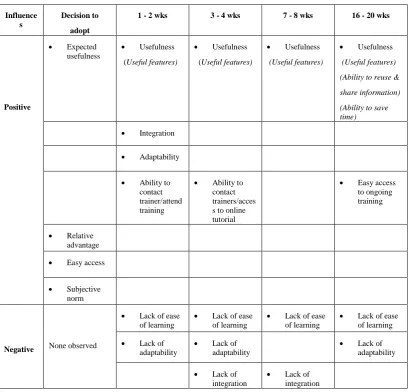
Over time, as users gained experience in using the technology, usefulness continued to be a strong influence on use of EndNote. Usefulness was expressed in terms of the technology as a whole, its features, the ability to re-use and share information and the ability to save time while using it. In addition, the ability to contact trainers and attend on-going training courses was an on-going influence on continued use of the technology.
However, negative influences such as lack of ease of learning and the lack of adaptability were prominent negative influences over the 20 weeks.
DISCUSSION
By investigating how and why users adopt and then adapt a technology to suit their needs, over time, our study highlights the varying influences that encourage and discourage longer-term use and the uncertain length of time before a technology stabilizes. In identifying the influences that encourage and discourage appropriation and long term use of a technology in an educational environment, we view our findings through the practice lens of the MTA, which has three levels (Figure 1).
At the initial encounter, when the decision to adopt a technology is made (MTA level 1), we found that perceived usefulness, subjective norm and relative advantage were important influences that supported users’ decision to adopt. These findings are consistent with previous reports by others about subjective norm (Davis 1989; Venkatesh et al. 2003) and relative advantage (Moore and Benbasat 1991; Rogers 1995; Fidock, and Carroll 2006). We also found that easy and free access to a technology was a positive influence. The importance of cost has been observed in the MTA related studies on mobile technologies. These studies have identified cost, in terms of purchase and expected usage, as an influence that encouraged the decision to adopt (Herszfeld, Carroll and Howard 2003; Carroll et. al 2003). We therefore suggest that technologies with low or no purchase cost and easy availability may influence the decision to adopt along with other perceptions such as usefulness.
Perceived ease of use has been a strong influence in some studies on technology adoption (Davis 1989; Venkatesh et al. 2003) and appropriation of mobile and SMS-related environments (Herszfeld et al. 2003; Carroll et al. 2003). In this study however, we did not note perceive ease of use as an influence in decision to adopt EndNote. We suggest that perceived ease of use could sometimes be less important, for instance when users perceive that adopting the technology may improve their everyday work practices or simply the inexperience with the technology could hinder users’ judgement on whether a technology is easy to use or not. Strong influences such as expected usefulness, subjective norm, relative advantage and easy and free access to the technology may be stronger driving forces in enabling early decision-making with perceived ease of use taking a back-seat in the decision to adopt. In addition, the formation of perceptions, attitudes and high expectations, an outcome of effective training, may have contributed in the decision to adopt the technology.
Influence s
Decision to adopt
1 - 2 wks 3 - 4 wks 7 - 8 wks 16 - 20 wks
Positive
Expected usefulness
Usefulness
(Useful features)
Usefulness
(Useful features)
Usefulness
(Useful features)
Usefulness
(Useful features) (Ability to reuse &
share information)
(Ability to save time)
Integration
Adaptability
Ability to contact trainer/attend training
Ability to contact trainers/acces s to online tutorial
Easy access to ongoing training
Relative advantage
Easy access
Subjective norm
Negative
None observed
Lack of ease of learning
Lack of ease of learning
Lack of ease of learning
Lack of ease of learning
Lack of adaptability
Lack of adaptability
Lack of adaptability
Lack of integration
Lack of integration
Table 3: Positive and negative influences at different time points
Our study reveals that, with time, as users actually use a technology, ease of use may or may not emerge as an influence that encourages or discourages actual use of a technology. Different attributes of ease of use may emerge as users explore and adapt the technology in their everyday practices. In our study, we found that users expressed ease of use in terms of ease of learning to use a technology. Users of EndNote found it difficult to learn to use features of the technology during the entire period (observed from weeks 1-2 until 20). It is therefore important to realize that the determinant ease of use (Davis 1989; Venkatesh et al. 2003) may posses varying attributes over time. It is therefore necessary to make a clear distinction between ease of use and ease of learning to use while discussing influences that encourage and discourage appropriation and long-term use of a technology.
attributes of usefulness emerged with time. Usefulness was initially expressed in terms of the useful features and was later expressed in terms of the ability to re-use and share information. Our study suggests that users re-evaluate and continue changing their expectations over time. It is therefore important that information systems researchers gain deeper understanding of changing influences on the process that leads to longer-term use in respect to different technologies by different cohorts, in order togain in-depth understanding of when, how and why expectations and perceptions change over time.
Our study also suggests that lowered expectations and negative influences that persist with time may not discourage use completely if users see continued benefit from using a technology (also see Mendoza et al. 2008): that is, if the value of the benefits overrides the negative influences. We found that, for all EndNote users, the positive influence of usefulness outweighed the negative influences, such as the lack of ease of learning, integration and adaptability. It should be noted that a class-room based training session during adoption or early use may not be sufficient in encouraging longer term use. In this study, it was noted that training did not seem to overcome lack of ease of learning among users. The key to encouraging continued use may be easy access to varied support mechanisms. Contacting trainers and attending advanced training programs could be a way of encouraging users to overcome negative influences and see further benefits from using the technology. In our context, the ability to contact trainers or attend on-going training courses was a positive influence whenever users were adapting and exploring the technology.
With respect to stable use of the technology (MTA level 3), we observed that use of the technology stabilized in weeks 7-8. Our findings suggest that users established ways of using the technology to gain value from it by working around the problems they faced earlier or by lowering their expectations (Tyre and Orlikowski 1994; Mendoza et al. 2005). Users chose to employ some features to suit their research practices and temporarily rejected some or ignored other features. Adaptation took place in different forms: changing the physical configuration of the technology and substantially altering their existing research practices to suit the technology which may also involve using a suite of other technologies (also see Mendoza et al. 2007). Usefulness continued to positively influence longer-term term use of the technology.
Our study suggests that even after a technology is stable in use, further appropriation can still take place. That is, adaptation continues after an initial stabilisation of technology-in-use. Deeper evaluation of longer-term use in our study (weeks 16-20) revealed that stabilization of a technology may only be a temporary plateau. A stable technology can re-enter the process of appropriation. This re-entry has been noted in some previous findings (Carroll et al. 2002; Tyre and Orlikowski 1994). The need to explore and further adapt the technology is based on emerging events and on the need to resolve some of the problems that may have been experienced previously. These factors encouraged some users to further explore and adapt the technology even after a period of stabilisation. In addition, we found that strong negative influences such as the lack of adapting the technology to new needs and the lack of ease of learning to use the technology did not stop longer-term term use. It appears that the positive reinforcers are stronger than the negative influences.
Our work suggests that one way of encouraging further appropriation and avoiding stagnation of technology use is to provide ongoing access to support, such as advice from experts or further training. Such support was valuable for our participants through an initial dip in expectations, observed between weeks 1 to 4, and frustrations in resolving issues throughout the 20 weeks of this study. Some users in this case study attended a voluntary advanced training session. The training session helped them resolve pre-existing issues and further adapt the technology to suit ongoing activities in their research practices. From our experience, we argue that designers, trainers and managers need to be aware that providing training for users during the implementation stage alone may not be sufficient to support and improve persistent and longer-term term use of the technology. Access to a variety of support mechanisms, throughout the periods of exploration and stabilisations, may be a key factor in encouraging productivity and user satisfaction.
CONCLUSION
Three main implications have emerged from our study. First, influences on users’ appropriation activities change with time and user needs. Second, as a consequence of changing influences, the influences that encourage adoption of a technology may not be sufficient to sustain longer-term term use. As users move from the initial adoption to longer-termer term use, a shift from perceptions of expected usefulness to usefulness may be seen as users actually manipulate and evaluate the technology to suit their work practices. Over time, new aspects of usefulness can emerge. Third, stabilization of a technology may only be temporary, where users’ knowledge and expertise in using the technology are at a plateau. Changing needs, curiosity about possible features or changing evaluations of the technology encourage users to re-enter the process of appropriation – to explore and construct new practices - from a stable use of the technology.Trainingsupports this re-entry.
Our study therefore draws attention to the crucial role played by ongoing training services in encouraging the process of appropriation leading to persistent and productive use of a technology. The access to training programs and trainers may encourage users to overcome negative influences and see benefits from using a technology. Evidence of plateaus of stabilisation and re-entry into the process of appropriation between 16 and 20 weeks suggests that both researchers and practitioners have under-estimated the length of time required for some more enduring stabilisation (if achieved).
The findings in this research have been based on an in-depth study of how and why 14 participants appropriated EndNote over 20 weeks. Theoretical issues on the appropriation process including stabilization and further appropriation have been addressed. Further research will need to focus on understanding appropriation by different cohorts over a longer-term time period. Therefore, we plan to investigate longer-term use of different technologies in an educational environment and to extend the period of research beyond 20 weeks.
REFERENCES
Adams, D.A, Nelson, R.R and Todd, P.A. (1992) 'Perceived Usefulness, Ease of use and Usage of Information Technology: A Replication', MIS Quarterly, Vol 16 No 2, pp 227-47.
Brown, S.A., Massey, A.P., Montoya-Weiss, M.M. and Burkman, J.R. (2002) 'Do I really have to? User Acceptance of Mandated Technology', European Journal of Information Systems, Vol 11, pp 283-295.
Carroll, J., Howard, S., Peck, J. and Murphy, J. (2002) 'A Field Study of Perceptions and Use of Mobile Telephones by 16 to 22 year Olds', Journal of Information Technology Theory and Application (JITTA), Vol 4 No 2, pp 49-62.
Carroll, J., Howard, S., Peck, J. and Murphy, J. (2003) 'From Adoption to Use: The Process of Appropriating a Mobile Phone', Australian Journal of Information Systems (AJIS), Vol 10 No 2, pp 38-48.
Chau, P.Y.K., and Hu, P.J. (2002a) 'Examining a model of information technology acceptance by individual professionals: An exploratory study', Journal of Management Information Systems, Vol 18 No 4, pp 191-229.
Chu, T. and Robey, D. (2008) 'Explaining changes in learning and work practice following the adoption of online learning: a human agency perspective', European Journal of information Systems, Vol 17, pp 79-98.
Ciborra, C.U. (1996), Groupware and teamwork, John Wiley & Sons, New York.
Compeau, DR., Meister, D.B. and Higgins, C.A. (2007) 'From prediction to explanation: Re-conceptualizing and extending the perceived characteristics of innovating', Journal of the Association for Information Systems (JAIS), Vol 8 No 8, pp 409 - 39.
Cooper, R.B., and Zmud, R.W. (1990) 'Information Technology Implementation Research: A Technological Diffusion Approach', Management Science, Vol 36, pp 123-39.
Davenport, T., Jarvenpaa, S., and Beers, M. (1996) 'Improving knowledge work processes', Sloan Management Review, Vol 37 No summer, pp 53-65.
Davis, F.D. (1989) 'Perceived Usefulness, Perceived Ease of Use and User Acceptance of Information Technology', MIS Quarterly, Vol 13 No 3, pp 319-339.
Davis, F.D., Bagozzi, R.P., and Warshaw, P.R. (1989) 'User Acceptance of Computer-Technology - A Comparison of two Theoretical Models', Management Science, Vol 35 No 8, pp 982-1003.
DeSanctis, G. and Poole, M.S. (1994) 'Capturing the Complexity in Advanced Technology Use: Adaptive Structuration Theory', Organization Science, Vol 5 No 2, pp 121-147.
Fidock, J., and Carroll, J. (2006) 'The model of technology appropriation: A lens for understanding systems integration in a defence context', Proceedings of the 17th Australasian Conference on Information Systems (ACIS 2006), Adelaide, Australia.
Gallivan, M.J. (2001) 'Organizational Adoption and Assimilation of Complex Technological Innovations: Development and Application of a New Framework', The DATA BASE for Advances in Information Systems, Vol 32 No 3, pp 51-85.
Giddens, A (1984) University of California Press, Berkeley, CA.
Griffith, T.L. (1999) 'Technology features as triggers for sense making', Academy of Management review, Vol 24 No 3, pp 472-88.
Herszfeld, S., Carroll, J., and Howard, S. (2003) 'Job Allocation by SMS: Technology Appropriation in the Construction Industry', Proceedings of the 14th Australasian Conference on Information Systems (ACIS 2003), Perth, Australia.
Holstrom, J. (1999) '"It’s as if somebody slammed the door" On the limits of Organizational Change around Information Technology', Proceedings of the 7th European Conference on Information Systems, Vol 1, pp 320-329.
Jasperson, J., Carter, P.E and Zmud, R.W (2005) 'A Comprehensive Conceptualization of Post-adoptive behaviours associated with information Technology enabled work systems', MIS Quarterly, Vol 29 No 3, pp 525-57.
Karahanna, E., Straub, D.W. and Chervany, N.L. (1999) 'Information Technology Adoption Across Time: A Cross-sectional comparison of Pre-adoption and Post-adoption Beliefs', MIS Quarterly, Vol 23 No 2, pp 183-213.
Lee, A. S. (1991) 'Integrating Positivist and Interpretive Approaches to Organizational Research', Organization Science, Vol 2, pp 342-365.
Leonard-Barton, D. (1988) 'Implementation as Mutual Adaptation of Technology and Organization', Research Policy, Vol 17 No 5, pp 251-267.
Lyytinen, K. and J. Gaskin (2010) 'Psychological Ownership and the Individual Appropriation of Technology', Proceedings from the 43rd Hawaii International Conference on System Sciences, Koloa, Kauai, Hawaii.
Majchrzak, A., Rice, R., Malhotra, A. and King, N. (2000) 'Technology Adaptation: The Case of a Computer-supported Inter-organizational Virtual Team', MIS Quarterly, Vol 24 No 4, pp 569-600.
Markus, L.M., and Robey, D. (1988) 'Information Technology and Organizational Change: Causal Structure in Theory and Research', Management Science, Vol 34 No 5, pp 583-98.
Markus, M. L and Silver, S. M (Special Issue 2008) 'A Foundation for the Study of IT Effects: A New Look at DeSanctis and Poole’s Concepts of Structural Features and Spirit ' Journal of the Association for Information Systems, Vol 9, No 10/11, pp. 609-632.
Mendoza, A., Carroll, J. and Stern, L. (2005) 'Adoption, adaptation, stabilization and stagnation: software appropriation over time', Proceedings of the 16th Australasian Conference on Information Systems (ACIS 2005), Sydney, Australia.
Mendoza, A., Carroll, J. and Stern, L. (2007) 'Plateaus in long-term appropriation in an information system', Proceedings of the 18th Australasian Conference on Information Systems (ACIS 2007), Toowoomba, Australia.
Mendoza, A., Carroll, J. and Stern, L. (2008) 'Influences on continued use of an information system: a longitudinal study', Proceedings of the 16th European Conference on Information Systems (ECIS 2008), Galway, Ireland.
Miles, B.M. and Hubermann, A.M. (1994) Qualitative Data Analysis, 2nd ed., SAGE Publications.
Moore, C.G. and Benbasat, I. (1991) 'Development of an Instrument to Measure the Perception of Adopting an Information Technology Innovation', Information Systems Research, Vol 2 No 3, pp 192-222.
Orlikowski, W.J. (2000) 'Using technology and Constituting Structures: A practice lens for studying technology in organisations', Organisation Science, Vol 11 No 4, pp 404-28.
Orlikowski, W.J. (1996) 'Improvising organizational transformation over time: A situated change perspective', Information Systems Research, Vol 7 No 1, pp 63-92.
Orlikowski, W.J. (1992) 'The Duality of Technology - Rethinking the Concept of Technology in Organizations', Organization Science, Vol 3 No 3, pp 398-427.
Raymond, L. (1990) 'End-user Computing in the Small Business Context: Foundations and Directions for Research', Database, Vol 20 No 4, pp 20-26.
Rogers, E.M. (1995) Diffusion of innovations, 4th ed., Free Press, New York.
Sun, H. and Zhang, P. (2006) 'Applying Markus and Robey's Causal Structure to Examine User Technology Acceptance Research: A New Approach', Journal of Information Technology Theory and Application (JITTA), Vol 8 No 2, pp 69-81.
Szajna, B. (1996) 'Empirical evaluation of the revised technology acceptance model', Management Science, Vol 42, No 1, pp 85-92.
Taylor, S. and Todd, P.A. (1995) 'Understanding information technology usage - A test of competing models', Information Systems Research, Vol 6 No 2, pp 144-176 .
Thompson, R.L., Higgins, C.A. and Howell, J.M. (1991) 'Personal computing: Towards a conceptual model of utilization', MIS Quarterly, Vol 15 No 1, pp 124-143.
Trigg, R. and Bodker, J. (1994) 'From Implementation to design: Tailoring and the Emergence of systematization in CSCW', ACM Conference Computer-supported Cooperative Work CSCW 94, pp 45-54.
Turner, B. (ed.) (1988) 'Connoisseurship in the study of organizational cultures' in Doing research in organizations ', London: Routledge.
Tyre, M.J. and Orlikowski, W.J. (1994) 'Windows of Opportunity: Temporal Patterns of Adaptation in Organizations', Organization Science, Vol 5 No 1, pp 98-118.
Van de Ven, A.H. and Poole, M.S. (1995) 'Explaining Development and Change In Organizations', Academy of Management review, Vol 20 No 3, pp 510-40.
Van der Heijden, H. (2004) 'User acceptance of hedonic information systems', MIS Quarterly, Vol 28 No 4, pp 695-704.
Vaughn, S., Schumm, J.S. and Sinagub, J.M. (1996) Focus group interviews in education and psychology, Sage Publications, Thousand Oaks.
Venkatesh, V. (1999) 'Creation of Favourable User Perceptions: Exploring the Role of Intrinsic Motivation', MIS Quarterly, Vol 23 No 2, pp 239-260.
Venkatesh, V. and Davis, F.D. (2000) 'A Theoretical Extension of the Technology Acceptance Model: Four Longitudinal Field Studies', Management Science, Vol 45 No 2, pp 186-204. Venkatesh, V., Morris, G., Davis, G.B. and Davis, F.D. (2003) 'User Acceptance of Information
Technology: Towards a unified view', MIS Quarterly, Vol 27 No 3, pp 425-454.
Xia, W. and Lee, G. (2000) 'The Influence of Persuasion, Training, and Experience on User Perceptions and Acceptance of IT Innovation', Proceedings of the twenty first International Conference on Information Systems (ICIS), pp 371-384.