R E S E A R C H
Open Access
Extraction Kinetics of phytochemicals and
antioxidant activity during black tea
(
Camellia sinensis
L.) brewing
Chamira Dilanka Fernando
1,2and Preethi Soysa
1*Abstract
Background:Tea is the most consumed beverage in the world which is second only to water. Tea contains a broad spectrum of active ingredients which are responsible for its health benefits. The composition of constituents extracted to the tea brew depends on the method of preparation for its consumption. The objective of this study was to investigate the extraction kinetics of phenolic compounds, gallic acid, caffeine and catechins and the variation of antioxidant activity with time after tea brew is made.
Methods:CTC (Crush, Tear, Curl) tea manufactured in Sri Lanka was used in this study. Tea brew was prepared according to the traditional method by adding boiling water to tea leaves. The samples were collected at different time intervals. Total phenolic and flavonoid contents were determined using Folin ciocalteu and aluminium chloride methods respectively. Gallic acid, caffeine, epicatechin, epigallocatechin gallate were quantified by HPLC/UV method. Antioxidant activity was evaluated by DPPH radical scavenging and Ferric Reducing Antioxidant Power (FRAP) assays.
Results:Gallic acid, caffeine and catechins were extracted within a very short period. The maximum extractable polyphenols and flavanoids were achieved at 6–8 min after the tea brew is prepared. Polyphenols, flavanoids and epigallocatechin gallate showed a significant correlation (p< 0.001) with the antioxidant activity of tea. Conclusion:The optimum time needed to release tea constituents from CTC tea leaves is 2–8 min after tea is made.
Keywords:Camellia sinensisL, Black tea, Brewing time, Extraction kinetics
Background
Oxidation is an essential biological process for energy production reactions in living organisms. However,
ex-cessive in vivo production of reactive oxygen species
(ROS) leads to oxidative damage in lipids, protein and DNA. Oxidative damages cause the risk of development of neuro degeneration, mutagenesis, carcinogenesis, cor-onary heart disease, diabetes and cellular ageing [1]. Recently an increasing number of scientific publications suggest that certain edible plants may offer protection or treatment against some chronic diseases. In general, these beneficial effects can be attributed to their antioxidant
constituents such as vitamin C, vitamin E, carotenoids, flavonoids, catechins, anthocyanins, etc. [2].
Tea is the most consumed beverage in the world only second to water. CTC (Crush, Tear, Curl) tea is manu-factured in Sri Lanka from the two leaves and the bud
and young leaves of the shrub Camellia sinensis (L.)
Kuntze (family: Theaceae) [3]. The estimated amount of 18–20 billion tea cups consumed daily worldwide elicits its economic and social interest [4]. Most of the tea pro-duced worldwide is black tea, which represents 76–78 % of the tea produced and consumed worldwide [5]. The production of black tea involves allowing tea leaves to wither where the moisture content of the leaves is reduced followed by rolling and crushing to initiate fermentation [6].
* Correspondence:[email protected]
1
Department of Biochemistry & Molecular Biology, Faculty of Medicine, University of Colombo, Kynsey Road, Colombo 08, Sri Lanka
Full list of author information is available at the end of the article
The chemical composition of tea includes polyphenols, alkaloids (caffeine and theobromine), amino acids (mainly L-theanine), carbohydrates, proteins, chlorophyll, volatile compounds, minerals (aluminium, manganese and fluoride) and other unidentified compounds. Among these, polyphe-nols are one of the main bioactive compounds in tea [7]. The major polyphenolic compounds in tea are the flavan-3-ols (catechins) which include: (−)-epicatechin (EC), (− )-epi-gallocatechin (EGC), (−)-epicatechin gallate (ECG), (− )-epi-gallocatechingallate (EGCG), (−)-gallocatechins (GC) and (−)-gallocatechin gallate (GCG) [8]. During the manufac-turing process of black tea, the colourless catechins present in fresh tea leaves are oxidized both enzymatically and nonenzymatically to give two major groups of pigments: theaflavins and thearubigins which are responsible for the colour and sensory properties of black tea brew [9]. The fla-vonoids and other polyphenols present in tea have shown a wide range of biological and pharmaceutical benefits, in-cluding prevention of cancer [10], obesity [11], type 2 diabetes [12], depressive symptoms [13] cardiovascular diseases and cerebral ischemic damage [14]. Further tea possesses insulin-enhancing [15], antioxidative [16], hypo-lipidemic [17], antimicrobial [18], immune-stimulatory [19], anti-inflammatory [20], neuroprotective [21] and bone mineralization enhancement activities [22]. These beneficial effects may be attributed to antioxidant activity possessed by the polyphenolic compounds in tea [7]. Gallic acid has proven its cytotoxic activity against cancer cell lines [23]. Epidemiological studies have found a positive as-sociation between dietary flavonoid intake and overall good health [24].
Stirring and steeping conditions such as time and temperature are critical factors for extraction of cate-chins or theaflavins from teas [25]. The traditional method of making a cup of tea in some countries includ-ing Sri Lanka is to place loose leaves directly into a pot
and pour boiling water over the leaves. After a couple of minutes the leaves are usually removed and the infusion is consumed. The extractable phytochemicals associate with the health benefits and their levels depend on the method of tea preparation for its consumption. There-fore, this study aims to evaluate the kinetics of solid liquid extraction of polyphenols, flavonoids, gallic acid, caffeine, epicatechin and epigallocatechin gallate in tea infusion made with CTC tea.
Methods
Reagents and chemicals
HPLC grade acetonitrile was purchased from BDH (BDH
Chemicals Ltd. Poole, England). β-hydroxyethyltheophy
lline, caffeine, gallic acid, epicatechin, (−)-epigallocatechin gallate, Folin Ciocalteu reagent, 1,1-Diphenyl-2-picrylhy-drazyl (DPPH) and aluminium chloride were purchased from Sigma Chemicals, USA. Sodium nitrite was purchased from Riedel De Haen Ag, Wunstorfer Strasse 40, SEELZE1, D3016, Germany. Crush, Tear, Curl (CTC) low grown pure Ceylon black tea was obtained from Danduwangalawatta Tea factory, Millawitiya, Kuruwita, Sri Lanka.
Equipment
Shimadzu UV-1601 UV Visible spectrophotometer
(Shimadzu Corporation, Japan) was used to read the ab-sorbance. HPLC was performed with Shimadzu LC 10AS solvent delivery system equipped with UV/VIS variable wavelength detector Shimadzu SPD 10A (Shimadzu Cor-poration, Japan) and an integrator Shimadzu C-R8A (Shimadzu Corporation, Japan). Chromatographic reso-lution of components in tea was achieved on betasil phenyl HPLC column (2.1 x 150 mm) from Thermo scientific. Samples were injected with a syringe loading injector fitted with a 100μl loop.
A
B
Shimadzu Libror AEG-220 analytical balance (Shimadzu Corporation, Japan) was used to prepare standard solu-tions. Purified deionized water was obtained from Lab-conco Water Pro-PS UV ultra filtered water system (Labconco Corporation, Missouri) and distilled water was obtained by Aquatron A4S water system. Micro-centrifugation was performed using a BioFuge-Pico D-37520 centrifuge (Heraeus Instruments, Germany).
Preparation of tea brew
Tea brew was prepared according to the conventional method. Deonized water (500 ml) was boiled in a glass beaker placed on a hot plate. At the onset of boiling, heating was terminated and the tea leaves (5.0 g) were added to boiled water. The beaker was then covered with a watch glass. Magnetic stirrer was used at a con-stant speed to maintain a homogenous sample. A vol-ume of 1.0 ml was withdrawn at different time intervals (0, 1, 2, 4, 6, 8, 10, 12, 14, 20 min) and centrifuged. The
supernatant was assayed for their phenolic and flavonoid content by spectrophotometry. Gallic acid, caffeine, epi-catechin and epigalloepi-catechin gallate were quantified by Reversed Phase High Pressure Liquid Chromatography (RP-HPLC). Antioxidant activity was assayed by DPPH radical scavenging and Ferric reducing Antioxidant Power (FRAP) methods.
Determination of phenolic content
Total phenolic content was determined by Folin
Ciocal-teu method [26]. Samples (25 μl) were diluted up to
1500 μl with deionized water. Folin Ciocalteu’s reagent (1 N, 250μl) was added to the samples (500μl), and the mixture was allowed to stand at room temperature for 2 min. Sodium carbonate solution (10 %, 1.25 ml) was then added and incubated for 45 min in the dark at room temperature. The absorbance of the resulting solu-tion was measured at 760 nm against a blank prepared with deionized water. Calibration curves were con-structed with gallic acid and (−)-epigallocatechin gallate (EGCG) standards. The total phenolic content was expressed as gallic acid equivalents (GAE) mg/g of tea leaves as well as EGCG equivalents mg/g of tea leaves. Tea samples brewed independently were analyzed in replicates (n= 6).
Determination of flavonoid content
The flavonoid content was measured by the aluminum chloride colorimetric assay [27]. Tea brew (25 μl) col-lected at different time intervals were diluted with
deionized water up to 500 μl and mixed with sodium
nitrite (5 %, 30 μl). After 5 min aluminium chloride
Table 1Kinetic parameters for the extraction of nutraceuticals from tea infusion
C∞(mg/g) C20(mg/g) (observed) k1(g mg−1min−1)
GA 8.0 ± 1.2 7.6 ± 1.9 7.8 x10⁻²± 0.2 x10⁻²
Caffeine 42.2 ± 2.7 42.1 ± 1.9 4.1 x10⁻³± 0.3 x10⁻³
EGCG 11.8 ± 0.4 11.2 ± 1.1 1.4 x10⁻²± 0.8 x10⁻²
Polyphenols 131 ± 8a 124 ± 6a 2.4 x10⁻²± 0.7 x10⁻²
Flavanoids 322 ± 22b 310 ± 26b 5.8 x10⁻⁴± 0.1x10⁻⁴ a
Concentration is expressed in mg/g GAE andb
Concentration is expressed in mg/g EGCG equivalents
(C∞= the extraction capacity, C20= the concentration of the tea constituent in the solution at 20th
minute,k1= the second-order extraction rate constant)
A
B
(10 %, 30 μl) was added to the mixture followed by
sodium hydroxide (1 M, 200 μl) at the 6thminute. The
final volume was adjusted to 1000 μl with deionized
water and absorbance was measured at 510 nm against a blank prepared with deionized water replacing the tea brew. Calibration curve was plotted using EGCG stan-dards and flavonoid content was expressed as EGCG equivalents mg/g of tea leaves. Tea brew prepared independently were analyzed in replicates (n= 6).
Antioxidant capacity by 1,1-Diphenyl-2-picrylhydrazyl (DPPH) radical assay
Free radical scavenging ability of tea samples collected at different time intervals and authentic samples of tea constituents (gallic acid, caffeine, epicatechin and epi-gallocatechin gallate) was assayed by DPPH radical scavenging method with slight modifications [28]. Test samples (50 μl) were diluted up to 1000 μl with deion-ized water. DPPH reagent prepared in absolute ethanol (100 μM, 950 μl) was added to the test sample (50 μl) and the mixture was allowed to stand for 30 min in the dark. The scavenging activity was quantified by measur-ing the absorbance at 517 nm. Deionized water was used as the blank. The control was prepared by mixing
deion-ized water (50 μl) with DPPH (950 μl). Results were
expressed as percentage scavenging of DPPH radical calculated using the following equation:
%Scavenging of DPPH free radical
¼Abs:of control−Abs:of sample
Abs:of control 100%
Percentage scavenging of DPPH radical against time was plotted. Tea brew prepared independently was analyzed in replicates (n= 6) for antioxidant activity. L-Ascorbic acid was used as the standard antioxidant. The effective concentration needed to scavenge 50 % of the
DPPH radical with respect to the control (EC50) was
calculated for each of the tea constituents and the standard antioxidant.
Antioxidant capacity by ferric reducing antioxidant power (FRAP) assay
The ferric ion reducing power of the samples collected at different time intervals was determined according to Sharma and Kumar (2011) with slight modifications [29]. Samples (50μl) were diluted up to 1000μl with de-ionized water. The test sample (100μl) was mixed with
phosphate buffer (0.2 M, pH 6.6, 250 μl) and potassium
ferricyanide (1 %, 250μl). The mixture was incubated at 50 °C for 20 min. Trichloroacetic acid (10 %, 250μl) was added and the samples were centrifuged at 6500 rpm for 10 min. The supernatant was mixed with deionized water and ferric chloride (0.1 %) at a ratio of 1:1:2 re-spectively. The samples were vortexed and absorbance was measured at 700 nm. The reagent blank was pre-pared by replacing tea sample with deionized water. L-ascorbic acid was used as the standard antioxidant. The antioxidant capacity was expressed as Ascorbic acid equivalent reducing power (mg/g of tea leaves).
Determination of Gallic acid, Caffeine, Epicatechin (EC) and (−)-Epigallocatechin gallate (EGCG) using Reversed Phase High Pressure Liquid Chromatography
Tea brew was diluted as necessary for the quantification of gallic acid, epicatechin and (−)-epigallocatechin gallate
and caffeine. Samples (100 μl) were mixed with the
internal standard,β–hydroxyethyltheophilline (10μg/ml,
100 μl) and centrifuged (2000 rpm, 5 min). The
super-natant (25 μl) was injected onto the HPLC column. The
mobile phase used was isocratic elution system consists of 8 % acetonitrile, 1 % glacial acetic acid and 91 % deionized water at a flow rate of 0.5 ml/min. The peaks were de-tected at 280 nm. Standards were prepared with a mixture of gallic acid, caffeine, EC and EGCG (2.5–25μg/ml) in
A
B
deionized water. Calibration curve was constructed using peak area ratio of gallic acid, caffeine, EC and EGCG (ratio of peak area of the relevant standard to that of the internal standard) against the concentration. The HPLC method was validated for accuracy, intraday and interday preci-sion, linearity, limit of detection (LOD) and limit of quan-titation (LOQ) according to the guidelines provided [30].
Evaluation of kinetics of releasing phytochemicals from tea leaves
Kinetics of solid liquid extraction of polyphenols, flava-noids, gallic acid, caffeine, EC and EGCG mixtures were studied.
Second-order rate law for extraction of compounds from tea leaves is considered [31];
dc
dt¼k1ðc−c∞Þ
2 ð
1Þ
k1= the second-order extraction rate constant (g μg −1
min−1)
C∞= the extraction capacity (concentration of tea
con-stituents at saturation in g L−1)
C = the concentration of tea constituents in the solu-tion at any time (g L−1), t (min)
By considering the boundary condition t = 0 to t and C = 0 to C, the integrated rate law for a second-order extraction was obtained.
c¼ c
2
∞k1t
1þc∞k1t ð
2Þ
By linear transformation of the above equation, the rate constantk1can be determined by fitting the
experi-mental data.
t c¼
1 k1c2∞þ
t
c∞ ð3Þ
Statistical analysis
Results are presented as mean ± standard deviation (Mean ± SD) of six independent experiments. Statistical analysis, student’st-test and calculation of Pearson’s cor-relation coefficient (r) were performed using Microsoft Excel. Value ofp< 0.05 was considered as significant.
Results and discussion
Gallic acid, caffeine, EC, EGCG and the internal stand-ardβ-hydroxyethyltheophilline were eluted at 1.96, 5.89, 12.21, 15.49 and 4.21 min respectively. The calibration
A B
C D
E F
curves were linear over 2.5– 25μg/ml with R2 exceed-ing 0.995 for gallic acid, caffeine, EC and EGCG. The method showed repeatability, interday and intraday precision (CV %) less than 6.0 % and accuracy was 96– 103 % for all the compounds studied.
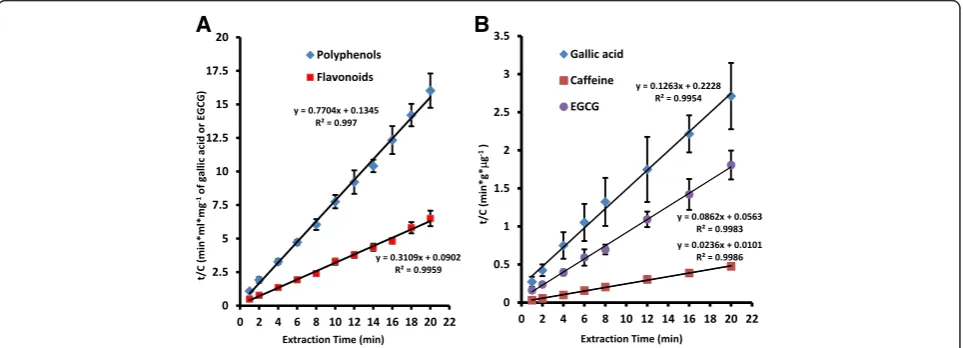
Concentrations obtained for all the compounds tested were fitted with the second order kinetics. Linear curves (R2> 0.99) were obtained for time against time/concen-tration (t/C) as described by many authors [32, 33] for all individual set of data (n= 6) for solid liquid extraction of each compound investigated. Curves obtained from the mean values of each compounds are illustrated in the Fig. 1. The gradient and intercept values of the curves were used to determine the extraction capacity (C∞) and second-order extraction rate constant (k1).
These kinetic parameters were calculated from the data obtained during first 5 min of tea brewing, assuming the change of temperature to be negligible during this period. However the effect of temperature has not af-fected the linearity of the curves (Fig. 1). The calculated values with the observed values are listed in Table 1.
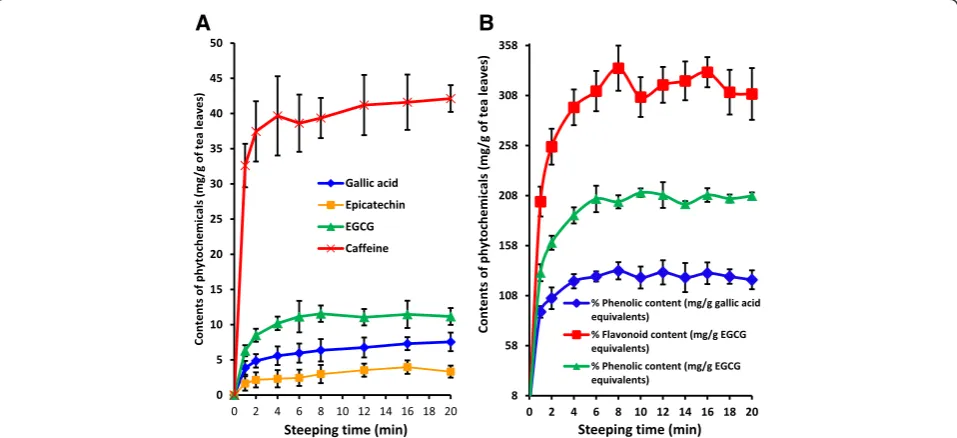
Rapid extraction was observed for gallic acid, caffeine, EC, EGCG within first two minutes and slowly increased with time (Fig. 2a). The release of compounds from tea leaves depends on the amount present and their solubil-ity. All the compounds investigated in the present study are water soluble. Caffeine is soluble in polar and non polar solvents and efficient release can be expected as observed in the present study. Furthermore caffeine present in the tea leaf is higher compared to the other three compounds investigated. The release of total phe-nols and flavonoids also showed rapid and slow release phases but comparatively slower than caffeine, gallic acid and other two catechins (Fig. 2a and b). Total poly-phenolic and flavonoid compounds extracted increased with the time and reached to a maximum concentration at 6–8 min (Fig. 2b). The values which represent total polyphenolic content (TPC) and flavonoid content ac-count for all the polyphenolic substances present in tea leaves having different solubility which could be respon-sible for slow release of TPC with time. The maximum concentrations observed for total phenols and flavonoids were 13.28 ± 0.86 w/w % GAE and 33.53 ± 2.26 w/w % EGCG equivalents respectively. At low temperature
caffeine complexes with polyphenols and forms insoluble complexes [34]. It is observed that the temperature de-creased from 100–75 °C during the first twenty minutes, but complexation of polyphenols with caffeine was not visible.
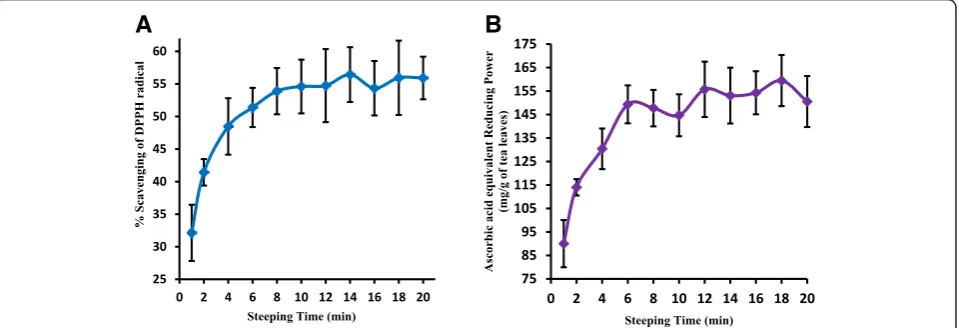
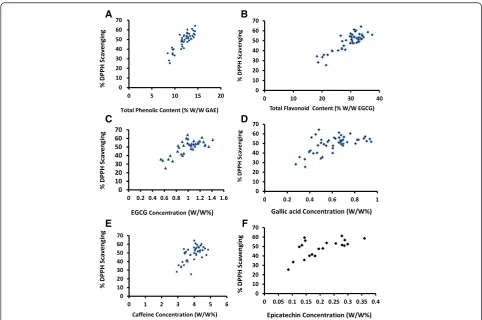
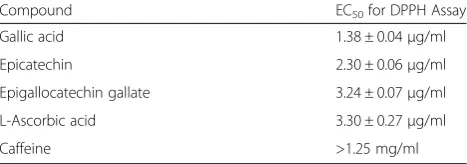
Most of the health benefits of tea are based on its anti-oxidant activity. According to DPPH and FRAP assays, the antioxidant activity was increased with the steeping time (Fig. 3a and b). A significant correlation (p< 0.001) was observed between the antioxidant activity with poly-phenols, flavonoids and EGCG (Fig. 4a–f ). A moderate or low correlation was observed between antioxidant ac-tivity and gallic acid, EC and caffeine present in the tea brew. Though the antioxidant capacity of gallic acid and EC is high (Table 2), their contribution in tea brew to scavenge DPPH is low since their concentration is rela-tively low when compared with EGCG and phenols. Present study reveals that polyphenols and EGCG are major constituents responsible for antioxidant activity. Although caffeine is not considered as a polyphenolic compound, its capability to inhibit lipid peroxidation has been reported [35]. However the authors suggest that its contribution to antioxidant activity in coffee and tea does not seem to be as important as the contribution of phenolic compounds. This is in agreement with the re-sults obtained in the present study.
Conclusions
The traditional method of preparing a CTC tea brew has influence on the extraction of total phenols, flavonoids and major phytoconstituents such as gallic acid, caffeine, EC and EGCG. The antioxidant capacity of CTC black tea significantly correlated well with levels of EGCG, fla-vonoids and total phenolics during steeping of the black tea. A very weak correlation was observed between caffeine content with antioxidant activity. Releasing of caffeine, gallic acid, EGCG and EC into the tea brew was much faster than the release of polyphenols and flavo-noids. The minimum brewing time required to release
tea constituents from CTC tea leaves is 2–8 min after
tea is prepared according to the traditional method. Since tea is one of the major beverages consumed worldwide, studying the effect of preparation of tea on the extractability of various health beneficial phytocon-stituents is highly valued.
Competing interests
The authors declare that they have no competing interests.
Authors’contributions
Both authors contributed to the study design, data analysis and drafting of the manuscript. Laboratory work was carried out by CDF. PS contributed to data interpretation and revising the manuscript for intellectual content. Both authors read and approved the final manuscript.
Table 2EC50values obtained in the DPPH assay for authentic samples of tea constituents and the standard antioxidant
Compound EC50for DPPH Assay
Gallic acid 1.38 ± 0.04μg/ml
Epicatechin 2.30 ± 0.06μg/ml
Epigallocatechin gallate 3.24 ± 0.07μg/ml
L-Ascorbic acid 3.30 ± 0.27μg/ml
Acknowledgements
We acknowledge the financial assistance by National Science Foundation Sri Lanka (Grant number RG/2005/HS/17) and Department of Biochemistry & Molecular Biology, Faculty of Medicine, University of Colombo. We particularly thank Mr. Saman Kolombage, Ms. Nilusha Rajapakse, Mr. Thisira Andrahennadi and Mr. Jayantha Weerasinghe, Department of Biochemistry & Molecular Biology, Faculty of Medicine, University of Colombo, for the technical assistance provided.
Author details
1Department of Biochemistry & Molecular Biology, Faculty of Medicine,
University of Colombo, Kynsey Road, Colombo 08, Sri Lanka.2Institute of Chemistry Ceylon, College of Chemical Sciences, Adamantane House, 341/22, Kotte Road, Welikada, Rajagiriya, Sri Lanka.
Received: 16 April 2015 Accepted: 17 July 2015
References
1. Moskovitz J, Yim KA, Choke PB. Free radicals and disease. Arch Biochem Biophys. 2002;397:354–9.
2. Podsedek A. Natural antioxidants and antioxidant capacity of Brassica vegetables: A Review. Food Sci Technol–LEB. 2007;40:1–11.
3. Shapiro H, Bruck R. Coffee and Tea consumption and chronic liver disease. Gastroenterology. 2006;130(6):931.
4. Fernandez-Caceres PMJ, Martin MP, Gonzalez AG. Differentiation of tea (Camellia sinensis) varieties and their geographical origin according to their metal content. J Agric Food Chem. 2001;49:4775–9.
5. McKay DL, Blumberg JB. The role of tea in human health: An update. J Am Coll Nutr. 2002;21(1):1–13.
6. Carloni P. Food Res Int. 2013;53:900–8.
7. Cabrera C, Gimenez R, López MC. Determination of tea components with antioxidant activity. J Agric Food Chem. 2003;51(15):4.427–35.
8. Peterson J, Druyer J, Bhagwat S, Haytowitz D, Holden J, Eldridge AL, et al. Major Flavonoids in Dry Tea. J Food Compos Anal. 2005;18:487–501. 9. Gupta S, Saha B, Giri AK. Comparative antimutagenic and anticlastogenic
effects of green tea and black tea: A review. Mutat Res. 2002;512:37–65. 10. Yuan JM. Cancer prevention by green tea. Am J Clin Nutr.
2013;98(suppl):1676S–81S.
11. Grove KA, Lambert JD. Laboratory, epidemiological, and human intervention studies show that tea (Camellia sinensis) may be useful in the prevention of obesity (Critical Review). J Nutr. 2010;140:446–53.
12. Deka A, Vita JA. Tea and cardiovascular disease. Pharmacol Res. 2011;64(2):136–45.
13. Zhang Q, Yang H, Wang J, Li A, Zhang W, Cui X, et al. Effect of green tea on reward learning in healthy individuals: a randomized, double-blind, placebo-controlled pilot study. Nutr J. 2013;12:84.
14. Stangl V, Dreger H, Stangl K, Lorenz M. Review Molecular targets of tea polyphenols in the cardiovascular system. Cardiovasc Res. 2007;73:348–58. 15. Anderson RA, Polansky MM. Tea enhances insulin activity. J Agric Food
Chem. 2002;50(24):7.182–6.
16. Sajilata MG, Bajaj PR, Singhal RS. Tea Polyphenols as Nutraceuticals. Compr Rev Food Sci Food Saf. 2008;7:229–54.
17. Yang CS. Tea and health. Nutrition. 1999;15:946–9.
18. Hamilton-Miller JM. Antimicrobial Properties of Tea (Camellia sinensisL.). Antimicrob Agents Chemother. 1995;39(11):2375–77.
19. Matsunaga K, Klein TW, Friedman H, Yamamoto Y. Epigallocatechin Gallate, a Potential Immunomodulatory Agent of Tea Components, Diminishes Cigarette Smoke Condensate-Induced Suppression of Anti-Legionella
pneumophilaActivity and Cytokine Responses of Alveolar Macrophages. Clin Diagn Lab Immunol. 2002;9(4):864–71.
20. Sano J, Inami S, Seimiya K, Ohba T, Sakai S, Takano T, et al. Effects of green Tea intake on the development of coronary artery disease. Circ J. 2004;68:665–70.
21. Kakuda T. Neuroprotective effects of theanine and its preventive effects on cognitive Dysfunction. Pharmacol Res. 2011;64:162–8.
22. Shen CL, Yeh JK, Cao JJ, Chyu MC, Wang JS. Green tea and bone health: Evidence from laboratory studies. Pharmacol Res. 2011;64(2):155–61. 23. Inoue M, Suzuki R, Sakaguchi N, Li Z, Takeda T, Olighara Y, et al. Selective
induction of cell death in cancer cells by gallic acid. Biol Pharm Bull. 1995;18:1526–30.
24. Scalbert A, Johnson IT, Saltmarsh M. Polyphenols: antioxidants and beyond. Am J Clin Nutr. 2005;81(Suppl):215S–7S.
25. Khokhar S, Magnusdottir SGM. Total phenol, catechin, and caffeine contents of teas commonly consumed in the United Kingdom. J Agric Food Chem. 2002;50:565–70.
26. Makkar HPS, Blummel M, Borowy NK, Becker K. Gravimetric determination of tannins and their correlations with chemical and protein precipitation methods. J Sci Food Agric. 1993;61:161–5.
27. Zhishen J, Mengcheng T, Jianming W. The determination of flavonoid contents in mulberry and their scavenging effects on Superoxide radicals. Food Chem. 1999;64:555–9.
28. Olugbami JO, Gbadegesin MA, Odunola OA.In vitrofree radical scavenging and antioxidant properties of ethanol extract ofTerminalia glaucescens. Pharmacognosy Res. 2015;7(1):49–56.
29. Sharma US, Kumar A.In vitroantioxidant activity ofRubus ellipticusfruits. J Advanc Pharm Tech Res. 2011;2(1):47–50.
30. Food and Drug administration. Guidance for Industry: Bioanalytical Method Validation. 2001. http://www.fda.gov/downloads/Drugs/Guidances/ ucm070107.pdf. Accessed 15 Jan 2015.
31. Chan CH, Yusoff R, Ngoh GC. Modeling and kinetics study of conventional and assisted batch solvent extraction. Chem Eng Res Des.
2014;92(6):1169–86.
32. Peleg M. An empirical model for the description of moisture sorption curves. J Food Sci. 1988;53:1216–7.
33. Lafka TI, Lazou AE, Sinanoglou VJ, Lazos ES. Phenolic extracts from wild olive leaves and their potential as edible oils antioxidants. Foods. 2013;2:18–31. 34. Yin JF, Xu YQ, Yuan HB, Luo LX, Qian XJ. Cream formation and main
chemical components of green tea infusions processed from different parts of new shoots. Food Chem. 2009;114:665–70.
35. Brezová V, Slebodová A, Stasko A. Coffee as a source of antioxidants: An EPR study. Food Chem. 2009;114:859–68.
Submit your next manuscript to BioMed Central and take full advantage of:
• Convenient online submission
• Thorough peer review
• No space constraints or color figure charges
• Immediate publication on acceptance
• Inclusion in PubMed, CAS, Scopus and Google Scholar
• Research which is freely available for redistribution