R E S E A R C H
Open Access
LogDrive: a proactive data collection and
analysis framework for time-traveling forensic
investigation in IaaS cloud environments
Manabu Hirano
1*, Natsuki Tsuzuki
1, Seishiro Ikeda
1and Ryotaro Kobayashi
2Abstract
This paper presents the LogDrive framework for mitigating the following problems of storage forensics in
Infrastructure-as-a-Service (IaaS) cloud environments: volatility, increasing volume of forensic data, and anti-forensic attacks that hide traces of incidents in virtual machines. The proposed proactive data collection function of virtual block devices mitigates the problem of volatility within the cloud environments and enables a time-traveling investigation to reveal overwritten or deleted evidence files. We employ a sector-hash-based file detection method with random sampling to search for an evidence file in the record of the write logs of the virtual storage. The problem formulation, the investigation context, and the design with five algorithms are presented. We explore the
performance of LogDrive through a detailed evaluation. Finally, security analysis of LogDrive is presented based on the STRIDE (Spoofing, Tampering, Repudiation, Information disclosure, Denial of service, and Elevation of privilege) threats model and related work. We posted the source code of LogDrive on GitHub.
Keywords: Cloud forensics, Surveillance, Anti-forensics, Hypervisor, Virtual machine monitor, Parallel distributed processing
Introduction
Our everyday lives depend on reliable and trusted cloud services located at distant data centers. For exam-ple, many products can be purchased from Internet-based marketplaces, and cloud-Internet-based office software and teleconferencing applications enable users to collabo-rate with colleagues in remote places. The systems of many Internet-based marketplaces and recent cloud-based applications are deployed in Infrastructure-as-a-Service (IaaS) cloud data centers [1].
This paper first describes three problems of cloud foren-sics: volatility, increasing volume of forensic data, and anti-forensic attacks. Reliable and efficient forensic inves-tigation of the current cloud environments is essential as the volume of activity within them increases. The next section presents two key technologies for mitigating the three problems: a wayback machine for a time-traveling
*Correspondence:[email protected]
1National Institute of Technology, Toyota College, 2-1 Eisei, 471-8525 Toyota, Japan
Full list of author information is available at the end of the article
investigation and sector-hash-based file detection with random sampling. The notation, the problem formulation, and the investigative context are presented. Then, Log-Drive, the proactive data collection and analysis frame-work for IaaS cloud environments, is proposed. The framework can be employed in any organization where an investigating authority or an administrator has control over the user infrastructure. This paper presents an imple-mentation strategy and a performance evaluation. Finally, a discussion of the framework from the perspective of security, performance, and size of logs is presented.
Contribution
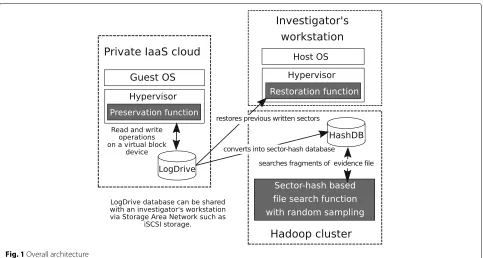
This is an extended version of our previous work [2,3] that presented the concept of a novel write-logging mechanism for virtual block devices in Infrastructure-as-a-Service clouds. Here, we extend the previous work by introducing sector hashing with random sampling for pro-cessing a large amount of forensic data. Figure1shows the overall architecture of the proposed LogDrive framework. The LogDrive framework preserves all write operations
Fig. 1Overall architecture
on a virtual block device of an customer’s guest operat-ing system. Then, the LogDrive database is converted into a sector-hash database (i.e., HashDB) to search fragments of evidence files in the past write operations. Finally, an investigator’s workstation restores an virtual block device at an arbitrary point in time from the LogDrive database to collect evidence files in a past incident.
Furthermore, we extend the previous work by intro-ducing the formal notation, the problem formulation, the investigative context, the detailed design with five new algorithms, and security analysis based on the STRIDE (Spoofing, Tampering, Repudiation, Information disclo-sure, Denial of service, and Elevation of privilege) threats model [4]. We explore the performance of LogDrive through a more detailed evaluation.
We posted the source code of LogDrive on GitHub. Therefore, users can test the authors’ implementation for proactive data collection on users’ IaaS infrastructure. Time-series logs taken by LogDrive can be used to analyze disk access patterns of applications. For example, a user can use output of LogDrive to model disk access patterns of ransomware using machine learning technique. Log-Drive includes data-processing functions using Hadoop MapReduce so that users will be able to process large amount of data easily.
Problems of volatility
This section shows that the problem of volatility in cloud environments negatively impacts forensic procedures and why proactive data collection is needed.
The Digital Forensic Research Workshop (DFRWS) released a forensic framework that consists of identifica-tion, preservaidentifica-tion, collecidentifica-tion, examinaidentifica-tion, analysis, pre-sentation, and decision [5]. The NIST SP800-86 defines the following four forensic steps: collection, examination, analysis, and reporting [6]. Recently, Elyas et al. proposed a refined digital forensic readiness framework [7]. In con-trast to investigations in conventional stand-alone com-puters, forensic investigation in a cloud environment is not easy. Ruan et al. proposed a definition of cloud foren-sics as a mixture of traditional forensic techniques and applications in cloud environments in 2011 [8]. Martini and Choo presented a conceptual digital forensic frame-work for cloud computing in 2012 [9]. Rahman et al. pro-posed a forensic-by-design framework for cyber-physical cloud systems [10].
Another important aspect in many cases of cloud foren-sics is legal issues. As described above, the IaaS cloud customers share the same physical hardware simulta-neously (e.g., a customer runs a virtual machine on a physical server while another customer runs a virtual machine on the same physical server). Although cus-tomers rent virtualized resources for a predetermined period, they usually do not have ownership of the physi-cal hardware from the perspective of their legal contracts. Grispos et al. discussed how the traditional preserva-tion and collecpreserva-tion model is impacted by the cloud [15]. They stated that imaging entire physical drives is imprac-tical and that partial imaging faces legal challenges. To solve legal issues regarding cloud investigations, Ruan et al. proposed creating a Service Level Agreement (SLA) that enables cloud forensic investigations. The pro-posed Service Level Agreement includes proactive foren-sic preparation, data collection, incident response and recovery, time synchronization, cross-border jurisdiction, and multi-tenant data issues [16]. Although they noted that proactive forensic data collection on cloud environ-ments is important, such professional tools are not yet available.
The problem is that investigative authorities cannot obtain physical disks even if they have warrants because the disks are shared by multiple tenants. Moreover, the virtual block device is released when the contract is fin-ished. Therefore, cloud providers need a mechanism to keep records of previous virtual disks for a certain period of time for a future possible investigation or incident response.
In this paper, we assume that providers and customers sign the Service Level Agreement (SLA) that enables the future use of the customer’s previous records of disks before starting the contract so that the provider can enforce the proactive data collection function on the cus-tomers. In addition, customers’ data might be present in a data center that is in a different country that has its own law regarding the ownership of that data. Nanda and Hansen pointed out the difficulties of multiple juris-dictions in their proposed Forensic-as-a-Service (FaaS) architecture [17], an infrastructure-level forensic support from cloud providers. The FaaS architecture includes a procedure of legal teams to fetch the data from different jurisdiction. Our proposal also needs a procedure of legal teams to assure that the locations of virtual machines and their write logs are in the countries that have appropriate jurisdiction.
The proactive data collection function might not be preferred by providers and customers who do not care about auditability, but it will be preferred by providers and customers who need auditability to ensure regulatory compliance for their business operations. If a customer does not agree with the SLA, the provider can reject the
customer’s use of the cloud service. It is dependent on the operational and business policies of the providers.
Problems of increasing volume of data
In the “pay-as-you-go” cloud environments, virtual stor-age is leased to customers. Such cloud environments generate a large amount of data over a short period. Pub-lic cloud services provide large amount of disk space to users and employ some techniques to save their stor-age space. File hosting services such as DropBox employ data deduplication as compression technique to save their storage capacity. The term data deduplicationrefers to techniques that store only a single copy of redundant data, and provide links to that copy instead of storing other actual copies of the data [18]. On the other hand, Amazon Elastic Compute Cloud (EC2), one of the major players of public IaaS cloud service, does not employ data deduplica-tion techniques for their virtual storage (i.e., Elastic Block Store; EBS) because of its latency and degration of cus-tomer experience. For example, users of Amazon EC2 can employ ZFS [19], a copy-on-write file system with built-in compression function, on their own EBS to reduce the user’s storage space.
In addition to the large amount of data generated by cus-tomers, if a provider employs proactive data collection for a future investigation, an investigator needs to process the large amount of collected forensic data when an incident occured. Here, a brief review of previous studies on how to process such a large amount of forensic data is presented. In 2004, Richard and Roussev showed that a regular expression search of a 6 GB disk image can be performed 18 to 89 times faster by using 8 machines with 1 GB RAM in a 1000BASE-T network [20] in a laboratory setup. They avoided the disk bound problem by storing all files in each machine’s RAM. MapReduce [21] is a more scalable solution to process a large amount of data using multiple computing nodes. Roussev et al. proposed MPI MapRe-duce [22] for CPU-bound processing in a forensic analysis. They employed the Message Passing Interface (MPI) and conventional Network File System (NFS) instead of using the Hadoop Distributed File System (HDFS). Although MPI MapReduce provides linear scaling with respect to the number of CPUs and CPU speed, the paper did not present an evaluation of a cluster composed of more than three machines.
He defined second generation forensic tools as tools that include parallel processing for a massive amount of data [23].
One method to tackle the problem is the combina-tion of parallel processing without file system informacombina-tion and conventional standalone forensic tools based on the file system information. In this paper, we employ sec-tor hashing with random sampling [24–27,42] to search for an evidence file in a large amount of write logs by using a MapReduce cluster. Moreover, we propose the restoration function of a previous virtual block device at an arbitrary point in the past so that investigators will be able to perform detailed analysis of the restored disk using conventional forensic tools based on the file system information.
Problems of anti-forensics
Harris stated that anti-forensics is any attempt to com-promise the availability or usefulness of evidence for the forensics process [28]. The volatility of virtual environ-ments of clouds has a negative impact on preserving the traces of such anti-forensic attacks. Cloud environments make erasing attackers’ traces easy. However, if a cloud provider employs proactive data collection as described earlier, the provider can keep track of the contents of the customers’ virtual disks. The recorded logs will help reveal some types of anti-forensic attacks. This section presents what type of anti-forensic attacks can be detected by proactive data collection. Please note that we describe this process not to prevent anti-forensic attacks but to preserve the traces of the attacks for future investigation.
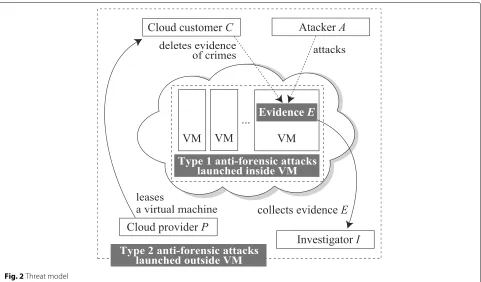
First, we classify anti-forensic attacks in the cloud into two types: type 1 attacks are launched inside virtual machines. For example, a customer could delete evidence of his or her crime or could overwrite the date and time of important access logs to evade capture. An outside attacker or malware who intruded into a virtual machine could also delete traces of an intrusion.Type 2attacks are launched outside virtual machines, for example, from an IaaS cloud provider’s management plane.Type 2attacks include direct attacks on forensic software.
Type 1 attacks: Intype 1attacks, a customer or an out-side attacker inout-side the virtual machine deletes, destroys, or manipulates his or her traces of files of incidents (e.g., access logs, rootkits, or temporary files) or hides evidence in slack space or other hiding places in the file systems [29]. The conventional collection method of IaaS clouds, which is taking snapshots, cannot preserve traces oftype 1attacks because the evidence may be removed or tam-pered with before acquisition of the virtual machine’s snapshot.
In addition, Garfinkel noted that anti-forensic attacks can exploit computer forensic tools by inputting data that are not properly validated by generating a massive amount
of data or bypassing fragile heuristics (e.g., file detec-tion by using a “magic number” of the first few bytes of files) [29]. Kessler reported malicious programs that alter file signatures and flip bits in order to evade file-hash detection in forensic software [30]. These attacks are launched in virtual machines to hide evidence from forensic software.
Type 2 attacks: Intype 2attacks, cloud providers can plant false evidence on a customer’s virtual machine image from outside virtual machines, e.g., from their cloud man-agement plane. Schneier and Kelsy proposed secure audit logs to support computer forensics in 1999 [31]. Zawoad et al. extended Schneier and Kelsy’s previous work to Secure Logging-as-a-Service (SecLaaS) to prevent attacks on logs in cloud environments by publishing proofs of past logs on public web sites or on Rich Site Summary (RSS) feeds periodically [32]. The limitation of both works [31, 32] is that the system cannot prevent the falsifica-tion of logs before creating the proof of the genuine logs. Type 2 attacks are also launched on forensic software. For example, an attacker might disable a forensic agent program on his or her machine to hide evidence.
As described earlier, proactive data collection for future investigation enables a time-traveling investigation by using recorded logs. Even if someone launches type 1 attacks inside his or her virtual machine, the traces of the attacks can be verified by using the records of disk changes. Please note that our proposal preserves traces oftype 1attacks, but it does not preventtype 2attacks. We have no silver bullet that prevents all types of attacks. We discuss possible measures against these attacks in the “Discussion” and “Related work” sections.
Preliminaries
This section introduces two key technologies of the Log-Drive framework: a wayback machine for restoring virtual block storage at an arbitrary point in time and sector hash-ing for searchhash-ing an evidence file from a wayback machine. The wayback machine mitigates the problems of volatility in IaaS clouds andtype 1anti-forensic attacks. The sec-tor hashing mitigates the problems of increasing volume of forensic data using parallel distributed processing and random sampling.
Wayback machine
A wayback machine is a mechanism for recording the whole write history for future investigations and for restoring the virtual block device at an arbitrary point in the past to discover evidence of incidents. This section presents the related work of the log-structured file system and copy-on-write system that can be used for creating the wayback machine.
Ouster-hout in the early 1990s [33]. They presented the structured File System. The idea of the original Log-structured File System is to collect a large amount of writes in a page cache and to flush the file system data onto a disk sequentially in a single large I/O for high through-put. This behavior is similar to appending records to the tail of a log file.
After the pioneering work [33], Cornel et al. employed the Log-structured File System for their user-level ver-sioning file system called Wayback by using the FUSE framework [34]. Strunk et al. also employed the Log-structured File System for their self-securing storage called S4 to prevent attackers from tampering with data [35]. Morrey and Grunwald applied the Log-structured File System design to their time-traveling disk called Peabody [36]. Peabody is implemented as an iSCSI tar-get instead of a file system. Recently, the log-structured design has been employed for file systems of non-volatile memories (NVMs) [37,38] because of its high through-put and space efficiency. The design of the Log-structured File System is also suitable for the latest cloud-based stor-age services. For example, Vrable et al. presented the BlueSky network file system backed by the cloud storage service of Amazon S3 [39]. They noted that the log-structured design on cloud storage services lowers costs and improves performance.
Another candidate for versioning and backup systems for block devices is copy-on-write. Copy-on-write systems save a data block in another place when the write oper-ation is issued, and then, the original data block is over-written by a new data block. The important detail is that copy-on-write systems save only the oldest data blocks until a new snapshot is created. Therefore, they cannot hold the complete history of write operations. Current virtual machine monitors or hypervisor software use a vir-tual disk format such as QEMU Copy-on-write version 2 (QCOW2) [40] and Microsoft’s virtual hard disk (VHD) [41]. They do not employ log-structured design but rather copy-on-write design for creating space-efficient snap-shots of virtual block devices.
Although the copy-on-write system restores a previous block device from a snapshot, the log-structured system can restore a past state of a virtual block device from an arbitrary point in time. For this reason, the copy-on-write system cannot reveal type 1 anti-forensic attacks in certain circumstances. For example, an attacker in a virtual machine can create files and delete the files between two distant checkpoints in time. On the other hand, the log-structure system records all write opera-tions sequentially; therefore the traces of type 1 anti-forensic attacks can be restored for the appropriate time in the past. In this paper, we employ the log-structured design for recording all written sectors on a virtual block device.
Sector-hash-based file detection
Sector hashing is a technique to check the existence of evidence files on a suspect’s media without reference to the underlying file system. This section shows the related work on sector hashing and presents how to apply sector hashing to a large amount of write logs that are generated from a wayback machine.
The pioneering work on sector hashing [24, 42, 43] was conducted by Garfinkel et al. They proposed using cryptographic hashes of small data blocks to identify file fragments and entire files. In contrast to file hashing, sec-tor hashing can find the fragments or remains of a piece of a sector from partially deleted or corrupted physical disks. Young et al. [26] examined the validity of sector hashing on user-generated contents using three datasets (Gov-docs [44], OpenMalware2012, and 2009 NSRL RDS) that include word processing files, photos, and videos. For example, they reported that 98.93% of the 512-byte sec-tor hashes in the Govdoc dataset, which is a collection of documents from .gov web sites, are distinct. Their study indicated that sector hashing is effective for searching user-generated files, for example, photographs taken by pedophiles.
Garfinkel et al. [26, 42] described a performance improvement method for sector hashing for a rapid and largely automated analysis. They proposed random sam-pling of sectors instead of searching every sector on drives. Equation1shows the well-known “urn problem” that describes the probability of pulling red beans out of an urn that contains a mix of evenly distributed red and black beans. The probabilitypof not finding even a single red bean inndraws is as follows.
p=1−
n
i=1
((N−(i−1))−T)
(N−(i−1)) (1)
Sector hashing has limitations in the following cases. First, it cannot detect embedded files, such as pho-tographs in the latest Microsoft Office documents (e.g., .docx and .pptx files), because the contents are com-pressed in a ZIP archive file. To find embedded objects in the latest Office documents, a mechanism to extract their contents before applying sector hashing is needed. Addi-tionally, sector hashing is not supported for encrypted files or encrypted file systems. For encrypted file systems, it is necessary to decrypt the file system by mounting the media using an appropriate decrypting driver [24]. Although sector hashing has these limitations, it provides efficient parallel search functions. Sector hashing can also be applied to fragment detection of memory forensics.
The aim of this research is to extend the previous research on sector hashing for media [24, 26, 42, 43], such as HDD or SSD, by integrating this method with the wayback machine described in the previous section. Thus, sector hashing is used for searching frag-ments of a target file from past write logs of virtual block devices.
Notation
This paper uses the following notation.
C, A, P, and I - a customer, an outside attacker, a cloud provider, and an investigator, respectively.
VMc- a virtual machine of a customerC.
E- evidence on a customer’s virtual machine.
VBDc- a customerC’s virtual block device, denoted asVBDc= {so,s1,s2, . . . ,sn−1}, wherenis the number of sectors. In the collection phase, aVBDcis accessed through aC’s guest operating system. In the analysis phase, any past state ofVBDccan be reconstructed from a LogDrivec database on an investigator I’s forensic workstation. Therefore,VBDc∈LogDrivec.
VBDc,t- customerC’s restored virtual block device at the point in timet. An investigatorI can access
VBDc,tin the read-only mode.
si- a sector that is written on anith sector ofVBDc.
i represents a Logical Block Address on VBDc. A Logical Block Address (LBA) is the value used to reference a logical sector of HDDs or SSDs [45].
LogDrivec- the database of recorded sectors that are written onVBDc, denoted asLogDrivec= {Log0,Log1,
Log2, . . . ,Logn−1}, wherenis the number of sectors in VBDc. A LogDrivec database is created for each customerC’sVBDc.
Logi - logs of past written sectors at LBAi, denoted asLogi= {Logi,0,Logi,1,Logi,2, . . . ,Logi,m−1}, wherem is the number of writes on LBAi.Logi,jmeans the log of the(j+1)th written sector at LBAiofVBDc.
Logi,j - each log is denoted as Logi,j = {times-tamp in seconds ts, timestamp in nanoseconds tns,
byteOffsetOfPreviousLog,size,si,j}. The proposed sys-tem uses the UNIX timestamp that is defined as the number of seconds since 00:00:00 UTC, 1st Jan-uary, 1970. size represents the size of a sector si,j. The maximum value of sizeis 4096 in our current implementation. The data structure ofLogiis a singly linked list of a set ofLogi,j. The newly written block is inserted in the head of the list. When the system needs to read the previous sectorsi,j−1, it traverses the listLogi by usingLogi,j.byteOffsetOfPreviousLog. The value of byteOffsetOfPreviousLog holds a byte offset of the previousLogi,j−1that is calculated from the beginning of the LogDrive database file. If the value ofbyteOffsetOfPreviousLogis null, then there are no more previous sectors.
LogDrive.index[i] - this value holds a byte offset of the latest writtenLogi,m−1. This value points to the head of a singly linked list Logi. The byte off-set is calculated from the beginning of theLogDrivec database. If the value is null, then any sector is not yet written at LBAi.
LogDrive.disk_size- total size of aVBDcin bytes.
LogDrive.sector_size- internal sector size of aVBDc in bytes. LogDrive uses 4096 in LogDrive. Please note that LogDrive provides virtual block devices of 512 byte sector size (logical and physical) to virtual machines.
HashDB- key-value pairs for sector-hash-based file search.
H(s)- hash value of sectors.
N,T,r, andp- total number of sectors inHashDB, total number of sectors in a file F, sampling rate, and probability that at least one sector will be found, respectively.
Problem formulation
The threat model of this paper involves the following four entities: cloud providersP, cloud customersC, out-side attackers A, and cloud investigatorsI, as shown in Fig. 2. This paper assumes that cloud customers C and outside attackersAare not trusted, while cloud providers
P and investigators I are trusted. InvestigatorsI can be law enforcement agents, incident response teams, or other internal groups in the human resources or legal depart-ments.
Fig. 2Threat model
is impossible to prevent every incident, it is important to securely retain evidence even if type 1 anti-forensic attacks (e.g., tampering with important logs or legal docu-ments and hiding traces of crimes) are launched onVMc. From the perspective of threat modeling, our model is directly involved with “tampering with data” and “repudi-ation” of the STRIDE threats model [4]. Please note that we discuss how to detect false evidence created outside
VMc(i.e.,type 2attacks) in the “Related work” section. If incidents occurred in the virtual machine VMc, an investigatorIhas to collect and analyze digital evidenceE
from cloud providerP’s physical storage devices. However, the investigatorIcannot seize the physical storage devices because they may have data owned by other customers who are not directly related to the crimes. Moreover, in most cases, the cloud providerP does not need to keep customer C’sVMc for a long time after the end of the contract. A part of physical storage may be recycled to other customers’ services immediately. Consequently, the investigatorIcan no longer collect the digital evidenceE.
Investigation context
The proposed system assumes the following investigation context. First, a providerPand a customerCagree with the Service Level Agreement (SLA) that permits proac-tive data collection from the customer’s virtual machines
VMc in the provider’s IaaS cloud environments to allow
for future audits and investigations. At this point, the cus-tomer C has no intention of doing illegal or malicious activities. For example, a customer C will be able to sign the SLA that permits proactive data collection for monitoring the company’s employees who might commit crimes in the future on their virtual machines (e.g., tam-pering with important legal documents and access logs to evade capture). If the providerPand the customerC
agree to the SLA, the provider begins to record the cus-tomer’s activities on virtual machinesVMc. Although the proposed system cannot be used to investigate a crime on a non-suspected or non-monitored customer’s virtual machine VMc after the fact, it can be used to investi-gate a crime after starting surveillance based on the SLA between the providerPand the customerC.
The aim of the proposal is to reveal evidence of crimi-nal activities andtype 1anti-forensic attacks (i.e., attacks launched inside the virtual machine VMc). Please note that the measures againsttype 2anti-forensic attacks (i.e., attacks launched outside the virtual machine VMc) are described in the “Discussion” and “Related work” sections.
Design goal
1). Efficient collection: the collection function should not affect customerC ’s activities. We have to minimize the overhead of a surveillance mechanism on a virtual block deviceVBDcand aVMc.
2). Reliable collection: an attackerA or a malicious customerC should not be able to bypass or destroy the collection function. Moreover, the timestamps of the mechanism should be protected againstA and C. Thus, the proposed framework must be executed inside a trusted region.
3). Wayback storage: an investigatorI needs to restore a virtual block deviceVBDc,tat an arbitrary point in timet to analyze the past state of the customer C ’s VBDc. The restoredVBDc,tneeds to be accessed as a normal block device via an operating system in read-only mode. This enables an investigatorI to analyze the restoredVBDc,tby using conventional forensic software, for example, EnCase or Forensic Tool Kit (FTK). For this purpose, the read
throughput of the restoredVBDc,tmust be practical. 4). Rapid search of an evidence file in the wayback
storage: an investigatorI needs to find an evidence fileF, which correlates with certain incidents, from theLogDrivecdatabase across time. TheLogDrivec database holds a large amount of sectors that were recorded in the past. For a rapid and efficient search, the system must support parallel distributed
processing.
5). Cost efficiency: we need to develop a forensic framework that achieves maximum effectiveness by using affordable hardware available to most investigative organizations. The source code of the software should be provided to forensic communities.
Design
The LogDrive framework consists of the following three functions: proactive data collection, file search in a Log-Drive database, and restoration from a LogLog-Drive database.
Proactive data collection function
Figure3shows the system model of the collection func-tion. The collection function monitors each written sec-tor s on the virtual block device VBDc. The sectors s∗
can be written by a customerC’s applications (e.g., web browsers, word processing software, or e-mail client) or by an attacker A’s malicious programs such as rootk-its. LogDrive saves each data of a sector si with Logical Block Address (LBA) i, timestamp t, and size onto a
LogDrivecdatabase immediately. The value ofsizecan be between one and 4096 (4 KiB). If customerC’s programs or attackerA’s malicious codes onVMcread a sectorsion the virtual block deviceVBDc, LogDrive returns the lat-est written sectorsi that is retrieved from theLogDrivec database.
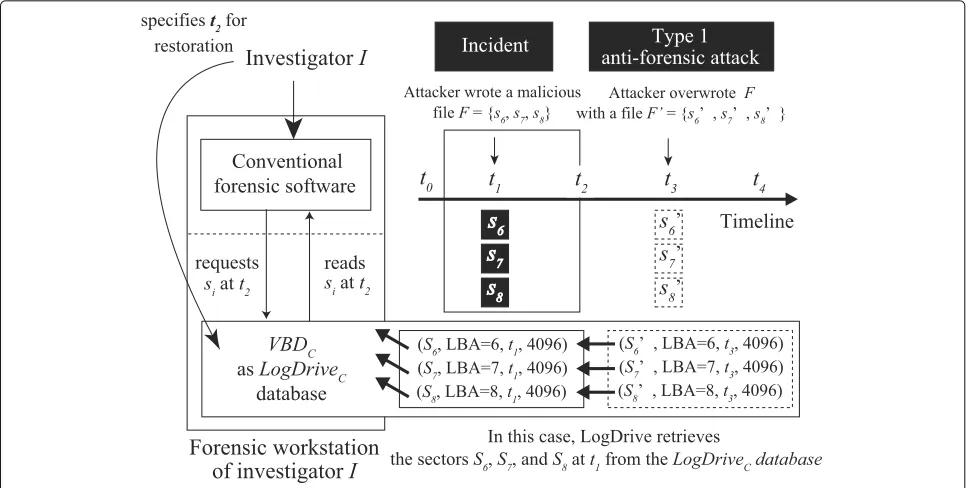
TheLogDrivecdatabase is a set of past written sectors on customerC’s virtual block deviceVBDc. Figure3shows that atype 1anti-forensic attack deletes evidence (i.e., the fileFconsists of the three sectorss6,s7, ands8) of the inci-dent att1by overwriting them with three new sectors at
t3. The LogDrive framework records all written sectors of both the original fileFatt1and the compromised fileF’ att3in theLogDrivecdatabase so that it can be used for wayback storage in a future forensic investigation.
File search function of the LogDrive database
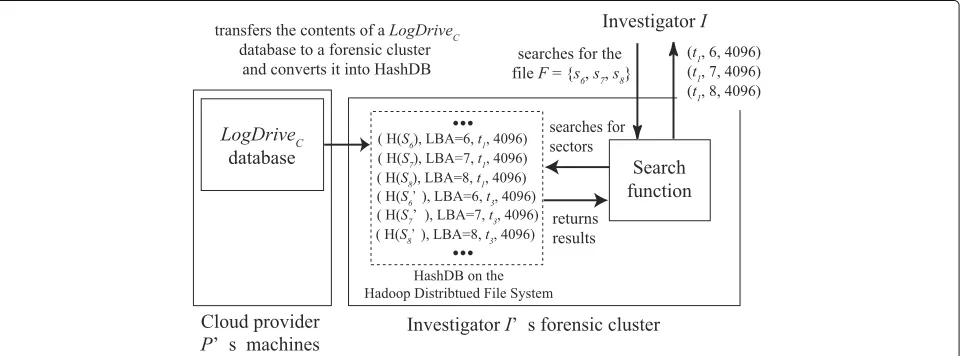
Figure4shows how to generateHashDBfromLogDrivec and transfer it to the Hadoop distributed file system on a forensic cluster.HashDBis a set of key-value pairs that consist of the hash values of each sector H(s) as the key and each sector’s timestampt, LBAi, andsizeof the sector as the value.HashDBis used for the sector-hash-based file search function.
After creating a HashDB, an investigator I searches the evidence file F (e.g., photographs or videos of child pornography, evidence files of terrorist activities, mal-ware, and rootkit) from theHashDBby using sector hash-ing. The evidence fileF is first sent to a forensic cluster; then, the search function splits the fileFinto 512-byte sec-tors and searches forF= {s0,s1, . . . ,sn−1} in theHashDB, wherenis the number of sectors of evidence fileF. The results of the query are pairs of timestampt, LBAi, and
sizeof each sector. Thus, the output is the creation time of the sectorsand its written location and size on the virtual block device. No output indicates that the evidence fileF
was not written on the monitored virtual block device in the past. Even if the evidence file F was deleted or was tampered with by a customerCor an attackerAbefore an investigation (i.e.,type 1anti-forensic attack), an investi-gatorIcan search the creation time of the evidence fileF
fromHashDB.
The LogDrive framework records all written sectors that include the file system’s metadata in addition to the con-tents of files. Therefore, the system can search sectors not only from files but also from hidden data in the slack space or other unused space of file systems. In addition, the investigatorIcan search the evidence fileFin a set of
HashDBthat are generated from potential candidates of multiple virtual machines.
Please note that the proposed system model assumes that an investigatorIalready has an evidence fileFthat is found from other sources such as a suspect’s thumb flash drive or an e-mail. For now, automatic identification of an evidence fileFis outside the scope of this paper.
Restoration function of the LogDrive database
After identifying the creation time of the evidence fileF
Fig. 3System model of the collection function
tfor further analysis, wheret0≤t≤tn−1. The timestamp of the first written sector on theVBDc is denoted ast0, and the timestamp of the last (nth) written sector on the
VBDcis denoted astn−1.
Figure5shows how the investigatorI restores the vir-tual block device VBDc,t2 that includes the evidence at t1 before being overwritten by the anti-forensic attack at t3. The investigator I first specifies t2, and the sys-tem restores the past state of VBDc. Then, the inves-tigator I can read any sector from the restored virtual block device VBDc,t2 in read-only mode. The
investiga-tor I can apply conventional forensic software, such as dd, EnCase, or FTK, to analyzeVBDc,t2. The investigator
Ican also inspect the detail of the anti-forensic attack at
t3 by comparing the restoredVBDc,t2 with the restored VBDc,t4.
4096-byte sector vs. 512-byte sector
The most common sector size in the current hard drive industry is 512 bytes or 4096 bytes. Although enterprise HDDs and SSDs are shifting to native 4096-byte sector size known as 4Kn, consumer HDDs or SSDs still use the 512-byte sector size. While current 512-byte sector drives employ 4096-byte sectors at the physical level, they emulate 512-byte sectors at the logical level for legacy software. Major operating systems (e.g., Windows 8 or
Fig. 5System model of the restoration function
later and Linux kernel 2.6.31 or later) already support 4096-byte sectors.
Because of the existence of two sector sizes, Log-Drive provides VBD of 512-byte sector size to virtual machines to support both legacy and new operating sys-tems. Although LogDrive employs the 4096-byte sector size for internal structure ofVBD, it employs 512-byte sec-tor size for secsec-tor-hash-based file detection. LogDrive can change both sector sizes to 4096-bytes when many storage devices and software support the 4 KiB native setup.
Algorithms
This section presents five algorithms for proactive data collection, file search, and restoration of a LogDrive database.
Proactive data collection function
In the collection phase, the proposed LogDrive architec-ture provides normal input and output operations of a customerC’sVBDcwith the help of the underlying hyper-visor software. While the system provides the normal I/O operations to C’s VMc, the data collection func-tion records all written sectors on a LogDrivec database. The LogDrivec database is a log-structured virtual block device.
Algorithm 1 shows how the LogDrive framework works during write operations on VBDc. The write operation consists of creating Logi,jand appending it to the tail of the LogDrivecdatabase. The process for writing a log to aLogDrivecdatabase is executed for the group of Logi,j,
Algorithm 1:WriteSectorAsLog
input : A written 4 KiB sectors, LBAi, current UNIX timestamp in secondsts, and current UNIX timestamp in nanosecondstns output: An updated version of aLogDrivecdatabase
1 begin
2 foreachwrite request to VBDcon VMcdo 3 previous←LogDrivec.index[i]; 4 Logi,j←createLog(ts, tns, previous,
sizeof(s), s);
5 appendLogToLogDrive(Logi,j,
LogDrivec);
6 LogDrivec.index[i]←sizeof(LogDrivec)
−sizeof(Logi,j)+ 1;
7 end 8 end
not for everyLogi,j, to minimize the overhead of frequent writes on the physical block device by using the buffering mechanism of the host operating system.
Algorithm 2 shows how the LogDrive framework works during read operations. The read operation of a sector is just retrieving the head element Logi,m−1 of the list
Algorithm 2:ReadSectorFromLog input : An LBAi
output: A 4 KiB sectorsi,m−1, where(m−1)is the latest written sector at LBAi
1 begin
2 foreach read request to VBDcon VMcdo 3 Logi,m−1←
retrieveLog(LogDrivec.index[i]);
4 if Logi,m−1!= nullthen
5 returnLogi,m−1.s;
6 else
7 return
SEC-TOR_PADDED_WITH_ALL_ZEROS;
8 end
9 end 10 end
File search function of the LogDrive database
The file search function is composed of the following two steps: (1) creatingHashDBand (2) searchingHashDBfor a fileF. The creation ofHashDBis performed using the MapReduce framework [21]. Please note that aHashDBis not an index such as a B-tree index but a set of hash values of each sectorsfor the sector-hash-based file search. The search process for a fileF is executed using the MapRe-duce framework. When an investigator needs to triage an evidence fileFfrom a largeLogDrivedatabase, the random sampling technique is applied.
We first tried to employ B-tree as an efficient and fast search algorithm. However, we finally decided to employ a simpler sequential search algorithm with statistical ran-dom sampling, because (1) B-tree algorithm is not suitable to be implemented on a scalable distributed parallel pro-cessing framework such as Hadoop MapReduce, (2) B-tree search algorithm is fast but the creation time of a B-tree index can be very long, especially when we need to create the index from a largeLogDrivedatabase, and (3) statisti-cal random sampling is faster than B-tree algorithm at a certain confidence level.
Algorithm 3 shows how the LogDrive framework
cre-ates HashDB from the LogDrive database. A LogDrivec
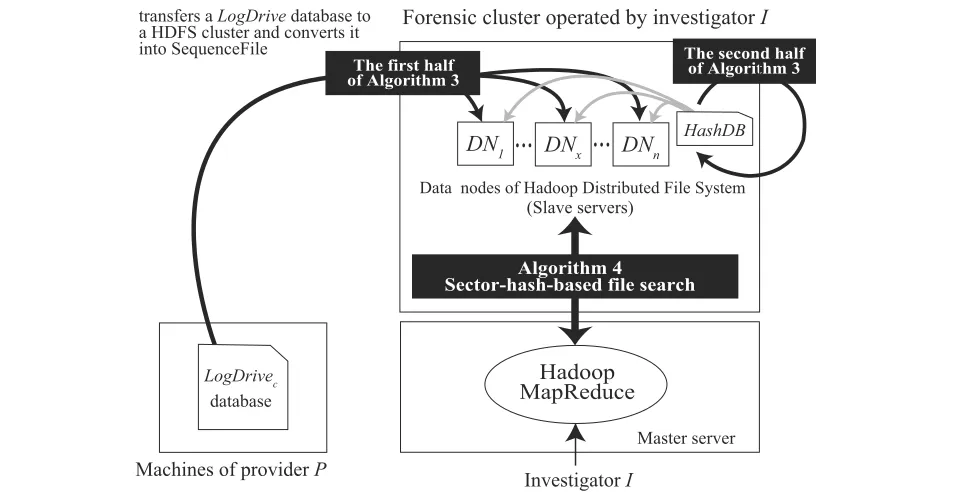
database file is located on a local drive of a cloud provider P. The first half of the algorithm transfers a
LogDrivec database from the local drive to a Hadoop
distributed file system (HDFS) [46] and converts the Log-Drive database into the Hadoop’s SequenceFile format. Hadoop’s SequenceFile format is used to process binary key-value pairs. The last half of the algorithm creates key-value pairs; the key consists of eight hash values for each 512-byte sector created from a 4096-byte sector, and the value consists of the timestamp, the LBA, and the size
Algorithm 3:CreateHashDB
input : ALogDrivecdatabase file on a local file system, random sampling rater(e.g.,
r←0.005 for 0.5%)
output: AHashDBon a Hadoop Distributed File System (HDFS)
1 begin
2 SECTOR_SIZE_FOR_FILE_SEARCH←512;
3 MAX_LBA←
LogDrivec.disk_size LogDrivec.sector_size−1
;
4 for i←0toMAX_LBAdo
5 Logi,m−1←
retrieveLog(LogDrivec.index[i]);
6 while Logi,j!=nulldo
7 key←concatenate(Logi,j.ts, Logi,j.tns,
i,Logi,j.size);
8 value←logi,j.s;
9 writeBinaryPairToHDFS(key,value);
10 Logi,j←retrieveLog(Logi,j.
byteOffsetOfPreviousSector);
11 end
12 end
13 foreach createHashDBMapper(key, value)
do
14 key_for_output←null;
15 value_for_output←null;
16 for k←0 to
LogDrive.sector_size
SECTOR_SIZE_FOR_FILE_SEARCH −1
do
17 sectork←
splitIntoKthSector(value, k);
18 key_for_output←key_for_output+
hash(sectork)+”,”;
19 value_for_output←key;
20 end
21 if
allSectorsFilledWithConstant(key _for_output)then
22 continue;
23 end
24 sendToReducer(key_for_output,
value_for_output);
25 end
26 foreach createHashDBReducer(key, value)
do
27 if random(0,1)<rthen
28 writeBinaryPairToHDFS(key,
value);
29 end
of the sector. For random sampling, the key-value pairs must be stored in evenly distributed orders. The MapRe-duce framework automatically sorts key-value pairs using keys (i.e., hash values) in the reduce steps. Therefore, Log-Drive guarantees evenly distributed orders of HashDB. Please note that a 4096-byte sector filled with consntant value (e.g., 0x00 or 0xFF) is ignored because the 4096-byte sector cannot be distinct [42].
For searching a large amount ofLogDrivedatabases, the system employs a random sampling technique [47]. The sampling rate r = n/N can be calculated using Eq. 1, where N is the total number of sectors (i.e., key-value pairs) inHashDB,Tis the number of target sectors of a file
F, andpis the probability that at least one sector of the file
Fwill be found in thenrandom samplings. Because of the seriousness of the cases that law enforcement deals with, it is desirable to achieve a 99% confidence level [27]. We employ a 99% confidence interval for the reliability of the random sampling. The system prepares a set of sampled
HashDB at different sampling rate for some representa-tive file size (e.g., 1 MiB, 10 MiB, 100 MiB, 1GiB) of search target in advance.
Algorithm 4 shows how the LogDrive framework searchesHashDBfor a fileF. The system first splitsFinto 512-byte sectors and calculates a hash value for each sec-tor. If the last sector is smaller than 512 bytes, the system pads the remainder of the sector with zeros before calcu-lating its hash value. The system ignores a 512-byte sector filled with consntant value (e.g., 0x00 or 0xFF) because the 512-byte sector cannot be distinct [42]. The current design employs the MD5 message-digest algorithm [48] that computes a 128-bit hash value. Anti-forensic attacks that use the weakness of the collision resistance in the MD5 algorithm are described in the “Discussion” section.
Restoration function of the LogDrive database
Algorithm 5 shows how the LogDrive framework reads a past sector si at the point in time t. The algorithm is used for restoring a past state of a customer C’s
VBDc,t for the forensic analysis phase. The VBDc,t can be accessed in read-only mode. For example, an inves-tigator can mount the restored VBDc,t, access it via the forensic workstation’s file system, make a disk image by using dd, and analyze it by using conventional forensic software.
Implementation
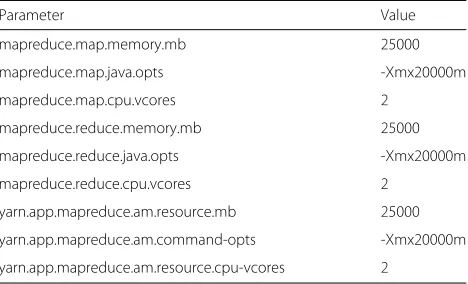
We implemented the system model and the algorithms on the hardware and software shown in Tables1and2, respectively. The master server is used for collection, restoration, and the management of the Hadoop slave servers. The Hadoop slave servers are used for the sector-hash-based file search. Table3shows the configuration of the Hadoop MapReduce cluster.
Algorithm 4:SearchFile input : A fileF
output: A list of (ts,tns, LBAi,size)
1 begin
2 SECTOR_SIZE_FOR_FILE_SEARCH←512 ;
3 FILE_SIZE←sizeof(F);
4 NUMBER_OF_SECTORS←
roundup(SECTOR_SIZEFILE_SIZE );
5 query[ ]←null;
6 for k←0 toNUMBER_OF_SECTORS−1do
7 sectork←splitFileIntoKthSector(F,
k);
8 if filledWithConstant(sectork)then
9 continue;
10 end
11 if sizeof(sectork)<
SECTOR_SIZE_FOR_FILE_SEARCHthen
12 zeroPadding(sectork);
13 end
14 query[ ]⇐hash(sectork);
15 end
16 foreach searchHashDBMapper(key, value)
do
17 for k←0 to
LogDrive.sector_size
SECTOR_SIZE_FOR_FILE_SEARCH −1
do
18 for l←0 to NUMBER_OF_SECTORSdo
19 if KthHash(key)==query[l]then 20 writeSearchResultToHDFS
(value,null);
21 end
22 end
23 end
24 end 25 end
Figure6shows the implementation of the proactive data collection function. We implemented Algorithms 1 and 2 in the LogDrive collection driver of the Xen hypervisor using the blktap2 mechanism [49–51]. The gray region in Fig. 6is protected against customers Cand attackers
A. The isolation capability between a customer C’s vir-tual machine and a providerP’s host operating system is provided by the Xen hypervisor [52]. This paper assumes that the customersCor attackersAcannot access the gray region as long as the underlying hypervisor software is not compromised.
Algorithm 5:ReadPastSectorFromLog
input : An LBAi, a UNIX time in secondsts, a UNIX time in nanosecondstns, aLogDrivecdatabase output: A 4 KiB sectorsi,j, wherejsatisfies
Logi,j.(ts.tns)≤ts.tns<Logi,j+1.(ts.tns)
1 begin
2 foreach read request on VBDc,tdo 3 Logi,m−1←
retrieveLog(LogDrivec.index[i]);
4 whileLogi,j!=nulldo
5 if Logi,j.(ts.tns)≤(ts,tns)then
6 returnLogi,j.s;
7 end
8 Logi,j←retrieveLog(Logi,j.byteOffset
OfPreviousSector);
9 end
10 return
SECTOR_PADDED_WITH_ALL_ZEROS;
11 end 12 end
Figure 7 shows how Algorithms 3 and 4 are imple-mented using the Hadoop cluster. The first half of Algo-rithm 3 converts a LogDrive database on a local drive into a SequenceFile on a Hadoop cluster. The last half of Algorithm 3 creates a HashDB. Algorithm 4 is exe-cuted by using the combination of the sequential search algorithm and random sampling. Both algorithms were implemented in the MapReduce programs.
Figure 8 shows the implementation of Algorithm 5. We implemented Algorithm 5 in the LogDrive restora-tion driver by using the blktap2 mechanism of the Xen hypervisor.
Evaluation
This section presents the performance evaluation. We discuss how LogDrive can be adapted to larger cloud environments in theDiscussionsection.
Table 1Hardware specification
Master Slave
CPU Xeon E5-2630v3 x2 Core i7 5820K
(No. of cores) (16) or 7800X (6)
RAM DDR4 64 GiB DDR4 64 GiB
NIC 10GBASE-T 10GBASE-T
Storage RAID0 consists of M.2 SSD
three SATA3 SSDs (Samsung 960EVO)
(Crucial CT512)
Usage Algorithms 1, 2, and 5 Algorithms 3 and 4
No. of servers 1 7
Table 2Software specification
Master Slave
Kernel 2.6.32.57 2.6.32-573.el6
OS CentOS 6.8 64bit CentOS 6.8 64bit
Hypervisor Xen-4.1.2 N/A
Hadoop Version 2.7.1 Version 2.7.1
Compiler gcc 4.4.7 OpenJDK 1.7.0
Usage Algorithms 1, 2, and 5 Algorithms 3 and 4
No. of servers 1 7
Proactive data collection function
Figure 9 shows the throughput of the block write and block read of the LogDrive collection driver and of the normal Xen hypervisor. The experiments were conducted using the Bonnie++ benchmark software on up to 16 vir-tual machines. The master server shown in Table1 was used for the experiments. Table4shows the configuration of the virtual machines.
The write throughput of the proposed LogDrive col-lection driver was higher than that of the normal Xen hypervisor without LogDrive when two or more virtual machines were executed simultaneously. For example, the write throughput of LogDrive was 6.9 times faster than that of the normal Xen hypervisor when 16 vir-tual machines were executed simultaneously. The average write throughput of LogDrive was 4.1 times faster than that of the normal Xen hypervisor without LogDrive.
The read throughput of the proposed LogDrive collec-tion driver was lower than that of the normal Xen hyper-visor in all cases. The decreasing rate of the worst read throughput of four virtual machines was 54%. The average decreasing rate of the read throughput of LogDrive was 27%. We confirmed that the log-structured design mainly offers users the advantage of write throughput.
File search function of the LogDrive database
We created aLogDrivedatabase using the following pro-cedures. First, a virtual machine with the configuration shown in Table4was booted. CentOS 5.11 Linux as the
Table 3Configuration of the Hadoop MapReduce cluster
Parameter Value
mapreduce.map.memory.mb 25000
mapreduce.map.java.opts -Xmx20000m
mapreduce.map.cpu.vcores 2
mapreduce.reduce.memory.mb 25000
mapreduce.reduce.java.opts -Xmx20000m
mapreduce.reduce.cpu.vcores 2
yarn.app.mapreduce.am.resource.mb 25000
yarn.app.mapreduce.am.command-opts -Xmx20000m
Fig. 6Implementation of the proactive data collection function
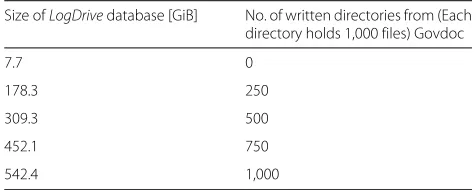
guest OS was installed on the virtual machine. Then, files of the Govdoc dataset [44,53] were written on the virtual machine for generatingLogDrivedatabases. The Govdoc dataset consists of one million files that were collected from web servers of the .gov domain. The fiveLogDrive
databases shown in Table5were created for the following experiments.
In the experiment, we used CentOS 6.8 with ext4 file system for the host operating system and CentOS 5.11 with ext3 file system for guest operating system. In our setup, we could not boot guest operating systems with ext4 file system because of the limited support of Xen 4.1.2 we used. However, the design of LogDrive supports any file system (e.g., an operating system with ext4 file
Fig. 8Implementation of the restoration function of the LogDrive database
Table 4Configuration of the virtual machines
Virtual CPU 1 core
Virtual RAM 2 GiB
Virtual block device LogDrive.disk_size= 1 TiB
LogDrive.sector_size= 4096
Guest OS CentOS 5.11 32bit
File system ext3
Benchmark software Bonnie++ 1.9.7
system) because LogDrive does not need to process any specific information of underlying file system. As shown in Algorithms 1 and 2, LogDrive processes a 4 KiB sec-tor, a logical block address (LBA), and a UNIX timestamp as an input. A UNIX timestamp is obtained from a host operating system and the timestamp is independent of file systems of guest operating systems. A 4 KiB sector and an LBA are also independent of file systems. These data do not include any file system related information such as file system’s metadata. In addition, Algorithm 5 processes a logical block address and a UNIX timestamp as an input. These data do not include any file system related information. Therefore, the design of LogDrive is independent of underlying file systems in guest operating systems.
Figure10shows the time for converting the LogDrive
database into SequenceFile and for creatingHashDB. The Hadoop cluster that consists of the seven slave servers shown in Table1was used. The average throughput of the first half of Algorithm 3 was 28.4 MiB/s and of the second half of Algorithm 3 was 239 MiB/s. As the size of the Log-Drivedatabase increased, the processing time increased linearly. Therefore, the time complexity of Algorithm 3 is O(n), where nis the number of written sectors in a
LogDrivedatabase.
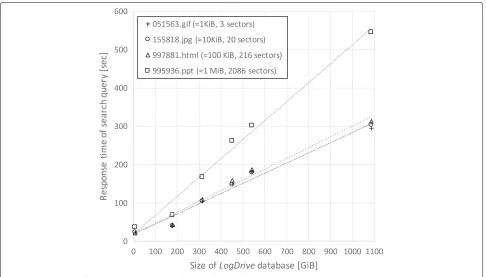
Figure11shows the response time of Algorithm 4 with-out random sampling. The experiments of a LogDrive
Table 5Size of theLogDrivedatabases for the experiments
Size ofLogDrivedatabase [GiB] No. of written directories from (Each directory holds 1,000 files) Govdoc
7.7 0
178.3 250
309.3 500
452.1 750
542.4 1,000
The first row shows the size of theLogDrivedatabase after a clean installation of the guest OS
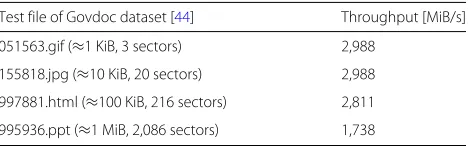
database larger than 542.4 GiB were conducted using mul-tiple 542.4 GiB LogDrive databases. As the number of sec-tors in aLogDrivedatabase increased, the response time increased linearly. Table6shows the average throughput of the search queries (i.e., the slopes of the lines shown in Fig. 11). While our setup searched for a file smaller than 100 KiB at about 2.86 GiB/s, the query through-put was dropped to 1.69 GiB/s when the system searched for the 1 MiB file. Evaluating the average throughput of an investigator’s setup is useful when the investiga-tor has to estimate the processing time and to determine the appropriate specification of the forensic cluster (e.g., the number of computing nodes). For example, our setup will be able to search for a 100 KiB file in a 100 TiB LogDrive database without random sampling in about 10.3 h.
Figure 12 shows the response time of Algorithm 4 with random sampling in logarithmic scale. The exper-iments of a LogDrive database larger than 542.4 GiB were conducted by using multiple 542.4 GiB LogDrive
databases. The sampling rate r = n/N was calculated using Eq. 1, where p > 0.99, N is the number of sec-tors in a LogDrive database, and T is the number of sectors in a file F. Table 7shows the sampling raterfor each file size. The sampled HashDB files were created using Algorithm 3 with these sampling rates. For exam-ple, the search for the 10 MiB file (017804.pdf ) in a 100 TiB LogDrivedatabase required 2.9 min. Table 8 shows the average throughput of Algorithm 4 with random sam-pling. While our setup searched for a file smaller than 10 MiB at about 398 GiB/s, the query throughput was dropped to 103 GiB/s when the system searched for the 100 MiB file.
Restoration function of the LogDrive database
First, a virtual block device VBD with 12 GiB capac-ity formatted with ext4 file system was created. Then,
a LogDrive database was created by overwriting
an 8 GiB test file 16 times. The test file was gen-erated by executing the command dd if=/dev/ urandom of=test.dat count=8 bs=`echo 2ˆ30| bc`. After creating the LogDrive database, the read throughput of the LogDrive restoration driver was measured.
Figure 13 shows the throughput of the imple-mentation of Algorithm 5. In the experiment, we restored VBD at 16 points in time at which the test file was overwritten. The throughput of the sequen-tial block read was measured by the command
hdparam -t on VBD. The throughput of the file system read was measured by mounting VBD as an ext4 file system and by executing the command
Fig. 10Conversion to SequenceFile and creation ofHashDB
both in the guest OS and in the host OS. The page cache read was measured by the same method instead of dropping the page cache in the host OS. As the number of overwrites increased, the read through-put decreased except for the page cache read. The
file system read was slower than the sequential block read. Once the file was loaded into the buffer cache of the host OS, the proposed system could access the restored file system at a throughput of 2 GB/s.
Table 6Average query throughput of Algorithm 4 without random sampling
Test file of Govdoc dataset [44] Throughput [MiB/s]
051563.gif (≈1 KiB, 3 sectors) 2,988
155818.jpg (≈10 KiB, 20 sectors) 2,988
997881.html (≈100 KiB, 216 sectors) 2,811
995936.ppt (≈1 MiB, 2,086 sectors) 1,738
Average throughput=size of LogDrive/response time
Discussion
This section presents a discussion about security, perfor-mance, and size of the logs.
Security
We classify possible attacks on the LogDrive framework into six categories based on the STRIDE threats model [4]. The STRIDE threats consist of spoofing, tampering, repudiation, information disclosure, denial of service, and elevation of privilege. Table 9 shows the summary of security threats against the LogDrive framework.
Spoofing.The system cannot detect identity spoofing in virtual machines. If someone pretends to be a gen-uine customer C by using remote control malware and commits crimes in virtual machines, the LogDrive frame-work cannot identify the person who commits crimes over the Internet. The customerC is responsible for prevent-ing identity spoofprevent-ing by employprevent-ing strict authentication
mechanisms and regular software updates on the virtual machines.
Tampering. The current standard Linux kernel peri-odically flushes the page cache if it is older than 30 s. If attackers can set the interval of flushing the page cache to be longer, the LogDrive collection driver cannot record precise timestamps of each sector. However, a longer interval affects normal operations of applications on the virtual machines; therefore, the attack has only a limited effect on timestamps. This limitation can be mitigated by using memory forensics in addition to storage forensics. Please note that the timestamps of the guest operating sys-tem have no effect on LogDrive because the timestamps of LogDrive are managed by the host operating system.
Tampering withLogDrivedatabases outside the virtual machine is discussed in the “Related work” section.
Repudiation.Even if an attackerAcreates a modified file F by inserting an extra 1 byte near the start of an original file F to bypass sector hashing, LogDrive pre-serves both the original fileFand the modified fileF. In this case, similarity digest hash algorithms, such as sdhash [54], are needed to findFusing the original fileF.
The current implementation employs MD5 to generate hash values of sectors. MD5 and SHA-1 are vulnerable against collision attacks [55,56]. If the attackers can make a false file or a malicious program that has hash values of sectors identical to those of known-good files (e.g., known-good system files) and if the LogDrive framework is used for excluding fragments of known-good files by
Table 7Sampling rate for each file size
Target file size Sampling rate forp>99%
1 MiB 0.00229492
10 MiB 0.000229490
100 MiB 0.000022950
1 GiB 0.0000022400
using white lists (not black lists), the system will not be able to detect the malicious file created by the attacker. To prevent the attack, the MD5 hash algorithm should be replaced with collision-resistant hash algorithms such as SHA-256 or SHA-512.
An attacker can make files unreadable in a virtual machine by using cryptography or steganography to repu-diate his or her past incidents. LogDrive cannot recover an encrypted file or a stego file. Therefore, other tools such as data recovery tools or memory forensic tools are needed [57] for recovering the original message.
Information disclosure.If the attackers gains accesses to the cloud management plane on the host operating system, they can steal the LogDrivedatabases of all the customers C of the provider P. LogDrive employs the combination of the Xen hypervisor [52], a host operat-ing system, and the LogDrive framework as a trusted computing base (TCB). LogDrive assumes the integrity of the underlying trusted computing base. Hardware-based attestation mechanisms have the ability to check the integrity of the trusted computing base both in bootstrap step and in runtime [58]. A providerP is responsible for protecting the TCB against attackers.
Denial of service.If attackers issue a large number of write requests on virtual machines (e.g., DDoS attacks on a web server in a virtual machine to overflow the web server’s logs), the LogDrive framework may not be able to save all written sectors on aLogDrivedatabase because of the limit of storage capacity. If LogDrive detects denial of service (DoS) attacks, it can intentionally slow down the throughput of the virtual block deviceVBD. The system can also return I/O errors to mitigate the attacks. In addi-tion, the system can mitigate the attacks by transferring old logs of aLogDrivedatabase to a Hadoop Distributed File System (HDFS) or other cloud storage periodically to
Table 8Average query throughput of Algorithm 4 with random sampling (p>0.99)
Test file of Govdoc dataset [44] Throughput [GiB/s]
995936.ppt (≈1 MiB, 2,086 sectors) 396
017804.pdf (≈10 MiB, 21,273 sectors) 400
042665.doc (≈100 MiB, 208,096 sectors) 103
118276.txt (≈1.3 GiB, 2,785,897 sectors) 26
Average throughput=size of LogDrive/response time
Table 9The STRIDE threats of LogDrive
Threat Attack method Protection Anti-forensic attacks
type 1 type 2
Spoofing Pretending someone in VMs
Authentication on guest OS
Tampering Incorrect timestamps Memory forensics Tampering with LogDrive database Secure audit log
Repudiation Changing a few bits of a file
Similarity digest hash
Collision attacks Collision resistant hash algorithm Cryptography and steganography Data recovery tools, memory forensics Information disclosure Stealing LogDrive database Protection of TCB Denial of service Overflowing logs Throughput control of LogDrive Elevation of privilege
Taking control of LogDrive
Protection of
TCB
secure sufficient storage space. A log rotation mechanism is needed both for long-term collection and for mitigating the DoS attacks.
Elevation of privilege.Finally, we discuss direct attacks on the LogDrive framework. If an attacker could elevate his or her privilege, he or she might be able to attack LogDrive directly on a host operating system. In addition to hardware-based attestation mechanisms [58], minimiz-ing the code size of the trusted computminimiz-ing base is also important to reduce the complexity of the system and to reduce the vulnerability of LogDrive. For this reason, we have developed the LogDrive framework on a lightweight security-purpose hypervisor called BitVisor [59].
Performance
Fig. 13Throughput of the LogDrive restoration driver
sectorsionto scattered positions of each LBAion the host operating system. On the other hand, the average decreas-ing rate of the read throughput was 27%. The reason for the decrease in the read throughput is the overhead of the log-structured design. We confirmed that the LogDrive collection driver offers users improved write throughput (i.e., four times faster than the normal throughput without LogDrive) and moderate read throughput.
We believe that LogDrive is the first work to log all write operations on a virtual block device for forensic purpose. Therefore, we cannot compare with other prior work of same purpose. Here, we compare LogDrive with SNPdisk (snapshot disk), a copy-on-write snapshot mech-anism. Table10shows the performance comparison with SNPdisk [60]. Although SNPdisk degrades the both read throughput and write throughput, LogDrive improves write throughput because of our log-strucutred design. King et al. presented time-traveling virtual machine
Table 10Performance comparison with copy-on-write snapshot
LogDrive (Log-structured) SNPdisk (Copy-on-write)
Read throughput 73% 86%
Write throughput 410% 86%
The above values are the percentage of read throughput and write throughput compared with non-snapshot. The performance of SNPdisk is based on scheme 1 of the experiment in [60]
for reverse debugging of operating systems [61]. King et al. implemented their time-traveling virtual machine (TTVM) by using ReVirt [62] and User-Mode Linux. TTVM records the contents of a virtual machine’s CPU registers, virtual memory pages, and virtual disks (i.e., virtual block devices). While TTVM employs a copy-on-write method to save changes in memory pages and in disk blocks, LogDrive employs log-structured design to save changes in a virtual block device. Although TTVM takes checkpoints at a certain interval such as 10 s, LogDrive takes continuous checkpoints without any interval. The performance overhead of TTVM that took checkpoints every 10 s was 16–33%. In contrast, the average decreas-ing rate of read throughput in LogDrive is 27% and the average increasing rate of write throughput in LogDrive is 410%. LogDrive improved write throughput because of its log-structured design.