R E S E A R C H A R T I C L E
Open Access
A flexible online platform for computerized
adaptive testing
Stefan Oppl
1,3*, Florian Reisinger
1, Alexander Eckmaier
1and Christoph Helm
2* Correspondence:
[email protected] 1Department of Business
Information Systems– Communications Engineering, Johannes Kepler University of Linz, Altenberger Straße 69, Linz 4040, Austria
3Department of Software Science,
Radboud University, Mailbox 47, PO Box 9010, Nijmegen 6500, GL, The Netherlands
Full list of author information is available at the end of the article
Abstract
Computerized Adaptive Testing (CAT) is a field of research originating in
psychometrics that has been adopted in the last years for formative and summative assessment activities in educational settings in general and in online learning in particular. While a variety of platforms is available for designing and deploying CAT the challenge of providing the flexibility in test and item design required for domain-specific assessment formats in education has hardly been addressed so far. The present article introduces a software architecture to fill this gap and enable the development of fully customizable CAT tools with respect to domain-specific item design and visualization as well as deployed CAT algorithms. A prototypical implementation of the architecture and a set of domain-specific item types are presented to demonstrate the feasibility of the proposed approach and outline future directions of development and research.
Keywords:Computerized Adaptive Testing, Learning platform, Domain-specific Testing
Introduction
Computerized Adaptive Testing (CAT) is a concept dating back to the 1970s (Reckase, 1974), and has been applied in educational psychology ever since then. Due to progress in psychometric research and rising capabilities of the technical support platform, the conceptual design and technical development of appropriate testing environments re-mains a topic of engineering research until today (Kröhne & Frey, 2011). With the ad-vent of the world-wide-web, several platforms have been developed that could administer adaptive tests over the web. Commercial and non-commercial products are available,1with the platform Concerto (Scalise & Allen, 2015) probably being the most widely recognized effort in this field.
In recent years, interest has risen to use CAT in the context of online learning pro-cesses in order to adapt the difficulty level of proposed learning materials (Salcedo, Pinninghoff, & Contreras, 2005) or to perform summative evaluation of learning out-comes (Guzmán & Conejo, 2005). It is also seen as a potentially important component in Massive Open Online Courses (MOOCs) (Meyer & Zhu, 2013).
Currently available CAT systems focus on items (i.e., questions presented to the ex-aminees) that can be answered dichotomously or on a multi-part scale (e.g., similar to Likert-scales). While this is appropriate for latent-trait-testing, the primary use-case of CAT in psychometrics (Bortolotti, Tezza, Andrade, Bornia, & Sousa Júnior, 2013), the
evaluation of learning outcomes might require more complex and open answering op-tions (Guzmán & Conejo, 2005). Some systems, such as Concerto (Scalise & Allen, 2015) or SIETTE (Conejo et al., 2004), enable such item types by providing means to specify simple HTML forms. However, items requiring the presentation and evaluation of answers comprising of multiple components (e.g. several input fields, locating mul-tiple errors in conceptual drawings such as electronic circuits or process models) are not supported. Furthermore, items containing dynamic elements that rely on user interaction (such as assessing the behavior of a physical system) can only be adminis-tered when using third-party technological solutions, e.g., based on Adobe Flash (Triantafillou, Georgiadou, & Economides, 2008) or Java Applets (Conejo et al., 2004), which do not integrate with the testing system.
The present work addresses this limitation and aims at providing a flexible architec-ture for enabling CAT with arbitrarily complex item types, putting a particular focus on integration in online learning settings. The architecture is designed in a way that does not only allow to alter the types of items, but also the testing strategies, the algo-rithms for item selection, and the user interface. Using the proposed architecture en-ables technology-proficient users to integrate CAT in their online learning platform and provides a light-weight, XML-based, item specification format to domain experts responsible for maintaining the item pool.
The remainder of this paper is structured as follows: in the next section, we briefly summarize the properties of CAT to establish the design frame that guides the identifi-cation of requirements on the framework to be developed. Related work section gives an account on related work and reviews it with respect to these requirements. In Plat-form development section, we describe the architecture of our platPlat-form and give explain the extension points that are provided for customization. Design of domain-specific items section reports on prototypical instances we have implemented for the field of testing accounting skills in vocational business schools and business process management skills in a bachelor’s program in information systems. We close with a dis-cussion of the current status of the framework, its limitations and directions of future research.
Computerized Adaptive Testing for online learning
In order to establish a research framework to examine the design space for a flexible platform for online CAT, we need to draw on the underlying kernel theories. We thus briefly discuss item response theory in the context of psychometric testing to establish the context of our research, before we give an overview about the development of CAT.
These descriptions will provide the foundation deriving the requirements on the plat-form to be developed at the end of this section.
Item response theory
variety of item selection algorithms and scoring procedures. They try to estimate an ex-aminee’s skill level and therefore find a connection between an examinee’s answers to particular items and their skill level (Chen & Wang, 2010).
These estimation approaches mainly differ in the number of parameters the estima-tion is based on. The most wide-spread approach, the 1-parameter-logistics-model (or Rasch-model), only requires to determine the difficulty level of each item (Reckase, 2010). The remaining parameters–discrimination(the amount of information the item provides for skill estimation) and guessing (the probability of guessing the right an-swer)–remain fixed here. 2- and 3-parameter-logistics are considered to give a more exact and/or faster estimation of an examinee’s skill level, but require to determine the additional parameters for each item (Reckase, 2010).
CAT process
CAT aims at implementing a testing process, which adjusts to an examinee’s skill level via dynamically selecting appropriate testing items (Moosbrugger & Kelava, 2012). The difficulty of the next selected item depends on all previously answered items. The next item should be selected in a way which provides the most information regarding the currently estimated skill level (Linacre, 2000).
Items are drawn from an item pool that contains all items that can be used for test-ing. The items for a specific test are selected from the item pool based on the exam-inee’s estimated skill level (Veldkamp & Matteucci, 2013). In order to enable this selection, the items need to be calibrated. Calibration refers to the process of determin-ing the parameters for each item that are necessary for skill estimation durdetermin-ing testdetermin-ing (Krass & Williams, 2003).
CAT is primarily used in combination with IRT models (Wainer & Mislevy, 2000). Items prepared for use in IRT can take different forms. If an item can be evaluated unambiguously to be either true or false, it is called “dichotomous” (Weiss, 2004). If there are more than two response options, the items are referred to as “polytomous” (Bortolotti et al., 2013). Moreover, IRT models exist for unidi-mensional CAT (UCAT) as well as for multidiunidi-mensional CAT (MCAT). “ Unidi-mensionality” refers to the test estimating exactly one skill of the tested person.
“Multidimensionality” means that the test estimates multiple person parameters representing more than one skill (H. Lin, 2012). Literature further distinguishes selected-response formats from constructed-response formats to differentiate be-tween items with prepared answers that need to be selected by examinees, from items that provide open answering options. The latter require examinees to specify their answers themselves (Bennet & Ward, 1993).
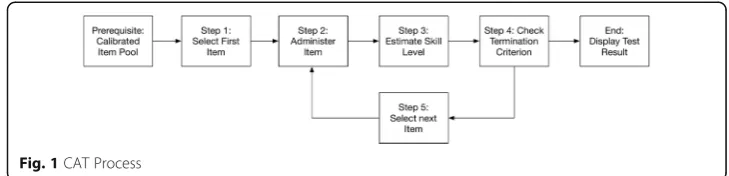
The CAT-process (cf. Fig. 1) requires that all items of an item pools are calibrated by administering them to examinees with the intent to estimate the associated item pa-rameters in a pre-testing phase. Item pools are usually segmented into intervals (also
“bags” or “bins”), to which items are assigned according to their determined difficulty parameter. During testing, the items are selected from these“bags”based on to the cur-rently estimated skill level (Reckase, 2010).
thus usually either is selected randomly or taken from an item bag of medium difficulty (Veldkamp & Matteucci, 2013).
Secondly, the selected item is administered, i.e., presented, to the examinee. Based on the answer, the current skill level is (re-)estimated using the selected IRT model. Litera-ture proposes choosing mechanisms that attempt to select the item that maximizes the discriminatory value for the given skill level of the examinee (H. Lin, 2012). In general, if an examinee answers correctly, the next question will be slightly more challenging than the previous one, and vice versa.
The final step is to check whether the stopping criterion has been met. If this is not the case, another item is drawn from the pool, administered, and the skill level is computed again. The procedure is repeated until the termination criterion is fi-nally met and the test concludes (Veldkamp & Matteucci, 2013). In “fixed-length testing”, a fixed number of items is administered to the examinee. In “ variable-length testing”, a certain level of measurement accuracy or precision is used as a termination criterion (Segall, 2004). Other criteria for ending a test comprise a maximum test time that has been reached, or if all available items have been con-sumed. Arbitrary combinations of these criteria can be made (Segall, 2004) follow-ing the purpose of the test (ibid.).
Requirements on testing platform support
Considering all of the design dimensions of CAT described above, the premier require-ment on a platform enabling to deliver CAT to learners in general is to provide a flex-ible and configurable architecture that can be instantiated in a structured way for different use cases. The following generic requirements can be derived from the pleth-ora of approaches proposed to be used in CAT:
– R1:Flexibility in testing strategy and item pool design–the platform has to be able to operate with arbitrary testing strategies and different item pool designs.
– R2:Flexibility in item selection algorithm–the platform has to be able to use different item selection strategies for the identification of first item and for succeeding items.
– R3:Flexibility in specifying the termination criterion–the platform has to allow for flexible specification under which constraints the test is executed und when it is considered to be finished.
For usage in online learning settings, further requirements on the platform can be identified, which are not directly related to CAT:
– R4:Possibility of technical integration with learning platforms on different layers–the platform should allow to be integrated in arbitrary learning platform on user interface, functional and/or data layer, enabling external platforms to provide data handing, presentation of tests to users or functional integration with other features of the external platform to support examinees during testing (Pellegrino,2010). – R5:Ability to display and evaluate items stemming from arbitrary domains–the
platform has to support the presentation and evaluation of items that require domain-specific display and data representation. It furthermore has to enable domain-domain-specific ways of interaction for examinees to provide answers (Achtenhagen,2012).
In the following section, we review related work with respect to these require-ments, and identify the gap in the state-of-the-art to be addressed with the present work.
Related work
The challenge of supporting CAT in online educational settings has been addressed in several approaches over the last years. Related work has been identified via two sources. First, the products listed on the website of the International Association for Computer-ized Adaptive Testing2 have been considered for inclusion. Those products which are openly available for adaptation for specific educational use cases have been included. Furthermore, we have conducted a literature study in the field of learning technologies that use CAT for formative or summative assessment. Studies have been included that explicitly mention the development of CAT software and describe its features. The re-view is structured along the aims of the platforms and separates the body of available work in two categories–platforms that focus on web-based delivery of CAT (mainly in the context of psychometrics), and platforms that explicitly use CAT in an educational context. The platforms are qualitatively compared within their categories in the follow-ing two sections and subsequently are assessed with respect to the identified requirements.
Platforms for web-based delivery of CAT
The platforms reviewed in this section use the web as a delivery channel for CAT-based psychometric tests. They mainly differ in the flexibility they offer for testing strat-egies and item selection. Concerto3(Scalise & Allen, 2015) is the most flexible platform to that respect. It is designed for stand-alone deployment and uses the catR-library (Magis & Raîche, 2012), which offers different IRT testing strategies, several methods for next item selection, and three stopping rules. Tests and items can be designed by specifying HTML-templates using a drag-and-drop editor. While this allows for easy editing, test answering options are limited to standard HTML input forms. This is a limitation for domain-specific tests, where more complex answering options might be required.
A single-technology approach has also been chosen in CAT-MD (Triantafillou et al., 2008). It focusses on mobile delivery of tests and has been implemented using the then-state-of-the-art Adobe Flash technology, which today limits its potential for real-world deployment. Its testing framework is of limited flexibility and supports multiple-choice-items and true-false-items that are evaluated using a non-configurable CAT-algorithm based on the Rasch-model.
Learning platforms with CAT features
This section discusses platforms that have been developed from an educational per-spective and include CAT features for formative or summative testing.
The SIETTE platform (Conejo et al., 2004; Guzmán & Conejo, 2005) is part of a system that comprehensively supports web-based teaching and learning systems. The testing system–similarly to Concerto–allows to specify items and configure tests via a web-interface. Items can contain dynamically determined parameters (e.g., to change numeric values in a calculation task) and interactive elements (real-ized by then-state-of-the-art Java Applets) for item presentation and evaluation of provided answers. The system allows to select one of three predefined item selec-tion strategies based in IRT. A similar, yet less flexible, system is proposed by (Huang, Lin, & Cheng, 2009), which provides CAT functionality for eLearning sce-narios. It has a modular architecture based on ASP.NET and thus can be inte-grated with other platforms building on the same technology stack.
The MISTRAL eLearning platform (Salcedo et al., 2005) includes CAT components for formative testing and should allow to determine the optimal learning content for a particular student. It uses an IRT-approach for item selection and differs from other systems in that it considers tasks that need to be assessed by a human due to their qualitative nature. The evaluation results of such items are then manually entered into the skill estimation algorithm.
The issue of integration with external e-learning platforms is addressed in the soft-ware framework proposed by Duda and Walter (2012). While they constrain their sys-tem to only work with multiple-choice questions, they explicitly consider different types of items and discuss requirements on items that should be evaluated automatic-ally by a technical system. They thus do not focus on a single assessment mechanism, but rather discuss a service-oriented middleware that can be used to flexibly configure the system and integrate it with other platforms.
Discussion
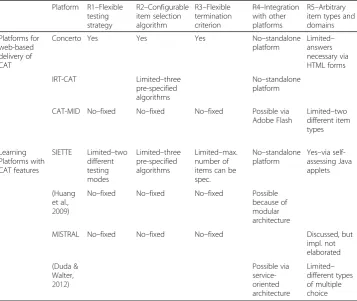
The description of related work shows that all requirements identified in the last sec-tion have already been addressed in related work. While this indicates the relevance of the requirements, there is no single approach that meets all of them. Table 1 gives an overview about properties of the approaches discussed above. Empty cells indicate that the requirement is not explicitly addressed.
Platform development
Based on the requirements identified in Computerized Adaptive Testing for online learning section, we propose an architecture for a computerized adaptive testing system that can be used in the course of online learning activities. In the following subsection, we describe the architecture and identify, where domain- or application-specific exten-sions and adaptations can be performed. Afterwards, we revisit the current implemen-tation of the architecture, which relies on catR for item selection. This section closes with a comparison of the platform’s features with the requirements identified above.
Architecture
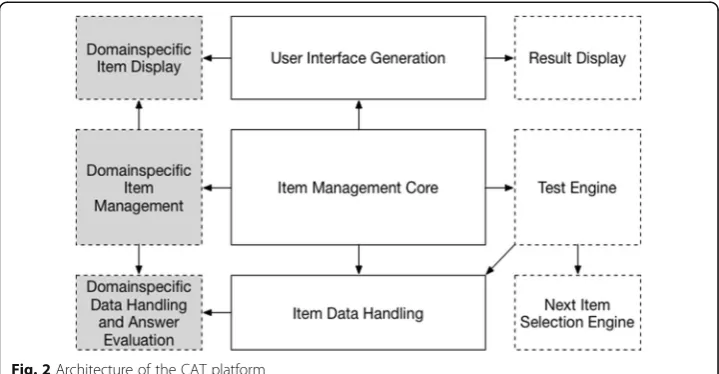
The architecture focuses on providing flexibility in terms of testing domain, testing strategy, data storage, and user interface display. Figure 2 gives an overview about the fundamental components. Components with a dashed outline can be altered according to the intended testing scenario. Components with a grey background need to be adapted to the domain the test is carried out in.
The central component of the architecture is theItem Management Core. It provides the central services for coordinating the components necessary to load, start, and carry out a test. It interlinks the other components using interfaces and abstract classes, mak-ing them exchangeable without needmak-ing to change the implementation of the core.
TheTest Engineimplements the control flow for a test. This comprises the manage-ment of the item pool and storing all information necessary to carry out a test (e.g., storing the history of administered items and their answers).
Table 1Comparison of related work
Platform R1–Flexible testing strategy
R2–Configurable item selection algorithm
R3–Flexible termination criterion
R4–Integration with other platforms
R5–Arbitrary item types and domains
Platforms for web-based delivery of CAT
Concerto Yes Yes Yes No–standalone
platform
Limited– answers necessary via HTML forms
IRT-CAT Limited–three
pre-specified algorithms
No–standalone platform
CAT-MID No–fixed No–fixed No–fixed Possible via Adobe Flash
Limited–two different item types
Learning Platforms with CAT features
SIETTE Limited–two different testing modes
Limited–three pre-specified algorithms
Limited–max. number of items can be spec.
No–standalone platform
Yes–via self-assessing Java applets
(Huang et al.,
2009)
No–fixed No–fixed No–fixed Possible because of modular architecture
MISTRAL No–fixed No–fixed No–fixed Discussed, but
TheNext Item Selection Engineimplements the adaptiveness of the tests via selecting an item from the item pool. As this selection usually relies on advanced statistical algo-rithms, the platform here provides an interface to the R software package (R Develop-ment Core Team, 2009) that can be used, e.g., in combination with the catR-library (Magis & Raîche, 2012). Using the interface to external software is not required. Adap-tive or non-adapAdap-tive selection algorithms, such as a fixed branch strategy (Moosbrugger & Kelava, 2012), could also be implemented directly. The platform thus is not restricted to CAT-applications but can be used for testing in general.
The Item Data Handling component is used to load and manage the items that are to be used in a test. The test engine accesses this component when retrieving data ne-cessary for the selection of a next item. As a test not necessarily only comprises items of a single type, the ways to address items and evaluate answers given by examinees need to be generic. This component thus consists of a set of interfaces that need to be implemented for domain-specific item types.
User Interface Generation provides the fundamental functionality to render HTML output for the test. It is controlled by the core component and relies on further do-main- and application-specific components to provide the test interface to examinees via a web browser. It feeds user inputs back to the core component, which forwards it to the test engine for evaluation.
Result Display is used by the user interface generation component to render the re-sult and feedback page for a completed test. It has been established as a separate com-ponent, as the feedback for a particular test is application-specific and requires to include different kinds and amount of information.
The remaining components are domain-specific, i.e., have to be adapted to the do-main of the test. Domain-specific item management inherits its functionality from the core component and extends it in terms of domain-specific user support measures, i.e., the provision of supporting information that should be made available to examinees when answering the administered items. Furthermore, this component determines the data format of domain-specific items. In this way, items can be retrieved flexibly from different storage formats, such as XML, or from a relational database, but could also be loaded via JSON from remote locations, e.g., via a web-service.
Domain-specific data handling and answer evaluation comprises classes that repre-sent different domain-specific item types. This includes the data necessary to display the question, information about expected answer formats, and procedures to evaluate the correctness of an answer. These classes can also contain polytomous or multi-stage evaluation procedures. The domain-specific item management component loads the available items and instantiates respective item objects. The item objects are then added to the item pool of the test engine via the core component.
Domain-specific item display comprises classes that render an item’s question to HTML and provide means of user input to collect the examinees’answers. The man-agement component instantiates the respective objects, when the user interface gener-ation component requests them for display.
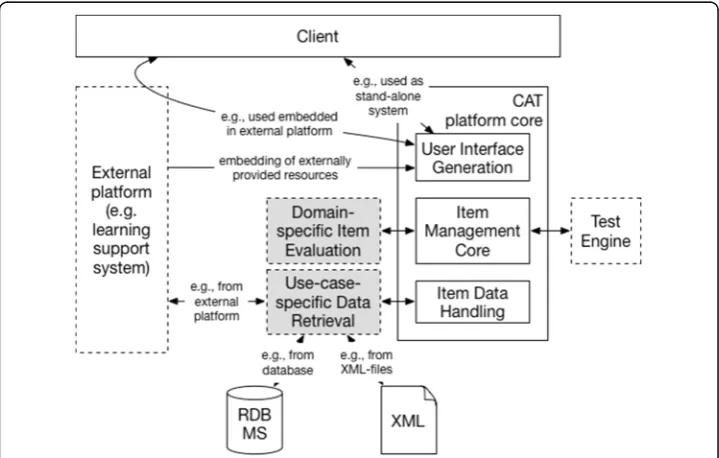
The components described above are the main conceptual building blocks of the platform architecture. Its interplay with external components is shown in Fig. 3. Plat-form implementations can be integrated with external platPlat-forms on a data level (for item retrieval), on a functional level (for using externally provided test support re-sources) and on an UI level (for integrating tests in an external platform’s genuine UI).
In the following subsection we demonstrate the use of the architecture in a concrete platform implementation. It is domain-agnostic, i.e., can be adapted for tests with arbi-trary item types. Examples for concrete item types are described in Design of domain-specific items section.
Current implementation
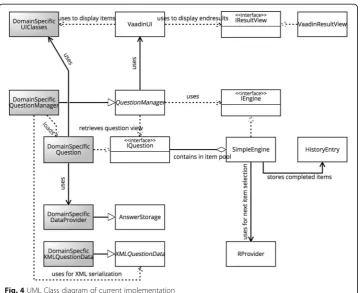
The current implementation allows to administer IRT-based CAT usable with dichot-omous or polytdichot-omous items. It contains implementations of testing routines, data stor-age and a UI, and thus is designed for stand-alone deployment. The architecture is visualized in the UML class diagram in Fig. 4. In the following, we outline the
properties of this implementation and describe, how it can be adapted to items from a particular domain.
Figure 4 follows the standard notation for UML class diagrams (Rumbaugh, Jacobson, & Booch, 2004). At the same time, its layout roughly resembles the component struc-ture shown in Fig. 2 and described above.
User interface generation
The implementation of the user interface relies on the Vaadin5framework. Vaadin fo-cusses on single-page web-apps, i.e., does not reload the page after an item has been answered. This inherently avoids that examinees can use the “back”-button of the browser to revisit a former item. The test state is maintained completely on the server. The single-page approach also allows to show overlays without losing the current state of the test. This can be used to dynamically provide supporting information for an item, e.g., reference materials that might be required to answer an item, or even integrate in-formation or functionality provided by an external learning platform.
Item data handling
Item storage has been implemented using the JAXB-mechanism.6 JAXB enables a transparent binding between java objects and XML structures. The XML-schema is generated from the (annotated) domain-specific item classes. These schemas can be used for offline preparation of items directly in XML via schema-aware editors.
Test engine & item selection
A test engine (SimpleEngine) has been implemented using an item pool with a flexible number of bags. The number of bags and their difficulty bounds are specified when the engine is instantiated.
During a test, the engine uses the selection component for the next item. In the current implementation, this is realized by interfacing the catR-library (Magis & Raîche, 2012), that is also used in the Concerto platform. catR is used to estimate the required difficulty of the next item to be administered based on the history of answers. The en-gine is currently configured for use with dichotomous items but can be altered to use all features of catR. The result calculated by catR is used to determine the bag from which the next item should be drawn. The actual item is then drawn randomly from the respective bag.
Discussion of requirements R1-R4
In this section, we have described the architecture of our proposed CAT platform and have introduced a prototypical implementation to be used as a stand-alone implemen-tation for IRT-based testing of dichotomous items. The current version of the source code can be obtained via Github.7
The requirements identified in Computerized Adaptive Testing for online learning section have been met by the platform in its current implementation as follows:R1and R3 are met via the exchangeable test engine that can be implemented to handle arbi-trary item pools, conduct different testing strategies and check diverse stopping criteria. R2 has been implemented in the architecture by providing a dedicated interface that item selection modules can implement. In the current implementation, this flexibility is maintained by integrating the catR library that offers different skill level estimation al-gorithms. R4 has been met by conceptually separating test management from user interface generation and data storage. In the current implementation, the Vaadin library enables to embed the user interface in any learning platform that is based on Java serv-let technology.R5is enabled by providing a generic interface for question handling on all levels of architecture from data handling over evaluation logic to user interface gen-eration. In the current implementation, the use of XML for data representation enables domain-specific item types with different data formats for each item.
Focus has been put on maintaining flexibility in terms of applied testing strategies and item types. The ability to administer arbitrary item types in particular is a feature that sets apart our approach from available related work. In the following section, we thus focus on demonstrating the flexibility of the platform in terms of administering item types that differ in content presentation as well as form and amount of user inter-action required when providing answers.
Design of domain-specific items
In the former section, we have introduced our architecture and a prototypical imple-mentation with a test engine using catR. We were able to show that the CAT-oriented requirements R1–R3 could be met by our architecture. The technical feasibility of inte-grating the platform with other systems on presentation or data layer (R4) has been shown in principle by adopting the Vaadin framework for displaying information and XML as one potential form of item data representation.
programming tests, etc.) during tests. Furthermore, the ability to display and evaluate items stemming from arbitrary domains (R5) has yet to be shown. Both requirements relate to the domain-specific part of the architecture. In the following, we thus show how R4 and R5 are addressed in different item types.
Item-type 1: business administration–impact on profit
The first example for an item-type is taken from an item pool designed for testing ac-counting skills of students in vocational business schools in Austria. Details about the results of these tests are described in (Helm, 2016). The item-type is prototypical for di-chotomous items with simple display and answer option requirements, which are also supported in existing platforms.
Aim of item-type
Items of this type confront examinees with a brief textual description of a business transaction and ask them to decide, whether this transaction impacts the profit of the company. There are three potential answering options, of which exactly one is correct for any given business transaction. The items thus are to be considered dichotomous.
User interface
The user interface for this item type (as shown in Fig. 5) comprises the textual descrip-tion of the business case. The answering opdescrip-tions are presented in a drop-down list.
Data representation and assessment
The domain-specific data representation in XML for the item type is shown in Fig. 4 exemplified for the same item as used in Fig. 6.
The XML-question format comprises three second-level tags that remain stable for all item types. The tag dataStorage comprises the data necessary to evaluate the answer of the examinee. The tag question holds the content to be displayed on the user inter-face. Here, this content is represented by plain text. The tag difficulty holds the param-eters necessary for sorting the item into the correct bag in the item pool and for subsequent evaluation of the estimated skill level of the examinee. Items for this test are described using the Rasch-model. If more complex testing models are used, the re-spective item-data-classes need to be extended with the necessary information types.
Item-type 2: business administration–accounting
The second item-type is taken from the same test as described above. Both types have been used in combination to assess accounting skill of students in vocational business education schools in Austria (Helm, 2016). The expected answering format of this item-type is more complex. Items follow a constructed-response format, requiring ex-aminees to provide answers in a pre-specified structure.
Aim of item-type
Items of this type again confront examinees with a brief textual description of a busi-ness transaction, identical to the items-type described above.
Examinees are required to correctly describe the accounting record in double-entry bookkeeping for the business transaction. They have to identify the affected accounts, assign them to either debit or credit and calculate the respective amount of money to be booked on each account. An answer is only correct, if all components are correctly described (i.e., all affected accounts assigned correctly to either debit or credit listed with the correct amounts of money).
Students are allowed to use a searchable chart of accounts when solving the task. The searchable chart of accounts is stored as an external resource separated from the testing platform and is functionally embedded in the user interface only for items of the present type (following R4).
User interface
The top of the user interface remains identical to item-type 1. The lower part desig-nated for providing the constructed answer resembles so-called T-accounts, which are a common notation for accounting records in double-entry bookkeeping (cf. Fig. 7).
The chart of accounts is provided by two means. First it is encoded as filtering drop-down list for each field taking an account name, retrieving only data from the external component (cf. Fig. 8).
The second support measure is the actual chart of accounts (cf. Fig. 9). It provides in-formation on the numerical account IDs, which need to be entered in the T-account. Students are allowed to consult the chart at any time. Here, the external component also provides the presentation, which is only embedded in the test display.
Data representation and assessment
The fundamental structure of the XML representation of the items remains identi-cal to the format presented above. A fundamental difference, however, can be found in the contents of the dataStorage-Tag. It holds a domain-specific structure containing the correct answer, i.e. the filled T-account serialized to an XML-representation (cf. Fig. 10).
The information contained in the tags debit and credit is assessed procedurally in the evaluation method implemented in the domain-specific item-class. This enables to as-sess answers according to domain-specific rules. In the present case, e.g., answers need to be rated correct independently of the sequence the accounts are listed in the T-account. Such domain-specific evaluation behavior cannot be easily implemented in existing platforms.
Item-type 3: business process modeling–syntax of conceptual models
The third item-type is part of an ongoing effort to create a test for assessing skills in business process modeling. In this case, not only the answer format requires multi-step interaction with the examinee, but also question presentation requires more complex visualizations. It thus is used as an example here to demonstrate the flexibility of the item-specification approach followed in the present work.
Fig. 8Dynamically filtered account list as a support measure for correctly filling the T-account
Fig. 9Chart of accounts as a support measure for correctly filling the T-account
Aim of item-type
Business process modeling is an activity performed in the field of business process management (Weske, 2010). It is a conceptual modeling task that aims at making organizational processes representable and supportable by information systems (Recker, Rosemann, Indulska, & Green, 2009) and more transparent to members of the organization (van der Linden, Proper, & Hoppenbrouwers, 2014). Assessment of con-ceptual modeling skills is still in its infancy and has only been a subject of research in recent years, with a focus on formative research exploring potential dimensions for as-sessment and their operationalization during testing (Bider & Perjons, 2015; Frederiks & van der Weide, 2006).
One skill considered necessary in this field is the ability to transform natural language statements to abstract conceptual structures that adhere to particular syntactic structures specified in a modeling language (Frederiks & van der Weide, 2006). One prerequisite for this ability is to be able to determine whether a given model is syntactically correct (Overhage, Birkmeier, & Schlauderer, 2012).
For testing this ability, the items contain a graphical representation of a business process model, using the modeling language BPMN (White & Miers, 2008). Exam-inees assess these items in a two-step approach. First, they locate a potential error in the model by clicking on the erroneous model construct. In the currently chosen approach, each model either is correct or only contains one error at max-imum. If an error has been identified, examinees need to select the assumed type of error from a set of pre-specified options. The two-stage approach here thus combines a constructed-response format (the click on an arbitrary position in the model to locate the error) with a selected-response format (the selection of the error type from a provided list). Correctness is currently evaluated dichotomously (i.e., both, the located error and the reason need to be correct). An extension toward polytomous answers (e.g., by including several errors, or by considering partially correct answers) is currently being assessed from a test-theoretical point-of-view and is currently not part of the implementation.
User interface
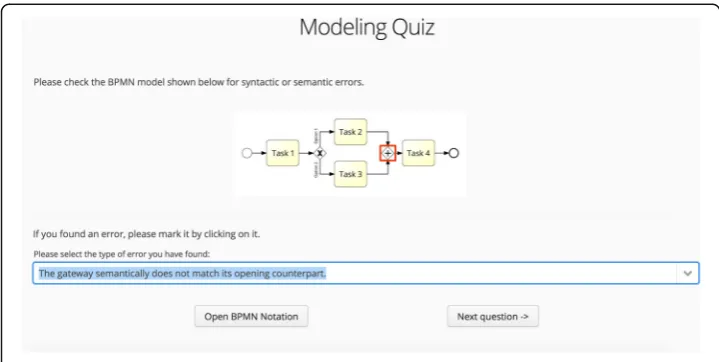
Figure 11 shows the user interface in the state after a complete answer has been pro-vided and before the next question button is clicked.
As described above, the item type requires a two-stage answer. First, an assumed error in the model must be selected by clicking on it. The selected element is marked using a red outline. The elements available for selection can be specified in the item definition–the difficulty of the item thus can be tuned.
The answering options are dynamically loaded in the drop-down-list depending on the selected element. For this purpose, each selectable item is typed with the class of el-ements it belongs to. If, as shown in the example, a “closing gateway”is selected, a set of error types is loaded, which in principle could occur at such an element. Examinees are then required to select the correct option.
Data representation and assessment
In order to realize the interaction possibilities on the user interface described above, the data stored for representing the question is more complex than in the former items. Figure 12 shows this representation.
The semantics of the task description is specified on a more fine-grain level, which allows to construct the user interface more flexibly. The tag model links to the image of the graphical model to be displayed and specifies an arbitrary number of selectable areas of the model with their respective type of element. The element selection in Fig. 10 is represented by the element-tag with id 6 and is stored with type =“gw-cl”, which represents a“closing gateway”.
The correct answer represented in the dataStorage-tag consequently also is more complex, as the item solution comprises two parts. The data format in principle allows to store models with several errors. This option, however, would require polytomous item handling and is currently not used.
Fig. 12XML for storing data of items for assessing BPMN modeling skills
Discussion of requirements R4 and R5
The three examples described above have demonstrated that the platform architecture enables flexible provision of domain-specific item in CAT with respect to data repre-sentation, answer evaluation and item presentation. It also allows to functionally in-clude interactive external resources in a test.
Item data storage is flexible not only with respect to storing domain-specific details required for presentation and answer evaluation, but also with respect to storing item parameters required for different IRT-algorithms. The same is true for parameters re-quired to correctly evaluate polytomous items.
Answer evaluation is performed procedurally specific for each item type. Procedural evaluation enables to easily formulate flexible answer constraints (such as the variable order of accounts in example 2) or enable multi-step answers (as used for example 3), which are currently not available in existing platforms and contribute towards fulfilling R5.
Item presentation and including external support measures is realized by embedding item-type-specific rendering of items as well as answer structures (such as the prepared empty T-account for item-type example 2) in the platform. The platform also enables to provide interactive item visualizations (such as the list of potential errors in a model in item-type example 3, which changes dynamically depending on the selected model element). The same mechanisms are used to integrate externally provided support mea-sures for examinees during the test in a controlled manner (e.g., only providing them for specific items). Examples of such support measures include the interactive chart of accounts in example 2 or the BPMN notation in example 3. Support options integrated more deeply in an item type, such as the dynamically filtered list of accounts to support correct input of account names used in example 2, can be realized by retrieving data from external sources when creating item-specific display routines.
In all, we could show how the architecture of the platform in general and the current implementation in particular enable to meet the design requirements R4 and R5. The presented platform thus provides an amount of flexibility for designing and embedding CAT in online learning approaches that has not yet been available in any other plat-form discussed in related work. It aims at contributing to spread CAT as a practically feasible approach for educational assessment activities. Deploying CAT still causes high upfront effort for setting up a valid, calibrated item pool. The effort for the technical implementation of a testing tool tailored for the specific scenario, however, is signifi-cantly reduced with the platform presented in this article.
Conclusions
functional integration of resources provided by external platforms. In this way, we could show that our approach meets the identified requirements.
The present work has several limitations. First, the platform currently enables to ad-minister tests and facilitates the CAT-process, but does not yet enable easy test- or item-administration. This limitation will be addressed in future iterations of our plat-form. Second, the platform has yet to be integrated in a comprehensive online learning system to further examine the feasibility of the embedding mechanisms that are part of the architectural design on data- and UI-level. Third, the current implementation of the test-engine is only prepared to work with dichotomous items that are evaluated with the 1-parameter-logistics model. The version deployed as open-source via the GitHub-repository, however, will be equipped with a more comprehensive test engine that can be configured to work with different IRT-approaches.
In our future work, we aim at addressing the current limitations described above. The platform furthermore is currently being prepared for deployment in large-scale evaluations in real-world case studies in different application domains. Our research in this area will focus on examining the potential effects of the CAT-platform on the as-sessment process in presence-based and online learning settings.
Endnotes 1
http://iacat.org/content/cat-software
2
http://iacat.org/content/cat-software
3
http://www.psychometrics.cam.ac.uk/newconcerto
4
https://sourceforge.net/projects/irt-cat/
5
https://vaadin.com/home
6
Java Architecture for XML Binding, https://jcp.org/en/jsr/detail?id=222
7
https://github.com/win-ce/AdaptiveTesting2
Abbreviations
CAT:Computerized Adaptive Testing; HTML: Hypertext Markup Language; IRT: Item response theory; JAXB: Java XML Binding; MOOC: Massive Open Online Courses; UI: User interface; XML: Extensible Markup Language
Availability of data and materials
The software implementation of the presented platform can be obtained as open source software under the GNU Lesser Public License at https://github.com/win-ce/AdaptiveTesting2.
Authors’contributions
SO has developed the conceptual framework presented in this paper, has carried out the study of related work and has developed usage scenario 3. He has furthermore acted as the main author of the article. FR has developed the platform architecture and the prototypical implementation and has contributed to its description. AE has contributed to the study and description of the kernel theories the requirements are based upon. CH has provided the usage scenarios used for demonstration of the platform features. He has furthermore contributed to the study of related work. All authors read and approved the final manuscript.
Competing interests
The authors declare that they have no competing interests.
Author details
1Department of Business Information Systems–Communications Engineering, Johannes Kepler University of Linz,
Altenberger Straße 69, Linz 4040, Austria.2Department of Educational Psychology, Johannes Kepler University of Linz, Altenberger Straße 69, Linz 4040, Austria.3Department of Software Science, Radboud University, Mailbox 47, PO Box
9010, Nijmegen 6500, GL, The Netherlands.
References
Achtenhagen, F. (2012). The curriculum-instruction-assessment triad.Empirical Research in Vocational Education Training, 4(1), 5–25.
Bennet, S., & Ward, W. (1993).Construction versus choice in cognitive measurement: issues in constructed response, performance testing, and portfolio assessment. Lawrence Erlbaum Associates, Inc.
Bider, I., & Perjons, E. (2015). Design science in action: developing a modeling technique for eliciting requirements on business process management (BPM) tools.Software & Systems Modeling, 14(3), 1159–1188.
Bortolotti, S. L. V., Tezza, R., Andrade, D. F., Bornia, A. C., & Sousa Júnior, A. F. (2013). Relevance and advantages of using the item response theory.Quality & Quantity, 47(4), 2341–2360. http://doi.org/10.1007/s11135-012-9684-5. Chen, J., & Wang, L. (2010). Computerized Adaptive Testing: A New Trend in Language Testing. InInternational
Conference on Artificial Intelligence and Education (ICAIE)(pp. 725–728).
Čisar, S. M., Radosav, D., Markoski, B., Pinter, R., &Čisar, P. (2010).Computer Adaptive Testing for Student’s Knowledge in C ++ Exam. Presented at the 11thIEEE International Symposium on Computational Intelligence and Informatics, Budapest, Hungary.
Conejo, R., Guzmán, E., Millán, E., Trella, M., Pérez-Del-La-Cruz, J. L., & Rios, A. (2004). SIETTE: A Web-Based Tool for Adaptive Testing.International Journal of Artificial Intelligence in Education, 14(1), 1–33.
Duda, I., & Walter, T. (2012).A software framework for e-testing. Presented at the IADIS International Conference e-Learning 2012, Lisbon, Spain.
Frederiks, P. J. M., & van der Weide, T. P. (2006). Information modeling: The process and the required competencies of its participants.Data & Knowledge Engineering, 58(1), 4–20. http://doi.org/10.1016/j.datak.2005.05.007.
Guzmán, E., & Conejo, R. (2005). Self-assessment in a feasible, adaptive web-based testing system.IEEE Transactions on Education, 48(4), 688–695.
Helm, C. (2016). Berufsbildungsstandards und Kompetenzmodellierung im Fach Rechnungswesen. InBildungsstandards und Kompetenzorientierung. Herausforderungen und Perspektiven der Bildungs- und Berufsbildungsforschung(pp. 149–168). Bonn: W. Bertelsmann Verlag.
Huang, Y.-M., Lin, Y.-T., & Cheng, S.-C. (2009). An adaptive testing system for supporting versatile educational assessment.Computers & Education, 52(1), 53–67.
Krass, I. A., & Williams, B. (2003).Calibrating CAT Pools and Online Pretest Items Using Nonparametric and Adjusted Marginal Maximum Likelihood Methods.Presented at the Annual Meeting of the National Council on Measurement in Education, Chicago, IL, USA.
Kröhne, U., & Frey, A. (2011).Multidimensional Adaptive Testing Environment (MATE)–Software for the Implementation of Computerized Adaptive Tests.Presented at the International Conference on Computerized Adaptive Testing, Pacific Grove, CA, USA.
Lin, H. (2012).Item selection methods in multidimensional computerized adaptive testing adopting polytomously-scored items under multidimensional generalized partial credit model. Doctoral dissertation. University of Illinois at Urbana-Champaign.
Linacre, J. M. (2000). Computer-Adaptive Testing : A Methodology Whose Time Has Come. In S. Chae, U. Kang, E. Jeon, & J. M. Linacre (Eds.),Development of Computerized Middle School Achievement Test(pp. 1–58). Seoul: Komesa Press. Magis, D., & Raîche, G. (2012). Random generation of response patterns under computerized adaptive testing with the
R package catR.Journal of Statistical Software, 48(8), 1–31.
Meyer, J. P., & Zhu, S. (2013). Fair and equitable measurement of student learning in MOOCs: An introduction to item response theory, scale linking, and score equating.Research & Practice in Assessment, 8, 26–39.
Moosbrugger, H., & Kelava, A. (2012). Testtheorie und Fragebogenkonstruktion. InStatistik für Human- und Sozialwissenschaftler(pp. 7–26). Berlin, Heidelberg: Springer. http://doi.org/10.1007/978-3-642-20072-4_2. Overhage, S., Birkmeier, D., & Schlauderer, S. (2012). Quality marks, metrics, and measurement procedures for business
process models.Business & Information Systems Engineering, 4(5), 229–246.
Pellegrino, J. W. (2010).The design of an assessment system for the race to the top: A learning sciences perspective on issues of growth and measurement. Proceedings of the Exploratory Seminar: Measurement Challenges Within the Race to the Top Agenda. Educational Testing Service, Princeton.
R Development Core Team (2011).R: A Language and Environment for Statistical Computing. Vienna, Austria: the R Foundation for Statistical Computing. ISBN: 3-900051-07-0. Available online at http://www.R-project.org/. Reckase, M. D. (1974). An interactive computer program for tailored testing based on the one–parameter logistic
model.Behavior Research Methods and Instrumentation, 6(2), 208–212.
Reckase, M. D. (2010). Designing Item Pools to Optimize the Functioning of a Computerized Adaptive Test.
Psychological Test and Assessment Modeling, 52(2), 127–141.
Recker, J. C., Rosemann, M., Indulska, M., & Green, P. (2009). Business process modeling-a comparative analysis.Journal of the Association for Information Systems, 10(4), 333–363.
Rumbaugh, J., Jacobson, I., & Booch, G. (2004).The Unified Modeling Language Reference Manual. London: Pearson Higher Education.
Salcedo, P., Pinninghoff, M. A., & Contreras, R. (2005). Computerized adaptive tests and item response theory on a distance education platform. In J. Mira & J. R. Álvarez (Eds.),Artificial Intelligence and Knowledge Engineering Applications: A Bioinspired Approach(pp. 613–621). Heidelberg: Springer.
Scalise, K., & Allen, D. D. (2015). Use of open-source software for adaptive measurement: Concerto as an R-based computer adaptive development and delivery platform.British Journal of Mathematical and Statistical Psychology, 68(3), 478–496.
Segall, D. O. (2004). Computerized Adaptive Testing. In K. Kempf-Leonard (Ed.),Encyclopedia of Social Measurement(pp. 429–438). San Diego, CA: Academic.
Triantafillou, E., Georgiadou, E., & Economides, A. A. (2008). CAT-MD: Computerized adaptive testing on mobile devices.
International Journal of Web-Based Learning and Teaching Technologies (IJWLTT), 3(1), 13–20.
van der Linden, D., Proper, H. A., & Hoppenbrouwers, S. J. B. A. (2014). Conceptual Understanding of Conceptual Modeling Concepts: A Longitudinal Study among Students Learning to Model. In L. Iliadis, M. Papazoglou, & K. Pohl (Eds.),
Veldkamp, B. P., & Matteucci, M. (2013). Bayesian computerized adaptive testing.Ensaio: Avaliação e Políticas Públicas em Educação, 21(78), 57–82. http://doi.org/10.1590/S0104-40362013005000001.
Wainer, H., & Mislevy, R. J. (2000). Item Response Theory, Item Calibration, and Proficiency Estimation. In H. Wainer (Ed.),
Computerized Adaptive Testing A Primer(pp. 61–100). New York: Lawrence Erlbaum Associates.
Weiss, D. J. (2004). Computerized adaptive testing for effective and efficient measurement in counseling and education.
Measurement and Evaluation in Counseling and Development, 37(2), 70–84.
Weske, M. (2010).Business process management: concepts, languages, architectures. Heidelberg: Springer. White, S. A., & Miers, D. (2008). BPMN Modeling and Reference Guide: Understanding and Using BPMN.The Journal of
Strategic Information Systems, 3, 23–40. Florida, USA: Future Strategies Inc. http://doi.org/10.1016/0963-8687(94)90004-3.
Submit your manuscript to a
journal and benefi t from:
7Convenient online submission 7Rigorous peer review
7Immediate publication on acceptance 7Open access: articles freely available online 7High visibility within the fi eld
7Retaining the copyright to your article