R E S E A R C H A R T I C L E
Open Access
Game-based learning and gamification in
initial teacher training in the social
sciences: an experiment with MinecraftEdu
Ramón Cózar-Gutiérrez
1*and José Manuel Sáez-López
2* Correspondence:
1Faculty of Education of Albacete,
University of Castilla-La Mancha, 02071 Albacete, Spain Full list of author information is available at the end of the article
Abstract
This study analyzes the application of game-based learning and gamification using MinecraftEdu, which allows for an exploration of the possibilities regarding immersive learning environments. We analyze the contributions of second-year university students who are pursuing a degree in Primary Education and are enrolled in a subject entitled Social Sciences II: History and Teaching at Castilla-La Mancha University. On four scales, we detail descriptive data and statistical inference through a quasi-experimental design using a Wilcoxon test and a sign test. The instruments provide content and construct validation based on data triangulation as a strategy. Despite the fact that participants consider video games as non-essential tools in an educational context, they value the fact that game-based learning through immersive environments allows for learning that involves a higher level of activity and engagement of the students. Interest level, educational innovation and motivation are valued positively and show statistically significant improvements.
Keywords:Game-based learning, Interactive learning environment, Pedagogical issues, Primary education, Teaching/learning strategies
Introduction
Preparing students for learning a new culture imposed by our virtual era (Adell and Castañeda 2012) is a challenge for educators and it forces us to rethink the goals of education (European Commission 2013; Mishra et al. 2011). From our perspecti-ve—that of our initial training of future teachers—we must address this change by de-veloping training activities that include the most suitable opportunities and strategies for successful acquisition not only of teaching skills (Esteve et al. 2014a) but also those fundamental to resolving problems and situations in the digital world. Digital learners, or digital natives, have grown up in a technological and digital environment (Palfrey and Gasser 2008) and their prevalence is recognized by the growing expansion of ICT (Esteve et al. 2014b).
In recent years, the changes experienced since the creation of the European Higher Education Area have generated new educational formulas geared towards active and dynamic learning designs and teaching methods that are student-centred and linked to the availability and use of technologies that can be integrated into the classroom. Some teachers and education policies interested in introducing innovative strategies have not
hesitated to add video games to the long list of possible tools and resources (Gómez 2014). TheNMC Horizon Report: 2014 Higher Education Edition(Johnson et al. 2014) identifies the emerging technologies that are bound to have a significant impact on learning, teaching and creative thinking in higher education. The aforementioned re-port targets gaming and gamification as technologies whose impact on university edu-cation will arrive in two to three years. The edition of this report, which analyzes the major trends and emerging innovations that may affect elementary and secondary edu-cation environments, also identifies games and gamifiedu-cation along with emerging tech-nology implementation in the medium term (2–3 years).
From our perspective as teacher trainers, we decided to investigate and analyze opin-ions about emerging technologies that use gamification and game-based learning in ini-tial training for future teachers, as well as the real presence of these key trends in university training contexts. To do so, we relied upon the implementation of Minecraf-tEdu (http://minecraftedu.com), the educational version of the popular virtual world Minecraft.
Theoretical framework
According to Kapp (2012), “Gamification is using game-based mechanics, aesthetics and game thinking to engage people, motivate action, promote learning, and solve problems”(p. 10). It is a method used to create a meaningful and motivating experience through the integration of mechanical play in non-recreational environments and appli-cations. Thus, game-based learning refers to the use of games to enhance the learning experience, while maintaining a balance between content and gaming and its applica-tion in the real world. With the introducapplica-tion of gaming, the methodology was renamed digital game-based learning (Prensky 2001). Van Eck (2006) sets out three aspects to the use of this approach in the classroom: a) the use of commercial titles—motivating and attractive games that can be used for educational purposes, but which require trained teachers and curriculum planning so as not to lose sight of the pedagogical ap-proach; b) the so-called ‘serious game’—those specially developed to educate, train and inform (Michael and Chen 2006); c) games built by the students themselves that there-fore develop problem-solving skills, programming and game design. Gertrudix and Ger-trudix (2013) add one more aspect: d) gamification process integration in educational activities mediated by technology. Despite the differences between concepts, we agree with Kapp’s (2012) statement, “when you get right down to it, the goals of both are relatively the same. Serious games and gamification both are trying to solve a problem, motivate, promote learning and using game-based thinking and techniques”(p. 16).
multi-tasking tool, the ability to interact, the assimilation and interconnection of content, the development of values, the simulation of situations, improved decision-making, and immediate feedback.
We also found less positive reviews. For Blunt (2007) “there is not enough research to determine the relationship between video games and learning”(p. 2). De Freitas and Oliver (2006) argue that “although a number of frameworks exist that are intended to guide and support the evaluation of educational software, few have been designed that consider explicitly the use of games or simulations in education” (p. 262). De-Marcos et al. (2014) state that“there are drawbacks to their use for educational purposes asso-ciated with educational content, transfer of learning, assessment, potential problems of teacher involvement or technical infrastructure” (Borrás et al. 2014, p. 2). And others like Akkerman et al. (2009), and Moshirnia and Israel (2010) in the article by Young et al. (2012) agree that when it comes to integrating gaming in areas such as the present one (history)“adding text or historical information to gaming is not enough to foster learning”(p. 80). Overall, despite the criticism, it is undeniable that video games are technological tools that are fully integrated into society (Revuelta and Guerra 2012). As for incorporation into classrooms, a 2012 study by the Spanish Association of Games indicates that 67 % of Europeans and 58 % of Spaniards consider the use of en-tertainment software in general and video games in particular as educational tools as something beneficial (aDeSe 2012; Marín and Martín-Párraga 2014). The report also states that 30.9 % of Spanish elementary teachers acknowledge having used video games in their teaching, mainly in subjects like maths, science and Spanish. Moreover, 79.2 % of teachers believe that video games’great teaching capacity and their introduction in the classroom can function as a stimulating teaching method (aDeSe 2012, p. 32). How-ever, they also state that due to a lack of information and guidance regarding the possi-bilities of applying video games in schools (75.9 %), there should be more support from the public administration to provide resources and facilitate the realization of this type of activity (64.4 %) and, in general, the centres are not adapted (poor Internet connec-tions, lack of computers, etc.) for this type of activity (63.4 %).
In this regard, the need to promote adequate initial ICT training of future teachers (derided in the curriculum) has led us to train students enrolled in the Social Sciences II: History and Teaching subject in the second year of their master’s degree in Primary Education course in the Faculty of Education of Albacete, University of Castilla-La Mancha, Spain. By following a TPACK model as an intervention approach, we have ed-ucated them in the pedagogical integration of video games for the teaching of historical and artistic content. To do this, we relied upon the use of MinecraftEdu (http://mine-craftedu.com), the educational version of the popular virtual world Minecraft. This is an immersive environment that responds to the sandbox model, with its own educa-tional community composed of teachers and programmers, and with a set of specific tools for the development of educational activities within the environment personalized by and adapted to different educational levels and subject areas (Gertrudix and Gertru-dix 2013).
Method
adapted studies on MinecraftEdu by Sáez-López and Domínguez (2013) to analyze the level of knowledge about game-based learning and gamification. Scale 3, entitled “ Ac-tive Learning”, contains four questions present in Hiltz et al. (2000). Scale 4, “Fun”, consists of five questions adapted from Laros and Steenkamp (2005).
In addition to the descriptive data, we proceed to evaluate results from statistical in-ference. Data are analyzed through a quasi-experimental design with a Wilcoxon test and sign test. The significance level αis 0.05. The calculated reliability coefficient using Cronbach provides a 0.73 value at different levels, always greater than 0.6, which is considered acceptable (Hair et al. 1998). Also, an exploratory factor analysis was per-formed using the principal component method for determining the most significant dif-ferent elements and factors on the various scales considered.
From the data triangulation approach (Cohen et al. 2000), and to give greater consistency and validity to the study, we only accepted and interpreted significant im-provements if they had been met in the two tests applied, i.e., in the Wilcoxon test and the sign test. This triangulation, implemented by using different analyses, test and quantitative and qualitative (open question) data, allows us to determine that there is evidence to support the validity of the results and minimize error variance (Goetz and LeCompte 1988).
Participants
The study population if formed by university students in the second year of their mas-ter’s degree in Primary Education course in the Faculty of Education of Albacete, en-rolled in the Social Sciences II: History and Teaching subject. The research sample is not probabilistic or intentional and consists of 89 individuals. Evidence from the quasi-experimental design was applied as related samples were linked to a pre-test and post-test design.
The experimental group consists of 75.3 % females and 24.7 % males, which turns out to be a representative sample of gender disparity existing in teacher studies, in which there are always more women. The average age is 21 years. The group is quite homogeneous because the students are almost all the same age and educational level.
Results
Descriptive analysis
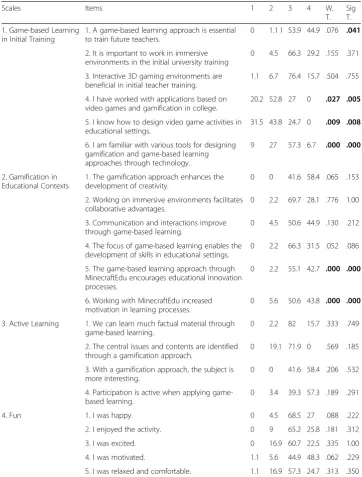
In the analysis of scale 1, “Game-based Learning in Initial Training”, we can see that most students bring positive assessments regarding the consideration of this approach as essential in training future teachers, and regarding the importance in initial univer-sity training to work with immersive environments, with positive values (agree or strongly agree) higher than 95 %. The benefits of 3D interactive gaming environments in initial teacher training also get positive values from over 90 % of the sample. As for initial training and skills in this field, just under a quarter of the sample had worked with video games and gamification in college applications; similar values are seen re-lated to how to design video game activities in educational settings.
development and educational innovation. And finally, more than 94 % indicate that communication, interaction and motivation in learning processes are positive aspects.
Regarding “Active Learning”, scale 3 highlights that 100 % of the students provide positive values regarding the view that the gamification approach allows the subject to be more interesting. Over 96 % of the sample believes that game-based learning permits active participation and that students ultimately learn. And more than 80 % consider that engaging with the content is better using this approach.
Finally, on scale 4 “Fun”, over 90 % of the participants say that they were happy, mo-tivated and enjoyed the activity, and more than 80 % felt relaxed and comfortable in the process.
Therefore, the values shown on the scales are quite positive, close to 90 % on most items except those referring to the experience of students in working with gamification and game-based learning and applications in college (item 1.4) and the ability to design video game activities in educational settings (1.5). These obtained values close to only 25 % of the sample.
Statistical Inference: Wilcoxon test and sign test
With regard to statistical inference, non-parametric tests were applied to test samples to evaluate related data from the pre-test post-test quasi-experimental design (as in the above description of the present study). Significant improvements were considered made only if the value was less than 0.05 in both the Wilcoxon test and the sign test (Table 1).
Significant improvements are obtained with regard to the evaluation of work based on video games and gamification in college applications. Students value work with higher positive results after the activity. Therefore, it is important to work games and gamification into initial training at university to enhance their future professional per-formance. Although the descriptive analysis highlighted that about 80 % of the students do not know how to design video game activities in educational settings, involvement in the activity has resulted in a significant improvement in this regard. Moreover, the experience has allowed the students to study various technologies to design approaches to gamification and game-based learning (items 1.4, 1.5 and 1.6).
With regard to scale 2 “Gamification in Educational Contexts”, the Wilcoxon test and the sign test found significant improvements with regard to educational improvement as students believe that game-based learning through MinecraftEdu encourages educational innovation processes (item 2.5). In addition, the motivation of students is also enhanced, i.e., working with MinecraftEdu increases motivation in learning processes (item 2.6).
Note that with respect to other items significant improvements are not seen since the pre-test values related to attitudes on gamification were already quite high and so the post-test results were very similar at close to 90 %, as detailed in the descriptive analysis. However, the intervention has led to improvements in the work, knowledge and creation of tools for designing gamification and game-based learning approaches, assessing the possibilities of motivation and its importance in educational innovation processes.
Exploratory factor analysis
Kaiser-Meyer-Olkin analysis (close to 0.8 in the four scales) and the Bartlett test of sphericity (all significant, 0.000). The extraction method is the principal component analysis and the rotation method was Varimax with Kaiser normalization. Therefore, we checked the underlying structure of the data matrix by analyzing the interrelation-ships of variables and using the information collected to explain the interrelationinterrelation-ships. The factors were interpreted from estimated correlations with the same variables of the study. These refer to various approaches described in the study and are structured in a coherent way.
Table 1Scales and items, descriptive analysis, Wilcoxon test and y signs test
Scales Items 1 2 3 4 W.
T. Sig T.
1. Game-based Learning in Initial Training
1. A game-based learning approach is essential to train future teachers.
0 1.1 l 53.9 44.9 .076 .041
2. It is important to work in immersive environments in the initial university training
0 4.5 66.3 29.2 .155 .371
3. Interactive 3D gaming environments are beneficial in initial teacher training.
1.1 6.7 76.4 15.7 .504 .755
4. I have worked with applications based on video games and gamification in college.
20.2 52.8 27 0 .027 .005
5. I know how to design video game activities in educational settings.
31.5 43.8 24.7 0 .009 .008
6. I am familiar with various tools for designing gamification and game-based learning approaches through technology.
9 27 57.3 6.7 .000 .000
2. Gamification in Educational Contexts
1. The gamification approach enhances the development of creativity.
0 0 41.6 58.4 .065 .153
2. Working on immersive environments facilitates collaborative advantages.
0 2.2 69.7 28.1 .776 1.00
3. Communication and interactions improve through game-based learning.
0 4.5 50.6 44.9 .130 .212
4. The focus of game-based learning enables the development of skills in educational settings.
0 2.2 66.3 31.5 .052 .086
5. The game-based learning approach through MinecraftEdu encourages educational innovation processes.
0 2.2 55.1 42.7 .000 .000
6. Working with MinecraftEdu increased motivation in learning processes.
0 5.6 50.6 43.8 .000 .000
3. Active Learning 1. We can learn much factual material through game-based learning.
0 2.2 82 15.7 .333 .749
2. The central issues and contents are identified through a gamification approach.
0 19.1 71.9 0 .569 .185
3. With a gamification approach, the subject is more interesting.
0 0 41.6 58.4 .206 .532
4. Participation is active when applying game-based learning.
0 3.4 39.3 57.3 .189 .291
4. Fun 1. I was happy. 0 4.5 68.5 27 .088 .222
2. I enjoyed the activity. 0 9 65.2 25.8 .181 .312
3. I was excited. 0 16.9 60.7 22.5 .335 1.00
4. I was motivated. 1.1 5.6 44.9 48.3 .062 .229
5. I was relaxed and comfortable. 1.1 16.9 57.3 24.7 .313 .350
On scales 3,“Active Learning”, and 4,“Fun”, only a rotated factor was obtained, so it was not necessary to proceed to data reduction. On scale 1 in Table 2 based on initial teacher training game learning, two factors explain 59.418 % of the total variance obtained.
Factor 1 is “attitudes to game-based learning” and refers to the ability and manage-ment presented by the participants with regard to the gamification approach as present today in emerging technologies. Factor 2 is “training benefits”, and bears a relation to the advantages of the approach of game-based learning in teaching and learning pro-cesses in university contexts for the initial training of future teachers.
Moreover, for scale 2 “Gamification in Educational Contexts”, three factors explain 73.526 % of total variance obtained (Table 3).
Factor 1 refers to motivation and innovation in respect of the aforementioned prac-tices. The second factor points to collaborative and creative possibilities and the third factor refers to developed skills, with special emphasis on communicative elements.
Qualitative analysis: open questions
Implementing the survey technique using a mixed questionnaire as the tool, there are open-ended questions to which allow students can respond freely. Frequencies are numbered and recorded in each subject of the questions, which provide elements and factors relevant to the study. They function to strengthen and reaffirm values obtained in the quasi-experimental design and the descriptive analysis.
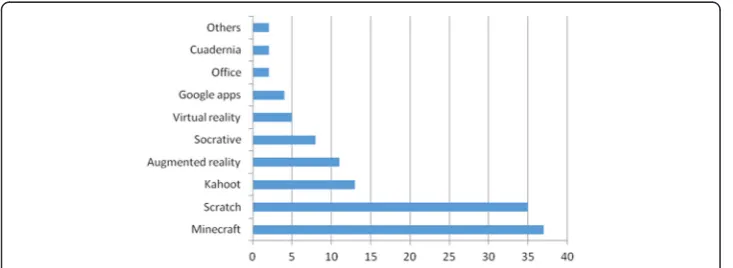
Answers to the question “In your view, what programs or applications offer a game-based learning approach?”highlight that, after the intervention, several subjects greatly
Table 2Scale 1 Rotated matrix
Component
1 2
Focus .662
Initial training .734
Beneficial .679
Worked on .813
I can design .841
I know .836
Principal component analysis. Rotation method: Varimax with Kaiser normalization
Table 3Scale 2 Rotated matrix
Component
1 2 3
Creativity .836
Collaboration .787
Communication .792
Competences .842
Innovation .852
Motivation .884
valued the Minecraft application for educational purposes in the context of game-based learning (Fig. 1).
Answers to the question “In your view, what are the strengths of using gamification in the classroom?” (Fig. 2) essentially highlight motivation, to the extent that it is the value with the highest frequency across the qualitative part of the study. Other listed strengths are interest, meaningful learning and participation. To a lesser extent, other elements such as creativity, attention, cooperation, fun and active approach are mentioned.
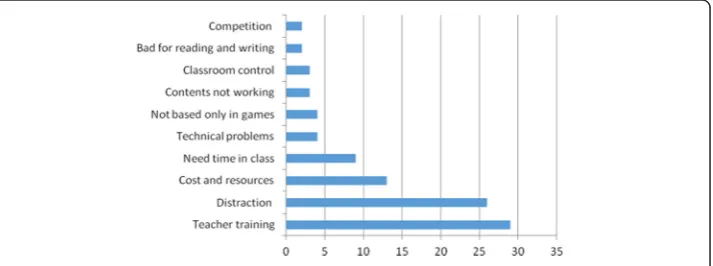
Answers to the last question“In your view, what are the weaknesses of using gamifi-cation in the classroom?”mainly highlight the need for teacher training in design, im-plementation and development of these practices in their teaching profession. Teacher training and distraction are the factors with the highest frequency. The distraction fac-tor can disrupt or hinder the students’learning processes, so an evaluation of this issue is proposed for future study. The availability of resources and lack of time in class are also considered difficulties that may arise when implementing this game-based learning approach (Fig. 3).
Discussion
From the data triangulation and results analysis, the following points can be concluded.
1. The sample group positively values training on game-based learning and gamification approaches during initial training to become teachers (scale 1) (3AB). Only a small number of students know and have worked on these concepts before (items 1.4, 1.5, 1.6 of Table1), and so a boost in university training is necessary. Integration into the curriculum was proposed, which also coincides with findings from other studies (Aldrich2004; Blunt2007; Young et al.2012).
2. The training has significantly favoured knowledge of, attitudes on and the application of game-based learning and gamification (Wilcoxon test, sign test). Students know and value Minecraft in pedagogical contexts with statistically significant improvements (scale 1, scale 2, 1AB). The obstacles to overcome are mainly the need for teacher training and the avoidance of distraction, which may have an effect on the application of these approaches.
3. Game-based learning and gamification enable educational innovation processes (1.5, scale 2, 2AB) and greatly increase student motivation (scale 1.6, scale 2, 2AB). This is in line with what it is proposed in other studies (Blunt2007; Gee2007; Greenfield
2010), in which the importance of increased engagement is underlined. However, we agree with Eseryel et al. (2014), who state that motivation must be combined with contents and pedagogical approaches to enable a better integration in school. 4. Both approaches develop creativity, collaboration and skills development (scale 2,
2AB) and facilitate active learning, participation and interest, and further enhance the student’s fun (scales 3 and 4, 2AB).
Consistent with other recent studies and reports (Sáez-López et al. 2015), this study provides evidence of attitudes, values and perspectives on game-based learning and gamification in university settings, noting that applications with MinecraftEdu enable a number of benefits and advantages centred on pedagogies that allow for greater activ-ity, motivation and involvement of students.
Those training teachers at university must begin to understand that international re-ports are raising these key trends, which will soon be adopted and will then promote a change in educational practices. Initial teacher training programmes must adapt to the challenges and demands of today’s society, by taking into account emerging trends now present in professional settings and soon to be present in the future. Otherwise, reality will surpass training programme designs in higher education.
Fig. 2In your view, what are the strengths of using gamification in the classroom?
About the authors
Ramón Cózar Gutiérrez [email protected]
ORCID: http://orcid.org/0000-0001-8255-6376
Lecturer, Faculty of Education of Albacete, University of Castilla-La Mancha, Spain
Dr Ramón Cózar Gutiérrez is a lecturer in the Department of History at the Faculty of Education of Albacete, University of Castilla-La Mancha (UCLM), Spain. He is the principal investigator of the research group Labintic_Ab. Laboratory integration of ICT in the classroom (labintic.uclm.es) at UCLM. He is the director of ENSAYOS. Revista de la Facultad de Educación de Albacete and campus coordinator of the master’s degree programme in Innovation and Educational Research at UCLM. He has had books and articles published in renowned national and international journals. He has been a visiting scholar at universities in Italy and Portugal and at research centres like the Spanish National Research Council. His research focuses on education and on teaching history, ICT, teaching innovation and teacher training. Universidad de Castilla-La Mancha
Facultad de Educación de Albacete Plaza de la Universidad, 3 02071 Albacete Spain
José Manuel Sáez López [email protected].
ORCID: http://orcid.org/0000-0001-5938-1547
Lecturer, Faculty of Education, National University of Distance Education, Spain
Dr Jose Manuel Sáez Lopez is an assistant lecturer at the National University of Distance Education (UNED), Spain, and a head teacher at a primary school. He holds a doctorate in Educational Models and ICT from the UNED. His scientific and academic work has been published in 31 peer-reviewed journals (three JCR and five Scopus). His research lines are the integration of educational technology in learning processes, analyzing virtual learning environments, the educational use of interactive video conferencing, methodological strategies and the academic use of Open Access. He is accredited as a“contracted doctor lecturer”by ANECA, the National Agency for Quality Assessment and Accreditation of Spain. He has been recognised as a Microsoft Expert Educator 2014 and Microsoft Innovative Expert 2015.
Universidad Nacional de Educación a Distancia Facultad de Educación
C/ Juan del Rosal, 14 28040 Madrid, Spain
Author details
1Faculty of Education of Albacete, University of Castilla-La Mancha, 02071 Albacete, Spain.2Faculty of Education,
National University of Distance Education, 28040 Madrid, Spain.
Received: 5 June 2015 Accepted: 19 September 2015
References
Adell J, Castañeda L (2012) Tecnologías emergentes, ¿pedagogías emergentes? In: Hernández J, Pennesi M, Sobrino D, Vázquez A (eds) Tendencias emergentes en educación con TIC. Asociación Espiral, Educación y Tecnología, Barcelona, pp 13–32
aDeSe (2012). Anuario de la industria del videojuego 2012. Retrieved from http://www.aevi.org.es/index.php?option=com_ mtree&task=att_download&link_id=60&cf_id=30. Accessed 6 May 2015
Akkerman S, Admiraal W, Huizenga J (2009) Storification in history education: a mobile game in and about medieval Amsterdam. Comput Educ 52:449–459
Aldrich C (2004) Simulations and the future of learning: an innovative (and perhaps revolutionary) approach to e-learning. Pfeiffer, San Francisco
Barab S, Sadler T, Heiselt C, Hickey D, Zuicker S (2007) Relating narrative, inquiry and inscriptions: a framework for socio-scientific inquiry. J Sci Educ Technol 16(1):59–82
Barab S, Gresalfi M, Dodge T, Ingram A (2010) Narratizing disciplines and disciplinizing narratives: Games as 21st century curriculum. Int J Gaming Comput Mediat Simul 2(1):17–30
Blunt R (2007) Does game-based learning work? Results from three recent studies. In: Proceedings of Interservice/ Industry Training, Simulation & Education Conference (I ITSEC). NTSA, Orlando, pp 945–954
Borrás O, Martínez M, Fidalgo Á (2014) Gamification in MOOC: challenges, opportunities and proposals for advancing MOOC model. In: Proceedings of the Second International Conference on Technological Ecosystems for Enhancing Multiculturality. ACM, New York, pp 215–220
Cebrián M (2013) Juegos digitales para procesos educativos. In: Aguaded I, Cabero J (eds) Tecnologías y medios para la educación en la e-sociedad. Alianza, Madrid, pp 185–210
Cohen L, Manion L, Morrison K (2000) Research methods in education. Routledge Falmer, London and New York De Freitas S, Oliver M (2006) How can exploratory learning with games and simulations within the curriculum be most
effectively evaluated? Comput Educ 46(3):249–264
De-Marcos L, Saenz-De-Navarrete J, Domínguez A, Pagés C (2014) An empirical study comparing gamification and social networking on e-learning. Comput Educ 75:82–91
Esteve F, Adell J, Gisbert M (2014a) Diseño de un entorno 3D para el desarrollo de la competencia digital docente en estudiantes universitarios: usabilidad, adecuación y percepción de utilidad. Revista Latinoameericana de Tecnología Educativa 13(2):35-47
Esteve M, Duch J, Gisbert M (2014b) Los aprendices digitales en la literatura científica. Diseño y aplicación de una revisión sistemática entre 2001 y 2010. Pixel-Bit. Revista de medios y educación. 45:9-21
European Commission (2013) Opening up Education: Innovative teaching and learning for all through new Technologies and Open Educational Resources. European Commission, Brussels, Retrieved from http://eur-lex. europa.eu/legal-content/EN/TXT/?uri=CELEX:52013DC0654. Accessed 6 May 2015
Gee J (2004) Situated language and learning: a critique of traditional schooling. Routledge, London
Gee JP (2007) Learning and games. In: Salen K (ed) The ecology of games: connecting youth, games, and learning. MIT Press, Cambridge, pp 21–40
Gertrudix M, Gertrudix F (2013) Aprender jugando. Mundos inmersivos abiertos como espacios de aprendizaje de los y las jóvenes. Revista de estudios de juventud 101:123–137
Goetz JP, LeCompte MD (1988) Etnografía y diseño cualitativo en investigación educativa. Evaluación del diseño etnográfico. Ediciones Morata, Madrid
Gómez M (2014) Ciencias Sociales y gamificación, ¿una pareja con futuro? In: Pagès J (ed) Una mirada al pasado y un proyecto de futuro: investigación e innovación en didáctica de las ciencias sociales. Universitat Autónoma de Barcelona; Asociación Universitaria de Profesores de Didáctica de las Ciencias Sociales, Barcelona, pp 257–262
Greenfield PM (2010) Video games revisited. In: van Eck R (ed) Gaming and cognition: theories and practice from the learning sciences. IGI Global, Hershey, pp 1–21
Hair JF, Anderson RE, Tatham RL, Black WC (1998) Multivariate Data Analysis, 5th edn. Prentice Hall, Upper Saddle River Hiltz SR, Coppola N, Rotter N, Turoff M (2000) Measuring the importance of collaborative learning for the effectiveness
of ALN: a multi-measure, multi-method approach. J Asynchronous Learn Netw 4(2):103–125
Johnson L, Adams S, Estrada V, Freeman A (2014) NMC Horizon Report: 2014 Higher, Educationth edn. The New Media Consortium, Austin
Kafai Y (1998) Children as designers, testers and evaluators of educational software. In: Druin A (ed) The design of children’s technology. Morgan Kaufmann Publishers, San Francisco, pp 123–145
Kapp K (2012) The gamification of learning and instruction: game-based methods and strategies for training and education. Pfeiffer, San Francisco
Laros FJM, Steenkamp JBEM (2005) Emotions in consumer behavior: a hierarchical approach. J Bus Res 58(10):1437–1445 Marín V, Martín-Párraga J (2014) ¿Podemos utilizar videojuegos para el desarrollo del currículo de la etapa de infantil?
New Approach Educ Res 3(1):21–27
Michael D, Chen S (2006) Serious games. Games that educate, train and inform. Thomson, Boston
Mishra P, Koehler M, Henriksen D (2011) The seven trans-disciplinary habits of mind: Extending the TPACK framework towards 21st century learning. Educ Technol 51(2):22–28
Moshirnia AV, Israel M (2010) The impact of distinct information delivery systems in modified video games on student learning. J Interact Learn Res 21(3):383–405
Palfrey J, Gasser U (2008) Born digital: understanding the first generation of digital natives. Basic Books, New York Prensky M (2001) Digital game-based learning. McGraw-Hill, New York
Revuelta F, Guerra J (2012) ¿Qué aprendo con videojuegos? Una perspectiva de metaaprendizaje del videojugador. Revistra de Educación a Distancia 33:1–25
Sáez-López JM, Domínguez C (2013) Integración pedagógica de la aplicación Minecraft Edu en educación primaria: un estudio de caso. Píxel-Bit Revista de medios y educación 45:95–110, Retrieved from http://dx.doi.org/10.12795/ pixelbit.2014.i45.07
Sáez-López JM, Miller J, Vázquez-Cano E, Domínguez-Garrido MC (2015) Exploring application, attitudes and integration of video games: MinecraftEdu in middle school. Educ Technol Soc 18(3):114–128, Retrieved from http://www.ifets. info/journals/18_3/9.pdf
Squire K, Jenkins H (2003) Harnessing the power of games in education. Insight 3(1):5–33
Van Eck R (2006) Digital game-based learning: it’s not just the digital natives who are restless. EDUCAUSE Rev 41(2):16–30 Young MF, Slota S, Cutter AB, Jalette G, Mullin G, Lai B, Yukhymenko M (2012) Our princess is in another castle: a
review of trends in serious gaming for education. Rev Educ Res 82:61–89
Submit your manuscript to a
journal and benefi t from:
7Convenient online submission
7Rigorous peer review
7Immediate publication on acceptance
7Open access: articles freely available online
7High visibility within the fi eld
7Retaining the copyright to your article