Licensed under Creative Common Page 218
http://ijecm.co.uk/
ISSN 2348 0386
EVALUATION OF EFFICIENCY OF MICROFINANCE
INSTITUTIONS IN KENYA: AN APPLICATION OF
DATA ENVELOPMENT ANALYSIS
Phares Ochola
Kenya School of Monetary Studies, Kenya [email protected]
Abstract
The study applies Data Envelopment Analysis (DEA) to evaluate relative technical efficiency of
MFI which are not only registered by AMFI but also those that have reported complete data in
the MixMarket database. The inputs are total operating expenses and total assets while the
outputs are financial revenue and gross loan portfolio. In order to comply with the requirement of
DEA that the some of the output variables must be equal to one third of the nine (9) DMUs
studied, the evaluation is undertaken by using each of the output variables separately. Both
reference sets (benchmarks) for inefficient MFIs and their improvement potential is also
computed. Results show that an average efficiency of 50.6% under both the financial revenue
and gross loan portfolio output scenarios with only 89% and 78% of the MFIs being efficient
under each scenarios respectively. A t-test shows that there are no statistically significant
differences between the two sets of efficiencies. On references sets and as expected, all the
inefficient MFISs have the same benchmarking peers under each scenario Findings on
inefficient MFIs’ improvement potentials shows that there is no significant difference
between the target values for each input under both his financial revenue and gross loan
portfolio scenario. This result shows that changing the output variable while keeping the input
variables the same does not produce a significantly different efficiency level and hence target
values.
Keywords: Data Envelopment Analysis, Microfinance Institutions, Slacks, Target Values,
Licensed under Creative Common Page 219
INTRODUCTION
According to Ferdousi (2013), the practice of Microcredit of rendering service to the poor segments of society who are usually underserved by commercial banks can be traced back to the 70s and 80s in Bangladesh’s Grameen Bank. Over the years, this financial innovation has been replicated especially in a number of developing economies. Developments in the sector have seen a move from the narrowly defined microcredit function to all encompassing microphones with its commercialization objective. Like in Bangladesh, the emergence of Microfinance Institutions (MFIs) in developing countries arose from the need to provide alternative sources of finance for the majority of the largely poor segments of the population, thus enhancing these countries’ financial inclusion agenda (Robinson, 2003 and CGAP, 2009).. There is little doubt that since inception, MFIs has played the critical role with marked successes. There is indisputable evidence that through the MFIs, the poor have been enabled to gradually build their assets, develop their enterprises and enhance their earning capacity among
In the East African region, the emergence of MFIs was a consequence of financial sector reforms in the 1990’s whose aim was to develop sustainable, efficient and effective financial systems with the capacity to serve the low-income segment of the society and thereby contribute to economic growth and reduce poverty. Since then, the institutions have seen significant growth. For example, the growth of MFIs has been more significant in Kenya and Rwanda with 22 MFIs 1.3 million having loaned 1.9 billion in 2012 the figure for Rwanda being 24 MFIs 0.8 million having loaned 0.87 billion (Market Information Exchange, (2012) Still in Kenya, according to AMFI Annual report (2013), the total asset of the sector reached the 298.4bn as of December, 2012, this being dominated by banks which represented 72% of the total. The relative market share consisted of 4 banks, 7 DTMs and 21 credit only MFIs representing 85%, 11% and 4% respectively. This scenario succinctly illustrates the significant position of MFIs in the Country’s economy. Questions however have persisted on their efficiency especially given that MFI target the small and medium enterprises. Literature is littered with a number of theoretical models that have widely been used to assess efficiency levels of users of inputs to producer of output with the most prominent methodology being the non-parametric data envelopment analysis (DEA)
Licensed under Creative Common Page 220 Sanchez, 2007), and transportation (Pathomsiri, 2006) and many other industries and organizations. Further, DEA-approach has proved especially valuable in cases where there are non-marketed inputs or outputs and/or cannot be derived or agreed upon among different DMUs. In this study, DEA is used to assess the efficiencies of the MFIs in Kenya
This paper is organized as follows: sub-Section 1.1 gives study problem, section 1.2 purpose and objectives of the study, section 2 gives a brief review of related literature section 3: methodology: model specification, section 4 gives Data and specification of inputs and outputs, section 5: findings and discussion and finally section 6: conclusion, limitation and recommendations.
Study Problem
The phenomenon growth of the sector in Kenya just as in majority of the developing economies has continued to elicit debate on whether this performance is accompanied with efficient use of scarce resource to produce the much need output. As pointed by Ferdousi (2013), MFI development, hitherto dependent on donor funding, has increasingly become dependent on internally generated funds and other inputs. The paradigm shift has exerted more pressure on the institutions to employ resources (input) more efficiently to realize desired results (outputs) and hence the efficiency question. There are very limited studies in the efficiency of MFIs, especially in the poor and developing countries such as in Sub-Saharan Africa region. Hence, the study on efficiency in Kenya is significant as it will contribute to the body of knowledge: theoretically and practically.
This study contributes to the existence empirical literature in two key ways. First, contrary to the previous studies which does not test for efficiency measurement on various output scenarios, our study determines if changing output variables while keeping input variables have a significant effect on efficiency levels and hence the improvement potentials for inefficient DMUs. The objectives of this study are therefore twofold: a) assess the efficiency levels of selected microfinance institutions under selected output scenarios and b) assess the improvement potential of inefficient MFIs under the selected output scenarios.
REVIEW OF RELATED LITERATURE
Licensed under Creative Common Page 221 productivity and efficiency has traditionally been measured by conventional financial ratios or indicators. This notwithstanding, majority of recent studies have increasingly used new methodologies such as data envelopment analysis (DEA) or stochastic frontier analysis (SFA) to assess MFI efficiency
Guitierrez-Nieto, et al (2007) investigated efficiency of MFIs in Latin American MFIs using the non-parametric data envelopment analysis approach. The study used total Assets, operating costs and number of employees as inputs with number of active female borrowers, average loan balance per borrower per Gross National Index and gross loan portfolio and financial revenue as output variables. The study found that Non-Governmental Organizations (NGOs) and non-bank financial institution were the most efficient.
Using DEA methodology, Abdelkader (2012) assessed the efficiency of microfinance institutions in the MENA region over the period 2006-2009. The inputs selected in this study were: total assets, operating expenses, and number of employee, while the outputs used were of two types: financial revenue (and benefit to the poorest. The result showed that average efficiency of most countries of the region had decreased over the period under study. The results further revealed that efficiency significantly differs by legal status among other factors.
A study by Ferdousi (2013) attempted to investigate the comparative performance of microfinance institutions (MFIs) in three Asian countries namely Bangladesh, India and China. Using data envelopment analysis, the study identified best practice MFIs and their efficiency determinants using tobit regression analysis. Findings revealed that MFIs in China and India performs more efficiently than those of Bangladesh under constant return to scale technology but under variable return to scale technology MFIs in Bangladesh perform more efficiently than others. Tobit regression analysis further confirms that the performance of MFIs in terms of total assets and financial performance in terms of profitability is critical for sustainable and efficient development of MFIs.
Hassan & Sanchez, (2009) used DEA methodology under two approaches, the intermediation and the production approach, to undertake a comparative study on MFI efficiencies in North Africa, Latin America and Middle East. The study used operating expenses, total financial expenses and labour inputs and gross loan portfolio, total funds and financial revenues outputs under the intermediation approach. Regarding the production approach, the study used operating expenses and labour and number of active borrowers as the only output. The study found that banks and credit unions MFIs) had a higher technical efficiency than non-profit and non-financial institutions.
Licensed under Creative Common Page 222 Africa. Regarding input variable selection, while under the production approach the study used Labor, Cost per borrower and cost per saver the study used Total number of staffs/personnel and Operating/administrative expense under the intermediary approach. On the output side, Number of borrowers per staff member and number of savers per staff member were used under the production approach while gross loan portfolio and Total savings employed under the intermediary approach. Results showed that non-governmental microfinance institutions were the most efficient as compared to bank-microfinance institutions which were more efficient under intermediation approach.
Nawaz (2010) study on the role played by subsidy on MFIs efficiency and productivity analysis used inputs such as positive subsidy, total assets, operating expenses, and number of employee, while the outputs used were of two types: financial revenue (for financial performance and benefit to the poorest (for social performance). The study used a 3 stage approach of by fist finding technical and pure efficiency scores through DEA followed by deriving DEA-Malmquist indices for internal productivity and finally undertaking Tobit Regression analysis to test a series of hypotheses concerning the relationship between financial efficiency and MFIs productivity, organization, outreach, sustainability and social impact.
A study by Ahmad (2011) undertook to estimate the efficiency of MFIs in Pakistan using Data Envelopment analysis methodology under both the input oriented and output oriented constant return to scale (CRS) and variable return to scale (VRS) assumptions. The output variable set used in this study were gross loan portfolio and number of active borrowers while selected input set was total assets and number of personnel . The study found that inefficiencies in Pakistan were majorly technical in nature and that improvements in managerial skills and technology were the most needed interventions to making inefficient MFIs realize efficiency status.
Licensed under Creative Common Page 223
METHODOLOGY
Decision Making Units (DMUs) and Variable Selection
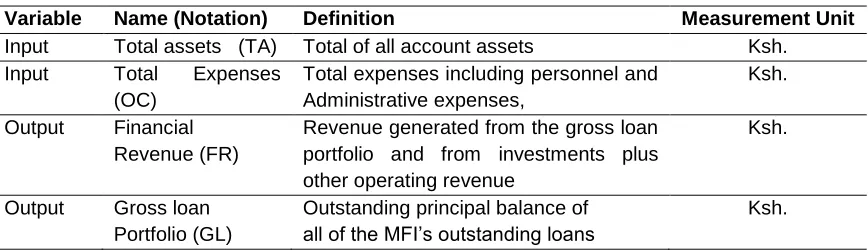
Data used in this study was drawn from Mix Market database and only for MFIs reporting complete information on the target variable. As mentioned earlier, regarding variable selection, various studies have used various input and output in the evaluation of MFI efficiency. In this study, given data availability, we use 5 input variables and 3 output variables in this study (Table 1)
Table 1: Selected Input and Output Variables
Variable Name (Notation) Definition Measurement Unit
Input Total assets (TA) Total of all account assets Ksh. Input Total Expenses
(OC)
Total expenses including personnel and Administrative expenses,
Ksh.
Output Financial Revenue (FR)
Revenue generated from the gross loan portfolio and from investments plus other operating revenue
Ksh.
Output Gross loan Portfolio (GL)
Outstanding principal balance of all of the MFI’s outstanding loans
Ksh.
To ensure meaningful efficiency scores, the number of MFIs (DMUs) must be large enough relative to the number of input and output variables. A rule of thumb is given by Banker, Charnes and Cooper (1984) as [s+m ≤ n/3], where s is the number of output variables, m the number of input variables, and n the number of DMUs. In this research, the number of input and output variables is (2+3), which is less than one-third of the number of DMUs. This is the rule that has been used in this study. In compliance with this rule and to test whether there is a significant difference between the DMU efficiencies derived from different output variables scenarios as follows;
Scenario 1: One output variable (Financial Revenue) and two input variables Total Assets and Total Expenses)
Scenario 2: One output variable (Gross Loan portfolio) and two input variables Total Assets and Total Expenses)
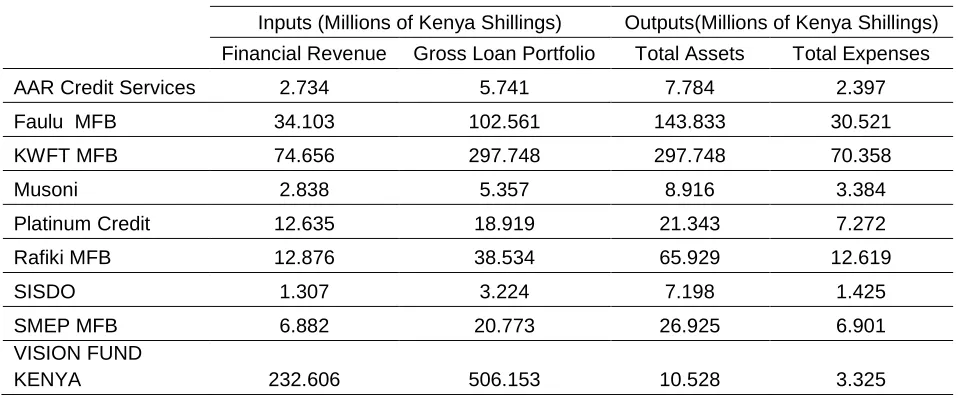
Data Collection
Licensed under Creative Common Page 224 Table 1: Input and Output Variable Data
Inputs (Millions of Kenya Shillings) Outputs(Millions of Kenya Shillings) Financial Revenue Gross Loan Portfolio Total Assets Total Expenses
AAR Credit Services 2.734 5.741 7.784 2.397
Faulu MFB 34.103 102.561 143.833 30.521
KWFT MFB 74.656 297.748 297.748 70.358
Musoni 2.838 5.357 8.916 3.384
Platinum Credit 12.635 18.919 21.343 7.272
Rafiki MFB 12.876 38.534 65.929 12.619
SISDO 1.307 3.224 7.198 1.425
SMEP MFB 6.882 20.773 26.925 6.901
VISION FUND
KENYA 232.606 506.153 10.528 3.325
Source: Mix Market database (2015)
DEA Model Specification
In this study we use the DEA method to assess the level of performance of MFIs efficiency in Kenya. Due to the fact that in MFIs, it is easier to control inputs rather than outputs, the DEA BCC input oriented model with variable return to scale (VRS) is used to compute MFI efficiencies.
Data Envelopment Analysis (DEA) methodology, was first introduced by Charnes, Cooper and Rhodes (1978) measures the relative efficiency of s Decision Making Unit , DMU0 in
comparison with a set of ‘‘n’’ DMUs in a given sample. Commonly know as CCR model after the names of the authors, DEA is a generalization of efficiency model proposed by Farrell (1957). The CCR model measures relative efficiency of a number of entities commonly referred to as Decision Making Units (DMUs) using a set of multiple inputs to generate a set multiple outputs.
DEA’s key objective is to establish a level of relative efficiency (
1
1
) for each DMU by comparing its quantities of inputs and outputs with other DMUs. Regarding the BCC input oriented model.By defining effeminacy as the weighted sum of outputs over the weighted sum of inputs, the following equation is developed:
(i) /
) , (
Licensed under Creative Common Page 225 Using the inputs and outputs of this research the equation cam be written as follows
(ii)
TE)
(
v
)
(
v
)
O
(
u
)
,
(
h
2 1 i 1o
TA
v
u
Where:
ho: Relative efficiency of the MFI
Oi Either Financial Revenue (FR) or Gross loan Portfolio (GL)
TA: Total Asset TE: Total Expenses
ur: Weight given to output r=1
vj: Weight given to inputs j=1,2
(iii)
)
s
s
(
-
min
41 3 1 r j
j r
Subject to: (iv) 1,2, i xx - io
i 9
1 ij j
j
s
(v) 1 i y y io i 9
1 rj j
j
s
.9
1,2,3,4...
j
and
0
j
For the BCC model, the following constract is added
1
9
1
j
jWhere compared is DMU which to DMU al hypothetic the defines that factos intensity of matrix a is : jo j
Efficiency Technical technical of measure reducing (input radial a : equalities to es inequaliti e convert th to used ables slack vari are S and r -i S number real postive a say an smaller th be to defined element n Archimedia An : 0 DEAP software version 2.1 is used in this study to measure the technical efficiency of the MFIs based on BCC input oriented model. It is also used to find the needed improvements of the inefficient MFIs in order to make them 100% efficient.
EMPIRICAL FINDINGS AND DISCUSSION
BCC Efficiency Results
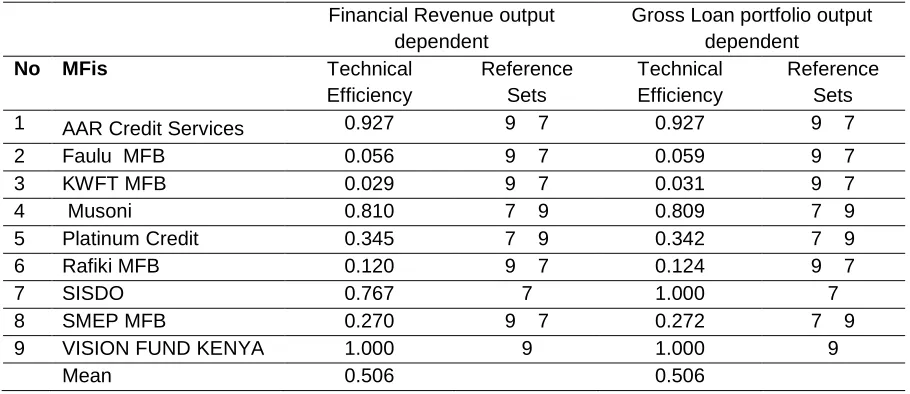
Licensed under Creative Common Page 226 the DEA efficiency scores and reference sets for each MFIs under the two output scenarios of financial revenue and gross loan portfolio while keeping the input variables unchanged.
Table 2: Variable Return to Scale DEA Efficiency and Reference sets Financial Revenue output
dependent
Gross Loan portfolio output dependent
No MFis Technical
Efficiency
Reference Sets
Technical Efficiency
Reference Sets
1 AAR Credit Services 0.927 9 7 0.927 9 7
2 Faulu MFB 0.056 9 7 0.059 9 7
3 KWFT MFB 0.029 9 7 0.031 9 7
4 Musoni 0.810 7 9 0.809 7 9
5 Platinum Credit 0.345 7 9 0.342 7 9
6 Rafiki MFB 0.120 9 7 0.124 9 7
7 SISDO 0.767 7 1.000 7
8 SMEP MFB 0.270 9 7 0.272 7 9
9 VISION FUND KENYA 1.000 9 1.000 9
Mean 0.506 0.506
Firstly, the average efficiency under both financial revenue output and gross loan portfolio scenarios is 0.506 even though there are some differences between corresponding efficiency values. For example, one MF is efficient under financial revenue output scenario while two are efficient under the gross loan portfolio output case. We then proceeded to test whether there is a significant difference between the two sets of technical efficiency values. By defining
μ
FR andGRL
μ as the mean efficiency derived using financial revenue and gross loan portfolio outputs
respectively, the following hypotheses were designed
GRL FR
0: μ μ
H
.
GRL FR
0: μ μ
H
Licensed under Creative Common Page 227 production of services. Interestingly in this study all the inefficient MFIs can benchmark on two DMUs: 7=SISDO and 9=Vision fund.
Assessment of Improvement Potential
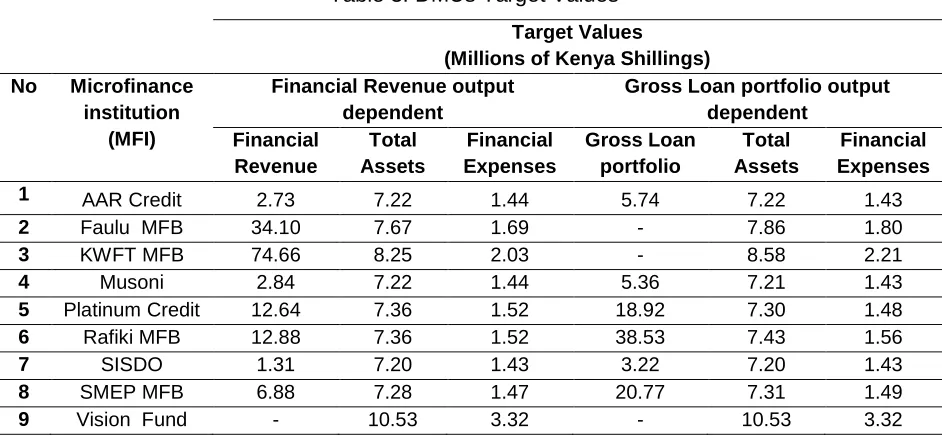
As alluded to earlier, Data Envelopment Analysis models derive input and output weights through optimization. Based on that, units can be classified into efficient and inefficient. In inefficient units, DEA indicates target values of inputs and outputs which would lead to efficiency that is potential for improvement. DEA target value is the amounts by which an inefficient MFI should decrease/increase its inputs/output to become efficient. Target input and output levels are the results of respective slack values added to proportional reduction amounts. For the inefficient DMUs, the targets for input variables comprise proportional reduction in the input variables value. Regarding outputs however, these are obtained by multiplying efficiency scores by the outputs and then adding the slack values to the result. Table 3 shows the target values of all the inputs and outputs in the context of financial revenue and gross loan portfolio efficiency scenarios.
Table 3: DMUs Target Values
Target Values
(Millions of Kenya Shillings)
No Microfinance
institution (MFI)
Financial Revenue output dependent
Gross Loan portfolio output dependent
Financial Revenue
Total Assets
Financial Expenses
Gross Loan portfolio
Total Assets
Financial Expenses
1 AAR Credit 2.73 7.22 1.44 5.74 7.22 1.43
2 Faulu MFB 34.10 7.67 1.69 - 7.86 1.80
3 KWFT MFB 74.66 8.25 2.03 - 8.58 2.21
4 Musoni 2.84 7.22 1.44 5.36 7.21 1.43
5 Platinum Credit 12.64 7.36 1.52 18.92 7.30 1.48
6 Rafiki MFB 12.88 7.36 1.52 38.53 7.43 1.56
7 SISDO 1.31 7.20 1.43 3.22 7.20 1.43
8 SMEP MFB 6.88 7.28 1.47 20.77 7.31 1.49
9 Vision Fund - 10.53 3.32 - 10.53 3.32
Licensed under Creative Common Page 228 Figure 1: Total Asset Actual and Target Values (Millions Kenya Shillings)
Figure 2: Financial Expenses Actual and Target Values (Millions Kenya Shillings)
Clearly, the two inputs exhibit surprisingly the same trend, this a part from the fact that as expected, target values are equal for efficient DMUs are equal. Similar results were realized under the financial revenue scenario. Further, we proceeded to perform a t-test at 5% level to determine if there is a significant difference between the mean target values under the financial
7.7840
143.8334
297.7481
8.9163 21.3430
65.9288
7.1984 26.924810.5284
0.0000 50.0000 100.0000 150.0000 200.0000 250.0000 300.0000 350.0000
1 2 3 4 5 6 7 8 9
To
tal A
ssets
DMUs
Actual
Target
2.40
30.52
70.36
3.38 7.27
12.62
1.43
6.90
3.32 0.00
10.00 20.00 30.00 40.00 50.00 60.00 70.00 80.00
1 2 3 4 5 6 7 8 9
Fi
n
an
ci
al
E
xp
e
n
ce
s
DMUs
Actual
Licensed under Creative Common Page 229 revenues and gross loan portfolio output scenarios. A p-value of 0.45 was obtained, once again, implying that changing the output variable invariably has no effect on the inputs target values.
CONCLUSIONS AND RECOMMENDATIONS
In this research we used the input minimizing Data Envelopment Analysis approach with variable return to scale to measure the technical efficiency of selected nine microfinance institutions in Kenya.
The objectives of the study were twofold: a) assess MFI efficiency levels under two output scenarios: financial revenue and gross loan portfolio; and b) assess the improvement potential of inefficient MFIs under the same output scenarios.
Under both scenarios, an average technical efficiency score of 0.506 was obtained showing that changing the output variable while keeping the inputs variables the same does not affect the average technical efficiency score. A t- test of differences between the mean scores confirmed this result. Analysis of correction between the MFIs technical efficiencies under for the two cases produced the same evidence.
Regarding improvement potential for each inefficient MFIs, the results show that the six inefficient DMUs under both scenarios can improve their performance by learning from SISDO and Vision Fund Kenya as benchmarking institutions. Similarly, on input target values, it was found that efficient MFI had their target values equal to the actual value and that when compared under the two scenarios, the emerging actual and target values trends were the same A t-test at 5% level of significance further showed that there was no statistically significant difference between the mean target value under the financial revenue and gross loan portfolio output scenarios.
From the findings, it is recommended that MFIs in Kenya should improve their efficiency by better use of resources and reducing the amount of waste with respect to inputs. It is further, recommended that in order to provide a more detailed insight on MFIs efficiency, an empirical assessment of their technical efficiency should be undertaken overtime by categorizing the MFIs in terms of their legal status including regulation. In addition, to bit regressions analysis should follow to determine which of the selected input and output factors have the most statistically significant effect on efficiency.
LIMITATIONS
Licensed under Creative Common Page 230 of input and output variables. Further, it would have been appropriate to compare regulated and non-regulated MFIs with availability of complete data for both cases. However, due to data limitation, this was not possible.
REFERENCES
Abdelkader, B., Jemaa, B., & Mekki, M. (2012). Microfinance Institutions’ Efficiency in the MENA region: a Bootstrap-DEA approach.
Ahmad, U. (2011). Efficiency Analysis of Microfinance Institutions in Pakistan, Munich Personal RePEc Archive, Retrieved from http://mpra.ub.uni-muenchen.de/34215
Association of Microfinance Kenya (2012). Annual report, 2nd Edition,
http://www.microfinanzarating.com/newsletter/documenti/2012_annual_report: Accessed on: 12/15/15.
Balkenhol, B. (2007b). Microfinance, Efficiency Return and Public Policy. Microbanking Bulletin, Issue 14, Spring.
Charnes, A.,Cooper, W.W.& Rhodes, E. (1978). Measuring the efficiency of decision making units. European Journal of Operation Research, 26, 29 – 44.
Ferdousi, F. (2013) Performance of Microfinance Institutions in Asia: DEA based efficiency analysis, International Conference on the Modern Development of Humanities and Social Science.
Guitiérrez-Nieto, B., Serrano-Cinca, C. and Molinero, M. (2007) Microfinance institution and efficiency. The international journal of Management Science, Omega, Vol.35.
Hassan, M. K., & Sanchez, B. (2009). Efficiency Analysis of Microfinance Institutions in Developing Countries. Indiana
Haq, M., Skully, M. and Pathan, S. (2010) Efficiency of Microfinance Institutions: A Data envelopment analysis”, Asia-Pacific Financial Markets, Vol. 17.
Kipesha, F. (2012), Efficiency of Microfinance Institutions in East Africa: A Data Envelopment Analysis Erasmus, European Journal of Business and Management, Vol. 4 (17).
Mircofiance Information Exchange (2012) https://www.google.com/?gws_rd=ssl#q=mix+market: Accessed on: 9/12/15