O R I G I N A L R E S E A R C H
What is the most important factor affecting
patient satisfaction
–
a study based on gamma
coef
fi
cient
This article was published in the following Dove Press journal: Patient Preference and Adherence
Jinming Fang1,2 Ling Liu2 Pengqian Fang1
1School of Medicine and Health
Management, Tongji Medical College, Huazhong University of Science and Technology, Wuhan 430030, People’s Republic of China;2Wuhan Forth
Hospital, Puai Hospital, Tongji Medical College, Huazhong University of Science and Technology, Wuhan, 430033, People’s Republic of China
Objective:To analyze the influencing factors of patients satisfaction andfind out the key factors, so as to provide suggestions for improving health policy.
Methods:A questionnaire survey was conducted in Wuhan China. A total of 2,719 ques-tionnaires were collected and 2,626 valid answer sheets were obtained. Through statistical description, chi-square test. Gamma coefficient analysis and binary logistic regression, the key factors affecting patient satisfaction were obtained.
Results: It was found that the “Medical staff’s service attitude” was the most important factor affecting patient satisfaction, followed by “Medical staff services technology” and
“Hospital convenience”. The demographic characteristics of patients had no significant effect on satisfaction, and “Medical services utilization” of patients had a certain impact on satisfaction. Patients had a higher degree of satisfaction with the “Hospital convenience”,
“Hospital facilities and environment”, “Medical staff services technology”,“Medical staff service attitude”, but had a lower degree of satisfaction with “Medical expense” and
“Reimbursement ratio for medical expenses”.
Conclusion: “Medical staff’s service attitude”, “Medical staff services technology” and
“Hospital convenience”was the most three important factors. The health managers should focus on the above three aspects and implement appropriate management decisions to improve patient satisfaction.
Keywords:patient satisfaction, urban, hospitals, health care reform, public policy
Introduction
Medical and health services were public utilities to promote people’s health.
Patients were the objects of medical and health services. The fundamental goal of the government in developing health services was to meet the growing health needs of the people. Patient satisfaction, which referred to the conclusion reached by patients and their families after comparing their feelings during the medical service with their previous expectations, was the criterion of medical service quality.
Patient satisfaction was usually measured by a patient’s questionnaire and was
critical in assessing the quality of medical care.1 In today’s highly competitive
medical environment, satisfaction had become the core competitiveness of medical
and health institutions.2,3Therefore, it was very important for medical institutions
and their superior departments tofind out the factors that affect patients’satisfaction
with medical services.
Correspondence: Pengqian Fang School of Medicine and Health Management, Tongji Medical College, Huazhong University of Science and Technology, 13 Hangkong Road, Qiaokou District, Wuhan 430030, People’s Republic of China Tel +861 339 715 3995 Email [email protected]
Patient Preference and Adherence
Dove
press
open access to scientific and medical research
Open Access Full Text Article
Patient Preference and Adherence downloaded from https://www.dovepress.com/ by 118.70.13.36 on 26-Aug-2020
Some countries tried to improve medical satisfaction through health care reform. The Netherlands had gradually
introduced a competition mechanism in the field of health
care through a series of administrative reforms, so as to
improve the efficiency of the reform in thefield of health
care and medical satisfaction. Britain implemented the patient-centered concept and introduced a competition mechanism in the general practitioner, to increase the
patient’s right of choice.4,5The Obama administration took
medical insurance as the breakthrough point in the reform, which to strengthen the government role, trying to keep the doctor from the medical insurance, medical authorization and medical lawsuit of trivial matters, in order to improve the
satisfaction on both patients and medical staff.6,7
In 2009, China launched a new round of medical and
health system reform.8–10Its short-term goals includedfive
areas: accelerating the establishment of the basic medical security system, implementing the national essential drug system, improving the primary health care service system, promoting the equalization of basic public health services,
and initiating the pilot reform of public hospitals.8,11,12
Among them, the pilot reform of public hospitals included the following contents: establishing the management sys-tem of public hospitals, establishing new operating mechanism of public hospitals, especially compensation mechanism, reducing the price of drug consumables, establishing the division of labor and cooperation between different levels of medical institutions, carrying out graded
diagnosis and treatment and two-way referral.13The
pur-pose was to reduce the medical economic burden of resi-dents, increase the income of the medical staff, reduce the risk of the medical security system, and provide safe, effective, convenient and cheap health services for the whole people, in order to improve the patient satisfaction. Previous studies had shown that there were many
fac-tors influencing patient satisfaction, Some researchers
found that, among demographic characteristics, age, health
status, and race consistently had a statistically significant
effect on satisfaction scores. Among the institutional
char-acteristics, hospital size consistently had a significant
effect on patient satisfaction scores.14 Some studies
sug-gested that patients with better health tend to be more
satisfied with their medical care, but the cause and effect
of this relationship had not been determined.15 Some
researchers believed that age and illness are important factors affecting patient satisfaction, and elderly patients
tended to be satisfied with the medical process, while
severe patients tended to be dissatisfied with the medical
process.16,17 Other studies had found that hospital
envir-onment, service attitude of hospital staff and other basic
services, such as catering, can affect patient satisfaction.18
Through literature review, it could be found that the factors affecting patient satisfaction mainly come from two aspects. One was the individual factors of patients, includ-ing gender, income, health status, medical insurance, mar-ital status, family size, etc. The second was the factors from the hospital, including medical conditions, fees, insti-tutional level, environmental facilities.19–24
However, the results of different research were not consistent, and there were few studies on the importance of factors affecting patient satisfaction. This study was
based on the background of China’s medical and health
reform. Try to explore the key factors affecting patient satisfaction and provide some suggestions for the reform.
Methods
Study populations
We chose to investigate in the Wuhan city in China. Wuhan was the capital of Hubei Province and was located in central China. Wuhan was rich in medical resources and its eco-nomic development was at a medium level in China. There
were many medical institutions of various affiliations and
levels. Wuhan City initiated the reform of the medical and health system at the end of 2015. In 2017, all public hospitals in Wuhan were carried out reform. The reform of public hospitals in Wuhan was relatively mature and stable, which
could accurately reflect the effect of China’s medical reform
policies. We believed this survey was representative of
China’s public hospital reform.
We stratified hospitals according to their affiliation and
adopt the method of stratified sampling. The stratum of
hospitals included: Hospital administered by the National Health Commission, Provincial Hospital, Municipal hospi-tal, District hospihospi-tal, Military hospihospi-tal, and Enterprise-owned hospital. The purpose was used to make the sample
more representative. Finally, thirteen hospitals were
selected, and the hospital level included Secondary hospital and Tertiary hospital, and the category included General
Hospital. Specialized Hospital, Hospital of Chinese
Medicine, and Maternal and Child Health Hospital. At least 200 patients were investigated in each hospital. For outpatients, a convenient sampling method was used to investigate the patients who had been treated. For inpatients, the inpatient departments of the hospital were randomly
sampled first, and then all patients with more than 3 days
Patient Preference and Adherence downloaded from https://www.dovepress.com/ by 118.70.13.36 on 26-Aug-2020
of hospitalization in the department were investigated. A total of 2,860 questionnaires were distributed and 2,719 were returned.After removing incomplete and illogical
ques-tionnaires, 2,626 valid answers were finally obtained. This
study was approved by the Ethics Committee of Puai hospi-tal (No: KY 2018-027-01). The privacy was strictly
pro-tected byfilling in the questionnaires anonymously.
Questionnaires
From previous studies, we selected possible influencing
fac-tors and put them in our questionnaire. The questionnaire
consisted of three parts. The first part collected the basic
Socio-demographic characteristics of patients, including
“Gender”,“Age”,“Place of residence”and“Type of medical
insurance”. The second part was medical services utilization
of patients including“Hospital affiliation”,“Hospital level”,
“Hospital category”,“Treatment type”, “Reason for
medi-cal”,“Whether this hospital is the preferred medical
institu-tion”, and “Registration method”. The third part was
patients’ overall satisfaction and factors related to patient
satisfaction, such as“Hospital convenience”,“Hospital
facil-ities and environment”, Medical staff services technology,
“Medical staff service attitude”, “Medical expenses”,
“Reimbursement ratio for medical expenses”. Considering
the cultural level and cognitive ability of the patients, the
questions about satisfaction adopted the Likert’s three-point
method, that was, one point meant very dissatisfied (which
meant very bad, very inconvenient, and very expensive), three points meant moderate (which meant not too bad),
and five points meant very satisfied (which meant very
good, very convenient, and very cheap).
Index of measurement
The Gamma coefficient was considered to be a good
indi-cator for the correlation analysis of ordered classification
data. Its value was between−1 and 1. When G=0, it meant
the two variables were irrelevant. When G>0, the two variables were positively correlated, and G<0 meant nega-tively correlated. The closer the absolute value of G was to
1, the greater the degree of association was, the closer its’
value was to 0, and the smaller the correlation degree was.
Statistical analyses
Excel 2016 was used for the preparation of a database, and a double check method was used to enter the data. SPSS 24.0 was used for statistical analysis. First, a preliminary analysis of the overall data was performed using statistical descriptions. Second, the chi-square test was used to
screen the influencing factors of satisfaction. Third, the
Gamma coefficient was used to analyze the correlation
between patients’ overall satisfaction and factors related
to patient satisfaction. Fourth, Multiple analysis was uti-lized to explore deeper relationships.
We took patient satisfaction as the dependent variable, encoding“very satisfied”as ‘1ʹ,“Moderate”and “very dis-satisfied”as ‘0ʹ, and then used binary logistic regression to determine the significant factors influencing patient
satisfac-tion. A linear regression model was usedfirst to determine
whether there was multicollinearity between independent vari-ables. After that, the variables were placed in binary logistic regression and the variable selection method was using the forward LR. Socio-demographic characteristics and medical services utilization of patients were included in the equation in the form of dummy variables, and factors related to patient satisfaction were included in the equation in the form of ordered variables. the type I error rate was set to 0.05. Odds
ratios(OR)were recorded with 95% confidence interval.
Results
Statistical description
Descriptive statistics were performed on the patients’basic
characteristics and Table 1 was obtained. The patients inves-tigated were mainly comprised of female (53.8%). The majority of the patients were under the age of 35 years old (38.6%). Most of the patients lived in Wuhan (71.4%), and 83.0% of the patients had social medical insurance.
According to the patient’s medical services utilization, the
municipal hospitals (30.8%), tertiary hospitals (92.4%), and general hospitals (77.2%)were the main hospitals. and the main reason for medical was to be sick (87.2%). The hospital
Surveyed in was the patients’preferred medical institution
accounted for the majority(88.2%), and the Registration method was mainly concentrated in hospital registration (80.2%). The information was shown in Table 2.
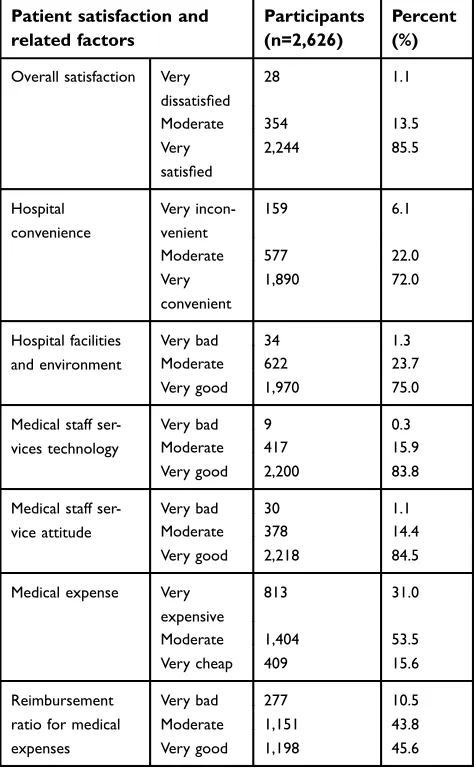
The percent of patients’ overall satisfaction was 85.5%,
The percent of satisfaction on the“Hospital convenience”,
“Hospital facilities and environment”, “Medical staff
ser-vices technology”, “Medical staff service attitude”,
“Medical expenses”, and“Reimbursement ratio for medical
expenses”was 72.0%, 75.0%, 83.8%, 84.5%, 15.6%, 45.6%
respectively (Table 3).
Univariateanalyses
Taking the overall satisfaction as the indicator variable and the Socio-demographic characteristics and medical
Patient Preference and Adherence downloaded from https://www.dovepress.com/ by 118.70.13.36 on 26-Aug-2020
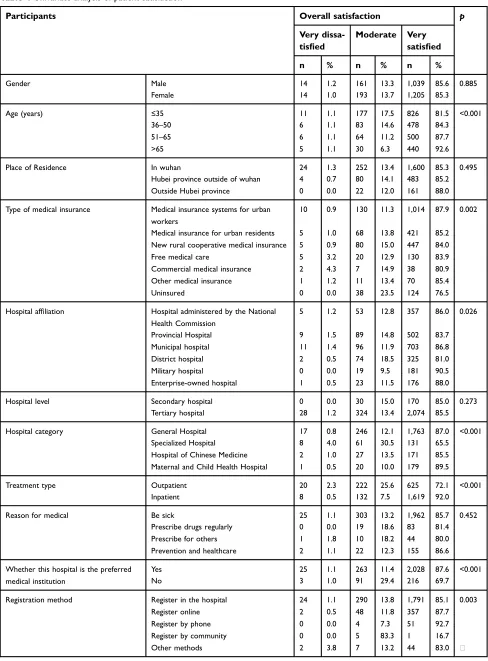
services utilization of patients as the grouping factors, the chi-square test was performed, and Table 4 was obtained.
There was no statistically significant difference in
“Gender”, “Place of Residence”, “Hospital level”, and
“Reason for medical” (p>0.05), the other factors
exhib-ited significant differences (p<0.05).
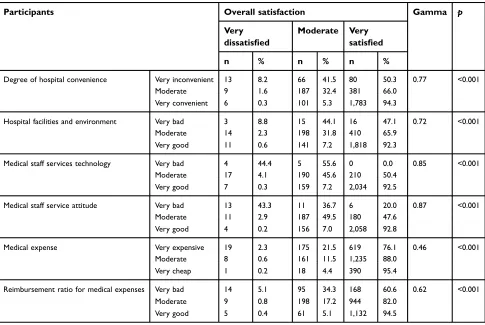
In the Gamma test, all factors related to patient satisfaction had a positive correlation with overall satisfaction(Table 5) and were statistically significant (p<0.001),The three most relevant
factors were“Medical staff service attitude”(Gamma=0.87),
“Medical staff services technology” (Gamma=0.85) and
“Hospital convenience” (Gamma=0.77). All the statistically
significant factors would be analyzed in the Multivariate
analysis.
Multivariate analyses
Prior to binary logistic regression, a linear regression model was used to test for the existence of
multicollinear-Table 1Socio-demographic characteristics of patients
Characteristics Participants
(n=2,626)
Percent (%)
Gender Male 1,214 46.2
Female 1,412 53.8
Age (years) ≤35 1,014 38.6
36–50 567 21.6
51–65 570 21.7
>65 475 18.1
Place of residence
In Wuhan 1,876 71.4
Hubei province out-side of Wuhan
567 21.6 Outside Hubei province 183 7.0 Type of medical insurance Medical insurance systems for urban workers
1,154 43.9
Medical insurance for urban residents
494 18.8
New rural coopera-tive medical insurance
532 20.3
Free medical care 155 5.9
Commercial medical insurance 47 1.8 Other medical insurance 82 3.1
Uninsured 162 6.2
Table 2Medical services utilization of patients
Medical services utilization of patients Participants (n=2,626) Percent (%) Hospital affiliation
Hospital admi-nistered by the National Health Commission 415 15.8 Provincial hospital 600 22.8 Municipal hospital 810 30.8
District hospital 401 15.3 Military hospital 200 7.6
Enterprise-owned hospital
200 7.6
Hospital level Secondary hospital
200 7.6
Tertiary hospital 2,426 92.4
Hospital category
General hospital 2,026 77.2 Specialized hospital 200 7.6 Hospital of Chinese Medicine 200 7.6 Maternal and Child Health Hospital 200 7.6
Treatment type Outpatient 867 33.0
Inpatient 1,759 67.0
Reason for medical
Be sick 2,290 87.2
Prescribe drugs regularly 102 3.9 Prescribe for others 55 2.1 Prevention and healthcare 179 6.8 Whether this hospital is the preferred medi-cal institution
Yes 2,316 88.2
No 310 11.8
Registration method
Register in the hospital
2,105 80.2
Register online 407 15.5
Register by phone 55 2.1 Register by community 6 0.2
Other methods 53 2.0
Patient Preference and Adherence downloaded from https://www.dovepress.com/ by 118.70.13.36 on 26-Aug-2020
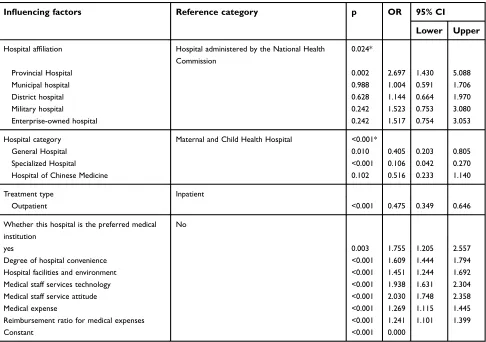
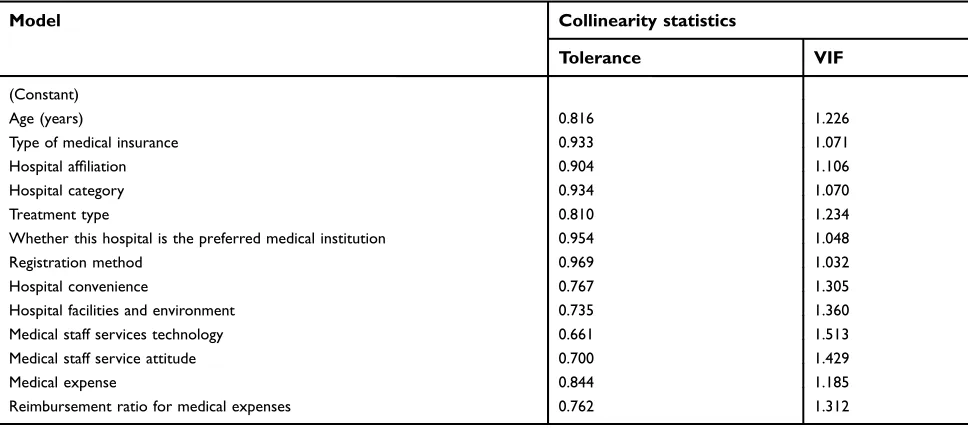
ity between independent variables. The result showed that all independent tolerance value of was greater than 0.1 and VIF value was not great than 5 (which could see in supplementary materials), that was to say, all the indepen-dent variables did not have multicollinearity, then we could place all variables into the binary logistic regression directly. After 6 iterations, 10 variables entered the
equa-tion. The Variables were “Hospital affiliation”, “Hospital
category”,“Treatment type”,“Whether this hospital is the
preferred medical institution”, and all factors related to
patient satisfaction (p<0.05; Table 6). The Omnibus Tests
of Model Coefficients showed the chi-square value was
914.993 (p<0.001), which meant the model is statistically
significant. The Hosmer and Lemeshow Test showed the
chi-square value was 15.518 (p=0.050), which meant that
the information in the current data had been fully extracted
and the goodness-of-fit of the model was enough. This
model could correctly predict 90.7% of the study subjects, with the sensitivity of 97.3%.
In particular, compared with the “Hospital
adminis-tered by the National Health Commission”, the odds of
patient satisfaction in the “Provincial Hospital”,
“Municipal hospital”,“District hospital”,“Military
hospi-tal”, and “Enterprise-owned hospital”was higher (the OR
was 2.697, 1.004, 1.144, 1.523, 1.517 respectively).
Compared with the “Maternal and Child Health
Hospital”, the odds of patient satisfaction in “General
Hospital”, “Specialized Hospital”, and “Hospital of
Chinese Medicine”was lower (the OR was 0.405, 0.106,
0.516 respectively). Compared with “inpatients”, the
“Outpatients” were less likely to feel satisfied
(OR=0.475,p<0.001). Compared with“non-preferred
hos-pitals”, the patients were more likely to feel satisfied with
the“preferred medical institution”(OR=1.755.p=0.003.)
With the improvement of “Hospital convenience” for
each grade, the patients’ overall satisfaction odds would
increase by 60.9% (OR=1.609,p<0.001). With the
improve-ment of“Hospital facilities and environment”for each grade,
the patients’ overall satisfaction odds would increase by
45.1% (OR=1.451, p<0.001). With the improvement of
“Medical staff services technology” for each grade, the
patients’overall satisfaction odds would increase by 93.8%
(OR=1.938,p<0.001). With the improvement of “Medical
staff service attitude”for each grade, the patients’ overall
satisfaction odds would increase by 103.0% (OR=2.030,
p<0.001). With the improvement of“Medical expense”for
Each grade, the patients’ overall satisfaction odds would
increase by 26.9% (OR=1.269,p<0.001). With the
improve-ment of “Reimbursement ratio for medical expenses” for
each grade, the patients’ overall satisfaction odds would
increase by 24.1% (OR=1.241,p<0.001).
Discussion
The theory of customer satisfaction originated from enterprise
management. Most scholars’understanding of customer
satis-faction revolves around the “expectation-difference”
para-digm. The basic connotation of this paradigm was that customer expectation forms a reference point for product and service comparison and judgment. Customer satisfaction was perceived as a subjective feeling, which described the degree
to which customers expect to be satisfied with the purchase of
a particular commodity. Customer satisfaction was at the heart of modern marketing theory and practice. Hospitals, like enterprises, were able to survive by meeting consumer
Table 3 Patients’ overall satisfaction and factors related to patient satisfaction
Patient satisfaction and related factors
Participants (n=2,626)
Percent (%)
Overall satisfaction Very dissatisfied
28 1.1
Moderate 354 13.5
Very satisfied
2,244 85.5
Hospital convenience
Very incon-venient
159 6.1
Moderate 577 22.0
Very convenient
1,890 72.0
Hospital facilities and environment
Very bad 34 1.3
Moderate 622 23.7
Very good 1,970 75.0
Medical staff ser-vices technology
Very bad 9 0.3
Moderate 417 15.9
Very good 2,200 83.8
Medical staff ser-vice attitude
Very bad 30 1.1
Moderate 378 14.4
Very good 2,218 84.5
Medical expense Very expensive
813 31.0
Moderate 1,404 53.5
Very cheap 409 15.6
Reimbursement ratio for medical expenses
Very bad 277 10.5
Moderate 1,151 43.8
Very good 1,198 45.6
Patient Preference and Adherence downloaded from https://www.dovepress.com/ by 118.70.13.36 on 26-Aug-2020
Table 4Univariate analysis of patient satisfaction
Participants Overall satisfaction p
Very dissa-tisfied
Moderate Very satisfied
n % n % n %
Gender Male 14 1.2 161 13.3 1,039 85.6 0.885
Female 14 1.0 193 13.7 1,205 85.3
Age (years) ≤35 11 1.1 177 17.5 826 81.5 <0.001
36–50 6 1.1 83 14.6 478 84.3
51–65 6 1.1 64 11.2 500 87.7
>65 5 1.1 30 6.3 440 92.6
Place of Residence In wuhan 24 1.3 252 13.4 1,600 85.3 0.495
Hubei province outside of wuhan 4 0.7 80 14.1 483 85.2
Outside Hubei province 0 0.0 22 12.0 161 88.0
Type of medical insurance Medical insurance systems for urban workers
10 0.9 130 11.3 1,014 87.9 0.002
Medical insurance for urban residents 5 1.0 68 13.8 421 85.2 New rural cooperative medical insurance 5 0.9 80 15.0 447 84.0
Free medical care 5 3.2 20 12.9 130 83.9
Commercial medical insurance 2 4.3 7 14.9 38 80.9
Other medical insurance 1 1.2 11 13.4 70 85.4
Uninsured 0 0.0 38 23.5 124 76.5
Hospital affiliation Hospital administered by the National Health Commission
5 1.2 53 12.8 357 86.0 0.026
Provincial Hospital 9 1.5 89 14.8 502 83.7
Municipal hospital 11 1.4 96 11.9 703 86.8
District hospital 2 0.5 74 18.5 325 81.0
Military hospital 0 0.0 19 9.5 181 90.5
Enterprise-owned hospital 1 0.5 23 11.5 176 88.0
Hospital level Secondary hospital 0 0.0 30 15.0 170 85.0 0.273
Tertiary hospital 28 1.2 324 13.4 2,074 85.5
Hospital category General Hospital 17 0.8 246 12.1 1,763 87.0 <0.001
Specialized Hospital 8 4.0 61 30.5 131 65.5
Hospital of Chinese Medicine 2 1.0 27 13.5 171 85.5 Maternal and Child Health Hospital 1 0.5 20 10.0 179 89.5
Treatment type Outpatient 20 2.3 222 25.6 625 72.1 <0.001
Inpatient 8 0.5 132 7.5 1,619 92.0
Reason for medical Be sick 25 1.1 303 13.2 1,962 85.7 0.452
Prescribe drugs regularly 0 0.0 19 18.6 83 81.4
Prescribe for others 1 1.8 10 18.2 44 80.0
Prevention and healthcare 2 1.1 22 12.3 155 86.6
Whether this hospital is the preferred medical institution
Yes 25 1.1 263 11.4 2,028 87.6 <0.001
No 3 1.0 91 29.4 216 69.7
Registration method Register in the hospital 24 1.1 290 13.8 1,791 85.1 0.003
Register online 2 0.5 48 11.8 357 87.7
Register by phone 0 0.0 4 7.3 51 92.7
Register by community 0 0.0 5 83.3 1 16.7
Other methods 2 3.8 7 13.2 44 83.0
Patient Preference and Adherence downloaded from https://www.dovepress.com/ by 118.70.13.36 on 26-Aug-2020
needs.25In modern hospital management, patient satisfaction was also the embodiment of hospital comprehensive strength.
There were many factors influencing patient satisfaction, and
through this study, we identified the key factors that affect
patient satisfaction.
“
Medical staff service attitude
”
,
“
medical
staff services technology
”
, and
“
hospital
convenience
”
were the three most
important factors affecting patient
satisfaction
Previous studies had revealed that Chinese patients were more
concerned about doctors’attitudes toward services, medical
quality and rationality of medical costs. Dissatisfaction among Chinese patients had focused on high costs (including expen-sive drugs, high testing costs, expenexpen-sive medical devices, and over-treatment), long waiting times (including long queues and many medical links) and unreasonable processes (such as
paying first and then seeing a doctor),26 Some experts had
shown that interpersonal skills, the humanitarian quality of the staff, a good doctor-patient relationship, information
provided to the patient about his or her condition are
crucial,1,27,28There were also studies believed that doctors’
professional knowledge was one of the main factors that affect
patient satisfaction,29and many patients were highly
dissatis-fied with hospital facilities.
In our research, “Hospital convenience”, “Hospital
facilities and environment”, “Medical staff services
tech-nology”, “Medical staff service attitude”, “Medical
expense”, “Reimbursement ratio for medical expenses”
were all influential factors with statistical significance.
this was roughly the same as the previous study, but our research had taken a further step. We ranked these factors,
among which, the strongest influencing factor was
“Medical staff service attitude”, followed by “Medical
staff services technology” and “Hospital convenience”.
This indicated that most patients were more concerned about whether their condition was cared about and respected by doctors. It also showed that being patient-centered was more important than being disease-patient-centered.
The weakest influencing factor was“Reimbursement ratio
for medical expenses”, that meant, although the
“Reimbursement ratio for medical expenses” had
Table 5Correlation analysis of patients’overall satisfaction and factors related to patient satisfaction
Participants Overall satisfaction Gamma p
Very dissatisfied
Moderate Very satisfied
n % n % n %
Degree of hospital convenience Very inconvenient 13 8.2 66 41.5 80 50.3 0.77 <0.001
Moderate 9 1.6 187 32.4 381 66.0
Very convenient 6 0.3 101 5.3 1,783 94.3
Hospital facilities and environment Very bad 3 8.8 15 44.1 16 47.1 0.72 <0.001
Moderate 14 2.3 198 31.8 410 65.9
Very good 11 0.6 141 7.2 1,818 92.3
Medical staff services technology Very bad 4 44.4 5 55.6 0 0.0 0.85 <0.001
Moderate 17 4.1 190 45.6 210 50.4
Very good 7 0.3 159 7.2 2,034 92.5
Medical staff service attitude Very bad 13 43.3 11 36.7 6 20.0 0.87 <0.001
Moderate 11 2.9 187 49.5 180 47.6
Very good 4 0.2 156 7.0 2,058 92.8
Medical expense Very expensive 19 2.3 175 21.5 619 76.1 0.46 <0.001
Moderate 8 0.6 161 11.5 1,235 88.0
Very cheap 1 0.2 18 4.4 390 95.4
Reimbursement ratio for medical expenses Very bad 14 5.1 95 34.3 168 60.6 0.62 <0.001
Moderate 9 0.8 198 17.2 944 82.0
Very good 5 0.4 61 5.1 1,132 94.5
Patient Preference and Adherence downloaded from https://www.dovepress.com/ by 118.70.13.36 on 26-Aug-2020
statistical significance on patient satisfaction, it was not
a strong influence factor. It could only be considered as
a secondary factor in improving patient satisfaction. For the health care reform department and hospital admin-istrators, it was very difficult to improve all aspects of patient satisfaction, so it was especially important to grasp the most important factors affecting patient satisfaction. Our results showed that if hospitals wanted to quickly improve patient satisfaction, they should focus on improving service attitudes.
The demographic characteristics of
patients had no signi
fi
cant effect on
satisfaction, and the medical services
utilization of patients had a certain impact
on satisfaction
Some studies had shown that older patients, patients with low education levels, married patients and patients with high social
status have higher satisfaction.30Some studies believed that
the patient’s personal characteristics were the decisive factor
of satisfaction,31in addition, some studies had shown that men
tended to have higher satisfaction scores than women.32
Conversely, others believed that patients’demographic
vari-ables were not associated with patient satisfaction,33,34In this study, after adjusting confounding factors by multivariate regression analysis, we found that “Gender”,“Age”,“Place of Residence”,“Type of medical insurance”had no significant effect on satisfaction.
We also found that the medical services utilization of
patients had a certain impact on satisfaction. The hospitals’
affiliation determined the medical resources it received and
the comprehensive medical capacity.35This might affect the
patient’s feeling. The satisfaction of inpatients was higher
than that of outpatients, which was consistent with previous
research.26,36Perhaps the inpatients had more contact with
the medical staff and had a better understanding of the
hospital’s complicated service processes, so they could be
more considerate of the hard work of the medical staff.
Table 6Multiple analysis of the factors influencing patient satisfaction
Influencing factors Reference category p OR 95% CI
Lower Upper
Hospital affiliation Hospital administered by the National Health Commission
0.024*
Provincial Hospital 0.002 2.697 1.430 5.088
Municipal hospital 0.988 1.004 0.591 1.706
District hospital 0.628 1.144 0.664 1.970
Military hospital 0.242 1.523 0.753 3.080
Enterprise-owned hospital 0.242 1.517 0.754 3.053
Hospital category Maternal and Child Health Hospital <0.001*
General Hospital 0.010 0.405 0.203 0.805
Specialized Hospital <0.001 0.106 0.042 0.270
Hospital of Chinese Medicine 0.102 0.516 0.233 1.140
Treatment type Inpatient
Outpatient <0.001 0.475 0.349 0.646
Whether this hospital is the preferred medical institution
No
yes 0.003 1.755 1.205 2.557
Degree of hospital convenience <0.001 1.609 1.444 1.794
Hospital facilities and environment <0.001 1.451 1.244 1.692
Medical staff services technology <0.001 1.938 1.631 2.304
Medical staff service attitude <0.001 2.030 1.748 2.358
Medical expense <0.001 1.269 1.115 1.445
Reimbursement ratio for medical expenses <0.001 1.241 1.101 1.399
Constant <0.001 0.000
Notes:Variable screening using the forward LR method. The Socio-demographic characteristics factors and Medical services utilization of patients were included in the
equation in the form of dummy variables, and thep-value marked with an asterisk was the omnibusp-value. Factors related to patient satisfaction were included in the
equation in the form of ordinal variables.
Patient Preference and Adherence downloaded from https://www.dovepress.com/ by 118.70.13.36 on 26-Aug-2020
However, outpatients often experienced complicated proce-dures and needed to wait a long time to get a shorter
treat-ment service,26 which could cause dissatisfaction. It was
suggested that the hospital should strengthen outpatient management, optimize the diagnosis and treatment process, shorten the waiting time of patients. Patients were more
satisfied with the preferred hospital, which might be due to
their approval of the preferred hospital. In China, the hier-archical medical system was not yet established, and patients were not restricted by medical insurance, they could choose any hospital for diagnosis at will. Therefore,
the assessment would be more naturally satisfied when the
patient chose a hospital that was familiar and trusted. When patients came to a non-preferred hospital, they were unfa-miliar with everything, so it was easy to bring about com-munication problems and caused dissatisfaction. It was suggested that hospital managers should pay more attention to referral patients from other hospitals, strengthen the introduction of the basic hospital information, make patients more familiar with the hospital environment and medical service process, and make full communication for the treat-ment and prognosis of the disease, so the patients would feel
more comfortable and satisfied.
Other relevant information obtained
from the statistical analysis
From descriptive statistics, patient satisfaction rate with the
“Hospital convenience”, “Hospital facilities and
environ-ment”, “Medical staff services technology” and “Medical
staff service attitude” were much higher than “Medical
expense”and“Reimbursement ratio for medical expenses”,
indicating that further efforts were needed to control the cost of patients and increase the reimbursement ratio of medical insurance . Patients with social medical insurance accounted for the majority, the proportion of uninsured patients was
very small, indicating that China’s health insurance coverage
was quite good. The relatively low proportion of commercial insurance indicated that the commercial insurance market had not yet fully developed. The main reason for medical
treatment was“Be sick”, indicating that the concept of
med-ical treatment was still the mainstream, and the concept of health prevention still needed to be popularized. Although various channels such as online booking and telephone book-ing had been used in each hospital, the utilization rate of them was not high. The vast majority of patients still chose to register in the hospital. These issues must be taken seriously by the health care reform department.
Limitation
This study was a cross-sectional study. It could only obtain the views of patients at that time, and could not compare the situation before and after. The categories of some
influencing factors in this study were not detailed enough,
which will be further improved in subsequent studies.
Conclusion
We found that the three factors most associated with patient
satisfaction were“Medical staff service attitude”,“Medical
staff services technology”, and“Hospital convenience”. The
demographic characteristics of patients had no significant
effect on satisfaction, and medical services utilization of patients had a certain effect on satisfaction. The medical reform department should make policy adjustment accord-ingly to promote the reform development.
Ethics approval
The study was reviewed and approved by the Ethics Committee of Puai hospital, Wuhan, China (No: KY 2018-027-01). The survey documentation included printed instructions and information for patients about the anon-ymous nature of the survey and aggregated data processing
which ensured that patient identification was not possible.
Given that no identifiable information was collected, and
the format of“informed oral consent”was accepted by the
Ethics Committee, no signed informed consent was requested, All the patients were informed and provided oral consent. The voluntary return of completed question-naires was taken as consent to participate in the study.
Acknowledgments
The authors thanked all the patients took part in the sur-vey. This work was supported by the National Social Science Foundation of China (No: 15ZDC037) and Wuhan Health and Family Planning Commission Fund (No: WG15A03).
Author contributions
All authors contributed to data analysis, drafting and
revis-ing the article, gave final approval of the version to be
published, and agree to be accountable for all aspects of the work.
Disclosure
The authors report no conflicts of interest in this work.
Patient Preference and Adherence downloaded from https://www.dovepress.com/ by 118.70.13.36 on 26-Aug-2020
References
1. Tsai TC, Jha AK, Orav EJ. Patient satisfaction and quality of surgical care in US Hospitals. J Surg Res. 2014;186(2):528. doi:10.1016/j. jss.2013.11.382
2. Jh H, Stockard J, Tusler M. Hospital performance reports: impact on quality, market share, and reputation. Health Aff. 2005;24 (4):1150–1160. doi:10.1377/hlthaff.24.4.1150
3. Koch LC, Pd R. Assessing consumer satisfaction in rehabilitation and allied health care settings.Work. 2008;31(3):357–363.
4. Ruggie M. Markets and medicine: the politics of health care reform in Britain, Germany, and the United States. J Health Polit Policy Law. 2004;29(3):135–144. doi:10.1215/03616878-29-3-525 5. Griggs E. The politics of health care reform in Britain.Quart Polit.
2010;62(4):419–430. doi:10.1111/j.1467-923X.1991.tb00872.x 6. Mckillop CN, Waters TM, Kaplan CM, Kaplan EK, Thompson MP,
Graetz I. Three years in–changing plan features in the U.S. health insurance marketplace. BMC Health Serv Res. 2018;18(1):450. doi:10.1186/s12913-018-3198-3
7. Geyman J. Crisis in U.S. health care: corporate power still blocks reform. Int J Health Serv. 2018;48(1):5. doi:10.1177/0020731417729654 8. Fang P, Luo Z, Fang Z. What is the job satisfaction and active
participation of medical staff in public hospital reform: a study in Hubei province of China. Hum Resour Health. 2015;13:34. doi:10.1186/s12960-015-0026-2
9. Jiang S, Wu WM, Fang P. Evaluating the effectiveness of public hospital reform from the perspective of efficiency and quality in Guangxi, China. Springerplus. 2016;5(1):1922. doi:10.1186/s40064-016-3598-y 10. Yip WC-M, Hsiao WC, Chen W, Hu S, Ma J, Maynard A. Early
appraisal of China’s huge and complex health-care reforms.Lancet. 2012;379(9818):833–842. doi:10.1016/S0140-6736(11)61880-1 11. Liu Y. Reforming China’s health care: for the people, by the
people? Lancet. 2009;373:281–283. doi:10.1016/S0140-6736(09) 60080-5
12. Li L. The challenges of healthcare reforms in China.Public Health. 2011;125:6–8. doi:10.1016/j.puhe.2010.10.010
13. Chen Z. Launch of the health-care reform plan in China.Lancet. 2009;373(9672):1322–1324. doi:10.1016/S0140-6736(09)60753-4 14. Gary J, Mm Y, Desai KR. Patient satisfaction with hospital care:
effects of demographic and institutional characteristics. Med Care. 2000;38(3):325–334.
15. Hall JA, Milburn MA, Epstein AM. A causal model of health status and satisfaction with medical care.Med Care. 1993;31(1):84–94. 16. Hargraves JL, Wilson IB, Zaslavsky A, et al. Adjusting for patient
characteristics when analyzing reports from patients about hospital care.Med Care. 2001;39(6):635–641.
17. Rahmqvist M. Patient satisfaction in relation to age, health status and other background factors: a model for comparisons of care units. Int J Qual Health Care. 2001;13(5):385. doi:10.1093/ intqhc/13.5.385
18. Hasin MAA, Seeluangsawat R, Shareef MA. Statistical measures of customer satisfaction for health care quality assurance: a case study. Int J Health Care Qual Assur. 2001;14(1):6–14. doi:10.1108/ 09526860110366214
19. Meina Liu QZ, Lu M, Kwon C-S, Quan H. Rural and urban disparity in health services utilization in China. Med Care. 2007;45 (8):767–774. doi:10.1097/MLR.0b013e3180618b9a
20. Qian D, Pong RW, Yin A, Nagarajan KV, Meng Q. Determinants of health care demand in poor, rural China: the case of Gansu Province.Health Policy Plan. 2009;24(5):324–334. doi:10.1093/ heapol/czp016
21. Moorin RE, Holman CD. The effects of socioeconomic status, acces-sibility to services and patient type on hospital use in Western Australia: a retrospective cohort study of patients with homogenous health status.BMC Health Serv Res. 2006;6:74. doi:10.1186/1472-6963-6-74
22. Mao Z, Wu B. Urban-rural, age and gender differences in health behaviours in the Chinese population: findings from a survey in Hubei, China.Public Health. 2007;121(10):761–764. doi:10.1016/j. puhe.2007.02.015
23. Lopez-Cevallos DF, Chi C. Health care utilization in Ecuador: a multilevel analysis of socio-economic determinants and inequality issues.Health Policy Plan. 2010;25(3):209–218. doi:10.1093/heapol/ czp052
24. Fang P, Han S, Zhao L, Fang Z, Zhang Y, Zou X. What limits the utilization of health services among the rural population in the Dabie Mountains- evidence from Hubei province, China?BMC Health Serv Res. 2014;14:379. doi:10.1186/1472-6963-14-379
25. Farzianpour F, Byravan R, Amirian S. Evaluation of patient satisfac-tion and factors affecting it: a review of the literature. Health. 2015;07(11):1460–1465. doi:10.4236/health.2015.711160
26. Chen N, Zhou X, Zhang Y. Comparisons between Chinese and Mongolian patient satisfaction. Psychology. 2017;08 (13):2126–2137. doi:10.4236/psych.2017.813135
27. Shrivastava SR, Shrivastava PS, Ramasamy J. Exploring the dimen-sions of doctor-patient relationship in clinical practice in hospital settings. Int J Health Policy Manag. 2014;2(4):159–160. doi:10.15171/ijhpm.2014.40
28. Thompson DA, Yarnold PR, Williams DR, Adams SL. Effects of actual waiting time, perceived waiting time, information delivery, and expressive quality on patient satisfaction in the emergency department.Ann Emerg Med. 1996;28(6):657–665.
29. Laveist TA, A N-J. Is doctor-patient race concordance associated with greater satisfaction with care? J Health Soc Behav. 2002;43 (3):296–306.
30. Hall JA, Dornan M. Patient sociodemographic characteristics as pre-dictors of satisfaction with medical care: A meta-analysis.Soc Sci Med. 1990;30(7):811–818. doi:10.1016/0277-9536(90)90205-7 31. Ware JEJ, Mk S, Wr W, Ar D. Defining and measuring patient
satisfaction with medical care. Eval Program Plann. 1983;6 (3):247–263.
32. Quintana JM, González N, Bilbao A, Aizpuru F, Escobar A. Predictors of patient satisfaction with hospital care. BMC Health Serv Res. 2006;6(1):102. doi:10.1186/1472-6963-6-102
33. Ammo MA, Abu-Shaheen AK, Kobrosly S, Al-Tannir MA. Determinants of patient satisfaction at tertiary care centers in Lebanon. Open J Nurs. 2014;04(13):939–946. doi:10.4236/ ojn.2014.413100
34. Gopalakrishna VMP. Mediators versus moderators of patient satisfaction.J Health Care Mark. 1995;15(4):16.
35. Hsiao W. The Chinese health care system: lessons for other nations. Soc Sci Med. 1995;41(8):1047–1055.
36. Jenkinson C. Patients’experiences and satisfaction with health care: results of a questionnaire study of specific aspects of care.Qual Saf Health Care. 2002;11(4):335–339.
Patient Preference and Adherence downloaded from https://www.dovepress.com/ by 118.70.13.36 on 26-Aug-2020
Supplementary material
Before binary logistic regression, a linear regression model was used to examine whether there was multi-collinearity between independent variables. The result showed that the tolerance value of all independent was
greater than 0.1 and the value of VIF was less than 5, that was to say, all the independent variables did not have multicollinearity, then we could put all variables into the binary logistic regression directly (Table S1).
Patient Preference and Adherence
Dove
press
Publish your work in this journal
Patient Preference and Adherence is an international, peer-reviewed, open access journal that focusing on the growing importance of patient preference and adherence throughout the therapeutic conti-nuum. Patient satisfaction, acceptability, quality of life, compliance, persistence and their role in developing new therapeutic modalities and compounds to optimize clinical outcomes for existing disease
states are major areas of interest for the journal. This journal has been accepted for indexing on PubMed Central. The manuscript management system is completely online and includes a very quick and fair peer-review system, which is all easy to use. Visit http:// www.dovepress.com/testimonials.php to read real quotes from pub-lished authors.
Submit your manuscript here:https://www.dovepress.com/patient-preference-and-adherence-journal
Table S1Multicollinearity test in independent variables
Model Collinearity statistics
Tolerance VIF
(Constant)
Age (years) 0.816 1.226
Type of medical insurance 0.933 1.071
Hospital affiliation 0.904 1.106
Hospital category 0.934 1.070
Treatment type 0.810 1.234
Whether this hospital is the preferred medical institution 0.954 1.048
Registration method 0.969 1.032
Hospital convenience 0.767 1.305
Hospital facilities and environment 0.735 1.360
Medical staff services technology 0.661 1.513
Medical staff service attitude 0.700 1.429
Medical expense 0.844 1.185
Reimbursement ratio for medical expenses 0.762 1.312
Note:Dependent variable was the overall satisfaction.
Patient Preference and Adherence downloaded from https://www.dovepress.com/ by 118.70.13.36 on 26-Aug-2020