WITH SPECIAL
REFERENCE
TOTARGUM ONKELOS
by
PINCHAS TOLEDANO
UNIVERSITY COLLEGE, LONDON
LONDON
1980
ACKNOWLEDGMENT
I would be failing in my duty were I not to express
my heartfelt gratitude to my dear friend, Raphael
Loewe, Reader in Jewish Studies at the University College London, without whose constant encourageroent and help at all times I would never have been able
to pursue my research or produce this Thesis. -r::J'(P
nr,)'~LY ,,,,,,"":HV~
''':1:n1,41!l '-:;
-z:a~U"
• 1 ,,"{ -'LV'
'":""~rl '~
"May the Lord God of Israel give him all that he deserves".
My sincere thanks also to Professor S. Stein who helped me during the earlier stages of this Thesis.
I wish to put on record my gratitude to the Board of Elders and congregants of the Spanish and Portuguese Jews' Congregation for their help and encouragement
during my studies at the University College London.
My deep appreciation is also expressed to my Secretary,
Mrs. Pat Goldstein, for h~r loyalty and dedication
(
(
'" _ ignored)
.:t b bb (-:"" ~ f). -, )
)
-r
g gg
d dd
, v
, z
n
h'ta t
r>
1 .
.J'D
•
j k, ch
1
m
n
s
"
I I
)f
I _ marked where essential only)p, f, or ph
ts
q or k
r
sh s
A few frequently occurring terms have been treated
for the purpose of this Thesis as loan-words in English, and consequently left without technical
translation: thus Peshat is written rather than Peshat (~U'-'), as against Peshitta (KJ"H.!)·~.9),Gaon and
• •
Geonim rather than Galon, Gelonim, Onkelos (not 'Onqelos) etc.
The English translation of each verse is taken from the N.E.B. (Oxford University Press - Cambridge University Press 1970) except in a few places and especially in the Section of "Anti-anthropomorphisms"
where the N.E.B. paraphrases the text. In these
Tal. Talmud
Bab. Babylonian
Palest. Palestinian
Ps. Jonathan. Pseudo Jonathan
f' Targ. Targum
Sanh. Sanhedrin
Ch. ( s) Chapter (s)
Kerit. Keritut
Gitt. Gittin
Sot. Sotah
Ket. Ketubot
Shabo Shabbat
Rab. Rabbi
Ned. Nedarim
B.D.B. Brown - Driver - Briggs
Irub. Irubin
Men. Menahot
Hag. Hagiga
Tam. Temurah
Tanh. Tanhuma
Yalk. Yalkut
Mace. Maeeot
Pes. Pesahim
Beeh. Beehorot
Kid. Kiddushin
N.E.B. Naz. Yeb. Rosh-Hash. zeb. Shek. Meg. Neg. Ohal Kel.
Ab. Zara.
Prove Ez. Sam. Jos. Is. Jer. Zech. Neh. Jud. Ps. Chron. Hab. Lam. Gen. Ex. Num. Lev. Deut.
New English Bible Nazir
Yebamot
Rosh Hashanah Zebahim Shekalim Megillah Negaim Ohalot Kelim
1. General Introduction
2. Halacha
Introduction
Group A(l) -Where Onkelos interprets against the accepted Halacha of the Talmud and Rashi makes no comment.
Group A (II)-The Targumim contain pre-tannaitic
Tradition.
Group B
Group C
Group D
-Where Ookelos interprets "Halachic verses" literally and thereby fails to explicate the Halacha whether designedly or otherwise.
-Rashi quotes Ookelos, but only in a few instances be remarks without labouring the point that Onkelos is against the expositions of the Rabbis.
-In a few instances Rashi quotes Onkelos for no apparent purpose, since the same "Halachic interpretations" occur in the Talmud or other sources of Jewish
Group E
Group F
Group G
Summary
In at least 55 cases Ookelos expounds "halachic verses" in
accordance with talmudic tradition but Rashi passes him over in
silence.
In cases where Rashi follows one tannaitic opinion and
Onkelos another, Rashi never adds that Ookelos' view corresponas to the other opinion.
Rashi and Halacha.
In some cases Rashi interprets against the current HaLacha. Furthermore in places where the tannaitic Rabbis were at variance Rashi interprets not in accordance with the accepted ruling of
3. Midrash
Introduction
Group A
Group B
Group C
Group D
Rashi quotes Onkelos for no apparent purpose since the
latter's "haggadic inter-pretations" occur in the Midrash.
When Onkelos' haggadic inter-pretations differ from those of the Midrash, Rashi quotes Onkelos and fits his inter-pretations in line with the wording of the text.
Onkelos' haggadic inter-pretations correspond to those of the Rabbis, yet Rashi ignores him and quotes only the Hidrash.
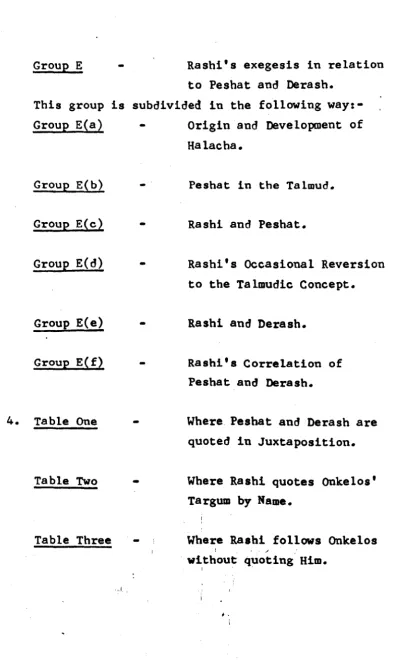
Group E Rashi's exegesis in relation to Peshat and Derash.
This group is subdivided in the following
way:-Group E(a) Origin and Development of
Group E(b)
Group E(c)
Group E(d)
Group E(e)
Group E(f)
4. Table One
Table Two
-Table Three
, •. 1, ,
Halacha.
Peshat in the Talmud.
Rasbi and Peshat.
Rashi's Occasional Reversion to the Talmudic Concept.
Rashi and Derash.
Rashi's Correlation of Peshat and Derash.
Where Peshat and Derash are quoted in Juxtaposition.
Where Rashi quotes Ookelos' Targum by Name.
Where Rashi follows Onkelos
1 • ~
without quoting Him.
I
I .
5. Rashi as Philologist.
Introduction.
Chapter 1.
Chapter 2.
Chapter 3.
Chapter 4.
Chapter 5.
-Chapter 6.
Chapter 7.
Chapter 8.
Chapter 9.
".I
Chapter 10.
-Rashi's Use of Onkelos' Targum with regard to Nouns and Verbs.
Rashi's Use of the Targum without identifying Onkelos.
Free Translation.
Translation of Biblical Idioms into Aramaic.
Injection of "Derash and "Halacha" in Onkelos' Targum.
The Influence of Aramaic Language on the Hebrew.
Rejection of Onkelos' Translations.
Rashi and Menachem Ben Seruk.
, I
I ! 1 I
I '
.-Onkelos and Hebrew Grammar.
1 ,
Rashi and the Text of Onk.los.
6. Anti-anthropomorphisms.
Introduction
Group A.
Group B.
Group
c.
Group D.
Group E.
Group F.
Group G.
-Group H.
-Group I.
Motion and Place denied God.
Reference. to Human Form and Organs.
Reference to Human Emotions.
References to Physical Reaction.
Reference to Human Senses.
Prepositions implying Motion or other Corporeality.
Intermediary Elements.(Divine Name Elaborated or Substituted).
Direct and Indirect Softening(Or Free Substitution).
References Exposed to Polytheistic Interpretation.
i
I
, I
i
I .
. -'
7. Reverence to God.
8. Veneration of the Patriarchs and their
De scendant s.
Introduction
GrouE A
Group B
Group C
Group D
Veneration and Idealization of the Patriarchs and their Wives.
Veneration and Idealization of the Patriarch's Sons.
Veneration 9nd Idealization of the Prophet Moses.
- Veneration and Idealization of
Aaron,the Priests,The Elders of Israel and the People of Israel.
9. Rashi and Ps.Jonathan Targum.
10. Rashi and Jonathan's Targum on the Prophets.
11. Notes.
Before we analyse Rashi's attitude towards Onkelos'
Targum which is our main subject, a briefl
introduction dealing with Rashi's life, as well as about his adopted approach and method with regard to his commentary on the Pentateuch, may facilitate comprehension of his treatment of Onkelos' Targum.
2
Rashi (1040-1105) was born at Troyes - France. His father was a scholar whom Rashi quotes in his
commentary on the Talmud (Ab.Zara 75a). Very little
is known about his early life except that he attended
the academies of Mainz and Worms. At about the
age of 25 he returned to Troyes3 and
~~:~Q~
influence was notable. Around 1070, he founded his
an academy which attracted many pupils from different parts of the world. Most likely during that period he began
Talmud. often he
to write his comments on the Bible and His style is clear and concise. Quite solves a difficulty by adding a single word. One or two words suffice for him to explain an
obscure verse or refute a false interpretation. It has been said that in Rashi's time "a drop of ink
4
was worth a piece of gold". "The scholar and bibliog-rapher H.J.D. Azulai, scarcely exaggerated when he
said that Rashi could express in one letter tbat for
5
terseness in not quoting the full text of a Siphre (e.g. DEUT.1 3), or of the Talmud,6 is due to his assuming that the reader is fully aware of the relevant details. In consequence, it is a mistake to assume that Rashi's commentary was intended exclusively for the masses. His vast knowledge
-a'1/' ~ TAre
enabled him to ~»aBS~6e almost the whole Talmud,
but his mastery lies essentially in his commentary on the Torah. His grandson, Jacob of Rameru,
(Ramerupt) known as Rabbenu Tam,7 the leader of
the Tosafists, said "I could also write a commentary on the Talmud like my grandfather, but as for his commentary on the Bible, I have not the intellectual
strength for that work and cannot do it". 8 Later
generations accorded him the title of Parshandata.9
Rashi's commentary on the Torah is an~eal example
of the methodology of the French exegetes. Having
a wide knowledge of Biblical and Rabbinical literature, Rashi was able to incorporate in his commentary not
10 11
only Halacha, Midrash and Peshat, but also a
fairly large measure of philological and grammatical
observations.12 To do this Rashi took his
inter-pretations from different sources such as the Midrashim, Sipbre, Siphra, Mechilta, Mishna and
GENERAL INTRODUCTION
In the field of grammar and philology he derived
his principles from Rabbinic literature and the Hebrew work of the Spanish lexicographers Menachem Ben Seruk and Dunash Ben Labrat. Not being versed in Arabic literature he never learnt of Judah Ben
David Hayyuj's work or Jonah Ibn Janah's work on
1Jwr 13
triconso~talism. However, scattered throughout
his commentary there are several comments on syntax, tenses, conjugations, and transposition of woxd
order.14 One of the characteristics of Rashi's
exegesis is the manner in which he formulated his
comments. In many instances he did not quote a
midrash literally, but either abridged or augmented
it and several times he even altered its wording.
lS
His prime concern was to elucidate the biblical text for which purpose his commentary was written.
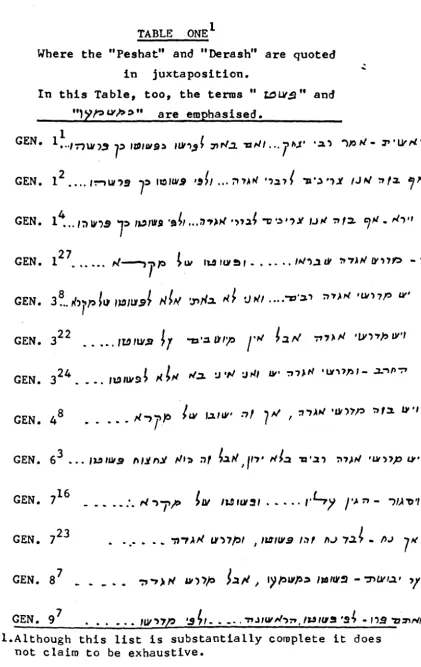
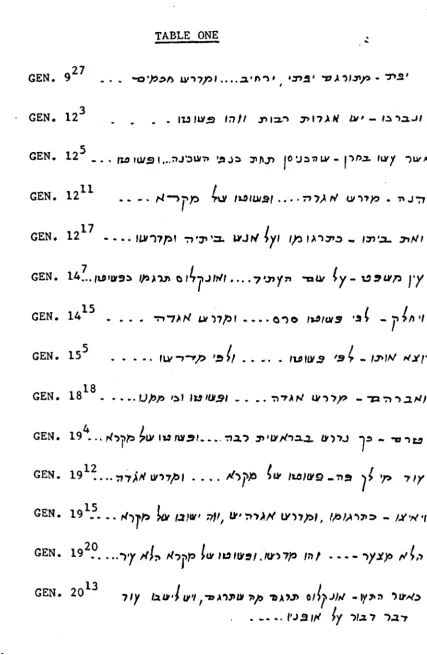
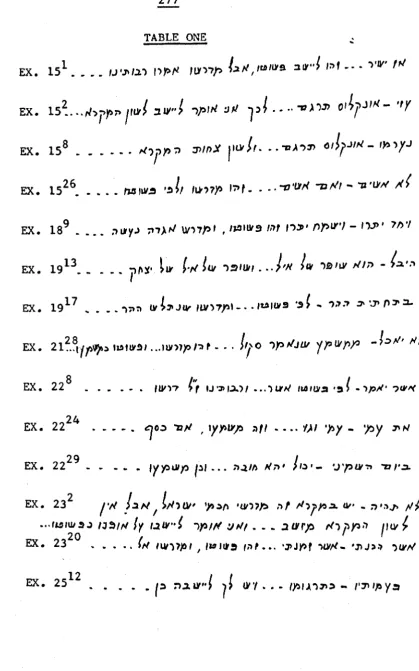
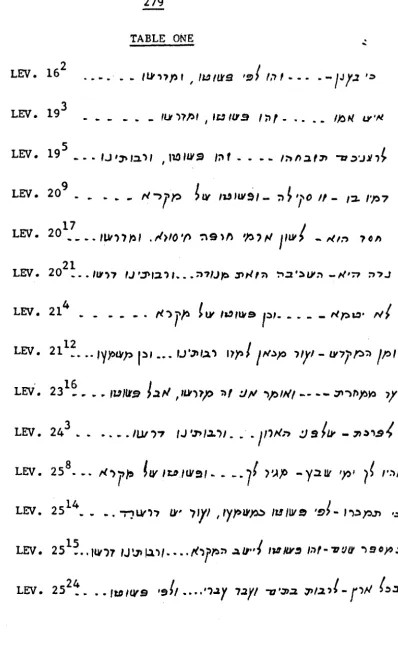
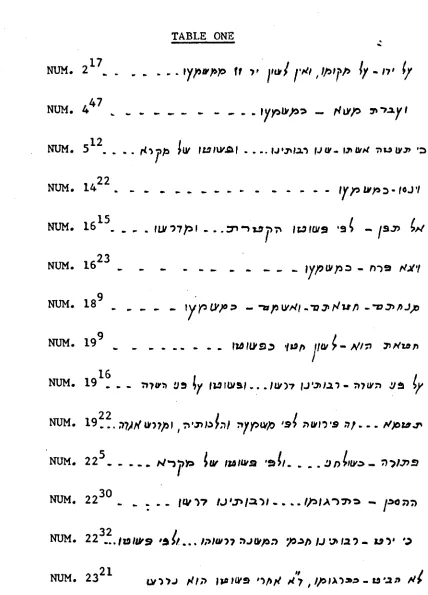
Another characteristic aspect of Rashi's exegesis is the deliberate juxtaposition of Peshat and Derash. "Table One" will show the st1,ldent Rashi's concern for the "Peshat" of the text, and that even though he quotes the 'tDerash" the Peshat is by no means
sacrificed. In fact his emphatic mode of expression shows his concern for the Pe.hat method. - "There
are many midrashic explanati~ns and our teachers
the words of Scripture in a manner that fits in
16 ..
with them. His commitment to the Peshat led him
to put not only the Peshat and the Derash side by 17
side, but also the "Peshat Halacha" with tb.at of thE 18
"Dc.rash Halachalt
• However, quite often he interprets
the text in the light of the"Derash Halacha"only,19 but sometimes his prime concern for the Peshat of the text led him to reject the "Derash Halacha"::O For this reason too, if the Mechilta offers several halachic interpretations Rashi selects such specimens of "Derash Halacha" that do the least violence to
21
the Peshat of the text. Similarly in cases of controversy where the Rabbis argue as to the interpretation of a halachic text, Rashi adopts the halachic opinion which is nearer to the Peshat of the text although it is not the accepted ruling of the Talmud:2 Rashi was fully aware that the prime purpose of his commentary is not to deduce Halachot,but rather to afford insight into the
depth of the biblical sense. His prime concern,
text). Hmvever, as said above, even when he is
dissatisfied with the current llalacha, he nonetheless, 23
puts side by side his own halachic deductions with
those of the talmudic Rabbis. The deliberate
juxtaposition of the two interpretations show that the ttpeshat Halacha" and the "Derash Halacha" do not conflict, but on the contrary, the juxtaposition characterises the validity of both interpretations.
However, despite his assertion abnut the importance of the Peshat, he does not keep to his rule and quite often, for no apparent reason, he falls back upon the Midrash,or. at least, he does not offer
the Peshat of the text. At times Rashi makes it clear that the text could be understood through
24
the aid of the Midrash only. He does so even
25 when the scriptural text offers no difficulty.
At this stage, it is worth mentioning that Rashi has not always taken the term "Peshat" to mean the literal meaning of the text, as in fact we understand today,but rather follows the looser
talmudica126 understanding of this term. And so long
as the Derash does no violence to the text, Rashi
France, to introduce the above mentioned method
of biblical
exeg~~i~~l,
i.e. the deliberatejux-taposition of Peshat and Derash. This new trend
may have been due to the Franco-German environment
of his days. The Jewish public was imbued with
midrashic exegesis and was not ready to abandon it. Rashi, therefore, who realised that the Peshat
ought not to be disre.garded, projected a new
method by putting Peshat and Derash side by side, thus catering not only for the emergence of the new school of thought which considered Peshat
exegesis as paramount for the understanding of the text, but also for the old school of thought which cared merely for midrashic exegesis and was not
28
prepered to abandon it. This, too, would explain Rashi's incorporation of Philology and grammatical points in his commentary. Most likely his intention was to awaken the interest of Ashkenaz
(Franco-German) Jewry to study the Bible from a philologica129
concept and not solely according to the Derash method.
Another contributing factor to the growth of Peshat exposition in France,may have been the result of
, 30
1 .
r
31..
itheir christo og1ca 1nterpretat ons.
No doubt, too, the rise of the Karai~es in the eighth century iu Spain, and in particular in the Niddle East, contributed to the advancement of
Peshat method. The Karaites rejected the Oral law
(the Talmud) and held exclusively to the scriptuL~1
texts. The controversy between the Rabbanites and the Karaites with regard to the interpretations of biblical texts, brought into existence a new method of exegesis, independent of the Hidra sh and the
. Talmud. To suppress the Karaites' views, Saadia
Gaon (892-942) and his followers were compelled to seek new methods and the Peshat, the natural method, was applied for the interpretation of
biblical texts. Although Rashi and his school were not familiar with the works of the Karaites
un-doubtedly they had heard2 of their
existenc~
andtheir methods in interpreting the biblical texts. Consequently to safeguard the masses from following
p~~
the sect's views Rashi PQstulatee the Peshat and the Derash side by side, the two methods by which a scriptural text could be interpreted. Rashi,
therefore, impresses on his generation that both
~ethods are legitimate for the understanding of
the text. At a later t~me, however, the Peshat
completely rejected as can be seen from Samuel-ben-Meir's commentary. We may even say that the Peshat
became so indispensable that the French Jewry was in danger of creating its own"Karaite schism". Rashbam's commentary and the like certainly had
~4-~,.L ,If'" A
strengthened and intensified the(new schismJ~
~hQir views., namely that biblical texts do not
invariably indicate the laws as known to the Rabbis,
33
e.g. the wearing of the Tephillin.
As has been said above, one of Rashi's main
sources was Onkelos' Targum. It seems that he was
the first one, er at least among the French Rabbis,
who made extensive use of Onkelos' Targum. He used
it not only because of its
pOPularit~~
but alsodue to the fact that he assumed that the Targum which goes under Onkelos' name was, in its present
form, written by Onkelos the proselyte, the disciple of Rabbi Joshua and Rabbi Eliezer.35 Rashi' s
~xtensive use of this Targum may also have been due to the fact that on the whole Onkelos' Targum is close to the text, and in matters including philology (or xather semantics) this was a great help to Rashi. The fact, too, that Hebrew and
Aramai~ are related semitic languages, may well
, 36
have been'the reason for Rashi to turn to Onke1os •
II
GENERAL INTRODUCTION
In addition, Rashi was fully aware that the Targum was intended for use in the public worship of the
37
Synagogue and, therefore, it could be assumed that
any rules of translation adopted by the Targum would
38
have been laid down and approved by the Rabbis, for no teacher could expound the law for the public unless his exposition was approved by the Sages. Rashi, therefore, revered the Targum Onkelos so much that even though his own interpretations are
supported by the Talmud, nonetheless he quotes
the support of Onkelos.39 Indeed through the aid of
Onkelos' Targum, Rashi was able to illuminate
several midrashic40 and balachic4l passages in the
Talmud itself. Rashi turns to Onkelos not only in
42 43
the fields of Derash Aggadab and Derash Halacha,
but even more extensively in the field of philology.44 His mastery of the Aramaic language enabled him to explain also the various ways adopted by Onkelos
15
in translating a text. Thus in GEN.43 Rashi has
this to say:
-1''''lY
~~ ,.~~:1.:1""':2.71
tJI~",-np _
I'1):J:L -n "'/,'.:z.
nr"""
~:.l'?.:a.,
,.".,'"J'UI~;a.
":IJUI"'D7"',"
':7'tn'f~' ~O"11 "n7~
IJ
'f:> ) "\:J) r.> "'1:2 • .., .:1"'7 ~ .-\ ':'J.J~.:z. f\r
:J n --.,:l7/,::J/ tJ J / , J ',I') .... ":7') n• --,.:z.-"
Aramaic for taking money and for taking a person [with one
J.
In the case of an object that can betaken by hand, Onkelos uses - ::z..·o J - "he carried", whilst in the case of a person who is conducted by
" 45
verbal persuasion, Onkelos uses - .,:17 - be
red
(away) •When Onkelos' interpretation seems to be detached from the context of the text, Rashi endeavours to conform his interpretation in line with the text
and thus he says in GEN. 2016 -
'P~'T
o,f\J,"","
t
y
f:"J ",-;'
7~ ,..t~r~":J
!'lk!'
~
-r:::J •...,,.,~ -c/J~;J...
,,~')""" ;')
"Onkelos translated in a different manner, and the words of the text fit in with the Targurn in the
46
following way". If Onkelos uses a verb different from the expected one Rashi exrlains the cause for
the change. Thus in GEN.4314 Rashi has this to
say:--cl)''"):1';Z
J~'J
I)'l'il ....,~,)..,~~ ,,~t -,~!'"
--c.:>(
"f
l!'• "
~
"" we'> /'"" "a :t .. ·tHY ( '.,~
LVn
/0/'1,'U-
t
"Render -"~IJf'
-
a s the Targum ha s i t , may Herelease him from his bonds •••• It would not have been adequate to translate it in the Targum by -
"L,1V'I-(the same root ..
"fUl)
and may He send to you, your other brother - because as a matter of fact they47
In grammatical points, when the Targum seems
confusing due to the numerous changes of tense in the Hebrew,which it attempts to mirrorJRashi
endeavours to explain the reason.48 Thus 1n
GEN.296 -
-n~;L
IJI.:t- ("., -ttRachel his daughteris coming" - the Targum has - N''''''' pol -but in
ver.;e 9 -
-:')~~ ~f\~'-
the Targum reads - -:r"I"!MN{"..,,-and "Rachel came". In other words the Targum distinguishes between the former, which is a
49
participle and the latter, which is a past tense.
Quite often after explaining an obscure word
according to Onkelos, Rashi supports his translation from similar expressions ( or words) occurring
either in the Bible, 50 the Mishna,5l the Talmud,52
53
the midrashic literature
itself.54 With the aid of
or from Onkelos' Targum 55
Jonathan's Targum on
the prophets and other Palestinian Targumim, 56
Rashi was also able to shed light on several obscure texts of the Torah.57
In several instances Rashi quotes the exact wording of Onkelos without identifying him, by use of such
convention58 as -
'~'.A"''''':>
-
or - -=J-,"T')O'~rJIft(1
or - ,p'~~~/- and sometimes he refers to Onkelos
59
by the talmudical expression -
l
oJ ')') ""-,~)":),-Rashi, not being acquainted with secular sciences, was not troubled as were some Spanish commentators
on the Bible when they were confronted with a
difficult bibl~cal passage. But one does not
have to be acquainted with science to appreciate a
logical inconsistency or a cbronological impossibility. Thus in GEN.126 - "And the tanaanite was then in
~
land" - Rashi contented himself with the following comment: "They (the tanaanites) were gradually conquering the land of Israel from the descendants of Shem".60 The comment is explicable only on the premise that Rashi saw, and expected any Bible-reader to see the difficulty occasioned by the word then
- ,~- since the writer is Moses. He also refrained
from dealing with problems associated with phil.sophy_ Perhaps this was due to the fact that in Rashi's
time tbe study of philosophy was not taught in
Ashkenaz (Franco-Germany).In consequence the
question of reconciling philosophy with the Bible did not arise. At any rate unlike Nahmanides,Rashi
GENERAL INTRODUCTION
Scholars have noted that one of the themes in the Targumim and especially that of Onkelos, is to avoid or paraphrase many terms which appear to attribute human qualities to God in the Holy Scriptures, whereas some scholars maintain that Rashi on the other hand, was not worried about the anthropomorphisms contained in the Old Testament. In the chapters termed - "The Anti-anthropomorphisms of Onkelos, and Rashi's attitude" - it is shown
that this statement is inaccurate and that in many instances Rashi follows Onkelos in avoiding or toning down expressions or conceptions attributing
human form, passions and emotions to God.
Further-more there is abundant evidence that in some
instances Rashi went even further than Onkelos in anti-anthropomorphic scruple.
Throughout his Targum, Onkelos followed by Rashi, displays great respect for the Patriarchs, their wives and their sons, the prophet Moses and his
an alternative phrase or word, thus avoiding
61
any adverse implications.
As said above, Rashi • undisturbed by the radical questions which may be raised by allowing full
62 range to a lively intellect • never doubted the authenticity of a biblical passage. His
simple and perfect faith led him to believe in the integrity of the divine origin of the Pentateuch. He relied unquestioningly on the Massorah and naturally assumed that the Pentateuch,in the exact form in which he himself knew it,was also in the hands of Onkelos. Thus when the Targum
elaborates, Rashi is quick to realise that Onkelos' elaboration is purely "an addition on his part63 having no words in the Hebrew text to correspond
64
to it".
In
other instances Rashi is quick tonote that Onkelos' elaboration is because he int-erpreted the text in two different ways, and fused them into one without indicating the fact,by use of such convention as: --,,,"
.,:z....,
.Itanotherinter-pretation.65 Rashi's comment is merely to warn
against entertaining what would be to him
exhypothesi a misconception, namely that Onkelos had a different text from the current one •
Sometimes Rashi makes it clear that a verse is elliptical and "the Targum explains what is
66
implied by the terseness of the Hebrew text". Again this remark is purely made in order to prevent the student of the Targum from thinking that Onkelos had a different version in that particular text. Through the aid of this method
Rashi warns the readers of the Torah, as he goes along, that certain verses are elliptical. Thus in GEN.4ll3
-,:J~
(y
;t.'&" ,,,,,.t-"Me He restored unto my office". Rashi explains:"b!.
meansPharaoh etc. The phrase is elliptical not stating explicitly who is the subject of - :Z'tl'':? - , for it is not necessary to be explicit (who restored):Obviously the one who has the power to restore viz.,Pharaoh.
67
This is the case with all the elliptical verse~'.
With Rashi's comment in.mind we can now understand Onkelos' method in adding one or two words in many
. 44
of his translations. Thus in LEV.23
-••• •
~I'I"lJ1'
.:J:J-/~ '~
"':\up "'):2.-,.,
• ?
Y
rJ':j J ) ' ""And Moses declared unto the children of Israel the appointed festivals". Onkelos
translates:-. I"translates:-.,,,,,·
:.1.:1..(,'J'!2/'"
rI'?yr~ ~..".
:7\'~l¥'" I·/~,"
The word -,'J
'9(,I,
-is' purely an addition on the. 68
part of' Onkelos,having no word in the Hebrew
, . 69
to misinterpretation. Onkelos,therefore, followed by Rashi, eliminates possibilities of confusion. Thus in EX.2l 35 - i.J"I'I ""U/
,,~,
';>, -nAnd ifan ox hurt etc': Rashi says: - U/''''
tUl
--,IU/ - LV'''' -"tY "The ox of a man". In other ,.,ords the -...,'01 -
is in the construct state, so that the object of - , ) ' -is not - ,y',( - but -'TtY"
""IY 7' '" - . Onkelos byparaphrasing the construct by use of - '7 - avoids
the possibility of misinterpretation: -
I:J''''
'''''N'
4
...,~ .. ~ ""1':1' -. Similarly, EX.22 : - .,"'" ":'l-,LJI;:l..
-'Y:J-,
"And shall ...,,, ~ tJI,,,,
man".(i.e.
devastate the field etc." Rashi explains:
tUt
f/..,UI;:J.. .. .,,,,, :J,W.:z, I t In the field of anothernot in another field for - -:'7-'
..
tlf:z,-:.
is inconstruct form). Onkelos, however, translates
literally -
r-'l'ltl~rn.:L t,~·,
-
and perhaps better70
to read in Onkelos:
-,.,,,rl.,.
Ps. Jonathan makesit clear: - ,-, ,.",.l
-,;2.
~ ~
r":z.
I
,~.,
-In the light of the foregoing, it is most important to note that when Onkelos does not give a precise
A~amaic equivalent for the Hebrew word in his
translation, we should not automatically assume that Onkelos had a different version in the text, but should rather assume that' he was not meticulous
- -,:)''''':''~.:l-'"CI·IYJK~. "For the men shall eat with
me at noon". Onkelos translates -
-,:::2'-,":"')!:L-by - !'I. .,..."-,,tM!I.. Onkelos, here, translates freely
for -,., '!7"
,.,·cJI -
in Aramaic means - .,.,.,,yo -
"mea 1" ,and the Aramaic word for - -&:1'''':'.1'- is -
",-,T"'t.:I-"noon". Rashi, who was aware tbat Onkelos translates
71 ,
freely has this to say:-
-=>''''''P ':',_
-c:;l."")':'!.1;1.-0 IA')'"
~" ~l,J
.•;~t
":u,,,fI., ;r.",d1'0'/
,.t ':>1)' ",.l,., ,-,'IY;:
• ~ ""':"7'~ -g'''':'7.Y/w
In other words, he understands Onk£los to have
inaccurately extended the se:nantic range of - ,.l~'''·tV
to mean "[midday) meal".
Again, in NUM.521 - on the word s - -:--'1:1.Y
lJU.!1--Onkelos translates - ""'~J
"'Y)':> -
instead of- ";)"S.J
T0.,;,
-as indeed Ps. Jonath.3n translates.In several instances, Onkelos' prime concern is not the philological meaning of a textual word,
but rather what it conveys within the framework of the whole subject in question.
Furthermore, it appears that Onkelos' reason for translating freely certain biblical texts is purely
to inject midrashic and halachic traditions.72
",L.;J,..
Moreover, there are cer~ain Hebrew idiomsLif
translated as they stand w~uld certainly have made
no sense to the Aramaic reader unless he was
conditioned to treat them as a "calque" of the
Hebrew. Onkelos, therefore, paraphrases the text
1 and keeps the meaning intact. Thus, in GEN.17
!J ~~
If,.,.,.,,:, -
"Walk before Me" - Rashi explains:- '1>'"
"/.:1
'/')'),"'):1'1':> - "Understand this as the Targumtakes it: - "Worship before Me". In short, there is a strong tendency in Onkelos (in fact in all Targumim) to eliminate obscure, obsolete, or
metaphorical expressions and to substitute factual 73
statement. We must also bear in mind that certain
biblical phrases have their origin in Aramaic and they must, therefore, be understood in the light of
74
that language.
As has been said above, since its first appearance Onkelos' Targum became very popular and widely read in the Synagogues, with the result that many corrections were made by various Rabbis and scholars. Several of these corrections were inserted in the Targum itself by later copyists. Almost in every single manuscript text of the Targum, therefore, we have different versions. Among' the many scholars who endeavoured to establish the correct reading in
/ 75
the Targum are A. Berliner and A. Sperber. The
latter ,collated more than 650 variant versions in
~
76
the Targum. Rashi also has not failed to
remark on the incorrect reading of the Targum, and now and then points out the correct one. Many of Rashi's corrections have been inserted in the Targum Onkelos by various copyists. Others, however, can still be seen throughout his commentary. A.
Berliner77 believes that each time Rashi says
-
'~'''--''':rJ'-
the intention is to correct thereading of Onke10s' text. This is incorrect for in GENe4138; EXe820; EXe1614, Rashi points to the
correct reading in the Targum without saying-
'1>').
")-.:1'1'or -
"ZlJ.")~ O'!'J'~I
-
or - IfJ' ,,-,:n::> e Furthermore some commentators of Rashi would like us to believethat78 if Rashi quotes Onkelos' translation first,
and then that of the Midrash, it is a sign that Rashi favours Onkelos' interpretation: If, vice versa, then it is an indication that the Midrash interpretation is the correct one and that of the Targum serves only as a less acceptable alternative. These rules need no refutation when one bears in mind that Rashi did not write prefaces to his
79 on
commentary, orjthe method to be pursued. We may
even say that at first Rashi wrote his commentary
for
himself8~
(as was the custom of the Rabbis in, I I ' /
the middle ages), and it'was only at a later time, when most probably he was urged by his disciples to
to publish it that it became popularly known. Bearing this in min'd, it is futile to contemplate
finding out the rules and method Rashi pursued, for Rashi works unsystematically and in some places he
quotes Onkelos' Targum first81 and then the Midrash
and in others the "Derash" first and Onke10s last,82 as we have indeed pointed out throughout the
midrashic section.83
Rashi made extensive use of Onke10s, not only in the
84
fields of philology, grammar and Peshat, but also
in the field of Haggadah. Several scholars believed
that Onkelos' Targum is just a "literal translation" and has nothing to offer in the field of Haggadah.
85
These scholars , however, failed to account for the substantial number of instances of free trans-lation and midrashic elements which exist in Onkelos'
86
Targum. In order.to appreciate fully the great
contribution of this Targum in this field one has to study it in the light of the Palestinian Targumim, for Onkelos usually abridges and modifies the
interpretations of these. Although some scholars have failed to notice haggadic interpretations in Onke1os,yet mediaeval Jewish commentators, such as
j I ' j ,
Rashi and Nahmanides were'fu1ly aware of the
,
. .midrashic elements found in this Targum as can be
GENERAL INTRODUCTION
seen from their commentaries. In particular, Rashi,
as we show in our Hidrashic Section, made extensive use of Onkelos' midrashic interpretations, and
although the latter's interpretations are identical with those of the Midrash, nonetheless, Rashi quoted
87
Onkelos only. Furthermore when Onkelos'
inter-pretations differ from tbose of the Midrash, Rashi bas not failed to quote Onkelos and put his Derash
88
in line with the text. Similarly, when Onkelos'
"Halachic Derasb" differ from that of the current Halacha, Rashi tries to put his interpretation in
line with tbe text.89 In cases where Rashi disagrees
with Onkelos' translation, Rashi nonetheless, some-times makes sure that one tannaitic opinion is in
line with that of the Targum.90 MOreover even
when the text is comprehensible and does not call for a midrashic interpretation, yet Rashi has not
failed to quote Onkelos' Derash. Onkelos' brief and concise translations might lend themselves to
being misunderstood and lead ~o confusion. Rashi,
therefore, for the sake of clarification fuses
91 Onkelos' interpretations with those of the Hidrash. Thus Onkelos' comment is fully vindicated. Sometimes, Rashi uses the Targum as the basis Qf his own inter-pretation, and sometimes be shows preference for
, ' 26
the Targum over the Midrash. Thus, GEN.49
"n
K 1" J -"the prince among his brothers" - Rashi says:-,---,fJ"
If')~
"nNP4..,.2JIV,
'":)/nt<'7 tlt:¥';!J -"n!'1 ,"J-"nf(
'-"'J,
t,t-l-,w'
:.J:J.. '1J'''j'1>"Understand this as the Targum takes it: the one who was separated from his brothers". The word
--"IJ - is from a root signifying separation as in
LEV.222 -
l--,'J',-
and ISAIAH 14 - ,-,fJ - "they (the 92Israelites) have separated themselves from God turning
backward". In adopting this explanation Rashi has ignored the Midrash's interpretation which takes it from - -"', J - in the sense of Nazarite. 93_ -V'>Ir(
'/~
':1...,-
'~y
,-,!)U'"',,0/"
!:1t~!)., I":"~Y N~'"
J"~"'I.V ,..,~
LlI IV}:)? -"'.J Again, Rashi EX.Ill_r(.--,~,t'l.,.,~
""p
/Y,I).-,:n:;,-:n'J::JOf;l'-,y. "translate this as the Targum does: cities which areplaces for treasures". In adopting Onkelos' pretation Rashi has ignored the two midrashic
inter-94
pretations given by Rab and Shemuel in Bab. Tal.
a
Sot. 11 •
Rashi, who often quotes Menachem Ben Seruk supports
. 95
his translations from Onkelos' Targum and sometimes
he rejects them because they are not in line with
96
Onkelos' Targum ,or because they are not in accordance with Hebrew grammar. 97
However, despite the great reverence Rashi has for Onkelos, nonetheless his desire for the truth enables
him and even, at times, to reject his interpretations entirely. Sometimes because they do not fit in with
98 99
the sense of the text or the wording of the text ;
because they are not according to the Peshat of the
textlOO or because they imply inadequate appreciation
of
th~
poetic imagery of the Bible,IOI or again102 because they do not conform to the rules of grammar. Rashi's mastery of the Aramaic language permitted him to feel competent to use strong terms in refuting
Onkelos' explanation where he felt that he had 103
given the wrong Aramaic word. In points where
grammar must affect lexicography he prefers
Menachem-ben-Seruk's explanation to that of
Onke1os~04
In some instances, he favours the interpretations 105
of Rabbi Mosheh Hadarshan (the preacher) in
106
preference to those of Onkelos. And at others
he prefers the Midrash's explanation to that of the Targum e.g. EX.24ll - 'I"'-'IJ" 9.:J-
·t-.~H
(x,
•••• , ' ,J"
"tU'
",t
"But the Lord did not stretch out his hand towardsleaders of the children of Israel". Rashi explains:
":\ - ,,"" ; 7' -C:7..2-
,,(:ptk:ll
-00,"'"
I'r>Ulll:>jO - ,,( l1'~I
.,
~~'J> 7~
'f'I'J'1Y1 ;'(':>!I7"P
"'f)).,l.~
I:z..,.1:>~tJP
"This implies that they well deserved that God should stretch forth his hand against them; they arrogantly gazed at Him in the course of their meal. Thus does the Midrash Tanhuma explain it. Onkelos, however, does not translate the text this way". [i.e. Onkelos does not take it in a depreciative
sense that the Elders acted improperly. His
translation is:
f,n
:J:1~r::l-
r'''
I"M'n.,
""')T'
::7)',,~,"
" . , .~
1)1 , .~~
'" ,I
'Il:> ,?
;l.r .,., ,.,. ,
"They beheld God's Glory and rejoiced over their offerings which were accepted as though they were eating and drinking".
J
In departing from Onkelos' interpretation, Rashi is simply implying that thewords·-
,~, ~t~~,
-
do not fit well with this107
interpretation. At times he even rejects the
Peshat of Onkelos and apparently for no sound
reason resigns himself to the Derash of the Rabbis. Thus in NUM.167 -
·,t!>,,2.
"'C,)~
.l." -"You take toomuch upon yourselves you sons of Levi". Onkelos explains • .l." -by-'J. () ·"enough" and this fits well with the sense of the text. Rashi, however, derives
- ;1.-' - from root - ;1'''' -, strive, and refers it to
"God", and thus he says: -a~~~J
1,7)
j.:l-,"".-:J";l..r-n·
~y
-'
r
'~f) ~ -=~ 'j':)xy~
"A great responsibility have you taken upon
your-" 108
Witb regard to translation of obscure biblical words
always .
Rashi does not/quote Onkelos which suggests that he is not satisfied with his translation.· Thus in
DEUT.234 -
~
'YI/,?> - Rashi explains it as meaningI
"men" and rejects Onkelos' translation - '" ''.:1."
-II II i t:"'- I I I , ",
strong men. Aga n
LM".
-
-g.-op • .,"" - Raslu S.3ys: - -op-:t -r:J":1!l"!l.'J
lJl ~ t"')tJI , ~ pI
,t.i~-
it ha s themeaning of "tribute", i.e. the officers who exact
the tributel09 of labour from them. Onkelos'
translation ,in this respec~ is regarded as
un-acceptabla - /'1J""':J.y:t
/'J'u
(til
-And they appointed over them nevil-doing" governors. 11055 . J
Again, NUM.33 --a'"tt) - Rashi explains: - ,:/",.,,~,I Nt!)''''
,,-
.
:1"7''''~~
-r;,')"::T"-a~:,"Y
,
:1"''''''=',
JP':' - "As pinswhich prick out your eyes". The Targurn translation of "pins" or "pegs"lll is -
,",,~'''''.-
Rashi points out that the Targum itself supports him and therefore,Onkelos who translates: -
~ ,~
,t.;1,
r
t
1"
It
tJJ,1"
I
-112 i " i i
"groups carrying arms aga n t you - s ncorrect
- . 113
or at any rate paraphrastic in his translation. Finally, Rashi's zeal for the truth enabled him to reject not only Onkelos' interpretations but also those of the Rabbis when they do not fit in with the plain sense of the text,114 or when they do not
, ' 115
conform with the rules of grammar. Even in places
Onkelos' Targum, Rashi is not concerned and rejects both interpretations, if they are not in line with
116
the sequence of the text.
Bearing in mind the foregoing analysis, we may conclude that Rashi's approach to the Talmud is different from his approach to the Bible. For in his commentary to the Talmud Rashi is the faithful servant of the text. His main objective is to explain the rules and views of the "Tannaim" and "Amoraim". He never suspected that they might be "wrong" in the
sense of being subjective, arbitrary or even perverse in the way in which they link their halachic or
midrashic derivations and interpretations with the biblical text. Nowhere do we find him arguing with
them or rejecting their exegesis. On the contrary,
here and there, we find him groping to clarify their way of thinking and the method they have adopted.
117
In contrast to this fundamental principle, Rashi
in his commentary on the Torah appears to give himself a "free hand", selecting only those inter-pretations which fit well with what was for him the true meaning of the text, i.e. that aspect of it which he felt to be primary. On the whole, his
words, nml arguing with the interpretation and
again rejecting the midrashic and halachic derivations as not being in accordance with the sense of the text. The method therefore, he has adopted in explaining
the biblical text is fully understandable. It is
possible that Onkelos' own independence in treatment of the pentateuchal sources may have influenced
Rashi to take his own line. We may, also, add that
thanks to the stimulus of his commen~ary~he study
INTRO roCTI ON
As said in our General Introduction Rashi's commentary
1
consists of Peshat, Derash Aggadah and Derash Ha1acha. To do this Rashi took his interpretations from
different sources such as Midrash Rabbah, Siphra
Mechilta and Talmud. However, one of Rashi's main
sources was the Targum Onkelos. Separate chapters
will b. ~eal~ W'~A ~e show Rashi's attitude towards
2
midrashic elements and translation of obscure words
and philological3 observations in Onkelos' Targum.
However, regarding "halachic matters" Rash!, to a great extent, ignored Onkelos, and. there is an
almost complete silence on the part of Rashi, not only when the Targum is in harmony with current Halacha but even when Onkelos interpreted against the traditional
4
interpretations expounded in the Talmud. Before
setting out the details of Rashi's attitude towards
Onkelos' Targum,
we
give a summary classificationof his treatment.
The groups are as
follows:-GROUP A (1)
Where Onkelos interprets against the accepted Halacha of the Talmud and Rashi makes no comment.
GROUP A (II)
The Targumim contain pre-tannaitic tradition.
GROUP B
Where Onkelos interprets "halachic verses" literally and thereby fails to explicate the Halacha whether designedly or otherwise.
GROUP C
Rashi quotes Onkelos, but only in a few instances he remarks without labouring the point that Onkelos is against the expositions of the Rabbis.
GROUP D
GROUP E
In at least 55 cases Onkelos expounds "halachic verses" in accordance with talmudic tradition but Rashi passes him over in silence.
GROUP F
In cases where Rashi follows one tannaitic opinion and Onkelos another, Rashi never adds that Onkelos' view corresponds to the other opinion.
GROUP G - Rashi and Halacha
In some cases Rashi interprets against the current
Halacha. Furthermore in places where the tannaitic
Rabbis were at variance Rashi interprets not in accordance with the accepted ruling of the Talmud.
1.
2.
In several instances Onkelos' interpretations are against current halacbic expositions in the Talmud, and Rashi has failed to notice that Onkelos ia against the current Halacha. However, he has not invariably failed to notice, for we do find that in a few places Rashi has in a subtle way pointed out that the Targum is against the interpretations of the Rabbis.l
Here are a few examples to illustrate the main point.
6
GEN.9 -
1.9
LV' ,,,., ~..,tI:::.- -r:,-,I'I" "'7 7!J1~."He that sheds the blood of a man, for that man bis blood shall be shed ...
Onkelos interprets -
~y "~:JO:J.
rillJI'/? ri'f)7"ur''''
... -'&)'31' :7 'p7 1't:J'? -'f'J.~
"Whosoever shed a a man's blood before witnesses
2
according to the word of the Judges , shall his blood be shed". The plural nouns - ''''':70 - and -
I"f'J'"?-·are significant. However, this being against the current Halacha, for the Bab.Tal.Sanb. 57b states that a "Ben Noah" can be sentenced to death by a single judge on
3
the evidence of a single witness.
• .. .. • ~JI U'~~ ,,~t
".2. '''' ,,)..
I
~ '/II-"If the ox gores a son or a daughter, the same rule
""'3t
"Whether it has gored a male Israelite or female Israelite".
From this interpretation, we can only assume that the Targum intended to exclude "proselyte victims", but this is unlikely, Onkelos himself, its reputed author, was a proselyte. At any rate this is against
. 4
the tradition for the Mechilta states clearly that this law includes proselytes - -zl,,;o\
~~'HY'
!'fIN,J
/'1'1-.... ,
,~ n~,'
:7,:7~.9IY"~
"")p,4
7'''~'"
?J:JY>
Ps. Jonathan is like Ookelos -"~J: ~I'h\)" '").l.~
/'I't
,.-rn
~J''':>
""J'tN.,..."
~:z.~
1'1(
tI,':fl
--~"L..!...,
r
'~y-::r-J'
-
Neofiti .alsointer-ttl lY)'
~f(.,I.V'
:).2. /"'-' ..,.:>?";2.
'1'1
--.. oo,;),
r/..J'"--'''TO~ ~"'.,
.... , :J:l./P ':"J.:l.rJ~".:z.
prets likewise
-It appears we have in the Targumim a pre-tannaitic 5
tradition, namely that the "proselyte, victims" are excluded.
3. EX.223 - ...""" 71 .,'11)'>
~.:z.:JA:')
'7'.
"~h:P
tI,x/,>":?~);'
.._..,\ W' -a'J t.l' ""'/1
~U'
'7
"But if the animal is fo~ alive in his possession,be it ox, ass, or sheep, he shall repay two". This is N.E.B's translation, and it agrees with Onkelos' 6 translation that the stolen ass was found
(-c"n ) alive -
I'J'rI.,
-,,.,'11'"
7)OJ)'7, ....
f);>:1)IY' "n~71"'''"'DN
. .."
,~.,.,,:n .,,,
~.r":0
But the Mechilta,quoted by Rasbi links - ...
,t" -
witb the following --=L..,IJ"
-a~w
-i.e. two livinganimals in payment;either living animals,or else the
7
value of living animals is to be paid. Rashi,however, does not comment on Onkelos,who translates differently
from the accepted tradition.8
4. EX.23 19 _
"You sl1all not boil a kid in its mother's milk". Rashi, following the Rabbis' interpretation in Bab.
b
Hul.IIS explains that the law prohibiting kid-seething
occurs in three different9 passagesJ once for the
purpose of prohibiting the eating of meat food with milk food,once to prohibit us from deriving any other benefit ( -r-II'/J" ")/()'tl)from such mixture and once to prohibit the boiling of meat with milk. 10 However, in all these three places Ookelos explains only the prohibition of eating meat and milk together and seems to ignore the prohibition of "cooking" and "deriving benefit" -
.::1L.-,n!1.
...,1Y,2,r~.,,:::T') "'~
11
There is, however, no comment by Rashi. Ps.Jonathan
mentions the prohibition of "cooking and eating"
~
.:l.~".:1
-,tv.:z.
~,.),p~ rl~' rI~\Y;2.}:)~
Nt
-but not the prohibition of - -nNJ-:-t -"benefit" .Neofiti translateslikewise - .:l.
~n.::l-
-,U''':)''1'~"'.7'
"I,
1'~lY.2'"
!it.
5. LEV .S24 - JlYN'-,:z.
l.:n'"
"f1~U" "rlJ'~
"ly
1.:1""
')11;'(~.)!>
'''' __
I'~'
,0/# I':nl)'"'"
6.
Rashi - ",",LVP" ,-"By using the plural -
I':MUI)')",-the Torah includes in this law of restitution I':MUI)')",-the many additional fifths possible in respect to one
principal
['-'rJ
so that if he denies the "fifth" (i.e. he asserts that he has repaid both capitaland fi~th, but has not in fact paid the latter)
and takes an oath that he has paid it but afterwards admits the claim then he must pay a further fifth to the original fiftb etc".13 Rasbi's interpretation
a 14
is taken from the Bab.Tal.Baba. Kamma 108, but
Rashi does not comment on Onkelos wbo is against the
15
Halacba, for he translated -
.
,t:MIY),>"'-
in the singular.,.
..
~-~LYy)nI·-
..
: '
..
: 9LEV. 11 - ., 1Y '"
~
.) ):> ,~
::u( :n -:" ,"":T''' _
-::n~rl1r' ~'SJ(J ,~
-.&JIN"Of creatures that live in water these you may eat: all those that have fins and scales". Although the
biblical text is in the singular - "~rl.lr'
"':SJO-"fin and scale", Onkelos translates these two words in the plural - I'S
~r'
r,x!X
-"fins and scales". 16 However, by translating them in the plural it appears that he bolds that one fin and one scale are notenough, and this is against the accepted Halacba
a 17
for in Mishna Hullin 59 , the Rabbis bold that the
7. LEV.11 14 _
8.
"The kite and every kind of falcon".
Onkelos translates - rl-:n'.s-n~1 ,.(:7)''''. However, in
13 ' ? ?
DEUT.14 - '; ,"
-:-'1'
7'7'rI,,:? -:nNI ":7"'''~/_18
"the kite, every kind of falcon, every kind of
crow"-- Onkelos translates - ":"'7":r1'?1 "~'S''''''I I"ISJ':> :J'»!l/_ Onkelos takes -
"':"1'-r",
",:,f'{-,-N -as one kind, whereashe takes -
,r/--,-n,
-nf(..,.,..,
-as two different kinds of birds. This is contrary to the Talmud Hullin 63a,and Rashi in DEUT. quotes the tradition that - ~,~
19
~,.t., -and - ~,"'- mean one and the same, but
he does not remark on Onkelos, who takes - ":'""')r(-, ~'f( and - ":""),.,.- as three separate birds.
4
LEV.21
-"Nor shall he make himself unclean for any married
20
woman among his father's kin, aDd so profane himself'.
Rasbi takes -
l,y.:z.-
as husband, a [priest1
husband sball not defile himself by proximity to bis wife's body,while it is among its people, i.e. unburied (for sbe is not - -;,1:1)':>
:7'r.».
This refers to such a one who bysuch conduct could become
-'~n~~-
and tbus disqualifiedfrom priestly duties. This is in fact the accepted
21 .
interpretation of tbe Rabbis in Siphra. Onkelos,
however, translates -
'MI"""~"I\'~
7J'l'y:a. r/:1.,:L''''~O'''~
He does not take -
~
,;:" - in tbe sense of busband but in the sense of -rl:J.-' - "Master" .In otber words the22
people should not defile himself. Rashi does not
comment on Onkelos.23
9. LEV.2213 -
~l--,
1'''
y..,,,
~WI'J' ~J»~'" :')':')"'~
,:')'>.:1':1'" ••••• but if she (the Priest's daughter) is widowed or divorced and is childless ••••• 1tOnkelos translates -
':"t~ :T',~
!:.! ...
':"IT)"tt I:')::>
",:1' -"And if a Priest's daughter be a widow or divorced, and she has ~o son •••• ". It is difficult to understand why he translates - ~." - as "son" and not just as "child", as also in GEN.153, for according to thetalmudical law,24 there is no difference in this respect between a son and a daughter. Ps.Jonathan
translates -
y." -
by -"'~,
-Neofiti reads-'n~ ""~
1:.J::a.I·
"And he that slDiteth a beast •••• and he that smiteth a man shall be put to death".
25
Rashi who follows the tradition interprets that
Scripture is speaking here o~ one who smites his
father or mother, in which case he is punishable by
death for merely smiting them without fatal results. Scripture put this case in position with "smiting a beast" - (":")",i'.::a. :"J::lYJ) in order to teach us that a person is subject to the law only if he smote it whilst it was alive.
Similarly, one who smites his father is punishable only
• .ro.
if he smites him whilst he is alive, thus excluding the death penalty if one smites his father's dead body. Rashi,however, fails to comment on Onkelos
who translates not in accordance with the current Halacha
L....,Uj'':MI
NUlJr(~''''i''''7' ,:,).J',,~url
r<..,'y:.
LV.9J~1~r'7'.
"And he that killeth a beast, he shall pay for it;but he that killetb a man should be put to death".
26 I
In this vein, Ps.Jonathan interprets - . ,)I~r''''
rfol)?'-- Lrfol)?'--,Ui'''' NUlJ''''
~'''''r''' r~Y>' ';1J~~IV'
""''/.::L.
Neofiti is likewise
L,'''r''
:7»'
~:tt' 'C~LV'
1I..,'y:z.~,ur'"
1(1)'>1-l,Uj'"' LV)
.,.:2. .The Targumim contradict the Halacha foras Rashi explains Scripture speaks of one who inflicts a wound upon the beast and not of one who kills it. Similarly with regard to 'l"! -=-rl'< -:'I;:,p -Seripture is
speaking of one who smites his parents,in which case he is punisbable by deat~ for merely smiting them
without fatal results. Perhaps, however, the Targumim
hold like -
-=-"'r
P" '.::L" H.J-:r-'J - who hold that. Scripture speaks of one who kills a man. (See Bab.
Keth.3Sa). Maimonides -
.:--,t",,:z.
~-'Y.J :n,~~;')
.)1.f(j,-has this to say -
:J.1:f)~':J r~"
,.d
;'P;,).:L a,sJ~;'fJ
:t»
rl~
-a'71'< U'.9J ';'):>f:> ' ' ' '"}')'~IY'" '.:l""~ 71'):>~ ~~'~./.2...
_I'P'~W~,,:)
If.)
,~U,!)~ ,',p~
.Ullli/,;1.
:1/77:l;7r~n
11. DEUT.147 - -:"Y'OIY:J
:,)O".9~
'O"")'J}oI ....,~:.f'(,7)f(I:1,
-rt'"
Rashi interprets -
o;-"'1y
IOI.Y:'1 -as"a certain animal27 which has two backs and two spinal columns.1t
This is, in fact, the interpretation of the Rabbis in
b
Bab.Hul.GO that -
-ny'oUl-
here is not an adjectivebut a noun and means a specific "animal". However,
.
Onkelos does not follow the traditional view andinterprets -
-:tY'OIJ/-
as - r(.I?J"--,''fI'~7tpr.>
-"cleft ones" (hoofs divided into [ two] nails). Ps.. . 28
Jonathan, however, follows the traditional view
-/'")3)
~,~., "'~'~tr···I'~:>'''' I\'~
1'''
:J'J'..,'").:2,-••• l:ll
/,N
....,..,IJ/
('::1'"
-'':1'1('\.V''''
12. DEUT.2ll8
~ '~/ft(
,--'0', ••.
':'t"»I"''''O/.:1.IY'''~
;J':J";:,-"When a man bas a son who is disobedient ••••• or pay attention when they punish him".
Onkelos translates -
1.9~Y>'
•••.
'-,},;)I'JlG~.:z. ..,.::a~~
I:')' , . , , ,-_ " I ,Jr.>
L..,.:l,
rf;)
,(I."
-:'):J')' -"When a man has a son •••and though they teach him etc". This is, however, again.! t b
tradition, for the Babylonian Tal. Sanh.7l by Dlans of
. 29 I
analogy deduces that -
'r:"')'"
'''''0'1- means -""'r
'1 p "scourging". In DEUT.2218 regarding the calumniationC\...
of ki;a wife's virginity Onkelos renders -
I':r"'"
''''0'1-"they shall chastise him" by -~,."
I'r
~'/
-
and theyshall flog him. Again Rashi makes no comment. Ps.
Jonathan follows Onkelos' interpretation. In DEUT.2ll8
he translates - I'i7J}')
'.!f~'f( ~:lr" tl~,
-and in DEUT.2218 heinterprets -
"'-'-:r-'"'"
/'r
~
'I. In both places, however, Neofiti reads - ,''''' /'..,..., 'I-13. DEUT.259 - ... I:J.!!l:l.
-:-»r-"' .. .
"~f{
''''1).:1.'
":)\Y).JI."His brother's widow shall go up to him ••• and spit in his face •••••• "
Rashi interprets -The word - 1'').9::1 in his face). This
'7
r'j'
':1.,\~y
-
r!J.!J!L":1p-"'--means on the ground (and not
is the traditional view in Siphre30 that the spitting must be on the ground before the
Elders of Israel. Onkelos translates - ·'M/,sJrI:z.
;""':nl-"and she shall spit in his face". Ps. Jonathan,
however, follows the traditional view -
"'»'p
i'"
'31/.-NI}")'.)f)~
'",,:n),)'
t<1¥!.9.)"i""-
"sbe must spit before31
him an expectoration visible to tbe Sages". Neofiti
also reads -
"P"?
i""'':1'I.
'Tbe fact that the Targumim contain pre-tannaitic traditions, may have caused the Rabbis in the Siphra