Age at Menarche, Depression, and
Antisocial Behavior in Adulthood
Jane Mendle, PhD, a Rebecca M. Ryan, PhD, b Kirsten M. P. McKone, BAcBACKGROUND: Early pubertal timing in girls is one of the best-replicated antecedents of a range of mental health problems during adolescence, but few researchers have examined the duration of these effects.
METHODS: We leverage a nationally representative sample (N = 7802 women) managed prospectively from adolescence over a period of ∼14 years to examine associations of age at menarche with depressive symptoms and antisocial behaviors in adulthood.
RESULTS: Earlier ages at menarche were associated with higher rates of both depressive symptoms and antisocial behaviors in early-middle adulthood largely because difficulties that started in adolescence did not attenuate over time.
CONCLUSIONS: These findings indicate that the emotional sequelae of puberty extend further than documented in previous research, and suggest that earlier development may place girls on a life path from which it may be difficult to deviate. The American Academy of Pediatrics already provides guidelines for identifying and working with patients with early pubertal timing. Pediatricians and adolescent health care providers should also be attuned to early maturers’ elevated mental health risk and sensitive to the potential duration of changes in mental health that begin at puberty.
abstract
NIH
aDepartment of Human Development, Cornell University, Ithaca, New York; bDepartment of Psychology, Georgetown University, Washington, District of Columbia; and cDepartment of Psychology, University of Pittsburgh, Pittsburgh, Pennsylvania
Dr Mendle conceptualized and designed the study, performed data analyses, and drafted the manuscript; Dr Ryan jointly conceptualized and designed the study, performed data analysis, and reviewed and revised the manuscript; Ms McKone provided assistance with preliminary analyses, coordinated and organized other aspects of data management, and reviewed and revised the manuscript; and all authors approved the final manuscript as submitted and agree to be accountable for all aspects of the work.
DOI: https:// doi. org/ 10. 1542/ peds. 2017- 1703 Accepted for publication Oct 3, 2017
Address correspondence to Jane Mendle, Phd, Department of Human Development, Martha van Rensselaer Hall, Cornell University, Ithaca, NY 14853. E-mail: [email protected]
PEDIATRICS (ISSN Numbers: Print, 0031-4005; Online, 1098-4275). Copyright © 2018 by the American Academy of Pediatrics
FINANCIAL DISCLOSURE: The authors have indicated they have no financial relationships relevant to this article to disclose.
FUNDING: Funded by the National Institutes of Health grant R03HD084711. Funded by the National Institutes of Health (NIH).
POTENTIAL CONFLICT OF INTEREST: The authors have indicated they have no potential conflicts of interest to disclose.
COMPANION PAPER: A companion to this article can be found online at www. pediatrics. org/ cgi/ doi/ 10. 1542/ peds. 2017- 3460.
WhAT’S KNOWN ON ThIS SUbjECT: Earlier menarche
in girls is one of the most consistently replicated antecedents of adolescent mental health problems, but almost no researchers have examined the longevity of these effects.
WhAT ThIS STUDy ADDS: Early-maturing girls’
elevated rates of depression and antisocial behavior persisted further into adulthood than what has been documented in previous research. Pediatricians should be attuned to the mental health risks associated with earlier puberty and be sensitive to the duration of its effects.
Sweeping changes in biology, appearance, self-perception, behavior, and emotion combine to make puberty one of the most pivotal phases of the life span. Although puberty presents challenges for all adolescents, girls who mature ahead of their peers are particularly vulnerable. Earlier pubertal
timing in girls is one of the best-replicated antecedents of adolescent mental health problems, including depression, anxiety, disordered eating, delinquency, substance use, and school failure or dropout.1
Because physical maturation is entwined with changes in social roles and relationships, this association is commonly attributed to the natural difficulty of contending with new changes and stressors at a younger chronological age2 coupled
with specific, puberty-triggered neural changes that may increase susceptibility for psychopathology during adolescence.3
Surprisingly little is known about the long-term impact of earlier development. Although hundreds of studies document associations of early pubertal timing with mental health through late adolescence, almost no researchers have conducted assessments past this point. This is likely, in part, due to the financial and logistical complexities of managing participants for extended periods of time. The small body of research on long-term effects varies in methodology, sample size, and demographics but suggests several points worth considering. First, from the animal literature, mice who experience high levels of stress during puberty display greater levels of depressive symptoms in adulthood than mice that are stressed pre- or postpubertally.4
One plausible interpretation is that puberty constitutes a sensitive period for emotional development, with events and experiences at this time more likely to impart lasting effects on well-being. Second, retrospective
studies indicate that women in inpatient treatment of substance dependence and eating disorders report earlier ages at menarche than healthy controls.5, 6 Third,
a handful of prospective studies report associations of early puberty with elevated rates of depression, substance abuse, eating disorders, and antisocial behavior in early adulthood, 7–9 but at least 1 major
longitudinal study does not.10
Two possible trajectories might characterize early puberty’s relationship with long-term health. One route is for difficulties related to pubertal timing simply to persist over time. In support of this, experiencing 1 episode of major depressive disorder increases the likelihood of future depressive episodes, and the onset of depression in childhood or adolescence is strongly associated with psychosocial impairment, symptom severity, and number of recurrences of depression in adulthood.11, 12
Therefore, early pubertal timing may be associated with long-term psychopathology because symptoms began in adolescence and (although they may have fluctuated episodically) continued into adulthood. Alternatively, girls’
difficulties may worsen over time. Because adolescence often serves as a foundation for future life events, girls who experience psychopathology during this time may be more likely to face compromised career and educational options, related life stressors, and feelings of futility regarding potential improvements or changes to their lives (a phenomenon sometimes called stress generation).13
This trajectory would result in higher or more severe depression in adulthood even after accounting for symptoms in adolescence.
A third possibility is that the struggles associated with earlier development are transient, naturally waning as girls age into adulthood, strengthen their
inter- and intrapersonal resources, and encounter new social contexts and life circumstances. Certainly, the experiences that often mediate early puberty’s association with adolescent mental health are specific to that development stage and primarily reflect the growing importance of peers. For example, difficulty getting along with less physically developed peers plays a role in the onset of depression, whereas affiliation with new (and often older) peer groups has been identified as key for antisocial behavior.14–16 It is logical to
expect that when the social upheavals of adolescence pass, early-developing girls’ emotional difficulties may likewise attenuate.
If early puberty leads to long-term disruptions in psychological well-being, the public health implications of a declining age at pubertal onset may be larger than presently assumed; if the disruptions of early puberty are limited to adolescence, the public health implications may be weaker. Without a better awareness of the magnitude and longevity of early puberty’s effects, we cannot know whether, when, and on what processes to intervene. In response to these gaps in knowledge, we aim in the current study to clarify long-term associations of early pubertal timing in girls with depressive symptoms and antisocial behaviors in adulthood.
METhODS
Data were drawn from the National Longitudinal Study of Adolescent Health (Add Health), 17 a nationally
representative study in which researchers assess adolescent health and risk behavior. Add Health was collected in 4 waves between 1994 and 2008 and is notable for a high degree of racial, ethnic, and socioeconomic diversity. Of the 20745 participants interviewed in-home at Wave I, 10480 were girls (Mage = 15.8
interviews were completed from 1995 to 1996 (Wave II; Mage = 16.1 years; range: 12–23 years), 2001 to 2002 (Wave III; Mage = 21.7 years; range: 18–27 years), and 2007 to 2009 (Wave IV; Mage = 28.7 years; range: 24–34 years). Add Health provides survey and design weights to account for the clustered nature of the sample and produce nationally representative point and variance estimates based on sampling design and attrition.18
The current analyses comprise 7802 female participants for whom data were available on age at menarche and who also had valid survey weights. Sample characteristics are reported in Table 1.
Measures Age at Menarche
Participants reported at Waves I and II if they had ever had a menstrual period and, if so, during which month and year they experienced the first menstrual cycle. At Wave III, they were asked, “How old were you
when you got your period for the first time?” Test-retest reliability for age at menarche measured at Waves I, II, and III by using Cronbach’s coefficient
α was 0.80. The first reported age at menarche was used to avoid telescoping bias, 19 which occurs
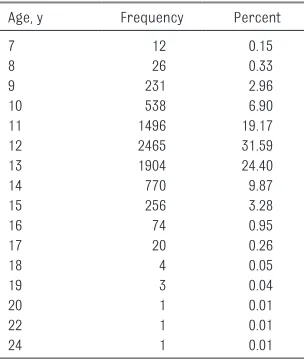
when individuals remember events as closer to the date of the interview than they actually are. This was most often reported at Wave I (89.7% of the sample). Frequencies for age at menarche are presented in Table 2.
Depressive Symptoms
At Waves I and IV, participants completed the Center for
Epidemiologic Studies Depression Scale (CES-D), 20 a self-report
measure of cognitive, affective, and physiologic symptoms of depression experienced in the past week. Although the full CES-D was given at Wave I, a 10-item short form was given at Wave IV. The correlation between the full CES-D and 10-item abbreviated version at
Wave I was r = 0.96, indicating the short form adequately represented the information provided in the full version; to keep measurement consistent, the short version was used to quantify depressive symptoms at Waves I and IV. For each item, participants reported whether they had experienced that symptom, where 0 = “never or rarely,
” 1 = “sometimes, ” 2 = “a lot of the time, ” and 3 = “most of the time or all of the time.” Scores of 8 to 10 have been suggested as clinical cutoffs for the short-form CES-D.21, 22
Antisocial Behaviors
At Waves I and IV, participants reported frequency of engagement in antisocial behaviors in the past 12 months, with 0 = “never, ” 1 = “1 or 2 times, ” 2 = “3 or 4 times, ” and 3 = “5 or more times.” Behaviors assessed at both time points included property damage, stealing something worth >$50, stealing something worth <$50, breaking into a building, and selling drugs. Wave I additionally included running away from home, lying to parents, driving a car without the owner’s permission, shoplifting, and being loud and rowdy in public, whereas Wave IV included deliberately writing a bad check, using someone else’s debit card without permission, and buying
TAbLE 1 Sample Characteristics
M or % SD
Menarche 12.17 1.43
Depression, Wave I 6.37 4.61
Depression, Wave IV 5.69 4.36
Antisocial behavior, Wave I 2.84 3.64
Antisocial behavior, Wave IV 0.19 0.89
Age at Wave I, y 15.36 1.74
Age at Wave 4, y 28.45 1.77
Income-to-needs ratio 2.96 3.57
Maternal education
less than HS 0.18 —
HS diploma or GED 0.24 —
Mother has college degree 0.16 —
Father absence
Always absent 0.14 —
Absent 0–5 y 0.12 —
Absent 6–13 y 0.11 —
Always present, 0–13 y 0.63 —
Race and/or ethnicity
European American 0.66 —
African American 0.12 —
Hispanic 0.16 —
Other race and /or ethnicity 0.06 —
AFDC receipt 0.08 —
All means and percentages are drawn from the final imputed data set and weighted by using Add Health Wave IV survey weights. Numbers that indicate means include SDs as well; numbers that indicate percentages do not. AFDC indicates the participant’s family received public assistance benefits in Wave I. Depression refers to summed CES-D short-form scores. Scores of 8 to 10 have been suggested as a clinical cutoff. Antisocial behaviors refer to the summed frequency of antisocial behaviors. AFDC, Aid to Families with Dependent Children; GED, graduate equivalency diploma; HS, high school;
—, not applicable.
TAbLE 2 Frequency of Age at Menarche for 1 Randomly Selected Imputed Data Set
Age, y Frequency Percent
7 12 0.15
8 26 0.33
9 231 2.96
10 538 6.90
11 1496 19.17
12 2465 31.59
13 1904 24.40
14 770 9.87
15 256 3.28
16 74 0.95
17 20 0.26
18 4 0.05
19 3 0.04
20 1 0.01
22 1 0.01
or selling stolen property. The frequency of behaviors endorsed at each time point was summed.
Additional Covariates
Analyses included demographic and familial covariates commonly associated with earlier puberty or elevated depression and/or antisocial behaviors: race and/or ethnicity (with European American as the reference category), father absence (coded as absent from birth, early childhood, or middle childhood, with father presence as the reference), and socioeconomic indicators indexed by receipt of public assistance, household income–to–needs ratio at Wave I, and maternal education (with no high school degree as the reference).23, 24
Age at Wave I was also included because older age permits more time for symptoms to emerge and because during adolescence, older adolescents tend to report higher levels of depressive symptoms and antisocial behaviors than younger adolescents.
Missing Data
The analytic sample included all individuals with age at menarche but not necessarily complete data on all covariates or Wave IV dependent variables (Fig 1 A and B). To address missing data, data were multiply imputed by using the ice command in Stata 12.0 (StataCorp, College Station, TX), which is based on a regression-switching protocol using chained equations.25 Missing covariates ranged
from 0.1% (for race and/or ethnicity) to 28% (income–to–needs ratio). Ten imputed data sets were generated, with coefficients and SEs combined by using the MI estimate command. Girls with complete data on all variables did not differ in age at menarche or Wave IV antisocial behaviors from those who needed imputation for 1 or more variables. However, participants with complete data for all variables reported fewer depressive symptoms at Wave IV than those with missing data for 1 or more variables (M = 5.55 vs 5.86; t [7790] = 3.04; P < .01).
Analytic Strategy
A series of ordinary least-squares regression models was used to assess associations of age at menarche with (1) depressive symptoms and (2) antisocial behaviors. All models were weighted by using Wave IV survey and design weights.18 Models
represented 3 different conceptual associations between pubertal timing and psychological outcomes. The proximal influences model regressed depressive symptoms and/or antisocial behavior at Wave I on age at menarche and covariates to provide baseline information about puberty’s association with
FIGURE 1
mental health during adolescence. The lingering influences model regressed depressive symptoms and/ or antisocial behaviors at Wave IV on age at menarche and covariates. This model did not include adolescent symptom levels to test a direct association of pubertal timing with mental health in adulthood. The increasing influences model included adolescent levels of symptoms as an additional covariate to estimate whether early pubertal timing was related to depressive symptoms and/ or antisocial behaviors in adulthood above and beyond what might be predicted by adolescent levels. For each model, age at menarche was entered both as a linear and a quadratic term to assess potential nonlinear effects.
RESULTS
Depressive Symptoms
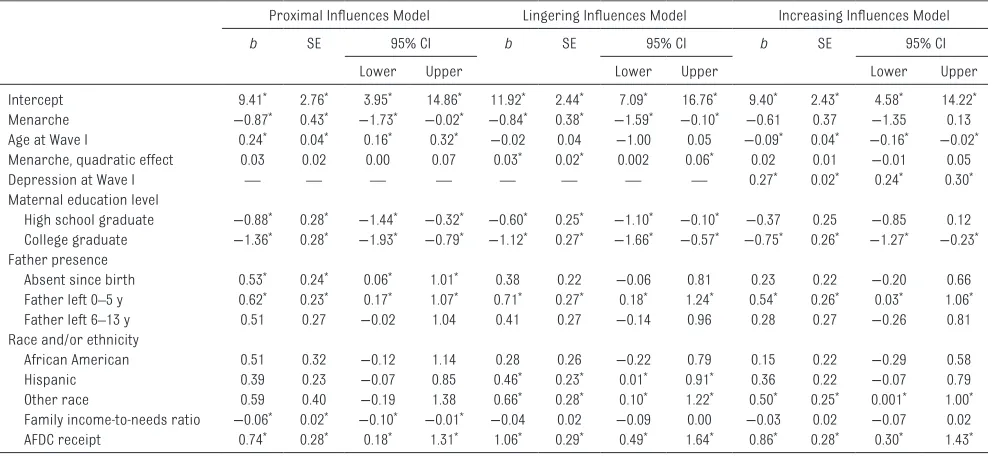
As shown in Table 3, the proximal influences model suggested that age at menarche significantly and linearly predicted depressive symptoms
during adolescence, with later ages of menarche associated with lower levels of symptoms (b = −0.87; P < .05). There was also a marginally significant quadratic association (b = 0.03; P = .09) indicating a trend for depressive symptoms to be more steeply related to earlier menarche. To illustrate, a girl who reached menarche at age 10 years (∼2 years earlier than the mean) would have depressive symptoms 8% of 1 SD greater in adolescence, whereas a girl who reached menarche at age 8 years would have depressive symptoms 25% of 1 SD greater. By Wave IV, when participants were nearly 30 years of age, associations of menarche with depressive symptoms were still evident. The lingering influences model indicated that menarche was both linearly (b =−0.84; P < .05) and quadratically (b = 0.03; P < .05) associated
with symptoms at Wave IV. This corresponds to an effect of 6% of 1 SD for a girl who reached menarche at age 10 years and 20% of 1 SD for those who reached menarche at age 8 years relative to those who
reached menarche at 12 years. When accounting for baseline levels of depressive symptoms at Wave I in the increasing influences model, menarche was no longer significantly associated with symptoms at Wave IV (blinear = −0.61, ns; bquadratic = 0.02, ns). Collectively, this pattern of results suggests that early-maturing girls are more prone to depressive symptoms in adulthood than their later-maturing peers primarily because they become depressed as adolescents, and this vulnerability persists over the next decade and one-half.
Antisocial behavior
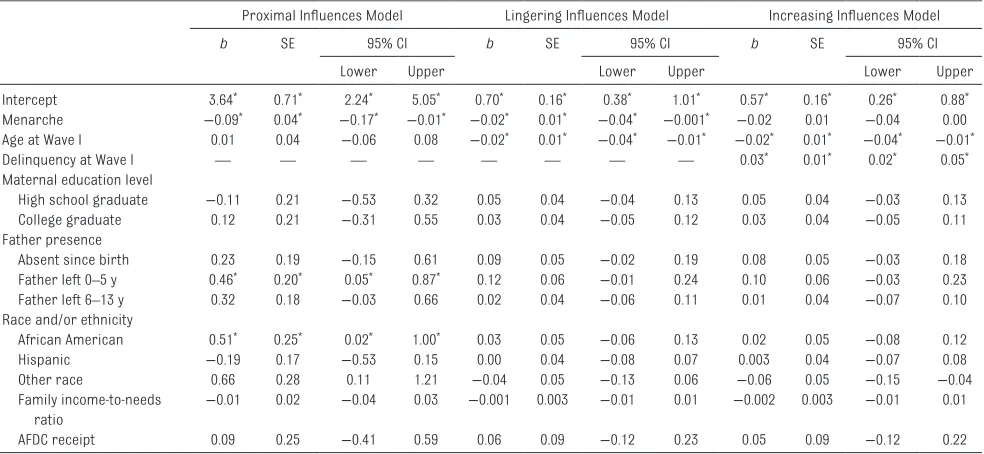
A slightly different pattern of results emerged for antisocial behaviors (full model results displayed in Tables 4). In the proximal influences model, age at menarche was significantly and linearly related to antisocial behaviors during adolescence, with early-maturing girls reporting a higher frequency of antisocial behaviors (b = −0.09;
P < .05). These results indicate that
TAbLE 3 Age at Menarche and Depressive Symptoms in Adulthood
Proximal Influences Model lingering Influences Model Increasing Influences Model
b SE 95% CI b SE 95% CI b SE 95% CI
lower Upper lower Upper lower Upper
Intercept 9.41* 2.76* 3.95* 14.86* 11.92* 2.44* 7.09* 16.76* 9.40* 2.43* 4.58* 14.22*
Menarche −0.87* 0.43* −1.73* −0.02* −0.84* 0.38* −1.59* −0.10* −0.61 0.37 −1.35 0.13
Age at Wave I 0.24* 0.04* 0.16* 0.32* −0.02 0.04 −1.00 0.05 −0.09* 0.04* −0.16* −0.02*
Menarche, quadratic effect 0.03 0.02 0.00 0.07 0.03* 0.02* 0.002 0.06* 0.02 0.01 −0.01 0.05
Depression at Wave I — — — — — — — — 0.27* 0.02* 0.24* 0.30*
Maternal education level
High school graduate −0.88* 0.28* −1.44* −0.32* −0.60* 0.25* −1.10* −0.10* −0.37 0.25 −0.85 0.12 College graduate −1.36* 0.28* −1.93* −0.79* −1.12* 0.27* −1.66* −0.57* −0.75* 0.26* −1.27* −0.23* Father presence
Absent since birth 0.53* 0.24* 0.06* 1.01* 0.38 0.22 −0.06 0.81 0.23 0.22 −0.20 0.66
Father left 0–5 y 0.62* 0.23* 0.17* 1.07* 0.71* 0.27* 0.18* 1.24* 0.54* 0.26* 0.03* 1.06*
Father left 6–13 y 0.51 0.27 −0.02 1.04 0.41 0.27 −0.14 0.96 0.28 0.27 −0.26 0.81
Race and/or ethnicity
African American 0.51 0.32 −0.12 1.14 0.28 0.26 −0.22 0.79 0.15 0.22 −0.29 0.58
Hispanic 0.39 0.23 −0.07 0.85 0.46* 0.23* 0.01* 0.91* 0.36 0.22 −0.07 0.79
Other race 0.59 0.40 −0.19 1.38 0.66* 0.28* 0.10* 1.22* 0.50* 0.25* 0.001* 1.00*
Family income-to-needs ratio −0.06* 0.02* −0.10* −0.01* −0.04 0.02 −0.09 0.00 −0.03 0.02 −0.07 0.02
AFDC receipt 0.74* 0.28* 0.18* 1.31* 1.06* 0.29* 0.49* 1.64* 0.86* 0.28* 0.30* 1.43*
Analyses were conducted in Stata’s design-based weighting program to account for the clustered nature of the sample; this program does not provide R2 values. The proximal influences
model uses CES-D scores at Wave I as the dependent variable; the lingering influences and increasing influences models use CES-D scores at Wave IV as the dependent variables. AFDC, Aid to Families with Dependent Children; CI, confidence interval; —, not applicable.
a girl who reached menarche at age 10 years would display antisocial behaviors 5% of 1 SD greater in adolescence than those who reached menarche at the mean age of 12 years; a girl who reached menarche at age 8 years would have antisocial behaviors 10% of 1 SD greater. This association persisted longitudinally (lingering influences model;
b = −0.02; P < .05) and remained marginally significant and of similar magnitude even after including adolescent levels of antisocial behaviors in the model (increasing influences model; b = −0.02; P = .08). These findings indicate that earlier menarche is associated with higher rates of antisocial behaviors in both adolescence and adulthood even after accounting for important demographic covariates. Although marginally significant, it may also be possible that antisocial behaviors slightly worsen in adulthood for early-maturing girls relative to later-maturing girls. Quadratic associations of age at menarche with antisocial behaviors were not significant in any models of antisocial behaviors;
consequently, the quadratic term was dropped from final models.
DISCUSSION
Earlier pubertal timing in girls is often accompanied by distinct rises in the prevalence, severity, and onset of psychopathology. These associations have been documented consistently over the past half-century in diverse communities within America and in various cultures and countries around the world.26 Although many
psychological disorders in adults first emerge in childhood and adolescence,
27 surprisingly few researchers have
examined the longevity of pubertal timing effects, likely because of the practical complexities of managing participants for extended periods of time. As a result, the overwhelming majority of researchers have not conducted assessments past late adolescence.
Not understanding the long-term sequelae of earlier puberty is not merely a gap in the research
literature but a public health issue. The age of pubertal onset has declined dramatically over the past half-century.28, 29 It is difficult to
know whether, when, and on what processes to intervene if we cannot establish how much pubertal timing matters for well-being later in life. Results from the current study suggest that girls who experienced earlier menarche continued to report elevated psychopathology in early-to-middle adulthood even after accounting for demographic and contextual variables commonly associated with vulnerability for mental health. These findings align with the broad body of work linking early puberty with higher psychopathology during adolescence1
as well as with the few studies showing longer-term associations with mental health in adulthood.5–9
Associations of age at menarche with adult psychopathology may operate in different ways for depressive symptoms versus antisocial behaviors. In the case of depressive symptoms, women who experienced earlier menarche seem
TAbLE 4 Age at Menarche and Antisocial Behaviors in Adulthood
Proximal Influences Model lingering Influences Model Increasing Influences Model
b SE 95% CI b SE 95% CI b SE 95% CI
lower Upper lower Upper lower Upper
Intercept 3.64* 0.71* 2.24* 5.05* 0.70* 0.16* 0.38* 1.01* 0.57* 0.16* 0.26* 0.88*
Menarche −0.09* 0.04* −0.17* −0.01* −0.02* 0.01* −0.04* −0.001* −0.02 0.01 −0.04 0.00 Age at Wave I 0.01 0.04 −0.06 0.08 −0.02* 0.01* −0.04* −0.01* −0.02* 0.01* −0.04* −0.01*
Delinquency at Wave I — — — — — — — — 0.03* 0.01* 0.02* 0.05*
Maternal education level
High school graduate −0.11 0.21 −0.53 0.32 0.05 0.04 −0.04 0.13 0.05 0.04 −0.03 0.13
College graduate 0.12 0.21 −0.31 0.55 0.03 0.04 −0.05 0.12 0.03 0.04 −0.05 0.11
Father presence
Absent since birth 0.23 0.19 −0.15 0.61 0.09 0.05 −0.02 0.19 0.08 0.05 −0.03 0.18
Father left 0–5 y 0.46* 0.20* 0.05* 0.87* 0.12 0.06 −0.01 0.24 0.10 0.06 −0.03 0.23
Father left 6–13 y 0.32 0.18 −0.03 0.66 0.02 0.04 −0.06 0.11 0.01 0.04 −0.07 0.10
Race and/or ethnicity
African American 0.51* 0.25* 0.02* 1.00* 0.03 0.05 −0.06 0.13 0.02 0.05 −0.08 0.12
Hispanic −0.19 0.17 −0.53 0.15 0.00 0.04 −0.08 0.07 0.003 0.04 −0.07 0.08
Other race 0.66 0.28 0.11 1.21 −0.04 0.05 −0.13 0.06 −0.06 0.05 −0.15 −0.04
Family income-to-needs
ratio −
0.01 0.02 −0.04 0.03 −0.001 0.003 −0.01 0.01 −0.002 0.003 −0.01 0.01
AFDC receipt 0.09 0.25 −0.41 0.59 0.06 0.09 −0.12 0.23 0.05 0.09 −0.12 0.22
Analyses were conducted in Stata’s design-based weighting program to account for the clustered nature of the sample; this program does not provide R2 values. The proximal influences
model uses antisocial behaviors measured at Wave I as the dependent variable; the lingering influences and increasing influences models use antisocial behaviors measured at Wave IV as the dependent variables. AFDC, Aid to Families with Dependent Children; CI, confidence interval. ; —, not applicable.
to show higher levels of symptoms in adulthood primarily because they were more likely to become depressed as adolescents, and that propensity for depression seems to have been sustained over time. It is unlikely that these women were continually depressed, without remission, from adolescence into adulthood. Rather, the effect of pubertal timing was robust enough to withstand vicissitudes in the timing of assessments relative to depressive episodes. In addition, effects seemed to be nonlinear, suggesting that effects are more pronounced and menarche is more steeply related to depressive symptoms when it occurs at a younger age.
Antisocial behaviors were also elevated among women who experienced earlier menarche. The more typical developmental pattern is for externalizing to lessen postadolescence because of ongoing neural maturation, improvements in impulse control, and increased orientation toward future life events.30, 31 The discrepancy in
antisocial activity between early and not-early maturers widened in adulthood relative to adolescence, although it should be noted that effects for antisocial behaviors were relatively modest and smaller in magnitude than those found for depressive symptoms. However, given the myriad influences that predict antisocial behaviors coupled with the high cost these behaviors present to society, even a small effect of pubertal timing is notable.
This study is one of the few studies of puberty on which researchers managed participants past adolescence, providing needed information about the magnitude of the risk of earlier development. But it also holds several limitations. Chief among these is an imperfect understanding of the mechanisms underlying these longitudinal effects. Because early puberty disrupts social, emotional, and academic trajectories,
there are numerous reasons why it might be associated with continued psychological vulnerability. A challenge for future researchers is to specify the cognitive, social, neural, and biological mechanisms that mediate this continued risk. Of particular importance are hypotheses that go beyond developmental characteristics generally limited to adolescence. Now that we have ascertained the longevity of effects, our mechanistic hypotheses require updating as well.
Second, our indicator of pubertal timing was age at menarche. Although menarche is one of the most commonly used indicators of pubertal timing, it typically occurs at Tanner Stage 4 or 5 and would not capture social, emotional, or hormonal processes that occur earlier in puberty. Third, we used only youth self-reports of adolescent psychopathology and do not have parental reports to provide a more complete picture of functioning. We also only consider 2 domains of psychopathology and cannot assume that long-term effects extend to other disorders. Finally, it should be noted that research on early pubertal timing has been disproportionately skewed toward girls. All extant research suggests that puberty is more challenging for girls than for boys, and girls experience a greater severity and diversity of clinical symptoms associated with physical development. Yet it is hard not to see the dearth of research on pubertal timing in boys as a limitation of the current study as well as the field more broadly.
CONCLUSIONS
Girls’ pubertal timing is directly connected to mental health. Yet, puberty is underrepresented in research compared with other correlates of psychopathology, and there have been no purposeful efforts to investigate its influence beyond
the adolescent years. The current research suggests that the sequelae of earlier development are not transient growing pains but are predictive of difficulties and challenges that persist into adulthood.
Understanding the longevity of these associations offers new challenges to researchers, practical information for pediatricians and adolescent health care providers, and highlights that the emotional sequelae of puberty may endure well past the proximal period of adolescence.
AbbREvIATION
CES-D: Center for
Epidemiological Studies Depression Scale
REFERENCES
1. Mendle J. Why puberty matters for psychopathology. Child Dev Perspect. 2014;8(4):218–222
2. Ge X, Natsuaki MN. In search of explanations for early pubertal timing effects on developmental psychopathology. Curr Dir Psychol Sci. 2009;18(6):327–331
3. Whittle S, Yücel M, lorenzetti V, et al. Pituitary volume mediates the relationship between pubertal timing and depressive symptoms during adolescence. Psychoneuroendocrinology. 2012;37(7):881–891
4. Blaustein JD, Ismail N. Enduring influence of pubertal stressors on behavioral response to hormones in female mice. Horm Behav. 2013;64(2):390–398
5. Fairburn CG, Welch Sl, Doll HA, Davies BA, O’Connor ME. Risk factors for bulimia nervosa. A community-based case-control study. Arch Gen Psychiatry. 1997;54(6):509–517 6. Mangweth-Matzek B, Rupp CI,
nonpsychiatric control group. Int J Eat Disord. 2007;40(8):705–710
7. Graber JA, Seeley JR, Brooks-Gunn J, lewinsohn PM. Is pubertal timing associated with psychopathology in young adulthood. J Am Acad Child Adolesc Psychiatry. 2004;43(6):718–726 8. Harden KP, Mendle J.
Gene-environment interplay in the association between pubertal timing and delinquency in adolescent girls. J Abnorm Psychol. 2012;121(1):73–87 9. Natsuaki MN, Biehl MC, Ge X.
Trajectories of depressed mood from early adolescence to young adulthood: the effects of pubertal timing and adolescent dating. J Res Adolesc. 2009;19(1):47–74
10. Copeland W, Shanahan l, Miller S, Costello EJ, Angold A, Maughan B. Outcomes of early pubertal timing in young women: a prospective population-based study. Am J Psychiatry. 2010;167(10):1218–1225 11. Hölzel l, Härter M, Reese C, Kriston l.
Risk factors for chronic depression–a systematic review. J Affect Disord. 2011;129(1–3):1–13
12. Zisook S, lesser I, Stewart JW, et al. Effect of age at onset on the course of major depressive disorder. Am J Psychiatry. 2007;164(10):1539–1546 13. liu RT, Alloy lB. Stress generation
in depression: a systematic review of the empirical literature and recommendations for future study. Clin Psychol Rev. 2010;30(5):582–593 14. Mendle J, Harden KP, Brooks-Gunn
J, Graber JA. Peer relationships and depressive symptomatology in boys at puberty. Dev Psychol. 2012;48(2):429–435
15. Mrug S, Elliott MN, Davies S, Tortolero SR, Cuccaro P, Schuster MA. Early puberty, negative peer influence, and problem behaviors in adolescent girls. Pediatrics. 2014;133(1):7–14
16. Nadeem E, Graham S. Early puberty, peer victimization, and internalizing symptoms in ethnic minority adolescents. J Early Adolesc. 2005;25(2):197–222
17. Harris KM, Halpern CT, Whitsel E, et al. The national longitudinal study of adolescent health: research design. 2009. Available at: http:// www. cpc. unc. edu/ projects/ addhealth/ design 18. Biemer P, Aragon-logan E. National
Longitudinal Study of Adolescent Health. Wave IV Weights. Research Triangle Park, NC: Springer; 2009 19. Janssen SM, Chessa AG, Murre
JM. Memory for time: how people date events. Mem Cognit. 2006;34(1):138–147
20. Radloff lS. The CES-D scale: a self-report depression scale for research in the general population. Appl Psychol Meas. 1977;1(3):385–401
21. Cheung YB, liu KY, Yip PS. Performance of the CES-D and its short forms in screening suicidality and hopelessness in the community. Suicide Life Threat Behav. 2007;37(1):79–88
22. Björgvinsson T, Kertz SJ, Bigda-Peyton JS, McCoy Kl, Aderka IM. Psychometric properties of the CES-D-10 in a psychiatric sample. Assessment. 2013;20(4):429–436
23. Bogaert AF. Menarche and father absence in a national probability sample. J Biosoc Sci. 2008;40(4):623–636
24. James-Todd T, Tehranifar P, Rich-Edwards J, Titievsky l, Terry MB. The
impact of socioeconomic status across early life on age at menarche among a racially diverse population of girls. Ann Epidemiol. 2010;20(11):836–842 25. Royston P. Multiple imputation of
missing values: further update of ice, with an emphasis on interval censoring. Stata J. 2007;7(4):445–464 26. Mendle J, Eisenlohr-Moul T, Kiesner
J. From menarche to menopause: women’s reproductive milestones and risk for psychopathology—an introduction to the special series. Clin Psychol Sci. 2016;4(5):859–866 27. Merikangas KR, He JP, Burstein M,
et al. lifetime prevalence of mental disorders in US adolescents: results from the National Comorbidity Survey Replication–Adolescent Supplement (NCS-A). J Am Acad Child Adolesc Psychiatry. 2010;49(10):980–989 28. lee Y, Styne D. Influences on the
onset and tempo of puberty in human beings and implications for adolescent psychological development. Horm Behav. 2013;64(2):250–261 29. Mendle J. Beyond pubertal timing
new directions for studying individual differences in development. Curr Dir Psychol Sci. 2014;23(3):215–219 30. Monahan KC, Steinberg l, Cauffman
E, Mulvey EP. Trajectories of antisocial behavior and psychosocial maturity from adolescence to young adulthood. Dev Psychol. 2009;45(6):1654–1668 31. Piquero AR. Taking stock of
DOI: 10.1542/peds.2017-1703 originally published online December 26, 2017;
2018;141;
Pediatrics
Jane Mendle, Rebecca M. Ryan and Kirsten M. P. McKone
Age at Menarche, Depression, and Antisocial Behavior in Adulthood
Services
Updated Information &
http://pediatrics.aappublications.org/content/141/1/e20171703
including high resolution figures, can be found at:
References
http://pediatrics.aappublications.org/content/141/1/e20171703#BIBL
This article cites 28 articles, 1 of which you can access for free at:
Subspecialty Collections
y_sub
http://www.aappublications.org/cgi/collection/psychiatry_psycholog Psychiatry/Psychology
icine_sub
http://www.aappublications.org/cgi/collection/adolescent_health:med Adolescent Health/Medicine
following collection(s):
This article, along with others on similar topics, appears in the
Permissions & Licensing
http://www.aappublications.org/site/misc/Permissions.xhtml
in its entirety can be found online at:
Information about reproducing this article in parts (figures, tables) or
Reprints
http://www.aappublications.org/site/misc/reprints.xhtml
DOI: 10.1542/peds.2017-1703 originally published online December 26, 2017;
2018;141;
Pediatrics
Jane Mendle, Rebecca M. Ryan and Kirsten M. P. McKone
Age at Menarche, Depression, and Antisocial Behavior in Adulthood
http://pediatrics.aappublications.org/content/141/1/e20171703
located on the World Wide Web at:
The online version of this article, along with updated information and services, is
by the American Academy of Pediatrics. All rights reserved. Print ISSN: 1073-0397.