Impact of Subspecialty Training in Pediatrics?
WHAT’S KNOWN ON THIS SUBJECT: No studies have focused on the financial impact of fellowship training in pediatrics.
WHAT THIS STUDY ADDS: The results from this study can be helpful to current pediatric residents as they contemplate their career options. In addition, the study may be valuable to policy makers who evaluate health care reform and pediatric workforce-allocation issues.
abstract
OBJECTIVES:To (1) analyze the financial returns of fellowship training in pediatrics and to compare them with those generated from a career in general pediatrics and (2) evaluate the effects of including the newly enacted federal loan-repayment program and of changing the length of fellowship training.
BACKGROUND:Although the choice to enter fellowship is based on many factors, economic considerations are important. We are not aware of any study that has focused on the financial impact of fellow-ship training in pediatrics.
METHODS:Using standard financial techniques, we estimated the fi-nancial returns that a graduating pediatric resident might anticipate from additional fellowship training followed by a career as a pediatric subspecialist and compared them with the returns that might be ex-pected from starting a career as a general pediatrician immediately after residency.
RESULTS:The financial returns of pediatric fellowship training varied greatly depending on which subspecialty fellowship was chosen. Pur-suing a fellowship in most pediatric subspecialties was a negative financial decision when compared with pursuing no fellowship at all and practicing as a general pediatrician. Incorporating the federal loan-repayment program targeted toward pediatric subspecialists and decreasing the length of fellowship training from 3 to 2 years would substantially increase the financial returns of the pediatric subspecialties.
CONCLUSIONS:Pediatric subspecialization yielded variable financial returns. The results from this study can be helpful to current pediatric residents as they contemplate their career options. In addition, our study may be valuable to policy makers evaluating health care reform and pediatric workforce-allocation issues. Pediatrics 2011;127:254– 260
AUTHORS:Jonathan M. Rochlin, MDa,b,cand Harold K.
Simon, MD, MBAa,b,d
Departments ofaPediatrics anddEmergency Medicine, Emory
University School of Medicine, Atlanta, Georgia;bPediatric
Emergency Medicine, Children’s Healthcare of Atlanta, Atlanta, Georgia; andcDepartment of Emergency Medicine, State
University of New York, Downstate Medical Center, Brooklyn, New York
KEY WORDS
human capital, health economics, educational investment, salaries and fringe benefits, graduate medical education, training, career choice, pediatrics, residency, fellows, subspecialists
ABBREVIATIONS
NPV—net present value
AAMC—Association of American Medical Colleges PGY—postgraduate year
www.pediatrics.org/cgi/doi/10.1542/peds.2010-1285
doi:10.1542/peds.2010-1285
Accepted for publication Oct 19, 2010
Address correspondence to Jonathan M. Rochlin, MD, Department of Emergency Medicine, SUNY Downstate, 450 Clarkson Ave, Box 1228, Brooklyn, NY 11203.
E-mail: [email protected]
PEDIATRICS (ISSN Numbers: Print, 0031-4005; Online, 1098-4275).
Copyright © 2011 by the American Academy of Pediatrics
The financial returns in most primary care fields, including pediatrics, are lower than those in law, business, den-tistry, or even procedure-based medical or surgical specialties.1 Compounding
this problem is the fact that many grad-uate medical school with significant amounts of debt. Indeed,⬎87% of 2008 medical school graduates had some ed-ucational debt and among those who did, the mean debt burden approached $160 000.2These issues make the
finan-cial implications of choosing a career in pediatrics significant.
Most graduating pediatric residents either begin practice as a general pe-diatrician after a 3-year residency or pursue subspecialty training by enter-ing a 3-year fellowship.3 Recently, an
increasing number of graduating pedi-atric residents are opting to enter fel-lowship.3Although the choice to enter
fellowship is clearly based on many factors, economic considerations are certainly important.4,5
But what are the financial implications of the decision to pursue a pediatric fellowship? Studies published previ-ously have addressed the financial re-turns of fellowship training in several medical and surgical specialties.5–10
Results from these analyses have var-ied and have depended on the particu-lar fields studied. However, we are not aware of any report that has focused on the financial implications of pediat-ric fellowship training. In this study we sought to analyze the financial returns of fellowship training in pediatrics and to compare these with those gener-ated from a career in general pediat-rics. We also evaluated the impact of implementing the newly enacted fed-eral loan-repayment program and of altering the length of fellowship training.
METHODS
We obtained information on fellowship stipends, subspecialty-specific
compen-sation, general pediatric compencompen-sation, and educational debt to create a model that estimated age-specific net income for general pediatricians and for pediat-ric subspecialists in 11 different fields over a working lifetime. As in previous reports,5–10 to compare these
age-specific net incomes, standard finan-cial techniques used to analyze the val-ues of different investments were employed, and a frequently used mea-sure to evaluate financial returns was calculated, the net present value (NPV). This process allowed us to esti-mate the financial returns that a grad-uating pediatric resident might expect from additional fellowship training followed by a career as a pediatric subspecialist and to compare these with the returns that might be antic-ipated from starting a career as a general pediatrician immediately af-ter residency.
Stipend and Compensation Data
Stipend and compensation informa-tion were obtained from 3 different sources and, as in earlier reports, we focused on mean figures.5,6,8–10In
addi-tion, we used 2007 numbers, which represented the most current data from our various sources.
Similar to previously published stud-ies,5,7,9,10we used figures from the
an-nual Association of American Medical Colleges (AAMC) Survey of Resident/ Fellow Stipends and Benefits to esti-mate fellowship stipends for postgrad-uate year 4 (PGY-4), PGY-5, and PGY-6.2
We assumed these year-specific sti-pends were the same, regardless of which fellowship was chosen.11
For compensation estimates after fel-lowship that were subspecialty-specific and that varied with age and experience, we used information from the AAMC’s Report on Medical School Faculty Salaries.12The data used
repre-sented mean actual annual total com-pensation, including bonus, before taxes
and retirement and fringe benefits of full-time faculty affiliated with Liaison Committee on Medical Education– accredited medical schools. The infor-mation was based on figures garnered from the AAMC’s Faculty Salary Survey, an annual survey that has studied compensation of medical school fac-ulty for ⬎40 years. Our analysis in-cluded information for 4083 pediatric subspecialists. The compensation esti-mates we used for fellowship-trained pediatric subspecialists were based on academic salaries because nearly two-thirds of recently trained pediat-ric subspecialists practice in an aca-demic environment.13 We assumed
that, after fellowship, graduates were hired as assistant professors, where they remained for 7 years; they then were eligible to be promoted to asso-ciate professors. They remained as as-sociate professors for 7 more years, at which time they were eligible to be-come professors. Compensation-by-rank data within each subspecialty were used to calculate subspecialty-specific growth rates between ranks and more modest subspecialty-specific growth rates within ranks. These growth rates were then em-ployed to construct subspecialty-specific and age-subspecialty-specific net income streams that could be used for comparison.
To obtain compensation estimates for general pediatricians that varied with age, we used information from the Medical Group Management Associa-tion Physician CompensaAssocia-tion and Pro-duction Survey,14 which is a
well-regarded and often quoted annual survey that targets single and multi-specialty medical group practices. Similar to the AAMC data for pediatric subspecialists, the Medical Group Management Association figures rep-resented mean actual annual total compensation, including bonus, be-fore taxes and retirement and fringe
used private practice instead of aca-demic compensation for the general pediatric group because the majority of recently trained general pediatri-cians enter private practice; only 15% are employed in an academic envi-ronment.15
Compensation-by-years-in-specialty data were used to create an age-specific net income stream that could be used for comparison.
Educational Debt
We assumed each career option was associated with the mean educational indebtedness of those graduating medical school at the completion of the 2007 academic year, a figure that included both the debt incurred from attending medical school as well as the debt incurred from educational ac-tivities before attending medical school. This information was obtained from the AAMC Medical School Gradu-ation Questionnaire, which is adminis-tered annually to graduating medical students.2 We assumed that loan
re-payment was deferred during resi-dency and fellowship and that the ac-crued interest was capitalized once training was completed and employ-ment began in the chosen field. For our analysis, we used the current annual interest rate on federal Stafford edu-cational loans, which is a fixed rate of 6.8%.16Finally, we assumed that, after
graduation from residency or fellow-ship, debt was repaid over 25 years, which is reportedly the most likely re-payment option chosen by today’s young physicians.16
Other Assumptions
We assumed no time was taken off be-tween high school, college, medical school, and residency. Graduating PGY-3 residents immediately started working as general pediatricians or entered fellowship and, for those
pur-graduating residents or fellows worked in their chosen careers until retirement, which, as in previous stud-ies, occurred at age 65.5,8,9Finally, we
assumed pediatricians in each field worked the equivalent number of hours per year and they all worked full-time.
NPV
The NPV is the financial concept that addresses the fact that income ob-tained today is more valuable than in-come obtained in the future, because today’s income can be invested at an interest rate to yield an immediate re-turn. It allows for the comparison of different income streams over time by discounting them back to the present at a constant discount (or interest) rate. The formula for NPV is17:
⌺t⫽1
n
NIt⁄ (1⫹ r) t
where NI is the annual net income, which we defined as annual compen-sation less annual debt-repayment costs. The formula takes the sum of the annual net incomes over time (from t⫽1 tonyears) and discounts them back to the present at a discount rate (r), which, as in previous studies, was set at 5%.5–10From this calculation, one
is able to compare the current value of future net income streams.
We calculated a measure called the Lifetime Relative NPV, which we de-fined as the present value of the net income generated from a career in 1 of 11 different pediatric subspecialties relative to that generated from a ca-reer in general pediatrics over the working lifetime. It represented the present value of the difference in life-time net income between a pediatric subspecialist and a general pediatri-cian. This calculation incorporated the concept of opportunity cost, which, in general terms, represents the value of
atric fellowship training was the net income a graduating pediatric resi-dent could have earned had he or she decided not to enter a 3-year fellow-ship and had instead started to work immediately after residency as a general pediatrician. In our model, this opportunity cost was estimated as the age-specific net income earned by a general pediatrician, and it represented the financial costs of fellowship training. The op-portunity cost was the same for all subspecialties.
Sensitivity Analyses
We performed several sensitivity analyses. First, we analyzed the ef-fect of a loan-repayment program targeted toward pediatric subspe-cialists. On March 23, 2010, President Obama signed into law the heath care reform bill, which has a section devoted to the allocation of loan-repayment funds for physicians who pursue full-time employment as pediatric subspecialists.18
RESULTS
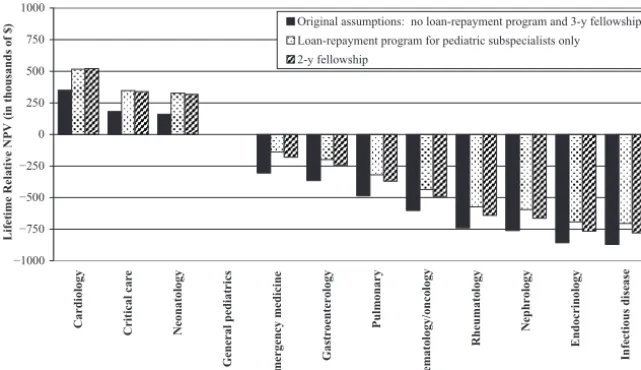
Fig 1 displays the Lifetime Relative NPV of 11 different pediatric subspecialties relative to general pediatrics and is an illustration of the present value of the difference in lifetime net income be-tween a pediatric subspecialist and a general pediatrician. As such, the Life-time Relative NPV of general pediatrics is $0. The solid black bars represent the Lifetime Relative NPV on the basis of our original assumptions: there is no loan-repayment program targeted toward pediatric subspecialists, and pediatric fellowships are 3 years in length. In this scenario, the largest Lifetime Relative NPV is seen in cardi-ology, which yields a positive $349 532 financial return relative to general pe-diatrics over the working lifetime. In addition, critical care and neonatology experience positive financial returns compared with general pediatrics. Ca-reers in the other 8 pediatric subspe-cialties analyzed (emergency medi-cine, gastroenterology, pulmonary, hematology/oncology, rheumatology, nephrology, endocrinology, and infec-tious disease) generate negative finan-cial returns relative to general pediat-rics over the working lifetime ranging from negative $305 621 for emergency
medicine to negative $870 995 for
in-fectious disease. Stated differently, a graduating third-year pediatric resi-dent would need to be given a lump sum payment of $870 995 to make the decision to forego a career in general pediatrics and enter fellowship train-ing in infectious disease financially neutral.
The second bar for each career choice
in Fig 1 illustrates the effect of the pro-vision contained in the recently en-acted heath care reform bill which allocates $35 000/year in loan-repayment funds for 3 years to individuals who pursue the pediatric subspecialties; this bill allocates no loan-repayment funds to those who pursue general pe-diatrics.18 Comparing these
polka-dotted bars to the solid bars conveys that the effect of the newly enacted pe-diatric subspecialist federal loan-repayment program is substantial. This is because of the fact that, in the lorepayment scenario, while the an-nual debt-repayment costs for general pediatricians are the same, those for all pediatric subspecialists are greatly reduced.
The third bar for each career choice in Fig 1 shows the Lifetime Relative NPV
when pediatric fellowships are 2 years in length. Comparing these striped bars to the solid bars conveys that shortening the length of training con-siderably enhances the relative finan-cial returns of pediatric subspefinan-cializa- subspecializa-tion. This is because, in this scenario, although there is no change in the compensation of general pediatri-cians, pediatric subspecialists experi-ence the increase in compensation as-sociated with the completion of training 1 year earlier, and they earn this heightened level of compensation for 1 more year over the course of their careers. In addition, shortening the length of fellowship decreases the interest on educational debt that ac-crues during training and thereby re-duces annual debt-repayment costs. It should be noted that although the ef-fect of the loan-repayment program and the alteration in fellowship length are not large enough to change the re-sult that only 3 subspecialties (cardiol-ogy, critical care, and neonatology) have higher Lifetime Relative NPVs than general pediatrics, they do bring the other 8 subspecialties closer to the financial returns enjoyed by general pediatrics.
DISCUSSION
We used standard financial techniques to estimate the financial returns of fel-lowship training in pediatrics and to compare these with those generated from a career in general pediatrics. Our analysis revealed that an invest-ment in a pediatric fellowship gener-ated variable returns, depending on which subspecialty fellowship was chosen. Pursuing a fellowship in pe-diatric cardiology, critical care, or neonatology yielded greater finan-cial returns than pursuing no fellow-ship at all and practicing as a gen-eral pediatrician. However, pursuing a fellowship in the other 8 pediatric subspecialties analyzed was a nega-tive financial decision when
com-−1000 −750 −500 −250 0 250 500 750 1000 C a r d iol ogy Cr iti c al car e N e on at ol ogy Genera l p e di a tri cs E m e r ge n c y m e d ic in e Ga stro entero lo g y Pu lm on ary H e ma to lo gy /o n c ol o g y Rh e u mat o log y N e p h r o logy E n do cri no lo g y In fe c ti o u s di se a se Li fet ime R e la ti v e N P V (in t h o u sa nd s o f $
) Original assumptions: no loan-repayment program and 3-y fellowship Loan-repayment program for pediatric subspecialists only 2-y fellowship
FIGURE 1
Lifetime Relative NPV.
Our results are in contrast to a re-cently published report that showed that, in most orthopedic subspecial-ties, financial returns are positive for additional fellowship training.6
The reasons for this difference are twofold. First, orthopedic fellow-ships last for only 1 year, whereas pediatric fellowships are 3 years long. Thus, the financial burdens as-sociated with fellowship, such as lower compensation levels dur-ing traindur-ing and increased debt-repayment costs after training, are much more substantial in pediatrics than in orthopedics. In fact, our anal-ysis revealed that decreasing the length of pediatric fellowships from 3 years to 2 years considerably en-hanced the relative financial returns of pediatric subspecialization.
The second reason for this difference between orthopedics and pediatrics is annual compensation. In most ortho-pedic subspecialties, the starting sal-ary is much higher than the starting salary of a general orthopedist.6
How-ever, in most pediatric subspecialties, even after 3 years of fellowship train-ing, the starting salary is similar to or is indeed potentially less than the starting salary of a general pediatri-cian. Standard methods to calculate the financial returns on an educational investment compare the financial ben-efits of added training (the relative in-crease in compensation after training) to the costs of this training (lost earn-ings during training and increased debt-repayment costs after training). Yet most pediatric subspecialties never experience any financial bene-fits of added training because there is no relative increase in compensation after training. Indeed, our results are an illustration of the career-long effect of the relatively low compensation
lev-than those in other medical and surgi-cal specialties.1
In addition, our analysis provided the financial rationale for the provision contained in the recently enacted heath care reform bill, which allocates loan-repayment funds for those who pursue the pediatric subspecialties. We concluded that a federal loan-repayment program targeted toward pediatric subspecialists could have a substantial impact on increasing the financial returns and, as a result, po-tentially the attractiveness of the pedi-atric subspecialties.
The results from this study may be im-portant to those currently training in or thinking of pursuing training in pe-diatrics. Although trainees often do not rigorously analyze the financial impli-cations of pursing a fellowship, it is necessary to comprehend the financial effect of this additional training to make an educated decision regarding career alternatives. Trainees can use this analysis as a framework for for-mulating prudent financial decisions regarding their career plans. They can use our results to compare the esti-mated financial returns afforded by different career options and to help them choose which particular fellow-ship to enter or whether to enter a fel-lowship at all.
Our study also may be valuable to pol-icy makers. We found that 8 pediatric subspecialties had negative financial returns compared with general pedi-atrics, which bodes poorly for the rel-ative financial attractiveness of these fields. Differences in expected finan-cial returns may have significant ef-fects on the distribution of physicians.8
When variations in returns between fields are substantial, fewer graduat-ing residents may opt to pursue the careers with significantly lower
re-vor pursuing a fellowship in most pe-diatric subspecialties. Although the de-cision to enter a pediatric fellowship certainly is not solely a financial one, as our nation’s economy continues to struggle and as the costs of a medical education and the debt burden associ-ated with it continue to increase, the effect that financial incentives have on the decision to pursue a pediatric fel-lowship may become only more impor-tant. These trends have the potential to impact the distribution of the pediatric workforce and may lead to impaired patient access to pediatric subspe-cialty care. Therefore, understanding the financial implications of fellowship training in pediatrics is essential as we seek to guarantee sufficient num-bers of general pediatricians and pedi-atric subspecialists. As our country faces a shortage of pediatric subspe-cialists and an increased demand for their services,19policy makers can use
the results from this study to help quantify the current disparities in fi-nancial returns between general pedi-atrics and the pediatric subspecial-ties, disparities that may have an impact on the training and supply of future pediatric subspecialists. Those charged with guaranteeing that an ad-equate number of doctors are practic-ing in all the vital pediatric subspecial-ties might consider reforms that promote federal and other loan-repayment programs targeted toward pediatric subspecialists and that de-crease the length of pediatric fellow-ship training from 3 to 2 years.
as-sumed that pediatric subspecialists were eligible for promotion after 7 years at a particular rank. Had we as-sumed that pediatric subspecialists were promoted, for example, after 10 years at a particular rank, those in the pediatric subspecialties would experi-ence financial returns even lower than those reported here. In addition, our analysis is based on compensation fig-ures for general pediatricians in pri-vate practice and pediatric subspecial-ists in academic practice. If, for instance, we had based our study on pediatric subspecialists in private practice, the financial returns of the pediatric subspecialties might look more attractive than those reported here because private practice com-pensation is generally higher than compensation in academia. However, our goal was to offer a representation of the choices faced by a majority of pediatric trainees, and we believe our assumptions allowed us to achieve this objective because most graduat-ing pediatric residents work either as general pediatricians in private
prac-tice or as pediatric subspecialists in academic-affiliated practices. We be-lieve our assumptions allowed us to present the most pertinent informa-tion for today’s graduating pediatric residents who are evaluating different career options and today’s policy mak-ers who are contemplating health care reform and pediatric workforce-allocation issues.
Second, we do not capture every com-pensation and expense parameter. For instance, we do not include earnings from moonlighting. In addition, com-pensation disparities on the basis of geography and gender are not ac-counted for. Moreover, our analysis assumes that pediatricians in each field work the equivalent number of hours per year and that they all work full-time. It is possible that the differ-ences in financial returns reported here partially reflect variations in, for example, gender-based compensation or hours worked. However, no recent or reliable data sets were found that quantified gender-based compensa-tion or the number of hours worked by
pediatric subspecialty. In addition, even if such data had been available, it would have been extremely difficult to
account for disparities between fields in overnight, weekend, and holiday work as well as in variations in the number of part-time workers.
Finally, we hope that the decision to
pursue a fellowship is not based solely on financial considerations, and our analysis ignores the nonfinancial moti-vations that may play a role in career decisions. For example, prestige,
intel-lectual stimulation, the interest in spe-cific diseases or organ systems, the desire to work with certain patient populations, lifestyle issues, and re-search and academic aspirations cer-tainly affect career selection.4,5Our
fi-nancial analysis does not account for these intangible factors because it is extremely hard to quantify their im-pacts. Individual residents can mod-ify the financial returns presented
here based upon the importance of these nonfinancial factors in their own lives.
REFERENCES
1. Weeks WB, Wallace AE. The more things change: revisiting a comparison of educa-tional costs and incomes of physicians and other professionals.Acad Med. 2002;77(4): 312–319
2. Association of American Medical Colleges.
AAMC Data Book: Medical Schools and Teaching Hospitals by the Numbers. Wash-ington, DC: Association of American Medical Colleges; 2009
3. Freed GL, Dunham KM, Jones MD Jr, Mc-Guinness GA, Althouse L; Research Advi-sory Committee of the American Board of Pediatrics. General pediatrics resident perspectives on training decisions and ca-reer choice.Pediatrics. 2009;123(suppl 1): S26 –S30
4. Freed GL, Dunham KM, Switalski KE, Jones MD Jr, McGuinness GA; Research Advisory Committee of the American Board of Pe-diatrics. Pediatric fellows: perspectives on training and future scope of practice.
Pediatrics. 2009;123(suppl 1):S31–S37
5. Weeks WB, Wallace AE. Long-term
finan-cial implications of spefinan-cialty training for physicians. Am J Med. 2002;113(5): 393–399
6. Gaskill T, Cook C, Nunley J, Mather RC. The financial impact of orthopaedic fellowship training.J Bone Joint Surg Am. 2009;91(7): 1814 –1821
7. Muffly TM, Weeks WB. Income differentials required to make fellowship training in fe-male pelvic medicine and reconstructive pelvic surgery financially neutral.Int Urogy-necol J Pelvic Floor Dysfunct. 2008;19(1): 151–156
8. Prashker MJ, Meenan RF. Subspecialty training: is it financially worthwhile?Ann In-tern Med. 1991;115(9):715–719
9. Weeks WB, Wallace AE. Financial returns on specialty training for surgeons.Surgery. 2002;132(5):795– 802
10. Weeks WB, Wallace AE. Return on educa-tional investment in geriatrics training.J Am Geriatr Soc. 2004;52(11):1940 –1945
11. Association of American Medical Col-leges. 2008 AAMC Survey of Resident/
Fellow Stipends and Benefits. Available at: w w w . a a m c . o r g / d a t a / s t i p e n d / 2 0 0 8 _ stipendreport.pdf. Accessed August 30, 2009
12. Association of American Medical Colleges.
Report on Medical School Faculty Salaries:
2007–2008. Washington, DC: Association of American Medical Colleges; 2009
13. Freed GL, Dunham KM, Switalski KE, Jones MD Jr, McGuinness GA; Research Advisory Committee of the American Board of Pediatrics. Recently trained pediatric subspecialists: perspectives on training and scope of practice. Pediatrics. 2009; 123(suppl 1):S44 –S49
14. Medical Group Management Association.
Physician Compensation and Production
Survey: 2008 Report Based on 2007 Data. Englewood, CO: Medical Group Management Association; 2008
15. Freed GL, Dunham KM, Switalski KE, Jones MD Jr, McGuinness GA; Research Advisory Committee of the American Board of Pediatrics. Recently trained general pediatricians: perspectives on
Physician Indebtedness: An Update to the 2004 Report. Washington, DC: Association of American Medical Colleges; 2007
17. Microsoft Office Online. NPV. Available at: http://office.microsoft.com/en-us/excel/
to amend the Internal Revenue Code of 1986 to modify the first-time homebuyers credit in the case of members of the Armed Forces and certain other federal employees, and for other purposes. Available at: www.
19. Landro L. For severely ill children, a dearth of doctors.Wall Street J. January 12, 2010. Available at: http://online.wsj.com/article/ SB10001424052748703652104574652311818 328216.html. Accessed December 8, 2010
THE HUMAN TOUCH:Last week, I was consulted in the NICU on a three-week-old infant born at 25 weeks gestation. She was mechanically ventilated, had multi-ple catheters, and now had evidence of necrotizing enterocolitis with perfora-tion. Vancomycin, meropenem, and fluconazole were administered. The mother had never held her and now visited infrequently. I went from the consult in the NICU to a planning meeting for a one month visit to a NICU in east Africa. That NICU, which is in the major university teaching hospital, has oxygen but not compressed air, no serviceable ventilators or incubators, and the only antibi-otics available were ampicillin and gentamicin. What could my traveling com-panion and I bring to the care of neonates? Clearly, this was a situation where stepping back was better than trying to bring more money or technology. Al-though some aspects of kangaroo care are used in the U.S., in resource limited areas, kangaroo care makes all the difference in the world. As discussed inThe New York Times(December 13, 2010: Opinionator), kangaroo care uses the mother as a human incubator. The premature infant is clothed only in a diaper and cap, and placed directly on the mother’s chest. All but the infant’s head is covered by the mother’s shirt. The direct skin contact is constantly maintained even during maternal sleep. The physiologic and emotional benefits, both for the neonate and mother, are remarkable. In areas with resources, studies have shown that kangaroo care babies have shorter hospital stays, better growth, and fewer severe infections. Mothers bond better with their infants. In areas with few resources, survival is clearly dependent on kangaroo care. Recogniz-ing its key role, kangaroo care has been an endorsed practice by the World Health Organization since 2003. While I am happy that I can use meropenem through a central venous catheter here in the US, the old adage, “keep it simple” resonates both here and in resource limited areas. It is comforting to know that the human touch is important regardless of where one practices.
DOI: 10.1542/peds.2010-1285 originally published online January 24, 2011;
2011;127;254
Pediatrics
Jonathan M. Rochlin and Harold K. Simon
Training in Pediatrics?
Does Fellowship Pay: What Is the Long-term Financial Impact of Subspecialty
Services
Updated Information &
http://pediatrics.aappublications.org/content/127/2/254
including high resolution figures, can be found at:
References
http://pediatrics.aappublications.org/content/127/2/254#BIBL
This article cites 11 articles, 4 of which you can access for free at:
Subspecialty Collections
ub
http://www.aappublications.org/cgi/collection/career_development_s Career Development
b
http://www.aappublications.org/cgi/collection/medical_education_su Medical Education
following collection(s):
This article, along with others on similar topics, appears in the
Permissions & Licensing
http://www.aappublications.org/site/misc/Permissions.xhtml
in its entirety can be found online at:
Information about reproducing this article in parts (figures, tables) or
Reprints
http://www.aappublications.org/site/misc/reprints.xhtml
DOI: 10.1542/peds.2010-1285 originally published online January 24, 2011;
2011;127;254
Pediatrics
http://pediatrics.aappublications.org/content/127/2/254
located on the World Wide Web at:
The online version of this article, along with updated information and services, is
by the American Academy of Pediatrics. All rights reserved. Print ISSN: 1073-0397.