University of Pennsylvania
ScholarlyCommons
Publicly Accessible Penn Dissertations
1-1-2013
Linear Types, Protocols, and Processes in Classical
F°
Karl Mazurak
University of Pennsylvania, [email protected]
Follow this and additional works at:
http://repository.upenn.edu/edissertations
Part of the
Computer Sciences Commons
This paper is posted at ScholarlyCommons.http://repository.upenn.edu/edissertations/777 For more information, please [email protected].
Recommended Citation
Mazurak, Karl, "Linear Types, Protocols, and Processes in Classical F°" (2013).Publicly Accessible Penn Dissertations. 777.
Linear Types, Protocols, and Processes in Classical F°
Abstract
Session types and typestate both promise a type system that can reason about protocol
adherence. The complexity budgets of most programming languages, however, do not
allow for new forms of types aimed at specific problem domains--even domains as broad
as these.
Classical F◦ --read "F-pop"--is a typed λ-calculus based on classical (i.e., full) linear
logic, wherein session types arise naturally from the interaction between the usual sums,
products, and implications of linear logic and a simple process model, with the dualizing
negation of classical logic naturally accounting for how a protocol is seen by each of a
channel's endpoints. Classical F◦ expressions evaluate to processes, reminiscent of those
in the π-calculus, that communicate over channels, but source expressions, rather than
including processes and channels, employ only two novel control operators that account
for process creation and communication.
F◦ is introduced by way of its intuitionistic fragment, which even on its own can account
for typestate: the combination of linearity and polymorphism leads to natural encodings
of many programmer-specified protocols. In fact, any protocol expressible as a regular
language can be encoded in an intuitionistic F◦ type. F◦ distinguishes between linear
and unrestricted types by using kinds together with a notion of subkinding, avoiding
the pitfalls of approaches based on type qualifiers or modalities; kinds are related by a
subkinding order that allows unrestricted types to be treated as though they were linear.
Soundness for intuitionistic and classical F◦ is proved both in the standard operational
sense of preservation and progress and for an augmented semantics that shows more
directly that the expected properties of linearity are preserved. This establishes the absence
of deadlocks in closed, well-typed F◦ programs; it also guarantees that such programs will
Degree Type
Dissertation
Degree Name
Doctor of Philosophy (PhD)
Graduate Group
Computer and Information Science
First Advisor
Steve Zdancewic
Keywords
linear types, polymorphism, programming languages, session types, typestate, type theory
Subject Categories
LINEAR TYPES, PROTOCOLS, AND PROCESSES IN
CLASSICAL F
◦Karl Mazurak
A DISSERTATION
in
Computer and Information Science
Presented to the Faculties of the University of Pennsylvania
in
Partial Fulfillment of the Requirements for the
Degree of Doctor of Philosophy
2013
Steve Zdancewic, Associate Professor of Computer and Information Science Supervisor of Dissertation
Val Tannen, Professor of Computer and Information Science Graduate Group Chairperson
Dissertation Committee
David Walker, Associate Professor of Computer Science
Jean Gallier, Professor of Computer and Information Science
Benjamin Pierce, Professor of Computer and Information Science
LINEAR TYPES, PROTOCOLS, AND PROCESSES IN CLASSICAL F◦
COPYRIGHT
2013
Acknowledgements
Many people deserve thanks for helping me reach this stage, and I doubt my ability
to properly thank them all. I would first like to express my gratitude to my committee—
Stephanie Weirich, Benjamin Pierce, Jean Gallier, and David Walker—and especially to my
advisor, Steve Zdancewic, for their guidance and patience. I could truly not ask for a better
advisor than Steve, and I would not have made it even to the beginning of the work that
led to this dissertation without him.
The University of Pennsylvania PL Club has been an amazing setting for the difficult
journey of graduate school, and I would like to thank everyone involved for having made
this a group that cares deeply about rigorous mathematics and yet remains warm and
welcoming, a group with board game nights that feature only infrequent discussions of
category theory. I would especially like to thank Jeff Vaughan, Jianzhou Zhao, Limin Jia,
Luke Zarko, and Joseph Schorr, my coauthors over the years—along with Steve, they have
firsthand experience with the patterns of my work, for good or for ill.
My parents, Peter and Elizabeth, deserve credit for first introducing me to computers,
to the fact that computers can be programmed, and to the fact that this can be fun, and they
supported my interests at a time when I could not have pursued those interests without
assistance. I will not say that I’ve never felt unprepared in pursuing computer science, but,
thanks to their early support, I have felt far less unprepared than I might have. I also owe
thanks to my family as a whole for providing an environment where intellectual curiosity
was always treated as worthwhile.
I first encountered real computer science thanks to Thomas Naps, whose teaching style
managed to convey the significance of elegance in programming without shaming any of
programming at the same time that Remzi Arpaci-Dusseau gave me the opportunity to
learn about what can go wrong when programming in C; I doubt either of them intended
for me to become a type theorist, but what’s done is done. Tim Chevalier helped me
research departments that might satisfy my new-found curiosity—and later helped me
find the internship that inspired this dissertation—while Sheree Schrager’s perseverance
in the face of graduate school inadvertently inspired my own decision to pursue a PhD.
After a difficult first year of graduate school, the Oregon Programming Languages
Sum-mer School provided the ideal setting to renew my excitement for type systems—as well
as a chance to vent with Erika Rice Scherpelz.
I survived graduate school thanks to many friends in and around Philadelphia; I would
like to thank—in addition to those whose names have already been mentioned—Diane
Amoroso-O’Connor, Karena Arroyo, Sarah Cousins, Kuzman Ganchev, Andrew Hilton,
Christina Jenkins, Kathryn Kennerly, Danielle Lancellotti, Andrea Piernock, Bryan and
Michelle Segroves-Graves, Catherine Silverberg, Justin Smith, Nicholas Taylor, and others
too numerous to list. I also owe thanks to my friends in Madison, especially Brian Aydemir,
Debbie Chasman, Jessica Eanes, Joanna Lee, Mindy Preston, Cislyn Smith, Jessica Sorrell,
and Zach Welhouse, all of whom have, at various times, gone along with a rather dubious
claim of mine: that spending time with me while I write and edit this dissertation might
somehow count as “fun”.
My work at the University of Pennsylvania was supported by National Science
Foun-dation grants CNS-0346939, CNS-0524059, and CCF-541040, but in order to find these
numbers I had to look through my old publications, as at no point during my studies
did I need to memorize any of these or many, many other logistical details. For this I must
thank a great many employees of the Computer and Information Science department and
of the School of Engineering and Applied Science—but in particular Michael Felker, whose
valiant bureaucratic navigation leaves so many graduate students free to worry about their
ABSTRACT
LINEAR TYPES, PROTOCOLS, AND PROCESSES IN CLASSICAL F◦
Karl Mazurak
Steve Zdancewic
Session types and typestate both promise a type system that can reason about protocol
adherence. The complexity budgets of most programming languages, however, do not
allow for new forms of types aimed at specific problem domains—even domains as broad
as these.
Classical F◦—read “F-pop”—is a typed λ-calculus based on classical (i.e., full) linear
logic, wherein session types arise naturally from the interaction between the usual sums,
products, and implications of linear logic and a simple process model, with the dualizing
negation of classical logic naturally accounting for how a protocol is seen by each of a
channel’s endpoints. Classical F◦ expressions evaluate to processes, reminiscent of those
in the π-calculus, that communicate over channels, but source expressions, rather than
including processes and channels, employ only two novel control operators that account
for process creation and communication.
F◦ is introduced by way of its intuitionistic fragment, which even on its own can
ac-count for typestate: the combination of linearity and polymorphism leads to natural
en-codings of many programmer-specified protocols. In fact, any protocol expressible as a
regular language can be encoded in an intuitionistic F◦type. F◦distinguishes between
lin-ear and unrestricted types by using kinds together with a notion of subkinding, avoiding
the pitfalls of approaches based on type qualifiers or modalities; kinds are related by a
subkinding order that allows unrestricted types to be treated as though they were linear.
Soundness for intuitionistic and classical F◦is proved both in the standard operational
sense of preservation and progress and for an augmented semantics that shows more
di-rectly that the expected properties of linearity are preserved. This establishes the absence
of deadlocks in closed, well-typed F◦programs; it also guarantees that such programs will
Contents
1 Introduction 1
2 Intuitionistic F◦ 4
2.1 Terms and types . . . 4
2.2 Examples . . . 13
2.2.1 A linear filesystem . . . 14
2.2.2 Reference cells. . . 16
2.2.3 Regular protocols . . . 19
2.3 Metatheory. . . 21
2.3.1 Standard soundness . . . 22
2.3.2 Annotated semantics and linearity at run time . . . 24
2.4 Related work. . . 30
2.4.1 Intuitionistic linear logic . . . 30
2.4.2 Type qualifiers . . . 32
3 Classical F◦ 34 3.1 Motivations, terms, and types . . . 36
3.2 Examples . . . 43
3.2.1 Futures . . . 43
3.2.2 Linking channel endpoints . . . 45
3.2.3 Diffie-Hellman key exchange . . . 47
3.3 Metatheory. . . 52
3.3.2 Annotated semantics and classical F◦ . . . 63
3.4 Related work. . . 65
3.4.1 Full linear logic . . . 65
3.4.2 Classical natural deduction and control . . . 66
3.4.3 Process calculi . . . 68
4 Extensions 69 4.1 Asynchronous semantics . . . 69
4.2 Recursive types . . . 72
4.3 Nondeterminism . . . 73
4.4 The mix rule . . . 74
4.5 Additional kinds . . . 75
4.6 Metatheory. . . 77
5 Conclusion 78
List of Figures
2.1 Intuitionistic F◦ . . . 5
2.2 Evaluation rules for intuitionistic F◦ . . . 6
2.3 Kinding rules for intuitionistic F◦ . . . 7
2.4 Auxiliary judgments for intuitionistic F◦typing . . . 9
2.5 Typing rules for intuitionistic F◦ . . . 10
2.6 Linearity-aware semantics for intuitionistic F◦ . . . 26
2.7 New kinding and typing rules for annotated intuitionistic F◦ . . . 27
2.8 Tagged contents of intuitionistic F◦expressions . . . 28
3.1 New syntax for classical F◦ . . . 38
3.2 New and modified kinding rules for classical F◦ . . . 39
3.3 Process evaluation rules for classical F◦ . . . 41
3.4 Process equivalence rules for classical F◦ . . . 42
3.5 Congruence rules for classical F◦ . . . 43
3.6 Evaluation oflink[τ]vsrc vsnk . . . 46
3.7 Evaluation ofecho[τ]v . . . 48
3.8 Auxiliary judgments for classical F◦expression typing. . . 52
3.9 Other expression typing rules for classical F◦ . . . 53
3.10 Auxiliary judgments for classical F◦process typing . . . 54
3.11 Process typing rules for classical F◦ . . . 54
3.12 Linearity-aware semantics for classical F◦ . . . 62
Chapter 1
Introduction
A programming language can be said to have a “complexity budget” limiting the distinct
features that may productively be added to it: add too much and the language loses in
everything from maintainability to accessibility. Simple features with diverse potential
ap-plications are thus highly desirable, and the core calculi present in the theoretical
program-ming languages literature are more than vehicles for soundness proofs: they demonstrate
the power of language features in isolation, making the case for their inclusion—following
refinement by both theoreticians and pragmatists, of course—in progressively larger
lan-guages. But where are the budget-conscious to look for their good deals in complexity?
Given the origins of the typed λ-calculus, it is unsurprising that related calculi still
draw much inspiration from the Curry-Howard isomorphism (Curry et al.,1958;Howard,
1980), the well-known correspondence between types in a programming language and
propositions in a logic, and between programs—without general recursion or equivalent
functionality—written in that language and proofs of the corresponding logical
proposi-tions. Time and time again the Curry-Howard isomorphism has led to elegant and
use-ful programming language design—for example, System F (Girard,1972;Reynolds,1974)
serves as both a proof language for a logic with second-order (but not first-order)
quantifi-cation and as the canonical language with fully general parametric polymorphism.
Meanwhile, linear logic (Girard, 1987; Girard et al., 1989) restricts the properties of
contraction (the ability to duplicate assumptions) and weakening (the ability to discard
straightforward ways. This immediately suggests utility in a programming language, and
indeed ideas from linear logic were quick to appear in the programming languages
litera-ture, adopted first to eliminate garbage collection (Lafont,1988) and shortly thereafter to
handle mutable state (Wadler,1990). Yet this interest has not translated into the
implemen-tation of linear types in even those languages favored by typed functional programmers.1
The case for linearity seems not to have been made well enough from the standpoint
of the complexity budget. While many have demonstrated the power of linear types—be
it through capability systems (Chargu´eraud and Pottier,2008;Crary et al.,1999), explicit
memory management and control of aliasing (Ahmed et al.,2007;F¨ahndrich and DeLine,
2002;Hicks et al.,2004;Vries et al.,2008;Zhu and Xi,2005), or program analysis of
chang-ing state (DeLine and F¨ahndrich,2001;Walker,2000)—such work has not presented
lin-earity as a simple language addition addressing a variety of needs. And, indeed, linear
types can lead to awkward programming models and complicated language designs that
are difficult both to implement and to use: a lack of implicit contraction and weakening
by necessity makes many programs cumbersome to write, and the best means by which
expressions of both linear and unrestricted type may coexist is not immediately obvious.
Further, those formulations of linear logic that do not restrict themselves to its
intuition-istic fragment are most naturally seen as sequent calculi, and when thus viewed as type
systems they suggest term languages that differ significantly from standardλ-calculi.
This dissertation proposes F◦—pronounced “F-pop”—a linearly typed core calculus
based on System F that aims to remedy the undersold status of linear typing. Rather than
restrict itself to intuitionistic linear logic, F◦demonstrates that the power of classical linear
logic2 is indeed compatible with λ-calculi. Linearity is particularly well suited, lacking
unconstrained weakening and contraction, to enforcingprotocolsconcerning how a term
may be used, and the diverse applicability of F◦ will be demonstrated through the varied
sorts of protocols it can enforce.
Chapter2introduces F◦by way of its intuitionistic fragment, demonstrating howkinds
1Clean is often seen as the exception to this, but there are subtle differences between its uniqueness types,
which consider how a value has been used (i.e., whether it has been aliased), and standard linear types, which consider how a value may be used in the future.
2This use of “classical” in contrast to intuitionistic is common in the programming languages literature,
allow linear (kind◦) and unrestricted (kind?) types to mingle without complication thanks to asubkindingrelation in which?6◦(reflecting the idea that it is always safe to use some-thing exactly once, even when it is not required). Intuitionistic F◦lets programmers enforce
their own protocol abstractions through the power of linearity and polymorphism—it
al-lows for the straightforward encoding oftypestate(F¨ahndrich and DeLine,2002;F¨ahndrich
et al.,2006), a desirable feature whenever, for instance, API calls must be made in a
cer-tain order—yet its typing discipline is lightweight enough to expose in a surface language:
apart from the addition of kinds and the standard products and sums of intuitionistic
lin-ear logic, it is exactly System F.
Chapter3presents the full classical F◦, extending intuitionistic F◦ with the control
op-erators go (spawning of a process) andyield (synchronizing on a channel), the type ‹
(process termination), and the kind•(strictly linear); at run time, classical F◦ expressions evaluate into processes in a very simple process calculus, and the standard linear
connec-tives naturally double assession types(Honda et al.,1998;Takeuchi et al.,1994;Vasconcelos
et al.,2006), with the duality of classical negation providing each channel endpoint with
its appropriate communication protocol. Soundness of classical F◦ implies the absence
of deadlocks in well-typed classical F◦ programs. The design of classical F◦ is
reminis-cent of the connection betweencallccand classical logic (Griffin,1990;Ong and Stewart,
1997) and specifically excludes the baffling (outside of a sequent calculus)`connective
of classical linear logic. Classical F◦suggests linearity’s applicability to systems in which
frequent communication among logical processes—which may or may not correspond to
physical processes or threads—is the norm (Armstrong et al., 1996; Haller and Odersky,
2009;Hickey,2007), systems that are becoming more common as the need for concurrency
grows.
Related work is discussed in greater detail at the end of Chapter 2 and Chapter 3,
depending on the nature of the work in question. Chapter4discusses possible extensions
to F◦and their ramifications, and Chapter5presents a brief conclusion.
A purely multiplicative variant of intuitionistic F◦, there called System F◦, was
pre-sented at TLDI (Mazurak et al.,2010); the monomorphic, all-linear fragment of classical F◦
Chapter 2
Intuitionistic F
◦
While some of the most interesting applications of F◦ require the full power of classical
linear logic, much is still possible within the intuitionistic fragment of the language—in
particular, intuitionistic F◦’s type system can enforce user-defined protocols through the
combination of polymorphism and linearity. Intuitionistic F◦is also a very familiar setting
in which to introduce F◦’s approach to linearity.
2.1
Terms and types
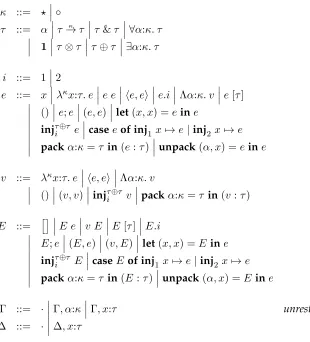
The syntax of intuitionistic F◦is given in Figure2.1; expressionseare categorized by types
τ, which are in turn categorized by kindsκ. Intuitionistic F◦ has only two kinds: ?,
pro-nounced “unrestricted”, and◦, pronounced “linear”. The types of intuitionistic F◦, and their introduction and elimination forms, are mostly standard, but some subtleties will
reveal their significance later on.
The function type in F◦ is writtenτ1→κ τ2, where the kind annotationκindicates how
the function itself may be used: functions of typeτ1 →? τ2 may be used any number of
times—that is, they may be duplicated or discarded—while those of type τ1
◦
→τ2 must
be used exactly once.1 To accommodate this kind annotation, the introduction form for
functions is writtenλκx:τ. e; functions are eliminated by standard applicatione1 e2.
1In the literature,
(is the traditional symbol for the linear function type, but, when linear and unrestricted functions are present in the same system, there is disagreement over whether the use of(rather than→
κ ::= ? ◦ kinds τ ::= α τ κ →τ τ &τ
∀α:κ. τ 1 τ ⊗τ τ ⊕τ
∃α:κ. τ types
i ::= 1
2 indices
e ::= x
λ
κx:τ. e
e e
he, ei
e.i
Λα:κ. v
e[τ] expressions
()
e;e
(e, e)
let(x, x) =eine
inj τ⊕τ i e
caseeof inj1 x7→e|inj2x7→e
packα:κ=τ in(e:τ)
unpack(α, x) =eine
v ::= λκx:τ. e
he, ei
Λα:κ. v values
()
(v, v)
inj τ⊕τ i v
packα:κ=τ in(v:τ)
E ::= îó
E e v E
E [τ]
E.i evaluation contexts
E;e
(E, e)
(v, E)
let(x, x) =E ine
inj τ⊕τ i E
caseE of inj1x7→e|inj2 x7→e
packα:κ=τ in(E:τ)
unpack(α, x) =Eine
Γ ::= ·
Γ, α:κ
Γ, x:τ unrestricted typing contexts
∆ ::= ·
∆, x:τ linear typing contexts
Figure 2.1: Intuitionistic F◦
The type τ1&τ2 is the additiveproduct ofτ1 andτ2—a curious choice of terminology
(given that “additive” in other contexts generally refers to sums rather than products) that
is nevertheless standard in the linear logic literature. The additive pairhe1, e2isuspends
e1 ande2; such pairs are eliminated with projectione.1 or e.2, after which evaluation of
selected component continues. To preserve linearity, each additive pair must be eliminated
exactly once, meaning that, inhe1, e2i, bothe1ande2will depend on the same set of linear
resources.
The universal types∀α:κ. τgives a kind annotationκto its type variableα; this annota-tion also appears in the type abstracannota-tion formΛα:κ. v. Type application is written ase[τ].
Note that F◦ makes use of thevalue restriction(Wright and Felleisen,1994), requiring that
fur-[E-APP] (λκx:τ. e)v −→ {x7→v}e [E-SELECT]he1, e2i.i −→ ei
[E-TAPP] (Λα:κ. v) [τ] −→ {α7→τ}v [E-SEQ] ();e −→ e
[E-LET]let(x1, x2) = (v1, v2)ine −→ {x17→v1, x27→v2}e
[E-CASE]case injτ1⊕τ2
i vof inj1x17→e1|inj2 x2 7→e2 −→ {xi 7→v}ei
[E-UNPACK]unpack(α, x) = (packα:κ=τ in(v:τ0))ine −→ {α7→τ, x7→v}e
[E-CTXT] e −→ e
0
Eîeó −→ Eîe0ó
[E∗-ID]e −→∗ e [E∗-TRANS] e −→ e
0 e0 −→∗ e00 e −→∗ e00
Figure 2.2: Evaluation rules for intuitionistic F◦
ther evaluation steps. This is a common restriction in languages that mix polymorphism
with other features—e.g., ML—and it turns out to be critical to the soundness of F◦.
The remaining constructs of intuitionistic F◦are entirely straightforward. The unit type
1has a single element()and is eliminated by sequencinge1;e2. Themultiplicative
prod-uctτ1 ⊗τ2 is more familiar than its additive cousin: a multiplicative pair(e1, e2) eagerly
evaluates its components, and they must depend on disjoint sets of linear resources; the
elimination formletx1, x2 =eine0binds both components of such pairs, as projection in
this case could violate linearity.
Sumsτ1⊕τ2are completely standard, introduced by injectioninjτi1⊕τ2 eand eliminated
with case analysis case e of inj1 x1 7→ e1 | inj2 x2 7→ e2. F◦ uses superscript type
annotations in cases like injτ1⊕τ2
i e where additional type information is necessary for
typechecking but serves no further purpose—in this case, the type of the argument reflects
only one side of the sum type, so the annotation fills in the missing information.2
Finally, F◦ featuresexistential types ∃α:κ. τ, which differ from their standard presen-2One might instead introduce, in this case, polymorphicinj
1andinj2terms and rely on type application
[S-REFL]κ6κ [S-TOP]κ6◦ [K-SUB] Γ`τ :κ1 κ1 6κ2 Γ`τ :κ2
[K-TVAR] α:κ∈Γ
Γ`α :κ [K-ARROW]
Γ`τ1:κ1 Γ`τ2 :κ2
Γ`τ1→κ τ2:κ
[K-WITH]Γ`τ1 :κ1 Γ`τ2 :κ2 Γ`τ1&τ2 :◦
[K-ALL] Γ, α:κ`τ :κ
0
α /∈dom(Γ) Γ` ∀α:κ. τ :κ0
[K-UNIT] Γ`1:? [K-TENSOR] Γ`τ1:κ Γ`τ2 :κ Γ`τ1⊗τ2 :κ
[K-PLUS] Γ`τ1 :κ Γ`τ2:κ Γ`τ1⊕τ2 :κ
[K-EXISTS] Γ, α:κ`τ :κ
0
α /∈dom(Γ) Γ` ∃α:κ. τ :κ0
Figure 2.3: Kinding rules for intuitionistic F◦
tation only in the presence of the kind annotationκ. Existential types allow, essentially,
for pairs in which the first element is a type and the second is a term; the term may
de-pend on the structure of the type, but the enclosing context can only know that type as
an opaque type variable. Existentials are introduced, packaging together a term and a
type, withpack α:κ = τ in (e : τ0); the type annotationτ0 indicates which occurrences
ofτ within the type ofeshould be abstracted toα. Existential packages are opened with
unpack(α, x) =eine0; withine0, the type and term components of the existential package
eare bound toαandxrespectively.
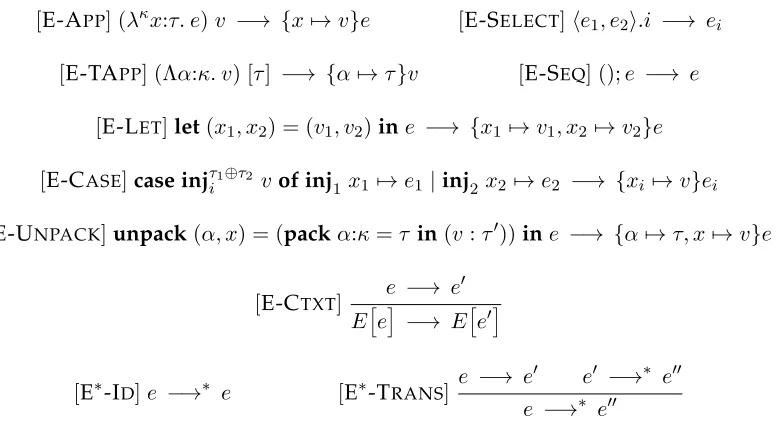
Intuitionistic F◦’s call-by-value operational semantics can be seen in Figure 2.2. It is
entirely standard and kind-agnostic; each elimination form reacts with its associated
in-troduction form. All other evaluation is accounted for, in rule E-CTXT, by decomposing
an expression into anevaluation contextEapplied to a subexpressione: ifesteps toe0, then
Eîeósteps toEîe0ó. The definition of evaluation contexts is also completely standard and
reflects the usual definition of call-by-value reduction—e.g., the left side of an application
is reduced before the right and values are exactly those expressions that cannot reduce
fur-ther. At this point evaluation contexts merely serve as a convenience, removing the need
To understand how types are assigned to intuitionistic F◦ expressions, we must first
look at how kinds are assigned to types. As mentioned, the kind?classifies unrestricted
types, the members of which may be duplicated or discarded, whereas ◦ classifies lin-ear types, the members of which must be used exactly once. But note that the behavior
allowed for expressions of linear type is included in the behavior allowed for those of
un-restricted type; it should thus be sound to classify an unun-restricted type as linear. In F◦, this
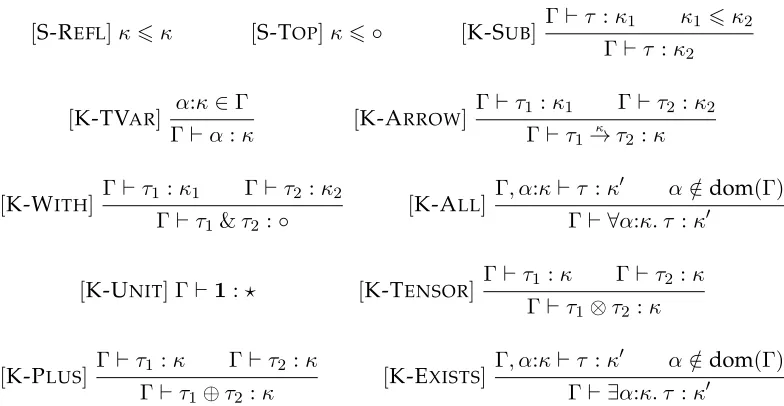
idea is captured through asubkindingjudgment, writtenκ1 6κ2, that yields a very simple
subkinding order:
6
◦
?
Here F◦ diverges from many linear systems that make memory management their first
priority (Wadler,1990;Ahmed et al.,2007;F¨ahndrich and DeLine,2002;Hicks et al.,2004):
if linearity is meant to imply that memory can be used in a way that might not be safe
otherwise, then clearly unrestricted shouldnotbe a subkind of linear. (However, while F◦
is not built around memory management in that sense, we will see in Section2.2.2that its
constructs are indeed well suited for ensuring that memory is used correctly.)
Figure2.3 shows the kinding rules for intuitionistic F◦, where the kinding judgment
is writtenΓ ` τ : κ. Rule K-SUB incorporates subkinding as described above, while K-TVAR, as one would expect, looks up a type variable’s kind in the context Γ. The next three rules, K-ARROW, K-WITH, and K-ALL, each deal with a construct that suspends computation, and each receives slightly different treatment. The kind ofτ1→κ τ2 isκ
re-gardless of the kinds ofτ1andτ2. The kind ofτ1&τ2, on the other hand, is always◦—more
permissive kinding in this case would actually complicate soundness, and the
functional-ity of unrestricted additive pairs can be achieved with multiplicative pairs of unrestricted
functions. Finally, the kind of∀α:κ. τ is simply the kind ofτ under the appropriate con-text extension—it is in fact this design decision that gives F◦the value restriction, as will
become clear in the discussion of type soundness.
The remaining kinding rules are all straightforward. K-UNITdeclares the unit type1 to be unrestricted for reasons of convenience, as F◦ will remain sound in either case. The
[B-LIN] Γ`τ :◦ Γ; ∆, x:τ `e:τ
0
x /∈Γ,∆ [Γ; ∆], x:τ `e:τ0
[B-UN]Γ`τ :? Γ, x:τ; ∆`e:τ
0 x /∈Γ,∆
[Γ; ∆], x:τ `e:τ0
[U-EMPTY]·d·=·
[U-LEFT] ∆1d∆2= ∆ x /∈∆ ∆1, x:τd∆2= ∆, x:τ
[U-RIGHT] ∆1d∆2 = ∆ x /∈∆ ∆1d∆2, x:τ = ∆, x:τ
Figure 2.4: Auxiliary judgments for intuitionistic F◦typing
match the kind of the type being constructed. Combined with subkinding, this gives the
expected result in the cases of sums and multiplicative products: to be given the
unre-stricted kind, both sides must be unreunre-stricted; if either the left or the right side can only be
linear, then the entire construct must be linear. Note that, while the presence of subkinding
makes kinding nondeterministic, it is clearly decidable and the simple subkinding lattice
makes it easy to define a type’s most specific kind.
While the kinding rules required just a single contextΓ—with no special consideration
needed concerning how often it appears in a rule’s premises—the typing rules depend on
both this unrestrictedΓ, which contains type variables and unrestricted expression
vari-ables, and a linear context∆, which contains linear expression variables. This two-context
presentation follows Barber’s DILL (Barber, 1997) and leads to a simpler metatheory as
compared to a single-context presentation. Due to subkinding, a variable of an unrestricted
type may be treated as though its type were linear and must be permitted to be bound in
eitherΓ or ∆. This is expressed concisely with the notation [Γ; ∆], x:τ ` e : τ0, indicat-ing that eitherΓor∆is extended with the binding forxfor purposes of typecheckinge.
Rule B-UNin Figure2.4requires that an extension ofΓbindxto an unrestrictedτ, while subkinding allows any well-formedτ to be accepted by B-LIN. Additionally, the linear resources in∆must be split whenever two subexpressions will both be evaluated—e.g., in
e1 e2 and(e1, e2)but not in he1, e2i. Such a linear context split into∆1 and∆2 is written
[T-LVAR] Γ;x:τ `x:τ [T-UVAR] x:τ ∈Γ Γ;· `x:τ
[T-LAM] [Γ; ∆], x:τ1`e:τ2 κ=? =⇒ ∆ =· Γ; ∆`λκx:τ1. e:τ1→κ τ2
[T-APP] Γ; ∆1`e1 :τ1
κ
→τ2 Γ; ∆2 `e2 :τ1
Γ; ∆1d∆2`e1e2:τ2
[T-APAIR]Γ; ∆`e1 :τ1 Γ; ∆`e2:τ2 Γ; ∆` he1, e2i:τ1&τ2
[T-SELECT] Γ; ∆`e:τ1&τ2 Γ; ∆`e.i:τi
[T-TLAM] Γ, α:κ; ∆`v:τ α /∈Γ
Γ; ∆`Λα:κ. v:∀α:κ. τ [T-TAPP]
Γ; ∆`e:∀α:κ. τ0 Γ`τ :κ
Γ; ∆`e[τ] :{α7→τ}τ0
[T-UNIT] Γ;· `() :1 [T-SEQ] Γ; ∆1 `e1 :1 Γ; ∆2 `e2 :τ Γ; ∆1d∆2 `e1;e2:τ
[T-MPAIR] Γ; ∆1`e1:τ1 Γ; ∆2 `e2 :τ2 Γ; ∆1d∆2 `(e1, e2) :τ1⊗τ2
[T-LET] Γ; ∆1`e1:τ1⊗τ2 [Γ; ∆2], x1:τ1, x2:τ2`e2:τ Γ; ∆1d∆2 `let(x1, x2) =e1 ine2 :τ
[T-IN] Γ; ∆`e:τi Γ`τ1 :κ1 Γ`τ2 :κ2 Γ; ∆`injτ1⊕τ2
i e:τ1⊕τ2
[T-CASE] Γ; ∆1 `e:τ1⊕τ2 [Γ; ∆2], x1:τ1 `e1:τ [Γ; ∆2], x2:τ2 `e2:τ Γ; ∆1d∆2 `caseeof inj1x17→e2 |inj2x27→e2:τ
[T-PACK] Γ; ∆`e:{α7→τ}τ
0
Γ`τ :κ
Γ; ∆`packα:κ=τ in(e:τ0) :∃α:κ. τ0
[T-UNPACK] Γ; ∆1 `e1:∃α:κ. τ [Γ, α:κ; ∆2], x:τ `e2 :τ
0
Γ; ∆1d∆2 `unpack(α, x) =e1ine2:τ0
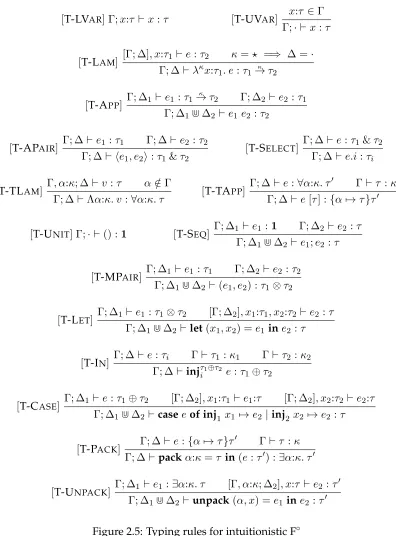
Intuitionistic F◦’s typing judgment, writtenΓ; ∆ ` e: τ, is defined in Figure2.5. The variable rules T-LVARand T-UVARhandle variables from the linear and unrestricted
con-texts respectively. Note that, while both rules allow an arbitraryΓ—permitting weakening
of unrestricted assumptions—∆may contain no variables aside from, in the linear case,
the variable whose type is being checked. T-LAMdemonstrates the non-deterministic ex-tension[Γ; ∆], x:τ in typechecking the body of a function; it further requires, if the entire
expression is meant to be unrestricted, that the body not depend on any linear variables.
This last restriction is essential in making sure that it is safe to duplicate or discard a
func-tion value of an unrestricted type.
The remaining typing rules are all fairly straightforward, but there are a few more
details of interest. First, the only circumstances under which a linear context is duplicated
are those in which only one subexpression typechecked with the duplicated context will
be evaluated at run time—e.g., in T-APAIR. The more common case is for a linear context to be split into∆1 d∆2, as in T-APP, T-SEQ, T-MPAIR, T-LET, and T-UNPACK. T-CASE
does both, using∆1 to typecheck the expression being analyzed and∆2 to typecheck the
branches, only one of which will ultimately be evaluated. Finally, both T-PACK and T-TAPPmake implicit use of subkinding: polymorphic expressions expecting a linear type may be given an unrestricted one, and unrestricted types may be hidden in an existential
package exposing a linear type variable.
Weakening (neglecting to use a variable) and contraction (using a variable more than
once) are only possible with variables of unrestricted type. Rather than add explicit
con-traction and weakening rules, these properties are built into the rules that require them.
The separation of linear and unrestricted typing contexts makes this fairly straightforward:
rules T-LVARand T-UVARpermit weakening by allowing an arbitraryΓat the leaves of typing derivations, while every rule with multiple premises duplicatesΓbut handles∆as
described above. Weakening and contraction thus follow naturally:
Property 1(Weakening). If Γ1,Γ2; ∆`e:τ0, Γ1 `τ :?, andxis not inΓ1,Γ2, or∆,
thenΓ1, x:τ,Γ2; ∆`e:τ0.
Property 2(Contraction). If Γ1, x:τ, y:τ, Γ2; ∆`e:τ0, andΓ1`τ :?,
From these rules we can see that the type ∀α:◦.∀β:?. α →?
β →?
α, for instance, is
uninhabited—there is no way to write the requisite unrestricted inner function in the
pres-ence of a linear variable of typeα. This is as it should be, because even though it ostensibly
promises to return its argument of typeα, the partial application of a function of this type
could be freely replicated or discarded, violating linearity. The same is true for the type
∀α:◦.∀β:?. α→◦ β→? α, but the types∀α:◦.∀β:?. α→? β→◦ αand∀α:◦.∀β:?. β→? α→? αare both inhabited, as their inhabitants behave appropriately with respect to linearity.
It is easy to see that, modulo the value restriction, intuitionistic F◦ is an extension of
System F. In fact, an earlier presentation (Mazurak et al.,2010) of a core of intuitionistic F◦,
there called System F◦, extended System F with only kind annotations, leveraging
well-known encodings for existentials and multiplicative products while omitting the additive
constructs. This is not the approach taken here, for reasons that will become clear in
Chap-ter3, but the encodings of System F remain useful. For instance, generalletexpressions
can be defined as
letx=eine0 , (λ◦x:τ. e0)e
where τ is the type of e—whenever let expressions are used in examples, τ should be
obvious from context. Note that, since the function representing the body of the let is
always used immediately and exactly once, it is a natural candidate for the linear function
type, allowingletexpressions to freely typecheck in the presence of linear free variables.
The standard System F encoding of natural number is also available, providing
unre-stricted values and making use of unreunre-stricted functions while still allowing an arbitrary
(potentially linear) type as the result of the elimination of a natural number:
Nat , ∀α:◦.(α→?
α)→?
α→?
α
As usual,n[τ]f xapplies the functionf (which takesτ toτ) toxa total ofntimes:
0 , Λα:◦. λ?s:α→? α. λ?z:α. z
1 , Λα:◦. λ?s:α→?
α. λ?z:α. s z
2 , Λα:◦. λ?s:α→? α. λ?z:α. s(s z)
It is instructive to look at the kind annotations in this definition and consider the functions
they serve. As α is the type argument for eliminating a natural number, giving α the
kind◦simply makes natural numbers as general as possible. The?annotation on eachλ
ensure that natural numbers themselves are unrestricted—were the second annotation◦, unrestricted natural numbers would become linear when partially applied to a
successor-eliminating function, and changing both to◦would give us natural numbers that must be treated linearly.
Replace the?on the inner arrow—i.e., the type ofs—with◦, however, and (in addition to requiring a◦on the second arrow and ruling out partial application) we no longer have natural numbers at all, as only the term representing1remains typeable: a linear argument
likesmust be applied exactly once, so givenzof typeτ andsof typeτ→◦ τ, the only well-typed expressions of typeτ are equivalent tos z. While this type is not particularly useful,
it suggests other possibilities. Consider, for example
∀α:◦.(α→◦ α)→? (α→◦ α)→◦ (α→◦ α)→◦ α→◦ α
Its inhabitants represent the different possible orders in which the three function
argu-ments can be applied to an argument, giving this type six canonical members. More
com-plex types in this vein, incorporating multiple type variables and both linear and
unre-stricted functions, can have an unbounded number of inhabitants while still enforcing,
thanks to linearity and polymorphism, restrictions on how often or in which order
cer-tain functions are applied. The next section demonstrates this with some more realistic
examples.
2.2
Examples
We will now see the applicability of intuitionistic F◦through three sets of examples. First,
an encoding of a safe filesystem establishes the basic techniques used to extract good
be-havior from a mix of linearity and parametric polymorphism. Second, a variety of
ref-erence cell implementations show that, while F◦ does not build in notions of references
and aliasing, protocols defining correct memory management can indeed be enforced by
corresponding F◦ type—in addition to establishing that a large class of protocols can be
encoded in our type system, this proof highlights intuitions about linearity that still need
formalization, which are addressed in Section2.3.2.
These examples all include records, always containing only fields of unrestricted type,
eliminated by projection—these records are often analogous to dictionaries in
implemen-tations of Haskell typeclasses (Wadler and Blott,1989). Such records add significant
read-ability and can clearly be encoded in terms of the multiplicative pairs. The single variable
letdefined in the previous section also sees frequent use, and n-ary existential types are
used for simplicity’s sake.
2.2.1 A linear filesystem
Linearity lets us specify a filesystem interface that requires each filehandle be closed
ex-actly once and forbids its use thereafter. Given the base typesStringandChar—but without
any understanding of linearity—an operating system might provide a typeUnsafeFHand
its associated file operations with the following augmented F◦signatures3:
UnsafeFH : ?
unsafe open : String→? UnsafeFH unsafe read : UnsafeFH→? Char unsafe write : Char→? UnsafeFH→? 1
unsafe close : UnsafeFH→? 1
Here UnsafeFH is analogous to a Unix file descriptor or FILE pointer, and there are no
static guarantees that a filehandle of this type is not read from or written to after it has
been closed. Intuitionistic F◦, however, makes it easy to create a safe interface protecting
filehandles from misuse. First, takingα to be the abstract filehandle type, let us define a
record typeFH(α)of safe file operations:
FH(α) , {read:α→?
Char⊗α write:Char→? α→? α, close:α→?
1}
3This example uses roughly the same interface given by DeLine and F¨ahndrich(2001) to motivate Vault
Nowopencan be defined to return an existential package, hiding the filehandle’s true type
behind a linear type variable and pairing the filehandle with its associated operations:
open : String→ ∃? α:◦. α⊗FH(α)
open , λ?f:String.lethandle=unsafe openf in
packα=UnsafeFHin
(handle,
{read=λ?h:UnsafeFH.(unsafe readh, h), write=λ?c:Char. λ?h:UnsafeFH.
unsafe writec h;h,
close=unsafe close
}) :α⊗FH(α)
While the typeUnsafeFHis unrestricted within the scope ofopen, the outside world sees
its occurrences at the existentially bound linear type variableα. Ifopentreats filehandles
correctly, which it does, then any use of the operations provided by an existential package
it creates must treat them correctly as well.
After unpacking a filehandle, a program may read or write from it simply by invoking
the provided member functions, but good programming practice requires the ability to
define new functions over filehandles. The separation of the linear filehandle from the
unrestricted file operations makes it easy to write functions like read line, which can be
given the following type:
read line:∀α:◦.FH(α)→?
α→?
String⊗α
This type suggests a usage pattern wherein many file operations occur within the scope of
a singleunpack; such a pattern allows for types that reflect, for instance, the fact that the
filehandle returned byread lineis the same one that it was given.
Writing functions this way allows for useful type coercions; for example, suppose we
are also able to open files in read-only mode, yielding restricted existential packages of the
form
ROFH(α) = {read:α→? Char⊗α, close:α→?
Many functions, including read line, may be defined over this weaker interface, and we
can always construct a record of type ROFH(α)out of a record of type FH(α) to allow a
read-write filehandle to be treated as though it were read-only.
Such a coercion from a record type with more members to a record type with fewer
is implicit in systems with structural subtyping and mirrors some of the simpler
relation-ships that can arise between Haskell typeclasses (Wadler and Blott,1989). The use of
exis-tential quantification in tying methods to their owners is reminiscent of object encodings
in languages with structural subtyping (Bruce et al.,1999).
2.2.2 Reference cells
An interface for unshareable linear reference cells looks remarkably similar to the
filehan-dle interface just presented. A reference type is already naturally thought of as
parame-terized over the type of its contents, however; let us distinguish between such ordinary
(and often unrestricted) type parameters from the linearcapability parameters by writing,
for instance,UniqRef[τ](α)for the type of unshareable reference cells containing values of
typeτ and making use of a capability—an opaque value—of the typeα. Such a reference
cell could be typed as follows:
UniqRef[τ](α) , {set:τ →? α→? α, get:α→?
τ ⊗α, free:α→? 1}
uniq ref : ∀β:?. β→ ∃? α:◦. α⊗Ref[β](α)
On its own, this is not particularly interesting, as such a linear reference cell simply
en-codes the practice of threading a value through a program—indeed, an implementation
of uniq refcould very well just equate α and τ. Instead, however, let us consider
varia-tions onUniqRefthat make more sense as safe interfaces wrapping operations over a type
UnsafeRefof manually managed memory, much asFilein the previous wraps potentially
unsafe filehandle operations.
itself requires no linearity—is the typeGCRef:
GCRef[τ](α) , {set:τ →? α→? 1, get:α ?
→τ }
gc ref : ∀β:?. β ?
→ ∃α:?. α⊗GCRef[β](α)
The operations included in a record of typeGCRef[τ](α) allow the retrieval and
assign-ment of the contents of the underlying reference cell of typeτ but do not provide a means
of freeing this memory, as is usually seen in languages with garbage collection. Even if
manually managed reference cells are also present, hiding the reference type behindα—
which may be unrestricted in this example—ensures that a garbage-collected reference cell
cannot mistakenly be freed.
This, too, is not particularly exciting. Intuitionistic F◦, however, works equally well
with references that begin their lives manually managed (and thus of linear type) but later
are put under the garbage collector’s control. UniqRef[τ](α) simply needs an additional
function to serve as the appropriate coercion:
gc:α→ ∃?
β:?. β⊗GCRef[τ](β)
By consuming and not returningα,gcpreventsfreefrom being called on the now
garbage-collected (but unrestricted) reference, even if, in actuality, both parameters are simply
bound to the underlying reference type. We now have a coercion from alias-free to
po-tentially aliased pointers, a fact that, were linearity conflated with alias-freedom, would
run counter to the subkinding relation of?6◦.
Going even further, an intermediate point between a strictly linear and a garbage
col-lected reference is a reference that must be explicitly aliased and whose aliases must be
explicitly discarded—i.e., the cell is managed using reference counting, but the operations
intu-itionistic F◦:
RCRef[τ](α) , {set:τ →?
α→?
α,
get:α→? τ ⊗α, alias:α→?
α⊗α, drop:α→? 1}
rc ref : ∀β:?. β→ ∃? α:◦. α⊗RCRef[β](α)
A straightforward implementation ofrc refcould use as its capability a pair of the reference
cell to be managed and a second, integer-valued cell to act as a counter to be adjusted by
thealiasanddropoperations. Both the main cell and the counter cell could safely be freed
when the count reaches zero.
However, whileRCRefstill provides a linear access capability, it is no longer possible
to know for certain that there are no other outstanding references to the cell in question.
To remedy this, as is often done in capability calculi (Ahmed et al., 2007; Chargu´eraud
and Pottier, 2008), we can give our cells both an exclusive capability parameterα and a
shared capability parameterβ, with possession of the exclusive access capability implying
that there currently exist no copies of the shared access capability. If, for example, the cell
contents should not be altered if any aliases exist, this can be accomplished with
ShareRef[τ](α, β) , {set excl:τ →? α→? α, get excl:α→?
τ ⊗α)
get shared:β→? τ⊗β, share:α→?
β,
claim:β→? α⊕β, alias:β→?
β⊗β, drop:β→? 1, free:α→? 1}
share ref : ∀γ:?. γ→ ∃? α:◦.∃β:◦. α⊗ShareRef[γ](α, β)
not, shared access remains. Exclusive access, of course, should only be granted if there are
no other shared access capabilities in existence for this reference cell, meaning that the
underlying representation can again be a pair of unsafe reference cells.
2.2.3 Regular protocols
What else can intuitionistic F◦ guarantee? Rather than present more individual examples,
let us see howanyprotocol expressible as a regular language can be written in F◦. (This
is not, of course, an upper limit on the expressivity of intuitionistic F◦—the previously
seenRCRefandShareRefare equivalent to the parenthesis matching that is the canonical
non-regular example. The regular languages, however, still serve as rich space of example
protocols that can be reasoned about in a straightforward way.)
As every regular language can be recognized by a deterministic finite automaton, let us
take the standard definition of a DFA as a tupleM = (Q,Σ, δ, q0, F), whereQis a finite set
of states,Σis a finite set of alphabet symbols (in our context, protocol actions),δis function
fromΣ×QtoQ(viewed also as a subset ofΣ×Q×Q) describing the valid transitions between states,q0 is a distinguished initial state, andF is a set of final states. Several of
the examples seen previously can be seen as finite automata with alphabets of methods
and capability parameters as. For example,UniqRef has two states, the second of which
(Freed) is its only final state,GCRefis a trivial automaton with only exactly one (final) state
(GC-managed), and, as the regular languages are closed under union and concatenation,
augmentingUniqRefwith the coerciongcyields a simple three state automaton with both
of these final states.
To present the encoding of DFAs into F◦ as naturally as possible, let us extend the
metavariable conventions used so far to allow q and r as type variables. Taking Q =
{q0, . . . , qn}, we can now define the automaton typeτM for the DFAM as
τM , ∃q0:◦, . . . , qn:◦. q0⊗ {a takes q to q0 :q→? q0
for every(a, q, q0)∈δ
.. .
done at q:q→? 1
Because the kind ofq0is◦, and becauseq0 appears in the outermost tensor product of this
construction, everyτM must have kind◦as well;τM is also trivially inhabited for anyM,
as one can always supply an existential package in which all type variables are bound to1
and every function isλ?x:1. x.
Ifecontains some subexpression of type τM, let us say that the evaluatione −→∗ v
reflects a wordw = a0. . . ak if the sequence of functions in that record that are applied
during evaluation is exactly
a0 takes q0 to r0, . . . ak takes rk−1 to rk
for some statesr0throughrk. To prove thatτM is an accurate representation ofM, it must
be shown that each w = a0. . . ak accepted byM corresponds to an expression of type
τM →? 1that reflectswand that anyf of typeτM →? 1reflects somewaccepted byM. The
former is fairly straightforward:
Lemma 3. For anyw =a0. . . ak accepted byM, there existsf such that·;· ` f :τM →? 1and
f nreflectswfor any closednwhere·;· `n:τM.
Proof. Recall that, ifw=a0. . . akis accepted byM, we have a trace ofM onwof the form
q0a0r0. . . rk−1akrk, where(a0, q0, r0) ∈ δ,(ai, ri−1, ri) ∈δ, andrk ∈ F. From this and the
definition ofτM, we can construct
f : τM
f , λ?n:τM.unpack(q0, . . . , qn, p) =nin
let(init,trans) =pin
lets0=trans.a0 takes q0 to r0initin
.. .
letsk=trans.ak takes rk−1 to rksk−1 in
trans.done at rk sk
Applyingf to any closednof typeτM clearly reflectsw, and, ifwis in fact accepted byM,
f will indeed have its declared type.
The other direction depends on arguments justified by the nature of linearity, which
Lemma 4. If·;· `f :τM →? 1, then there exists somewsuch thatM acceptswandf nreflects
wfor anynwhere·;· `n:τM.
Proof. (Sketch.) Because τM is linear,f must eliminatenbefore it can return anything of
type1. This will require first unpacking the existential—as everyτM is linear, this may
only be done once—and then pattern-matching against the pair, leaving the linear initial
state capabilityinitand unrestricted operations recordtrans.
If q0 ∈ F, then f might immediately apply trans.done at q0 to init. This reflects the
empty word , and, indeed, if q0 ∈ F, then M accepts . Alternatively, regardless of
whether q0 ∈ F, init can become some other state type (or even q0 again) by repeated
applications of thetrans.a takes q to q0functions. If, after such applications, the result can
be eliminated by sometrans.done at qj, then it must be thatqj ∈F. Moreover, because of
the construction ofτM, eachtrans.a takes q to q0application must represent a valid
transi-tion ofδ. Thus we are reflecting somewaccepted byM.
The above proof appeals to familiar intuitions about parametric polymorphism and the
limited ways in which expressions whose types are variables can be used. The assurance
thatw is properly reflected, however, also depends on the connection between the static
property having a linear rather than an unrestricted type and the behavior of expressions
at runtime. Such a dependence is not unexpected—it is equally true that both lemmas
depend on standard soundness’ promise that the evaluation of well-typed expressions
does not “go wrong”. It does mean, however, that the discussion of soundness in the next
section must make this connection between linearity and run-time behavior.
2.3
Metatheory
Soundness for intuitionistic F◦ implies that well typed terms cannot go wrong. As
men-tioned in the previous section, however, “not going wrong” must take into account the
ways in which subexpressions of linear type may be used in addition to guaranteeing the
absence of stuck terms. Happily, we shall see that standard sort of soundness for F◦—i.e.,
2.3.1 Standard soundness
Progress and preservation make up the standard definition of type soundness. Progress,
which states that a closed, well-typed expression that is not a value can always take an
evaluation step, is no different than in ordinary System F:
Lemma 5 (Progress). If·;· ` e : τ, then eithereis a value or there exists some e0 such that e −→ e0.
Proof. Induction on typing derivations and appeal to canonical forms—the property that
values of a given type always have the shape of that type’s introduction form. Completely
standard.
Preservation, which states that a well-typed expression that takes a step evaluates to
another well-typed expressions, requires more care. As expected, it depends on various
substitution lemmas, which state that a type of the correct kind may be substituted for a
type variable bound byΓin a kinding or typing derivation and that an expression of the
correct type may be substituted for an expression variable bound by either Γ or ∆ in a
typing derivation.
Lemma 6(Substitution).
1. If Γ1, α:κ0,Γ2`τ :κ and Γ1 `τ0 :κ0, thenΓ1,{α7→τ0}Γ2` {α7→τ0}τ :κ.
2. If Γ1, α:κ0,Γ2; ∆`e:τ and Γ1 `τ0 :κ0,
thenΓ1,{α7→τ0}Γ2;{α7→τ0}∆` {α7→τ0}e:{α7→τ0}τ.
3. If Γ1, x:τ0,Γ2; ∆`e:τ and Γ1;· `e0 :τ0, thenΓ1,Γ2; ∆` {x7→e0}e:τ.
4. If Γ; ∆1, x:τ0,∆2 `e:τ and Γ; ∆0 `e0 :τ0, thenΓ; ∆1d∆0d∆2 ` {x7→e0}e:τ.
Proof. Each proceeds by induction on the typing derivation ofe:τ (or, in the first variant,
the kinding derivation ofτ :κ). Weakening and contraction, mentioned in Section2.1, are
invoked in proving the third variant, while the fourth variant uses thedrelation to ensure
Note that the third substitution lemma typese0with respect to an empty linear context;
it in fact does hold ife0 is permitted to contain free linear variables. Similar results have
been observed for other linear systems (Wadler,1992;Maraist et al.,1995). Call-by-value
reduction means that the expressions being substituted will always be values, however,
and—because F◦uses the value restriction—we can prove that unrestricted values contain
no free linear variables:
Lemma 7. If Γ; ∆`v :τ and Γ`τ :?, then∆ =·. Proof. Simple induction on the typing derivation.
Finally, a permutation property for linear contexts, stating that the order of variables is
irrelevant, is required before preservation can be proved:
Lemma 8(Permutation). If Γ; ∆`e:τ and∆0is a permutation of∆, thenΓ; ∆0 `e:τ. Proof. Induction on the typing derivation and straightforward reasoning about
permuta-tions and thedrelation.
With these pieces in place, preservation follows easily:
Lemma 9(Preservation). If Γ; ∆`e:τ ande −→ e0, thenΓ; ∆`e0 :τ.
Proof. Straightforward induction on the typing derivation and appeals to the various
aux-iliary lemmas given above.
From preservation and progress, soundness follows naturally:
Theorem 10(Type soundness). If ·;· ` e:τ, then for anye0wheree −→∗ e0, eithere0 =vfor somevor there existse00such thate0 −→ e00.
Proof. Induction one −→∗ e0followed by direct application of Lemmas5and9.
Type soundness has been verified in Coq for the minimal subset of intuitionistic F◦
that contains only type variables, quantified types, and arrow types (Mazurak et al.,2010);
aside from the additive sum and product, all the other constructs we have seen so far can
A direct correspondence between these metatheoretic properties and intuitions about
what linearity provides for the programmer is not immediately obvious, however. This is
the topic of the next section.
2.3.2 Annotated semantics and linearity at run time
Formalize the intuitions about what linearity means for run-time behavior is not as
straight-forward as it might appear, as some common intuitions about linearity turn out to be
mis-leading. In essence, this is because linearity restrictsvariablesof linear type, while we want
to reason, at run time, about the behavior ofexpressions.
For instance, linearity does not guarantee that subexpressions—or even values—of
lin-ear type will be used exactly once. Nor would we want it to: recall that the encoding oflet
expressions seen previously involves a linear function, and we certainly want to allow for
letexpressions of unrestricted type.
Yet when we consider extending F◦with anything that must be protected by linearity—
e.g., stateful constructs like the references cells presented in Section2.2.2—we quickly find
examples that, in a naive call-by-name or call-by-need variant of F◦, would behave in ways
that should be prevented. For example, given a reference cell as defined previously—of
typeUniqRef extended withgc—unpacked as(ref,methods), one might dispose of it and
move on to evaluatingewith
methods.gcref;e
This call togc will only take place under call-by-value reduction—since its result is not
used, other evaluation strategies would simply discard the subexpression, leaking
mem-ory that the programmer had supposed would be (eventually) reclaimed by the garbage
collector. This is precisely the sort of error linearity should rule out rule out. (Clean, which
is not call-by-value, grapples with concerns analogous to these in the context of its
unique-ness types (Vries et al.,2008).)
Call-by-value reduction, with its assurance that function arguments are evaluated
ex-actly once, seems well-suited to avoiding these problems; indeed, we shall see that a
call-by-value setting—with the addition of the value restriction—rules out such problematic
in the previous section are everything needed to ensure that linearity provides what we
expect it will. To prove that this is so, the remainder of this section provides an extended
operational semantics with which we can reason more formally about what linearity
pro-vides at run time.
Annotating intuitionistic F◦
What does it mean to “use” a subexpression? In other contexts, one might mean by this
that an expression is evaluated to a value, that it is passed to a function, that it is applied
to an argument, or something else entirely. In order to understand the run-time effects of
linearity, which stem from restrictions on the use of variables, let us focus on two particular
uses of values:
1. A value is conscripted when it replaces a variable in the body of a function, a let
expression, or acaseexpression.
2. A previously conscripted value is dischargedwhenever evaluation proceedsbecause
it is a value—that is, the syntax of F◦ may allow an arbitrary expression, but if that
expression were not a value, evaluation would have continued in a different manner
(typically by using evaluation contexts to decompose the expression further). In
par-ticular, had a free variable been present instead of the discharged value, evaluation
would have been stuck.
Linearity’s contribution is now clear: in the course of evaluation, every conscripted linear
value must be discharged exactly once—unless it is suspended within the final result, in
which case it must not be discharged. Focusing exclusively on conscripted values
cap-tures the fact that linearity is, at its core, about variables: until a value is substituted for a
variable, the question of whether this value is “treated linearly” is meaningless.
This can be formalized by defining a linearity-aware operational semantics on
expres-sions extended with values that are tagged with a type andidentifier—any unique token
will suffice, as identifiers serve merely to match uses of a value corresponding to uses of a
variable, so let us use natural numbersj,k, and`. Tagged values are those that have been
[L-APP] (λκx:τ. e)v(v:τ)j−→jj+ 1 {x7→(v:τ)j}e [L-SELECT]he1, e2i.i−→ j j ei
[L-TAPP] Λα:κ. v[τ]−→ j
j {α7→(τ:κ)}v [L-SEQ] ();e
−→
j j e
[L-LET] let
τ1⊗τ2 (x
1, x2) = (v1, v2)ine(v1:τ1) j,(v
2:τ2)j+1
−→
j j+ 2
{x1 7→(v1:τ1)j, x27→(v2:τ2)j+1}e
[L-CASE]case injτ1⊕τ2
i vof inj1x17→e1 |inj2x27→e2 (v:τi)j
−→
j
j+ 1 {xi 7→(v:τ) j}e
i
[L-UNPACK] unpack(α, x) = (packα:κ=τ in(v:τ
0))ine(v:τ0)j
−→
j j+ 1
{α7→(τ:κ)αx7→(v:τ0)j}e
[L-TAG] (v:τ)k(v:τ)k−→
j
j v [L-CTXT]
eDC−→ j k e
0
EîeóDC−→ j
k E
î e0ó
[L∗-ID]e−→ ∗j
j e [L
∗
-TRANS] e
C1
D1−→
j k e
0
e0 C2
D2−→
∗k ` e
00
e C1, C2
D1, D2−→
∗j ` e
00
Figure 2.6: Linearity-aware semantics for intuitionistic F◦
letexpressions, and sequences of tagged values are also required:
j, k, ` ::= 0
1 2 . . . τ ::= . . . (τ:κ)
e ::= . . .
(v:τ)
j
let
τ⊗τ (x, x) =e
ine
C, D ::=
(v:τ)
j
C, C
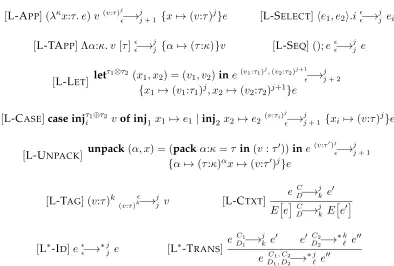
An augmented semantics for reasoning about this annotated variant of intuitionistic F◦is
given in Figure2.6: e C
D−→
j
k e
0 means that, givenj > `for every identifier`ine,esteps
to e0 while conscripting the sequence of tagged values C and discharging the sequence
D—the identifierk ≥jis guaranteed not to appear ine0,C, orD. Values are conscripted in rules L-APPLAM, L-LET, L-CASE, and L-UNPACK; i.e., whenever a value would be
[K-TTAG] Γ`τ :κ
Γ`(τ:κ) :κ [T-TAG]
Γ`v:τ
Γ`(v:τ)j :τ [T-TTAG1]
Γ`e:τ Γ`τ :κ
Γ`e: (τ:κ)
[T-TTAG2]Γ`e: (τ:κ) Γ`e:τ
Figure 2.7: New kinding and typing rules for annotated intuitionistic F◦
that variable’s type. Similarly, while L-TAPPLAMdoes not conscript, it does tag its type
argument with its expected kind, as does L-UNPACK; this keeps a record of the kind at which that type will be considered within its body (and requires no identifier).
Since a tagged value(v:τ)jis not itself a value—a necessary constraint to keep
evalua-tion deterministic—rule L-TAGdischarges the tagged value by removing its tag. Between
being conscripted and discharged, a tagged value may linger within a function closure or
additive pair, and a tagged value suspended within the final result of evaluation will never
be discharged. As before, evaluation does not depend on typing, but the record kept byC
andDineC
D−→
∗j k e
0 does reveal how arguments considered at various types were used.
The augmented kinding and typing rules in Figure 2.7are straightforward: the rules
K-TTAGand T-TAGsimply check that the tagged type or expression can indeed have the
kind or type that the tag declares it has. The rules T-TTAG1 and T-TTAG2 make kind annotations completely transparent at the expression level.
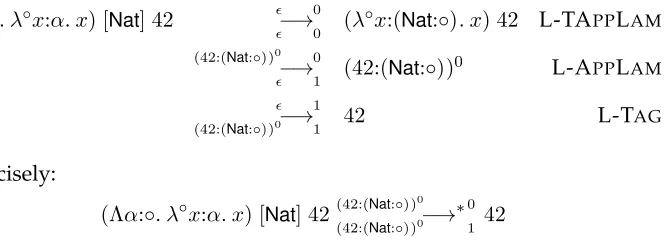
As an example, consider an application of the polymorphic linear identity function
Λα:◦. λ◦x:α. xto the natural number 42 of typeNat. This expression evaluates as follows:
(Λα:◦. λ◦x:α. x) [Nat] 42
−→
0
0 (λ
◦x:(Nat:◦). x) 42 L-TAPPLAM
(42:(Nat:◦))0
−→
0
1 (42:(Nat:◦))
0 L-APPLAM
(42:(Nat:◦))0−→
1
1 42 L-TAG
Or, more concisely:
(Λα:◦. λ◦x:α. x) [Nat] 42(42:(Nat:◦))
0
(42:(Nat:◦))0−→
∗0 1 42
In other words: over the course of evaluation, the value 42 was passed to a function and
T((v:τ)j) = {(v:τ)j} ]T(v)
T(x) = ∅
T(λκx:σ1. e) = T(e)
T(e1 e2) = T(e1)]T(e2)
T(he1, e2i) = T(e1)∪T(e2)
T(e.i) = T(e)
T(Λα:κ. v) = T(v)
T(e[τ]) = T(e)
T(()) = ∅
T(e1;e2) = T(e1)]T(e2)
T((e1, e2)) = T(e1)]T(e2)
T(let(x1, x2) =e1 ine2) = T(e1)]T(e2)
T(injτ1⊕τ2
i e) = T(e)
T(caseeof inj1x17→e1|inj2 x2 7→e2) = T(e)](T(e1)∪T(e2))
T(packα:κ=τ in(e:τ0)) = T(e)
T(unpack(α, x) =e1 ine2) = T(e1)]T(e2)
Figure 2.8: Tagged contents of intuitionistic F◦expressions
tagged 42 to appear more than once in the list of discharged values, linearity would have
failed us—although 42 is of typeNat, here it is being considered as linear becauseαwas
declared to be linear; conscripted at this type, it should be discharged exactly once. Were it
to instead appear as(42:Nat)0 or(42:(α:?))0, however, there should be no such restriction
on its use, as one can indeed write functions fromNattoNatthat use their arguments more
than once or that ignore them altogether.
This annotated variant of intuitionistic F◦is reminiscent of linear languages with heap
semantics (Turner and Wadler,1999), which involve tracking, instead of the traces along
the lines ofC andD, a single heapH. Such languages often perform substitution when
the expression being substituted is unrestricted, while associating that expression with
the variable in the heap in the linear case. Theorem12could still be proved with such a
semantics, but the ability to reason about the order of substitutions is necessary to support
the reasoning used in Section2.2.3.
Linearity at run time
A few more auxiliary definitions are necessary before the connection between linearity