EFFECT OF PRANAYAMA ON PULMONARY FUNCTIONS - AN OVERVIEW
Sud Sushant Sud Khyati S.1Department of Agad Tantra, 1Department of Kaya Chikitsa,
International Centre of Ayurvedic Studies, Shri Gulab Kunverba Ayurveda Mahavidylaya, Gujarat Ayurved University, Jamnagar, Gujarat, India
ABSTRACT
Pranayama practice has been reported to improve the lung functions in numerous studies. The benefits includes the prolongation of breath holding time, increase in PEFR (Peak Expiratory Flow Rate), FVC (Forced Vital Capacity), FEV1 (Forced Vital capacity in 1 second), MVV (Maximum Voluntary Ventilation) and lowered respiratory rate. Patients of chronic lung diseases like Asthma, Bronchitis, Emphysema, COPD, etc. may derive immense benefits from these changes in pulmonary functions. In the present paper a critical overview of recent researches in this regard, published in various international and indexed journals has been attempted.
Keywords:Pranayama, Pulmonary functions, Critical overview
INTRODUCTION
Yogic techniques are known to improve one’s overall performance.
Pranayama is an important, yet little
known part of Yoga. Until recently, this art and science of yogic breathing was almost completely unknown to the common man like many other ancient Indian arts. Those who knew it used to be very reluctant to share their knowledge and experience with anyone, unless a student proved by tests that he was ready to receive it.
“Tasmin sati swas praswas yogartivich Pranayama”
This having been (accomplished)
“Pranayama” which is control of
inspiration and expiration1 the inspiration of prana-vayu is shwasa and expiration is
prashwasa and the cessation of both is characteristic of Pranayama. Patanjali in
his Yoga Sutra describes – Yama, Niyama,
Asana, Pranayama, Pratyahara, Dharana,
Dhyana and Samadhi as eight angas
(parts) of Yoga. Amongst them, in the present materialistic world, the third and fourth part, Pranayama and Asana
(Postures) are considered as very important part and prescribed by modern medicine too.
The beneficial effects of different
Pranayama are well reported and has
sound scientific basis. 2-3There is reported evidences of Pranayama that it increases chest wall expansion and lung volumes. 4-5
OBJECTIVES
Practice of Pranayama has been known to modulate cardio-respiratory functions. Keeping this in view, the present study is conducted to collect all the possible data from the published articles in the journals like Journal of Physiological & Biomedical Sciences and Indian Journal of Traditional Knowledge showing the efficacy of Pranayama on the pulmonary functions.
2
www.iamj.in IAMJ: Volume 1; Issue 2; March – April 2013MATERIALS AND METHODS
Articles reviewed for the study (Original Clinical Research Database Articles)
1. Immediate effect of ‘Nadi -Shodhana
Pranayama’ on some selected
parameters of Cardiovascular and Pulmonary functions6
2. Role of Pranayama breathing exercises in rehabilitation of coronary artery disease patients – A pilot study7
3. Yoga exercise increases chest wall expansion and lung volumes in young healthy thais8
Methodology (Article No-1)
This study was carried out in Human Physiology Laboratory, Department of Physiology, Sikkim Manipal Institute of Medical Sciences, Gangtok. The trainer involved in this study addressed the class of 30 students on the purpose of this study, the procedure to be followed and willingness of the subjects to participate in this investigation. After the address, the trainer demonstrated the mode
of Nadi–Shodhana Pranayama to the
subjects.
In the study group, a recording was done before and immediately (within 5 minutes) after performing ‘Nadi-shodhana
Pranayama’. After an initial recording all subjects were put through Nadi-shodhana
Pranayama for 20 minutes. They were
asked to assume ‘Sukhasana’ (the comfortable posture) and regulate the alteration of breathing
Methodology (Article No-2)
Twenty clinically documented patients of CAD from Guru Teg Bahadur Hospital were selected for the study. All the patients were male and their CAD was stable for the past 2-6 yrs. They all belonged to the age group 35-55 yrs (mean age 48±6.57). They served their own control in the study. Informed consent was
taken and a standardized questionnaire related to cardio-respiratory health was worked out. The procedure of PFTs was properly explained to all the subjects. Parameters of the PFTs recorded were: forced expiratory volume in 1 sec (FEV1), forced vital capacity (FVC), FEV1/FVC ratio, peak expiratory flow rate (PEFR), forced mid expiratory flow (FEF25-75), peak inspiratory flow rate (PIFR) and maximum voluntary ventilation (MVV). After recording the basal PFTs, patients were taught
Pranayama breathing exercise. They were
advised to practice it (10 min) twice a day.
Methodology (Article No-3)
Fifty eight (58) healthy volunteers, 18-25 years of age, were recruited from the undergraduate students of Khon Kaen University and separated into two groups. General characteristics (age, body weight, height, and body mass index: BMI) were collected from all subjects. At the first day of study both groups came to the training room and their chest expansion and lung volumes were measured as pre-test data. The chest wall expansion was measured by a standard tape at three levels: upper (sterna angle), middle (rib 5) and lower (rib 8) levels.
20-3
www.iamj.in IAMJ: Volume 1; Issue 2; March – April 2013min Yoga exercise. At the end of 6 weeks period, all studied parameters were measured as post test data with the same methods.
The Yoga group performed five yoga postures: Uttita Kummersana (cat position), Ardha Matsyendrasana (sitting and twist the trunk), Vrikshasana (tree position), Yoga Mudra and Ushtrasana
(camel position) for 20 minutes a day, one time a day and 3 days a week until 6 weeks.
OBSERVATIONS AND RESULTS
Results (Article No-1)
The results of this study demonstrated the beneficial effect of
Pranayama on cardiopulmonary function.
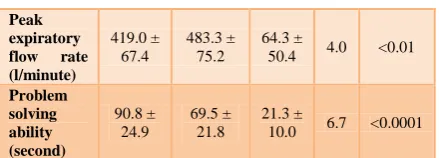
A significant improvement in peak expiratory flow rate was observed in the study. It is an effort independent flow and is mainly dependent on lung volume.
The ‘Nadi shodhana Pranayama’
involves using of lung spaces, not used up in normal shallow breathing. Therefore, the increased peak expiratory flow rate might be a consequence of small airway opening in lungs. The peak expiratory flow rate improved significantly (P<0.01) following Pranayama practice. No significant change in peak expiratory flow rate was observed. Results are shown in table 1. 9-10
Table 1: Immediate effect of Nadi-shodana Pranayama on cardiovascular and pulmonary functions (Data were mean ± SD; n = 10)
Parameters Before Pranay ama After Pranaya ma Mean differ ence
‘t’ p
Basal heart rate (beats/min) 85.9 ± 4.6 74.6 ± 4.1 11.3 ±
4.0 8.9 <0.0001
Systolic blood pressure (mmHg) 120.9 ± 5.8 116.6 ± 4.6 4.3 ±
2.2 6.1 <0.001
Diastolic blood pressure (mmHg) 79.0 ± 2.3 78.2 ± 2.1 0.8 ±
1.4 1.8 NS
Peak expiratory flow rate (l/minute) 419.0 ± 67.4 483.3 ± 75.2 64.3 ±
50.4 4.0 <0.01
Problem solving ability (second) 90.8 ± 24.9 69.5 ± 21.8 21.3 ±
10.0 6.7 <0.0001
Results (Article No-2)
The pulmonary function tests before and after two weeks of Pranayama
breathing exercises were assessed. FEV1%, PEFR, FEF25-75% and MVV are found to be significantly improved after 2 weeks of Pranayama breathing exercises. FEV1, FVC and PIFR also showed a trend towards improvement although not significant. Following the practice of
Pranayama breathing exercises, significant
improvements were seen in FEV1%, PEFR, FEF25-75% and MVV. This indicates that there is some degree of broncho-dilatation, which is leading to better oxygenation of the alveoli. Endurance power of the lungs also improved as shown by improvement in maximum voluntary ventilation.11-12
Improvement in PFTs in the study could be because of reduction of sympathetic reactivity attained with
Pranayama training. This may allow
bronchio-dilatation by correcting the ab-normal breathing patterns and reducing the muscle tone of inspiratory and expiratory muscles. Due to improved breathing patterns, respiratory bronchioles may be widened and perfusion of a large number of alveoli can be carried out efficiently.11 In response to variations in breathing patterns a number of central and autonomic nervous system mechanisms as well as mechanical (heart) and hemodynamic adjustments are also triggered, thereby causing both tonic and phasic change in cardiovascular functioning.12 Hence, it can be said that
4
www.iamj.in IAMJ: Volume 1; Issue 2; March – April 2013cardio-respiratory complications by emphasizing optimal physical and
mental conditioning. Results are shown in table 2.13
Table 2: PFT parameters before and after Pranayama breathing exercises
Subjects No. of
sub-jects
FVC (L) FEV1(L) FEV1/FVC
(%)
PEFR (L/sec)
FEF 25-75% (L/sec)
PIFR (L/min)
MVV (L/min)
Before
Pranayama 20 2.10±0.65 1.58±0.67 76.46±16.34 3.14±1.26 2.58±1.87 2.21±.58 54.08±15.86
After
Pranayama 20 2.23±0.72 1.86±0.69 82.78±13.96 4.16±1.64 3.18±1.12 2.43±0.6 66.15±14.56
Results (Article No-3)
At the beginning of the study (before or pre-test) all measured lung volumes were not significantly different between groups (Table 4). Yoga exercise significantly increased FVC, FEV1 and FEF 25-75% (p < 0.05) without any effect on tidal volume.14 However, only the post-test FEF 25-75% of Yoga significantly increased when compared to control. No lung volumes of the control were significantly different when compared between before and after values.
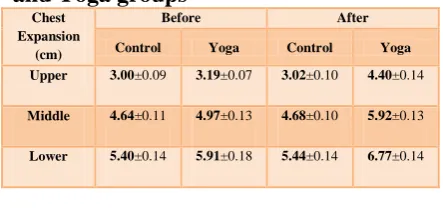
As general characteristics and lung volumes, baseline chest wall expansion was not significantly differently between groups (Table 3). At the end of 6 weeks Yoga training, chest wall expansion significantly increased (p < 0.05) in all three levels when compared to their pre-test values and post-pre-test control. The improvement was highest at the upper (38%) compared to middle (19%) and lower (15%) levels.15
It is likely that the improvement of respiratory function and increased chest wall expansion in the present study were resulted from the increased respiratory muscle strength. Like other types of exercise, Yoga practice decreased reaction time, indicating improvement of neuro-muscular system (Bhavanani et al., 2003). Increased nerve conduction velocity was reported in dynamic exercise (Masuda et
al., 2001; Ross et al., 2001), but not yet in the Yoga training.16
Abdominal breathing uses the diaphragm primarily and is congruent with the shape of the lungs and the capacities of the breathing muscles. It performs respiration with the least effort and is associated with mental stability and calmness.
In contrast, chest breathing utilizes primarily inter costal muscle plus accessory breathing muscles: trapizius, scalenes, pectoral, and sterno mastoid (Chaitow and Bradley, 2002; Frownfelter, 1978; Levenson, 1992). It is less efficient, aerates less of the lung, fatigues the neck and upper chest if used habitually and is associated with urgency and anxiety (Gilbert, 1999). Results shown below.17
Table 3: Lung volumes of control and Yoga groups
Lung Volume
Before After
Control Yoga Control Yoga
VT(L) 0.55±0.03 0.53±0.03 0.57±0.03 0.55±0.03
FEV1 (L) 2.54±0.13 2.46±0.10 2.46±0.14 2.78±0.11
FEV 25-75%
(L/sec) 3.83±0.21 4.10±0.23 3.72±0.20 4.77±0.12
FVC (L) 2.53±0.13 2.49±0.12 2.51±0.14 2.82±0.12
Table 4: Chest wall expansion of control and Yoga groups
Chest Expansion
(cm)
Before After
Control Yoga Control Yoga
Upper 3.00±0.09 3.19±0.07 3.02±0.10 4.40±0.14
Middle 4.64±0.11 4.97±0.13 4.68±0.10 5.92±0.13
5
www.iamj.in IAMJ: Volume 1; Issue 2; March – April 2013OVERALL RESULT ASSESSMENT
While looking into the results obtained in all the three studies mentioned above, it can be understood that not only beneficial effect of Pranayama on cardiopulmonary function was achieved but some significant improvements in peak expiratory flow rate was also observed. It was observed from the studies that improvement of respiratory function and increased chest wall expansion were resulted from the increased respiratory muscle strength because of Pranayama
effect. Moreover, from the results it can be said that Pranayama breathing may prevent serious cardio–respiratory complications.
CONCLUSION
Pranayama breathing may prevent
serious cardio-respiratory complications by emphasizing optimal physical and mental conditioning. It also helps in tranquilizing the mind and as a result patients feel Pranayama is found to be so beneficial in improving the lung functions of CAD patients. It can be inferred that pulmonary functions can be improved and complications can be prevented by encouraging CAD patients to practice
Pranayama breathing exercises regularly. The positive results found in all these studies shows that a few minutes practice daily helps in setting the mind better on works and studies. The daily practice could also be parts of physical fitness and life style modification programs in maintaining better physical and mental health. In summary, it can be said that
Pranayama improves respiratory breathing
capacity by increasing chest wall expansion and forced expiratory lung volumes.
REFERENCES
1. Buddhi Prakash. Maharishi Patanjali Yoga Asthanga Yoga. Prakash Yoga Seva Trust. Tuesday, 10 August 2010. http://www.prakashyoga.com/vedic-literature/vedic-period/52
2. Joshi LN, Joshi VD, Gokhale LV: Effect of short term Pranayama on Ventilatory functions of lung. Indian J Physiol Pharmacol 1992; 36: 105-8. 3. Bhattacharya S, Pandey US, Verma
NS: Improvement in oxidative status with yogic breathing in young healthy males. Indian J Physiol Pharmacol 2002; 46: 349-54.
4. Chanavirut R, Khaidjapho K, Jaree P, Pongnaratorn P: Yoga Exercise Increases Chest Wall Expansion and Lung Volumes. Thai Journal of Physiological Sciences 2006 April: Volume 19/1
5. Arogyadham-seva.com, Arogyadham Sevagram, International Symposium on YOGism for Healthy & Happy Living and Aging Cosponsored by Central Council for Research in Yoga and Naturopathy CCRYN, Govt. of India. Dec 2010. Available from: http://www.arogyadham-seva.com. 6. N.K. Subbalakshmi, S.K. Saxena,
Urmimala and Urban J.A. D’souza: Immediate effect of Nadi -Shodhana
Pranayama on some selected
parameters of Cardiovascular, Pulmo-nary and higher functions of Brain. Thai journal of physiological sciences 2005; August; Vol 18-2.
6
www.iamj.in IAMJ: Volume 1; Issue 2; March – April 20138. Chanavirut R, Khaidjapho K, Jaree P, and Pongnaratorn P: Yoga exercise increases chest wall expansion and lung volumes in young healthy thais. Thai journal of physiological sciences 2006; April; Vol 19/1.
9. Joshi LN, Joshi VD & Gokhale LV: Effect of short term Pranayama practice on breathing rate and ventilatory functions of lung. Indian J Physiol Pharmacol 1992: 32/105-108.
10.Manchanda SC, Narang R & Reddy KS: Retardation of coronary atherosclerosis with yoga lifestyle intervention, JAPI 2000; 48/687-694. 11.Smith C & Fowler S: Efficacy of
breathing and coughing exercises in the prevention of pulmonary complications after coronary artery surgery. Journal publications chest-net.org;1995:
ttp://journal.publications.chestnet.org/d ata/Journals/CHEST/21708/587.pdf 12.Jenkins SC, Soutar SA & Loukota
JM: Physiotherapy after coronary artery surgery are breathing exercises necessary. Thorax an International Journal of Respiratory Medicine 1989: 44/634-639.
13.Raghuraj P, Ramakrishnan AG, Nagendra HR & Telles S: Effect of two selected yogic breathing techniques on heart rate variability. Indian J Physiol Pharmacol 1998: 42/467-472.
14.Udupa KN, Singh RH, and Settiwar RM: Studies on the effect of some yogic breathing exercises (Pranayama) in normal persons. Indian J Med Res 1975: 63/1062-1065.
15.Mandan Mohan, Jatiya L, Udupa K, Bhavanani AB: Effect of yoga training on handgrip, respiratory pressures and
pulmonary function. Indian J Physiol Pharmacol 2003:
16.Raub JA: Psycho physiologic effects of Hatha Yoga on musculoskeletal and cardiopulmonary function- a literature review. J Altern Compl Medicine 2002: 8/797-812.
17.Yadav RK and Das S: Effect of yogic practice on pulmonary functions in young females. Indian J Physiol Pharmacol 2001 Oct: 45-4/493-6.
CORRESPONDING AUTHOR Dr. Sushant Sud
Department of Agad Tantra, International Centre of Ayurvedic Studies, Shri Gulab Kunverba Ayurveda Mahavidylaya, Gujarat Ayurved University, Jamnagar, Gujarat, India.