
SYNTHESIS, CHARACTERIZATION AND STUDY OF ANTIMICROBIAL ACTIVITY OF 2,6-DITERTIARY BUTYL-1,4-BENZOQUINONE HYDRAZONES
5
0
0
Full text
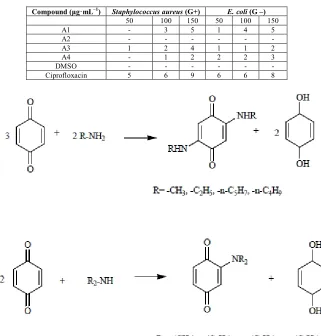
(2) Anees Pangal et al. Int. Res. J. Pharm. 2013, 4 (8) position of p-benzoquinone. For example, Aseed and Omer have synthesised 2, 5-Diamino-3, 6-dibromo-1, 4benzoquinone by reacting various amines with 2, 3, 5, 6tetrabromo-1, 4-benzoquinone Figure 3 which exhibit antibacterial activity against Aspergillus niger and Candida albicans respectively33. In present paper we have reported the synthesis and antimicrobial or antibacterial activity of four hydrazones of 2,6-Di-tert-butyl-1,4-benzoquinone. The compounds are tested for their antimicrobial activity against Gram +ve (Staphylococcus aureus) and Gram –ve (Escherichia coli). MATERIALS AND METHODS Solvents for synthesis were reagent grade and dried by standard procedures23. The starting materials such as 2,6ditertiary butyl-1,4-benzoquinone, thiosemicarbazide, 4hydroxy benzoic acid hydrazide, 3-hydroxy naphthoic acid hydrazide, Indol 3-acetic hydrazide, were obtained from. Sigma-Aldrich chemicals and acetone, methanol, ethanol and dichloromethane, which were obtained from SRL Chemical Limited, India. All compounds were routinely checked by TLC on silica gel G plates using petroleum ether / ethyl acetate (7 : 3; 6 : 4; 5 : 5 by V / V) as solvent system and the developed plates were visualized by UV light and iodine vapours. The detailed synthesis has been shown in Scheme 1. Melting points of as synthesized compounds were determined with open capillary tube on a VEEGO melting point apparatus. The H1-NMR and Liquid chromatography mass spectra (LCMS) were obtained from NCL, Pune, India and purity was checked by “HPLC—Systronics”. IR spectra were recorded by “FT- IR Jasco” spectrometer at the centre. Nutrient broth was used for growth of the organisms. The media was prepared and autoclaved for 15 minutes at 121°C, 15 lb pressure. The autoclaved media were inoculated with seed culture and incubated at 37°C for 24 hours.. Table 1: Antimicrbial Activity Results in Comparison with Standard Compound (μg·mL–1) A1 A2 A3 A4 DMSO Ciprofloxacin. Staphylococcus aureus (G+) 50 100 150 3 5 1 2 4 1 2 5 6 9. 50 1 1 2 6. E. coli (G –) 100 150 4 5 1 2 2 3 6 8. Figure 1: Nucleophilic Substitution Reations of Benzoquinone. Page 173.
(3) Anees Pangal et al. Int. Res. J. Pharm. 2013, 4 (8). H N. R. N. O. +. H N. MeOH. R. H 2N. X. R e fl u x , 1 - 2 H r s X. O O 2,6 -d i-tert-b u tyl-1,4 -b en zo q u in o n e. H y d ra zid e. 2 ,6 -d i-ter t-b u tyl-1,4 -b en zoq u in o n eh yd razon e. W h er eA1. R =. X =. O. X =. S. X =. O. X =. O. N H A2. R =. A3. R =. A4. R =. -N H 2. OH. HO. Scheme 1: General Scheme of Synthesis of Hydrazones. Page 174.
(4) Anees Pangal et al. Int. Res. J. Pharm. 2013, 4 (8) RESULTS AND DISCUSSIONS Procedure for the Synthesis of A1: N'-(3,5-di-tert-butyl-4oxocyclohexa-2,5-dienylidene)-2-(1H-indol-2yl)acetohydrazide 200 mg of 2,6-ditertiarybutyl-1,4-benzoquinone and 172 mg Indol-3-acetic acid hydrazide were dissolve it in the 15 ml methanol and refluxed for 2-3 hours with constant stirring. Monitor the reaction by TLC. The reaction mixture was poured in ice to get orange coloured solid. Colour: Orange. Yeild: 69 %, M. P.: 198°C. Purity (HPLC): 99.6 %, Mass (LCMS): 391, FTIR (KBr, cm-1): 3265.86 (-NH), 2958.27 (CH), 1660.41 (-C=O), 1647.56 (-C=N), 1057.03 (-N-N). H1NMR (CDCl3) (δ, ppm,): 1.29 (s, 18H, -C(CH3)3), 3.56 (s, 2H, -CH2-), 6.49 (s, 2H, oleifinic H), 7.24 (s, 1H, -NH), 7.36 (s, 4H), 6.66 (s, 1H, indolic H), 10.4 (s, 1H,indolic NH). Procedure for the Synthesis of A2: (1-(3,5-di-tert-butyl-4oxocyclohexa-2,5-dienylidene) thiosemicarbazide 200 mg of 2,6-ditertiarybutyl-1,4-benzoquinone and 82.72 mg thiosemicarbazide were dissolve it in the 15 ml methanol and refluxed for 2-3 hours with constant stirring. Monitor the reaction by TLC. The reaction mixture was poured in ice to get yellow coloured solid. Colour: Yellow. Yeild: 85 %, M. P.: 66°C. Purity (HPLC): 98.7 %, Mass (LCMS): 293, FTIR (KBr, cm-1): 3385.42 (-NH), 2963.09 (-CH), 1671.02 (-C=O), 1525.42 (-C=N), 1139.72 (-N-N). H1-NMR (CDCl3) (δ, ppm,): 1.28 (s, 18H, -C(CH3)3), 2.5 (s, 2H, -NH2), 6.50 (s, 2H, oleifinic H), 7.24 (s, 1H, -NH). Procedure for the Synthesis of A3: N'-(3,5-di-tert-butyl-4oxocyclohexa-2,5-dienylidene)-4-hydroxybenzohydrazide 200 mg of 2,6-ditertiarybutyl-1,4-benzoquinone and 138 mg 4-hydroxy benzoic acid hydrazide were dissolve it in the 15 ml methanol and refluxed for 2-3 hours with constant stirring. Monitor the reaction by TLC. The reaction mixture was poured in ice to get yellow coloured solid. Colour: Yellow. Yeild: 89 %, M. P.: 164°C. Purity (HPLC): 99.8 %, Mass (LCMS): 354. FTIR (KBr, cm-1): 3370 (-NH), 3026.20 (OH), 2958.27 (-CH-), 1618.95 (-C=O), 1551.45 (-C=N), 1225.21 (-N-N). H1-NMR (CDCl3) (δ, ppm,): 1.28 (s, 18H,C(CH3)3), 3.56 (s, 2H, -CH2-), 6.50 (s, 2H, oleifinic H), 7.24 (s, 1H, -NH), 7.84 (dd, J = 8 Hz, 2H), 7.68 (dd, J = 8 Hz, 2H), 9.75 (s, 1H, exchangeable –OH). Procedure for the Synthesis of A4: N'-(3,5-di-tert-butyl-4oxocyclohexa-2,5-dienylidene)-3-hydroxynaphthalene-2carbohydrazide 200 mg of 2,6-ditertiarybutyl-1,4-benzoquinone and 183.63 mg 3-hydroxy 2-naphthoic hydrazide were dissolve it in the 15 ml methanol and refluxed for 2-3 hours with constant stirring. Monitor the reaction by TLC. The reaction mixture was poured in ice to get yellow coloured solid. Colour: Yellow. Yeild: 85 %, M. P.: 202°C. Purity (HPLC): 99.6 %, Mass (LCMS): 404. FTIR (KBr, cm-1): 3426.89 (-NH), 3291.89 (-OH), 2968.87 (-CH), 1589.70 (-C=O), 1504.20 (C=N), 1057.03 (-N-N). H1-NMR (CDCl3) (δ, ppm,): 1.28 (s, 18H, -C(CH3)3), 6.50 (s, 2H, oleifinic H), 7.24 (s, 1H, -NH), 7.66 (m, 6H, naphthoic Hs), 9.73(s, 1H, exchangeable –OH). Antimicrobial Activity The anti-microbial results showed that some of the compounds were active against both Gram-positive Staphylococcus aureus and Gram-negative Escherichia coli bacteria. Among the tested compounds the compounds A1, A3 and A4 showed good antibacterial activity against the test. organisms. The compound A2 had no anti-bacterial activity against. Maximum antibacterial activity was shown by compounds containing the heterocyclic rings in the structure. On the other hand, compared to the standard antibacterial drugs namely, Ciprofloxacin was showed moderate activity against test organisms. The obtained results of antibacterial activity have been summarized in Table 1. CONCLUSION Out of four hydrazones synthesized only three shows effective antibacterial activity. A1 is more active than A3 and A4 where as A2 is non-active. All the three hydrazones are moderately active when compared with ciprofloxacin. The Minimum Inhibitory Concentration (MIC) of A1 is 100 μg·mL–1 for Gram +ve and 50 μg·mL–1- for Gram –ve bacteria; whereas the MICs for A3 and A4 are 50 and 100 μg·mL–1 respectively for Gram +ve and 50 μg·mL–1 each for Gram –ve bacteria. The shown activity can be accounted for the presence of either a heterocyclic or an aromatic moiety in the respective hydrazide. As the synthesized hydrazones are biological active, study of their anticancer activity is of our further interest. ACKNOWLEDGMENT The authors are grateful to the principal, Abeda Inamdar Senior College, Pune, India for extending the laboratory facilities. The authors are also like to acknowledge encouragement and assistance received from the authorities of Abeda Inamdar Senior College, Pune, India. REFERENCES 1. Arntzen CJ, Pakrasi HB. Photosystem II reaction center: Polypeptide subunits and functional cofactors. In: Encyclopedia of Plant Physiology. New series, Staehelin; L. Al; Arntzen, C.J.; Eds.; Springer-Verlag: Berlin 1986; 19: 457-467. 2. Pink JJ, Planchon SM, Tagliarino C, Varnes ME, Siegel D, Boothman DA. NAD(P)H: Quinone oxidoreductase activity is the principal determinant of π-lapachone cytotoxicity. J. Biol. Chem 2000; 275: 54165424. http://dx.doi.org/10.1074/jbc.275.8.5416 PMid:10681517 3. Ross D, Kepa JK, Winski SL, Beall HD, Anwar A, Siegel D. NAD(P)H: quinone oxidoreductase 1 (NQO1): chemoprotection, bioactivation, gene regulation and genetic polymorphisms. Chem. Biol. Interact 2000; 129: 77-97. http://dx.doi.org/10.1016/S0009-2797(00)00199-X 4. Sagnou M, Strongilos A, Hadjipavlou Litina D, Couladouros EA. Synthesis of Novel Benzoquinones with Anti-Inflammatory Activity. Lett. Drug Des. Discov 2009; 6: 172-177. http://dx.doi.org/ 10.2174/157018009787847792 5. Yezerski A, Ciccone C, Rozitski J, Volingavage B. The effects of a naturally produced benzoquinone on microbes common to flour. J. Chem. Ecol 2007; 33: 1217-1225. http://dx.doi.org/10.1007/s10886-0079293-2 PMid:17473960 6. Awino OS, Kiprono PC, Keronei KP, Kaberia F, Obala AA. Antimicrobial activity of 2,5-dihydroxy-3-methyl-1,4-benzoquinone from Embelia schimperi. Z Naturforsch. C 2008; 63: 47-50. PMid:18386487 7. Bogdanova NS, Pershin GN, Nikolaeva IS, Grinev AN, Shvedov VI. Antiviral activity of p-benzoquinone and hydroquinone derivatives. Farmakol. Toksikol 1970; 33: 488-496. PMid:5525967 8. Lindsey RH, Jr Bromberg KD, Felix CA, Osheroff N. 1,4-Benzoquinone is a topoisomerase II poison. Biochemistry 2004; 43: 7563-7574. http://dx.doi.org/10.1021/bi049756r PMid:15182198 9. Lee CS. Excision repair of 2, 5-diaziridinyl-1,4-benzoquinone (DZQ)DNA adduct by bacterial and mammalian 3-methyladenine-DNA glycosylases. Mol. Cell 2000; 10: 723-727. http://dx.doi.org/10.1007 /s100590000035 10. Beall HD, Murphy AM, Siegel D, Hargreaves RH, Butler J, Ross D. Nicotinamide adenine dinucleotide (phosphate): quinine oxidoreductase (DT-diaphorase) as a target for bio reductive antitumor quinones: quinone cytotoxicity and selectivity in human lung and breast cancer cell lines. Mol. Pharmacol 1995; 48: 499-504. PMid:756563 11. Winski SL, Hargreaves RH, Butler J, Ross D. A new screening system for NAD(P)H:quinone oxidoreductase (NQO1)-directed antitumor quinones: identification of a new aziridinylbenzoquinone, RH1, as a NQO1-directed antitumor agent. Clin. Cancer Res 1998; 4: 3083-3088. PMid:9865924. Page 175.
(5) Anees Pangal et al. Int. Res. J. Pharm. 2013, 4 (8) 12. Aggarwal BB, Kunnumakkara AB, Harikumar KB, Tharakan ST, Sung B, Anand P. Potential of Spice-Derived Phytochemicals for Cancer Prevention. Planta Med 2008; 74: 1560-1569. http://dx. doi.org/10.1055/s-2008-1074578 PMid:18612945 13. Padhye S, Banerjee S, Ahmad A, Mohammad R, Sarkar FH. From here to eternity - the secret of Pharaohs: Therapeutic potential of black cumin seeds and beyond. Cancer Ther 2008; 6: 495-510. PMid:19018291 PMCid:PMC2583426 14. Packter NM. Studies on the biosynthesis of quinones in fungi. Incorporation of 6-methylsalicylic acid into fumigatin and related compounds in Aspergillus fumigatus I.M.I. 89353, Biochem J 1965; 97: 321-332. PMid:16749133 PMCid:PMC1264643 15. Thomson RH. Naturally Occurring Quinones, 2nd ed. Academic Press: London; 1971. 16. Mikami Y, Takahashi K, Yazawa K, Arai T, Namikoshi M, Iwasaki S, Okuda S. Biosynthetic studies on Safaramycin A: Quinone antitumor antibiotic produced by Streptomyces lavendulae. J. Biol.Chem 1985; 260: 344-348. PMid:3880741 17. Morton RA. Biochemistry of Quinones, Academic Press: New York; 1965. 18. Patel IC, Skauen DM. Ultrasonic extraction of Cassia acutifolia. J. Pharm. Sci 1969; 58: 1135-1139. http://dx.doi.org/10.1002 /jps.2600580922 PMid:5346081 19. Scholz F, Düsse H, Meyer B. A new pH-sensor based on quinhydrone. Fresenius' J. Anal. Chem 1993; 347: 458-459. 20. Hashimoto M, Takagia H, Yamamuraa K. Three dimensional supramolecules of triptycene-quinone and its 6, 7-dimethyl derivative formed by weak intermolecular π – π interactions and C-H···O hydrogen bonds. Tetrahedron. Lett 1999; 40: 6037-6040. http://dx.doi.org /10.1016/S0040-4039(99)01196-X 21. Berkovitch Yellin Z, Leiserowitz L. The role played by C-H···O and CH···N interactions in determining molecular packing and conformation. Acta Crystallogr 1984; B40: 159-165. 22. Laskowski DE. Influence of structural features on formation of solid charge-transfer complexes of quinones with carcinogenic and related non-carcinogenic electron donors. Cancer Res 1967; 27: 903-911. PMid:6025254 23. Inaba K, Takahashi YH, Ito K, Hayashi S. Critical role of a thiolatequinone charge transfer complex and its adduct form in denovo disulfide bond generation by DsbB. Proc. Natl. Acad. Sci.USA 2006; 103: 287292. http://dx.doi.org/10.1073/pnas.0507570103 PMid:16384917 PMCid:PMC1323469. 24. Bangal PR. Hydrogen-bonding and protonation effects on the formation of charge transfer complex between para-benzoquinone and 2,6dimethoxy phenol. Chem. Phys. Lett 2005; 401: 200-204. http://dx. doi.org/10.1016/j.cplett.2004.11.061 25. Regeimbal J, Gleiter S, Trumpower BL, Yu CA, Diwakar M, Ballou DP, Bardwell JCA. Disulfide bond formation involves a quinhydrone-type charge-transfer complex. Proc. Natl. Acad. Sci. USA 2003; 100: 1377913784. http://dx.doi.org/10.1073/pnas.1935988100 PMid:14612576 PMCid:PMC283498 26. Fedyanin IV, Lyssenko KA, Vorontsova NV, Rozenberg VI, Antipin MY. Trans annular interaction in 4,7-[2.2] paracyclophane quinone. 2003; 13: 15-16. http://dx.doi.org/ Mendleev Commun 10.1070/MC2003v013n01ABEH001693 27. Sugiyama H, Kamogawa H. Studies on polymers containing functional groups. III. Charge transfer interaction between quinone and aza polymers. J. Polym. Sci. Part A-1: Polym. Chem 2003; 4: 2281-2288. 28. Uliana MP, Vieira YW, Donatoni MC, Corrêa AG, Brocksom U, Brocksom TJ. Oxidation of Mono-Phenols to para-Benzoquinones: a Comparative Study. J. Braz. Chem. Soc 2008; 19: 1484-1489. http://dx.doi.org/10.1590/S0103-50532008000800007 29. Thiele J. Thiele Reaction: Formation of triacetoxy aromatic compounds. Ber 1898; 31: 1247-1249. 30. Hikosaka A. The reaction of aliphatic amines with p-benzoquinone, the effect of the alkyl group of amines on the reaction. Bull. Chem. Soc. Jpn 1970; 43: 3928-3929. http://dx.doi.org/10.1246/bcsj.43.3928 31. Harley Mason and Laird AH. Isolation and structure of the fluorescent substances formed in the oxidative reaction of adrenaline and noradrenaline with ethylenediamine. Tetrahedron 1959; 7: 70-76. http://dx.doi.org/10.1016/0040-4020(59)80053-3 32. Asahara T, Seno M, Teshirogi T. Reaction of p-benzoquinone derivatives with ethylenediamine. Bull. Chem. Soc. Jpn 1971; 44: 16871689. http://dx.doi.org/10.1246/bcsj.44.1687 33. Saeed AEM and Omer NMA. Synthesis of some 2,5- diamino-3,6dibromo -1,4-Benzoquinones. Afr. J. Pure. Appl. Chem 2009; 3: 275280. Cite this article as: Anees Pangal, Khursheed Ahmed and Sajid Shaikh. Synthesis, characterization and study of antimicrobial activity of 2,6-ditertiary butyl1,4-benzoquinone hydrazones. Int. Res. J. Pharm. 2013; 4(8):172-176 http://dx.doi.org/10.7897/2230-8407.04834. Source of support: Nil, Conflict of interest: None Declared. Page 176.
(6)
Figure
Related documents
• Taxpayers subject to the provisions of Title II of the Income Tax Law (ITL) which have declared taxable income of $644,599,005 or more in the immediately preceding tax
Most companies recruit for full-time and internship positions, but some indicate Co-Op as a recruiting priority, while not attending Professional Practice
Although theoretically the likelihood of finding evidence that dumped imports have in- jured the domestic industry should fall as the industry increases its output, the results from
During the thesis work, I measured six different parameters: the number of emergency processes, hash table entry number, caching replacement policy, cache entry
Although total labor earnings increase with the unskilled unions’ bargaining power, we can say nothing when the increase in production is due to stronger skilled unions, since
Using a nationwide database of hospital admissions, we established that diverticulitis patients admitted to hospitals that encounter a low volume of diverticulitis cases have
Electron micrographs of mannonamide aggregates from water (a-e) or xylene (f): (a and b) details of aged fiber aggregates of D-mannonamide 2 negatively stained
18 th Sunday in Ordinary Time Saint Rose of Lima Parish Parroquia Santa Rosa de Lima.. August
